Key Takeaways
- The fall of the Berlin Wall on November 9, 1989, acted as the catalyst for rapid German reunification, turning a distant dream into an immediate geopolitical reality.
- The 'Two Plus Four Agreement' served as the definitive international treaty, resolving the post-WWII sovereignty questions of the four occupying powers.
- Chancellor Helmut Kohl's decisive diplomacy, backed firmly by US President George H.W. Bush, overcame deep-seated French and British anxieties regarding a resurgent, unified Germany.
The geopolitical landscape of post-World War II Europe was defined by the division of Germany. For over four decades, the Federal Republic of Germany (FRG, West Germany) and the German Democratic Republic (GDR, East Germany) stood as the frontline states of a polarized, bipolar world. However, the dramatic collapse of the Soviet bloc in 1989 opened a brief, highly volatile window of opportunity. Between November 1989 and October 1990, rapid diplomatic maneuvers, profound public pressure, and masterclass statecraft culminated in the reunification of Germany. This historic event did not merely merge two states; it fundamentally restructured the European continent, ending the Cold War division and giving rebirth to a European giant.
Historical Context and Origins
The division of Germany was never intended to be permanent when the Allied powers met at the Potsdam Conference in 1945. Yet, as the Cold War intensified, the zones of occupation hardened into sovereign, ideological rivals. The FRG, established in May 1949, integrated into the Western capitalist sphere, becoming a core member of NATO and the European Economic Community (EEC). Conversely, the GDR, established in October 1949, became a highly militarized satellite of the Soviet Union and a member of the Warsaw Pact.
For decades, the physical manifestation of this division was the Berlin Wall, erected in August 1961 to halt the massive brain drain from East to West. West German foreign policy fluctuated between absolute non-recognition of the East under the Hallstein Doctrine and pragmatic engagement under Willy Brandt’s Ostpolitik in the late 1960s and 1970s. Ostpolitik normalized relations and fostered human contacts, but it operated under the assumption that division was a long-term reality.
THE ROAD TO REUNIFICATION
- 1945: Allied Occupation
- 1949: Separation (FRG/GDR)
- 1961: Berlin Wall Erected
- 1989: Fall of the Wall
- 1990 (July): Monetary Union
- 1990 (Oct): Reunification
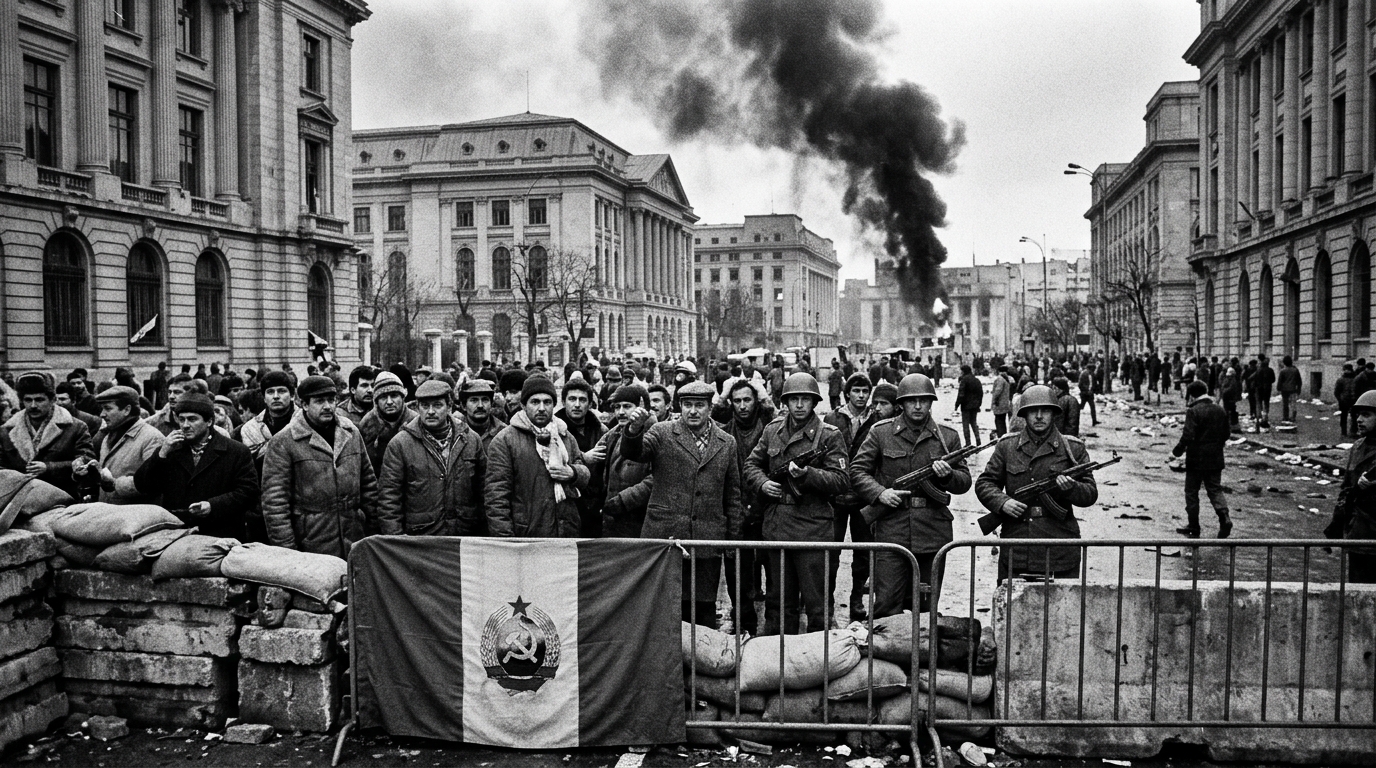
By the late 1980s, structural rot within the Soviet empire began to crack the foundations of the East German state. The catalyst for change was the ascension of Mikhail Gorbachev as General Secretary of the Communist Party of the Soviet Union in 1985. Recognizing that the USSR could no longer sustain its empire through economic subsidies and military coercion, Gorbachev introduced the reforms of Glasnost (openness) and Perestroika (restructuring). Crucially, he abandoned the Brezhnev Doctrine—which mandated Soviet military intervention to preserve communist regimes—in favor of what Soviet foreign ministry spokesman Gennady Gerasimov jokingly called the "Sinatra Doctrine": letting Eastern European nations do it "their way." 1
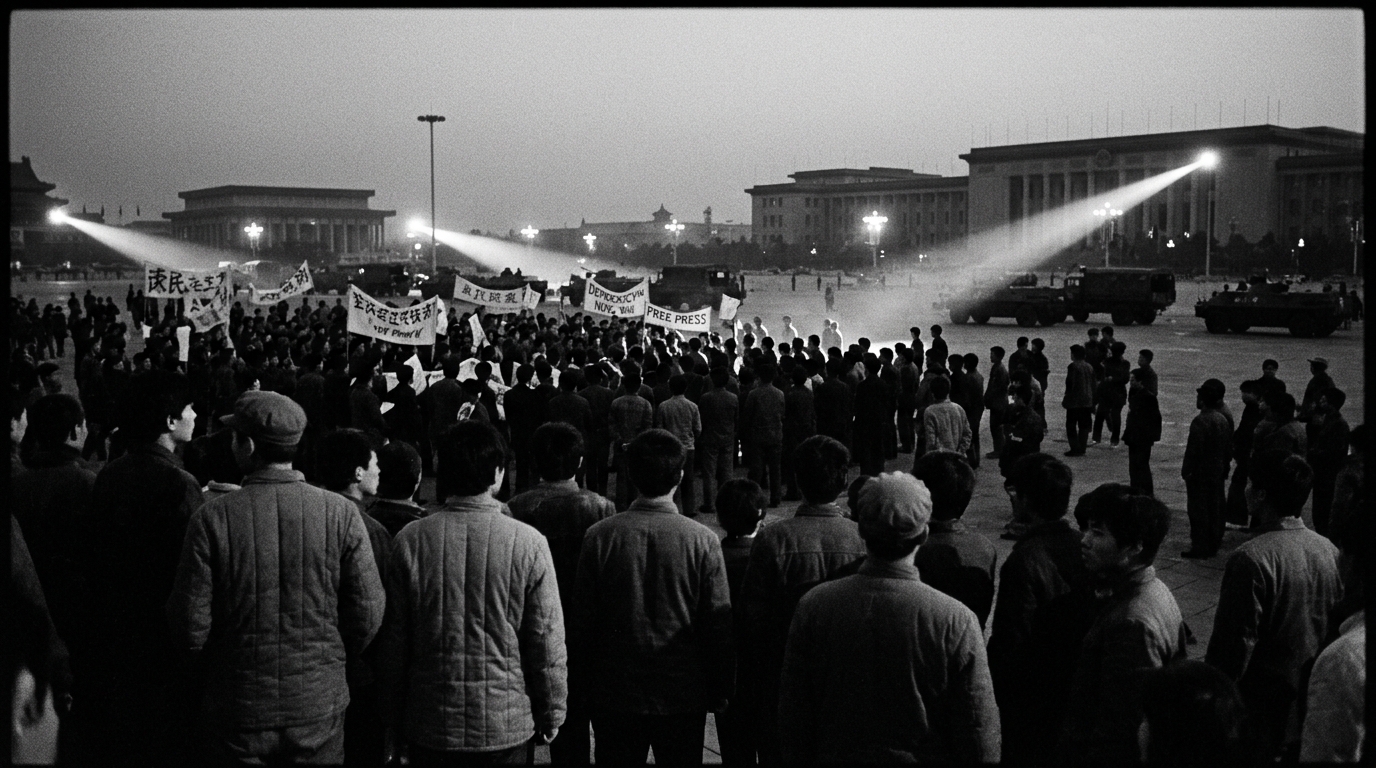
This seismic shift in Soviet foreign policy triggered a chain reaction. In May 1989, Hungary began dismantling its border fence with Austria. This breach in the Iron Curtain allowed thousands of East German citizens, who were ostensibly on vacation, to flee to the West via Hungary and Austria. Back home, those who remained took to the streets. Every Monday, starting in Leipzig, peaceful protesters marched to demand civil liberties, chanting:
"Wir sind das Volk!" (We are the people!)
The East German regime, led by the ailing Erich Honecker, found itself economically bankrupt, politically isolated, and physically unable to suppress the mass movement without Soviet military backing—which Gorbachev explicitly refused to provide.
Timeline of Events and Key Moments
The speed at which German reunification progressed surprised even the most seasoned diplomats of the era. What was once envisioned as a decades-long evolutionary process occurred in less than eleven months.
The Collapse of the Border: November 1989
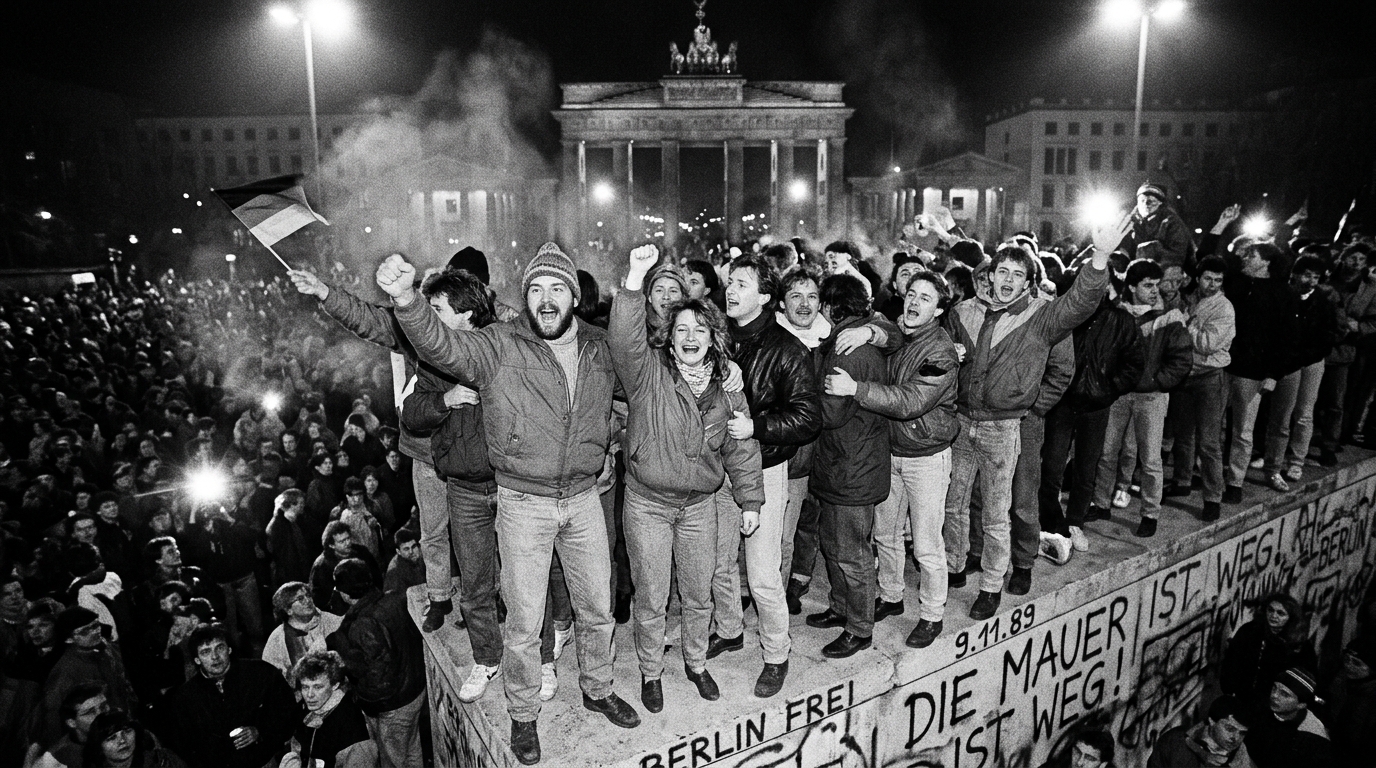
On the evening of November 9, 1989, East German politburo member Günter Schabowski was handed a note detailing new, relaxed travel regulations designed to ease public pressure. Unprepared and misinformed, Schabowski declared during a live-broadcast press conference that private travel abroad would be permitted "immediately, without delay." Within hours, tens of thousands of East Berliners gathered at the border crossings. Overwhelmed and lacking instructions, East German border guards opened the gates. The Berlin Wall had effectively fallen.
Kohl’s Ten-Point Plan: November 1989
Recognizing the vacuum of power in East Germany, West German Chancellor Helmut Kohl took a massive political gamble. On November 28, 1989, without consulting his Western allies or his coalition partner, the Free Democratic Party (FDP), Kohl presented a "Ten-Point Plan" (Zehn-Punkte-Programm) to the Bundestag. The plan outlined a step-by-step process of confederative structures between the two Germanies, leading ultimately to federation. While it provoked immediate anxiety in Moscow, Paris, and London, it set the political agenda, shifting the narrative from reform of the GDR to outright unification.
The Democratic Breakthrough: March 1990
On March 18, 1990, the GDR held its first—and only—free parliamentary elections. The Alliance for Germany (Allianz für Deutschland), a coalition heavily backed by Kohl's Christian Democratic Union (CDU), won a resounding victory. This vote was widely interpreted as a referendum on rapid unification and the adoption of the West German Deutsche Mark (DM). The new East German government, led by Lothar de Maizière, immediately began negotiating the terms of its own dissolution.
| Date | Event |
|---|---|
| Nov 09, 1989 | Fall of the Berlin Wall |
| Nov 28, 1989 | Kohl presents the Ten-Point Plan |
| Mar 18, 1990 | First free elections in the GDR |
| May 18, 1990 | Currency and Economic Union Treaty signed |
| Jul 01, 1990 | DM becomes official currency in the GDR |
| Sep 12, 1990 | Two Plus Four Agreement signed in Moscow |
| Oct 03, 1990 | German Reunification officialized |
Monetary Union: July 1990
To stem the continuous westward flow of East Germans and stabilize the Eastern economy, Kohl pushed for an immediate currency union. On July 1, 1990, the Deutsche Mark became the official legal tender of the GDR. Despite warnings from Karl Otto Pöhl, the President of the Bundesbank, Kohl insisted on a highly generous 1:1 exchange rate for wages, pensions, and basic savings. While economically disruptive in the long run, this move cemented the integration process and made political division irreversible.
The Two Plus Four Agreement: September 1990
Because Germany’s division was bound to the post-WWII international order, domestic agreements were insufficient. The external aspects of reunification had to be negotiated through the Two Plus Four framework, consisting of the two German states and the four victorious allied powers: the United States, the Soviet Union, Great Britain, and France.
Negotiations culminated on September 12, 1990, with the signing of the Treaty on the Final Settlement with Respect to Germany in Moscow. The treaty terminated all remaining Allied rights and responsibilities in Germany, restored full sovereignty to the country, and confirmed its permanent external borders (notably the Oder-Neisse line with Poland). 2
The Day of German Unity: October 3, 1990
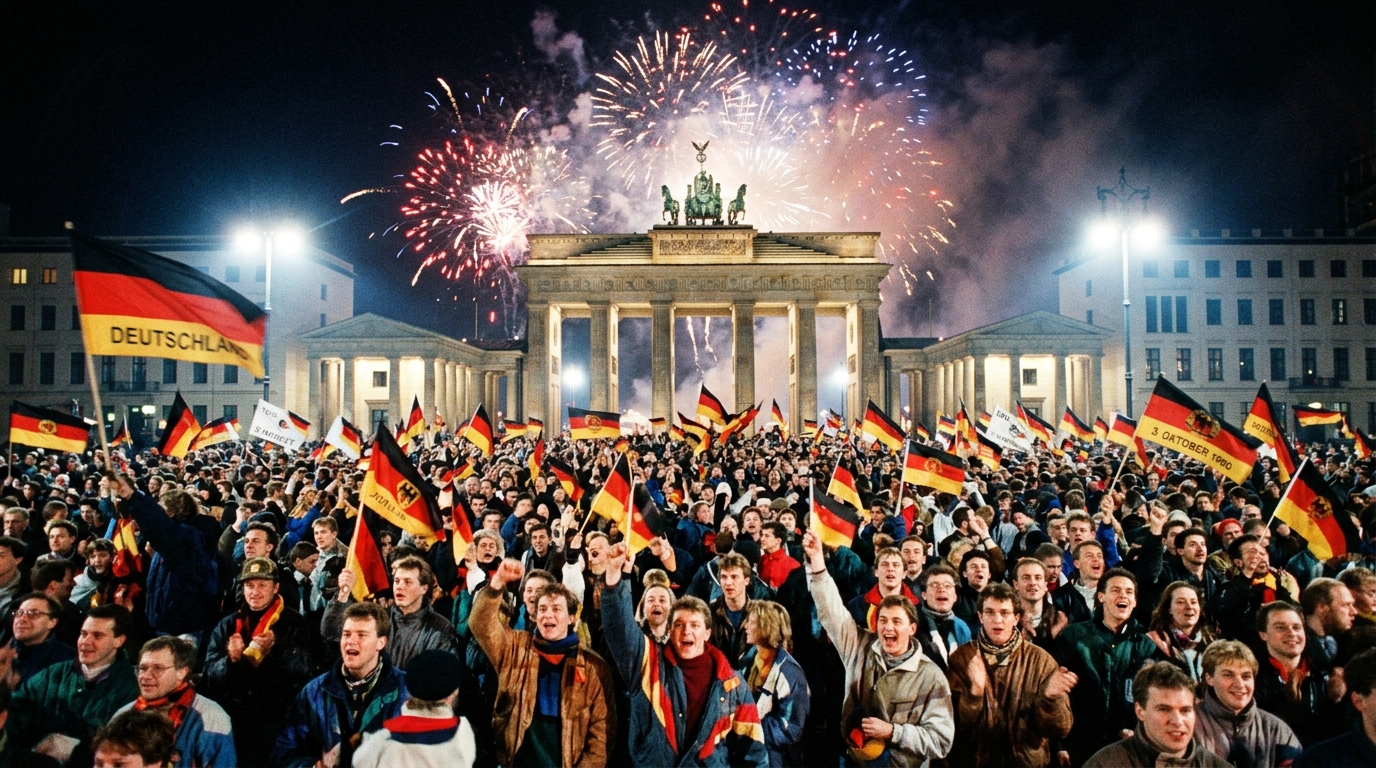
Rather than drafting a new constitution, the West German government utilized Article 23 of the Basic Law (Grundgesetz), which allowed for the accession of new federal states (Bundesländer). On the night of October 3, 1990, the five recreated states of the former GDR (Brandenburg, Mecklenburg-Western Pomerania, Saxony, Saxony-Anhalt, and Thuringia) officially joined the Federal Republic of Germany. At midnight, the black-red-gold flag was raised in front of the Reichstag building in Berlin to the sound of the national anthem.
Geopolitical Consequences and Aftermath
The reunification of Germany fundamentally rearranged the tectonic plates of global politics, producing both immediate structural shocks and long-term socio-economic challenges.
GEOPOLITICAL IMPACTS
- EUROPEAN INTEGRATION
- NATO EXPANSION
The Redesign of European Integration
The emergence of a united Germany with a population of 80 million posed a profound challenge to France’s traditional hegemony in European affairs. French President François Mitterrand feared that a larger Germany would turn away from Western Europe and look toward its historical sphere of influence in the East. To prevent this, Mitterrand extracted a strategic concession from Kohl: in exchange for French approval of reunification, Germany had to sacrifice its beloved Deutsche Mark and commit to the creation of a single European currency. This grand bargain directly paved the way for the Maastricht Treaty of 1992 and the birth of the Euro. 3
NATO's Eastward Expansion
The status of a reunited Germany within the North Atlantic Treaty Organization (NATO) was the most contentious issue of the Two Plus Four negotiations. The Soviet Union initially demanded that Germany remain neutral. However, Helmut Kohl and US President George H.W. Bush stood firm: a united Germany must remain a full member of NATO.
To appease Gorbachev, the parties agreed to a special status for the territory of the former GDR: no foreign NATO troops or nuclear weapons would be stationed there, and the Soviet army would have four years to withdraw its 380,000 personnel. This arrangement created a critical precedent. Decades later, Russian leadership would argue that Western assurances during these talks—such as US Secretary of State James Baker's famous "not one inch eastward" remark—constituted a binding promise not to expand NATO to Eastern Europe, a claim that remains a flashpoint in contemporary international relations.
The Economic Shockwave: The Treuhandanstalt
While political integration was a triumph, economic integration was painful. The East German economy was hopelessly uncompetitive. To manage the transition from a state-run command economy to a capitalist market, the German government established the Treuhandanstalt (Trust Agency). The Treuhand was tasked with privatizing, restructuring, or liquidating around 8,500 state-owned East German enterprises (Volkseigene Betriebe).
The social cost was catastrophic. Millions of East Germans lost their jobs as factories were shut down, leading to massive deindustrialization and a persistent economic gap between the East (neue Bundesländer) and the West (alte Bundesländer). To fund the rebuilding of the East, West Germans were subjected to a "solidarity surcharge" (Solidaritätszuschlag), a tax that became a source of political debate for decades.
Analysis of Key Actors and Decisive Actions
The rebirth of the European giant was not an inevitable historical trajectory; it was shaped by the distinct personalities and political calculations of key world leaders.
| Leader | Country | Key Goal | Strategic Action |
|---|---|---|---|
| Helmut Kohl | West Germany | Rapid, complete unification under Western terms. | Bypassed allies with the Ten-Point Plan; secured Soviet consent with financial aid. |
| George H.W. Bush | USA | Safe transition of power; keeping Germany in NATO. | Offered unwavering diplomatic support to Kohl; resisted French and British hesitation. |
| Mikhail Gorbachev | USSR | Economic salvation for USSR; stable European security. | Agreed to German sovereignty and NATO membership in exchange for financial support. |
| François Mitterrand | France | Avoid German dominance; deepen European integration. | Tied German unification to the creation of the Single European Currency (Euro). |
Helmut Kohl: The "Chancellor of Unity"
Helmut Kohl, often underestimated by intellectuals as a provincial politician, proved to be a master of tactical opportunism. He realized that the window of opportunity opened by Gorbachev’s weakness could close at any moment. Kohl acted with immense speed, bypassing bureaucratic hurdles and utilizing personal diplomacy to win over foreign leaders. His boldest move was his meeting with Gorbachev in the Caucasus in July 1990, where, dressed in casual sweaters, the two leaders finalized the terms of Germany's NATO membership in exchange for generous financial packages to support the bankrupt Soviet state.
George H.W. Bush: The Indispensable Ally
While Britain and France wavered, the United States under President George H.W. Bush was the only foreign power to offer unconditional support for German reunification from the outset. Bush viewed a strong, united, and NATO-aligned Germany not as a threat, but as the cornerstone of his vision for a "Europe whole and free." Bush's steady hand and refusal to gloat over the collapse of the Soviet bloc allowed Gorbachev to make concessions without losing face domestically.
Mikhail Gorbachev: The Pragmatic Realist
Gorbachev's role was defined by his refusal to use force. When the Berlin Wall fell, Soviet tanks remained in their barracks. Faced with an unsustainable economic crisis at home, Gorbachev traded geopolitical territory for financial assistance. West Germany provided the USSR with billions of Deutsche Marks in loans and direct aid to fund the withdrawal of Soviet troops and the construction of housing for them back in Russia. 4
Margaret Thatcher and François Mitterrand: The Sceptics
Both British Prime Minister Margaret Thatcher and French President François Mitterrand harbored deep historical anxieties about a resurgent German hegemony. Thatcher famously carried a map of Germany’s pre-WWII borders in her handbag and attempted to build a joint Anglo-French front to slow down the process. However, her efforts were bypassed by the swift cooperation between Washington and Bonn, leaving Britain largely marginalized in the final negotiations.
Trivia and Lesser-Known Facts
- The Secret Seminar at Chequers: In March 1990, Margaret Thatcher convened a highly confidential seminar at her country residence, Chequers, with prominent historians to discuss "how dangerous the Germans might be." The briefing paper, which was later leaked, characterized Germans as possessing "alphabetical characteristics" such as aggression, self-pity, and a craving for dominance.
- The Sweater Diplomacy in the Caucasus: During their critical meeting in July 1990, Helmut Kohl and Mikhail Gorbachev abandoned strict diplomatic protocol. Instead of formal suits, they wore matching, casual knit cardigans while walking along the rivers of Arkhyz. This relaxed setting helped build the personal trust necessary to finalize the historic agreement.
- The "Two Plus Four" Naming Trick: The name of the negotiations was carefully chosen. West German Foreign Minister Hans-Dietrich Genscher insisted on "Two Plus Four" (the two Germanies negotiating first, supported by the four powers) rather than "Four Plus Two," to emphasize that the German states were sovereign actors directing their own destiny, rather than subjects of Allied dictation.
- The Liquidation of the NVA: The National People's Army (Nationale Volksarmee, NVA) of East Germany was completely disbanded upon reunification. West Germany’s Bundeswehr absorbed only a small fraction of its officers, while vast stockpiles of Soviet-designed military equipment were sold off, donated (such as MiG-29 fighter jets given to Poland), or scrapped.
References and Literature
- Treaty on the Final Settlement with Respect to Germany - Official text of the Two Plus Four Agreement signed on September 12, 1990.
- Kohl's Ten-Point Plan for German Unity - German History in Documents and Images (GHDI) archive of the November 1989 Bundestag speech.
- George Bush Presidential Library and Museum - Declassified national security memoranda regarding US policy on German reunification.
- Foreign Affairs: The Legend of 1990 - Analysis of the NATO expansion debate and the assurances given to Mikhail Gorbachev.
---
Footnotes & Explanations
- This phrase was popularized by Gerasimov on October 25, 1989, when he told reporters that the Soviet Union was now operating under the "Sinatra Doctrine," allowing Warsaw Pact allies to chart their own course. ↩
- The treaty officially entered into force on March 15, 1991, when the Soviet Union deposited its instrument of ratification, formally restoring complete sovereignty to Germany. ↩
- Historically, this exchange is referred to as the "Euro-for-Unity" bargain, though historians debate whether Mitterrand explicitly forced it or if Kohl was already a committed European integrationist willing to make the sacrifice. ↩
- Germany spent over 15 billion Deutsche Marks on transition payments to the Soviet Union specifically to fund the logistical withdrawal of the Western Group of Forces. ↩