Key Takeaways
- In May 1998, India and Pakistan conducted a series of underground nuclear tests, ending decades of strategic ambiguity and officially declaring themselves nuclear-armed states.
- The tests triggered severe international condemnation and economic sanctions, particularly from the United States, but ultimately forced a realignment of South Asian geopolitics.
- The crisis demonstrated the 'stability-instability paradox,' as both nations engaged in the localized Kargil War in 1999 under the shadow of mutual nuclear deterrence.
In May 1998, the global nuclear non-proliferation regime was shaken to its core. Within a span of less than three weeks, India and Pakistan crossed the nuclear threshold, conducting a series of underground tests that ended decades of strategic ambiguity on the subcontinent. The events of that fateful spring not only transformed the security architecture of South Asia but also forced the international community to grapple with the reality of two new, mutually hostile nuclear-armed states sharing a contiguous, highly disputed border.
This dramatic escalation was the culmination of decades of covert research, deep-seated regional rivalries, and a perceived breakdown in the global arms control architecture. By going atomic, both New Delhi and Islamabad sought to project strength, secure sovereign deterrence, and redefine their positions on the global stage.
Historical Context and Origins
To understand the decision-making of 1998, one must examine the deep historical anxieties of both nations, tracing back to the bloody partition of British India in 1947. The subsequent decades saw the two neighbors fight three major conventional wars (in 1947, 1965, and 1971), leaving behind unresolved territorial disputes—most notably over the region of Jammu and Kashmir.
The Legacy of 1974 and the Security Dilemma
India’s nuclear journey began in earnest during the mid-20th century under the guidance of physicist Homi J. Bhabha. Though initially framed as a peaceful energy program, the defeat of India in the 1962 Sino-Indian War and China’s subsequent nuclear test at Lop Nur in 1964 radically shifted New Delhi's strategic calculus. India felt squeezed between a hostile, newly nuclear-armed China to the north and a bitter adversary in Pakistan to the west.
In May 1974, under Prime Minister Indira Gandhi, India conducted its first underground nuclear test at Pokhran, euphemistically termed a "Peaceful Nuclear Explosion" (PNE) and code-named "Smiling Buddha." 1 While India asserted that the test was for peaceful purposes and did not immediately weaponize its capability, the event fundamentally altered the balance of power in South Asia.
- 1962 Sino-Indian War
Pakistan's Quest for Strategic Parity
For Pakistan, the 1974 Indian test was an existential threat. Still reeling from the humiliating defeat in the 1971 war, which resulted in the secession of East Pakistan (now Bangladesh), Islamabad viewed India's nuclearization as an intolerable asymmetry. Prime Minister Zulfikar Ali Bhutto famously declared that Pakistanis would "eat grass, even go hungry, but we will get one of our own [nuclear bomb]." 2
Pakistan initiated a highly classified, multi-pronged nuclear weapons program. While the Pakistan Atomic Energy Commission (PAEC) pursued plutonium-based designs, Dr. Abdul Qadeer Khan, a metallurgist who had worked in Europe, established the Khan Research Laboratories (KRL) to focus on uranium enrichment using stolen centrifuge designs. By the mid-1980s, Pakistan had achieved a "recessed" or covert deterrence capability, aided by clandestine technology transfers and tacit diplomatic maneuvering during the Soviet-Afghan War, when the United States chose to overlook Islamabad's nuclear activities in exchange for its support against the Soviet army.
The Non-Proliferation Treaty and Global Pressure
The international landscape of the 1990s added urgent structural pressures. In 1995, the Treaty on the Non-Proliferation of Nuclear Weapons (NPT) was indefinitely extended, a move India criticized as a mechanism to perpetuate "nuclear apartheid" by legitimizing the arsenals of the five recognized nuclear-weapon states (the P5) while forbidding others from acquiring them.
Furthermore, negotiations for the Comprehensive Nuclear-Test-Ban Treaty (CTBT) were finalized in 1996. India refused to sign the treaty, arguing that it failed to present a commitment to universal, time-bound disarmament. Strategists in New Delhi realized that if India did not test its weapons soon, the window of opportunity to validate its designs and establish a credible deterrent would be permanently closed by international law and global political pressure.
Timeline of Events and Key Moments
The catalyst for the 1998 tests was the ascension of the Hindu nationalist Bharatiya Janata Party (BJP) to power in India in March 1998. Led by Prime Minister Atal Bihari Vajpayee, the BJP had openly campaigned on a platform that included inducting nuclear weapons into India’s national security framework.
| Date | Event |
|---|---|
| May 11 & 13 | Pokhran-II: India Tests |
| Mid-May | Intense US Diplomacy |
| May 28 & 30 | Chagai-I & II: Pakistan Tests |
Operation Shakti: India's May 11 and 13 Tests
Upon taking office, Vajpayee quietly authorized the Defense Research and Development Organisation (DRDO) and the Department of Atomic Energy (DAE) to prepare for tests. The operation was shrouded in absolute secrecy. To prevent detection by foreign espionage satellites, particularly those of the U.S. Central Intelligence Agency (CIA), activities at the Pokhran test site in the Thar Desert of Rajasthan were heavily camouflaged. Scientists and military personnel wore military uniforms, used false names, and moved heavy equipment only under the cover of night or during periods of heavy sandstorms. 3
On May 11, 1998, Prime Minister Vajpayee suddenly called a press conference in New Delhi to deliver a brief, momentous statement:
"Today, at 15:45 hours, India conducted three underground nuclear tests in the Pokhran range... These tests have established that India has a proven capability for a weaponized nuclear program."
The three devices detonated on May 11 included:
- A thermonuclear device (claimed by Indian scientists to yield approximately 45 kilotons, though western analysts disputed the figure).
- A standard fission device (yield of approximately 15 kilotons).
- A sub-kiloton device designed to gather data for computer simulations.
On May 13, India conducted two additional sub-kiloton tests, declaring that the test series—collectively known as Pokhran-II or Operation Shakti—was complete. Vajpayee declared that India was now a "nuclear-weapon state" and announced a voluntary moratorium on further testing, alongside a draft "No First Use" (NFU) policy to project responsible stewardship.
The Interregnum: Diplomatic Arm-Twisting and Pakistan's Dilemma
The Indian tests caught the world, and especially the United States, completely off guard. The Clinton administration expressed deep anger over the intelligence failure and immediately triggered the Glenn Amendment of the Arms Export Control Act, imposing sweeping economic sanctions on India.
Attention quickly shifted to Islamabad. Pakistani Prime Minister Nawaz Sharif faced an agonizing dilemma. On one hand, the domestic public, military establishment, and opposition politicians demanded an immediate, symmetrical response to restore national honor and strategic parity. On the other hand, the international community, led by U.S. President Bill Clinton, engaged in frantic telephone diplomacy, offering Sharif a lucrative package of military and economic aid—including the release of F-16 fighter jets that had been held up by previous sanctions—if Pakistan refrained from testing.
For seventeen days, the Pakistani leadership debated their options. Western intelligence agencies watched anxiously as preparations were detected at the remote Ras Koh Hills in Balochistan. Ultimately, the political and strategic costs of restraint were deemed too high. Sharif concluded that a failure to demonstrate Pakistan's capability would leave the country vulnerable to Indian conventional and nuclear coercion.
Chagai-I and Chagai-II: Pakistan Restores the Balance
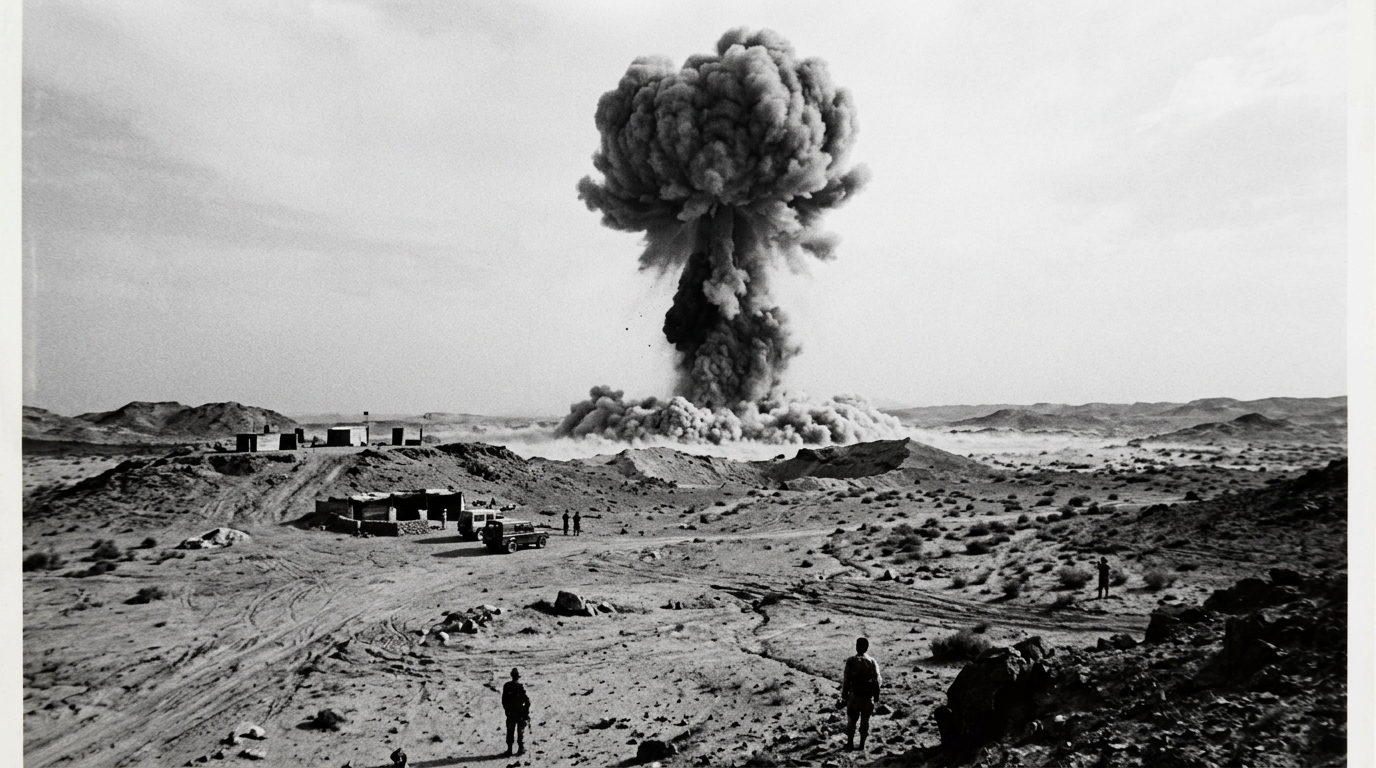
On the afternoon of May 28, 1998, Pakistan responded. In a remote, dry mountainous region of the Chagai District in Balochistan, the Pakistan Atomic Energy Commission detonated five underground devices in a single, synchronized blast wave. The test series was designated Chagai-I.
| Feature | INDIA | PAKISTAN |
|---|---|---|
| Code | Operation Shakti | Chagai-I & Chagai-II |
| Dates | May 11 & 13, 1998 | May 28 & 30, 1998 |
| Location | Pokhran, Rajasthan | Ras Koh & Kharan, Bal. |
| Fuel | Plutonium / Thermonuclear | Highly Enriched Uranium |
| Count | 5 underground devices | 6 underground devices |
The choice of five devices was highly symbolic, mirroring the total number of tests India had conducted over the preceding days. To ensure the world understood that the balance had been restored, TV screens across Pakistan broadcast footage of the Ras Koh mountain turning a pale yellow-white under the immense force of the underground explosions.
Two days later, on May 30, Pakistan conducted a sixth test—a plutonium-based device—at the Kharan Desert site, designated Chagai-II. Prime Minister Nawaz Sharif addressed his nation, declaring that Pakistan had "settled the score" and established a "credible minimum deterrent" of its own.
Geopolitical Consequences and Aftermath
The consequences of the May 1998 tests were immediate, far-reaching, and structurally altered the geopolitical alignment of the subcontinental rivals and their relations with the global superpowers.
International Sanctions and Economic Fallouts
The immediate global response was swift condemnation. The United Nations Security Council passed Resolution 1172, which condemned the tests by both nations, demanded that they refrain from further testing, and urged them to sign the NPT and CTBT without conditions.
The economic fallout was particularly severe for Pakistan. Unlike India, which possessed a large, relatively self-reliant domestic market and was undergoing structural economic reforms, Pakistan’s economy was fragile, heavily dependent on foreign aid, remittances, and international financial institutions. The imposition of U.S. and multilateral sanctions triggered a severe balance-of-payments crisis, forcing Islamabad to adopt emergency economic measures and seek emergency bailouts from the International Monetary Fund (IMF) to avoid sovereign default.
India’s economy, while affected by the temporary suspension of development aid and technology transfers, proved remarkably resilient. The sanctions did little to deter New Delhi's economic rise, and within a few years, the sheer size of the Indian market forced Western powers to re-evaluate their punitive stances.
The Lahore Summit and the Kargil Crisis: War in the Nuclear Shadow
In the immediate aftermath of the tests, both nations recognized the terrifyingly high stakes of their new nuclear reality. In February 1999, Prime Minister Vajpayee took a historic bus journey across the border to Lahore, Pakistan, where he met with Prime Minister Sharif. The resulting Lahore Declaration was hailed as a major breakthrough, establishing a framework for bilateral engagement, confidence-building measures (CBMs), and joint commitments to avoid accidental nuclear conflict.
- May 1998: Nuclear Tests
- Feb 1999: Lahore Summit (Peace efforts)
However, the euphoria of the Lahore Summit was short-lived. Just months later, in May 1999, Pakistani troops disguised as Kashmiri militants infiltrated the Kargil sector of Jammu and Kashmir, triggering a high-altitude military conflict. The Kargil War was a crucial test of nuclear deterrence theory. It represented the first direct military clash between two nuclear-armed states.
Political scientists pointed to Kargil as a classic manifestation of the "stability-instability paradox." 4 While mutual nuclear possession made a full-scale, conventional war too risky (stability at the strategic level), it encouraged lower-level, localized military adventurism (instability at the tactical level) because Pakistan believed its nuclear shield would prevent India from launching a massive retaliatory invasion across the international border. The crisis was eventually defused through intense diplomatic intervention by U.S. President Bill Clinton, who pressured Sharif to withdraw Pakistani forces behind the Line of Control (LoC).
Redefining the Global Non-Proliferation Regime
Over the longer term, the 1998 tests shattered the rigid dichotomy of the NPT-centric world. Although neither India nor Pakistan was officially admitted as a "Nuclear Weapon State" under the strict definitions of the NPT, the international community had no choice but to accept them as de facto nuclear powers.
By the mid-2000s, the United States, seeking a strategic counterweight to the rapid rise of China, initiated a major policy shift toward India. This culminated in the 2008 U.S.-India Civil Nuclear Agreement (often called the 123 Agreement). The deal effectively carved out a unique exception for India, allowing it to engage in civilian nuclear commerce with global suppliers despite not being an NPT signatory, provided it separated its civilian and military nuclear facilities and placed the civilian ones under International Atomic Energy Agency (IAEA) safeguards. 5
Pakistan, much to its frustration, was denied a similar deal by Western powers, primarily due to concerns over its record of nuclear proliferation, particularly the activities of the A.Q. Khan network, which was exposed in 2004 for selling enrichment technology to Libya, Iran, and North Korea.
Analysis of Key Actors and Decisive Actions
The nuclear crisis of 1998 was shaped not only by systemic forces but also by the personality traits, domestic political calculations, and strategic doctrines of the leaders at the helm.
Atal Bihari Vajpayee: The Calculated Risk-Taker
Prime Minister Vajpayee's decision to greenlight Pokhran-II was a masterstroke of political timing and strategic calculation. As the leader of a fractious, multi-party coalition government, the tests provided an immediate boost to national unity, centering his administration around a wave of patriotic fervor.
Vajpayee successfully navigated the international backlash by coupling India’s sudden assertiveness with a sophisticated diplomatic offensive. He immediately addressed a letter to President Clinton, framing the tests not as an act of aggression, but as a direct defensive response to the security threats posed by China's nuclear arsenal and Pakistan's covert programs. By declaring a voluntary moratorium on further testing and promulgating India’s "No First Use" doctrine shortly after the tests, Vajpayee positioned India as a mature, responsible nuclear power, laying the groundwork for its subsequent rehabilitation into the global mainstream.
Vajpayee's Dual Strategy
| Strategic Assertiveness | Responsible Stewardship |
|---|---|
| Detonated 5 devices | Declared voluntary moratorium |
| Defied NPT/CTBT regimes | Drafted No First Use (NFU) policy |
| Boosted national unity | Initiated Lahore peace bus initiative |
Nawaz Sharif: Balancing Public Clamor and International Pressure
Unlike Vajpayee, who actively sought the tests, Pakistani Prime Minister Nawaz Sharif was a reluctant protagonist. A businessman by background, Sharif was acutely aware of the devastating economic consequences that international sanctions would have on Pakistan’s fragile economy.
However, his room for maneuver was exceptionally narrow. He was squeezed between an agitated domestic population—where rallies demanding an immediate response were held daily—and a powerful military leadership led by Army Chief General Jehangir Karamat, which viewed a failure to respond as an existential surrender of deterrence. In the end, Sharif’s decision to proceed with Chagai-I was not driven by personal ideological fervor, but by a cold calculation that his political survival, and the security of the Pakistani state, depended on demonstrating strategic parity.
The Scientists and Strategists: Behind the Technological Feats
The success of both programs rested on the shoulders of brilliant, deeply competitive scientific institutions:
- In India: The tests were led by a triumvirate of key figures: Dr. APJ Abdul Kalam (head of the DRDO and later President of India), Dr. R. Chidambaram (Chairman of the Atomic Energy Commission), and Dr. K. Santhanam (Director for Pokhran-II). Their ability to coordinate a highly complex, multi-site series of detonations while evading global satellite surveillance remains one of the most celebrated achievements in modern Indian history.
- In Pakistan: The technical execution was a collaborative yet intensely competitive effort. While Dr. Samar Mubarakmand of the Pakistan Atomic Energy Commission (PAEC) was the lead scientist who physically supervised the Chagai-I tests, Dr. A.Q. Khan of the KRL seized the public spotlight, claiming a lion's share of the credit for providing the highly enriched uranium that made the weapons possible.
Trivia and Lesser-Known Facts
- The Spy Game: The CIA's failure to detect preparations at Pokhran-II was considered one of the biggest intelligence failures of the decade. Indian scientists had analyzed the precise orbits of U.S. reconnaissance satellites and scheduled all their physical labor during "blind spots" when no satellites were overhead. They also designed dummy mock-ups of equipment to mislead analysts.
- The Codename Deception: During the operations, the Indian scientists used pseudonyms to preserve secrecy. Dr. APJ Abdul Kalam was given the codename "Major General Prithvi Raj," while Dr. R. Chidambaram was referred to as "Natraj."
- The "White House" Site: The control room for the Pakistani tests at Chagai was situated inside a custom-built, reinforced underground bunker, which the scientists colloquially nicknamed the "White House."
- The F-16 Paranoia: In the tense days leading up to the Chagai tests, Pakistan’s military went on high alert due to intelligence reports suggesting that the Israeli Air Force, possibly in collusion with India, was planning a pre-emptive strike on Pakistan's nuclear sites, similar to Israel’s 1981 strike on Iraq’s Osirak reactor. F-16 jets of the Pakistan Air Force were scrambled to patrol the skies over Kahuta and Chagai with orders to shoot down any intruding aircraft.
- The Changing of the Rock: The Ras Koh mountain where the Chagai-I tests were conducted was composed of dark grey granite. The intense thermal heat of the subterranean nuclear explosions bleached the entire mountainside, turning it a stark, pale white color in a matter of seconds.
References and Literature
- Weapons of Mass Destruction: Pokhran-II (May 1998) - An exhaustive technical and chronological overview of India’s 1998 nuclear tests.
- The Chagai Hills Nuclear Tests: Pakistan's Response - Comprehensive studies by the Stockholm International Peace Research Institute (SIPRI) on the strategic implications of the 1998 South Asian nuclear tests.
- Talbott, Strobe. (2004). Engaging India: Diplomacy, Democracy, and the Bomb. Brookings Institution Press. - A detailed memoir by the former U.S. Deputy Secretary of State, analyzing the diplomatic negotiations with India and Pakistan immediately following the tests.
- Perkovich, George. (1999). India's Nuclear Bomb: The Impact on Global Proliferation. University of California Press. - Widely considered the definitive academic work on the history and geopolitical motivations behind India's nuclear program up to the 1998 tests.
Footnotes & Explanations
- The 1974 "Smiling Buddha" test took place on May 18, 1974, yielding between 6 to 12 kilotons, and was conducted deep within the army base in Pokhran, Rajasthan. ↩
- Bhutto made this famous declaration during a dinner speech in 1965, anticipating India's pursuit of nuclear technology following China's 1964 test. ↩
- The 58th Engineers Regiment of the Indian Army played a pivotal role in masking the shafts, restoring sand dunes overnight, and moving cables out of satellite view. ↩
- The "stability-instability paradox" is an international relations concept first articulated by Glenn Snyder, which suggests that when two countries have nuclear weapons, the probability of a major war decreases, but the probability of minor, localized conflicts increases. ↩
- The U.S.-India Civil Nuclear Agreement was signed in 2005 and finally approved by the U.S. Congress in October 2008, bringing India into the global civil nuclear commerce loop despite its non-NPT status. ↩