Key Takeaways
- The Taliban emerged from the catastrophic power vacuum following the Soviet withdrawal and the subsequent civil war, fueled by public disillusionment with rampant warlordism and corruption.
- The 1996 seizure of Kabul represented a fundamental and violent shift from a fractured state governed by competing mujahedeen factions to a centralized, ideologically rigid theocracy under Mullah Omar's command.
- Decisive external support from Pakistan’s intelligence services (ISI), coupled with financial backing from Saudi Arabia and the UAE, played a critical role in the Taliban's rapid military success and consolidation of power.
- The establishment of the Islamic Emirate of Afghanistan led to severe human rights abuses, particularly against women, and provided an unrestricted sanctuary for Osama bin Laden's Al-Qaeda network, setting the stage for global terrorism.
Historical Context and Origins
To comprehensively understand the meteoric rise of the Taliban in 1996, one must delve into the multifaceted collapse of the Afghan state, a process initiated long before their emergence. The Soviet withdrawal in February 1989, a direct consequence of the Geneva Accords, did not usher in peace but rather ignited a catastrophic power vacuum. The communist regime of Mohammad Najibullah, though initially resilient, eventually crumbled in April 1992 following the cessation of Soviet aid and a coup attempt by key generals. This event opened the gates of Kabul to the victorious mujahedeen factions, victors of the protracted anti-Soviet jihad.
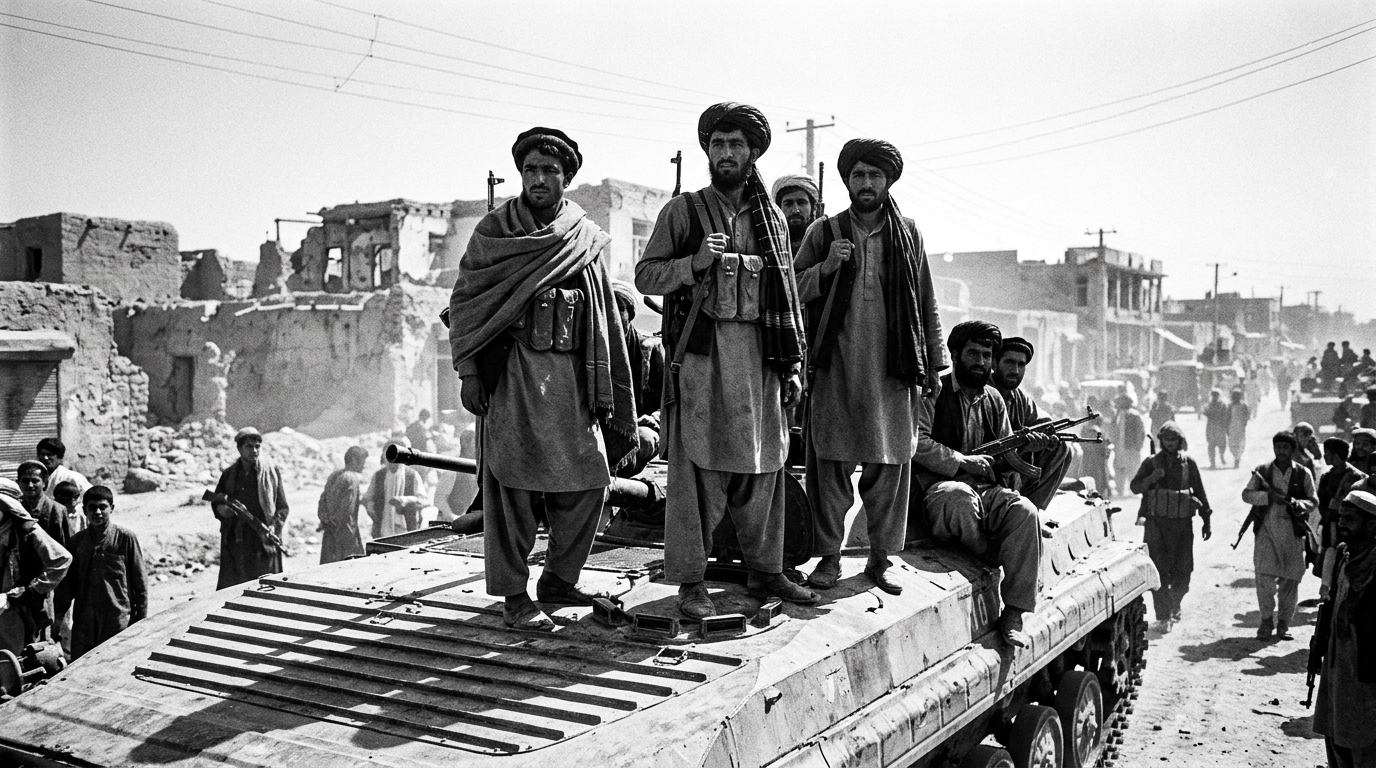
However, the promised peace under the "Peshawar Accords," an attempt to establish an interim government, quickly dissolved into a brutal and destructive civil war (1992-1996). Commanders such as Ahmad Shah Massoud (Jamiat-e Islami, largely Tajik), Gulbuddin Hekmatyar (Hezb-e Islami, predominantly Pashtun), Abdul Rashid Dostum (Junbish-i Milli-yi Islami Afghanistan, Uzbek), and Abdul Ali Mazari (Hezb-e Wahdat, Hazara) turned their arsenals against each other. Kabul became the epicenter of this internecine conflict, subjected to relentless shelling, indiscriminate rocket attacks, and the predation of local checkpoints controlled by avaricious warlords. The city, once a vibrant capital, was reduced to rubble, its population traumatized by an estimated 50,000 civilian casualties during this period. Beyond the capital, the entire country fragmented into fiefdoms, where lawlessness, corruption, and arbitrary violence became the norm. The Afghan populace, after more than a decade of Soviet occupation and another four years of internecine warfare, was utterly exhausted and desperate for stability.
It was into this crucible of despair and disorder that the Taliban movement materialized in the southern Pashtun heartland province of Kandahar in late 1994. The charismatic and reclusive figure of Mullah Mohammed Omar, a modest, one-eyed former mujahedeen commander who had fought against the Soviets, gathered a small but fervent group of students—or taliban—from religious seminaries (madrassas) predominantly located in the refugee camps and border regions of Pakistan. Many of these recruits were orphans or children of the Soviet-Afghan War, raised in a deeply conservative and often austere environment, steeped in a puritanical religious education that emphasized strict adherence to Islamic law. They shared a profound disillusionment with the existing political order, viewing the mujahedeen factions as corrupt, un-Islamic, and ultimately responsible for the suffering of the Afghan people. They offered a stark, yet compelling, promise: security, an end to warlordism, and divine justice through the immediate and rigid imposition of Sharia law. A key foundational moment often cited is Mullah Omar's initial campaign to free two girls from a local warlord in Kandahar, a bold act that garnered him significant local legitimacy and the support of tribal elders weary of chaos.
The rapid ascendancy of the Taliban, however, was far from a spontaneous grassroots phenomenon. It was significantly facilitated by a convergence of overwhelming local resentment against the warlords and powerful external strategic interests. Pakistan’s Inter-Services Intelligence (ISI) agency, deeply frustrated by the chronic instability in Afghanistan, viewed the emerging Taliban as a potent and ideologically aligned proxy force. Islamabad's strategic objectives were manifold: to secure its western border, establish a friendly regime in Kabul (preferably Pashtun-dominated) that would grant "strategic depth" against India, open lucrative trade routes to Central Asian republics, and perhaps most importantly, curb the influence of rival powers like Iran and Russia. The ISI provided the Taliban with crucial logistical support, military training, arms, ammunition, and even direct military and financial aid, effectively nurturing the nascent movement into a formidable fighting force.
Historical Precedents and Ideological Roots
The Taliban's rise, while seemingly abrupt, was rooted in a complex interplay of historical precedents and specific ideological currents within Afghanistan and the broader Islamic world. Afghanistan has a long history of resistance to foreign influence and a strong conservative Pashtun tribal code known as Pashtunwali, which emphasizes honor, justice, and hospitality. Reformist efforts, such as those by King Amanullah Khan in the early 20th century, often faced fierce backlash from religious conservatives and tribal leaders, demonstrating a deep-seated suspicion of externally imposed or modernizing changes. This inherent conservatism and a preference for traditional social structures provided fertile ground for a movement promising a return to perceived Islamic purity.
Central to the Taliban's ideological framework was the Deobandi school of thought. Originating in the Darul Uloom Deoband seminary in British India in the mid-19th century, Deobandism emerged as a reformist and revivalist movement reacting against colonial influence and perceived moral decay. Its core tenets include:
- Strict adherence to Islamic law (Sharia): Emphasizing the Hadith (sayings and actions of Prophet Muhammad) and traditional Islamic jurisprudence.
- Rejection of Bida'h (innovations): A strong aversion to practices considered outside classical Islamic tradition, often manifesting as iconoclasm and opposition to music, art, and modern education.
- Emphasis on religious education (Madrassa system): Seen as crucial for preserving authentic Islamic knowledge and morality.
- Anti-imperialism and political activism: While originally focused on spiritual reform, the Deobandi movement also fostered a strong sense of Islamic identity that could be mobilized against foreign domination or secular governance.
The Deobandi influence spread rapidly through the vast network of madrassas established for Afghan refugees along the Pakistan-Afghanistan border during the Soviet-Afghan War. These institutions, often funded by Saudi Arabian charities promoting Wahhabi-Salafi doctrines (which shared common ground with Deobandism in their puritanical zeal), became a breeding ground for the taliban (students). Many of these students, lacking formal secular education or exposure to diverse viewpoints, were exclusively trained in a narrow, rigid interpretation of Islam, divorced from Afghanistan's rich and complex cultural heritage, including its Sufi traditions and a more pluralistic understanding of Islam. They offered a clear, simple, and uncompromising vision for societal order, which resonated deeply with a population traumatized by chaos and yearning for stability, even if it came at the cost of personal freedoms and cultural diversity. This ideological underpinning, combined with Pashtun tribal codes, provided the moral and philosophical justification for the Taliban's extreme policies and their vision of an "Islamic Emirate."
Timeline of Events and Key Moments
The trajectory of the Taliban from a peripheral militia to the de facto government of Afghanistan was remarkably swift, a testament to their military prowess, ideological appeal, and significant external support.
| Year | Milestone | Description |
|---|---|---|
| 1994 | Emergence in Kandahar | Mullah Omar forms the Taliban, initially composed of a small group of madrassa students, in southern Kandahar province. Their first acts involve dismantling local warlord checkpoints and restoring basic security. |
| 1994 | Capture of Kandahar City | November 1994, the Taliban seize Kandahar city with surprising ease, aided by local commanders' defections and disillusionment with existing warlords. This marks their first major territorial gain. |
| 1995 | Rapid Southern Expansion | The Taliban quickly expand their control across southern and western Afghanistan, taking Ghazni, Maidan Shar, and parts of Helmand, leveraging their reputation for restoring order and swift justice. |
| 1995 | Capture of Herat | September 1995, the Taliban capture Herat from the forces of Ismail Khan. This victory demonstrates the vulnerability of the Rabbani government's northern-based forces and secures a vital economic corridor to Iran. |
| 1995 | Initial Advance on Kabul Repelled | Late 1995, the Taliban launch their first major offensive on Kabul but are pushed back by Ahmad Shah Massoud's forces, suffering significant casualties. This temporary setback highlights the resilience of the Northern Alliance. |
| 1996 | Capture of Jalalabad | September 1996, the Taliban capture the eastern city of Jalalabad, effectively cutting off Kabul's supply routes from Pakistan and isolating the capital. |
| 1996 | The Fall of Kabul | September 27, 1996, the Taliban seize the capital, Kabul, as Burhanuddin Rabbani's government forces withdraw northward. |
| 1996 | Execution of Najibullah | Immediately upon entering Kabul, Taliban forces seize former President Mohammad Najibullah from the UN compound where he had sought asylum since 1992, publicly torture, and execute him and his brother. |
| 1996 | Proclamation of Islamic Emirate | The Islamic Emirate of Afghanistan is formally established, with Mullah Omar declared Amir al-Mu'minin (Commander of the Faithful), fundamentally changing the national identity and governance structure. |
| 1997 | International Recognition (Limited) | Only Pakistan, Saudi Arabia, and the United Arab Emirates formally recognize the Taliban government, isolating it diplomatically. |
The conquest of Kabul in 1996 was a watershed moment, not just for Afghanistan but for regional and international security. As the Taliban surged toward the capital, having encircled it from the south, east, and west, the forces of the Rabbani government, under the command of Ahmad Shah Massoud, collapsed with surprising speed. Massoud made a strategic withdrawal northward, preserving his forces for future resistance. Upon entering the city, the Taliban forces immediately occupied the United Nations compound, breaching its diplomatic sanctity. They seized the former President Mohammad Najibullah, who had been granted sanctuary there since 1992, along with his brother, Shahpur Ahmadzai. They were brutally tortured, hanged from a traffic signal in Ariana Square, and their bodies left on public display for hours. This act of extreme violence served as a chilling and unambiguous announcement of the new order: the era of secularism, pluralism, and any vestiges of a traditional Afghan state were effectively declared dead, replaced by a ruthless, ideologically driven regime.
Geopolitical Consequences and Aftermath
The Taliban's 1996 victory irrevocably transformed Afghanistan into an international pariah, while simultaneously making it the undisputed epicenter of global jihadist militancy. The immediate implementation of a draconian social code represented an unprecedented regression for Afghan society, particularly for women. This included:
- Education for Girls: Banned all girls' schools and prohibited women from attending universities.
- Employment: Women were forbidden from working outside the home, forcing many professional women (doctors, teachers, civil servants) into destitution.
- Public Appearance: Strict enforcement of the burqa (head-to-toe covering), and women were forbidden from leaving their homes without a male escort (mahram).
- Public Punishments: Reintroduction of harsh public punishments, including lashing for minor infractions, amputations for theft, and stoning for adultery, often carried out in stadiums.
- Cultural Repression: Banning of music, television, cinema, photography, kite-flying, and even children's toys like dolls, deemed un-Islamic or idolatrous.
These policies led to widespread condemnation from international human rights organizations and governments, fueling a severe humanitarian crisis. The United Nations and numerous NGOs struggled to operate under such restrictive conditions, often forced to withdraw or severely limit their aid programs.
The most profound and ultimately catastrophic geopolitical consequence, however, was the sanctuary granted to Osama bin Laden and his Al-Qaeda network. Having been forced out of Sudan in 1996 under international pressure, bin Laden returned to his historical theater of operation. His ties to Mullah Omar and the Taliban leadership ran deep, forged during the anti-Soviet jihad, when many "Arab-Afghan" fighters fought alongside the mujahedeen. Mullah Omar granted bin Laden bay'ah (an oath of allegiance), creating a "bond of brotherhood" that would prove unbreakable until the 9/11 attacks.
This symbiosis between the Taliban's state power and Al-Qaeda's transnational terrorist ambitions created a dangerous vacuum. Because the Taliban rejected the norms of the international state system, refusing to join most international organizations or acknowledge modern state boundaries, they were largely immune to diplomatic pressure. Their lack of formal recognition by most of the world (only Pakistan, Saudi Arabia, and the UAE ever recognized their government) meant they had little to lose in hosting transnational terrorist networks. Al-Qaeda established extensive training camps across Afghanistan, recruited and indoctrinated thousands of foreign fighters, and leveraged the country's lawless environment to plan and execute global terror plots, including the 1998 bombings of U.S. embassies in Kenya and Tanzania, and ultimately the September 11, 2001, attacks on the United States. Afghanistan, under the Taliban, thus became the world's premier launching pad for global instability and terrorism.
"The Taliban government represents a medieval approach to modern governance, turning Afghanistan into a black hole of human rights, a breeding ground for extremist ideology, and an unrestricted launching pad for global instability. Their defiance of international norms and their harboring of terrorists pose a direct threat to peace and security worldwide." — Contemporary geopolitical analysis, late 1990s, updated to reflect broader implications.
Analysis of Key Actors and Decisive Actions
The Taliban, despite its rapid growth, was not a monolithic organization but rather an ideologically coherent force anchored by the cult-like devotion to its enigmatic leader, Mullah Mohammed Omar. His authority was not merely political but deeply religious, derived from his claim to be the Amir al-Mu'minin (Commander of the Faithful) – a title that elevated his leadership beyond mere politics into the realm of theological necessity for his followers. Omar's reclusive nature, rarely appearing in public and preferring to govern from his compound in Kandahar, paradoxically enhanced his mystique and perception as a divinely guided leader.
Strategic Alliances and Enablers:
- The ISI (Pakistan): The strategic depth doctrine was a primary driver for Pakistan. The ISI provided the Taliban with an array of support, including:
- Transnational Jihadists: A significant and often overlooked aspect of the Taliban's early success was the influx of foreign fighters, primarily "Arab-Afghans" who had fought against the Soviets, but also Chechens, Uzbeks (from the Islamic Movement of Uzbekistan, IMU), and other radical Islamist elements. These foreign fighters provided not only ideological fervor but also specialized military expertise (e.g., demolitions, urban warfare, intelligence gathering) that the poorly trained Taliban rank-and-file often lacked. Their presence solidified the ideological extremist core of the Taliban, linking it intrinsically to the broader global jihadist movement.
- The Warlord Economy and Merchant Class: One of the Taliban's most potent appeals was their promise to end the pervasive criminality and arbitrary "taxation" (extortion) imposed by warlords on trade routes. By offering to dismantle these checkpoints and ensure predictable, albeit repressive, security for goods, the Taliban gained crucial support from the Pashtun merchant class. This economic incentive, combined with the promise of stability, allowed them to garner popular backing in key agricultural and trade areas, facilitating their rapid expansion. Moreover, the Taliban soon established their own "taxation" system on trade and, crucially, on Afghanistan's burgeoning opium production, which became a significant source of revenue, albeit one they publicly condemned.
The decisive action that sealed the Taliban’s consolidation of power was their ability to appeal to the Pashtun heartland, particularly in the south and east. By framing the struggle not just as a religious crusade but also as an ethnic reclamation against the predominantly Tajik and Uzbek mujahedeen factions of the Northern Alliance, they mobilized a segment of the population that had felt alienated and marginalized by the Tajik-dominated Rabbani government in Kabul. This Pashtun nationalist sentiment, intertwined with a puritanical religious ideology, proved a powerful force for unity and mobilization in a deeply fractured country.
International Responses and Missed Opportunities
The international community's response to the Taliban's rise and rule was fragmented, inconsistent, and ultimately characterized by a mix of cautious engagement, diplomatic isolation, and missed opportunities.
United States: Initially, Washington viewed the Afghan civil war through the lens of post-Cold War disengagement, largely seeing it as an internal conflict. Some US policymakers even entertained the idea that the Taliban might bring stability and facilitate oil/gas pipeline projects through Afghanistan from Central Asia. However, this perspective quickly shifted with the growing evidence of the Taliban's human rights abuses, particularly against women, and crucially, their increasingly overt hosting of Osama bin Laden and Al-Qaeda. By the late 1990s, the US policy moved towards containment, imposing limited sanctions (e.g., freezing assets, travel bans) and attempting to pressure the Taliban through Pakistan. Efforts to convince the Taliban to hand over bin Laden were met with defiance, culminating in the 1998 cruise missile strikes on Al-Qaeda camps in Afghanistan following the East Africa embassy bombings. Yet, a robust, coordinated strategy to dislodge or neutralize the Taliban did not materialize before 9/11.
United Nations: The UN consistently condemned the Taliban's human rights record and called for a peaceful resolution to the conflict. UN Security Council resolutions, such as 1267 (1999) and 1333 (2000), imposed sanctions specifically targeting the Taliban for their refusal to hand over bin Laden, including an arms embargo and a ban on international flights. However, these sanctions proved largely ineffective due to the Taliban's self-imposed isolation and continued external support. The UN's diplomatic efforts to foster an intra-Afghan dialogue failed repeatedly, as the Taliban refused to compromise on their hardline ideological stances or share power.
Regional Powers:
- Pakistan: Remained the Taliban's primary patron, providing critical support despite international pressure. Islamabad saw the Taliban as crucial for its strategic depth doctrine and a counterbalance to Indian influence, though the rise of radicalism within its own borders eventually became a concern.
- Saudi Arabia & UAE: Were among the few nations to recognize the Taliban. Saudi Arabia's support stemmed from ideological affinity (Wahhabism's puritanical leanings resonating with Deobandi extremism) and strategic interests in projecting influence. However, by the late 1990s, Saudi Arabia began to distance itself due to the Taliban's hosting of bin Laden, who targeted the Saudi monarchy.
- Iran: Was fiercely hostile to the Sunni-Pashtun Taliban. Tehran supported the predominantly Shia Hazara factions and Ahmad Shah Massoud's Northern Alliance. Tensions escalated significantly in 1998 after the Taliban massacred Hazaras and Iranian diplomats in Mazar-i-Sharif, bringing both countries to the brink of war.
- Russia and Central Asian States: Viewed the Taliban with profound alarm, fearing the export of radical Islam, drug trafficking, and instability into their own territories. They provided significant support to the Northern Alliance, seeing Massoud as a bulwark against the Taliban's southward expansion.
The international community's inability to forge a unified strategy, coupled with conflicting geopolitical interests, created a void that allowed the Taliban to consolidate power, enforce their extreme agenda, and provide safe harbor for Al-Qaeda. The world watched, largely ineffectually, as Afghanistan transformed into a breeding ground for global terrorism, a critical missed opportunity that would have devastating consequences.
Socio-Economic Impact and Daily Life under the Taliban
Life under the Taliban's Islamic Emirate was characterized by severe restrictions, economic hardship, and a pervasive atmosphere of fear, fundamentally altering the fabric of Afghan society.
Social Repression: The imposition of a radical interpretation of Sharia law led to an unprecedented rollback of human rights and personal freedoms.
- Women and Girls: The most severe impact was on women. They were denied education, banned from working, and forced into strict seclusion. Access to healthcare was severely limited for women, as they could only be seen by female doctors who were themselves forbidden to work. Public beatings and executions for perceived transgressions became common, leading to a drastic decline in public health and literacy among women.
- Cultural Life: All forms of entertainment were banned. Music, television, movies, and photography were strictly forbidden and destroyed. Cultural artifacts, particularly pre-Islamic ones, were targeted for destruction, culminating in the tragic demolition of the ancient Buddhas of Bamiyan in 2001, seen as idolatrous.
- Justice System: The secular judicial system was dismantled, replaced by Mullah Omar's direct decrees and Sharia courts staffed by mullahs often with limited formal legal training. Punishments were swift and brutal, including amputations for theft and public executions.
Economic Hardship: Despite the Taliban's initial promise of security for trade, Afghanistan's economy spiraled downwards due to international isolation, sanctions, and internal mismanagement.
- Trade Routes: While the Taliban initially streamlined some trade routes by eliminating warlord checkpoints, the overall economy suffered from lack of foreign investment, sanctions, and the withdrawal of international aid organizations.
- Opium Cultivation: The Taliban initially struggled with the vast opium trade, banning it in 2000 under international pressure, leading to a temporary reduction. However, they had previously taxed and benefited from the trade, and it quickly resumed after their fall in 2001. The overall economic reliance on opium further linked Afghanistan to illicit global networks.
- Poverty and Famine: The combination of prolonged conflict, severe drought (late 1990s), and the regime's repressive policies led to widespread poverty, food insecurity, and displacement. Humanitarian crises were exacerbated by the regime's obstruction of aid efforts and its harsh treatment of minority populations.
Ethnic Cleansing and Minorities: The Taliban's predominantly Pashtun composition and ideology led to the systematic persecution of ethnic and religious minorities, particularly the Hazaras (Shia Muslims) in central Afghanistan. Massacres in Mazar-i-Sharif (1998) and Bamiyan were well-documented, demonstrating the regime's brutal sectarian and ethnic bias. This intensified the internal fragmentation of Afghanistan and fueled the resistance of the Northern Alliance. Daily life for non-Pashtun communities was marked by discrimination, fear, and insecurity, often leading to mass displacement.
The cumulative effect of these policies was the systematic deconstruction of Afghanistan's nascent civil society and economy, leading to a profound humanitarian catastrophe and turning the country into an isolated, failed state, serving primarily as a base for extremist ideologies.
Legacy and Historiographical Debates
The 1996 rise of the Taliban cast a long, enduring shadow over Afghanistan and profoundly reshaped global geopolitics, whose legacy continues to be debated and analyzed by historians and geopolitical analysts.
Immediate and Long-Term Legacy:
- The 9/11 Catalyst: The most undeniable legacy is Afghanistan's role as the launching pad for the September 11, 2001 attacks, which directly led to the U.S.-led invasion of Afghanistan, the longest war in American history, and the subsequent global War on Terror.
- State Collapse and Reconstruction: The Taliban's rule further devastated Afghanistan's already fragile state institutions. Their overthrow in 2001 initiated a two-decade-long, internationally backed effort at nation-building, democracy promotion, and economic reconstruction, which ultimately proved unsustainable.
- Resilience of Extremism: Despite their initial defeat, the Taliban demonstrated remarkable resilience, regrouping and eventually returning to power in 2021, highlighting the deep-seated nature of their ideology and the limits of external intervention. This resurgence is a direct continuation of the movement that consolidated power in 1996.
- Women's Rights: The legacy of the Taliban's first rule continues to impact the struggle for women's rights in Afghanistan, with women facing renewed oppression under their current regime, directly echoing the policies of 1996-2001.
- Regional Instability: The Taliban's ascent fueled regional instability, impacting Pakistan's own security, and fostering radical movements across Central Asia and beyond.
Modern Historiographical Debates: Historians continue to grapple with several key questions surrounding the Taliban's 1996 rise:
- The "Organic" vs. "Engineered" Debate: Was the Taliban primarily an organic, indigenous movement arising from Afghan societal despair and religious conviction, or was it largely an external creation, engineered and sustained by Pakistan's ISI? While most scholars acknowledge a combination, the emphasis often varies. Some argue that without ISI's sustained patronage, the Taliban would have remained a local phenomenon. Others point to the deep-seated grievances and ideological resonance within Afghanistan that allowed the movement to flourish.
- The Role of Western Inaction: To what extent did the international community, particularly the United States, miss opportunities or fail to adequately respond to the growing threat posed by the Taliban's extremism and their harboring of Al-Qaeda in the 1990s? Some argue that early and more robust engagement, or even military action against the Taliban's growing power, could have averted the eventual catastrophe of 9/11. Others contend that intervention would have been politically unfeasible or simply ineffective given the complexity of Afghan dynamics.
- Taliban's True Intentions: Was the Taliban's goal primarily domestic (restoring order and enforcing Sharia within Afghanistan) or always implicitly global (supporting international jihad)? The debate often centers on the relationship between Mullah Omar and Osama bin Laden, and whether Omar fully grasped the implications of hosting Al-Qaeda's transnational ambitions. While Mullah Omar's pronouncements largely focused on internal Afghan affairs, the inherent ideological links and operational freedom granted to Al-Qaeda suggest a deeper, if not fully articulated, alignment with global jihad.
- The Nature of Afghan Statehood: The Taliban's rise also sparked debates about the viability of a centralized, pluralistic state in Afghanistan, given its diverse ethnic makeup and history of regional autonomy. Was the return to a highly centralized, ideologically uniform "emirate" a rejection of the very concept of a modern Afghan nation-state, or a historical pattern of strongman rule under a different ideological guise?
These ongoing debates reflect the complexity of Afghanistan's history and the profound, enduring impact of the Taliban's initial ascent to power in 1996, an event that continues to resonate in contemporary global affairs.
Trivia and Lesser-Known Facts
- The "Kabul" Symbolism: The Taliban’s first act after entering Kabul on September 27, 1996, was not merely military administration but a symbolic and deeply ideological one: they immediately closed girls' schools and banned women from public life. This emphasized that their objective was as much about a total societal overhaul and psychological control as it was about tactical military victory.
- The Saudi Connection: Initially, only three countries—Pakistan, Saudi Arabia, and the United Arab Emirates—formally recognized the Taliban government. Saudi Arabia's recognition was a significant diplomatic boost, reflecting the complex, often conflicting interests of the Sunni world, where some elements saw the Taliban as upholding a "pure" form of Islam. However, this support waned as bin Laden turned against the Saudi monarchy.
- Religious Iconoclasm: The destruction of the colossal Buddhas of Bamiyan in March 2001, ordered by Mullah Omar, was a culmination of the Taliban's rejection of all pre-Islamic cultural artifacts as idolatry. However, the seeds of this iconoclasm were sown much earlier, with the Taliban systematically destroying statues, paintings, and other cultural heritage deemed 'un-Islamic' from 1996 onwards.
- Radio Sharia: The Taliban masterfully utilized radio broadcasts as their primary instrument of mass control and public communication. They renamed Radio Kabul to 'Radio Sharia' and used it to disseminate their mandates, religious decrees (fatwas), and propaganda throughout the country, often announcing new prohibitions or punishments directly to the populace.
- The "White Flag" Symbolism: The Taliban adopted a plain white flag as the banner for their Islamic Emirate. This simplicity was intended to symbolize purity, religious devotion, and the unity of their movement, a stark contrast to the colorful flags of the various mujahedeen factions.
- Mullah Omar's Obscurity: Despite being the supreme leader and Amir al-Mu'minin, Mullah Omar was notoriously reclusive. He rarely left Kandahar, almost never met non-Muslims, and few photographs of him existed. This aura of mystery contributed to his revered status among his followers but also made him an elusive figure for international diplomacy.
- Failed Gas Pipeline: A significant, albeit ultimately unrealized, geopolitical driver behind some early international engagement with the Taliban was the prospect of building a trans-Afghan gas pipeline (TAP or TAPI pipeline project) from Turkmenistan to Pakistan and India. American oil company Unocal was involved in early discussions, hoping the Taliban could stabilize the country sufficiently for such an infrastructure project, before ultimately withdrawing due to security and human rights concerns.
References and Literature
- Rashid, A. (2000). Taliban: Militant Islam, Oil and Fundamentalism in Central Asia. Yale University Press. - An seminal and authoritative analysis of the Taliban's origins, ideology, external support (especially from Pakistan and Saudi Arabia), and their impact on Afghanistan and Central Asia. Rashid meticulously documents the movement's rise and provides crucial context for its geopolitical significance.
- Coll, S. (2004). Ghost Wars: The Secret History of the CIA, Afghanistan, and Bin Laden. Penguin Books. - A Pulitzer Prize-winning, definitive account detailing the intricate and often clandestine interactions between the CIA, Saudi intelligence, Pakistan's ISI, and the various Afghan factions, including the Taliban, during the 1990s leading up to 9/11. Essential for understanding the intelligence landscape.
- Rubin, B. R. (2015). Afghanistan from the Cold War Through the War on Terror. Oxford University Press. - Provides a comprehensive historical overview of Afghanistan, placing the Taliban's rise within the broader context of the country's tumultuous modern history, state collapse, and international interventions.
- Goodson, L. P. (2001). Afghanistan's Endless War: State Failure, Regional Politics, and the Rise of the Taliban. University of Washington Press. - Offers an in-depth academic examination of the factors contributing to state failure in Afghanistan and how regional geopolitical dynamics facilitated the Taliban's ascent.
- Maley, W. (2002). The Afghanistan Wars. Palgrave Macmillan. - Explores the multiple conflicts in Afghanistan, providing a detailed analysis of the civil war era and the Taliban's consolidation of power, and its implications for human rights and governance.
- United Nations Archive: Report on the Situation in Afghanistan. - Official documentation from various UN bodies (UNAMA, UNHCR, UNHCHR) providing contemporary reports on the humanitarian crisis, human rights abuses, and the political situation following the 1996 fall of Kabul. These reports offer crucial primary source insights into the international response and the regime's policies.
- The Taliban: The Rise of the Fundamentalist Movement in Afghanistan. (Various Authors). - A deep dive into the socio-political origins of the Deobandi influence in Afghan seminaries, often found in academic journals or edited volumes focused on South Asian studies and Islamic movements.
- Massoud, A. S. (Various Interviews and Speeches). - Archival records of Ahmad Shah Massoud's statements provide a crucial perspective from the primary opposition leader during the Taliban's ascent, detailing the nature of the conflict and the international neglect.