Key Takeaways
- Korean Air Lines Flight 007 strayed off-course due to a navigational error, penetrating highly sensitive Soviet military airspace over Kamchatka and Sakhalin.
- Amid heightened Cold War paranoia and active US reconnaissance operations, Soviet air defenses misidentified the Boeing 747 as an American spy plane and shot it down, killing all 269 people aboard.
- The incident triggered international outrage, accelerated the weaponization of the Cold War, and ultimately led to the civilian release of Global Positioning System (GPS) technology.
Historical Context and Origins
The year 1983 is widely regarded by historians as one of the most dangerous periods of the late Cold War, marked by a level of systemic paranoia and military brinkmanship not seen since the Cuban Missile Crisis 1. Relations between the United States and the Soviet Union had deteriorated rapidly following the Soviet invasion of Afghanistan in 1979 and the subsequent election of Ronald Reagan to the US presidency. Reagan had abandoned the policy of détente, actively labeling the Soviet Union an "evil empire" and embarking on a massive military buildup designed to counter Soviet influence globally.
- U.S. Reconnaissance Flights (RC-135)
- U.S.-Soviet Tensions (Operation RYAN / SDI)
- Soviet Military Bastion (Kamchatka/Sakhalin)
- KAL 007 Navigational Error (INS vs. HDG)
| Root Event / Context | Impacted Areas |
|---|---|
| U.S. Reconnaissance Flights (RC-135) | U.S.-Soviet Tensions (Operation RYAN / SDI) |
| U.S.-Soviet Tensions | Soviet Military Bastion (Kamchatka/Sakhalin) |
| Systemic Navigation Failure | KAL 007 Navigational Error (INS vs. HDG) |
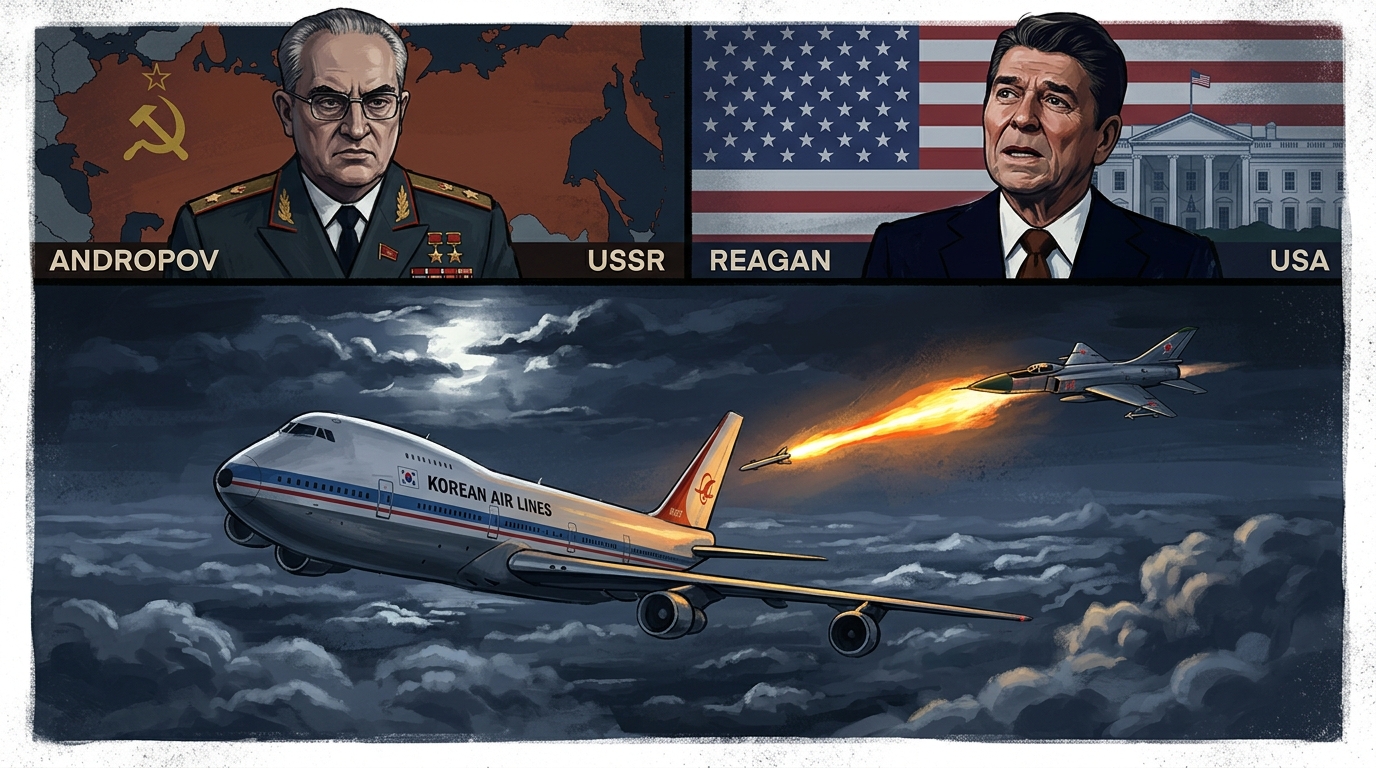
Central to this geopolitical friction was the Soviet leadership's intense anxiety over a potential American first strike. General Secretary Yuri Andropov, the former KGB chief who succeeded Leonid Brezhnev in 1982, was convinced that the West was actively preparing for a nuclear war. Under Andropov, the KGB and Soviet military intelligence launched Operation RYAN (Raketno-Yadernoe Napadenie), a massive intelligence-gathering effort designed to detect early warning signs of a surprise US nuclear attack 2.
In the Pacific theater, this tension translated into a highly militarized standoff. The Kamchatka Peninsula and Sakhalin Island in the Soviet Far East were ultra-sensitive military zones. Kamchatka housed major strategic submarine bases, while Sakhalin served as a forward listening post and air defense shield. The Sea of Okhotsk, positioned between them, was treated by Moscow as a closed Soviet military bastion where ballistic missile submarines (SSBNs) could operate safely from Western detection.
The United States regularly tested these defenses. Under the command of the US Navy and the National Security Agency (NSA), American electronic intelligence (ELINT) aircraft, such as the Boeing RC-135, routinely patrolled the periphery of Soviet airspace, deliberately triggering Soviet radar installations to map their frequencies and response times. To the Soviet Air Defense Forces (PVO Strany), any unidentified radar blip in this region was treated not as an innocent error, but as a deliberate probe by hostile Western intelligence.
Timeline of Events and Key Moments
On August 31, 1983, Korean Air Lines Flight 007 (KAL 007), a Boeing 747-230B carrying 240 passengers and 29 crew members, departed John F. Kennedy International Airport in New York bound for Seoul, South Korea. After a routine refueling stop at Anchorage International Airport in Alaska, the aircraft took off at 13:00 UTC (3:00 AM local time) on September 1.
The Navigational Deviation
Shortly after takeoff, the flight crew, commanded by experienced pilot Chun Byung-in, was instructed to fly a path that would merge with "Romeo 20" (R-20), a standard commercial aviation corridor that bypassed Soviet airspace to the south, passing over the Aleutian Islands. However, almost immediately, the aircraft began to deviate from its assigned flight plan.
Expected Flight Path (R-20 Corridor)
- Anchorage
- Aleutian Islands
- Tokyo
- Seoul
Actual Flight Path (KAL 007)
- Anchorage
- Kamchatka Peninsula (USSR)
- Sakhalin Island
- Shot Down
The deviation went unnoticed by the crew. It is highly probable that the pilot left the autopilot set to "HEADING" mode instead of arming the "Inertial Navigation System" (INS) mode, or that the INS was engaged after the aircraft had already drifted too far off-course to lock onto the computerized path. Consequently, instead of tracking along R-20, KAL 007 flew a constant magnetic heading of 246 degrees. This straight line took the airliner directly toward the heavily fortified Kamchatka Peninsula.
Intrusion into Soviet Airspace
At 15:51 UTC, KAL 007 crossed into the outer ring of Soviet radar coverage. Soviet defense systems immediately went on alert. Compounding the situation, a US RC-135 spy plane had been operating in the area just hours earlier, performing an electronic reconnaissance mission. On the radar screens of Soviet operators, the radar signatures of the Boeing 747 and the military RC-135 (which is also based on a Boeing airframe) appeared highly similar. Soviet command centers concluded that the intruder was the US spy plane returning to gather intelligence on a highly classified Soviet missile test scheduled to take place on Kamchatka that night.
As KAL 007 flew over Kamchatka, Soviet MiG-23 and Sukhoi Su-15 interceptors were scrambled. However, the airliner crossed back over the international waters of the Sea of Okhotsk before the interceptors could locate it. The Soviet Far East Command realized they had missed the target but anticipated that the intruder would likely cross over Sakhalin Island next.
The Interception and the Fatal Order
At 18:12 UTC, KAL 007 re-entered Soviet airspace over southern Sakhalin Island. Three Su-15 fighters and a MiG-23 were scrambled to intercept the target. Among them was Major Gennadi Osipovich, piloting a Su-15.
"I saw two rows of windows and knew that this was a Boeing. I knew this was a civilian plane. But for me this meant nothing. It is easy to turn a civilian passenger plane into one for military use." — Major Gennadi Osipovich (recollected in a 1996 interview) [^3]
At 18:16 UTC, Osipovich caught visual sight of the aircraft. Ground control, however, pressured him to act quickly before the target could escape into international airspace. Osipovich was ordered to fire warning shots. He executed this by firing over 200 rounds from his aircraft's cannon. However, because his shells did not contain tracer ammunition, they were invisible to the crew of KAL 007 in the pitch-black night.
18:12 UTC: KAL 007 re-enters Soviet airspace over Sakhalin. 18:16 UTC: Su-15 piloted by Major Osipovich makes visual contact. 18:20 UTC: KAL 007 climbs to save fuel, slowing down; Soviets interpret this as an evasive maneuver. 18:24 UTC: Soviet ground control orders the strike. 18:26 UTC: Two K-8 air-to-air missiles are fired; KAL 007 is struck.
At 18:20 UTC, the pilots of KAL 007, completely unaware of the intercepting fighters or their own location, contacted Tokyo Area Control Center to request a climb to Flight Level 350 (35,000 feet) to conserve fuel. As the airliner slowed down to climb, the trailing Su-15 rapidly closed the distance. To Soviet ground controllers, this deceleration and climb appeared to be an evasive maneuver designed to evade interception.
Believing the target was escaping, the commander of the Far East Military District Air Defense Forces gave the final order to destroy the aircraft. At 18:26 UTC, Major Osipovich fired two K-8 air-to-air missiles. One missile missed, but the other detonated near the tail of the Boeing 747, severing the cabin pressure lines and crippling the aircraft's control systems. The damaged airliner went into a spiraling descent, eventually crashing into the Sea of Japan near Moneron Island. All 269 passengers and crew on board were killed.
Geopolitical Consequences and Aftermath
The destruction of KAL 007 sent shockwaves through the international community and plunged superpower relations to their lowest point since the early 1960s. The immediate rhetorical battle was fierce, with both sides utilizing the tragedy to advance their strategic narratives.
The Rhetorical War
On September 5, 1983, President Ronald Reagan addressed the nation from the Oval Office, condemning the attack in the strongest possible terms:
"This was the Soviet Union against the world and the moral precepts which guide human relations among people everywhere... It was an act of barbarism, born of a society which wantonly disregards individual rights and the value of human life." — Ronald Reagan, National Address on KAL 007 [^4]
The United States used the incident to rally its Western allies, portraying the Soviet leadership as ruthless, paranoid, and indifferent to human civilian life. In response, the Soviet Union initially denied any knowledge of the crash. When forced to admit their involvement after Western intelligence released intercepted radio transmissions of the Soviet interceptor pilots, Moscow pivoted. The Kremlin claimed that the flight was part of a coordinated, provocative intelligence-gathering mission orchestrated by the CIA and the Pentagon, utilizing innocent civilians as human shields.
Downing of KAL 007 (1983)
- Strategic Escalations
- Technological Shifts
Strategic and Military Escalations
The crisis significantly strengthened Reagan’s domestic and international policy positions. Critics of his administration's hawkish defense spending and his proposed Strategic Defense Initiative (SDI, colloquially known as "Star Wars") were temporarily silenced by the wave of anti-Soviet sentiment.
- Weapon Deployment: The incident smoothed the path for the controversial deployment of US Pershing II and Gryphon cruise missiles in West Germany, Great Britain, and Italy later that year.
- Able Archer 83: The heightened state of alarm contributed directly to the extreme danger of the NATO command post exercise Able Archer 83 in November of that year, during which the Soviets, fearing a real first-strike scenario, placed their nuclear forces on high alert.
Practical and Civil Reform
The tragedy led directly to several major reforms in global aviation and military technology:
- Civilian GPS Authorization: In a move that fundamentally reshaped global navigation, President Reagan directed that the United States military's Global Positioning System (GPS), then in its developmental phase, be made freely available for civilian use once fully operational to prevent similar navigational tragedies.
- Aviation Communication Reforms: The International Civil Aviation Organization (ICAO) revised its protocols, mandating stricter tracking of civilian flights and improving communications between military interceptors and civilian air traffic controllers.
- Establishment of New Routes: The Northern Pacific (NOPAC) route system was restructured, and high-frequency military-to-civilian communication links were established across the North Pacific to ensure that military radars could verify the identities of commercial aircraft.
Analysis of Key Actors and Decisive Actions
The tragedy of KAL 007 was not merely the result of a mechanical failure or a singular bad decision; it was the product of a systemic breakdown driven by ideological polarization, institutional rigidity, and high-stakes military calculations.
| Key Actor | Key Decisions Made | Strategic Motivation | Geopolitical Impact |
|---|---|---|---|
| Ronald Reagan | Formulated a highly moralistic public condemnation; declassified intelligence intercepts; opened GPS to civilians. | Delegitimize the Soviet regime; build domestic consensus for US defense buildup and SDI. | Isolated the USSR diplomatically; accelerated the deployment of intermediate-range nuclear forces in Europe. |
| Yuri Andropov | Maintained a rigid defensive posture; accused the US of espionage; authorized withholding of the black box. | Prevent the perception of Soviet military weakness; protect state secrets regarding Far East defenses. | Reinforced Western perceptions of Soviet paranoia; worsened relations just prior to Able Archer 83. |
| Far East Command (USSR) | Misidentified the target; ordered the shootdown without positive civilian identification. | Protect highly sensitive nuclear submarine bases and military airspace from suspected surveillance. | Caused 269 civilian deaths; triggered international condemnation and permanent damage to Soviet credibility. |
| Flight Crew (KAL 007) | Failed to verify the autopilot mode (INS vs. Heading); did not recognize the warning signs of off-course flight. | Routine operational assumptions; complacency during a long-haul overwater flight. | Led the aircraft into one of the most heavily armed military zones on Earth. |
The Soviet Rigid Command Structure
The actions of the Soviet air defense network on the night of September 1 highlight the pathological rigidity of the USSR's military command chain. Ground radar operators and local commanders were terrified of failing to protect the border. In 1978, a Korean Air Lines Flight 902 had similarly strayed into Soviet airspace over Murmansk; it was shot at and forced to crash-land, which had led to severe reprimands for local commanders who had failed to intercept it quickly enough.
In 1983, Far East commanders faced a choice: risk letting an American spy plane escape with vital intelligence about their secret military installations, or shoot down a suspicious, unidentified aircraft. Operating within a closed, paranoid political ecosystem that viewed every Western action through the lens of imminent conflict, they chose the latter.
Trivia and Lesser-Known Facts
- The Congressman on Board: Among the 269 victims was Larry McDonald, an active United States Representative from Georgia and the serving president of the ultra-conservative, fiercely anti-communist John Birch Society. His death led to intense conspiracy theories in the United States, with some asserting that the Soviets had targeted the flight specifically to assassinate him.
- The Secret Recovery of the Black Box: For years, the Soviet Union claimed they had been unable to locate the flight data recorder and cockpit voice recorder (the "black boxes") of KAL 007. In reality, Soviet naval vessels had found them in the waters near Moneron Island shortly after the crash. Fearing that the tapes would disprove their claim that the plane was on an espionage mission, the Kremlin kept the discovery classified. The boxes were finally handed over to the ICAO by Russian President Boris Yeltsin in 1992, following the collapse of the Soviet Union [[^5]].
- The "Cobra Ball" Correlation: The US spy plane that had crossed paths with KAL 007 earlier that night was an RC-135 "Cobra Ball," a specialized aircraft used to monitor Soviet missile telemetry. The proximity of the two aircraft on radar screens is what initially confused Soviet radar operators, creating a tragic case of mistaken identity that sealed the fate of the civilian airliner.
- The Prophetic Film: Just three years before the incident, in 1980, a French-made thriller film titled La Banquise (The Ice Floe) detailed a fictional scenario where a commercial airliner is shot down by Soviet interceptors after straying over sensitive military installations in the Arctic, mirroring the real-world events of 1983 with unsettling accuracy.
References and Literature
- Report of the Completion of the Fact-Finding Investigation into the Landing/Downing of KAL 007 - The official, definitive technical investigation report compiled by the International Civil Aviation Organization (ICAO) in 1993 after the release of the flight recorders.
- The Target Is Destroyed: What Really Happened to Flight 007 and What We Decided to Do About It - Seymour M. Hersh's landmark investigative book detailing the intelligence failures and political maneuvers on both sides of the Iron Curtain.
- The Cold War: A New History - John Lewis Gaddis's comprehensive historical analysis of the Cold War, contextualizing the 1983 crisis within the broader geopolitical dynamics of the Reagan-Andropov era.
- Soviet Air Defense and the KAL 007 Disaster - Foreign Affairs journal article examining the military doctrine, radar limitations, and decision-making apparatus of the Soviet PVO Strany.
Footnotes & Explanations
- John Lewis Gaddis, The Cold War: A New History (New York: Penguin Books, 2005), 228-230. ↩
- Benjamin B. Fischer, A Cold War Conundrum: The 1983 Soviet War Scare (Center for the Study of Intelligence, 1997). ↩
- Gennadi Osipovich, interview with The New York Times, September 9, 1996. ↩
- Ronald Reagan, "Address to the Nation on the Soviet Attack on a Korean Civilian Airliner," September 5, 1983. ↩
- International Civil Aviation Organization (ICAO), Report of the Completion of the Fact-Finding Investigation: June 1993, 45-48. ↩