Key Takeaways
- The split shattered the monolith of the Eastern Bloc, shifting the Cold War from a bipolar to a tripolar geopolitical dynamic.
- Deep-seated ideological disputes regarding de-Stalinization, 'peaceful coexistence' with the West, and the correct path to socialist revolution drove the wedge between Moscow and Beijing.
- The conflict escalated from rhetorical polemics to military clashes along the Ussuri River in 1969, bringing the two nuclear-armed giants to the brink of war and paving the way for Sino-American rapprochement.
In the immediate aftermath of the Chinese Communist Revolution in 1949, the Western world viewed the communist bloc as a monolithic, unstoppable force. The alliance between the Union of Soviet Socialist Republics (USSR) and the newly declared People’s Republic of China (PRC), formalized in the 1950 Treaty of Friendship, Alliance, and Mutual Assistance, seemed to unite Eurasia under the banner of Marxism-Leninism. Western strategists feared a unified red behemoth stretching from the Elbe to the South China Sea.
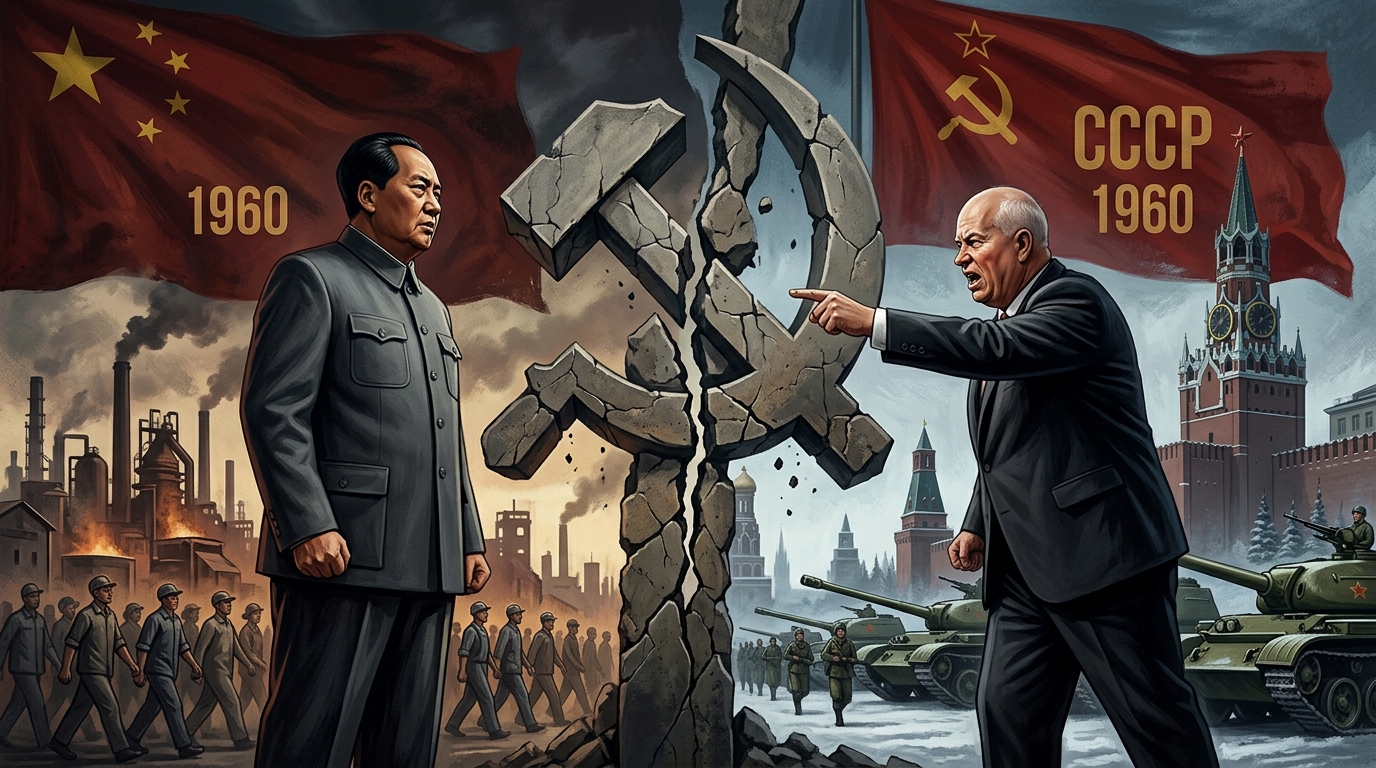
However, by the early 1960s, this ostensibly unbreakable union had fractured. What began as subtle doctrinal disagreements rapidly deteriorated into fierce public denunciation, diplomatic sabotage, and eventually, armed border clashes. The Sino-Soviet split was one of the defining geopolitical events of the 20th century. It shattered the illusion of a unified global communist movement, transformed the bipolar dynamic of the Cold War into a complex tripolar struggle, and altered the trajectory of international relations by facilitating an unexpected rapprochement between Washington and Beijing.
Historical Context and Origins
To understand the suddenness and severity of the split, one must look beneath the veneer of shared ideology to examine the deep-seated historical, structural, and cultural differences between the Soviet Union and China.
Theoretical Divergence: Proletariat vs. Peasantry
The first major source of tension lay in the very nature of each country's revolution. Soviet Marxism-Leninism was built upon the orthodox Marxist belief that the industrial proletariat (the urban working class) was the vanguard of the revolution. Russia’s Bolsheviks had seized power in the cities before extending their control to the countryside.
Conversely, Mao Zedong’s rise to power was achieved through "Maoism" (or Mao Zedong Thought), which adapted Marxist theory to fit a highly agrarian society. Mao identified the peasantry, rather than the minuscule urban working class, as the primary revolutionary force in China. This ideological divergence created an undercurrent of mutual intellectual condescension. Soviet theoreticians viewed Mao’s peasant-led revolution as ideologically primitive and provincial, while Mao regarded Soviet dogmatism as disconnected from the realities of the decolonizing, developing world.
The Legacy of Joseph Stalin
During the reign of Joseph Stalin, the asymmetric nature of the relationship was maintained through raw power and prestige. Stalin treated the Chinese Communist Party (CCP) as a junior partner, often issuing tactical directives during the Chinese Civil War that favored Soviet state interests over the immediate success of the Chinese communists. Mao deeply resented this patronizing treatment 1.
Despite this friction, Mao respected Stalin as a monumental Marxist-Leninist theoretician and leader. When Stalin died in March 1953, a precarious power vacuum emerged within the global communist hierarchy. Mao, having led the world’s most populous nation through a successful revolution, viewed himself as the natural intellectual successor to Stalin. However, the new leadership in Moscow, eventually consolidated under Nikita Khrushchev, had no intention of ceding ideological leadership to Beijing.
The Ideological Split at a Glance
| Soviet Union (Khrushchev) | PRC (Mao Zedong) |
|---|---|
| De-Stalinization & Reform | Defense of Stalinism |
| "Peaceful Coexistence" with US | Armed Struggle/War |
| Industrial Proletariat Vanguard | Peasantry Vanguard |
| Senior Partner Status | Equal Partnership |
Khrushchev's Secret Speech and "Peaceful Coexistence"
The turning point occurred in February 1956 during the 20th Congress of the Communist Party of the Soviet Union (CPSU). Without consulting or forewarning his Chinese allies, Khrushchev delivered his famous "Secret Speech" (On the Cult of Personality and its Consequences), which systematically denounced Stalin's purges, terror, and dictatorial excesses 2.
Mao was deeply offended and alarmed by this move. From a domestic standpoint, Mao’s own leadership style was heavily modeled on Stalinist centralization and a cult of personality; Khrushchev’s denunciation of Stalin was seen as an indirect threat to Mao’s authority. Furthermore, Mao argued that publicly tarnishing Stalin's legacy damaged the credibility of the entire global communist movement.
Compounding this ideological rift was Khrushchev's new foreign policy doctrine of "Peaceful Coexistence" (Mirnoye Sosushchestvovaniye) with the capitalist West. Khrushchev argued that in the nuclear age, a direct military conflict between the US and the USSR would result in mutual annihilation. Therefore, communism would have to defeat capitalism through economic and social competition rather than military confrontation.
Mao vehemently rejected this thesis, branding it as "revisionism." He argued that imperialism was a "paper tiger" and that the global socialist camp should actively support armed revolutionary struggles in Asia, Africa, and Latin America, even if it risked provoking a confrontation with the United States.
"Imperialism and all reactionaries are paper tigers... In appearance, the reactionaries are terrifying, but in reality they are not so powerful. From a long-term point of view, it is not the reactionaries but the people who are really powerful." — Mao Zedong, Imperialism and All Reactionaries Are Paper Tigers (1957)
Timeline of Events and Key Moments
As the 1950s drew to a close, the ideological dispute rapidly translated into concrete diplomatic and military friction. The 1960s would witness the complete unraveling of the alliance.
The Taiwan Strait Crises (1954–1958)
The geographical friction points between the two powers became apparent during the Taiwan Strait Crises. In 1958, without informing Moscow beforehand, China began a heavy artillery bombardment of the Nationalist-held islands of Kinmen (Quemoy) and Matsu.
Khrushchev was furious. The United States had signaled it would defend Taiwan, potentially dragging the Soviet Union into a nuclear confrontation with the US under the terms of the 1950 Sino-Soviet mutual defense treaty. Khrushchev made it clear that Soviet defense commitments applied only to attacks on the Chinese mainland, not to Chinese offensive actions against Taiwan. This lack of unconditional Soviet support convinced Mao that Moscow was an unreliable ally.
| Year | Event |
|---|---|
| 1956 | Khrushchev's "Secret Speech" denounces Stalin; Mao feels threatened. |
| 1958 | Taiwan Strait Crisis; USSR refuses to support Chinese military brinkmanship. |
| 1959 | USSR cancels nuclear technology agreement; Khrushchev visits Camp David. |
| 1960 | Soviet technicians and aid abruptly withdrawn from China. |
| 1962 | Dual Crises: Sino-Indian War and Cuban Missile Crisis crystallize the split. |
| 1969 | Violent military clashes erupt over Zhenbao/Damansky Island on the border. |
The Nuclear Disagreement and the Camp David Spirit (1959)
In 1957, Moscow had agreed to assist China in developing its own nuclear weapons, promising to provide a prototype atomic bomb and technical designs. However, alarmed by Mao’s radical rhetoric regarding nuclear war—Mao famously suggested that even if half of humanity perished in a nuclear war, the other half would survive to build a socialist utopia—Khrushchev rescinded the agreement in June 1959.
Later that year, Khrushchev became the first Soviet leader to visit the United States, engaging in friendly talks with President Dwight D. Eisenhower at Camp David. The resulting diplomatic thawing, dubbed the "Spirit of Camp David," was viewed by Beijing as the ultimate betrayal. Mao believed the Soviets were conspiring with the American imperialists to preserve a nuclear monopoly and isolate China.
The Great Withdrawal (1960)
The split became public and irreversible in 1960. At the Romanian Communist Party Congress in Bucharest, Khrushchev and the Chinese representative, Peng Zhen, openly traded insults in front of international delegates.
In July 1960, Khrushchev retaliated economically by abruptly ordering the immediate withdrawal of all 1,400 Soviet scientists, engineers, and technical advisors working in China. Moscow also canceled over 250 joint scientific and industrial projects. This move was devastating to the Chinese economy, which was already reeling from the catastrophic agricultural and industrial failures of the Great Leap Forward 3. Left with half-finished factories and missing blueprints, China’s industrial development was severely retarded, cementing a deep, national resentment against the Soviets.
1962: The Year of Divergence
Two major events in 1962 crystallized the geopolitical hostility between the two nations: the Sino-Indian War and the Cuban Missile Crisis.
- The Sino-Indian War (October–November 1962): When border disputes between China and India erupted into war, the Soviet Union refused to support its communist ally. Instead, seeking to maintain its influence in the non-aligned movement, Moscow adopted a neutral stance and continued to sell MiG fighter jets and transport helicopters to India. Mao viewed this as a direct act of betrayal, where Moscow preferred a bourgeois capitalist state over a brotherly socialist nation.
- The Cuban Missile Crisis (October 1962): Mao utilized the Cuban Missile Crisis to attack Khrushchev’s leadership on the world stage. When Khrushchev deployed nuclear missiles to Cuba, Mao accused him of "adventurism." When Khrushchev agreed to withdraw the missiles in exchange for a US promise not to invade Cuba, Mao lambasted him for "capitulationism" and "kneeling before the imperialist aggressor."
The Border War of 1969: The Precipice of Total War
By the late 1960s, ideological polemics had transformed into a massive military buildup along the 4,380-kilometer Sino-Soviet border. Tensions culminated in March 1969 on Zhenbao (Damansky) Island, a small, uninhabited landmass on the Ussuri River.
On March 2, 1969, a Chinese military unit ambushed Soviet border guards on the island, killing dozens of Soviet soldiers. The Soviets retaliated on March 15 with heavy artillery and advanced BM-21 Grad rocket launchers, devastating Chinese positions.
The skirmishes threatened to escalate into a full-scale war. In the summer of 1969, Soviet officials quietly sounded out Western governments, including the United States, regarding their reaction to a potential Soviet preemptive nuclear strike against China’s nuclear testing facilities at Lop Nur 4. The United States warned Moscow that such an action would have catastrophic global consequences and would not be tolerated, forcing the Soviets to de-escalate.
Geopolitical Consequences and Aftermath
The ramifications of the Sino-Soviet split permanently altered the geopolitical landscape, introducing a dynamic that ultimately accelerated the end of the Cold War.
The Rise of Triangular Diplomacy
The most significant strategic consequence of the split was the Sino-American Rapprochement. Recognizing that China faced a severe security threat from the north, and wishing to extricate the United States from the Vietnam War, President Richard Nixon and his National Security Advisor Henry Kissinger initiated "triangular diplomacy."
Nixon calculated that by improving relations with China, he could gain leverage over the Soviet Union, which was desperate to prevent a US-China alliance. In February 1972, Nixon made his historic visit to China, meeting with Mao Zedong and Premier Zhou Enlai. This diplomatic coup forced Moscow to seek its own détente with Washington, leading to strategic arms limitation talks (SALT I) and a temporary stabilization of US-Soviet relations.
Fragmentation of the Global Communist Movement
For decades, Moscow had operated as the undisputed Vatican of global communism. The split demolished this centralized authority, giving rise to polycentrism within the global left:
- The Sino-Soviet Rivalry for Influence: Communist parties across Europe, Asia, Latin America, and Africa split into competing "pro-Soviet" (orthodox) and "pro-Chinese" (Maoist) factions.
- The Balkan Defiance: Albania, under the ultra-stalinist Enver Hoxha, broke relations with the USSR in 1961, aligning itself entirely with Beijing, which provided economic aid. Romania, while remaining in the Warsaw Pact, used the rift to assert greater independence from Soviet foreign policy.
- Decolonization Struggles: In developing nations, the two powers actively competed for influence, often backing rival revolutionary factions. In Angola, Mozambique, and the Horn of Africa, Soviet-backed factions clashed ideologically and logistically with Chinese-backed groups.
Proxy Wars in Southeast Asia
Nowhere was the split more destructive than in Southeast Asia during the late 1970s. Following the end of the Vietnam War, unified Vietnam aligned itself with the Soviet Union, signing a mutual defense treaty in 1978. Meanwhile, neighboring Democratic Kampuchea (Cambodia), ruled by the genocidal Khmer Rouge under Pol Pot, aligned itself with Beijing.
In late 1978, Vietnamese forces invaded Cambodia to overthrow the Khmer Rouge. In retaliation, China launched a punitive invasion of northern Vietnam in February 1979 (the Sino-Vietnamese War). This conflict pitted two communist states, backed by different communist superpowers, against one another in a brutal war of attrition, illustrating that nationalism and state interests had completely superseded communist internationalism 5.
Analysis of Key Actors and Decisive Actions
The trajectory of the Sino-Soviet split was heavily influenced by the distinct personalities, political vulnerabilities, and worldviews of Mao Zedong and Nikita Khrushchev.
Mao Zedong: The Revolutionary Zealot
Mao’s actions throughout the split were driven by a synthesis of nationalist pride, revolutionary ideology, and domestic political calculation.
- Anti-Imperialist Purism: Mao truly believed that the West was on the verge of collapse and that any compromise with capitalism was a betrayal of Marxist-Leninist principles. He viewed Khrushchev’s pursuit of détente as weak and cowardly.
- Domestic Mobilization: Mao frequently used foreign crises to mobilize the Chinese population and justify his domestic political campaigns. The perceived Soviet threat was utilized to rally the country during the disastrous aftermath of the Great Leap Forward. Later, during the Cultural Revolution (1966–1976), Mao branded his domestic political rivals—such as Liu Shaoqi and Deng Xiaoping—as "China’s Khrushchevs" and "revisionists," demonstrating how the foreign split was weaponized to purge domestic opposition.
Mao Zedong's Strategic Calculus
- 1. Consolidate absolute personal authority domestically.
- 2. Reject "Revisionism" and defend revolutionary zeal.
- 3. Guard Chinese sovereignty against foreign hegemony.
Nikita Khrushchev: The Pragmatic Reformer
Khrushchev’s approach was shaped by the immense responsibility of managing a nuclear superpower and his desire to reform the rigid Soviet system he inherited from Stalin.
- The Reality of Nuclear War: Unlike Mao, Khrushchev understood the terrifying reality of thermonuclear weapons. His experiences during the Cuban Missile Crisis solidified his belief that some level of communication and compromise with the United States was essential to prevent global catastrophe.
- Misjudgment of Chinese Sovereignty: Khrushchev failed to realize how sensitive China was to any perceived infringement on its sovereignty. Having suffered under Western and Japanese colonialism during the "Century of Humiliation," China was highly allergic to Soviet attempts to dictate its foreign policy or military strategy. Khrushchev's proposals for a joint Sino-Soviet submarine fleet and joint radio stations on Chinese soil were viewed by Mao as imperialistic encroachments.
Trivia and Lesser-Known Facts
- Swimming Pool Diplomacy: During a high-stakes diplomatic visit by Khrushchev to Beijing in August 1958, Mao sought to subtly humiliate his Soviet counterpart. Knowing that Khrushchev could not swim well, Mao, an avid swimmer, insisted on holding a critical meeting in the outdoor swimming pool of his Zhongnanhai residence. Mao swam laps while speaking, forcing a sweating, uncomfortable Khrushchev to wear a life vest in the shallow end while interpreters ran along the edge of the pool [[^6]].
- Project 131: Fearing a sudden Soviet nuclear strike during the height of tensions in 1969, China constructed "Project 131," a massive, top-secret underground military headquarters in Hubei Province. The facility was designed to house the Chinese high command and survive a direct nuclear blast, featuring blast doors, advanced air filtration systems, and luxurious bunkers for Mao and Lin Biao.
- The Albanian Paradox: Tiny, isolated Albania became China’s loudest mouthpiece in Europe. Because China lacked international representation in many global forums (the UN seat was still held by Taiwan until 1971), Albania frequently acted as China’s proxy, introducing resolutions and delivering fierce anti-Soviet speeches on behalf of Beijing. In return, Beijing shipped grain, steel, and military equipment to Tirana.
- Reverting to Racial Slurs: As relations degenerated, the ideological veneer slipped away, revealing deep-seated ethnic and racial prejudices. In private communications, Soviet officials often referred to the Chinese in derogatory terms, reviving old Tsarist anxieties about the "Yellow Peril." Meanwhile, Chinese propaganda mocked the Soviets as fat, decadent Westerners.
References and Literature
- The Sino-Soviet Split: Cold War in the Communist World - Lorenz M. Lüthi's comprehensive academic analysis of the economic, diplomatic, and ideological causes of the division.
- Two Suns in the Heavens: The Sino-Soviet Struggle for Supremacy, 1962–1967 - Sergey Radchenko's detailed look into Soviet and Chinese archives detailing the height of the split.
- The Cold War: A New History - John Lewis Gaddis's seminal work on the overarching architecture of the Cold War, featuring extensive chapters on how the split reshaped global diplomacy.
- The Wilson Center Digital Archive: Sino-Soviet Relations - A curated repository of primary source documents, declassified telegrams, and meeting minutes between Soviet and Chinese officials.
---
Footnotes & Explanations
- For a detailed study of the asymmetric relationship between Stalin and Mao during the early years of the PRC, see Lorenz M. Lüthi, The Sino-Soviet Split: Cold War in the Communist World (Princeton University Press, 2008), pp. 19-23. ↩
- Khrushchev’s secret speech did not just alienate Beijing; it sent shockwaves throughout the entire Eastern Bloc, leading to unrest in Poland and the Hungarian Revolution of 1956. Mao argued that the Soviet leadership was handling the fallout of de-Stalinization with extreme incompetence. ↩
- The sudden withdrawal of Soviet technical assistance in 1960 came at the worst possible moment for China, as the Great Leap Forward (1958–1962) had already triggered a catastrophic famine that resulted in the deaths of tens of millions of Chinese citizens. ↩
- See Henry Kissinger, On China (Penguin Books, 2011), Chapter 8, which details the back-channel communications between the US, the USSR, and China during the critical border crisis of 1969. ↩
- Edward C. O'Dowd, Chinese Military Strategy in the Third Indochina War: The Last Maoist War (Routledge, 2007), pp. 45-48. ↩
- This incident is famously recounted in Nikita Khrushchev's memoirs, Khrushchev Remembers (Little, Brown and Company, 1970). ↩