Key Takeaways
- Finland’s accession to NATO represents the most significant shift in European security architecture since the end of the Cold War, triggered by Russia's 2022 invasion of Ukraine.
- The move abruptly terminated Finland's seventy-year policy of military non-alignment, a sophisticated survival strategy rooted in the post-WWII 'Finlandization' era.
- The addition of 1,340 kilometers of border between NATO and Russia fundamentally alters the strategic calculus of the Baltic and Arctic regions, turning the Baltic Sea into a de facto "NATO lake."
- The decision was underpinned by a dramatic and swift shift in Finnish public opinion and political consensus, overcoming historical caution and foreign policy inertia.
- Russia's aggressive actions, intended to push NATO back, paradoxically led to the alliance's most significant expansion in decades, highlighting a major geopolitical miscalculation by the Kremlin.
Historical Context and Origins
For over seven decades, Finland occupied a unique and often precarious geopolitical position in Europe. Wedged between the democratic West and the authoritarian Soviet Union, and later Russia, Finland's foreign policy was meticulously crafted to ensure national survival and sovereignty. This strategic posture, often encapsulated by the term "Finlandization," was far more complex and nuanced than its detractors sometimes implied, representing a sophisticated survival strategy rather than mere subservience.
The roots of Finnish neutrality run deep into the traumas of World War II. Having fought two brutal wars against the Soviet Union—the Winter War of 1939-1940 and the Continuation War of 1941-1944—Finland emerged with its independence intact but at a steep cost. The 1947 Paris Peace Treaty imposed severe reparations and territorial concessions, notably the cession of Karelia. To prevent future conflicts and guarantee its continued existence as a sovereign, democratic state, Helsinki adopted a pragmatic policy of non-alignment. This culminated in the 1948 Treaty of Friendship, Cooperation, and Mutual Assistance (YYA Treaty) with the USSR. Under the YYA Treaty, Finland committed to resisting any attack on Soviet territory across Finland, or against Finland itself, by Germany or its allies. Crucially, the treaty allowed Finland to remain outside military blocs, avoiding the fate of nations like Czechoslovakia or Hungary, which were integrated into the Warsaw Pact.
This neutrality was not merely a passive state of being; it was a dynamic and active foreign policy. Finnish leaders, most notably President Urho Kekkonen, mastered the delicate art of balancing relations between East and West. While Finland maintained a robust defense force capable of independent action, it also cultivated strong economic ties with the Soviet Union and engaged in active diplomacy. This unique position allowed Finland to serve as a vital bridge during the Cold War, exemplified by Helsinki's hosting of the landmark 1975 Conference on Security and Cooperation in Europe (CSCE) which led to the Helsinki Accords, an agreement often credited with laying some groundwork for détente and human rights in Europe. The domestic political landscape was often influenced by this careful balancing act, with a strong consensus on the imperative of not provoking Moscow while preserving Western-style democracy and a market economy.
Even after the collapse of the Soviet Union in 1991, Finland maintained this non-aligned posture. The YYA Treaty was unilaterally annulled by Russia, and Finland seized the opportunity to deepen its integration with the West by joining the European Union in 1995. This move marked a significant step away from the most restrictive aspects of "Finlandization," yet the core principle of military non-alignment endured. While Finland enthusiastically deepened military interoperability with NATO through the Partnership for Peace (PfP) program, participating in joint exercises and adopting alliance standards, the prevailing political consensus remained that formal alliance membership would be an unnecessary provocation to Moscow that outweighed the potential security benefits. Public opinion consistently hovered around 20-30% support for NATO membership for decades, reflecting a deep-seated caution and a belief in the efficacy of neutrality.
The shift toward NATO membership was therefore not a sudden impulse, but an tectonic adjustment to a new reality, forcing a re-evaluation of long-held doctrines. The 2014 annexation of Crimea by Russia had already begun to shift Finnish strategic thinking and public opinion, sparking renewed debates about security guarantees. However, it was the events of February 24, 2022—Russia's full-scale invasion of Ukraine—that proved the final breaking point, irrevocably altering the European security architecture and with it, Finland’s strategic calculus.
Historical Precedents & Strategic Evolution
Finland's path to neutrality, and its eventual departure from it, is steeped in a unique blend of geographical necessity, historical trauma, and pragmatic statecraft. Unlike other neutral states such as Switzerland or Austria, whose neutrality was either self-imposed from a position of relative strength or stipulated by post-war agreements, Finland's neutrality was forged in the crucible of direct conflict with a powerful neighbor. The Winter War, in particular, imbued the Finnish national psyche with the concept of "never again alone" and a profound understanding of the need for robust self-defense, even while formally non-aligned.
For decades, Finnish foreign policy operated under the premise that an independent, non-aligned buffer state served the interests of all parties, including Moscow, by providing stability in a sensitive region. This strategic choice was, in part, a grand bargain: Finland traded the perceived benefits of collective security for the tangible outcome of sovereignty and internal freedom. This was not a passive neutrality, but an active one, requiring constant diplomatic vigilance, a strong and well-trained conscript army, and a national defense doctrine rooted in total defense, preparing the entire society for potential conflict. The Finnish Defense Forces (FDF) consistently maintained a high level of readiness and spent proportionally more on defense than many NATO members, ensuring a credible deterrent despite the absence of formal allies.
The post-Cold War era brought a period of "soft security," where the threat from Russia seemed to diminish. Finland's EU membership in 1995 integrated it deeply into the Western economic and political sphere, but the military component remained distinct. Participation in the Partnership for Peace program (PfP) allowed the FDF to develop high levels of interoperability with NATO forces, participate in peacekeeping missions, and train extensively with alliance members, particularly in areas like air defense and naval operations in the Baltic Sea. This "NATO-compatible, but not NATO-member" status became the prevailing doctrine. Experts often referred to Finland as a "silent ally" or a "shadow member" due to its advanced military capabilities and close operational ties.
However, the events of 2014, with the annexation of Crimea and the conflict in Donbas, served as a stark warning. The concept of "soft security" began to erode. Finnish defense planning intensified, focusing on readiness and territorial defense. The perceived Russian willingness to disregard international law and sovereign borders forced a re-evaluation of the fundamental assumptions underpinning Finnish security policy. The 2022 invasion of Ukraine then provided irrefutable proof that the foundational premise of Finnish post-war neutrality—that Russia would respect a non-aligned buffer zone—was demonstrably false. The strategic evolution was complete: from neutrality as survival, to neutrality as an active diplomatic choice, to the realization that neutrality could no longer guarantee security in an increasingly aggressive neighborhood.
Domestic Consensus & Public Opinion Shifts
The speed and decisiveness with which Finland moved from contemplating NATO membership to submitting its application were remarkable, reflecting an extraordinary shift in public opinion and political consensus. For decades, support for NATO membership in Finland rarely exceeded 20-30%, even among the political elite. The idea was often seen as unnecessary, provocative, and potentially destabilizing, given Finland's unique historical relationship with Russia.
This cautious approach was deeply ingrained in the Finnish national psyche, a legacy of the "Winter War spirit" (talvisodan henki) that emphasized self-reliance and pragmatic survival. There was a prevailing belief that joining a military alliance would make Finland a target rather than enhance its security. Political parties, even those ideologically aligned with the West, largely adhered to the non-alignment consensus, fearing domestic backlash or alienating segments of the electorate.
The turning point was immediate and dramatic, arriving on February 24, 2022, with Russia's full-scale invasion of Ukraine. This act of aggression fundamentally shattered the bedrock of Finnish security policy. For ordinary Finns, the sight of a large European power invading a sovereign neighbor, citing security concerns related to NATO expansion, resonated deeply with their own historical experiences. The invasion demonstrated that Russia was willing to attack a non-aligned country (Ukraine had no NATO security guarantees) and that Finland's long-held policy offered no inherent immunity.
Public opinion polls conducted within days and weeks of the invasion showed an unprecedented surge in support for NATO membership. Support rapidly climbed from around 25% to over 50% in late February, then to 60%, 70%, and eventually stabilizing above 75-80% by April 2022. This was not merely a passive shift; it was an active and widespread demand from the citizenry.
The political leadership, including President Sauli Niinistö and Prime Minister Sanna Marin, responded swiftly and decisively to this groundswell of public sentiment. Rather than leading the public, they listened and facilitated a robust national debate. A governmental white paper on the security environment, published in April 2022, outlined various options, but the trajectory towards NATO membership was clear. Parliament engaged in extensive cross-party consultations, and crucially, the decision was framed as a fundamental re-evaluation of national security interests, not a partisan issue. The Social Democratic Party, traditionally a bastion of non-alignment, quickly pivoted to support membership, solidifying a near-unanimous consensus across the political spectrum. This rapid, democratic process underscored the seriousness with which Finland approached its security and its determination to align with Western values and collective defense. The shift was a testament to both the severity of the perceived threat and the resilience of Finnish democratic institutions.
Timeline of Events and Key Moments
The transition from a neutral partner to a full NATO member was remarkably swift by the standards of international diplomacy, unfolding in just over a year. This compressed timeline reflected the urgency imposed by Russia's actions and the high degree of domestic consensus in Finland.
| Date | Event | Description |
|---|---|---|
| February 24, 2022 | Russia launches full-scale invasion of Ukraine. | This act of aggression immediately and profoundly shifts Finnish domestic public and political opinion regarding NATO membership. |
| March 1, 2022 | First post-invasion polls show majority Finnish support for NATO. | For the first time, polls indicate that over 50% of Finns support joining NATO, a dramatic increase from pre-invasion levels. |
| March 13, 2022 | Finnish Parliament begins debate on NATO membership. | Following a petition with over 50,000 signatures, the Parliament initiates formal discussions on a security policy report. |
| April 13, 2022 | Finnish government publishes a white paper on the security environment. | This official document, presented by Foreign Minister Pekka Haavisto, critically assesses Finland's security options, explicitly outlining NATO membership as a viable and increasingly necessary path. |
| May 12, 2022 | President Niinistö and PM Marin announce support for NATO. | In a joint statement, the two leaders publicly declare their support for Finland's immediate application to join NATO, reflecting the overwhelming parliamentary consensus. |
| May 17, 2022 | Finnish Parliament approves NATO application. | With a supermajority (188 votes to 8), the Eduskunta officially approves the proposal for Finland to apply for NATO membership. |
| May 18, 2022 | Finland and Sweden formally submit joint applications to NATO. | Ambassadors of Finland and Sweden hand over their letters of application to Secretary-General Jens Stoltenberg in Brussels. |
| June 29, 2022 | At the Madrid Summit, NATO formally invites Finland and Sweden. | All 30 NATO allies agree to invite Finland and Sweden to join, commencing the ratification process in member states. |
| July 5, 2022 | Accession protocols signed. | NATO allies sign the accession protocols for Finland and Sweden, a crucial step before national parliaments begin ratification. |
| September 2022 - March 2023 | Ratification by NATO member states. | The vast majority of NATO members rapidly ratify Finland's accession. Challenges emerge with Turkey and Hungary. |
| March 1, 2023 | Finnish Parliament votes on final national legislation. | Finland's Parliament passes the necessary national legislation to enable NATO membership, signaling its readiness regardless of Sweden's timeline. |
| March 31, 2023 | Turkey becomes the final parliament to ratify Finland's accession. | After protracted negotiations, Turkey's Grand National Assembly votes to ratify, removing the last hurdle for Finland. |
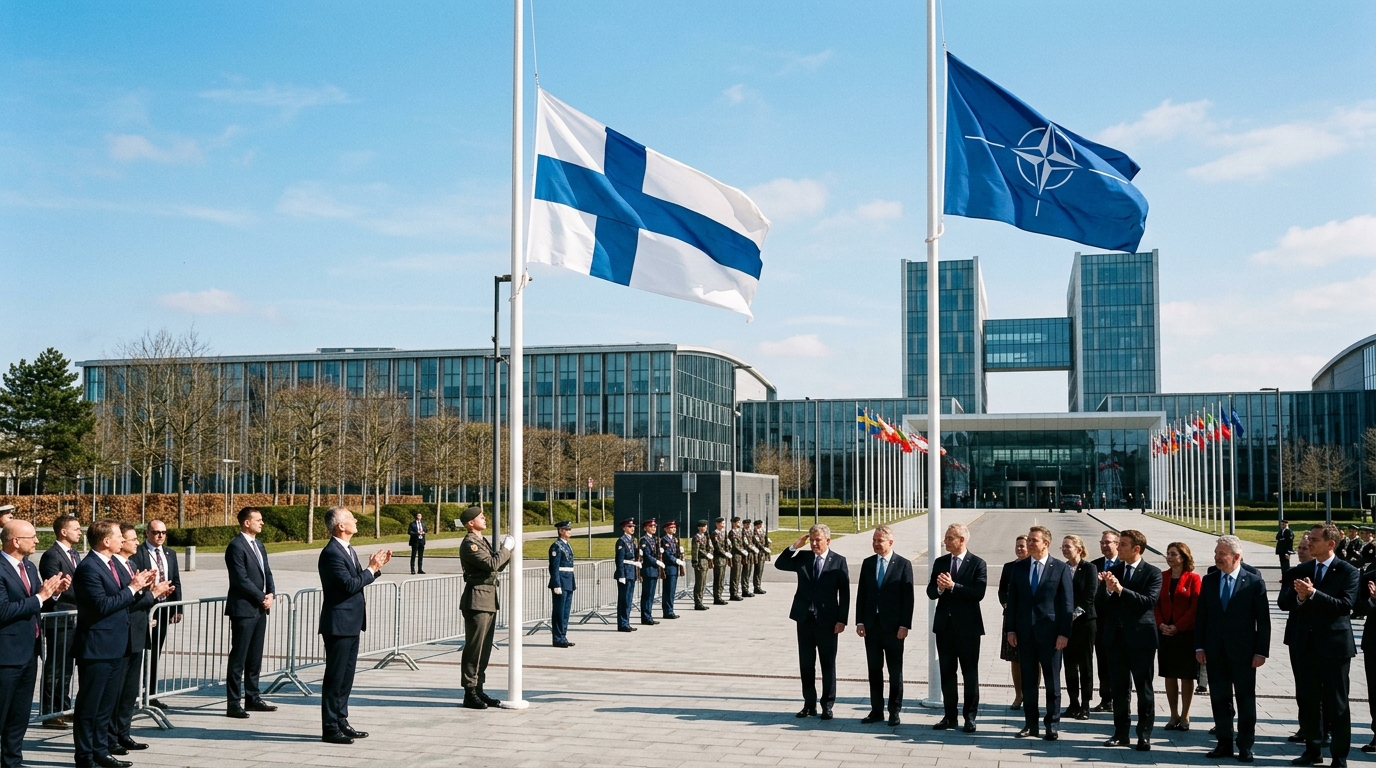
| April 4, 2023 | Finland formally becomes the 31st member of NATO. | In a historic ceremony at the alliance's headquarters in Brussels, Finland deposits its instrument of accession with the U.S. State Department and officially joins NATO. |
Geopolitical Consequences and Aftermath
The accession of Finland to NATO on April 4, 2023, has resulted in profound and multifaceted geopolitical consequences, fundamentally reshaping the security landscape of Northern Europe and beyond.
Primarily, it has dramatically altered the strategic geography of the Baltic Sea, effectively turning it into a "NATO lake." With the exception of Russia’s limited coastline at St. Petersburg and its Kaliningrad exclave, every nation bordering the Baltic Sea is now a member of the North Atlantic Alliance. This has immediate and significant implications for maritime security, freedom of navigation, and military planning. NATO's ability to control access to and egress from the Baltic Sea, particularly through choke points like the Danish Straits and the Åland Islands, is significantly enhanced. This strategic advantage complicates any potential Russian naval operations and strengthens NATO's capacity to defend its northern flank and support the Baltic states.
Furthermore, the "Finlandization" era is officially dead, consigned to the annals of history. The doubling of NATO’s direct land border with Russia—adding 1,340 kilometers (832 miles)—creates a significant strategic and logistical burden for the Russian military. Moscow must now monitor a long, heavily forested, and sparsely populated frontier that requires substantial personnel, surveillance assets, and infrastructure investment. This diverts resources and attention that might otherwise be utilized in Ukraine or other strategic theaters. The nature of the Finnish-Russian border, characterized by difficult terrain and a history of conflict, means that any Russian attempt to militarize it extensively would be a costly and complex endeavor.
For NATO, the Finnish military—which possesses one of the most capable artillery forces in Europe (boasting hundreds of pieces), a modern air force, and a highly trained reserve system with a wartime strength of approximately 280,000 personnel—provides a significant boost in regional defensive depth and conventional deterrence. Finland's expertise in Arctic warfare, its formidable cyber capabilities, and its robust national defense infrastructure are invaluable assets for the alliance, particularly in an increasingly contested Arctic region.
The long-term implications extend to the Arctic. Finland's membership, alongside Sweden's eventual accession, consolidates NATO's presence across the High North, an area rich in natural resources and strategically important shipping lanes. This shift brings new dynamics to the Arctic Council and other regional forums, potentially leading to increased militarization of the region and raising concerns about environmental impacts amidst growing geopolitical competition. Russia, which has historically dominated Arctic security, now faces a united front of Western allies across its northern frontier.
The symbolic impact is equally significant. Russia's aggressive actions, intended to push NATO back to its 1997 borders and weaken Western alliances, have instead achieved the precise opposite. The Finnish and Swedish decisions to join NATO represent the most significant expansion of the alliance in decades, directly demonstrating the unifying effect of Russian aggression and reinforcing NATO's "open door" policy. This outcome serves as a stark reminder of the law of unintended consequences in international relations.
Analysis of Key Actors and Decisive Actions
The swift and decisive shift in Finland's security policy was orchestrated by a confluence of key actors whose actions and leadership proved critical.
Sauli Niinistö: The Architect of Consensus and Pragmatic Statesman
President Sauli Niinistö played a central and masterful role in steering the Finnish ship of state towards NATO membership. Known for his methodical, pragmatic approach and a long history of cultivating relations with Russia, including numerous direct meetings with President Putin, Niinistö was uniquely positioned to articulate the fundamental shift in Finland's security environment. He carefully cultivated domestic political consensus, ensuring that the decision was not rushed but emerged from a broad-based, informed national debate. His leadership was characterized by calm authority, maintaining open dialogue with parliamentary groups across the political spectrum. Niinistö recognized that for the move to be sustainable and credible, it required near-unanimous support from the parliament and the public, which he successfully secured. His famous statement after meeting Putin, "You caused this. Look in the mirror," encapsulated the Finnish rationale and the direct culpability assigned to Moscow.
Sanna Marin: The Voice of a New Generation
Prime Minister Sanna Marin, leading a left-leaning coalition, provided critical governmental leadership and represented a younger generation of Finnish politicians less burdened by the Cold War legacy. Her government's commitment to a thorough parliamentary process, including the comprehensive white paper on security, was instrumental. Marin's clear communication and ability to articulate the strategic imperative for NATO membership to a global audience, alongside President Niinistö, reinforced the image of a united Finnish leadership. Her strong pro-Western stance and clear condemnation of Russian aggression resonated with the rapidly shifting public sentiment.
Pekka Haavisto: The Diplomat in Action
Foreign Minister Pekka Haavisto was instrumental in navigating the diplomatic complexities of the accession process. As the lead negotiator and communicator with NATO allies and partners, Haavisto worked tirelessly to garner support, address concerns, and explain Finland's evolving security posture. His extensive experience in international relations proved invaluable in managing the intricacies of the application, particularly in securing the crucial ratification from Turkey and Hungary, alongside Sweden's efforts.
Jens Stoltenberg: Managing the Alliance
NATO Secretary-General Jens Stoltenberg faced the delicate task of balancing the concerns of legacy members, such as Turkey and Hungary, while maintaining the alliance’s "open door" policy. His leadership ensured that the Finnish (and Swedish) applications were processed efficiently and were not derailed by regional grievances or external pressures. Stoltenberg consistently emphasized NATO's unity and its commitment to collective defense, reinforcing the image of a cohesive alliance adapting to new threats. His constant engagement with Ankara and Budapest, explaining the strategic benefits of Finnish and Swedish membership, was crucial in overcoming their respective reservations.
Vladimir Putin: The Unintended Catalyst
Vladimir Putin’s rhetoric regarding NATO’s "encirclement" and his demands for the alliance to withdraw from Eastern Europe backfired spectacularly. His stated goals in invading Ukraine included pushing NATO back to its 1997 borders and preventing further enlargement. Instead, his actions accelerated the most significant expansion of the alliance in two decades, forcing traditionally neutral states like Finland and Sweden into the arms of the West. His strategic miscalculation confirmed Moscow's willingness to use force to alter the European security order, thereby convincing Helsinki that its long-standing policy of non-alignment was no longer viable. The direct outcome of his aggression was a more unified, larger, and militarily stronger NATO positioned directly on Russia's longest European border.
"Russia has achieved exactly the opposite of what it intended," commented a senior NATO official following the accession, noting that the move was a direct result of Moscow’s destabilizing behavior in the European theater and a testament to the sovereign choices of nations.
Russia's Response and Future Dynamics
Russia's reaction to Finland's NATO accession was predictable and largely consistent with its established rhetoric regarding alliance enlargement. The Kremlin officially denounced the move as an "assault on Russia's security," a "direct threat," and an "encroachment" on its strategic interests. Russian Foreign Ministry statements and pronouncements from President Putin and Defense Minister Sergei Shoigu promised "countermeasures" and a "response" to what they termed an aggressive act by NATO.
Specific threats included the reinforcement of Russia's western military districts, a build-up of troops and equipment near the Finnish border, and potential deployment of tactical nuclear weapons to the Kaliningrad exclave or Belarus. Russia also threatened to withdraw from existing agreements on military transparency and trust-building measures, further exacerbating tensions in the Baltic region. The Russian Navy has increased its activity in the Baltic Sea, and there have been reports of increased electronic warfare and jamming activities near the Finnish border.
However, the practical military impact of Russia's immediate "countermeasures" was limited by several factors. Firstly, Russia's conventional military forces were heavily committed to the war in Ukraine, making a significant diversion of resources to the Finnish border challenging in the short term. Secondly, the Finnish Defense Forces were already highly capable and prepared for territorial defense, having meticulously planned for a potential conflict with Russia for decades. The existing state of readiness on the border was already high, mitigating the immediate shock of NATO expansion.
The long-term dynamics are more complex. Finland's NATO membership fundamentally alters the strategic balance in the Baltic and Arctic regions. While Russia may undertake symbolic military deployments, the reality is that any direct military confrontation with NATO carries existential risks for Moscow. Instead, Russia is likely to focus on:
- Hybrid Warfare: Intensifying cyberattacks, disinformation campaigns, and attempts to sow discord within Finland and among NATO allies.
- Economic Pressure: While Finland has diversified its energy and trade away from Russia since the Ukraine invasion, Moscow may seek other avenues for economic leverage.
- Military Posturing: Continued, though possibly limited, military build-up and exercises near the Finnish border to project strength and deter perceived threats.
- Diplomatic Isolation: Further deteriorating bilateral relations, limiting diplomatic contact, and using its state-controlled media to demonize Finland as a "hostile" state.
For Finland, the security guarantees of Article 5 are paramount, but they also bring new responsibilities. Finland will need to integrate its formidable defense capabilities fully into NATO's collective defense planning, participate in more joint exercises, and potentially host NATO infrastructure or forces. The long, forested border with Russia, once a zone of cautious neutrality, is now a front line of collective defense, requiring constant vigilance and robust capabilities. The future of Russo-Finnish relations will likely remain tense and confrontational for the foreseeable future, a stark departure from the carefully managed coexistence of the "Finlandization" era.
Trivia and Lesser-Known Facts
- Military Reserve Capacity: Finland maintains one of the largest reserve forces in Europe, with a wartime strength of approximately 280,000 personnel—a staggering figure for a nation of 5.5 million people. This is supported by a universal male conscription system and a high level of public enthusiasm for national defense.
- The "Border" Psychology: Finland’s history is intrinsically defined by the Winter War of 1939-1940. This experience ingrained a deep "spirit of the Winter War" (talvisodan henki) in the national psyche, which informs modern defense planning, a commitment to self-reliance, and the decision to keep the border with Russia strictly monitored and its defense prioritized.
- Civilian Defense Preparedness: Finland has a comprehensive "total defense" concept, meaning the entire society is geared for resilience in crisis. This includes an extensive network of civilian bunkers capable of sheltering the entire population, robust emergency stockpiles, and public education on crisis preparedness, making it one of the most resilient nations in Europe.
- Interoperability and Standardization: Because of decades of participation in NATO's Partnership for Peace (PfP) program, the Finnish Defense Forces were already using NATO-standard ammunition, communication systems, and operational procedures well before the formal application. This made the technical integration process remarkably seamless, requiring minimal adjustments.
- The Helsinki Accords Legacy: Ironically, the very city that once hosted the 1975 Helsinki Accords—intended to reduce Cold War tensions and foster cooperation between East and West—became the site of a profound hardening of those same tensions in the 2020s, as Finland's decision to join NATO reflected the collapse of the cooperative spirit the accords sought to build.
- The Role of Åland Islands: The Åland Islands, an autonomous, demilitarized, Swedish-speaking archipelago between Finland and Sweden, pose a unique strategic consideration. While demilitarized by international treaties since the Crimean War, Finland's NATO membership raises questions about the long-term status and defense of the islands in a new security environment, though Finland has reiterated its commitment to upholding international agreements.
- Finland's Air Force: The Finnish Air Force operates a modern fleet of F-18 Hornets, soon to be replaced by F-35s. Its pilots are highly trained, often considered among the best in Europe, reflecting a national emphasis on air defense given Finland's vast, strategically important airspace.
References and Literature
- NATO Official Website: Finland Accession - Comprehensive timeline and documentation regarding the accession process, statements, and official remarks.
- The Foreign Policy Research Institute: Finland's NATO Decision - An in-depth analysis of the shift in Finnish security doctrine post-2022, examining historical context and future implications.
- Hakovirta, H. (1988). East-West Conflict and European Neutrality: An Empirical Study of the Foreign Policy of Finland. - A foundational academic text on the origins of Finnish non-alignment and the geopolitical constraints of the Cold War.
- The Finnish Ministry of Defense: Security Reports - Official records detailing the strategic shift, the evolution of the Finnish military's role in European security, and detailed defense capabilities.
- Allison, R. (2014). "The Russian Annexation of Crimea: Causes and Implications." International Affairs, 90(6), 1241-1259. - Provides context on the 2014 event that began shifting Finnish (and European) security perspectives.
- Haavisto, P. (2022). Finnish Security and Defence Policy 2022. Government Report. - The official Finnish government report that paved the way for the NATO decision, outlining the new security environment.
- Forsberg, T. (2022). "Finnish Foreign Policy after the Invasion of Ukraine." Finnish Institute of International Affairs Comment. - Expert analysis from a leading Finnish think tank on the policy changes.
---
Footnotes & Explanations
- Niinistö, S. (2022). Reflections on the Changing Security Order in Northern Europe. Public statements and addresses from the President of Finland. ↩
- Stoltenberg, J. (2023). A Stronger Alliance for a New Era. NATO Press Office remarks and official communications. ↩
- Russian Ministry of Foreign Affairs (2023). Statement on the Accession of Finland to NATO. Official press releases and diplomatic notes from the Russian MFA. ↩
- Marin, S. (2022). Speeches and statements on Finland's security policy. Records from the Prime Minister's Office. ↩
- Public Opinion Research Finland (2022). Surveys on NATO Membership Support. Various polling agencies including YLE, Taloustutkimus, etc. ↩