Key Takeaways
- The 2004 Orange Revolution marked a watershed moment in post-Soviet history, demonstrating the power of mass civic mobilization against institutional electoral fraud.
- The crisis highlighted the deep geopolitical tug-of-war between the Russian Federation, which sought to maintain its sphere of influence over Kyiv, and Western powers supporting democratic self-determination.
- A historic Supreme Court decision annulled the rigged run-off election, leading to a legally sanctioned repeat vote that brought Viktor Yushchenko to the presidency.
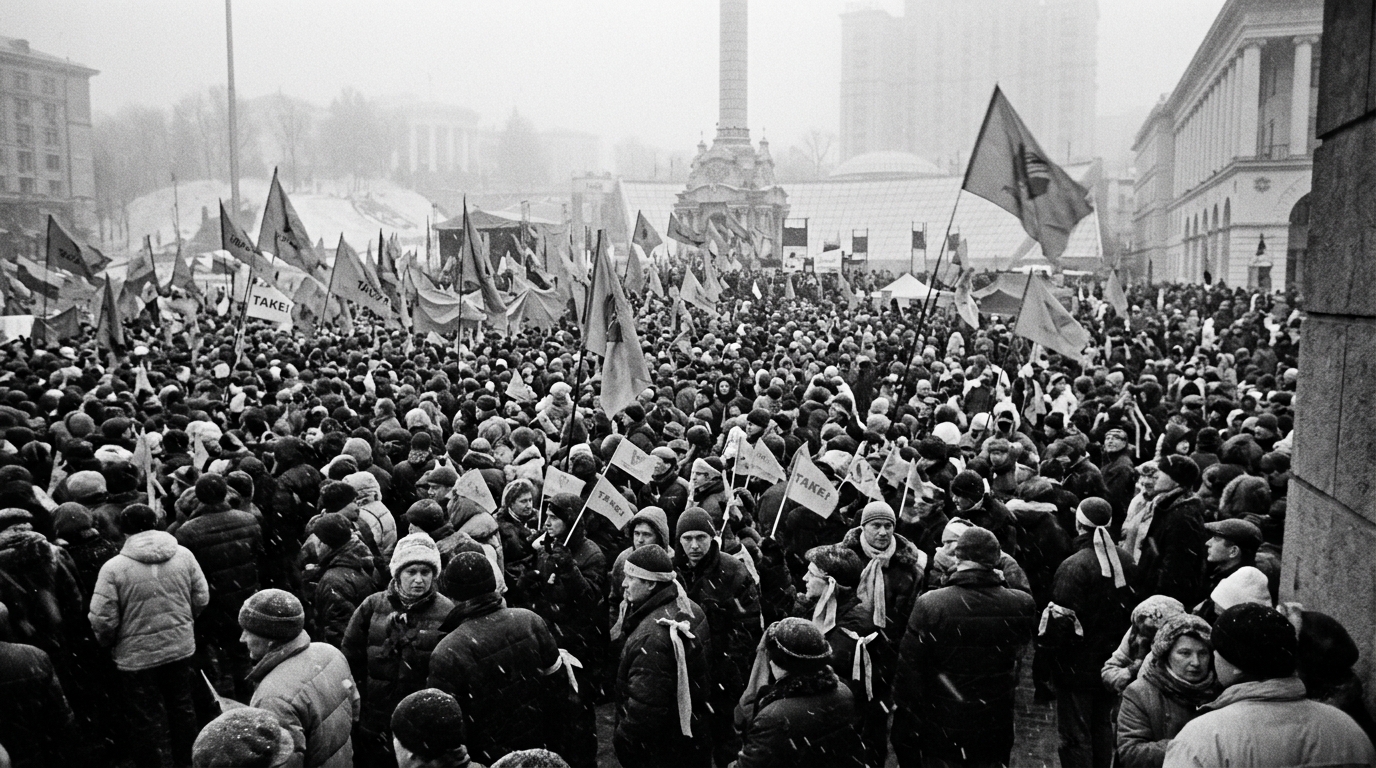
In late November 2004, the streets of Kyiv became the stage for one of the most significant geopolitical convulsions in the post-Soviet era. As temperatures plummeted below freezing, hundreds of thousands of Ukrainian citizens descended upon the central Independence Square (Maidan Nezalezhnosti), transforming the capital into a sea of vibrant orange.
The immediate catalyst was a blatantly rigged presidential election. However, the underlying drivers ran much deeper, touching on Ukraine’s national identity, its socio-economic path, and its geopolitical alignment. The Orange Revolution was not merely a protest against electoral fraud; it was Kyiv’s first sustained, mass-mobilized stand against post-Soviet authoritarianism, oligarchic consolidation, and the overbearing hegemony of the Russian Federation.
Historical Context and Origins
To understand the sudden eruption of public fury in the autumn of 2004, one must examine the decade of post-Soviet stagnation that preceded it. Following its declaration of independence in 1991, Ukraine struggled to shed the structural legacies of the Soviet command economy. Under its second president, Leonid Kuchma, who held office from 1994 to 2004, Ukraine developed a hybrid system of governance often termed "electoral authoritarianism" or "oligarchic pluralism."
Kuchma's Presidency (1994-2004)
- West-Leaning Opposition
- Oligarchic Power Base
During Kuchma's second term, political power became increasingly concentrated within competitive regional oligarchic clans, most notably the Dnipro and Donetsk networks. The state apparatus routinely used tax inspections, law enforcement, and highly biased state-controlled television to suppress political dissent and independent media.
The systemic corruption of the Kuchma administration was laid bare in 2000 during the "Cassette Scandal."1 Secretly recorded conversations leaked by a presidential bodyguard implicated Kuchma in various high-level abuses of power, including the abduction and brutal murder of investigative journalist Georgiy Gongadze. The scandal triggered the "Ukraine without Kuchma" (Ukraina bez Kuchmy) protests, which, although ultimately suppressed, laid the organizational and psychological groundwork for the massive civil society mobilization that would occur four years later.
By 2004, Kuchma’s constitutionally mandated retirement set the stage for a highly contested succession crisis. The ruling establishment coalesced around Viktor Yanukovych, the sitting Prime Minister and a prominent representative of the industrial Donetsk clan. Yanukovych’s platform emphasized continuity, close economic integration with Russia, and official status for the Russian language.
The disparate democratic opposition united behind Viktor Yushchenko, a charismatic former Prime Minister (1999–2001) and head of the central bank. Yushchenko, leading the "Our Ukraine" (Nasha Ukrayina) coalition, campaigned on a platform of anti-corruption, free-market reforms, judicial independence, and a decisive foreign policy pivot toward the European Union and NATO.
This domestic division was heavily mirrored on the international stage:
- The Russian Federation, led by President Vladimir Putin, viewed Ukraine's alignment with the West as an existential threat to its sphere of influence.
- The United States and the European Union viewed the upcoming elections as a crucial test of Ukraine’s democratic transition, especially in the wake of the 2003 Rose Revolution in Georgia, which had seen a pro-Western government come to power in Tbilisi.
Timeline of Events and Key Moments
The presidential campaign of 2004 was marked by unprecedented polarization, state-sponsored obstruction, and acts of violence that shocked the international community.
The Poisoning of Viktor Yushchenko
In early September 2004, as the campaign entered its most critical phase, Viktor Yushchenko fell catastrophically ill. His condition rapidly deteriorated, forcing him to be flown to the Rudolfinerhaus private clinic in Vienna, Austria. Doctors diagnosed him with severe, life-threatening acute pancreatitis combined with a skin condition known as chloracne.
Subsequent toxicological analyses revealed that Yushchenko had been poisoned with massive doses of pure TCDD (tetrachlorodibenzodioxin), one of the most potent dioxins known. His body contained concentrations of the chemical that were 50,000 times above normal levels. 2
The poisoning permanently disfigured Yushchenko’s once-youthful face, turning it into a deeply scarred, grayish symbol of the physical sacrifices demanded by the struggle for democratic change. While Yushchenko survived and returned to the campaign trail, the mystery surrounding the poisoning—widely believed to have occurred during a private dinner with the head of the Ukrainian Security Service (SBU), Ihor Smeshko, and his deputy Volodymyr Satsiuk—intensified the public's anger and suspicion toward the incumbent regime.
| Date | Event |
|---|---|
| Sept 5 | Yushchenko falls ill; later diagnosed with dioxin poisoning after Vienna medical examination. |
| Oct 31 | First Round of voting: Yushchenko narrowly wins (39.9% to 39.26%), triggering a run-off. |
| Nov 21 | Second Round run-off: Rigged results hand victory to Yanukovych. Independent exit polls show otherwise. |
| Nov 22 | Mass protests begin on Maidan Nezalezhnosti. Orange tents and barricades block Kyiv's center. |
| Dec 3 | Supreme Court of Ukraine voids the second round results due to widespread, systemic fraud. |
| Dec 26 | Repeat Run-off: Held under intense global scrutiny. Yushchenko wins cleanly (51.99% to 44.2%). |
The First and Second Rounds
The first round of the presidential election, held on October 31, 2004, concluded in a virtual tie. Out of a crowded field, Yushchenko secured 39.9% of the vote, while Yanukovych garnered 39.26%. Because neither candidate achieved an absolute majority, a run-off election was scheduled for November 21.
During the interim three weeks, the state apparatus went into overdrive to secure a Yanukovych victory. Administrative resources (adyinistratyvny resurs) were deployed on a massive scale: state employees, teachers, miners, and military personnel were coerced into voting for the government candidate under threat of termination.
When the polls closed on November 21, independent exit polls conducted by the Democratic Initiatives Consortium showed Yushchenko leading by a substantial margin of roughly 11 percentage points. However, as the night progressed, the state-run Central Election Commission (CEC), led by Serhiy Kivalov, began releasing tallies that flagrantly contradicted these findings. The CEC officially declared Yanukovych the winner by approximately 3 percentage points.
The Spark of Civic Resistance
The reaction of the Ukrainian public was immediate. In the early morning hours of November 22, answering a call issued by Yushchenko and opposition leaders, thousands of citizens assembled on Kyiv's central Khreshchatyk Boulevard and Maidan Nezalezhnosti. By midday, the crowd had swollen to over 100,000 people.
The protestors, donning orange clothing, ribbons, and flags—the official color of Yushchenko’s campaign—constructed a highly organized tent city capable of housing tens of thousands of demonstrators. This civic resistance was supported by local municipal authorities in western and central Ukraine, who openly refused to recognize the fraudulent election results.
"We are not a flock of sheep, we are citizens of Ukraine. We will not let them steal our future." — Popular slogan among protestors at the Maidan, November 2004
Over the next two weeks, the protests grew to an estimated one million people at their peak. Despite freezing temperatures, a festive, defiant, and strictly non-violent atmosphere prevailed.
Protesters blocked government buildings, including the Cabinet of Ministers and the Presidential Administration. The youth-led civil resistance movement Pora! ("It's Time!") played a crucial role in coordinating logistical support, ensuring a steady flow of food, hot tea, medical supplies, and winter clothing to the demonstrators.
The Judicial Intervention
With the country on the brink of total paralysis and potential civil conflict, international mediators—including Polish President Aleksander Kwaśniewski, Lithuanian President Valdas Adamkus, and EU Foreign Policy Chief Javier Solana—arrived in Kyiv to facilitate roundtable negotiations between Kuchma, Yushchenko, and Yanukovych.
The decisive breakthrough occurred in the legal arena. On November 29, the opposition filed a comprehensive lawsuit with the Supreme Court of Ukraine, presenting mountain-loads of evidence of systematic electoral fraud. The evidence included video footage of ballot-box stuffing, testimony from election workers, and records showing that in certain polling stations in Eastern Ukraine (such as Donetsk and Luhansk), voter turnout miraculously exceeded 100%, sometimes reaching as high as 140% of the registered electorate.
On December 3, 2004, in a landmark ruling that demonstrated the growing independence of Ukraine's judicial branch, the Supreme Court declared that the official results of the run-off election were invalid. The court ruled that the scale of irregularities made it impossible to determine the true will of the voters. Rather than declaring Yushchenko the outright winner, the court ordered a historic, legally unprecedented repeat run-off (povtorne holosuvannya) of the second round, scheduled for December 26, 2004.
2004 Election Run-off Results
- November 21 (Fraudulent Run-off)
- December 26 (Supreme Court Ordered Revote)
The third round of voting took place under the watchful eyes of over 12,000 international observers. The results were clear: Viktor Yushchenko won 51.99% of the vote, while Viktor Yanukovych received 44.20%. Despite subsequent legal appeals by Yanukovych's campaign team, the Supreme Court upheld the results, and on January 23, 2005, Viktor Yushchenko was officially inaugurated as the third President of Ukraine.
Geopolitical Consequences and Aftermath
The Orange Revolution was a major geopolitical shift that sent shockwaves across the post-Soviet space and permanently altered relations between the West and Russia.
Russia’s Strategic Shock and the "Color Revolution" Phobia
For Russian President Vladimir Putin, the events of late 2004 represented a humiliating strategic defeat. Putin had taken a direct, highly visible role in the election campaign, traveling to Kyiv shortly before the first round to praise Yanukovych and review a military parade alongside President Kuchma. Moscow had dispatched political spin-doctors (most notably Gleb Pavlovsky) and spent millions of dollars to secure a pro-Russian outcome.
The peaceful overthrow of a Kremlin-backed candidate by a mass public movement deeply alarmed Moscow. The Kremlin chose to view the Orange Revolution not as an authentic display of democratic will by the Ukrainian people, but as a highly sophisticated, geopolitical destabilization operation planned and funded by Western intelligence agencies—specifically the U.S. State Department and the CIA. 3
This perspective gave birth to a persistent "Color Revolution" phobia in Moscow, leading to several major policy shifts:
- Suppression of Domestic Dissent: The Kremlin rapidly consolidated control over its domestic political landscape, creating state-sponsored youth groups like Nashi ("Ours") to prevent similar movements from taking root in Russia.
- Aggressive Foreign Policy Reorientation: Moscow abandoned its cooperative rhetoric with the West, transitioning toward a zero-sum, revanchist foreign policy that was clearly articulated by Vladimir Putin at the 2007 Munich Security Conference.
- Weaponization of Energy Resources: In January 2006, just a year after Yushchenko's inauguration, Russia's state-owned energy giant Gazprom briefly cut off natural gas supplies to Ukraine. This move aimed to punish the new government in Kyiv and extract political concessions, marking the first of the infamous "gas wars" that highlighted Europe's energy vulnerability.
Geopolitical Reverberations of 2004
| For Kyiv | For Moscow | For the West |
|---|---|---|
| Domestic gridlock and security vulnerability | Sovereign democracy & fear of mass protests | Cautious integration & persistent skepticism |
The Western Response
The United States and European Union nations celebrated the Orange Revolution as a major triumph for democracy. However, the Western response soon exposed deep internal divisions, particularly within Europe.
While Central and Eastern European countries (like Poland and the Baltic states) pushed for Ukraine to be given a clear, expedited path toward EU and NATO membership, Western European powers—most notably Germany and France—remained highly cautious. Anxious to avoid alienating Russia, Paris and Berlin repeatedly blocked efforts to grant Ukraine a NATO Membership Action Plan (MAP), most notably during the fateful Bucharest Summit in April 2008.
The Tragedy of the "Orange Coalition"
Domestically, the immense promise of the Orange Revolution quickly gave way to bitter disappointment. The revolutionary coalition, primarily led by President Viktor Yushchenko and his prime minister, Yulia Tymoshenko, fractured almost immediately after taking power. The two leaders engaged in a destructive, highly personalized feud over executive authority, economic policy, and control over state resources.
This political paralysis was exacerbated by the constitutional compromises brokered during the heights of the protests in December 2004. To secure Kuchma's consent for the repeat run-off, the opposition had agreed to a package of constitutional reforms that shifted significant executive powers from the president to the parliament (Verkhovna Rada). This created a dysfunctional, semi-presidential system where the President and Prime Minister constantly undermined each other's decisions.
As a consequence of this internal gridlock, key structural reforms were abandoned. Oligarchic influence remained deeply entrenched in the economy, and corruption continued to flourish. The disillusioned Ukrainian public, weary of economic instability and political infighting, gradually turned away from the "Orange" leaders. This disillusionment paved the way for Viktor Yanukovych’s political comeback; in 2010, he narrowly defeated Yulia Tymoshenko in a free and fair presidential election, bringing his pro-Russian Donetsk clan back to the corridors of power.
Analysis of Key Actors and Decisive Actions
| Key Actor | Primary Affiliation | Geopolitical Alignment | Key Actions in 2004 | Historical Impact |
|---|---|---|---|---|
| Viktor Yushchenko | "Our Ukraine" Coalition | Pro-Western / Euro-Atlantic | Mobilized opposition, survived dioxin poisoning, contested fraudulent results through legal means. | Served as president (2005-2010); failed to implement deep reforms due to political infighting. |
| Viktor Yanukovych | Party of Regions | Pro-Russian | Leveraged administrative resources to rig election, attempted to claim victory, later conceded run-off. | Returned to win presidency in 2010; ousted in the 2014 Euromaidan Revolution. |
| Leonid Kuchma | Outgoing President | Multi-vector (Balanced) | Mediated between sides, refused to use lethal force against protesters, agreed to constitutional reform. | Presided over post-Soviet transition; his peaceful exit prevented potential civil war. |
| Vladimir Putin | President of Russia | Pro-Russian / Imperialist | Actively campaigned for Yanukovych, prematurely congratulated him on victory, viewed protests as Western coup. | Hardened Russia's anti-Western foreign policy; initiated energy-coercion tactics against Kyiv. |
The Neutrality of the Security Forces
One of the most critical, yet under-analyzed factors in the peaceful outcome of the Orange Revolution was the behavior of Ukraine’s security apparatus. During the protests, the Ministry of Internal Affairs (MVS), led by Mykola Bilokin, had drawn up plans to deploy internal troops to clear the Maidan by force. Heavy vehicles and armed units were positioned on the outskirts of Kyiv, and riot police were placed on high alert.
However, key figures within the Security Service of Ukraine (SBU) and the military refused to carry out these orders. SBU generals actively communicated with opposition leaders, assuring them that the intelligence services would not support a violent crackdown. SBU personnel even gathered intelligence on the regime's plans and shared it with the opposition, preventing a potential tragedy. This split within the security services effectively neutralized Kuchma’s ability to employ a "Tiananmen-style" solution, forcing the regime to seek a peaceful, negotiated political exit.
Trivia and Lesser-Known Facts
- The Orange Color's Practical Origins: While orange became a globally recognized symbol of democratic resistance, its selection was originally based on practical marketing principles. Yushchenko’s campaign team chose orange because it stood out vividly against Kyiv's gray late-autumn landscapes, and unlike red or blue, it had no prior political associations with either the Soviet past or rival oligarchic clans.
- The Silent Rebellion on State TV: On November 25, 2004, while state-run UT-1 television was broadcasting its heavily censored official news program, sign-language interpreter Natalia Dmytruk staged a silent, courageous act of rebellion. Refusing to translate the official script, she signed to the deaf audience:
- The Otpor Connection: The youth movement Pora! was closely modeled on the Serbian youth group Otpor! ("Resistance!"), which had played a key role in the overthrow of Slobodan Milošević in 2000. Activists from Serbia and Georgia traveled to Ukraine to train local students in non-violent resistance strategies, crowd psychology, and decentralized communications.
- The Premature Congratulations: Vladimir Putin’s eager desire to secure a Yanukovych victory led him to prematurely congratulate the Prime Minister on winning the presidency twice—once on November 22 and again on November 24—well before the Central Election Commission had finalized the vote count or resolved the opposition's legal challenges.
References and Literature
- Kuzio, Taras (2005). "Ukraine's Orange Revolution: The Bust to Boom." Journal of Democracy, Vol. 16, No. 2, pp. 117-130. - A comprehensive academic analysis of the structural causes and immediate outcomes of the revolution.
- McFaul, Michael (2005). "Transitions from Postcommunism." Foreign Affairs, July/August Issue. - A deep dive into the dynamics of democratic breakthrough in Ukraine and the post-Soviet space.
- Wilson, Andrew (2005). Ukraine's Orange Revolution. Yale University Press. - The definitive historical monograph detailing the political machinations, systemic corruption, and eventual civic uprising.
- Karshnycky, Adrian (2005). "Ukraine’s Orange Revolution." Foreign Affairs, Vol. 84, No. 2, pp. 35-52. - An evaluation of the domestic and international implications of Yushchenko's victory.
Footnotes & Explanations
- The "Cassette Scandal" or Kuchmagate began in November 2000 when opposition politician Oleksandr Moroz publicly released audio recordings implicating President Leonid Kuchma and other high officials in the murder of journalist Georgiy Gongadze. ↩
- Analytical reports from the Rudolfinerhaus clinic in Vienna, later confirmed by independent laboratories in Germany, Great Britain, and the Netherlands, concluded that Yushchenko had been administered TCDD, the most toxic of all dioxin congeners. ↩
- This narrative of a "Western-sponsored coup" was heavily promoted by Kremlin-controlled media and became a core tenet of modern Russian military and security doctrines regarding "hybrid warfare." ↩
- Dmytruk’s silent rebellion triggered a walkout by over 200 employees of state-run television, forcing the channel to abandon its heavily censored coverage and begin reporting the protests objectively. ↩