Key Takeaways
- The revolution marked the dramatic collapse of the Pahlavi dynasty, transforming Iran from a secular, pro-Western monarchy into a staunchly anti-Western, theocratic Islamic Republic.
- A combination of rapid modernization, severe economic inequality, political repression by the SAVAK, and cultural alienation united diverse opposition groups under the banner of Ayatollah Khomeini.
- The crisis permanently disrupted the Middle Eastern geopolitical landscape, ending the U.S. 'Twin Pillars' strategy and triggering decades of regional proxy conflicts.
Historical Context and Origins
The Iranian Revolution of 1979 was not a sudden explosion of religious fervor, but the culmination of decades of socio-political friction, economic mismanagement, and foreign intervention. To understand the collapse of the Pahlavi state, one must trace the roots of dissent back to the mid-20th century, specifically to the highly contested legacy of the Pahlavi Dynasty and its relationship with the West.
- 1953 Coup (Operation Ajax)
- The White Revolution
- Economic Inequality & Inflation
- Coalition of Opposition
- 1979 Revolution
In 1953, the popular nationalist Prime Minister Mohammad Mossadegh, who had nationalized Iran's British-controlled oil industry, was overthrown in a covert coup d'état orchestrated by the U.S. Central Intelligence Agency (CIA) and Britain's MI6.1 The restoration of Shah Mohammad Reza Pahlavi to absolute authority established a deep-seated domestic perception of the monarch as a puppet of Western—specifically American—imperialism. This event permanently damaged the monarchy's legitimacy among nationalists, secular intellectuals, and the religious establishment.
To consolidate his rule and modernize the country, the Shah launched the White Revolution in 1963. This ambitious series of economic and social reforms aimed to transform Iran into a global industrial power. Key components included:
- Land Reform: Redistributing agricultural land from wealthy elites and religious endowments to peasants.
- Infrastructure Expansion: Building modern transportation networks, dams, and factories.
- Social Liberalization: Granting women the right to vote, expanding secular education, and reforming family laws.
While the White Revolution modernized urban landscapes, it severely disrupted rural social structures. The land reform program was poorly executed; it carved estates into plots too small to sustain farming families, driving millions of landless peasants into city slums.2 This rapid urbanization created a volatile underclass, disconnected from their traditional rural roots and highly receptive to religious messages of social justice.
Furthermore, the reforms deeply alienated two powerful traditional pillars of Iranian society: the Bazaaris (merchant class) and the Ulama (clergy). The merchants feared foreign corporate encroachment, while the clergy viewed secularization, particularly the state's encroachment on religious education and judicial systems, as a direct assault on Islam.
Among the vocal critics of the White Revolution was a high-ranking cleric, Ayatollah Ruhollah Khomeini. In 1963, Khomeini delivered a scathing public sermon denouncing the Shah’s dependence on the United States and his recognition of Israel. Arrested and subsequently exiled in 1964, Khomeini spent the next fifteen years in Turkey, Iraq, and France. From exile, he developed the radical political philosophy of Velayat-e Faqih (Guardianship of the Islamic Jurist), arguing that monarchy was inherently un-Islamic and that government should be directed by leading Islamic jurists.3
The situation was exacerbated by the 1973 global oil boom. The quadrupling of international oil prices flooded Iran with cash, prompting the Shah to embark on an unsustainable spending spree. The resulting economic overheating triggered runaway inflation, severe housing shortages, and rampant corruption.4 While elite circles amassed ostentatious wealth, the working and middle classes struggled with the soaring cost of living. To suppress rising discontent, the Shah relied heavily on SAVAK, his notorious internal security and intelligence service. SAVAK’s pervasive surveillance, systemic torture, and arbitrary executions of dissidents succeeded in driving political opposition underground, inadvertently creating a climate where the mosque network became the only safe space for community organizing and political expression.
Timeline of Events and Key Moments
The revolutionary momentum built gradually throughout 1977, catalyzed by the Carter administration's emphasis on international human rights, which forced the Shah to moderately relax his security apparatus. However, 1978 marked the transition from passive discontent to open rebellion.
| Year | Month | Event |
|---|---|---|
| 1978 | Jan | Ettela'at Article Sparks Riots |
| 1978 | Aug | Cinema Rex Fire (Abadan) |
| 1978 | Sep | Black Friday Massacre (Jaleh Square) |
| 1978 | Dec | Ashura Protests (Millions March) |
| 1979 | Jan | The Shah Flees Iran |
| 1979 | Feb | Ayatollah Khomeini Returns |
| 1979 | Apr | Islamic Republic Declared |
The Spark: January 1978
On January 7, 1978, the state-run newspaper Ettela'at published an anonymous article attacking Ayatollah Khomeini, accusing him of being a British agent and a foreign conspirator. The following day, theology students in the holy city of Qom took to the streets in protest. Government security forces opened fire, killing several demonstrators.
In Shi'ite Islamic tradition, a memorial service is held forty days after a person's death. This tradition established a self-sustaining cycle of protests. On February 18, demonstrations marking the fortieth day of the Qom deaths occurred in major cities; in Tabriz, riots broke out, leading to more deaths, which in turn triggered another round of memorial protests forty days later.
The Escalation: Summer and Autumn 1978
As protests swelled, a series of catastrophic events galvanized the public:
- The Cinema Rex Fire (August 19, 1978): A devastating arson attack at a movie theater in Abadan trapped and killed over 400 people. Although modern historical analysis suggests Islamist radicals may have started the fire to target "Western decadence," the public instantly blamed SAVAK. The tragedy triggered nationwide fury against the regime.
- Black Friday (September 8, 1978): Fearing a total breakdown of order, the Shah declared martial law. On September 8, thousands of peaceful demonstrators gathered at Jaleh Square in Tehran, unaware of the ban on public assemblies. Imperial troops opened fire on the dense crowd. The massacre, which resulted in hundreds of casualties, shattered any remaining possibility of a negotiated settlement or constitutional transition under the monarchy.
"The ground was covered with bodies, blood, and shoes... It was the day the Shah lost his throne." — An eyewitness account from Jaleh Square, September 1978.
The Collapse of State Power: Late 1978
By late autumn, the nature of the protest shifted from street demonstrations to crippling economic warfare. A massive wave of wildcat strikes paralyzed the country. Crucially, workers in the southern oilfields walked out, reducing oil production from six million barrels a day to a trickle. The strike starved the Pahlavi regime of its primary source of revenue and brought industrial activity to a virtual standstill.
In December 1978, coinciding with the holy month of Moharram, millions of Iranians marched in Tehran and other major urban centers, chanting "Death to the Shah" and demanding the return of Ayatollah Khomeini. Recognizing that the military was demoralized and fracturing under the strain of continuous urban deployment, the Shah began planning his departure.
The Climax: January – February 1979
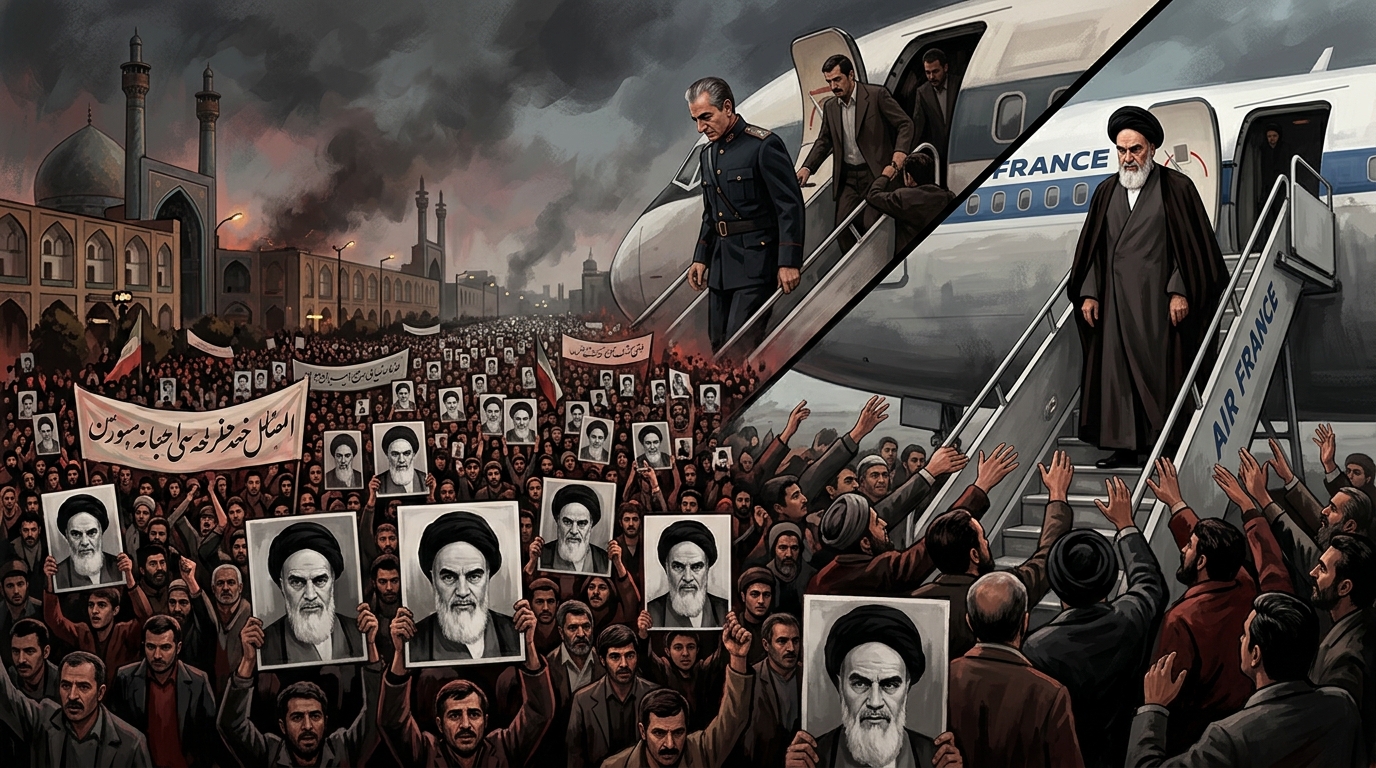
On January 16, 1979, Mohammad Reza Pahlavi, visibly weakened and suffering from undiagnosed terminal cancer, boarded his private Boeing 727 and flew out of Iran, ostensibly for a medical vacation. He would never return. He left power in the hands of a newly appointed reformist Prime Minister, Shapour Bakhtiar, a veteran nationalist who sought to implement a constitutional transition.
However, Bakhtiar’s government lacked popular legitimacy. On February 1, 1979, Ayatollah Khomeini arrived in Tehran on a chartered Air France flight from Paris. Over three million people lined the highway from the airport to greet him. Khomeini immediately rejected Bakhtiar’s administration, declaring:
"I shall appoint the government. I shall strike this government in the mouth." [^5]
- Air Force Cadet Mutiny
The final blow to the old regime occurred on February 9, when a mutiny broke out at the Doshan Tappeh airbase among pro-Khomeini Air Force cadets. When the elite Imperial Guard attempted to suppress the mutiny, civilian militias joined the fray, distributing weapons to the public. For two days, armed clashes raged across Tehran.
On February 11, 1979 (22 Bahman 1357), the Supreme Council of the Armed Forces, realizing the futility of further resistance and desperate to prevent a civil war, declared its "neutrality" and ordered troops back to their barracks. The Pahlavi state had collapsed.
Geopolitical Consequences and Aftermath
The fall of the Shah and the rise of the Islamic Republic of Iran fundamentally reshaped the geopolitical landscape of the Middle East and reordered Cold War alliances.
| Collapse of the Shah | Collapse of the Shah |
|---|---|
| End of 'Twin Pillars' | Regional Instability |
| U.S. Alliance Destroyed | Anti-Zionist & Anti-Western |
| Carter Doctrine & CentCom | Iran-Iraq War (1980-88) |
The Destruction of the U.S. Regional Security Framework
For decades, U.S. foreign policy in the Persian Gulf relied on the "Twin Pillars" strategy—backing Iran and Saudi Arabia as the primary regional anchors against Soviet expansionism and radical Arab nationalism. The revolution dismantled this framework. Overnight, a major non-NATO ally became an implacable adversary.
The crisis peaked on November 4, 1979, when radical Iranian students, fearing a U.S.-backed counter-coup after the exiled Shah was admitted to a New York hospital for cancer treatment, stormed the U.S. Embassy in Tehran. The resulting Iran Hostage Crisis lasted 444 days, destroying President Jimmy Carter's political career, cementing a deep mutual hostility, and leading to a complete severance of diplomatic ties.
In response to the loss of Iran and the subsequent Soviet invasion of Afghanistan in December 1979, President Carter formulated the Carter Doctrine. He declared that any attempt by an outside force to gain control of the Persian Gulf region would be regarded as an assault on the vital interests of the United States, a policy that led directly to the establishment of the U.S. Central Command (CENTCOM) and a permanent military presence in the region.
The Export of the Revolution and the Iran-Iraq War
Khomeini’s foreign policy was explicitly ideological, seeking to export the Islamic Revolution across the Muslim world and challenge secular, pro-Western Arab monarchies. This alarmed neighboring states, particularly the secular, Sunni-led Ba'athist regime of Iraq.
Sensing Iranian vulnerability amidst post-revolutionary purges of the military command, Iraqi President Saddam Hussein launched a full-scale invasion of western Iran on September 22, 1980. The resulting Iran-Iraq War lasted eight years, becoming one of the longest and bloodiest conventional conflicts of the 20th century.
The war served to consolidate the power of the clerical regime in Tehran, as it allowed Khomeini to rally the population around patriotic defense and systematically eliminate domestic secular and leftist political rivals under the guise of wartime unity.
| Geopolitical Metric | Pre-1979 Regime (Pahlavi) | Post-1979 Regime (Khomeini) |
|---|---|---|
| U.S. Relationship | Strategic Regional Ally (Twin Pillars) | Adversarial / Hostage Crisis |
| Regional Ideology | Secular Nationalism / Westernization | Islamism / Anti-Zionism / Anti-Imperialism |
| Oil Revenues | Western-linked Integration | Nationalized Autarky |
| Defense Alignment | Dependent on U.S. Military Hardware | Indigenous Development & Proxy Networks |
Analysis of Key Actors and Decisive Actions
The dramatic trajectory of the 1979 Revolution can be attributed to the critical decisions, strategic miscalculations, and personal characteristics of its main protagonists.
| Mohammad Reza Pahlavi | Ayatollah Khomeini |
|---|---|
| • Paralyzed by Illness | • Uncompromising Goal |
| • Waited for US Orders | • Tactically Flexible |
| • Unwilling to Reform | • Broad-Tent Coalition |
Mohammad Reza Pahlavi: The Paralyzed Monarch
The Shah’s response to the crisis was characterized by hesitation and inconsistency. Historically, this political paralysis is attributed to two factors:
- Secret Illness: The Shah had been diagnosed with terminal lymphocytic lymphoma in 1974. The medication and the psychological weight of the disease depleted his energy, leaving him highly indecisive during critical moments of the 1978 protests.
- Strategic Dependence: Having been restored to his throne by the United States in 1953, the Shah was psychologically dependent on American approval. Throughout 1978, he repeatedly sought clear directives from Washington on whether to deploy overwhelming military force or to make democratic concessions. Because the Carter administration sent highly contradictory signals, the Shah did neither effectively, alternating between bloody crackdowns and weak concessions that only emboldened the opposition.
Ayatollah Ruhollah Khomeini: The Uncompromising Ideologue
Khomeini's greatest strength was his unyielding stance. Unlike moderate secular politicians who sought to reform the constitution within the framework of the monarchy, Khomeini consistently maintained that the Shah had to abdicate and the monarchy be abolished. This refusal to compromise made him the undisputed focal point of the revolution.
Furthermore, Khomeini exhibited remarkable tactical pragmatism during his exile. He intentionally used vague, universalist language when speaking to Western journalists, framing his struggle as a fight for human rights, freedom, and social justice. This approach allowed him to build a broad-tent coalition that included:
- Traditional clerical networks and religious bazaar merchants.
- The secular, middle-class intelligentsia of the National Front.
- Leftist revolutionary organizations like the communist Tudeh Party and the Islamic-socialist Mujahedin-e Khalq (MEK).
Once the monarchy was overthrown, Khomeini utilized his immense popularity and the crisis atmosphere of the Iran-Iraq War to systematically marginalize, outlaw, and execute his former secular and leftist allies, establishing an absolute theocracy.
The United States: An Intelligence Failure of the First Order
The United States government failed to accurately read the ground reality in Iran. This failure was rooted in a structural reliance on the Shah’s intelligence channels. To avoid upsetting the monarch, the CIA had long restricted its contacts with opposition elements, leaving Washington blind to the depth of the public's grievances.
As late as August 1978, a CIA assessment famously concluded that:
"Iran is not in a revolutionary or even a 'pre-revolutionary' state." [^6]
This intelligence failure was compounded by a deep division within President Carter's cabinet. National Security Advisor Zbigniew Brzezinski urged the administration to encourage a military coup and a hardline suppression of the protests, while Secretary of State Cyrus Vance advocated for negotiations with the moderate opposition and pushed the Shah to respect human rights. The resulting policy paralysis left the administration incapable of taking decisive action.
Trivia and Lesser-Known Facts
- The Cassette Tape Revolution: Before the internet and social media, Khomeini’s sermons were smuggled into Iran on standard cassette tapes. Underground networks of religious students copied these tapes and distributed them through the country’s mosques, bypassing SAVAK's tight control over state television and radio.
- The 2500-Year Celebration at Persepolis: In October 1971, the Shah hosted an ultra-luxury gala at the ancient ruins of Persepolis to celebrate the 2,500th anniversary of the founding of the Persian Empire. Heads of state from around the world were flown in to dine on food catered from Maxim's in Paris, while vast swathes of rural Iran suffered from drought and poverty. This event became a symbol of Pahlavi extravagance and detachment, cementing public anger years before the revolution.
- The Jimmy Carter Toast: On New Year’s Eve 1977, less than a week before the first major revolutionary riots erupted in Qom, President Jimmy Carter visited Tehran and famously toasted the Shah, saying:
This statement became one of the most politically damaging foreign policy miscalculations in American history, illustrating the administration's disconnect from reality on the ground.
- Michel Foucault as a Revolutionary Correspondent: The prominent French philosopher Michel Foucault traveled to Tehran twice in late 1978 as a correspondent for the Italian newspaper Corriere della Sera. He became fascinated by the "political spirituality" of the movement, praising the revolution as an entirely new form of revolt against Western modernity—a position for which he was later heavily criticized when the new theocratic state began executing its political opponents.
References and Literature
- Iran Between Two Revolutions - Ervand Abrahamian's seminal historical study detailing the socio-economic transformations, political factions, and events leading to the 1979 collapse of the Pahlavi regime.
- Modern Iran: Roots and Results of Revolution - Nikki R. Keddie's comprehensive analysis of Iranian political and cultural history, offering deep insights into the social dynamics that empowered the religious leadership.
- The Shah - Abbas Milani's definitive, objective biography of Mohammad Reza Pahlavi, charting his psychological profile, political strategies, and terminal illness.
- All Fall Down: America's Tragic Encounter with Iran - Gary Sick's detailed insider account of the Carter administration's internal policy debates, intelligence struggles, and response to the hostage crisis.
Footnotes & Explanations
- Ervand Abrahamian, Iran Between Two Revolutions (Princeton: Princeton University Press, 1982), 280-281. ↩
- Nikki R. Keddie, Modern Iran: Roots and Results of Revolution (New Haven: Yale University Press, 2003), 145-147. ↩
- Abbas Milani, The Shah (New York: Palgrave Macmillan, 2011), 220-222. ↩
- Gary Sick, All Fall Down: America's Tragic Encounter with Iran (New York: Random House, 1985), 34-36. ↩
- Khomeini's address at Behesht-e Zahra Cemetery, Tehran, February 1, 1979. ↩
- U.S. Central Intelligence Agency, Iran: The Outlook for the Monarchy, Intelligence Assessment, August 1978. ↩