Key Takeaways
- The 2011 revolution marked the collapse of a 30-year autocracy, triggered by systemic corruption, economic stagnation, and police brutality.
- Tahrir Square became a global symbol of civil resistance, demonstrating the power of digital mobilization in the early social media era.
- The power vacuum left by Mubarak's fall accelerated a polarized transition that ultimately led to the short-lived presidency of Mohamed Morsi.
The 2011 Egyptian Revolution: The Fall of Hosni Mubarak on Tahrir Square
Historical Context and Origins
The Egyptian Revolution of 2011 was not an isolated outburst of spontaneous anger, but the culmination of decades of systemic decay under the autocratic rule of Hosni Mubarak. Mubarak ascended to the presidency in 1981, inheriting the reins of power following the assassination of his predecessor, Anwar Sadat, during a military parade. His reign, which spanned nearly three decades, was characterized by the pervasive application of the Emergency Law. This draconian piece of legislation, initially enacted to combat terrorism and political instability, became a permanent fixture of Egyptian governance, effectively suspended civil liberties, institutionalized a highly coercive security apparatus, and provided a legal veneer for widespread repression. Under this perpetual state of emergency, the regime maintained an iron grip on the nation through a potent combination of state-controlled media, stifling censorship, and a deeply entrenched security apparatus that monitored and suppressed dissent with ruthless efficiency.
Economically, Mubarak's Egypt fostered a crony-capitalist model. This system concentrated vast wealth and opportunity within a select elite, often closely connected to the ruling National Democratic Party (NDP) and the military establishment. For the vast majority of Egyptians, however, this economic model translated into precarious living conditions, soaring inflation that eroded purchasing power, and a stagnant job market offering little hope, particularly for the nation's burgeoning youth population. By the early 2010s, Egypt was grappling with a significant demographic challenge: a "youth bulge." This massive cohort of young adults, many of whom were relatively well-educated, found themselves facing a landscape of limited prospects, stifled entrepreneurship, and a palpable sense of disillusionment. Crucially, this generation was also the first to fully embrace digital technologies. Platforms like Facebook and Twitter offered unprecedented avenues for communication, organization, and information dissemination, allowing them to circumvent the tightly controlled state media and connect with like-minded individuals across the country.
The geopolitical climate of the region also played a catalytic role. The successful overthrow of Tunisia's long-serving autocrat, Zine El Abidine Ben Ali, in January 2011, sent ripples of hope and inspiration across the Arab world. The "Jasmine Revolution," as it became known, demonstrated that seemingly entrenched authoritarian regimes could indeed be toppled by popular will. This provided a tangible model and a psychological impetus for Egyptians who had long endured similar grievances. Furthermore, prior to 2011, several grassroots opposition movements had already begun to chip away at the edifice of Mubarak's rule. Groups like Kifaya (Enough) and the April 6 Youth Movement had, for years, been testing the limits of state control through protests, online activism, and civil disobedience campaigns. While their impact had been limited by the regime's security forces, they had successfully laid the groundwork for broader mobilization and cultivated a nascent sense of collective action among certain segments of the population.
The Spark and the Tahrir Uprising
The immediate catalyst for the widespread protests that erupted on January 25, 2011, was the brutal murder of Khaled Said, a young Alexandrian man, by police officers on June 6, 2010. The graphic images of Said's mangled body, circulated widely on social media, ignited a firestorm of public outrage. The "We Are All Khaled Said" Facebook page, created by activist Wael Ghonim, quickly garnered hundreds of thousands of followers, transforming Said's death into a potent symbol of the systemic police brutality and impunity that plagued Egypt. This online campaign tapped into a deep reservoir of public anger and provided a focal point for wider grievances.
The call for a "Day of Rage" on January 25th, coinciding with Police Day, resonated deeply. Tens of thousands of Egyptians took to the streets in Cairo, Alexandria, Suez, and other major cities, demanding an end to corruption, poverty, and police brutality, and chanting the revolutionary slogan, "The people want the fall of the regime." The scale and coordination of these initial protests took the Mubarak regime by surprise. The security forces, accustomed to quashing dissent with relative ease, found themselves overwhelmed by the sheer number of demonstrators and the unprecedented level of their organization, significantly facilitated by social media.
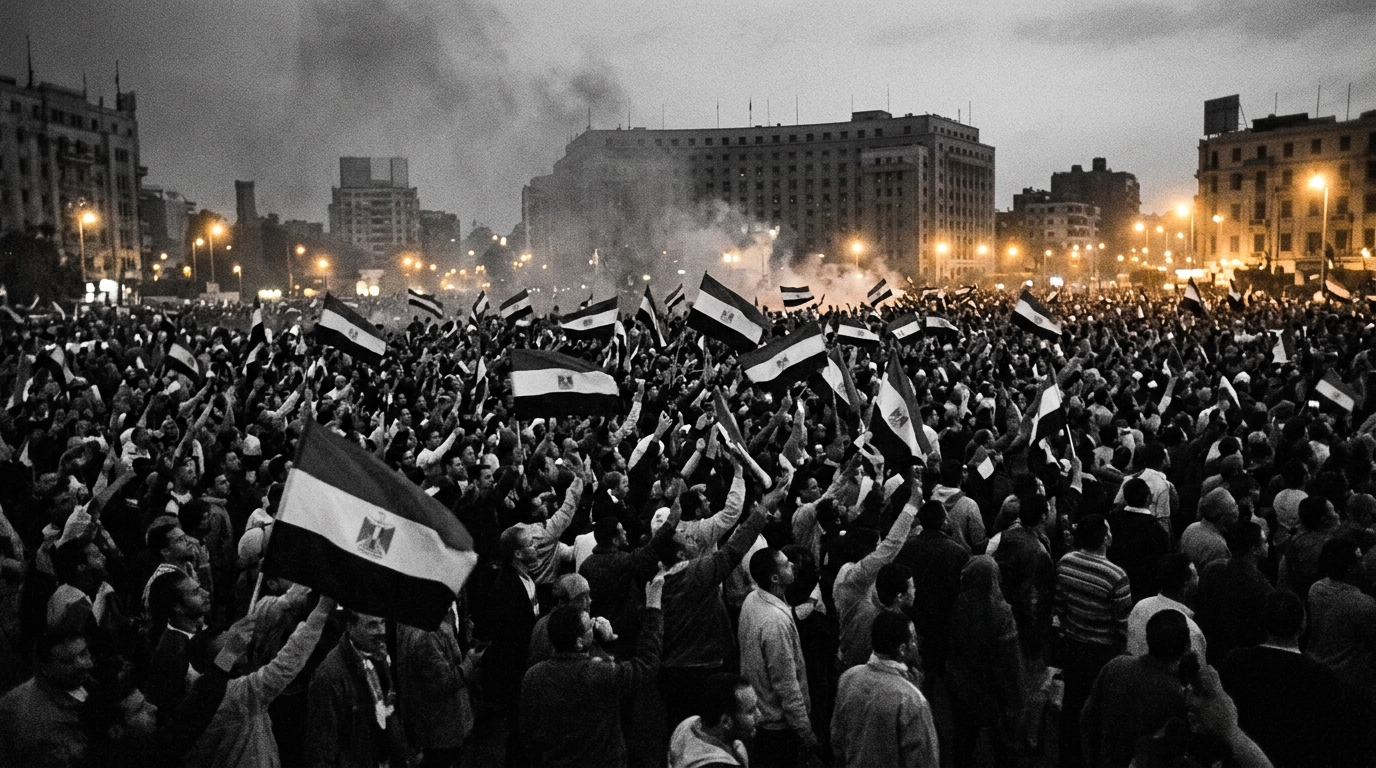
The government's response was initially characterized by denial and attempted repression. However, instead of deterring the protesters, the regime's heavy-handed tactics—including excessive force, mass arrests, and the controversial decision to implement a nationwide internet and mobile phone shutdown on January 28th—proved to be a strategic miscalculation. The internet blackout, intended to disrupt communication and coordination, paradoxically pushed more people onto the streets as they sought information and solidarity offline. This day, now known as the "Friday of Anger," witnessed a significant escalation of the protests. With police forces visibly retreating from many areas, protesters occupied Tahrir Square in downtown Cairo, transforming it into the epicenter of the burgeoning revolution.
Tahrir Square: A Global Symbol of Resistance
Tahrir Square, meaning "Liberation Square" in Arabic, became more than just a physical location; it transformed into a potent global symbol of civil resistance and the struggle for democracy. For eighteen days, the square was occupied by a diverse coalition of Egyptians: secular activists, liberal intellectuals, students, workers, and even segments of the middle class who had previously remained apolitical. They lived, ate, slept, and organized in the square, creating a vibrant, albeit temporary, micro-society. This occupation was remarkable not only for its scale and duration but also for the unprecedented level of unity displayed among Egyptians from different religious and socio-economic backgrounds. While the Muslim Brotherhood, with its established organizational infrastructure, played a significant role in mobilizing its members, the initial spark and the driving force of the Tahrir occupation came from a younger, more digitally-connected generation of activists who championed a broader vision of democratic reform.
The regime's attempts to regain control often backfired spectacularly. One of the most infamous incidents was the "Battle of the Camel" on February 2, 2011. In a desperate bid to dislodge the protesters, Mubarak loyalists, some on horseback and camelback, charged into Tahrir Square, attacking the demonstrators with stones, clubs, and other makeshift weapons. The scenes of chaos and violence, broadcast globally, served not only to galvanize the protesters and strengthen their resolve but also to elicit widespread international condemnation of the regime's brutality. Instead of crushing the movement, these tactics further unified the demonstrators and solidified international sympathy for their cause.
The presence of international media, live-streaming events from the square around the clock, ensured that the Egyptian Revolution captured the world's attention. The images of ordinary citizens standing their ground against a heavily armed regime resonated with people globally, inspiring similar protests in other Arab nations and beyond. The sheer resilience and determination of the protesters, coupled with the regime's increasingly desperate and violent responses, created an irreversible momentum that began to erode the pillars of Mubarak's authority.
The Military's Calculated Pivot
A crucial factor in Mubarak's downfall was the calculated decision by the Egyptian military, under the leadership of the Supreme Council of the Armed Forces (SCAF), to abandon him. While the military had long been a key pillar of the Mubarak regime, its primary loyalty lay with the institution itself and its considerable economic interests. As the protests intensified and Mubarak's hold on power weakened, the SCAF recognized that their own survival and institutional integrity were at stake. Firing on unarmed demonstrators would have been a catastrophic act, likely leading to widespread civil war and international opprobrium, thus jeopardizing the military's privileged position in Egyptian society and economy.
Instead, the SCAF adopted a strategy of strategic patience and calculated inaction. By refusing to deploy lethal force against the protesters and maintaining a neutral stance, they preserved their prestige, positioning themselves as the arbiters of the crisis and the guardians of the nation. This stance effectively deprived Mubarak of his ultimate coercive tool. His pleas for the military to restore order were met with silence, signaling his growing isolation. The SCAF's eventual communiqué, implicitly distancing the military from Mubarak's increasingly untenable position, was a clear signal that his time was up. On February 11, 2011, after weeks of intense pressure and widespread demonstrations, Vice President Omar Suleiman, appointed by Mubarak in a last-ditch effort to placate the masses, announced Mubarak's resignation. The announcement was met with jubilation in Tahrir Square and across Egypt, marking the end of an era.
Geopolitical Consequences and Regional Repercussions
The fall of Hosni Mubarak sent seismic waves through the complex geopolitical landscape of the Middle East. For decades, Mubarak's regime had served as a bedrock of regional stability and a linchpin of Western foreign policy in the Arab world. His government was a crucial partner for the United States in its counter-terrorism initiatives and a key mediator in the protracted Israeli-Palestinian peace process, notably playing a role in the landmark Camp David Accords. For Israel, Mubarak represented a rare Arab leader who had formally recognized the state of Israel and maintained a stable, albeit often cool, diplomatic relationship.
Consequently, Mubarak's removal triggered significant anxiety in Washington and Tel Aviv. The immediate concern was the potential for a power vacuum and the emergence of a successor regime less aligned with their strategic interests, or even hostile to Israel. The U.S. and Israel watched with apprehension as the SCAF assumed interim authority, attempting to steer Egypt through the transition. This anxiety manifested in a cautious approach to the unfolding events, with both nations seeking to influence the political process and ensuring their continued engagement with the military as a guarantor of regional security and the preservation of existing security agreements. This often led to a prioritization of strategic stability over immediate democratic ideals, a stance that drew criticism from some observers and activists who felt the West was too quick to embrace the military leadership.
The revolution also emboldened popular movements across the Arab world, fueling further uprisings in countries like Libya, Yemen, and Syria, albeit with vastly different outcomes. While Egypt's revolution initially offered a beacon of hope, its trajectory would prove complex and fraught with challenges, highlighting the difficulties inherent in transitioning from authoritarianism to democracy.
The "Revolutionary Dilemma" and the Rise of the Muslim Brotherhood
The period immediately following Mubarak's ouster was defined by what has come to be known as the "revolutionary dilemma." This refers to the inherent challenge faced by revolutionary movements: the very forces that successfully dismantle an existing authoritarian order are often ill-equipped to govern or manage the complex bureaucratic, economic, and security apparatus of a new state. In Egypt, this dilemma manifested starkly. The secular and liberal activists who had initially occupied Tahrir Square, driven by ideals of democracy, freedom, and human dignity, largely lacked the established organizational infrastructure, political experience, and deep societal penetration that their opponents possessed.
In the absence of strong, organized secular opposition parties, the Muslim Brotherhood, an Islamist movement with a long history of clandestine organization, social outreach, and electoral participation, was exceptionally well-positioned to capitalize on the newly opened political space. The Brotherhood, historically banned under Mubarak but tolerated to some extent, possessed a vast network of social services, mosques, and tightly organized cells across the country. They skillfully navigated the post-Mubarak political landscape, participating in elections and framing themselves as the most viable force capable of providing order and governance.
This led to a deeply polarized transition. The original revolutionary forces, often fragmented and struggling to translate their moral authority into political power, found themselves outmaneuvered. The SCAF, meanwhile, skillfully played the various factions against each other, adeptly preserving its institutional interests and economic dominance while projecting an image of necessary stability. The Brotherhood, through its organizational might, ultimately won the country's first post-revolution presidential election in June 2012, with Mohamed Morsi becoming president. However, Morsi's presidency proved to be short-lived and highly controversial. His administration was criticized for consolidating power, alienating secular and liberal opposition, and failing to address pressing economic issues. This further exacerbated societal divisions and ultimately paved the way for a massive wave of protests in 2013, which provided the pretext for the military, led by General Abdel Fattah el-Sisi, to stage a coup and reclaim full control of the state apparatus, effectively ending the nascent democratic experiment and ushering in a new era of authoritarian rule.
Socio-Economic Aftermath and Long-Term Legacy
The eighteen days of revolution and the subsequent tumultuous transition left an indelible mark on Egypt's socio-economic fabric. The immediate aftermath was characterized by significant economic disruption. The ouster of Mubarak led to a sharp decline in tourism, a vital source of foreign revenue, and a massive outflow of foreign investment as investors adopted a "wait-and-see" approach. The political instability and uncertainty further hampered economic recovery. The Egyptian pound depreciated, inflation surged, and unemployment, particularly among youth, remained a persistent challenge.
The dream of broad-based economic prosperity that many revolutionaries had hoped for remained elusive. The systemic issues of corruption and crony capitalism, though exposed, were not effectively dismantled. Instead, the military, under the SCAF and later under President el-Sisi, deepened its control over key sectors of the economy, further entrenching its economic interests. While the government has undertaken large-scale infrastructure projects and economic reforms, these have often been accompanied by austerity measures and a tightening of the state's grip on the economy, raising concerns about equitable growth and the welfare of the broader population.
The long-term legacy of the 2011 revolution is a complex and contested one. On one hand, it undeniably shattered the myth of Mubarak's invincibility and demonstrated the power of collective action in challenging entrenched authoritarianism. It instilled a sense of agency and political consciousness among a generation of Egyptians who had previously felt disenfranchised. The revolution also served as a powerful global demonstration of the potential of social media to mobilize dissent and bypass state censorship, influencing protest movements worldwide.
However, the revolution also exposed deep societal fissures and the challenges inherent in building a stable democracy from the ashes of autocracy. The failure to establish robust democratic institutions, the polarization between ideological factions, and the continued influence of the military and security apparatus have cast a long shadow over Egypt's post-revolutionary trajectory. The initial euphoria of liberation has, for many, given way to a sense of disillusionment and a recognition that the struggle for true democratic governance and social justice is a long and arduous process, far from over. The events of Tahrir Square remain a potent historical marker, a testament to the courage of a people yearning for change, but also a somber reminder of the intricate and often brutal realities of political transformation.
Modern Historiographical Debates
The academic and public discourse surrounding the 2011 Egyptian Revolution is dynamic and multifaceted, evolving as new evidence emerges and the long-term consequences become clearer. One central debate revolves around the nature of the revolution itself: was it primarily a social revolution driven by popular discontent, a digital revolution facilitated by new technologies, or a military coup in disguise? Scholars continue to analyze the interplay between grassroots mobilization, the role of nascent civil society, and the calculated maneuvering of established power structures like the military.
Another significant area of contention concerns the legacy of the "youth bulge" and the role of secular, liberal activists versus more organized political forces like the Muslim Brotherhood. Historiographical interpretations grapple with why the initial vanguard of Tahrir Square, often lauded for its idealism, was ultimately outmaneuvered politically. Debates arise over whether the revolution was "hijacked" or if this outcome was an inevitable consequence of the pre-existing power dynamics and the strategic advantages of established organizations.
Furthermore, the role of external actors, particularly the United States and its regional allies, remains a subject of intense scrutiny. Historians and analysts continue to dissect the motivations behind their responses, the extent of their influence on the transition, and whether their pursuit of regional stability superseded their stated commitment to democratic principles. The comparative analysis of Egypt's revolution with those in Tunisia, Libya, Syria, and Yemen also forms a crucial part of the ongoing historiographical endeavor, seeking to identify common threads, diverging paths, and the unique contextual factors that shaped each outcome. The question of whether Egypt has truly transitioned or merely reverted to a more sophisticated form of authoritarianism, albeit without Mubarak, is a central and enduring theme in current historical scholarship.
Trivia and Lesser-Known Facts
- Digital Mobilization: The hashtag #Jan25, popularized by activists like Wael Ghonim, served as the primary command-and-control center for the movement, forcing the regime to attempt an unprecedented national internet shutdown that ironically accelerated the physical gathering of crowds. This event served as an early case study in the power of social media to circumvent authoritarian control, though it also highlighted the vulnerability of digital infrastructure to state interference.
- The "Square" Symbolism: Tahrir Square, originally named Midan Ismailia after Khedive Ismail, who commissioned its development in the mid-19th century, was renamed Tahrir (Liberation) following the 1952 revolution led by Gamal Abdel Nasser. This historical renaming added a profound layer of symbolic resonance to its role in 2011, evoking earlier periods of national awakening and liberation.
- Economic Costs: During the eighteen days of protests, the Egyptian Stock Exchange suspended trading multiple times, and the country experienced a massive flight of foreign capital. The disruption to the Suez Canal, a critical global shipping route, and the general halt in economic activity created the significant economic instability that would dog post-revolutionary governments for years, impacting inflation, employment, and foreign investment.
- Pro-Mubarak Tactics: The "Battle of the Camel" remains one of the most documented instances of state-sponsored intimidation in the digital age. The chaos and violence, captured by hundreds of amateur videographers and citizen journalists present in the square, became critical visual evidence that circulated globally. This footage not only helped galvanize international condemnation but also played a role in subsequent legal proceedings against regime loyalists.
- The Role of Youth: While often generalized as a "youth revolution," the participants were diverse. However, the disproportionate representation and organizational drive of young people, many of whom had never experienced a political system other than Mubarak's, was a defining characteristic. Their access to technology and their willingness to take risks were crucial in initiating and sustaining the momentum.
References and Literature
- The Arab Uprisings: What Everyone Needs to Know by Shireen T. Hunter. Oxford University Press, 2013. A comprehensive academic overview of the political transitions and underlying dynamics of the Arab Spring, providing valuable context for the Egyptian revolution.
- Al Jazeera English: The 18 Days That Changed Egypt. A detailed historical archive, often presented as a timeline or series of articles, documenting the events of the revolution from its inception to Mubarak's resignation. (Specific URLs may vary, but archives are readily available).
- Foreign Affairs: The Egyptian Revolution and Its Discontents. A collection of critical analyses and essays from a leading international affairs journal, offering in-depth commentary on the geopolitical shifts, the political transition, and the challenges faced by Egypt post-2011. (Access typically requires subscription).
- The Square: A Film by Jehane Noujaim. This critically acclaimed documentary offers an on-the-ground perspective of the Tahrir Square occupation, capturing the spirit, camaraderie, and struggles of the protesters. It provides invaluable visual and emotional context to the historical events.
- Egypt on the Brink: From Tahrir Square to the Rise of the Muslim Brotherhood by Marisa L. Silverberg. Palgrave Macmillan, 2014. A scholarly examination of the immediate post-revolution period, focusing on the political power struggles and the rise of Islamist influence.
- The Battle for Egypt: Dispatches from the Revolutionary Days by Jonathan Brown. Nation Books, 2011. An on-the-ground account by a journalist who covered the revolution, offering vivid descriptions and insights into the events as they unfolded.
Footnotes & Explanations
- The "We Are All Khaled Said" page, spearheaded by Wael Ghonim, demonstrated the transformative power of social media in uniting disparate voices and focusing collective anger against state oppression. Ghonim's own initial anonymity and subsequent public role became a powerful narrative arc within the revolution. ↩
- The military's strategic pivot was confirmed when the Supreme Council of the Armed Forces (SCAF) issued its "Communiqué No. 1" on February 9, 2011, essentially distancing itself from Mubarak's position before his resignation. This communiqué signaled the military's intent to assume ultimate control and manage the transition, prioritizing institutional continuity over loyalty to the president. ↩