Key Takeaways
- The Oslo Accords marked the first direct, face-to-face agreement between the government of Israel and the Palestine Liberation Organization (PLO).
- Negotiated in total secrecy in Norway, the accords bypassed traditional diplomatic channels to overcome years of mutual non-recognition.
- The framework established the Palestinian Authority and introduced a model of limited self-rule, but deferred critical 'final status' issues, leading to long-term structural vulnerabilities.
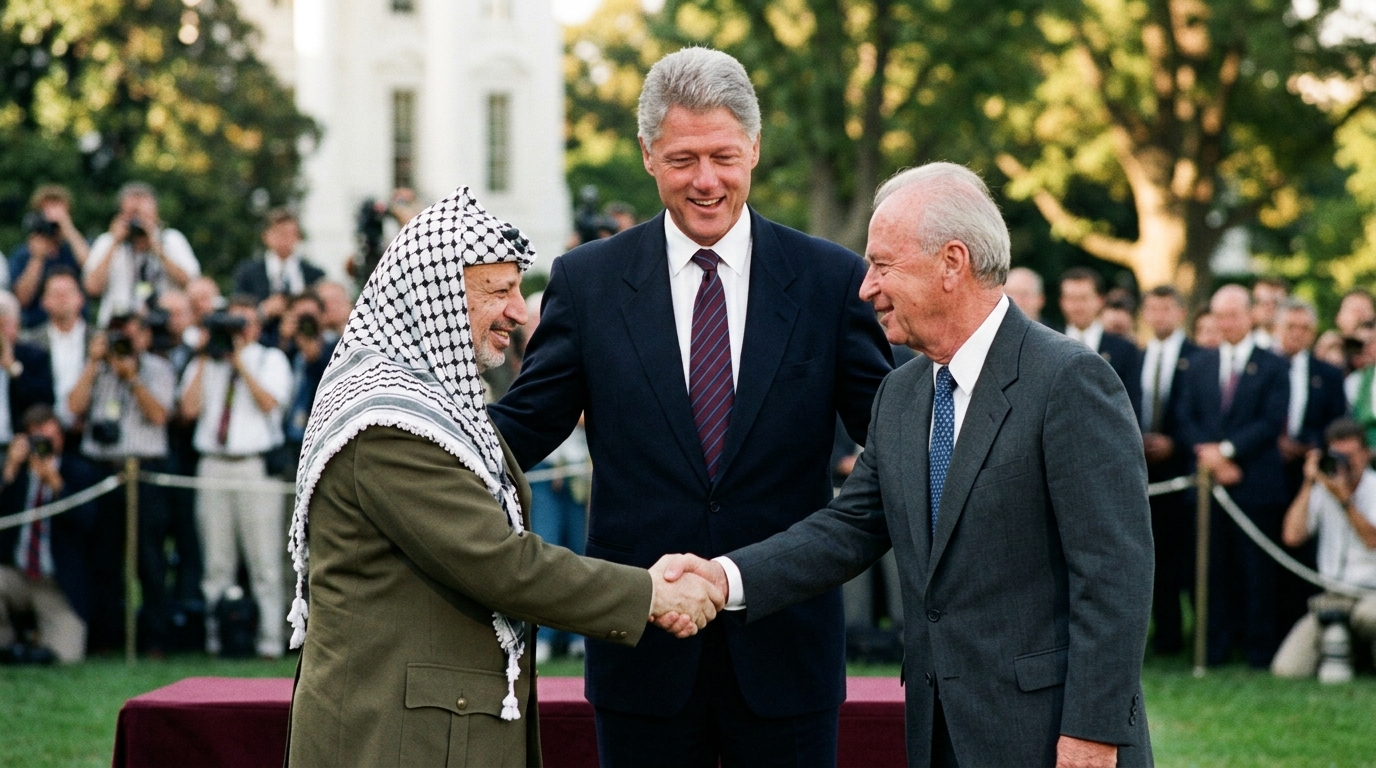
On September 13, 1993, the manicured South Lawn of the White House served as the stage for one of the most unexpected geopolitical spectacles of the late twentieth century. With U.S. President Bill Clinton standing between them, arms outstretched in a gesture of paternal facilitation, Israeli Prime Minister Yitzhak Rabin and Palestine Liberation Organization (PLO) Chairman Yasser Arafat shook hands. For decades, these two men had personified an existential struggle of mutual denial. Rabin, the battle-hardened general who had commanded Israeli forces in the 1967 Six-Day War, and Arafat, the ubiquitous symbol of armed Palestinian resistance, had signed the Declaration of Principles on Interim Self-Government Arrangements (DoP).
This historic handshake did not emerge from standard superpower shuttle diplomacy. Instead, it was the product of a highly unorthodox, deniable, and deeply secret backchannel facilitated by a small team of Norwegian diplomats and academics. The Oslo Accords reshaped the cartography of the Middle East, created the Palestinian Authority, and introduced a vocabulary of compromise to a conflict long defined by zero-sum calculations. Yet, the architectural flaws inherent in the accords—characterized by deferred decisions and reliance on incremental trust—would ultimately shadow their historic promise.
Historical Context and Origins
To understand the sudden breakthrough of 1993, one must examine the profound systemic shifts that shook the global and regional order at the dawn of the 1990s. For nearly forty years, the Arab-Israeli conflict had been viewed through the prism of Cold War bipolarity. The collapse of the Soviet Union between 1989 and 1991 abruptly deprived the PLO of its primary military and diplomatic patron, leaving Yasser Arafat's organization strategically exposed.
This vulnerability was compounded by Arafat’s catastrophic geopolitical miscalculation during the 1990–1991 Gulf War. By aligning the PLO with Iraqi dictator Saddam Hussein following his invasion of Kuwait, Arafat alienated the wealthy Gulf Arab monarchies. In retaliation, Saudi Arabia and other Gulf states cut off vital financial subsidies to the PLO and expelled hundreds of thousands of Palestinian workers, plunging the organization into near-bankruptcy and diplomatic isolation inside its exiled headquarters in Tunis.
Simultaneously, the center of gravity of Palestinian nationalism had shifted. Launched in December 1987, the First Intifada—a sustained, grassroots uprising against Israeli military rule in the West Bank and Gaza Strip—was led largely by local activists inside the territories 1. This internal rebellion caught the exiled PLO leadership in Tunis off guard. Arafat feared that if the PLO did not secure a diplomatic breakthrough soon, leadership of the Palestinian national movement would permanently pass to local leaders in the territories or, more worryingly, to rising Islamist movements like Hamas, which rejected any compromise with Israel.
On the Israeli side, political dynamics underwent a parallel transformation. In June 1992, the center-left Labor Party, led by Yitzhak Rabin, defeated the right-wing Likud Party of Yitzhak Shamir. Rabin campaigned on a platform of securing peace within late-twentieth-century realities, promising to achieve an agreement on Palestinian autonomy within six to nine months. Rabin, alongside his ambitious Foreign Minister Shimon Peres and Deputy Foreign Minister Yossi Beilin, recognized that maintaining indefinite military rule over millions of hostile Palestinians posed a long-term threat to Israel’s democratic institutions and Jewish demographic majority.
While official, public peace talks had commenced at the US-sponsored Madrid Conference in late 1991, they quickly devolved into sterile procedural gridlock. The Madrid framework suffered from a fundamental structural flaw: Israel refused to negotiate directly with the PLO, forcing Palestinian delegates to sit as part of a joint Jordanian-Palestinian delegation comprised solely of residents from the occupied territories who had to constantly consult Tunis by phone. Realizing that the official negotiations were a theatrical dead-end, reform-minded Israelis and pragmatic PLO officials began looking for an alternative route.
Timeline of Events and Key Moments
The road to the White House lawn was paved not in Washington, but in the quiet, pine-forested suburbs of Oslo, Norway. The process developed through a series of discrete phases, transitioning from academic discussions to high-stakes diplomatic drafting.
| Date | Event |
|---|---|
| Dec 1992 | Academic Contacts |
| Jan 1993 | Israeli Legal Change |
| May 1993 | Official Upgrading |
| Sept 9-10, 1993 | Mutual Recognition |
| Sept 13, 1993 | White House Lawn |
The Academic Genesis (December 1992 – January 1993)
The channel was conceived by Terje Rød-Larsen, a Norwegian sociologist, and his wife, Mona Juul, a diplomat in the Norwegian Foreign Ministry. Utilizing Norway’s unique position as a small, neutral nation with warm relations with both Israel and the Arab world, they proposed an informal channel. Under the cover of academic research into living conditions in the Gaza Strip, they brought together:
- Yair Hirschfeld and Ron Pundak: Israeli historians and academics representing the Israeli peace camp (discreetly backed by Israeli Deputy Foreign Minister Yossi Beilin).
- Ahmed Qurei (Abu Ala): The PLO’s highly capable finance director, representing the Tunis leadership.
The first meeting took place on January 20, 1993, at the Borregaard Manor in Sarpsborg, Norway 2. Crucially, just days prior, the Israeli Knesset had repealed a law banning direct contact between Israeli citizens and the PLO, shielding the academic participants from legal prosecution.
Upgrading the Channel (May 1993 – August 1993)
As the academic talks yielded surprising areas of convergence, Yitzhak Rabin authorized the formal involvement of his government. In May 1993, Uri Savir, the Director-General of the Israeli Foreign Ministry, joined the negotiations alongside Joel Singer, a prominent military lawyer and expert on the laws of occupation.
Savir’s arrival transformed the atmosphere from tentative intellectual exploration to hard-nosed statecraft. Singer meticulously drafted the emerging principles into a legally binding framework. Throughout the summer, the negotiators met in secluded locations across Norway, including the Halvorsbøle estate. The negotiations were characterized by immense stress, punctuated by frequent threats of collapse over territorial jurisdictions, security arrangements, and the status of Jerusalem.
On August 20, 1993, in a highly emotional late-night ceremony in Oslo, the secret Declaration of Principles (DoP) was initialed by Shimon Peres and Mahmoud Abbas (Abu Mazen), the PLO’s chief diplomat, in the presence of Norwegian Foreign Minister Johan Jørgen Holst.
The Letters of Mutual Recognition (September 9–10, 1993)
Before any public agreement could be signed, the two parties had to cross a monumental psychological barrier: recognizing each other’s right to exist. In a flurry of high-stress exchanges, Arafat and Rabin signed letters of mutual recognition 3.
Arafat wrote:
"The PLO recognizes the right of the State of Israel to exist in peace and security... [and] renounces the use of terrorism and other acts of violence."
Rabin responded with a succinct, historic confirmation:
"The Government of Israel has decided that in light of the PLO commitments... the Government of Israel will recognize the PLO as the representative of the Palestinian people."
The Washington Handshake (September 13, 1993)
The public culmination took place in Washington, D.C. The ceremony on the White House lawn was attended by over 3,000 guests, including former U.S. presidents and international dignitaries. The signing of the Declaration of Principles was punctuated by the iconic physical interaction between Rabin and Arafat. Rabin’s visible hesitation, followed by his resolute extension of his hand, symbolized the deep-seated anxiety and profound hope of the era.
Implementing the Interim Agreements (1994–1995)
The signing of the DoP set in motion a sequence of implementation agreements:
- The Gaza-Jericho Agreement (May 1994): Signed in Cairo, this initiated the withdrawal of Israeli military forces from the Gaza Strip and the West Bank town of Jericho, paving the way for Yasser Arafat’s triumphant return from exile to establish the Palestinian Authority (PA).
- The Oslo II Accord (September 1995): Formally known as the Interim Agreement on the West Bank and the Gaza Strip, this complex document divided the West Bank into three distinct administrative zones [[^4]]:
Geopolitical Consequences and Aftermath
The immediate geopolitical aftermath of the Oslo Accords was characterized by a wave of diplomatic normalization and regional restructuring. The signing of the accords broke the taboo of engaging with Israel in the Arab world, leading directly to the signing of the Israel-Jordan Peace Treaty in October 1994. Low-level diplomatic missions and trade offices were established between Israel and several North African and Persian Gulf states, including Morocco, Tunisia, Oman, and Qatar.
- Oslo Accords Signed (1993)
However, the structural design of the Oslo Accords contained the seeds of their own decay. Rather than negotiating a comprehensive, final peace treaty, the architects of Oslo chose a strategy of incrementalism. Under this approach, the most explosive and intractable issues—referred to as "final-status issues"—were deferred to negotiations scheduled to begin in the third year of the interim period and conclude by the fifth. These issues included:
- The final borders of Israel and a future Palestinian entity.
- The sovereignty over and status of Jerusalem.
- The right of return for millions of Palestinian refugees.
- The future of Israeli settlements in the West Bank and Gaza.
- Water rights and security guarantees.
This "constructive ambiguity" assumed that five years of successful security cooperation and economic integration would build enough mutual trust to make these intractable issues solvable. Instead, the delay allowed opponents of peace on both sides to mobilize, organize, and systematically destroy that trust.
For Palestinian critics, led by prominent intellectuals like Edward Said, the Oslo Accords represented a form of "Palestinian capitulation." Said argued that the accords transformed the PLO into an administrative subcontractor for the Israeli occupation, slicing the West Bank into isolated enclaves (Areas A and B) surrounded by expanding Jewish settlements, military checkpoints, and bypass roads in Area C. Indeed, the settler population in the West Bank and Gaza grew significantly during the Oslo years, rising from approximately 110,000 in 1993 to over 190,000 by 2000. This expansion undermined Palestinian faith in Israel's commitment to eventual statehood.
Concurrently, radical Islamist factions, most notably Hamas and Palestinian Islamic Jihad, launched a campaign of suicide bombings targeting civilian buses and shopping centers inside Israeli cities. These attacks were explicitly designed to maximize Israeli casualties, shatter the Israeli public’s sense of personal security, and turn the electorate against the Labor government’s peace policy.
On the Israeli political right, opposition to the accords was fierce. Likud leader Benjamin Netanyahu led mass rallies where Rabin was depicted in SS uniforms or as a traitor surrendering ancestral Jewish land. This toxic political polarization culminated in national tragedy. On November 4, 1995, following a massive peace rally in Tel Aviv, Yitzhak Rabin was assassinated by Yigal Amir, a right-wing Jewish extremist 5. Amir hoped to stop the peace process by eliminating its chief Israeli architect.
Rabin’s assassination dealt a devastating blow to the peace camp. Though Shimon Peres assumed the premiership, his government was hobbled by continuing Hamas suicide attacks. In the May 1996 elections, Benjamin Netanyahu was elected Prime Minister on a platform of halting the Oslo process's concessions. While the institutional framework of the Palestinian Authority survived, the political momentum of the peace process was permanently broken, culminating in the failed Camp David Summit of July 2000 and the subsequent outbreak of the Second Intifada.
Analysis of Key Actors and Decisive Actions
The trajectory of the Oslo Accords was profoundly shaped by the complex personalities and strategic decisions of its three central protagonists.
| Personality | Key Strategic Motive | Decisive Diplomatic Action | Political Risk/Outcome |
|---|---|---|---|
| Yitzhak Rabin | Secure Israel’s Jewish-democratic character; offload demographic burden of Gaza. | Signed Letters of Mutual Recognition; authorized direct PLO negotiation. | Assassinated in 1995 by a Jewish extremist. |
| Yasser Arafat | Save PLO from political irrelevance; establish a territorial foothold in Palestine. | Recognized Israel’s right to exist; renounced armed struggle in writing. | Left isolated in Ramallah during the Second Intifada. |
| Bill Clinton | Secure a major foreign policy triumph; institutionalize American hegemony. | Converted secret bilateral track into a global public event. | Failed to bridge the gap at Camp David in 2000. |
Yitzhak Rabin: The Pragmatic Soldier
Yitzhak Rabin was not a romantic peacemaker; he was a cold-eyed security realist. His willingness to negotiate with the PLO was born of a sober assessment that military force alone could not solve the Palestinian national question. Having served as Defense Minister during the early years of the First Intifada, Rabin understood the limits of military power in managing a civilian uprising. He recognized that by refusing to deal with the secular, nationalist PLO, Israel was inadvertently strengthening Hamas. Rabin’s decisive action was his willingness to break his own long-held taboo against direct talks with Arafat. He staked his career, his legacy, and ultimately his life on the conviction that partition was the only way to preserve Israel as a Jewish and democratic state.
Yasser Arafat: The Guerrilla Statesman
For Yasser Arafat, the Oslo Accords represented an existential gamble. By recognizing Israel and renouncing armed struggle, he abandoned the foundational tenets of the 1968 Palestinian National Charter. In exchange, he secured something no previous Palestinian leader had: an internationally recognized territorial foothold in Palestine. Arafat’s primary calculation was to transition the PLO from an exiled revolutionary movement to a state-in-waiting. However, Arafat struggled to make the transition from a clandestine guerrilla leader to the bureaucratic head of a state apparatus. He maintained a highly personalized, patrimonial system of governance that fostered corruption and weakened security cooperation, leaving him vulnerable to charges of playing a double game.
Bill Clinton: The Diplomatic Impresario
While the United States was entirely absent from the initial, secret phase of the Oslo negotiations, President Bill Clinton played a vital role in institutionalizing and legitimizing the process. Clinton recognized the immense diplomatic opportunity presented by the breakthrough. By lending the full prestige of the American presidency to the signing ceremony, Clinton elevated a fragile, bilateral agreement into a global covenant. The Clinton administration took on the role of the primary mediator and financial coordinator for the interim phase, although critics argue that Washington's close strategic alignment with Israel prevented it from acting as an entirely objective broker during subsequent implementation disputes.
Trivia and Lesser-Known Facts
- The "Grandmother's House" Cover: To maintain absolute secrecy, the Norwegian facilitators avoided formal diplomatic settings. Instead, they hosted the delegations in remote country estates like the Borregaard Manor. The negotiators stayed in close quarters, shared home-cooked meals, and were even served by the hosts' family members. This domestic atmosphere forced the Israeli and Palestinian delegates—who had spent their entire lives viewing each other as monsters—to interact as human beings, sharing stories of their children and grandchildren over late-night coffee.
- The Red Ink of the Map: During the intensive negotiations for Oslo II, which carved up the West Bank into Areas A, B, and C, the negotiators struggled to find precise maps. At one point, Israeli and Palestinian negotiators used simple felt-tip markers to draw borders on commercial road maps. The thick lines of the markers themselves often represented hundreds of meters on the ground, creating immense boundary disputes for years to come.
- Rehearsing the Handshake: Bill Clinton was highly conscious of the volatility of the physical encounter between Rabin and Arafat on the White House lawn. In the days leading up to September 13, Clinton physically practiced the handshake with his National Security Advisor, Anthony Lake, and Secretary of State, Warren Christopher. Clinton rehearsed how he would stand, open his arms to gently guide the two leaders together, and prevent Arafat from trying to kiss Rabin on the cheek, which Rabin’s team had warned would be politically disastrous in Israel.
- The Secret within the Cabinet: Rabin kept the early stages of the Oslo negotiations hidden not only from the United States and the Israeli military intelligence services, but also from most of his own cabinet. Only a tiny inner circle consisting of Shimon Peres, Yossi Beilin, and a few trusted aides knew of the channel’s existence until late August 1993, when the agreement was practically finalized.
References and Literature
- The Oslo Accords (1993) - Office of the Historian, U.S. Department of State. A comprehensive historical overview of the diplomatic process.
- The Oslo Accords: International Law and the Israeli-Palestinian Peace Process - Foreign Affairs. An in-depth academic critique of the legal and structural components of the peace process.
- Savir, Uri (1998). The Process: 1,100 Days that Changed the Middle East. New York: Random House - An insider account of the secret negotiations written by the chief Israeli negotiator.
- Abbas, Mahmoud (1995). Through Secret Channels: The Road to Oslo. Reading: Garnet Publishing - The primary memoir detailing the Palestinian perspective on the backchannel diplomacy.
---
Footnotes & Explanations
- The First Intifada erupted spontaneously in December 1987 in the Jabalia refugee camp in Gaza, quickly spreading to the West Bank and transforming the political terrain by demonstrating the power of popular, civil disobedience inside the territories. ↩
- The Sarpsborg meeting on January 20, 1993, marked the first time Israeli representatives and PLO officials sat down to draft a conceptual framework for peace, bypassing the legal constraints of the era. ↩
- The exchange of letters of mutual recognition on September 9–10, 1993, was a prerequisite for the signing of the Declaration of Principles, representing the formal dismantling of decades of mutual diplomatic denial. ↩
- The administrative division of the West Bank into Areas A, B, and C was formalized in the Israeli-Palestinian Interim Agreement on the West Bank and the Gaza Strip (Oslo II), signed in Washington, D.C., on September 28, 1995. ↩
- Yitzhak Rabin was assassinated on November 4, 1995, at the Kings of Israel Square (now Rabin Square) in Tel Aviv, immediately after addressing a crowd of over 100,000 Israelis demonstrating in support of the peace process. ↩