Key Takeaways
- The strike represented a significant escalation in the 'shadow war,' moving direct kinetic engagement from third-party proxies to a state-on-state confrontation.
- The event forced the Iraqi parliament to vote for the expulsion of US forces, fundamentally altering the diplomatic relationship between Washington and Baghdad and challenging the US military presence in the region.
- The incident demonstrated the limits of the 'maximum pressure' policy, as Iran responded with direct missile strikes, signaling a shift in Tehran’s strategic patience and willingness to directly confront US forces.
- The assassination had profound domestic repercussions in both the United States and Iran, galvanizing nationalist sentiment in Tehran while sparking debate in Washington over executive authority and strategic wisdom.
Historical Context and Origins
The assassination of Major General Qasem Soleimani on January 3, 2020, was not a singular event born of isolated provocation, but rather the violent culmination of four decades of adversarial relations between the United States and the Islamic Republic of Iran. To understand the gravity of the strike, one must examine the role of the Quds Force—the expeditionary wing of the Islamic Revolutionary Guard Corps (IRGC)—which Soleimani commanded since 1998, transforming it into a highly effective instrument of Iranian foreign policy.
The roots of this profound antagonism stretch back to the 1979 Islamic Revolution, which saw the overthrow of the US-backed Shah and the establishment of an anti-Western, revolutionary Shiite government. This was followed by the Iran-Iraq War (1980-1988), during which the US covertly supported Iraq, further cementing Iranian distrust. Throughout the 1980s and 1990s, Iran developed its "forward defense" doctrine, predicated on cultivating a network of non-state actors across the Middle East to project influence and deter direct attacks on its homeland. Soleimani, a veteran of the Iran-Iraq War, rose through the ranks of the IRGC and became the architect and chief operational commander of this strategy. Under his direction, the Quds Force became adept at asymmetric warfare, utilizing groups like Hezbollah in Lebanon, various Shiite militias in Iraq (including Kataib Hezbollah), and later the Houthis in Yemen, to challenge US and allied interests while maintaining a degree of "plausible deniability" for Tehran.
The early 21st century saw renewed friction. The US invasion of Iraq in 2003, which toppled Saddam Hussein—a mutual enemy of both the US and Iran—unintentionally created a power vacuum that Iran, under Soleimani’s astute guidance, was quick to exploit. Soleimani’s Quds Force played a pivotal role in organizing and arming Iraqi Shiite militias that targeted US forces during the Iraq War, honing the very tactics that would later be cited as justification for his elimination. His legend grew during the fight against ISIS, where he played a visible and instrumental role in coordinating Iraqi and Syrian forces, often appearing on battlefields, further solidifying his image as a national hero within Iran and a formidable adversary to the West.
The geopolitical landscape shifted dramatically again in 2018 when the Donald Trump administration withdrew from the Joint Comprehensive Plan of Action (JCPOA), the multilateral nuclear agreement, and subsequently launched a "Maximum Pressure" campaign. This campaign aimed to cripple Iran’s economy through unprecedented sanctions, forcing Tehran to renegotiate a more restrictive nuclear deal and curb its regional behavior. Instead, the policy led to a cycle of escalation: Iran responded by increasing its uranium enrichment, harassing international shipping in the Persian Gulf, and intensifying its support for proxy attacks on US assets and allies in the region. Tensions in the Persian Gulf escalated from diplomatic stagnation to active sabotage, drone attacks, and maritime insecurity throughout 2019.
The late 2019 period served as the immediate preamble. Increased rocket attacks on US-occupied bases in Iraq by Iranian-backed militias, specifically Kataib Hezbollah, reached a turning point on December 27, 2019, with the death of a US civilian contractor at the K-1 Air Base in Kirkuk. This incident, following months of lower-level provocations, crossed a perceived red line for the Trump administration. The subsequent US airstrikes on Kataib Hezbollah facilities on December 29, which killed at least 25 militants, were met with violent protests at the US Embassy in Baghdad. This siege, reminiscent of the 2012 Benghazi attack and directly linked by intelligence to Soleimani's orchestration, signaled to the White House that the existing deterrence strategy had failed and the status quo had become untenable. President Trump, believing Soleimani to be the central orchestrator of these regional disruptions and perceiving an imminent threat, determined that the architect of this strategy had to be removed to restore deterrence and protect American lives.
Timeline of Events and Key Moments
The escalation moved with rapid, almost mechanical precision during the final days of 2019 and the first week of 2020, demonstrating a critical failure of de-escalation mechanisms between Washington and Tehran.
| Date | Event | Significance |
|---|---|---|
| Dec 27, 2019 | Attack on K-1 Air Base, Kirkuk, Iraq | A volley of 30 rockets struck the base, killing a US civilian contractor and injuring several US and Iraqi service members. This was a direct, lethal attack on US personnel and triggered the US kinetic response. |
| Dec 29, 2019 | US Airstrikes on Kataib Hezbollah | US forces conducted precision strikes against five Kataib Hezbollah facilities in Iraq and Syria, targeting weapons depots and command centers. The strikes killed roughly 25 militants and injured 55, intended as a punitive response and deterrent. |
| Dec 31, 2019 | Baghdad Embassy Siege | Thousands of Iraqi protestors, many identified as members of Iranian-backed militias, breached the outer perimeter of the US Embassy in Baghdad, setting fires and chanting anti-American slogans. The siege, orchestrated by militia leaders including Abu Mahdi al-Muhandis, was perceived by the US as a direct assault on American sovereignty and a significant escalation. |
| Jan 1-2, 2020 | US Deployments and Warnings | The US dispatched additional troops to protect its embassy and warned Iran against further provocations. President Trump publicly blamed Iran for the embassy attack and stated Iran would pay a "very big price." |
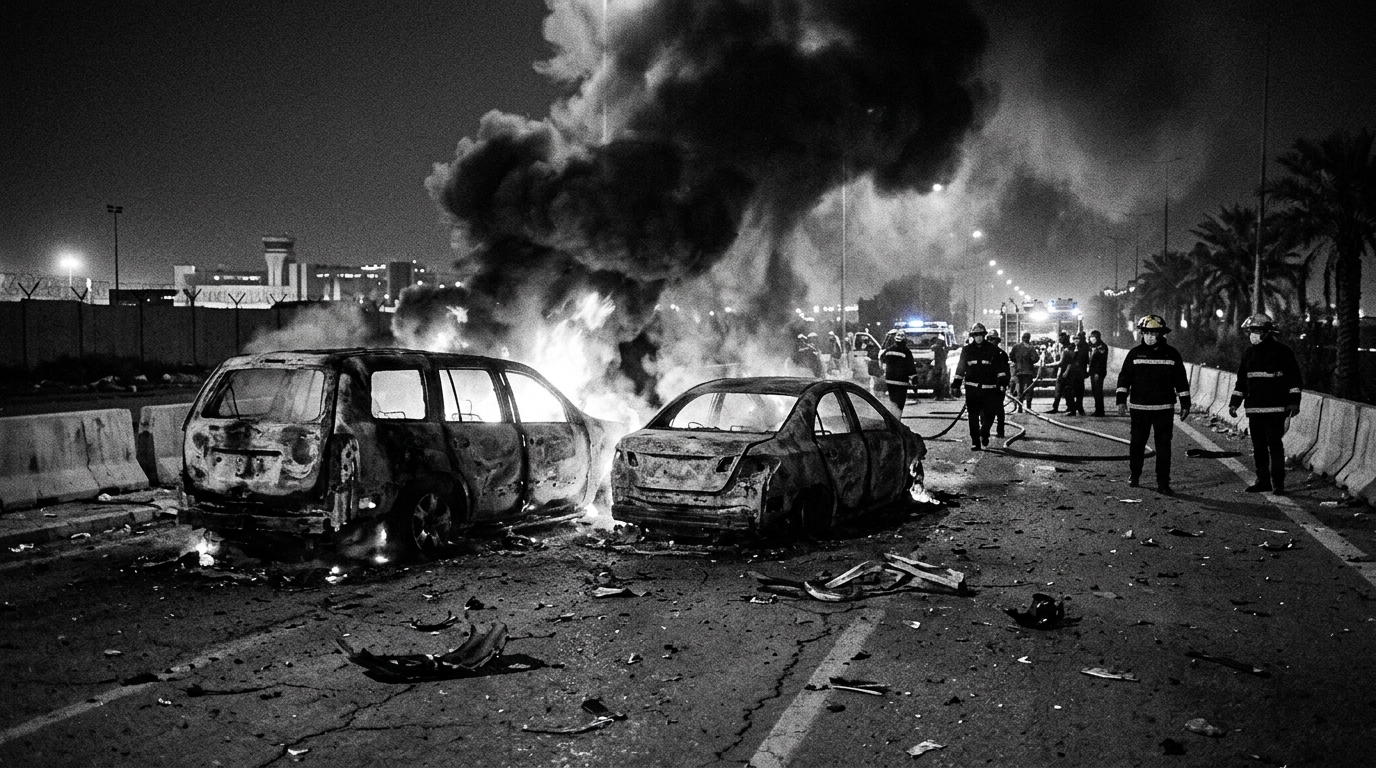
| Jan 3, 2020 | Operation Martyr Soleimani (US Strike) | A targeted drone strike killed Soleimani and Abu Mahdi al-Muhandis, along with several other officials, as their convoy departed Baghdad International Airport. The operation, authorized by President Trump, aimed to disrupt perceived imminent attacks and restore deterrence. |
| Jan 5, 2020 | Iran Announces Nuclear Withdrawal | Iran declares it will no longer abide by the operational limits set by the JCPOA, including restrictions on uranium enrichment capacity, quantity of enriched uranium, and research and development, effectively dismantling its commitments to the agreement. |
| Jan 8, 2020 | Operation Martyr Soleimani (Iran Retaliation) | Iran launches over a dozen ballistic missiles at Al-Asad Airbase and Erbil airbase in Iraq, which housed US and coalition forces. This was Iran's overt, direct military retaliation for Soleimani's assassination, aiming to demonstrate resolve without triggering a full-scale war. |
| Jan 8, 2020 | Ukraine International Airlines Flight 752 | An Iranian surface-to-air missile accidentally shot down a Ukrainian passenger plane shortly after takeoff from Tehran, killing all 176 on board. Initial denials were followed by an admission of responsibility by Iran, deeply embarrassing the regime and exposing internal divisions. |
The strike itself was carried out by an MQ-9 Reaper drone, a sophisticated Unmanned Aerial Vehicle (UAV) renowned for its precision strike capabilities. As Soleimani’s motorcade exited Baghdad International Airport, it was hit by AGM-114 Hellfire missiles. The attack was swift and decisive. The death of Abu Mahdi al-Muhandis, the deputy commander of the Popular Mobilization Forces (PMF) and a key Iranian liaison in Iraq, compounded the crisis, as he was not only a powerful Iraqi militia leader but also Soleimani's direct and most trusted operational partner in Iraq. His removal simultaneously stripped Iran of its most effective regional operational commander and its primary facilitator within the Iraqi political and paramilitary structure, creating a significant void in Iran's regional influence network.
Geopolitical Consequences and Aftermath
The immediate aftermath of the strike placed the Middle East on the precipice of full-scale war, a scenario that analysts and regional leaders feared could spiral out of control. While initial fears of a devastating regional conflict did not materialize into a conventional war, the geopolitical fallout was profound and long-lasting, fundamentally altering regional dynamics and US foreign policy.
Iran’s retaliation, codenamed "Operation Martyr Soleimani," saw over a dozen ballistic missiles fired at US-led coalition forces at Al-Asad and Erbil airbases in Iraq. This marked the first time since the 1979 Revolution that Iran had openly and directly attacked US military personnel, demonstrating a significant shift in its strategic posture. While the Trump administration initially reported no casualties, attributing the lack of fatalities to early warning systems and preventative measures, it was later disclosed that over 100 US service members suffered traumatic brain injuries (TBIs) from the concussive force of the blasts. This subsequent admission highlighted the inherent risks of escalation and fueled domestic debate in the US over transparency and the long-term health consequences for American troops.
The geopolitical fallout included:
- Diplomatic Crisis in Iraq: The assassination of Soleimani and Muhandis on Iraqi soil was widely condemned across the Iraqi political spectrum as a blatant violation of Iraqi sovereignty. The Iraqi Parliament, swayed by powerful Shiite factions, passed a non-binding resolution on January 5, 2020, demanding the expulsion of all foreign troops, including the 5,200 American soldiers stationed in the country. This placed the long-standing US-Iraq strategic partnership under immense strain, threatening the future of the anti-ISIS coalition and forcing a temporary withdrawal of coalition troops from frontline operations. While the resolution was non-binding, it created a significant political imperative for successive Iraqi governments to negotiate the terms of US presence, complicating Baghdad’s ability to balance its relationships with both Washington and Tehran.
- Nuclear Escalation: In response to the strike and the "Maximum Pressure" campaign, Iran announced on January 5, 2020, that it would no longer abide by any operational limits on its nuclear enrichment activities stipulated in the JCPOA. This decision, though framed as a "fifth and final step" away from its commitments, effectively ended its adherence to the nuclear deal's key constraints, raising concerns among international observers about Iran’s potential path to developing nuclear weapons capability. The move exacerbated tensions with European signatories who had been attempting to salvage the deal, further isolating Iran on the international stage while increasing proliferation risks.
- Regional Realignment and De-escalation: Gulf Arab states, particularly Saudi Arabia and the UAE, while generally supportive of strong action against Iran, were acutely aware of their vulnerability to potential Iranian retaliation. Fearful of being caught in the crossfire of a full-scale US-Iran war, these states quietly sought to de-escalate tensions with Tehran through back-channel communications and limited diplomatic overtures. This reflected a growing regional desire to manage risks and avoid direct confrontation, despite shared concerns about Iranian influence. Israel, a key US ally and a primary target of Iranian regional ambitions, remained largely quiet, closely monitoring the situation while expressing implicit support for the US action.
- Impact on the "Axis of Resistance": While Soleimani’s death was a significant blow to the Quds Force's operational capabilities and command structure, it did not dismantle the "Axis of Resistance." Instead, it created a new martyr figure, rallying various Shiite militias and political factions across the region. While the initial tactical shock was profound, Iran’s long-term strategy of supporting proxies and asymmetric warfare continued, albeit with a renewed emphasis on revenge and expelling US forces from Iraq.
- Economic Ramifications: The immediate aftermath saw a spike in global oil prices and increased volatility in financial markets, reflecting fears of broader regional conflict disrupting crucial oil shipping lanes in the Persian Gulf. While prices soon stabilized as the immediate threat of war receded, the underlying geopolitical risk remained, contributing to uncertainty for international businesses and investors in the region.
The "Maximum Pressure" campaign, intended to force Iran to the negotiating table on US terms, achieved the opposite: it solidified the resolve of the hardline faction within the Iranian government, diminished the prospects of a new nuclear deal, and deepened the strategic rift between Washington and Baghdad. The strike inadvertently strengthened the position of those within Iran who advocated for a more confrontational stance against the West.
Analysis of Key Actors and Decisive Actions
The assassination of Qasem Soleimani was a high-stakes decision driven by complex motives and calculations on multiple sides. Understanding the perspectives and actions of the key actors is crucial to grasping the event's profound impact.
Donald Trump: The Executive Decision
President Trump’s decision-making process was framed by a desire to avoid "endless wars" while simultaneously projecting American strength and restoring deterrence. He had long criticized previous administrations for perceived weakness against Iran and believed his "Maximum Pressure" policy was the only way to contain Tehran. The escalating attacks on US personnel and facilities in Iraq, culminating in the K-1 base fatality and the Baghdad Embassy siege, were viewed by Trump as direct challenges to US credibility and a failure of existing deterrence. Advisors such as Secretary of State Mike Pompeo, a staunch Iran hawk, and National Security Advisor Robert O’Brien reportedly pushed for a decisive response.
By authorizing the strike, Trump bypassed the traditional deliberative processes often associated with high-level assassinations of foreign military leaders, particularly those of a state actor. His rhetoric at the time emphasized that the strike was intended to prevent further, "imminent" attacks, positioning it as an act of preemption rather than an opening of a new conflict. The administration formally invoked Article II of the US Constitution, which grants the President powers as commander-in-chief, and cited the 2002 Authorization for Use of Military Force (AUMF), arguing the strike was an act of 'self-defense' against a designated foreign terrorist organization (the IRGC-Quds Force). This legal justification, particularly the evidence for "imminence," remained a subject of intense congressional and public debate. Politically, the strike allowed Trump to appear decisive and strong on foreign policy, especially important during his ongoing impeachment proceedings and ahead of the 2020 presidential election.
Qasem Soleimani: The Shadow Commander
Soleimani was not merely a military officer; he was a celebrity within Iran, a revered figure often referred to as "The Living Martyr," and the undisputed operational heart of the "Axis of Resistance." His methodology relied on asymmetric warfare, avoiding direct conventional confrontation with superior US forces while bleeding them through regional proxies, thereby projecting Iranian power and influence at a relatively low cost to Tehran. His strategic brilliance lay in his ability to cultivate deep personal relationships with a diverse array of non-state actors, from Hezbollah in Lebanon to various Shiite militias in Iraq and the Houthis in Yemen, effectively building a transnational network loyal to Iran's revolutionary ideology.
Soleimani's presence in Baghdad at the time of the strike was indicative of his hands-on management style, coordinating the activities of Iraqi militias, particularly Kataib Hezbollah, during a period of intense volatility. He was reportedly meeting with Abu Mahdi al-Muhandis to plan responses to the recent US airstrikes and the ongoing embassy siege. His death created an unprecedented void in Iran's military and intelligence apparatus, robbing Tehran of its most charismatic, experienced, and effective field commander.
Ali Khamenei: The Supreme Leader
For Supreme Leader Ali Khamenei, Soleimani’s assassination was an unparalleled affront to the dignity and power of the Islamic Republic, a direct blow to its strategic depth and a violation of its sovereignty. Khamenei, who held Soleimani in exceptionally high regard, immediately vowed "severe revenge." His response, however, was a calculated exercise in "strategic patience" failing to materialize into an all-out war, which he knew Iran could not win in a conventional sense against the US. Instead, he utilized the event to galvanize domestic support, framing Soleimani as a martyr (Shahid) and effectively neutralizing political dissent within Iran for several months. The massive public funerals held for Soleimani, drawing millions onto the streets, demonstrated the profound emotional impact of his death on the Iranian populace and the regime's success in leveraging it for national unity.
Khamenei’s decision to retaliate with direct ballistic missile strikes on US bases, rather than through proxies, was a significant departure from Iran's usual playbook. It was a deliberate signal of Iran’s willingness to directly confront the US, yet carefully calibrated to avoid US casualties (by reportedly providing prior warning to Iraqis, who then relayed it to the US), thereby allowing both sides to de-escalate without losing face. This demonstrated Khamenei's shrewd geopolitical calculations, balancing the need to avenge Soleimani and uphold national honor with the imperative to avoid a devastating war.
Abu Mahdi al-Muhandis: The Iraqi Facilitator
The death of Abu Mahdi al-Muhandis, the effective leader of Iraq's Popular Mobilization Forces (PMF) and commander of Kataib Hezbollah, was equally significant, though often overshadowed by Soleimani. Muhandis was Soleimani’s most trusted and indispensable lieutenant in Iraq, serving as the critical link between Iran's Quds Force and the myriad of Iraqi Shiite militias. He facilitated the flow of Iranian weapons, training, and funds to these groups, effectively integrating them into Iran’s regional network. His removal decapitated Iran’s operational leadership within Iraq and created immense instability within the PMF, a powerful state-sanctioned umbrella organization of mostly Shiite militias. Muhandis’s death exacerbated anti-American sentiment within Iraq and fueled calls for the expulsion of US forces, underscoring the complexities of Iraq's sovereignty and its delicate position between two powerful rivals.
"The criminal hands were stained with the blood of the pure martyr of Islam and the courageous commander... he was a glowing example of a person educated in Islam and the school of Imam Khomeini." — Statement from the Office of the Supreme Leader, January 2020, upon Soleimani's death.
Historical Precedents and Strategic Calculus
The assassination of Qasem Soleimani marked a significant departure from established US policy regarding the targeting of high-ranking officials of sovereign states. While the United States has a history of targeting terrorist leaders, Soleimani's role as a state military commander, even of a designated terrorist organization (IRGC-Quds Force), placed his killing in a different category from previous high-profile eliminations such as Osama bin Laden or Abu Bakr al-Baghdadi.
Historically, the US has refrained from assassinating foreign state officials to avoid accusations of illegal state-sponsored assassination and to prevent setting dangerous precedents that could invite reciprocal actions. The 1976 Executive Order 12333, prohibiting assassinations, though subject to interpretation regarding acts of war, has generally guided US actions. Soleimani's case, however, was framed by the Trump administration as a defensive military action against an "imminent threat" under the Authorization for Use of Military Force (AUMF), rather than an assassination. This distinction was crucial for the administration's legal justification, yet it sparked considerable debate among international legal scholars and within the US Congress.
The strategic calculus behind the strike was multi-layered:
- Restoring Deterrence: The primary stated goal was to restore deterrence against Iran and its proxies after a series of escalating attacks. The Trump administration believed its "Maximum Pressure" policy had been perceived as weakness, and a decisive blow was necessary to re-establish a credible red line.
- Disrupting "Imminent Attacks": The administration maintained that Soleimani was actively planning "imminent" attacks on US personnel and interests. While specific details of these plots were not fully disclosed, the claim served as the central pillar of the legal and moral justification for the strike. Critics, however, questioned the definition and specificity of "imminence," arguing that the intelligence did not support an immediate, large-scale attack.
- Decapitation Strategy: The elimination of Soleimani was a classic decapitation strike, aiming to cripple the Quds Force's operational capabilities by removing its charismatic and highly effective leader. The hope was that without Soleimani, Iran's regional network would be disorganized and less effective. While a temporary disruption was achieved, the long-term impact on the "Axis of Resistance" was more nuanced, as Iran quickly appointed a successor, Esmail Qaani, and adapted its strategies.
- Domestic Political Considerations: For President Trump, the strike projected an image of decisive leadership, appealing to his base and reinforcing his "America First" posture. It also occurred amidst his impeachment trial, leading some critics to suggest a political motivation, though the administration strongly denied this.
Iran's historical responses to aggression, particularly from the US or its allies, have typically involved a mix of overt and covert actions, often leveraging proxies to avoid direct confrontation while demonstrating resolve. The direct missile strike on Al-Asad airbase was therefore unprecedented, indicating a shift in Iran's willingness to engage directly. However, the calibrated nature of the response – reportedly warning Iraqis beforehand and aiming for infrastructure rather than maximum casualties – showed Iran's continued prudence in avoiding an all-out war with a superior military power. This delicate balance reflected Khamenei's understanding of Iran's conventional military limitations and the need to preserve the regime.
Domestic Repercussions and Legacy
The assassination of Qasem Soleimani rippled through the domestic political landscapes of both the United States and Iran, leaving a complex and enduring legacy.
In the United States, the strike generated a sharp partisan divide and sparked a vigorous debate over executive war powers. Congressional Democrats and some Republicans criticized the administration for not consulting Congress prior to the strike, arguing it circumvented constitutional requirements for declaring war. Resolutions were introduced in both the House and Senate to limit the President's ability to take military action against Iran without congressional approval, though these were largely symbolic. The debate highlighted deep divisions within Washington regarding the optimal approach to Iran – ranging from proponents of diplomacy and de-escalation to advocates of aggressive deterrence. The initial narrative from the White House regarding "imminent threats" faced scrutiny as administration officials struggled to provide consistent, detailed intelligence, fueling accusations of a shifting rationale. For President Trump, the strike initially boosted his approval ratings on foreign policy, portraying him as a strong leader willing to take decisive action. However, the subsequent revelation of US service members suffering traumatic brain injuries at Al-Asad airbase, after initial claims of "no casualties," led to accusations of downplaying the severity of Iran's retaliation and a lack of transparency. The event intertwined with the ongoing impeachment proceedings, with critics suggesting a potential diversionary tactic, although such claims remained unproven.
In Iran, Soleimani's death ignited an outpouring of national grief and anger not seen since the Iran-Iraq War. Millions poured into the streets for his funeral processions in cities like Ahvaz, Mashhad, Tehran, Qom, and Kerman, turning the event into a massive public display of unity and defiance against the United States. The regime masterfully capitalized on this sentiment, portraying Soleimani as a national hero and martyr, effectively diverting public attention away from recent anti-government protests over economic hardship and corruption. The martyrdom narrative served to consolidate public support around the Supreme Leader and the IRGC, at least temporarily.
However, the domestic unity was not absolute. The regime's credibility took a severe hit when, just days after the strike, the IRGC admitted to accidentally shooting down Ukraine International Airlines Flight 752, killing all 176 people on board. Initial denials and obfuscation by Iranian authorities were followed by an admission of responsibility under mounting international and domestic pressure, sparking renewed anti-government protests and reigniting public anger against the regime's incompetence and lack of transparency. This incident exposed the fragility of the post-Soleimani national unity and the deep fissures between the populace and the ruling establishment.
The long-term legacy of the Soleimani assassination is multifaceted:
- For Regional Stability: It severely undermined fragile de-escalation efforts, leaving the Middle East in a more precarious state. While full-scale war was averted, the underlying US-Iran proxy conflict intensified, particularly in Iraq, where calls for US troop withdrawal gained traction.
- For International Law: The strike generated considerable debate about the legality of targeting state officials in third countries, potentially eroding norms against such actions and raising concerns about international legal frameworks.
- For US Foreign Policy: It signaled a more aggressive, unilateral approach by the Trump administration, prioritizing kinetic action over diplomatic engagement. It challenged traditional notions of deterrence and escalation management, leaving future administrations with a complex precedent to navigate. The incident continues to inform debates about the appropriate use of force, executive authority, and the role of Congress in foreign military engagements.
- For Iran's Strategic Future: While the Quds Force quickly appointed a successor, Esmail Qaani, Soleimani's unique charisma and operational genius were irreplaceable. Iran's strategy post-Soleimani has continued its emphasis on asymmetric warfare and regional influence but with renewed caution against direct military engagement that could risk a full-scale war. The regime is forced to navigate between avenging Soleimani and preserving its survival, a delicate balancing act that shapes its ongoing foreign policy decisions.
Trivia and Lesser-Known Facts
- The Role of Technology: The assassination highlighted the lethal efficacy of modern drone warfare, where high-value targets can be eliminated with near-surgical precision. The MQ-9 Reaper drone, operating with sophisticated intelligence and targeting capabilities, demonstrated how advanced technology could fundamentally alter the dynamics of geopolitical conflict, enabling rapid and decisive strikes with profound, often unpredictable, political consequences.
- The "Missing" Intelligence: Much of the debate surrounding the strike focused on the definition of "imminence." While the Trump administration stated Soleimani was planning "imminent" attacks, the intelligence community remained divided on whether a specific, imminent plot was being orchestrated by Soleimani at the exact time of the strike. The lack of publicly released, specific intelligence created a credibility gap that fueled skepticism and congressional opposition.
- Casualty Reporting: The traumatic brain injuries sustained by over 100 US troops at Al-Asad airbase became a significant point of domestic political friction. The initial assessment by the White House minimized the damage, with President Trump dismissing the injuries as "headaches." This led to allegations of transparency failures and a perceived downplaying of the human cost of Iran's retaliation, prompting further criticism from veterans' advocates and lawmakers.
- Iraqi Complicity: Several reports suggested that intelligence provided by regional partners and internal informants within the Baghdad airport security apparatus was critical in locating Soleimani’s specific vehicle. This raised questions about the extent of Iraqi complicity or inadvertent assistance in the operation, further complicating the already strained US-Iraq relationship.
- The Succession: Soleimani's successor, Esmail Qaani, was a long-time deputy and veteran of the Iran-Iraq War, ensuring continuity in the Quds Force's command structure. However, Qaani lacks Soleimani's charismatic public persona and extensive network of personal relationships with regional proxies, requiring him to rely more on institutional structures rather than personal magnetism.
- Iran's Cyber Response: Beyond the missile strikes, Iran reportedly launched cyberattacks against US government websites and critical infrastructure targets, indicating a multi-domain response to the assassination. These attacks were largely contained but highlighted Iran's growing capabilities in cyber warfare.
References and Literature
- Foreign Affairs: The Soleimani Assassination - A comprehensive analysis of the legal and strategic shifts in US-Iran relations following the strike.
- The International Institute for Strategic Studies (IISS) - Detailed reports on the military capabilities and influence of the IRGC under Qasem Soleimani’s tenure and the broader geopolitical context.
- Congressional Research Service: U.S.-Iran Conflict - Official documentation regarding the legal basis for the strike, congressional oversight, and the subsequent parliamentary developments in Iraq.
- Soleimani: A Biography by Ali Alfoneh - A deep dive into the life, ideological foundations, and operational history of the Quds Force commander, offering insights into his strategic thinking and influence.
- Crisis Group: The Meaning of Soleimani’s Death for the Middle East - An in-depth report on the immediate and long-term implications of the assassination for regional stability and Iran's foreign policy.
Footnotes & Explanations
- U.S. Department of Defense, "Statement by the Department of Defense," January 2020. ↩
- International Crisis Group, "The Meaning of Soleimani’s Death for the Middle East," 2020. ↩
- Council on Foreign Relations, "Soleimani's Killing: What to Know," January 2020. ↩
- The New York Times, "Trump Says Soleimani Was Planning 'Very Big Attack'," January 2020. ↩