Key Takeaways
- The leaks fundamentally altered the global discourse regarding the tension between national security and individual digital privacy.
- The incident exposed the 'Five Eyes' intelligence alliance and the extent of US-led signal intelligence interception programs, including PRISM and Upstream.
- The fallout created a prolonged diplomatic stalemate between the United States and the Russian Federation, where Snowden was granted asylum.
- Major legislative reforms, such as the USA FREEDOM Act, were enacted in response to public outcry and legal challenges.
- The revelations catalyzed a global shift towards stronger encryption, data localization demands, and enhanced digital sovereignty efforts.
Historical Context and Origins
The landscape of intelligence gathering underwent a profound transformation in the wake of the September 11, 2001, terrorist attacks. The United States, grappling with an unprecedented sense of vulnerability, rapidly expanded its national security apparatus. This expansion was underpinned by legislative changes, most notably the USA PATRIOT Act of 2001, which dramatically broadened the government's surveillance powers, ostensibly to prevent future attacks. Section 215 of this Act, in particular, allowed the FBI to compel businesses to hand over "any tangible things," including vast amounts of customer records, if deemed "relevant" to an international terrorism investigation, a provision later interpreted to justify the bulk collection of telephone metadata.
Simultaneously, advancements in digital technology provided the means for unprecedented levels of data collection. The internet, initially conceived as a decentralized network, had evolved into a centralized nexus of global communication, largely controlled by a handful of American technology giants and routed through a limited number of fiber-optic cables. This infrastructure became the prime target for signals intelligence (SIGINT) agencies. The National Security Agency (NSA), already a powerful and secretive entity, rapidly scaled up its capabilities, moving from targeted surveillance to a philosophy of "collect it all" – accumulating vast quantities of data on the premise that identifying threats required sifting through an ocean of information.
The legal framework for this expansive surveillance was multifaceted. Beyond the PATRIOT Act, the Foreign Intelligence Surveillance Act (FISA) of 1978, originally intended for targeted foreign intelligence collection, was amended by the FISA Amendments Act of 2008 to include Section 702. This section authorized the NSA to target non-U.S. persons located outside the United States for foreign intelligence purposes, often through programs like PRISM, by compelling cooperation from U.S. internet service providers and tech companies. Alongside these statutory authorities, Executive Order 12333, a presidential directive predating FISA, provided broad authority for intelligence activities conducted entirely overseas, often allowing the NSA to tap into the internet's global backbone via programs like Upstream without the same level of judicial oversight.
This complex web of legal authorities and technological capabilities operated largely in secrecy, overseen by the highly specialized and opaque Foreign Intelligence Surveillance Court (FISC). The FISC, established to review requests for surveillance warrants in foreign intelligence cases, became known for its nearly unanimous approval rate of government requests, raising concerns about its effectiveness as a check on executive power.
Crucially, the post-9/11 expansion of intelligence services also saw a significant shift towards privatization. The intelligence community began heavily relying on private defense contractors to fill critical technical roles, offering specialized expertise and flexibility. Edward Snowden, a skilled computer professional, found himself employed in this ecosystem, first with the CIA and later with Booz Allen Hamilton as an NSA contractor. It was this access, coupled with his technical proficiency, that allowed him to witness the unprecedented scale and scope of these clandestine programs from within, leading to his moral awakening and decision to act. He gained unfettered access to highly sensitive documents detailing programs like PRISM, which collected data directly from major U.S. tech companies, and Upstream, which tapped fiber-optic cables, giving him a comprehensive view of what he perceived as a global surveillance dragnet violating fundamental rights.
Timeline of Events and Key Moments
The narrative of the Snowden leaks is not merely a single event but a carefully orchestrated series of disclosures, designed to maximize public impact and initiate a global debate.
| Date | Key Event | Description |
|---|---|---|
| May 2013 | Snowden leaves his post in Hawaii | Edward Snowden, an intelligence contractor for Booz Allen Hamilton, gathers final documents and flies from Hawaii to Hong Kong, believing it to be a jurisdiction with stronger legal protections against immediate U.S. extradition. |
| June 5, 2013 | The Guardian publishes first reports | The first major leak emerges, detailing a secret Foreign Intelligence Surveillance Court (FISC) order compelling Verizon to hand over daily metadata records for all its U.S. telephone calls, regardless of whether they were suspected of terrorism. |
| June 6, 2013 | PRISM program revealed | The Guardian and The Washington Post simultaneously break the story of PRISM, a top-secret NSA program that allowed direct access to the servers of major internet companies like Google, Facebook, Apple, and Microsoft to collect communications data. |
| June 9, 2013 | Snowden identifies himself | Edward Snowden reveals his identity in an exclusive video interview with The Guardian, stating he acted "to inform the public as to that which is done in their name and that which is done against them." |
| June 21, 2013 | U.S. Department of Justice files charges | The U.S. government unseals criminal charges against Snowden, including espionage, theft of government property, and unauthorized communication of national defense information. His passport is subsequently revoked. |
| June 23, 2013 | Snowden arrives in Moscow | Snowden, attempting to fly to Ecuador for asylum, lands at Moscow’s Sheremetyevo International Airport. With his U.S. passport revoked mid-flight, he becomes stranded in the airport's transit zone for over a month. |
| August 1, 2013 | Russia grants temporary asylum | After intense diplomatic pressure from the U.S. and weeks of uncertainty, Russia grants Snowden temporary asylum for one year, citing humanitarian grounds. This decision further exacerbated already strained U.S.-Russia relations. |
| October 2013 | Merkel phone tapping revelations | Reports, based on Snowden documents, reveal that the NSA had been monitoring the personal mobile phone of German Chancellor Angela Merkel, igniting outrage across Europe and causing a major diplomatic crisis with Germany. |
| December 2013 | Obama's initial reforms pledge | Facing domestic and international pressure, President Obama announces initial reforms to NSA surveillance, including limiting the bulk collection of phone data and establishing an independent oversight board. |
| June 2015 | USA FREEDOM Act passed | Congress passes the USA FREEDOM Act, ending the bulk collection of U.S. telephone metadata by the NSA and implementing modest reforms to FISA Section 702, requiring companies to hold the data themselves and mandating specific court orders for access. |
| November 2020 | Snowden granted permanent residency | Edward Snowden is granted permanent residency in Russia, solidifying his long-term presence in the country. |
| September 2022 | Snowden granted Russian citizenship | Russian President Vladimir Putin grants Snowden Russian citizenship, a move seen by many as a final act of defiance against U.S. extradition attempts. |
The immediate aftermath of the initial disclosures was a global media frenzy. The revelation that the NSA was collecting metadata—the "who, when, and where" of communications—on millions of innocent Americans and foreign nationals, alongside the content of communications via PRISM and Upstream, sparked immediate global backlash. President Barack Obama, initially defensive and dismissive of Snowden as a "hacker," later attempted to address these concerns by proposing intelligence reforms, yet the damage to the administration's narrative of transparency and commitment to civil liberties was already done. The sheer scale and indiscriminate nature of the surveillance programs shattered public trust and ignited an urgent debate about the balance between national security and individual digital privacy.
Geopolitical Consequences and Aftermath
The geopolitical ripples of the Snowden leaks were profound and long-lasting, fundamentally reshaping international relations, cybersecurity policies, and the global debate over internet governance. The revelations forced a reckoning among U.S. allies, who were not only surprised but deeply offended to discover they were targets of the very intelligence-sharing agreements they had helped sustain, such as the Five Eyes alliance (comprising the United States, United Kingdom, Canada, Australia, and New Zealand).
- Diplomatic Strains and Erosion of Trust: The most immediate and visible consequence was the severe deterioration of diplomatic relations with key allies. The revelation that the NSA had wiretapped the personal mobile phone of German Chancellor Angela Merkel, a stalwart U.S. ally, created a diplomatic rift that lingered for years. Merkel famously declared, "Spying among friends, that's just not done." Similar revelations of surveillance against Brazilian President Dilma Rousseff led to the cancellation of a state visit to Washington and a strong condemnation at the United Nations General Assembly. France, Mexico, and other nations also voiced strong protests. This widespread surveillance of allied leaders and citizens severely eroded trust in American foreign policy and intelligence practices, undermining the U.S.'s soft power and moral authority on issues of human rights and democracy.
- Push for Technological Sovereignty and Data Localization: The leaks catalyzed a global movement towards "digital sovereignty." Many nations, particularly in Europe and Latin America, began demanding data localization laws, forcing tech companies to store user data within national borders to prevent extraterritorial access by U.S. intelligence agencies. This concern directly fueled the development and eventual implementation of landmark privacy legislation like the European Union's General Data Protection Regulation (GDPR), which imposes strict rules on how personal data is collected, stored, and processed, regardless of where the data processing takes place. GDPR's extraterritorial reach has had a profound impact on global tech companies, forcing them to adopt higher privacy standards worldwide.
- Catalyst for Encryption and Privacy Technologies: The leaks acted as a powerful catalyst for the widespread adoption of strong end-to-end encryption and privacy-enhancing technologies. Faced with irrefutable evidence of mass surveillance, technology companies like Apple, Google, Facebook (WhatsApp), and others began implementing stronger default encryption in their products and services, making it significantly harder for intelligence agencies to access user data, even with a warrant. This phenomenon, often termed "going dark" by law enforcement and intelligence agencies, sparked a renewed and intense public debate about the balance between national security interests and individual privacy rights, leading to ongoing clashes between governments seeking "backdoors" and tech companies prioritizing user security.
- Impact on International Law and Norms: The revelations spurred efforts at the United Nations and other international bodies to develop new norms and legal frameworks for state surveillance in the digital age. Countries like Brazil and Germany championed resolutions calling for the protection of privacy in the digital realm, arguing that human rights, including privacy, must be protected online as they are offline. While concrete international treaties proved elusive, the leaks significantly shaped the discourse, highlighting the need for greater transparency, accountability, and proportionality in government surveillance.
- Weaponization by Adversarial States: Paradoxically, the Snowden leaks also provided rhetorical ammunition for authoritarian regimes like China and Russia. These countries used the revelations about U.S. surveillance to deflect criticism of their own extensive internet censorship and surveillance practices, arguing that Western democracies were equally culpable in violating digital freedoms. This narrative was used to justify tighter controls over their own internet infrastructure and further restrict civil liberties under the guise of national security, complicating efforts to promote internet freedom globally.
In essence, the Snowden leaks shattered the post-Cold War illusion of Western moral superiority in digital ethics and forced a global reckoning with the implications of pervasive state surveillance in an interconnected world. The consequences continue to unfold, shaping the future of the internet, international law, and the ongoing struggle for digital rights.
Legal and Ethical Debates: The Core of the Controversy
The Snowden revelations thrust a complex array of legal and ethical questions into the global spotlight, challenging fundamental interpretations of privacy, national security, and governmental accountability in the digital age.
At the heart of the American domestic debate was the Fourth Amendment of the U.S. Constitution, which protects against unreasonable searches and seizures. Critics of the NSA programs, particularly those involving bulk metadata collection under FISA Section 215, argued that collecting the communications records of millions of innocent Americans constituted an unconstitutional "general warrant" – precisely what the Fourth Amendment was designed to prevent. The government countered that metadata was not "content" and therefore did not constitute a search, or that it fell under the "third-party doctrine," where information voluntarily shared with third parties (like phone companies) has no reasonable expectation of privacy. However, a 2018 Supreme Court ruling in Carpenter v. United States (though not directly on the NSA programs) suggested that aggregated cell phone location data does merit Fourth Amendment protection, signaling a shift in judicial thinking about digital privacy.
The role of the Foreign Intelligence Surveillance Court (FISC) became a particular point of contention. Designed to provide judicial oversight for foreign intelligence surveillance, the FISC operated in near-total secrecy, issuing rulings that reinterpreted statutes like Section 215 to permit mass collection. Critics argued that the court lacked true adversarial proceedings, hearing only from the government's lawyers, leading to a rubber-stamping of surveillance requests and an expansion of executive power largely unchecked by the judiciary. The "secret law" created by FISC opinions, unavailable to the public, further fueled concerns about transparency and accountability.
The distinction between metadata and content also became a central ethical battleground. While intelligence agencies often argued that metadata was less intrusive than content, privacy advocates countered that metadata, when aggregated and analyzed, could reveal deeply personal information about an individual's life – their relationships, political affiliations, health concerns, and daily routines. As former NSA Director Michael Hayden admitted, "We kill people based on metadata." This highlighted the ethical dilemma of collecting such vast quantities of personal information, even without directly accessing message content, raising questions about data minimization, proportionality, and the potential for misuse.
Furthermore, the ethical implications extended to the principle of informed consent and democratic governance. The public was largely unaware of the vast scope of these surveillance programs, operated under a veil of secrecy. This raised questions about whether a truly democratic society could function if its citizens were unknowingly subject to pervasive government monitoring. The justification of "national security" was pitted against the democratic ideals of an open society, leading to a fundamental re-examination of the social contract in the digital age. Was the public truly safer under such a system, or was the cost to civil liberties and trust too high? These debates continue to inform legal challenges and policy discussions around the world, as nations grapple with how to balance security imperatives with individual rights in an increasingly interconnected and surveilled world.
Analysis of Key Actors and Decisive Actions
The Snowden saga is defined by the actions of a few pivotal figures whose decisions reverberated globally.
Edward Snowden himself remains one of the most polarizing figures of the 21st century. His motivations, laid bare in interviews and his memoir, Permanent Record, were rooted in a deep-seated belief that the U.S. government had overstepped its constitutional bounds and was engaged in widespread, indiscriminate surveillance that betrayed democratic principles. He saw himself not as a traitor, but as a whistleblower performing an essential public service by exposing an unconstitutional surveillance state. His decisive action involved meticulously downloading classified documents, strategically selecting those that revealed the broad scope of surveillance without compromising specific operational details or individual agents. His choice to flee to Hong Kong and then attempt to seek asylum in countries perceived as having strong human rights records, rather than a geopolitical adversary, was part of his effort to frame his actions as driven by conscience, not disloyalty. His deliberate partnership with experienced journalists like Glenn Greenwald and documentary filmmaker Laura Poitras was crucial. This collaboration ensured that the highly complex and technical information was accurately interpreted and disseminated to a global audience, giving the leaks credibility and amplifying their impact. Greenwald's reporting, in particular, meticulously detailed the mechanics of programs like PRISM and the legal justifications, transforming technical jargon into understandable public grievances.
Barack Obama found himself in an incredibly difficult position. Having campaigned on a platform of increased transparency and constitutional adherence, his administration's vigorous defense of the very surveillance programs he had inherited and previously criticized created a palpable sense of cognitive dissonance for his supporters. His initial response was to condemn Snowden, ordering his arrest and prosecution, while simultaneously defending the NSA programs as essential for national security and subject to robust oversight. However, the sheer scale of the public and international outcry, particularly after revelations of spying on allied leaders, forced his hand. His administration undertook a strategic pivot, acknowledging some legitimate public concerns and pledging to initiate reforms. This led directly to his announcement of changes in early 2014, including proposals to end the NSA's bulk collection of domestic phone records. This commitment ultimately paved the way for the passage of the USA FREEDOM Act in 2015. While the Act was touted as a significant reform, ending the government’s direct collection and storage of metadata, critics contended it was a limited measure that failed to address many of the broader surveillance programs (like Upstream) or truly enhance transparency and accountability. Obama's actions reflected a difficult tightrope walk between maintaining perceived national security capabilities and responding to growing calls for privacy and civil liberties.
The intelligence agencies themselves, particularly the NSA, were forced into an unprecedented public defense of their operations. Directors like General Keith Alexander and later Admiral Michael Rogers, along with senior officials, consistently argued that the programs were legal, necessary, and saved lives. They emphasized the meticulous legal review by the FISC and congressional oversight, often downplaying the scale of data collection and asserting that U.S. persons' communications were protected. However, their public statements were frequently undermined by further disclosures, creating a crisis of credibility for the intelligence community. Their decisive action was largely defensive, aimed at damage control and lobbying Congress to preserve as much of their operational latitude as possible while subtly adapting to new legal constraints imposed by the USA FREEDOM Act.
Long-Term Legacy and Modern Repercussions
The impact of the Edward Snowden leaks continues to reverberate, shaping policies, technologies, and public attitudes a decade later. The "Snowden Effect" has become a recognized phenomenon, referring to the heightened public awareness and skepticism regarding government surveillance, as well as the resultant changes in privacy-enhancing technologies and legislative frameworks.
- Public Awareness and Shifting Norms: Perhaps the most enduring legacy is the fundamental shift in public perception of digital privacy. Before Snowden, mass surveillance was largely an abstract concept for many. His leaks concretized the reality of pervasive state monitoring, catalyzing a global privacy movement. Phrases like "metadata" and "end-to-end encryption" entered mainstream discourse. This heightened awareness has driven consumer demand for more secure products and services and empowered civil society organizations to advocate more effectively for digital rights.
- Technological Innovation and the "Encryption Wars": The leaks served as a powerful accelerant for the adoption of stronger encryption by default across the tech industry. Companies like Apple and Google, previously more compliant with government data requests, faced immense pressure from users to protect their data. This led to a dramatic increase in encrypted communications services, from messaging apps like Signal and WhatsApp to encrypted cloud storage and operating systems. This widespread encryption has, in turn, intensified the "encryption wars" – an ongoing struggle between governments seeking "lawful access" (often backdoor access) to encrypted data and technology companies and privacy advocates staunchly defending the security and integrity of end-to-end encryption.
- Legislative and Regulatory Landscape Transformation: Beyond the USA FREEDOM Act, the Snowden revelations spurred a wave of regulatory action globally. The most significant example is the European Union's General Data Protection Regulation (GDPR), implemented in 2018. While already in development, the leaks provided undeniable impetus for GDPR's comprehensive framework for data protection, which significantly tightened rules on data collection, storage, and cross-border transfers. Other countries, from Canada to India, have similarly reviewed and strengthened their data protection laws. This has created a more fragmented and complex regulatory environment for multinational tech companies, but also a more robust set of protections for individuals.
- International Law and Cyber Diplomacy: The diplomatic fallout compelled international bodies to address issues of cyber sovereignty and state-sponsored surveillance. The United Nations General Assembly passed resolutions affirming the right to privacy in the digital age. Debates around internet governance shifted, with many nations advocating for a multi-stakeholder model that dilutes the historical dominance of the U.S. in internet policy, pushing for greater international oversight of critical internet infrastructure.
- Challenges to U.S. Credibility and Soft Power: The revelations dealt a significant blow to the U.S.'s image as a global champion of human rights and democracy. Its criticisms of surveillance practices in authoritarian states now often ring hollow, weakened by the documented scale of its own intelligence operations. This erosion of moral authority has complicated U.S. efforts to promote internet freedom and counter cyber espionage from adversaries, as other nations can easily point to Snowden's disclosures as evidence of hypocrisy.
- Continued Debate on Whistleblower Protection vs. National Security: The ongoing legal and political debate surrounding Snowden's status – hero or traitor – reflects a deeper societal tension. His case has highlighted the inadequate legal protections for whistleblowers in the intelligence community and sparked calls for reform, while also reinforcing the intelligence community's stance that unauthorized disclosures compromise national security. This unresolved tension continues to shape public discourse on government transparency and accountability.
- Authoritarian Exploitation: Unfortunately, the disclosures also offered a playbook and rhetorical justification for authoritarian regimes. Countries like Russia and China pointed to the U.S. as proof that mass surveillance is a standard practice for great powers, using the leaks to legitimize their own expansive censorship and surveillance networks. This has complicated the global struggle against digital authoritarianism.
In sum, the Snowden leaks ripped open a Pandora's Box, revealing the hidden architecture of the digital age. Its long-term legacy is a world far more aware of the pervasive nature of digital surveillance, constantly grappling with the trade-offs between security and liberty, and striving to build a more secure and privacy-respecting digital future amidst persistent geopolitical tensions.
Trivia and Lesser-Known Facts
- The "Guardian" Prototypes and PGP: Snowden originally contacted journalist Glenn Greenwald and filmmaker Laura Poitras using encrypted emails, specifically Pretty Good Privacy (PGP). Greenwald initially struggled with PGP, finding the process cumbersome. Poitras, however, was already familiar with encryption tools, having been on a U.S. government watch list herself. This technical hurdle highlights the digital divide even among privacy-conscious individuals at the time.
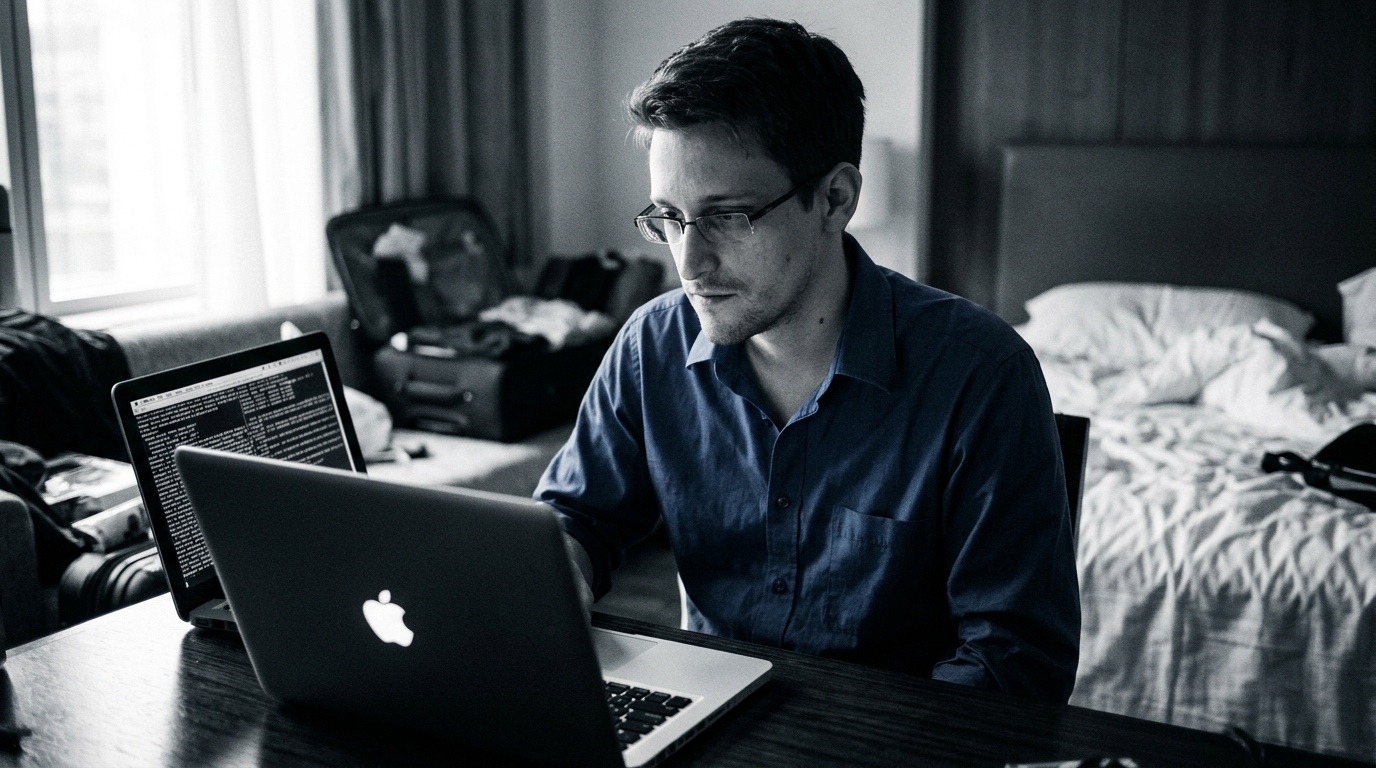
- The Laptop Hood Incident: While in his Hong Kong hotel room, worried about surveillance cameras, Snowden reportedly used a large red hood to cover his laptop and head while typing sensitive information. This image, later depicted in the film Snowden, became an iconic representation of his paranoia and the intense pressure he was under.
- The Data Haul and Selectivity: Estimates vary, but Snowden reportedly downloaded roughly 1.7 million classified documents. However, he did not indiscriminately release them. He worked with journalists to carefully select documents that demonstrated the scope of surveillance programs without compromising specific ongoing operations or revealing the identities of intelligence agents. Only a fraction of the documents he downloaded have ever been made public, leading to ongoing speculation about the full extent of his revelations.
- The Cube: Snowden often referred to the secure room in his Hawaii NSA facility where he would download documents as "the Cube." It was a highly secure, windowless office where he performed his duties and covertly executed his plan.
- Moscow Life and Advocacy: Despite being a constant point of contention in US-Russia relations, Snowden has largely maintained a quiet existence in Russia. He married his long-time girlfriend, Lindsay Mills, in 2017, and they had a son in 2020. He continues to engage in public speaking and privacy advocacy remotely, becoming a prominent voice for digital rights and often appearing at conferences via video link. His life in Russia, while offering him refuge, has also complicated his narrative for many, with critics questioning his impartiality given his host country's own surveillance record.
- The "Permanent Record" Backstory: Snowden's memoir, Permanent Record, published in 2019, detailed his upbringing, his journey into the intelligence world, his growing disillusionment, and the meticulous planning of the leaks. The book was designed to be his definitive account and an extension of his public service, aiming to explain his actions directly to the public.
References and Literature
- The Guardian - The Snowden Files - An exhaustive archive of the original 2013 reporting that broke the story, including primary documents and video interviews with Snowden.
- No Place to Hide by Glenn Greenwald - A detailed personal account of the logistics and moral implications of the Snowden leaks by the journalist who broke the story, offering an insider's perspective on working with Snowden.
- Permanent Record by Edward Snowden - Snowden's autobiography, providing his personal motivations, the meticulous planning behind the leaks, and his reflections on the aftermath.
- The NSA Archives (Foreign Affairs) - A resource for academic and policy analysis of how the 2013 disclosures impacted American soft power, international intelligence cooperation, and geopolitical stability.
- USA FREEDOM Act of 2015 (Congress.gov) - The official legislative outcome of the national debate triggered by the Snowden leaks, outlining its provisions and limitations.
- The Washington Post - The NSA files - Extensive reporting and analysis by The Washington Post, another primary outlet for the initial revelations, including detailed explanations of the programs.
- ACLU - Surveillance & Privacy - Resources and analysis from a leading civil liberties organization on the legal and constitutional implications of the Snowden leaks and ongoing surveillance debates.
---
Footnotes & Explanations
- PRISM was a signals intelligence (SIGINT) project managed by the NSA. It operated under Section 702 of the Foreign Intelligence Surveillance Act (FISA). ↩
- The Five Eyes is an intelligence alliance comprising Australia, Canada, New Zealand, the UK, and the USA, primarily focused on signals intelligence sharing. ↩
- USA PATRIOT Act, Public Law 107–56 (2001). Section 215 of the Act was central to the bulk metadata collection. ↩
- Carpenter v. United States, 585 U.S. ___ (2018). This Supreme Court case held that the government's acquisition of cell-site records was a Fourth Amendment search. ↩
- General Data Protection Regulation (GDPR), Regulation (EU) 2016/679. ↩