Key Takeaways
- The 2003 invasion fundamentally destabilized the Middle East, leading to the collapse of the Iraqi state, a protracted insurgency, and a power vacuum that facilitated the rise of militant extremism, including ISIS.
- The intelligence failure regarding Weapons of Mass Destruction (WMD) severely damaged the credibility of Western democratic institutions, international diplomatic norms, and contributed to a global crisis of trust in intelligence agencies.
- The transition from a secular, totalitarian regime to a fractured parliamentary democracy triggered long-standing sectarian tensions that redefined regional geopolitics, inadvertently empowering Iran and shifting the balance of power.
- The post-invasion occupation phase, marked by inadequate planning, de-Ba'athification, and the disbanding of the Iraqi army, directly contributed to the surge in violence, the collapse of civil order, and a lasting humanitarian crisis.
Historical Context and Origins
The roots of the 2003 invasion of Iraq are deeply embedded in the seismic shift in American foreign policy following the September 11, 2001, terrorist attacks. The horrific scale of the attacks on American soil created a profound sense of vulnerability and a fierce determination within the George W. Bush administration to prevent future threats. Within the corridors of the White House and the Pentagon, the doctrine of preemption—often referred to as the "Bush Doctrine"—gained primacy. This strategic shift argued that the United States could no longer wait for direct threats to materialize but must act proactively, even unilaterally, against hostile states and non-state actors who possessed or sought weapons of mass destruction (WMD) and harbored terrorists. This represented a dramatic departure from Cold War containment and deterrence strategies.
Iraq, under the iron-fisted rule of Saddam Hussein, was viewed through the lens of this new doctrine, albeit with a history predating 9/11. Following the First Gulf War in 1991, the international community had maintained over a decade of economic sanctions and "no-fly zones" over Iraq, enforced by U.S. and British airpower. The UN Special Commission (UNSCOM) and later UN Monitoring, Verification and Inspection Commission (UNMOVIC) had been tasked with disarming Iraq of its WMD programs. While much of Iraq's WMD capability had been dismantled in the 1990s, Saddam's regime often obstructed inspectors and engaged in cat-and-mouse games, fueling international suspicion. The perception in Washington and London, particularly among a powerful bloc of neoconservative thinkers, was that Saddam remained an unpredictable tyrant with deep-seated ties to terrorism and an ongoing, albeit clandestine, commitment to reconstituting his nuclear, biological, and chemical weapons programs. Figures like Vice President Dick Cheney and Secretary of Defense Donald Rumsfeld, alongside a network of neoconservative intellectuals, had advocated for regime change in Iraq since the mid-1990s, believing it was essential for regional stability and American strategic interests. The 9/11 attacks provided the necessary political impetus to transform this long-held ambition into actionable policy.
By 2002, the rhetoric surrounding Iraq decisively shifted from containment to "regime change." While the Bush administration cited intelligence reports—much of which was later proven to be flawed or deliberately exaggerated—the ideological push was also driven by neoconservative figures within the administration who argued that democratizing Iraq would create a "democratic domino effect" across the Middle East, challenging authoritarian regimes and potentially neutralizing the root causes of anti-Western sentiment and terrorism. This vision, often termed "Pax Americana," envisioned a restructured Middle East with a pro-Western, democratic Iraq as its cornerstone.
Historical Precedents & Context
The decision to invade Iraq in 2003 was not made in a historical vacuum but was influenced by a complex interplay of past events, policy debates, and long-standing regional dynamics.
The Legacy of the First Gulf War (1990-1991)
The First Gulf War, launched in response to Iraq's invasion of Kuwait, left Saddam Hussein in power but severely constrained by UN resolutions. Resolution 687, adopted in 1991, mandated Iraq's complete disarmament of WMDs and established the inspection regimes (UNSCOM, later UNMOVIC). For over a decade, Iraq engaged in a cat-and-mouse game with inspectors, often delaying, denying, or obstructing their work. This history of non-compliance, combined with the U.S. and U.K. enforcement of "no-fly zones" and periodic military actions like Operation Desert Fox (1998), hardened perceptions in Washington and London that Saddam would never truly disarm peacefully. The failure to remove Saddam in 1991 was seen by some policymakers, particularly neoconservatives, as a missed opportunity, fueling a desire for "finishing the job."
The "Dual Containment" Policy and its Evolution
In the 1990s, the U.S. pursued a "dual containment" strategy against both Iraq and Iran. The rationale was that both regimes posed significant threats to regional stability and U.S. interests. However, this policy proved difficult to sustain and was increasingly criticized for its cost and ineffectiveness. Advocates for regime change in Iraq argued that removing Saddam would simplify regional strategy, allowing the U.S. to focus its efforts or even foster a regional realignment.
The Role of UN Resolutions and International Law
From 1990 onwards, numerous UN Security Council resolutions addressed Iraq's compliance with disarmament and humanitarian obligations. Resolution 1441, passed unanimously in November 2002, was pivotal. It found Iraq in "material breach" of previous resolutions and offered Iraq "a final opportunity to comply with its disarmament obligations," warning of "serious consequences" for continued non-compliance. While the Bush administration interpreted this as implicit authorization for military action if Iraq failed to comply, many other nations, including France, Germany, and Russia, insisted that a new, explicit Security Council resolution was required to authorize the use of force. This fundamental disagreement over the interpretation of international law and the role of the UN Charter became a major source of transatlantic friction and undermined the legitimacy of the invasion.
The Neoconservative Movement
A significant intellectual and political force behind the drive to war was the neoconservative movement. Key figures like Paul Wolfowitz, Douglas Feith, and Richard Perle, many of whom were associated with think tanks like the Project for the New American Century (PNAC), had long argued for a more assertive American foreign policy, including regime change in Iraq. They believed in the transformative power of American military might and the spread of democracy, seeing a democratic Iraq as a catalyst for broader regional change. Their influence within the Pentagon and Vice President Cheney's office ensured that these ideas gained significant traction in the post-9/11 environment.
Timeline of Events and Key Moments
The trajectory toward war accelerated throughout 2002, culminating in the formation of the "Coalition of the Willing" and the military invasion.
| Date | Event | Significance |
|---|---|---|
| September 2002 | Bush UN Speech & National Security Strategy | President Bush challenges the UN to hold Iraq accountable, warning that failure to act would render the Security Council "irrelevant." The new National Security Strategy officially articulates the "Bush Doctrine" of preemption, asserting the right of the U.S. to act against perceived threats before they fully materialize. |
| October 2002 | Joint Resolution on Iraq | The U.S. Congress passes a resolution authorizing President Bush to use military force against Iraq, citing WMDs and links to terrorism. This provided domestic legal cover for the administration's actions. |
| November 2002 | Resolution 1441 | The UN Security Council unanimously demands Iraq provide a full, accurate, and complete declaration of its WMD programs. It offers Iraq "a final opportunity" and warns of "serious consequences" for non-compliance, but does not explicitly authorize military force. |
| December 2002 | Iraq's WMD Declaration | Iraq submits a 12,000-page declaration of its WMD programs. U.S. and British intelligence agencies immediately dismiss it as incomplete and untruthful, intensifying calls for military action. |
| February 2003 | Colin Powell's UN Address | Secretary of State Powell presents "evidence" of Iraqi WMDs and alleged links to terrorism to the UN Security Council, using satellite imagery, intercepted communications, and defector testimony. This presentation, later largely discredited, was a crucial part of the administration's public case for war. |
| March 17, 2003 | Bush's 48-Hour Ultimatum | President Bush issues a final ultimatum to Saddam Hussein and his sons to leave Iraq within 48 hours, or face military action. This marked the definitive end of diplomatic efforts to avert war. |
| March 20, 2003 | "Operation Iraqi Freedom" Begins | The U.S.-led coalition begins the bombing campaign, famously dubbed "Shock and Awe," targeting key military and government installations in Baghdad. This marked the formal commencement of the invasion. |
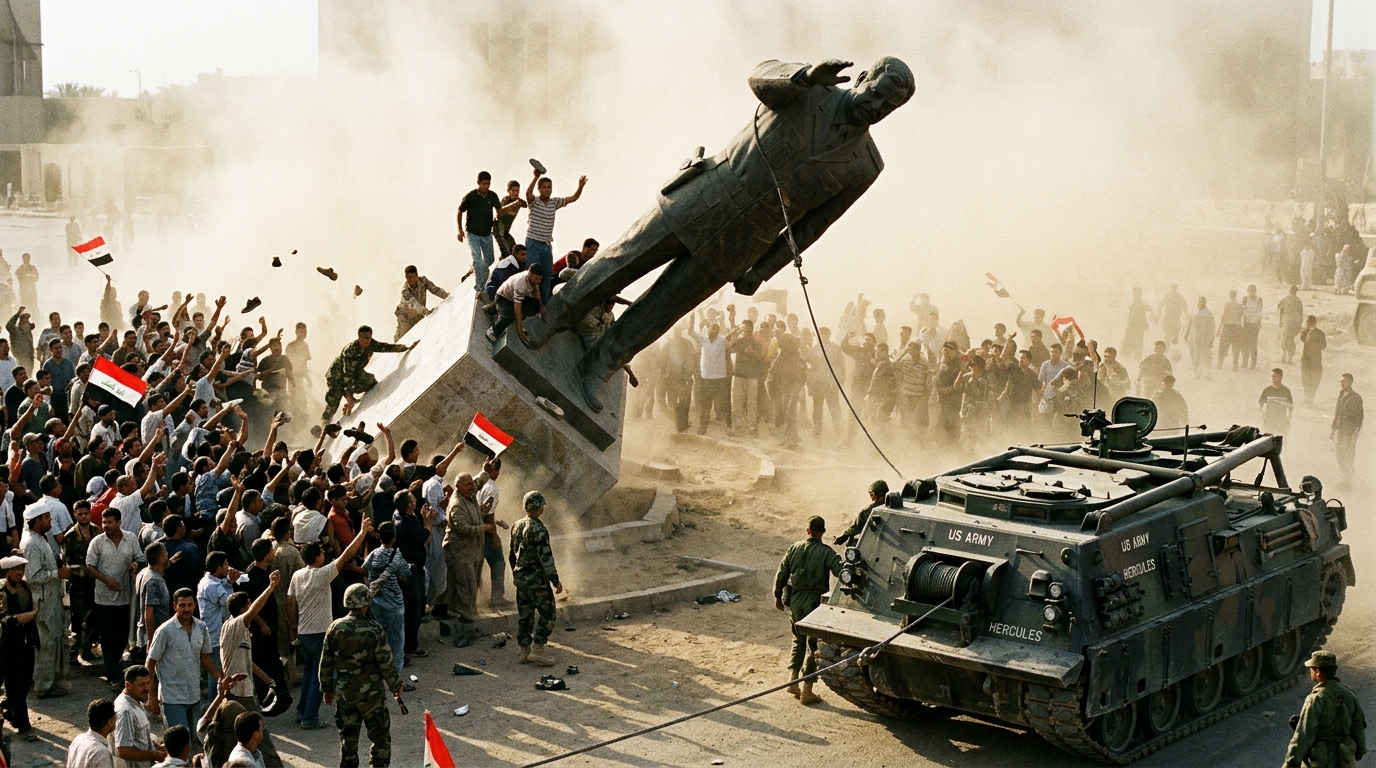
| April 9, 2003 | Fall of Baghdad | U.S. forces seize control of the capital, culminating in the iconic toppling of Saddam Hussein's statue in Firdos Square. This symbolized the collapse of the Ba'athist regime and was widely presented as the end of major resistance. |
| May 1, 2003 | "Mission Accomplished" Speech | President Bush delivers a speech on the USS Abraham Lincoln, declaring the end of major combat operations under a banner proclaiming "Mission Accomplished." This statement was widely criticized later as the insurgency in Iraq intensified significantly in the months and years that followed. |
| December 13, 2003 | Capture of Saddam Hussein | Saddam Hussein is captured by U.S. forces in a spider hole near Tikrit. His capture provided a sense of closure for the initial phase of the war but did little to quell the growing insurgency. |
Intelligence Failures and Manipulation
A critical and enduring controversy surrounding the 2003 invasion of Iraq centers on the intelligence used to justify the war. The consensus among numerous post-invasion inquiries, including the Duelfer Report, the 9/11 Commission Report, and the Chilcot Inquiry, is that the intelligence on Iraqi WMDs was fundamentally flawed, misinterpreted, and in some cases, politicized or exaggerated by the Bush and Blair administrations.
Key Intelligence Failures:
- "Curveball" (Rafid Ahmed Alwan al-Janabi): A major source for the claim that Iraq possessed mobile biological weapons laboratories was an Iraqi defector code-named "Curveball" by German intelligence. Despite German warnings about his mental instability and unreliability, his testimony was heavily relied upon by the CIA and presented by Secretary Powell at the UN as concrete evidence. "Curveball" later admitted to fabricating his story.
- Aluminum Tubes: Intelligence agencies presented aluminum tubes, imported by Iraq, as definitive proof of a clandestine nuclear weapons program, specifically for centrifuges to enrich uranium. However, experts from the Department of Energy argued these tubes were more likely intended for conventional artillery rockets. The Bush administration, notably Vice President Cheney, heavily promoted the centrifuge interpretation.
- Niger Yellowcake: The infamous claim that Iraq sought to purchase uranium yellowcake from Niger was based on forged documents. While initially part of the administration's narrative, this claim was later retracted by the White House after its falsity was exposed, leading to a major scandal involving Valerie Plame.
- Links to Al-Qaeda: Despite the Bush administration's repeated attempts to link Saddam Hussein to Al-Qaeda and the 9/11 attacks, independent intelligence assessments found no credible evidence of an operational alliance between Saddam's secular regime and the radical Islamist group. Indeed, their ideologies were largely antithetical. However, selective intelligence regarding alleged meetings or limited, indirect contacts was frequently presented to the public as proof of a significant threat.
- Exaggeration of Threat: Beyond specific factual errors, there was a systemic failure to critically assess and challenge existing assumptions about Iraq's WMD capabilities. Intelligence was often "stovepiped" – meaning it was shared selectively with officials who already supported the war, bypassing established analytic processes. The Office of Special Plans (OSP) in the Pentagon, established by Douglas Feith, was particularly criticized for cherry-picking intelligence to support the case for war and bypassing traditional intelligence channels.
Politicization of Intelligence:
Critics argue that the intelligence was not merely flawed but actively politicized. The administration faced intense pressure to find a definitive justification for regime change, and intelligence that supported the WMD narrative was often amplified, while dissenting voices or caveats were downplayed or ignored. This created an echo chamber where policymakers and the public were increasingly convinced of an imminent threat that did not, in fact, exist.
The profound impact of these intelligence failures extended far beyond the immediate decision to invade. It severely eroded public trust in government institutions, intelligence agencies, and the media in both the U.S. and the U.K. It also damaged the credibility of international bodies like the UN, whose inspectors (UNMOVIC) had consistently reported finding no evidence of active WMD programs in the months leading up to the invasion. The legacy of these failures continues to shape debates about intelligence reform, government transparency, and the use of military force based on unverified information.
Geopolitical Consequences and Aftermath
The fall of Saddam Hussein triggered a catastrophic collapse of social and political order in Iraq, with ripple effects that reshaped the entire Middle East. The power vacuum left by the defunct regime was rapidly filled by a myriad of competing actors, including sectarian militias, insurgent groups, and foreign powers. The rivalry between the majority Shia population—long suppressed under Saddam’s Sunni-dominated administration—and the Sunni minority intensified into a brutal civil war that lasted for years.
"The irony of the Iraq war is that it removed the greatest strategic obstacle to Iranian regional hegemony, yet it was executed by an administration that viewed Iran as a primary axis of evil." — Geopolitical Analyst, 2005
Key consequences included:
- The Rise of Extremism: The initial insurgency, led by remnants of the Ba'ath party, disgruntled Sunni military officers, and foreign fighters, evolved into Al-Qaeda in Iraq (AQI) under Abu Musab al-Zarqawi. AQI’s brutal sectarian tactics ignited the civil war and radicalized a generation. Following a period of decline after the U.S. "surge" and the Sunni Awakening, AQI rebranded and re-emerged as the Islamic State of Iraq (ISI) and later the Islamic State of Iraq and Syria (ISIS/Daesh) in 2013-2014, leveraging the chaos of the Syrian Civil War and continued instability in Iraq to seize vast swathes of territory, establish a self-proclaimed caliphate, and launch a global terrorist campaign.
- Iran’s Regional Ascent: The removal of Saddam Hussein, a staunch Sunni Arab nationalist and a long-standing adversary, fundamentally altered the regional balance of power in favor of Shia-majority Iran. With the Sunni-led Iraqi military shattered and a Shia-dominated government rising in Baghdad, Iran utilized its proxies (such as the Quds Force of the IRGC) and political influence to establish deep ties with the new Iraqi political elite and support powerful Shia militias. This expanded Iran’s arc of influence across the "Shia Crescent," from Tehran through Baghdad, Damascus, and Beirut, significantly empowering it as a regional hegemon and intensifying its rivalry with Sunni Arab states like Saudi Arabia.
- Transatlantic Friction and Erosion of International Law: The lack of explicit UN Security Council authorization for the invasion caused the most significant rift in the U.S.-European relationship since the founding of NATO. Major European powers like France and Germany vocally opposed the invasion, leading to strained diplomatic relations and challenging the notion of a unified Western foreign policy. The invasion also set a dangerous precedent, undermining the principle of state sovereignty and the UN Charter's prohibition on the aggressive use of force, contributing to a global perception of diminished respect for international law and multilateral institutions.
- The Kurdish Question and Regional Instability: The collapse of Saddam’s centralized state enabled the Kurdistan Region in northern Iraq to consolidate its autonomy, building its own robust institutions and military (the Peshmerga). This increased Kurdish aspirations for full independence, creating new tensions with Baghdad, Ankara (Turkey), and Tehran, who feared secessionist movements within their own Kurdish populations. The war also contributed to the destabilization of neighboring Syria, both through refugee flows and the eventual spillover of the Iraqi insurgency.
- Damage to U.S. Credibility and Soft Power: The failure to find WMDs, the protracted insurgency, reports of detainee abuse at Abu Ghraib, and the overall high human and financial cost of the war severely damaged America's international standing and its ability to garner global support for future foreign policy initiatives. It fueled anti-American sentiment in the Middle East and beyond, making it harder for the U.S. to project its values and influence through "soft power."
The Socio-Economic and Humanitarian Aftermath
Beyond the geopolitical shifts, the Iraq War exacted a staggering toll on Iraqi society and economy, leading to a profound humanitarian crisis that continues to reverberate.
Human Cost
The immediate and long-term human cost was immense. Estimates vary widely, but credible sources suggest that hundreds of thousands of Iraqis died as a direct or indirect consequence of the invasion, civil war, and subsequent violence. This includes civilian casualties from combat operations, sectarian killings, terrorist attacks, and the breakdown of essential services. Millions more were displaced internally or became refugees in neighboring countries like Syria, Jordan, and Turkey, fueling regional demographic shifts and straining host countries' resources. The psychological trauma inflicted on an entire generation of Iraqis is incalculable.
Economic Devastation and Failed Reconstruction
Iraq's economy, already crippled by decades of sanctions and the Iran-Iraq War, was further devastated. Critical infrastructure – including electricity grids, water treatment plants, oil facilities, and transportation networks – suffered extensive damage during the invasion and subsequent looting. Reconstruction efforts, managed primarily by the Coalition Provisional Authority and later the Iraqi government, were plagued by corruption, mismanagement, and the ongoing insurgency. Billions of dollars earmarked for reconstruction were lost or misspent, leaving many vital services unreliable or non-existent for years. Unemployment soared, particularly among the youth, providing a ready pool of recruits for militias and insurgent groups. The collapse of the state apparatus also fostered widespread corruption, institutionalizing it within the new political system and further undermining public trust.
Erosion of Social Fabric and Cultural Heritage
The sectarian violence shattered Iraq's historically diverse social fabric. The deliberate targeting of specific communities, forced displacements, and assassinations of professionals (doctors, engineers, academics) led to a massive "brain drain," depriving Iraq of its vital human capital. This compounded the challenges of rebuilding and reconciliation. Furthermore, Iraq's rich cultural heritage suffered irreparable damage. The immediate aftermath of the invasion saw widespread looting of archaeological sites and cultural institutions, most famously the National Museum of Iraq in Baghdad, where thousands of priceless artifacts from ancient Mesopotamia were stolen or destroyed. The U.S. military's failure to secure these sites drew international condemnation and symbolized the broader lack of planning for post-invasion stability.
Health Crisis and Environmental Impact
The conflict severely degraded Iraq's public health system. Hospitals were damaged, medical supplies became scarce, and many doctors fled the country. The lack of access to clean water and sanitation led to outbreaks of preventable diseases. The extensive use of weaponry, including depleted uranium munitions, also raised concerns about long-term environmental contamination and health impacts, although conclusive studies are still debated.
The socio-economic and humanitarian aftermath of the Iraq War underscores the profound and long-lasting consequences of military intervention, particularly when post-conflict planning is inadequate. The legacy of instability, violence, and human suffering continues to define Iraq's trajectory decades later.
Analysis of Key Actors and Decisive Actions
The Iraq War was shaped by the decisions and actions of a handful of influential figures, each driven by distinct motivations and operating within complex political landscapes.
George W. Bush
President Bush’s leadership was characterized by a deep personal conviction that the "liberation" of Iraq was a moral necessity and a cornerstone of American national security after 9/11. His focus on "preventive war," articulated in the Bush Doctrine, effectively abandoned the post-Cold War framework of collective security, establishing the U.S. as a unilateral actor willing to act decisively against perceived threats. Bush’s resolve, often described as steadfast and unwavering, was rooted in a belief that Saddam Hussein posed an unacceptable danger, possessed WMDs, and harbored terrorists. He relied heavily on a tight-knit inner circle, including Vice President Dick Cheney and Secretary of Defense Donald Rumsfeld, who were influential proponents of regime change and a more assertive American posture globally. Bush's decision to bypass explicit UN Security Council authorization, while securing congressional approval, reflected a prioritization of perceived national interest over international consensus, a move that permanently strained relations with key allies.
Saddam Hussein
Saddam's refusal to be transparent regarding his WMD capabilities was a fatal strategic error. He likely maintained a deliberate ambiguity about his programs, aiming to deter Iranian aggression and project strength in a hostile region, never anticipating that such ambiguity would be interpreted as concrete evidence of active stockpiles by a determined U.S. intelligence community and administration. His regime was built on a cult of personality, fear, and a sophisticated internal security apparatus. Believing he could withstand international pressure as he had in the past, Saddam underestimated the post-9/11 shift in U.S. foreign policy and the neoconservative drive for regime change. His strategic calculus, designed for regional deterrence, became a self-fulfilling prophecy for invasion.
Tony Blair
British Prime Minister Tony Blair became the most prominent international advocate for the war, standing shoulder-to-shoulder with President Bush. His decision to commit British forces to the invasion was deeply controversial within the UK and his own Labour Party. Blair's stated rationale for supporting the war was based on preventing Saddam from using or proliferating WMDs and upholding UN resolutions. He insisted on the veracity of intelligence reports, including the infamous "dodgy dossier," which was later criticized for exaggerating the immediate threat posed by Iraq's WMDs. His close relationship with Bush, often termed a "Poodle" by critics, led to accusations that he committed Britain to war without sufficient justification or independent assessment. The subsequent Chilcot Inquiry years later delivered a scathing verdict, concluding that the invasion was launched before peaceful options for disarmament had been exhausted, that the intelligence had not justified the level of certainty expressed, and that planning for post-invasion Iraq was "wholly inadequate." This significantly tarnished his political legacy.
Colin Powell
Perhaps the most tragic figure of the episode, Secretary of State Colin Powell’s presentation to the UN Security Council on February 5, 2003, gave the invasion a crucial, albeit temporary, veneer of international legitimacy. Powell, a highly respected former Chairman of the Joint Chiefs of Staff and a moderate voice within the administration, used satellite imagery, intercepted communications, and defector testimony to make the case for Iraq's WMDs, particularly mobile biological labs and ties to terrorism. He later described the presentation as a "blot" on his record, having been fed intelligence by the CIA that he later discovered was highly questionable and, in many cases, outright false. Powell's known caution and integrity were leveraged by the administration to add credibility to its assertions, making his later revelations of regret even more impactful and highlighting the pressures placed on senior officials during wartime.
Donald Rumsfeld
As Secretary of Defense, Donald Rumsfeld was a key architect of the war and its execution. A staunch neoconservative and proponent of a lean, agile military, he championed a rapid, technology-driven invasion plan ("shock and awe") over a larger, more traditional force deployment. He was also a leading voice in downplaying the need for extensive post-invasion planning, famously dismissing concerns about looting and insurgency as "stuff happens." His policies of "de-Ba'athification" and disbanding the Iraqi army, implemented by the CPA, proved catastrophic for post-invasion stability, alienating vast segments of the Iraqi population and fueling the insurgency. Rumsfeld's aggressive, often abrasive style and his dismissal of criticisms contributed to significant friction within the Pentagon and with State Department officials.
Dick Cheney
Vice President Dick Cheney was arguably the most powerful and influential proponent of the invasion within the administration. A long-time advocate for assertive American power and regime change in Iraq, he was instrumental in shaping the administration's post-9/11 security doctrine. Cheney was deeply involved in pushing for the war, frequently visiting the CIA to question analysts and promoting the most aggressive interpretations of intelligence, particularly regarding WMDs and Iraq's alleged ties to Al-Qaeda. His office, along with Rumsfeld's Pentagon, was criticized for creating its own intelligence analyses that often diverged from and circumvented official intelligence agencies, effectively creating a parallel intelligence stream that buttressed the case for war. Cheney’s influence ensured that the neoconservative vision for Iraq became a central pillar of U.S. foreign policy.
Trivia and Lesser-Known Facts
- The "Deck of Cards": In April 2003, the U.S. military issued a famous deck of playing cards to soldiers featuring the most wanted members of the Saddam regime, with their faces and positions. The Ace of Spades was Saddam Hussein himself, while his sons Uday and Qusay were the Ace of Hearts and Clubs, respectively. This initiative was part of a psychological operation to aid identification and capture of high-value targets.
- The Looting of the National Museum of Iraq: In the immediate aftermath of Baghdad’s fall, the National Museum of Iraq was looted of thousands of priceless ancient artifacts, some dating back millennia to the dawn of civilization. The U.S. military’s widely criticized failure to protect the museum became a powerful symbol of the broader failure of the occupation to secure basic order and safeguard Iraqi heritage, contributing to a black market for antiquities.
- The "Green Zone": The Coalition Provisional Authority established a heavily fortified area in central Baghdad, the "International Zone," which quickly became known as the "Green Zone." This sprawling, secure enclave housed coalition forces, diplomats, and the interim Iraqi government. It became a symbol of the disconnect between the occupying forces and the daily realities faced by ordinary Iraqis outside its walls, fostering resentment and suspicion.
- The Oil Factor: While often cited by critics as the primary motivation for the war, most economic analyses suggest that the actual cost of the war to the U.S. treasury (estimated at over $2 trillion) far outweighed any potential economic benefit from Iraqi petroleum. Despite the initial speculation, Iraqi oil production and exports faced significant challenges due to insurgency, corruption, and infrastructure damage, preventing any quick financial windfall.
- Private Military Contractors: The Iraq War saw an unprecedented reliance on private military and security companies (PMSCs). Thousands of contractors, performing tasks from security and logistics to intelligence gathering, operated in Iraq, often with less oversight and accountability than conventional military forces. This raised significant legal and ethical questions about their role in conflict zones.
- "Mission Accomplished" Backlash: President Bush's declaration of "Mission Accomplished" on May 1, 2003, just six weeks after the invasion began, proved to be an enduring public relations blunder. The banner, originally a tribute to naval personnel, quickly became a symbol of premature celebration and official disconnect as the insurgency escalated and the occupation dragged on for years.
References and Literature
- The Chilcot Report - The official British public inquiry into the role of the UK government in the Iraq War. It provides an exhaustive analysis of the decisions leading to war, the legal basis, and the post-invasion planning.
- The Duelfer Report (Comprehensive Report of the Special Advisor to the DCI on Iraq's WMD) - The comprehensive report by the Iraq Survey Group on the status of Iraq's WMD programs post-invasion. It conclusively found no active WMD programs.
- Fiasco: The American Military Adventure in Iraq by Thomas E. Ricks - A definitive and highly acclaimed account of the strategic and operational failures of the occupation phase, drawing heavily on military sources.
- The New York Times Iraq War Archive - A comprehensive collection of contemporary reporting, historical analysis, and interactive features detailing the conflict and its aftermath.
- Cobra II: The Inside Story of the Invasion and Occupation of Iraq by Michael R. Gordon and Bernard E. Trainor - Provides a detailed, behind-the-scenes account of the military planning and execution of the invasion and the initial months of the occupation.
- State of Denial: Bush at War, Part III by Bob Woodward - Explores the internal debates and conflicts within the Bush administration regarding the Iraq War, particularly focusing on the intelligence and post-invasion strategy.
Footnotes & Explanations
- The intelligence community's failure to verify human intelligence sources, specifically those like "Curveball" who fabricated stories about mobile biological weapons labs, led to the false WMD narrative. This lack of rigorous vetting was compounded by political pressure to find supporting evidence for the invasion. ↩
- The CPA Order Number 1, which effectively purged all members of the Ba'ath party from public life, and CPA Order Number 2, which disbanded the Iraqi military, essentially dismantled the entire administrative and security apparatus of the state. These decisions are widely regarded as critical missteps that fueled the insurgency and plunged Iraq into chaos. ↩