Key Takeaways
- The 1997 handover marked the end of over 150 years of British colonial rule in Hong Kong, symbolizing the definitive retreat of the British Empire from Asia.
- The transfer was executed under the 'One Country, Two Systems' constitutional framework, designed by Deng Xiaoping to preserve Hong Kong's capitalist system and lifestyle for 50 years.
- The transition period was marked by intense diplomatic friction over democratic reforms initiated by the last British Governor, Chris Patten, which Beijing strongly opposed.
Historical Context and Origins
The British colonization of Hong Kong was a direct consequence of the asymmetric conflicts of the 19th century, known collectively as the Opium Wars. The territories that formed the Crown Colony of Hong Kong were acquired by Great Britain in three distinct stages, each formalized through treaties that the Chinese Qing Dynasty later characterized as "unequal treaties."
The first stage occurred in the wake of the First Opium War (1839–1842). Under the Treaty of Nanking signed in 1842, Qing China ceded Hong Kong Island to the British Crown in perpetuity 1. Seeking to expand their foothold and secure the deep-water harbor, the British pushed north during the Second Opium War (1856–1860). The subsequent Convention of Peking in 1860 resulted in the permanent cession of the Kowloon Peninsula up to Boundary Street 2.
The third and geographically most significant expansion occurred in 1898. Recognizing the need for a defensive buffer zone and agricultural land to support the rapidly growing colony, Great Britain negotiated the Second Convention of Peking. This agreement leased the New Territories—comprising the land north of Kowloon up to the Sham Chun River and over 200 outlying islands—to Great Britain for a period of exactly 99 years, commencing on July 1, 1898 3. Unlike Hong Kong Island and Kowloon, which were held in perpetuity, the New Territories were bound by a strict legal expiration date: June 30, 1997.
GROWTH OF COLONIAL HONG KONG
| Territory | Treaty / Agreement | Legal Status |
|---|---|---|
| Hong Kong Island (1842) | Treaty of Nanking | Ceded in perpetuity |
| Kowloon Peninsula (1860) | Convention of Peking (1860) | Ceded in perpetuity |
| New Territories (1898) | Second Convention of Peking (1898) | 99-year lease (Expires 1997) |
By the late 1970s, the impending expiration of the New Territories lease emerged as an urgent practical problem. Because the New Territories accounted for over 90 percent of Hong Kong's total landmass and contained the majority of the colony’s water reservoirs, power plants, and modern industrial infrastructure, partition was structurally impossible. Investors in Hong Kong became increasingly hesitant to commit capital to long-term leases and infrastructure projects that extended beyond 1997.
In 1982, British Prime Minister Margaret Thatcher traveled to Beijing to initiate formal negotiations with Deng Xiaoping, the paramount leader of the People's Republic of China (PRC). Thatcher initially attempted to negotiate an extension of the British administration of the territory, proposing that Britain retain administrative control while conceding formal sovereignty to China. Deng rejected this proposal outright, asserting that sovereignty and administration were inseparable and that China would recover the entire territory of Hong Kong in 1997, by force if necessary 4.
Faced with China’s unyielding stance, British diplomats pivoted toward securing a framework that would preserve Hong Kong's unique legal, social, and economic systems. These arduous negotiations culminated on December 19, 1984, with the signing of the Sino-British Joint Declaration in Beijing. The Joint Declaration stipulated that the PRC would resume the exercise of sovereignty over the entire territory of Hong Kong on July 1, 1997.
To reassure the local population and global markets, China agreed to write Deng Xiaoping’s concept of "One Country, Two Systems" into the treaty. Under this framework, Hong Kong would become a Special Administrative Region (SAR) enjoying a "high degree of autonomy," except in foreign affairs and defense. Its capitalist economy, common law legal system, lifestyle, and basic civil liberties would remain unchanged for a period of 50 years, lasting until at least 2047 5. This principle was subsequently codified in the Basic Law of Hong Kong, which was promulgated by the Chinese National People's Congress in 1990 to serve as the mini-constitution for the post-handover era.
Timeline of Events and Key Moments
The road to July 1, 1997, was marked by intense diplomatic maneuverings, domestic political shifts, and escalating tensions between London and Beijing, particularly in the wake of the 1989 Tiananmen Square crackdown.
The Decisive Decade (1984–1992)
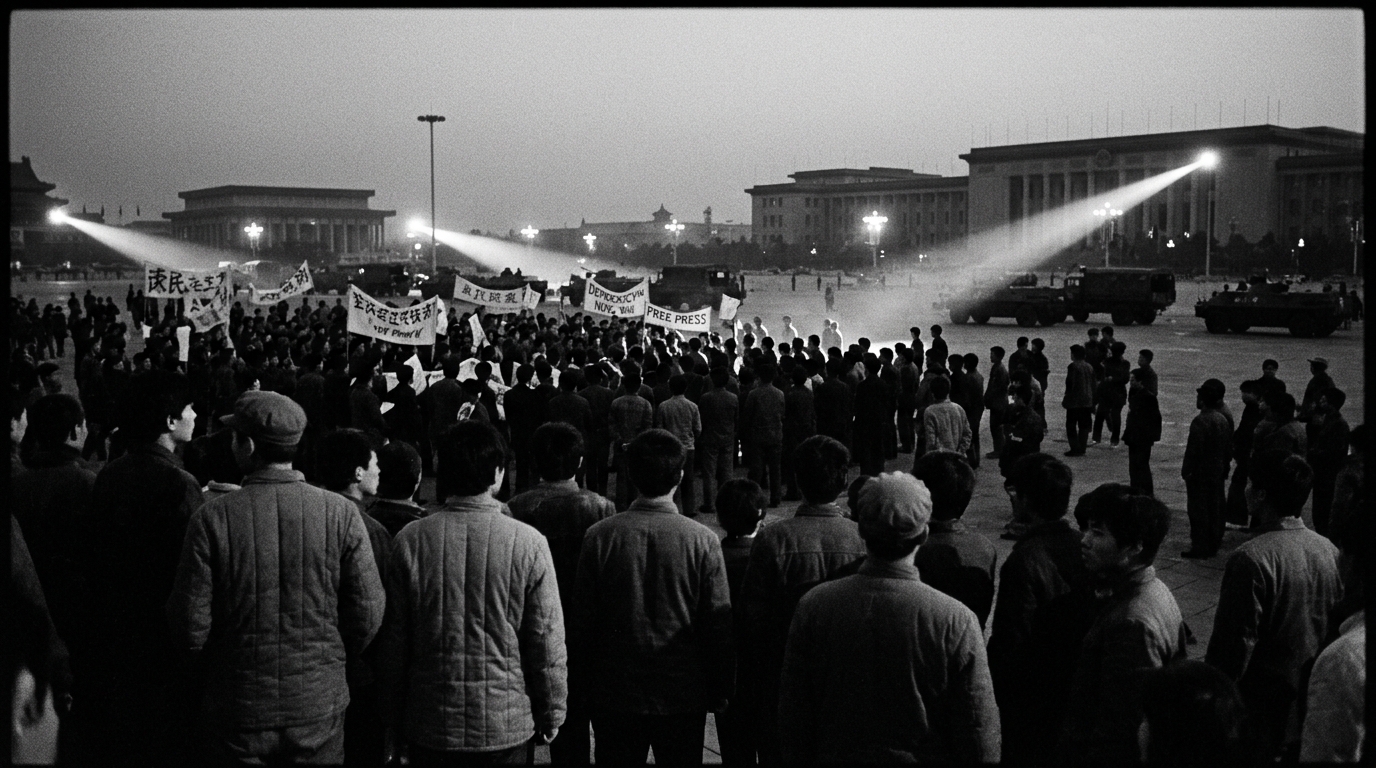
Following the signing of the Joint Declaration, a Sino-British Joint Liaison Group (JLG) was established to iron out the technical details of the transfer, such as civil aviation rights, military land use, and the status of treaties. However, mutual trust collapsed in June 1989. The violent suppression of pro-democracy protests in Beijing sparked massive demonstrations in Hong Kong, where over a million citizens took to the streets in solidarity. The event triggered widespread anxiety about the territory's future under Chinese rule, resulting in a massive wave of emigration—the "brain drain"—as middle-class professionals sought foreign passports, primarily in Canada, Australia, and the United Kingdom 6.
In response to the crisis of confidence, the British government, led by Prime Minister John Major, enacted several measures. It introduced the British Nationality Selection Scheme, granting full British citizenship to 50,000 key Hong Kong families to encourage them to stay in the territory, and passed the Hong Kong Bill of Rights Ordinance in 1991.
The Era of Chris Patten (1992–1997)
The dynamics of the transition changed dramatically in 1992 with the appointment of Chris Patten as the 28th and final Governor of Hong Kong. Unlike his predecessors, who were career diplomats and Sinologists favoring quiet diplomacy, Patten was a high-profile Conservative politician and former cabinet minister. He adopted a more confrontational and transparent approach toward Beijing.
CHRONOLOGY OF THE TRANSITION
- Dec 19, 1984: Sino-British Joint Declaration signed
- Jun 4, 1989: Tiananmen Square crackdown triggers panic
- Jul 9, 1992: Chris Patten arrives as the last Governor
- Jun 1994: LegCo passes Patten's electoral reforms
- Dec 1996: Tung Chee-hwa chosen as first Chief Executive
- Jun 30, 1997: Royal Farewell at East Tamar
- Jul 1, 1997: Handover Ceremony; HKSAR established
In late 1992, Patten announced a series of constitutional reforms designed to broaden the democratic franchise for the 1995 Legislative Council (LegCo) elections. He proposed lowering the voting age to 18 and replacing appointed seats with democratically elected functional constituencies, effectively giving almost every working citizen a vote in the legislature.
Beijing reacted with fury. Chinese officials accused Patten of unilaterally violating the spirit of the Joint Declaration and the Basic Law. Lu Ping, the director of China's Hong Kong and Macau Affairs Office, publicly branded Patten a "sinner for a thousand generations" (qiangu zuiren). Despite Beijing's fierce opposition and threats to dismantle the reforms after the transition, the Legislative Council passed Patten’s reform package in June 1994. The 1995 elections resulted in a sweeping victory for pro-democracy candidates.
In retaliation, Beijing declared that the "through train"—the agreement under which the legislature elected in 1995 would automatically transition into the post-handover legislature—was dead. In December 1996, China established a Provisional Legislative Council (PLC), composed of handpicked pro-Beijing figures, which met in Shenzhen during the final months of British rule to draft laws that would replace Hong Kong's liberalized statutes on July 1, 1997 7. Concurrently, Tung Chee-hwa, a conservative shipping tycoon, was selected by a Beijing-vetted 400-member Selection Committee to serve as Hong Kong’s first Chief Executive.
The Handover Night: June 30 – July 1, 1997
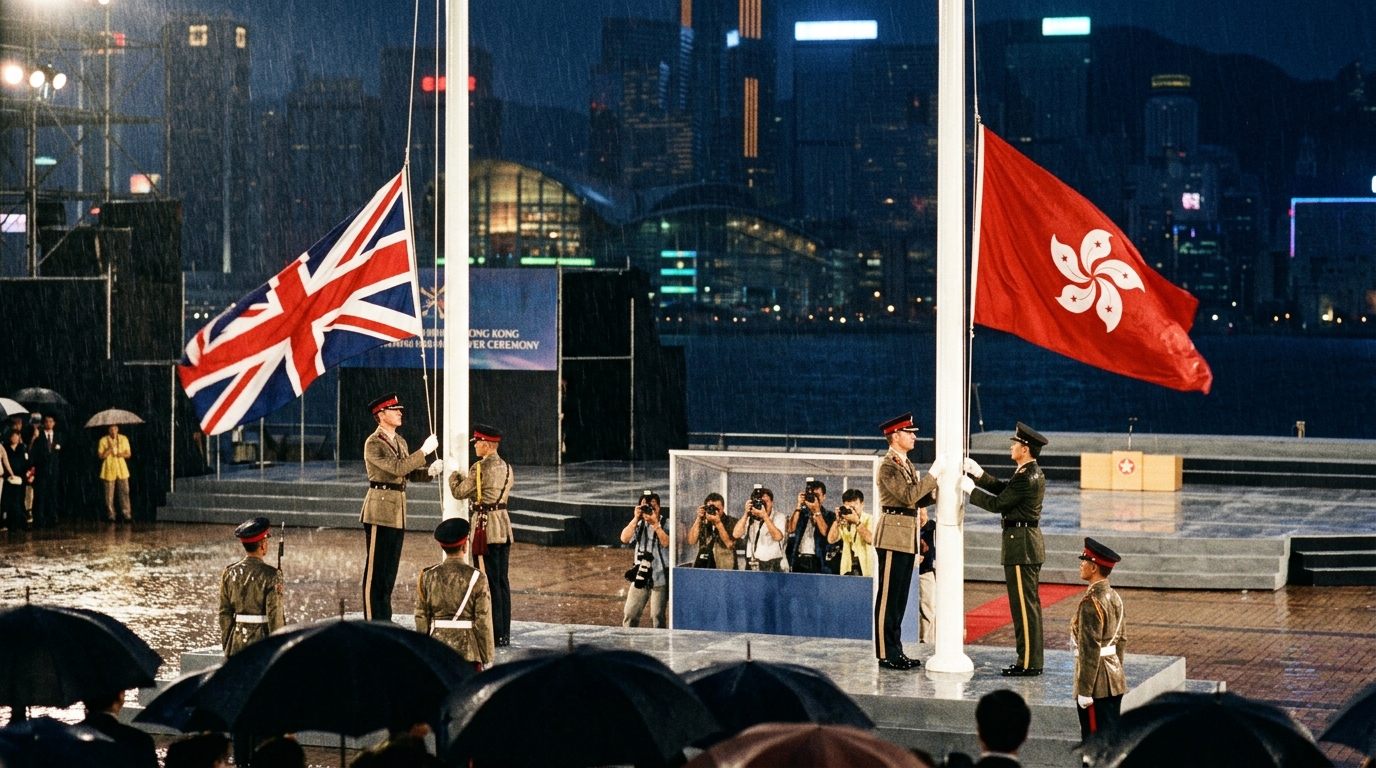
The formal transfer of sovereignty was executed during a series of highly choreographed ceremonies amid torrential monsoon rains.
- The British Farewell Ceremony (June 30, 4:00 PM – 8:00 PM):
- The Midnight Handover Ceremony (June 30, 11:30 PM – July 1, 12:15 AM):
At exactly 23:59:48, the British flag was lowered to the national anthem God Save the Queen. At precisely midnight, July 1, 1997, the flag of the People's Republic of China and the new Bauhinia flag of the Hong Kong Special Administrative Region were raised, accompanied by the Chinese national anthem, March of the Volunteers.
"The transfer of Hong Kong to Chinese sovereignty, which is taking place today, is a major event in the history of modern China and the world... The concept of 'One Country, Two Systems' is a creative, pioneering undertaking." — Jiang Zemin, President of the People's Republic of China, July 1, 1997 [[^8]]
Following the official speeches, Prince Charles and Chris Patten boarded the Royal Yacht Britannia at the naval basin, departing Hong Kong waters along with the final contingent of British forces. This departure marked the symbolic end of British imperial rule in Asia.
Geopolitical Consequences and Aftermath
The handover of Hong Kong in 1997 had profound geopolitical ramifications, signaling a structural shift in the global balance of power and the arrival of a multipolar world order.
For Great Britain, the loss of Hong Kong was the final major act of decolonization. While minor territories like Gibraltar and the Falkland Islands remained under British control, Hong Kong was the crown jewel of its remaining empire—a global financial hub of six million people, accounting for a massive share of the UK's remaining colonial footprint. The images of the Royal Yacht Britannia sailing into the dark night came to symbolize the definitive end of the British Empire, which had dominated global affairs for over three centuries 9.
IMMEDIATE GEOPOLITICAL REORGANIZATION
- PEOPLE'S REPUBLIC OF CHINA
- UNITED STATES & WESTERN ALLIES
For the People's Republic of China, the recovery of Hong Kong was celebrated as a historic triumph. It marked the successful reversal of what the Chinese Communist Party termed the "Century of Humiliation"—the period starting with the First Opium War during which Western powers and Japan extracted territorial concessions and infringed on Chinese sovereignty. The peaceful reacquisition of Hong Kong was presented to the domestic audience as proof of the strength and legitimacy of the PRC's political system under the banner of national rejuvenation.
In the years immediately following the handover, the "One Country, Two Systems" framework functioned surprisingly well. The Asian Financial Crisis of 1997 hit the region just days after the transfer of sovereignty. Under Tung Chee-hwa, the Hong Kong government intervened heavily in the stock market to defend the Hong Kong Dollar’s peg to the US Dollar. Beijing refrained from direct intervention, earning praise from international financial institutions and reinforcing confidence that Hong Kong’s economic autonomy was genuine 10.
However, systemic political contradictions began to surface over time. The fundamental tension between "One Country"—the absolute sovereignty of Beijing—and "Two Systems"—the civil liberties and democratic aspirations of the Hong Kong populace—became the defining fault line of the territory's modern history.
Major milestones of friction include:
- The 2003 Article 23 Protests: A massive demonstration by over 500,000 citizens forced the Hong Kong government to shelve a proposed national security law, revealing deep-seated public anxieties about Beijing's encroaching legal standards.
- The 2014 Umbrella Movement: A 79-day civil disobedience campaign triggered by Beijing's decision to pre-screen candidates for the Chief Executive elections.
- The 2019 Anti-Extradition Bill Protests: A period of sustained, widespread, and occasionally violent unrest that paralyzed parts of the city.
- The 2020 National Security Law: Following the 2019 protests, Beijing bypassed the local legislature to directly impose a sweeping National Security Law, fundamentally reshaping Hong Kong's legal and political landscape and drawing sharp condemnation from Western nations, who argued it represented a premature breach of the 1984 Joint Declaration [[^11]].
Analysis of Key Actors and Decisive Actions
The transfer of power was shaped by three key personalities who brought vastly different priorities, backgrounds, and ideological perspectives to the transition process.
| Name | Role | Focus |
|---|---|---|
| Jiang Zemin | PRC President | National Unity |
| Chris Patten | Last Gov of HK | Democratization |
| Tony Blair | UK Prime Min | New Pragmatism |
Jiang Zemin
Jiang Zemin, who assumed the presidency of the PRC following the death of Deng Xiaoping in February 1997, viewed the Hong Kong handover as a critical milestone for his personal political legacy and the consolidation of his authority within the Chinese Communist Party.
Jiang’s approach was highly conservative, focusing on national sovereignty, prestige, and stability. He was determined to project an image of a powerful, modernizing China that could successfully integrate a hyper-capitalist city without compromising party control. His decision to deploy troops of the People's Liberation Army (PLA) into Hong Kong at the exact stroke of midnight on July 1, 1997, was a calculated demonstration of sovereign control designed to signal to both domestic and international audiences that China’s authority over the territory was absolute and non-negotiable.
Chris Patten
As the last representative of the British Crown, Chris Patten sought to leave Hong Kong with "honor intact." He believed that Britain had a moral obligation to bequeath a durable democratic structure to the people of Hong Kong before the colony’s demise.
Patten’s decision to pursue unilateral political reforms without Beijing’s consent was a calculated gamble. He wagered that once democratic institutions and a culture of civic participation were established, they would be too difficult and politically costly for Beijing to dismantle. While his reforms were eventually undone by the establishment of the Provisional Legislative Council, Patten succeeded in fostering a politically active civil society. His legacy remains highly polarized: supporters view him as a principled defender of democratic values and human rights, while critics argue his combative approach needlessly alienated Beijing and doomed the smooth, long-term political transition of the territory 12.
Tony Blair
Tony Blair entered the Hong Kong drama at the eleventh hour, having won a landslide general election victory on May 1, 1997, just two months before the handover. As the leader of "New Labour," Blair was eager to distance his government from old imperial traditions while ensuring a dignified exit that preserved Britain’s global reputation.
Blair's objective was to transition Britain’s relationship with China from colonial confrontation to pragmatic cooperation. While he strongly supported Patten’s emphasis on the Joint Declaration, Blair was conscious of China's growing economic weight. During his meetings with Chinese leaders in June and July 1997, Blair sought to position Britain as a key economic partner in Europe for China, emphasizing that the smooth implementation of the "One Country, Two Systems" framework would be the ultimate test of China’s standing in the international community.
Trivia and Lesser-Known Facts
- The Weather's Metaphor: The torrential rain that fell on June 30, 1997, was one of the heaviest downpours in Hong Kong's recorded history. For British colonial officials, the rain was a melancholy backdrop to the end of empire. For many local Chinese, however, the heavy rain was viewed through the lens of traditional culture as a symbol of "cleansing" (sai gai), washing away the legacy of foreign colonial domination and bringing prosperity.
- The Royal Yacht's Final Mission: The HMS Britannia, which transported Prince Charles and Chris Patten out of Hong Kong, was decommissioned later that year in December 1997. The British government decided not to replace the yacht, making the departure from Hong Kong the final official state voyage of the vessel, which had served the Royal Family for 44 years.
- The "Through Train" Metaphor: The term "through train" (zhiztongche) was coined by political analysts and diplomats in the 1980s to describe the plan where members of Hong Kong’s pre-handover legislature would automatically become members of the first HKSAR legislature. When the train was "derailed" by Patten’s reforms, the members of the Provisional Legislative Council had to travel to Shenzhen, across the border, to hold their sessions before July 1, because they had no legal standing in colonial Hong Kong.
- The Black Friday of 1983: During the height of the Sino-British negotiations in September 1983, panic over the territory's future triggered a massive sell-off of the local currency. On "Black Friday" (September 24, 1983), the Hong Kong Dollar plummeted to an all-time low. This crisis forced the colonial government to peg the Hong Kong Dollar to the US Dollar at a rate of 7.80 HKD to 1 USD—a monetary system that remains in place to this day.
- The Secret Defense Plans: Throughout the Cold War, the British military conducted periodic reviews of Hong Kong's defenses. These classified assessments consistently concluded that the territory was militarily indefensible against a full-scale invasion by the PLA. Consequently, the role of the British garrison in Hong Kong was changed from external defense to internal security and border control, with plans for a rapid evacuation of British nationals in the event of an outbreak of hostilities.
References and Literature
- The Sino-British Joint Declaration (1984) - Official registered treaty text deposited at the United Nations, outlining the terms of the transfer of sovereignty.
- East and West: The Last Governor of Hong Kong on Power, Freedom and Future - Chris Patten's personal memoir detailing his tenure, political reforms, and relations with Beijing.
- Hong Kong's History: State and Society Under Colonial Rule - A comprehensive academic overview of the social and economic transformations of Hong Kong under British administration.
- The Fall of Hong Kong: China's Triumph and Britain's Betrayal - Mark Roberti's detailed journalistic account of the secret negotiations leading up to the 1997 handover.
Footnotes & Explanations
- Treaty of Nanking (1842): Article III of the treaty stipulated that "the Island of Hongkong" be ceded to the British Crown "in perpetuity." ↩
- Convention of Peking (1860): Article VI of this bilateral agreement expanded the British colony to include the Kowloon Peninsula. ↩
- Second Convention of Peking (1898): Under this agreement, Great Britain leased the New Territories for a fixed duration of 99 years, expiring June 30, 1997. ↩
- Thatcher-Deng Negotiations (1982): Official British diplomatic cables released by the National Archives record Deng’s assertion that China would "retrieve sovereignty in 1997." ↩
- Sino-British Joint Declaration (1984): Clause 3, Paragraph 12 guarantees that the basic policies of the PRC regarding Hong Kong will "remain unchanged for fifty years." ↩
- Emigration Wave: Over 500,000 citizens emigrated from Hong Kong between 1989 and 1997 due to anxieties over post-handover political stability. ↩
- Provisional Legislative Council: Established by China's Preparatory Committee in December 1996 to sit parallel to the colonial legislature. ↩
- Jiang Zemin's Speech: Address delivered at the Midnight Handover Ceremony, Hong Kong Convention and Exhibition Centre, July 1, 1997. ↩
- End of Empire: Historians generally regard July 1, 1997, as the formal end of the territorial British Empire due to the economic and demographic scale of Hong Kong. ↩
- Asian Financial Crisis: During the speculative attacks on the HKD in late 1997, the HKSAR government spent over $15 billion USD to defend the currency peg. ↩
- National Security Law (2020): Adopted by the Standing Committee of the National People's Congress on June 30, 2020. ↩
- Patten's Reforms: See Jonathan Dimbleby, The Last Governor: Chris Patten & the Handover of Hong Kong (Little, Brown, 1997) for an analysis of the policy differences within the Foreign and Commonwealth Office. ↩