Key Takeaways
- The extradition marked the first time a former head of state was transferred to an international tribunal, establishing a precedent for universal jurisdiction and individual accountability for mass atrocities.
- The event exposed deep fractures within the post-Milosevic coalition, pitting pro-Western reformers against nationalist-leaning traditionalists in a struggle over national sovereignty and the rule of law.
- The move was primarily driven by the urgent need for international financial aid and reintegration into the global community, proving that geopolitical necessity often necessitated judicial accountability.
- The clandestine nature of the transfer and the disregard for a domestic court injunction sparked a profound debate about "revolutionary legality" and the limits of national sovereignty in the face of international criminal justice.
Historical Context and Origins
The arrest and subsequent extradition of Slobodan Milosevic in 2001 represented a seismic shift in post-Cold War international relations and the burgeoning field of international criminal justice. To fully grasp its significance, one must delve into the turbulent decade that preceded it and the complex political landscape of post-Milosevic Yugoslavia.
Slobodan Milosevic rose to power in the late 1980s amidst the accelerating collapse of the Socialist Federal Republic of Yugoslavia. Exploiting deep-seated historical grievances and burgeoning nationalist sentiments, particularly concerning the status of Serbs in Kosovo, Milosevic skillfully transformed from a Communist Party bureaucrat into a populist nationalist leader. His incendiary 1987 speech at Kosovo Field is often cited as a pivotal moment, signaling the rise of a new, assertive Serbian nationalism that would ultimately dismantle the Yugoslav federation. His regime systematically centralized power, abrogated the autonomy of Vojvodina and Kosovo, and orchestrated a series of constitutional changes that cemented Serbian dominance within the diminishing Yugoslav state.
The subsequent wars of the 1990s in Slovenia, Croatia, Bosnia-Herzegovina, and Kosovo were largely fueled by Milosevic's expansionist policies and his regime's direct and indirect support for Serb paramilitary forces. These conflicts resulted in hundreds of thousands dead, millions displaced, and widespread atrocities, including ethnic cleansing and genocide. Internationally, Yugoslavia under Milosevic became a pariah state, subjected to severe economic sanctions and ultimately facing NATO military intervention in 1999 over the Kosovo crisis. By the end of the decade, the Federal Republic of Yugoslavia (comprising only Serbia and Montenegro) was economically devastated, politically isolated, and morally bankrupt.
The October 5, 2000 "Bulldozer Revolution" saw the dramatic overthrow of Milosevic, bringing to power the Democratic Opposition of Serbia (DOS), a broad and ideologically diverse coalition. The new leadership inherited a nation on the verge of total collapse: hyperinflation, crippled infrastructure, mass unemployment, and a deeply entrenched kleptocracy. The DOS coalition, however, was immediately plagued by internal contradictions. Two figures emerged as central to the unfolding drama: Prime Minister Zoran Djindjic and President Vojislav Kostunica.
Djindjic, a charismatic former philosophy professor and leading figure of the Democratic Party, represented the pragmatic, pro-Western, and reformist wing of the DOS. He believed that Serbia's future lay in rapid integration with Europe and the global financial system, requiring a decisive break from the past. For Djindjic, the extradition of Milosevic was not merely a matter of justice but an existential necessity for the state's economic survival and political rehabilitation.
Conversely, Vojislav Kostunica, a constitutional law scholar and leader of the Democratic Party of Serbia (DSS), embodied a more conservative, legalistic, and nationalist-leaning perspective. While acknowledging Milosevic's crimes, Kostunica viewed the International Criminal Tribunal for the former Yugoslavia (ICTY) with deep suspicion, often characterizing it as a politically motivated anti-Serb court. He prioritized national sovereignty, adherence to domestic legal procedures, and believed that any trial of Milosevic should ideally take place in Serbia. This fundamental ideological split would define the political struggle surrounding the extradition.
The international community, particularly the United States and the European Union, was unwavering in its demand for Milosevic's transfer to The Hague. The ICTY had already indicted Milosevic in 1999, while he was still in power, for crimes against humanity in Kosovo. Post-2000, his surrender became a non-negotiable prerequisite for lifting remaining sanctions and, critically, for unlocking billions of dollars in vital economic aid from institutions like the International Monetary Fund (IMF) and the World Bank. Without this aid, Yugoslavia faced imminent financial collapse, potentially destabilizing the entire region. The stage was thus set for a high-stakes confrontation between domestic legal principles, political pragmatism, and international demands for justice.
Historical Precedents and the Evolution of International Justice
The extradition of Slobodan Milosevic was not merely an isolated event but a landmark in a long, evolving trajectory of international criminal justice, significantly advancing the principle of individual accountability for mass atrocities. Its precedents lay in the aftermath of two world wars, yet it pushed the boundaries of what was previously considered possible.
The concept of holding individuals, rather than solely states, responsible for war crimes gained traction after World War II with the establishment of the International Military Tribunals at Nuremberg and Tokyo. These tribunals prosecuted high-ranking Nazi and Japanese officials for crimes against peace, war crimes, and crimes against humanity. While often criticized as "victors' justice," Nuremberg, in particular, established foundational principles: that international law could pierce the veil of state sovereignty to hold individuals accountable, that "following orders" was not an absolute defense, and that a head of state could not claim immunity for such grave offenses. These tribunals, however, were ad hoc bodies created by the victorious powers for specific conflicts.
For decades following Nuremberg, the Cold War geopolitical stalemate largely stifled further progress in international criminal justice. The idea of a permanent international court remained elusive. This changed dramatically with the end of the Cold War and the eruption of horrific conflicts in the former Yugoslavia and Rwanda in the 1990s. In response to the systematic atrocities unfolding, the United Nations Security Council established two ad hoc tribunals: the International Criminal Tribunal for the former Yugoslavia (ICTY) in 1993 and the International Criminal Tribunal for Rwanda (ICTR) in 1994.
These tribunals were crucial in bridging the gap between the post-WWII precedents and the eventual establishment of a permanent International Criminal Court (ICC). The ICTY, specifically, was mandated to prosecute individuals responsible for serious violations of international humanitarian law committed in the territory of the former Yugoslavia since 1991. Its jurisdiction covered war crimes, crimes against humanity, and genocide. The Milosevic indictment, issued in May 1999 while he was still in power, marked the first time a sitting head of state was indicted by an international court. This was a direct challenge to the traditional notion of sovereign immunity, which generally protected state leaders from prosecution by foreign courts.
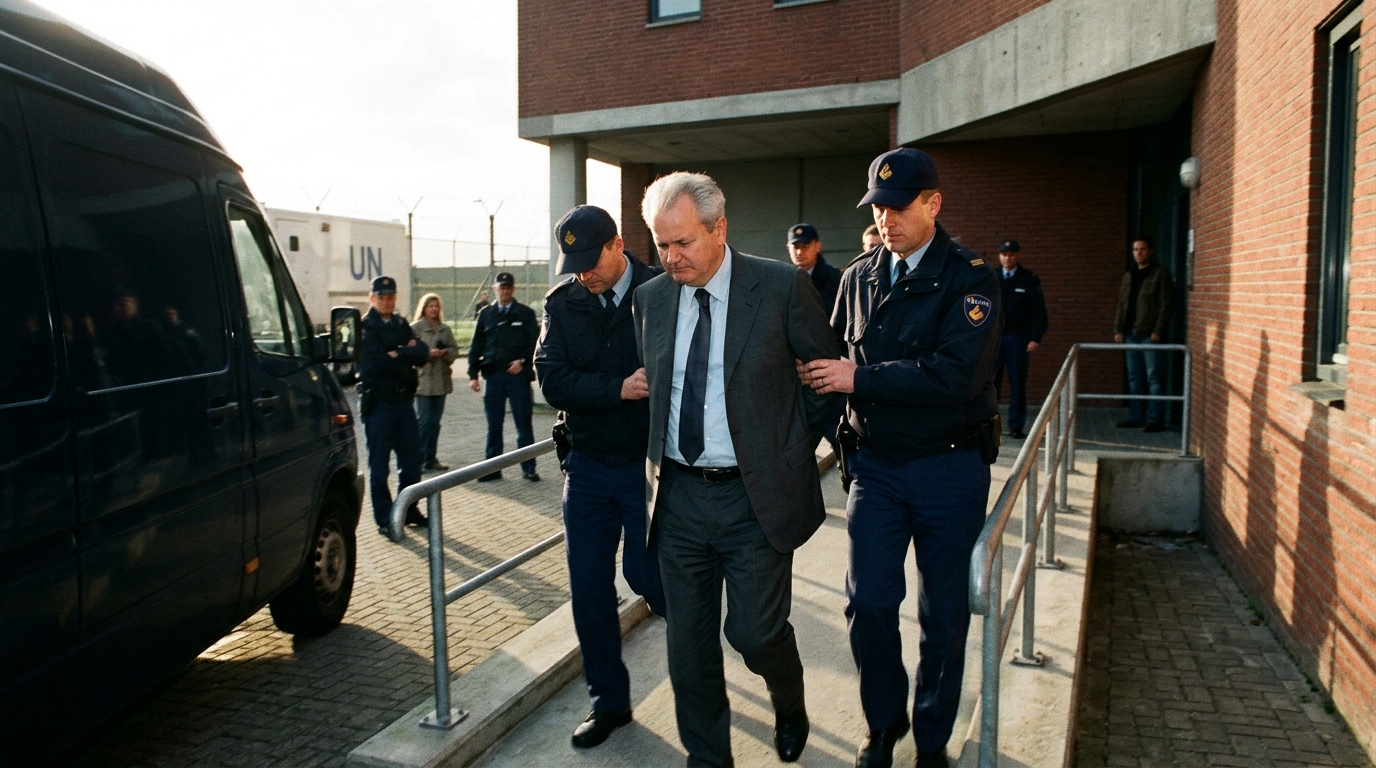
Milosevic's transfer to The Hague represented the physical manifestation of this legal evolution. It was the first time a former head of state had been forcibly transferred to an international court to face charges of genocide, war crimes, and crimes against humanity. This act solidified the principle that no leader, however powerful, was above international law when accused of such grave offenses. It demonstrated a shift from the almost exclusive focus on state-centric international law to one that recognized individual criminal responsibility as paramount in cases of mass atrocities. The concept of universal jurisdiction, allowing any state to prosecute individuals for certain international crimes regardless of where the crime was committed or the nationality of the perpetrator or victim, found its strongest practical expression in this event, despite Milosevic being tried by a UN tribunal rather than a national court exercising universal jurisdiction. This landmark moment served as a powerful signal that the world was moving towards an era of greater accountability, significantly influencing the later operationalization and perception of the International Criminal Court (ICC), which formally began its work in 2002.
Timeline of Events and Key Moments
The path to Slobodan Milosevic's extradition was a dramatic sequence of events, revealing the intense political and legal struggles within post-Milosevic Yugoslavia and the relentless pressure from the international community.
| Date | Event Description |
|---|---|
| April 1, 2001 | After a 36-hour standoff at his Belgrade villa, Milosevic is arrested on domestic charges of corruption and abuse of office. |
| May 27, 1999 | ICTY indicts Milosevic while he is still President of the Federal Republic of Yugoslavia, on charges related to Kosovo. |
| May 2001 | The ICTY confirms new charges of war crimes, crimes against humanity, and genocide against Milosevic, encompassing his role in Bosnia and Croatia. |
| June 23, 2001 | The Serbian government, acting without federal approval, adopts a decree allowing the extradition of Yugoslav citizens to international courts. |
| June 26, 2001 | The Federal Constitutional Court of Yugoslavia issues a temporary injunction against the government's decree, ruling it unconstitutional. |
| June 28, 2001 | Zoran Djindjic's government ignores the injunction and orders the clandestine transfer of Milosevic to the ICTY in The Hague. |
| June 29, 2001 | International donor conference in Brussels pledges over $1 billion in aid for Yugoslavia, fulfilling the key economic objective of the extradition. |
The first significant step was Milosevic's arrest on April 1, 2001. Following weeks of tense negotiations and rumors, Serbian special police forces surrounded his opulent villa in the upscale Dedinje district of Belgrade. What ensued was a dramatic 36-hour standoff. Milosevic, supported by a small contingent of loyal bodyguards and a dwindling number of ultranationalist supporters, refused to surrender. During the tense negotiations, reports emerged of a brief exchange of gunfire. Eventually, with a promise that he would be tried only in Serbia for domestic charges of corruption, abuse of power, and embezzlement, Milosevic capitulated. This initial arrest, while significant, was framed as an internal legal matter, a crucial distinction from his later extradition. He was subsequently detained at the Central Prison in Belgrade.
In the months leading up to the extradition, the ICTY, led by Chief Prosecutor Carla del Ponte, intensified its efforts to secure Milosevic's transfer. The ICTY had already indicted Milosevic in May 1999 for atrocities in Kosovo. By May 2001, the tribunal confirmed additional and expanded indictments, charging him with war crimes, crimes against humanity, and genocide across Croatia (1991-1995) and Bosnia-Herzegovina (1992-1995). These comprehensive charges cemented his status as the highest-ranking official ever to be indicted for such grave crimes by an international body.
The decisive move came on June 23, 2001, when the Serbian government, under Prime Minister Djindjic, adopted a decree on cooperation with the ICTY. This decree, circumventing the federal government and the federal parliament, was designed to create a legal basis for transferring indicted individuals, including Milosevic, to The Hague. Djindjic argued that this was the only viable path to unlock crucial international financial aid, explicitly tied to cooperation with the ICTY.
The decree immediately sparked a constitutional crisis. On June 26, 2001, the Federal Constitutional Court of Yugoslavia, acting on a request from President Kostunica's allies, issued a temporary injunction suspending the government's decree. The Court argued that the decree violated constitutional provisions prohibiting the extradition of Yugoslav citizens. This ruling directly challenged the authority of Djindjic's government and deepened the chasm between the reformist and legalist factions.
However, Djindjic's government made a calculated decision to defy the Court. On June 28, 2001, a date strategically chosen for its profound symbolic significance on Vidovdan (St. Vitus Day), Milosevic was removed from the Central Prison in Belgrade. The operation was carried out with extreme secrecy. He was transported by helicopter to a NATO air base near Tuzla in Bosnia-Herzegovina, reportedly still under the impression he was being moved to a different facility within Yugoslavia. Only upon seeing a plane marked with UN insignia did he realize his ultimate destination. From Bosnia, he was flown on a Dutch government aircraft directly to the Netherlands, where he was handed over to the ICTY at Scheveningen prison in The Hague. The transfer was swift, silent, and complete before the public or even key political figures like President Kostunica were fully aware. This decisive, albeit legally contentious, act marked the unequivocal end of Milosevic's freedom and ushered in a new era for international justice.
Legal and Constitutional Debates: The 'Revolutionary Legality' Conundrum
The extradition of Slobodan Milosevic on June 28, 2001, stands as a complex case study in the tension between international obligations, national sovereignty, and the rule of law in transitional states. At its heart was the dramatic clash between Prime Minister Zoran Djindjic's government and the Federal Constitutional Court of Yugoslavia, leading to the controversial application of what observers termed "revolutionary legality."
The constitutional framework of the Federal Republic of Yugoslavia (FRY) at the time was clear, at least on paper. Article 17 of the FRY Constitution explicitly prohibited the extradition of Yugoslav citizens. This provision, common in many national constitutions globally, aimed to protect citizens from being handed over to foreign jurisdictions. President Vojislav Kostunica and his allies steadfastly maintained that the extradition decree issued by the Serbian government was a direct violation of this fundamental constitutional principle, arguing that such a crucial decision should have been debated and ratified by the federal parliament, not unilaterally imposed by a republican government.
Djindjic's government, however, faced an unenviable dilemma. The country was financially desperate, teetering on the brink of economic collapse, and the international community—particularly the United States—had made it unequivocally clear: no Milosevic, no aid. The approaching donor conference in Brussels, crucial for securing billions in reconstruction funds, served as an immovable deadline. For Djindjic, strict adherence to a constitution crafted under Milosevic's shadow, which effectively shielded war criminals, was a luxury the nation could not afford. The perceived greater good of national survival and integration into the global community, he argued, necessitated a pragmatic, decisive, and swift action.
When the Federal Constitutional Court issued its temporary injunction on June 26, 2001, suspending the government's decree, it presented a direct challenge to the authority and legitimacy of Djindjic's administration. The Court, asserting its constitutional role, sought to uphold the rule of law as enshrined in the country's highest legal document. However, Djindjic's government chose to disregard the injunction. This defiance was based on the premise that the Court's decision was politically motivated and would paralyze the state's ability to act in its national interest.
This act of bypassing a judicial order for political expediency is what legal and political analysts refer to as "revolutionary legality." It describes a situation where, during periods of profound political transition or national crisis, the established legal framework is temporarily set aside or reinterpreted to achieve what the new power holders deem necessary for the revolutionary state or national survival. Examples can be found in various historical periods, from post-revolutionary France to post-colonial states. In the case of Milosevic, it was argued that the new democratic government, having overthrown a tyrannical regime, had a mandate to take extraordinary measures to consolidate its power, dismantle the vestiges of the old regime, and secure the nation's future, even if it meant temporarily sidestepping existing constitutional provisions.
The precedent set by this action was deeply contentious. On one hand, proponents argue it was a necessary evil, a painful but unavoidable step to break free from the past and secure a viable future for Serbia. It demonstrated a pragmatic flexibility in statecraft when faced with overwhelming international pressure and domestic paralysis. On the other hand, critics, particularly Kostunica and his supporters, condemned it as a dangerous erosion of the rule of law, arguing that it established a precedent for arbitrary governance and undermined the very constitutionalism that the new democratic order was supposedly championing. The disregard for judicial authority, they contended, was a slippery slope that could lead to authoritarian tendencies, even by a democratic government.
Ultimately, the Milosevic extradition highlighted the profound tension between international law (which demands accountability for grave crimes) and domestic law (which often protects national sovereignty and individual rights). It underscored the challenges faced by transitional societies in balancing the need for justice, economic recovery, and the establishment of robust, democratic institutions founded on the rule of law. The debate over revolutionary legality continues to resonate in Serbia, shaping political discourse and views on national identity and interaction with the international community.
Geopolitical Consequences and Aftermath
The extradition of Slobodan Milosevic was a watershed event, casting a long shadow over domestic Serbian politics and profoundly influencing the trajectory of international criminal justice and geopolitical relations in the Balkans.
Impact on Domestic Stability
Domestically, the immediate fallout was a profound political crisis. President Vojislav Kostunica, a staunch advocate for constitutionalism and national sovereignty, famously denounced the extradition as a "state of lawlessness" and a "humiliation" for the nation. He immediately launched an initiative to amend the constitution to explicitly prohibit extradition, a move that starkly underscored the deep ideological chasm within the ruling Democratic Opposition of Serbia (DOS) coalition. The political alliance, cobbled together to overthrow Milosevic, fractured almost immediately, triggering a period of sustained governmental instability.
The event ignited protests from Milosevic's Socialist Party of Serbia (SPS) and hardline nationalist groups, though these were largely contained and did not pose an existential threat to the new government. However, the extradition significantly alienated a segment of the Serbian population who viewed it as a national betrayal and an illegitimate act orchestrated by foreign powers. This sentiment played into the hands of nationalist forces and contributed to the enduring unpopularity of the ICTY within Serbia, often perceived as an anti-Serb court.
The decision also had tragic long-term consequences. Zoran Djindjic, the architect of the extradition, continued his ambitious program of Western-oriented reforms, challenging powerful vested interests within the security services, organized crime networks, and residual elements of the Milosevic regime. His uncompromising stance and willingness to confront these forces eventually made him a target. On March 12, 2003, Djindjic was assassinated in front of the Serbian government building in Belgrade. The assassination, perpetrated by elements linked to organized crime and disgruntled special police units (some with ties to the Milosevic era), was widely seen as a direct consequence of his reformist zeal, including his decision to send Milosevic to The Hague. His death plunged Serbia into further crisis and left a void in its reformist leadership, significantly slowing the country's path to European integration and genuine democratic transformation. The political rift between the "legalist" (Kostunica) and "reformist" (Djindjic) camps became a defining feature of Serbian politics for years, hindering consensus on crucial national issues, including EU accession and relations with Kosovo.
The Donor Conference Success
On the international front, Djindjic's controversial gamble paid off immediately. On June 29, 2001, just one day after Milosevic's transfer, a critical donor conference was held in Brussels. As promised by the international community, the conference successfully pledged over $1 billion in aid for the reconstruction and economic recovery of the Federal Republic of Yugoslavia. This swift and substantial financial commitment, a lifeline for a country facing economic destitution, effectively validated Djindjic's "transactional" approach to justice. It sent a clear message that cooperation with international tribunals was a necessary condition for post-conflict states seeking reintegration and financial assistance from the global community. The aid was instrumental in stabilizing the economy, beginning the arduous process of rebuilding infrastructure, and providing some relief to a population ravaged by years of war and sanctions.
Broader Geopolitical Implications
Beyond domestic politics and immediate aid, Milosevic's extradition had profound geopolitical implications:
- Strengthening of the ICTY and International Justice: The transfer undeniably boosted the credibility and authority of the ICTY. It demonstrated that the tribunal, despite its ad hoc nature, could successfully bring even the highest-ranking alleged perpetrators to justice. This success provided critical momentum for the nascent International Criminal Court (ICC), which was about to become operational.
- Erosion of Absolute Sovereign Immunity: The case firmly established a precedent that former heads of state were not immune from prosecution for grave international crimes, challenging traditional notions of state sovereignty in the face of universal human rights norms. This sent a chilling message to leaders around the world that accountability for mass atrocities was increasingly becoming a reality.
- Conditional Engagement in the Balkans: The extradition cemented the Western powers' strategy of "conditionality" in the Balkans. Future relations, including EU membership prospects and further financial aid, would consistently be tied to full cooperation with the ICTY and, later, the ICC. This policy continues to shape the geopolitical landscape of the Western Balkans, influencing judicial reforms and reconciliation efforts in the region.
- Reorientation of Yugoslavia: The transfer unequivocally signaled Yugoslavia's intention to break with its isolationist, nationalist past and reorient itself towards Euro-Atlantic integration, albeit amidst significant internal resistance and political turmoil. It marked a symbolic and practical turning point in the country's post-conflict identity.
In essence, the extradition of Slobodan Milosevic was a moment where the past, present, and future of a nation converged, setting in motion a chain of events that would redefine its domestic politics, international standing, and the very principles of global justice.
Analysis of Key Actors and Decisive Actions
The dramatic extradition of Slobodan Milosevic was shaped by the distinct philosophies, political calculations, and decisive actions of its central figures. Their interplay defines the complex legacy of this period.
- Zoran Djindjic (Prime Minister of Serbia): The Pragmatic Modernizer
- Vojislav Kostunica (President of the Federal Republic of Yugoslavia): The Legalist Nationalist
- Slobodan Milosevic (Former President of Serbia and FRY): The Defiant Icon
- Carla del Ponte (ICTY Chief Prosecutor): The Relentless Pursuer of Justice
The actions and beliefs of these key actors not only defined the dramatic events of June 2001 but also set the stage for the complex political and judicial challenges that would continue to shape the Western Balkans for decades to come.
Long-Term Legacy and Modern Historiographical Debates
The extradition of Slobodan Milosevic in 2001 cast a long and multifaceted legacy, shaping not only the political landscape of Serbia and the wider Balkans but also influencing the evolution of international law and global perceptions of justice. Modern historiography continues to grapple with the event's profound implications, offering varied interpretations of its necessity, legality, and ultimate effectiveness.
Legacy for Serbia and Post-Yugoslav States
For Serbia, Milosevic’s transfer to The Hague remains a deeply divisive issue. On one hand, it represented a symbolic break from the nationalist past, a necessary step towards confronting the atrocities of the 1990s, and a gateway to European integration. Many reformers and victims of the Milosevic regime viewed it as a belated but crucial act of justice. On the other hand, a significant portion of the population, influenced by nationalist narratives, continues to perceive the extradition as a national humiliation, a violation of sovereignty, and a concession to hostile foreign powers. This internal division reflects a broader struggle over national identity, historical revisionism, and the willingness (or unwillingness) to reckon with Serbia's role in the Yugoslav wars.
The legacy of the extradition also profoundly impacted Serbia's path toward EU accession. Cooperation with the ICTY, and later with its successor mechanism (IRMCT), became a stringent condition for progress in the integration process. This conditionality has compelled Belgrade to pursue other indicted war criminals and provide archival evidence, often leading to internal political clashes but ultimately reinforcing the principle of accountability. However, the perceived "anti-Serb bias" of the ICTY remains a powerful narrative among many Serbs, complicating reconciliation efforts within the former Yugoslavia and fostering a sense of victimhood rather than genuine introspection.
Across the other post-Yugoslav states, the extradition was largely hailed as a triumph for justice, offering some measure of solace to victims and reinforcing the narrative of Serbian aggression. It solidified the understanding that state-building and reconciliation in the region would be inextricably linked to confronting the crimes of the past and holding perpetrators accountable.
Legacy for International Law
For international law, the Milosevic extradition was a groundbreaking moment. It firmly cemented the principle of individual criminal responsibility for heads of state, proving that no leader, however powerful, was beyond the reach of international justice for crimes of genocide, war crimes, and crimes against humanity. This event provided critical momentum for the nascent International Criminal Court (ICC), which was established shortly thereafter, demonstrating the political will to enforce international humanitarian law.
The case also deepened the debate surrounding the tension between state sovereignty and universal jurisdiction. While national sovereignty traditionally protected leaders from foreign prosecution, Milosevic's transfer underscored the growing consensus that certain crimes are so heinous that they transcend national borders and warrant international intervention. It highlighted the challenges inherent in enforcing international law without a robust global enforcement mechanism, often relying on the cooperation of sovereign states, which can be inconsistent.
Modern Historiographical Debates
Contemporary historical and legal scholarship continues to debate several aspects of the Milosevic extradition:
- "Necessary Evil" vs. "Breach of Sovereignty": Historians and legal scholars often weigh Djindjic's pragmatic decision against Kostunica's legalist stance. Was the circumvention of the Constitutional Court a "necessary evil" for national salvation and a clear break with the past, or did it set a dangerous precedent that undermined the very foundations of the rule of law in a fragile democracy? This debate often reflects broader ideological divisions within post-Yugoslav historiography.
- The Role of Western Intervention: Scholars scrutinize the extent to which Western powers dictated Yugoslavia's internal affairs through conditional aid. Was this a legitimate exercise of international justice and humanitarian intervention, or an imposition of external will on a sovereign nation, albeit one with a problematic past?
- The Effectiveness of the ICTY: Milosevic's death in custody before the conclusion of his trial remains a point of contention. Some argue it denied victims full justice and allowed Milosevic to escape a definitive legal verdict. Others contend that the voluminous evidence presented during his trial, even if unfinished, provided an invaluable historical record of the conflicts and established critical facts about the atrocities committed.
- Justice vs. Peace: The extradition revived the perennial debate about whether prioritizing justice (through prosecutions) can hinder peace and reconciliation efforts, or if true peace is impossible without accountability. Milosevic's removal from the domestic political scene arguably allowed Serbia to move forward, but the lingering resentments and unhealed divisions suggest that justice alone is not a panacea for deep-seated historical trauma.
In conclusion, the extradition of Slobodan Milosevic was a pivotal moment, forcing a nascent democracy to confront its past and testing the boundaries of international justice. Its legacy is complex, marked by both progress and persistent divisions, reminding us that the pursuit of accountability for mass atrocities is an ongoing, challenging, and often controversial endeavor.
Trivia and Lesser-Known Facts
- The Vidovdan Provocation: The choice of June 28, Vidovdan (St. Vitus Day), for the transfer was no accident. This date commemorates the 1389 Battle of Kosovo, a central event in Serbian national mythology, often invoked by ultranationalists. By performing the extradition on this highly symbolic day, Djindjic's government not only fulfilled the international deadline but also sent a provocative message to nationalist forces, signaling a definitive break with the Milosevic-era ideology. It was a calculated affront to those who clung to a romanticized, often exclusionary, vision of Serbian history.
- The Last Belgrade Night: On the night of June 27, Milosevic was still in Belgrade's Central Prison. Reports indicate that he was kept isolated and largely unaware of the imminent operation until the very last moments. Serbian officials worked tirelessly to keep the transfer a secret, fearing both popular unrest and internal political sabotage.
- The Clandestine Route: The path Milosevic took to The Hague was intricate. From Central Prison, he was driven in a convoy under heavy guard to a helipad, where a Serbian police helicopter awaited. This helicopter took him to a military airfield in Tuzla, Bosnia-Herzegovina, a country where Milosevic had been a central figure in orchestrating conflict. At Tuzla, he was transferred to a Dutch government aircraft that then flew directly to the Netherlands. The stop in Bosnia was designed to bypass any potential direct flight issues from Belgrade and to ensure a safe, secure transfer outside Serbian airspace.
- Milosevic's Initial Confusion: According to later accounts from Serbian officials involved in the transfer, Milosevic reportedly believed he was being taken to an alternative detention facility within Yugoslavia, perhaps to a more comfortable location, as part of an arrangement for his cooperation. It was only when he saw the blue and white markings of the United Nations on the plane at Tuzla that the reality of his international destination dawned on him, leading to a visible shift in his demeanor, from confident defiance to stunned realization.
- The "Revolutionary Legality" Origin: The term "revolutionary legality" was not merely an academic description but was actively used by some of Djindjic's advisors to justify the government's actions. They argued that in the unique context of a post-revolutionary state, certain established legal norms could be temporarily set aside for the higher goal of democratic consolidation and national survival. This concept was deeply controversial but provided a theoretical framework for the government's defiance of the Constitutional Court.
- Impact on Other Indicted Individuals: The swift and decisive extradition of Milosevic sent a powerful message to other indicted individuals still at large in Serbia and the broader region. It demonstrated that international political will and financial leverage could overcome nationalistic resistance. This event was a major factor in the subsequent surrender or arrest of several other high-profile ICTY indictees from Serbia and Republika Srpska in the years that followed, culminating in the arrests of Radovan Karadzic (2008) and Ratko Mladic (2011).
References and Literature
- ICTY Archives: The Case of Prosecutor v. Slobodan Milošević - Official record of the indictment, trial proceedings, and judgments related to Slobodan Milošević at the International Criminal Tribunal for the former Yugoslavia.
- Judith Armatta, Twilight of Impunity: The War Crimes Trial of Slobodan Milošević - An exhaustive and critically acclaimed analysis of the Milosevic trial, its legal intricacies, and its broader implications for international justice.
- Sabrina P. Ramet, The Three Yugoslavias: State-Building and Legitimation, 1918-2005 - A comprehensive and authoritative history of the region, detailing the political, social, and economic tensions during the collapse of Yugoslavia and the early 2000s transition.
- Foreign Affairs: The Cost of Justice in the Balkans - Archival analysis and commentaries on how the ICTY influenced post-conflict regional stability, justice mechanisms, and the broader integration of Balkan states into the international system.
- BBC News: Milosevic's Last Hours of Freedom - Contemporary news reports providing detailed accounts of the arrest and transfer, including insights into the political maneuverings.
- Human Rights Watch: Bringing Justice: The ICTY and the Milosevic Trial - A detailed report examining the context, legal framework, and challenges of the Milosevic trial.
- Carla Del Ponte, Madame Prosecutor: Confrontations with Humanity's Worst Criminals and the Culture of Impunity - Memoirs of the ICTY Chief Prosecutor, offering an insider's perspective on the challenges and triumphs of bringing war criminals, including Milosevic, to justice.
Footnotes & Explanations
- The ICTY was established by UN Security Council Resolution 827 on May 25, 1993, to prosecute persons responsible for serious violations of international humanitarian law committed in the territory of the former Yugoslavia since 1991. ↩
- Zoran Djindjic was assassinated on March 12, 2003, an event widely linked to the residual power of the security structures and organized crime networks he challenged by extraditing Milosevic and pursuing aggressive reforms. His death remains a traumatic wound in modern Serbian history. ↩