Key Takeaways
- The October 5th Revolution marked the definitive collapse of Slobodan Milosevic's authoritarian regime, bringing an end to a decade of conflict, international isolation, and severe internal decay.
- It represented a complex, strategic alliance between disparate opposition parties, independent media, labor unions, and a vibrant civil society movement, notably Otpor!, all coalescing under the Democratic Opposition of Serbia (DOS).
- The transition served as a pivotal case study for the efficacy of non-violent resistance and democratic overthrow in the post-Cold War era, demonstrating the critical interplay of grassroots mobilization, opposition unity, and strategic international pressure.
- The events highlighted the fragility of state control when confronted by overwhelming popular dissent and the critical role of security forces' allegiance in moments of political crisis.
Historical Context and Origins: A Decade of Degradation and Disintegration
The dramatic fall of Slobodan Milosevic on October 5, 2000, was not an isolated incident but the inexorable culmination of over a decade of profound degradation, political manipulation, and violent disintegration that had plagued the former Yugoslavia. Milosevic, once a charismatic communist apparatchik who skillfully repurposed himself as a fervent Serbian nationalist, had ridden a wave of ethnic fervor to power in the late 1980s. His ascent coincided with, and largely precipitated, the unraveling of the Socialist Federal Republic of Yugoslavia. His political program, centered on the protection of Serbs across the federation, effectively dismantled the delicate balance of Tito’s multi-ethnic state and ignited a series of brutal ethno-nationalist conflicts.
The wars in Slovenia (brief, 1991), Croatia (1991-1995), and Bosnia and Herzegovina (1992-1995) saw Milosevic play a complex and often contradictory role: simultaneously presenting himself as a peacemaker to the international community while covertly supporting Serbian paramilitary forces and separatists. These conflicts resulted in hundreds of thousands of deaths, millions displaced, and widespread atrocities, fundamentally altering the demographic and political landscape of the Balkans. Serbia, under Milosevic’s iron fist, became increasingly isolated, burdened by United Nations sanctions that crippled its economy and fostered an environment of corruption, black markets, and hyperinflation that devastated the living standards of ordinary citizens.
By the mid-1990s, Milosevic had overseen the transformation of what remained of Yugoslavia—Serbia and Montenegro—into the Federal Republic of Yugoslavia (FRY), a pariah state ostracized by the international community. Domestically, his regime became increasingly authoritarian, characterized by a near-monopoly on state media, suppression of dissent, and manipulation of democratic processes. Independent media outlets like Radio B92 and later, independent newspapers, struggled to survive, becoming beacons of truth in a sea of state propaganda. The political landscape was one of fear, economic stagnation, and a pervasive sense of national humiliation, particularly after the Dayton Accords of 1995, which formally ended the Bosnian War but solidified Serbia's pariah status.
The final precipice came with the Kosovo War in 1999. Milosevic’s crackdown on Albanian separatists and civilians in Kosovo escalated into a full-blown humanitarian crisis, prompting NATO to launch an aerial bombing campaign against Serbia. For 78 days, Serbian infrastructure, military targets, and even civilian areas were hit, further devastating the country's economy and infrastructure. While Milosevic framed the bombing as an unprovoked assault on Serbian sovereignty, for many citizens, it underscored the catastrophic failures of his leadership and the utter futility of his nationalist project. The bombing ultimately forced Serbia to withdraw from Kosovo, which was then placed under UN administration, representing a profound strategic defeat for Milosevic and a severe blow to his already fragile legitimacy.
Against this backdrop of continuous warfare, economic collapse, and international condemnation, the Serbian opposition, long fragmented and often ineffective, began to coalesce. Earlier attempts to challenge Milosevic, such as the large-scale protests of 1996-97, had ultimately failed due to a combination of regime resilience, internal divisions within the opposition, and a lack of clear strategy. However, the cumulative weight of the 1999 NATO bombing, the enduring economic hardship, and the sheer exhaustion of the populace created a new urgency. The formation of the Democratic Opposition of Serbia (DOS) coalition, uniting a disparate group of eighteen opposition parties, signaled a maturity and strategic pragmatism previously absent. Led by the legal scholar Vojislav Kostunica, seen as a nationalist yet democratic alternative palatable to a broader spectrum of Serbian society, and the pragmatic tactician Zoran Djindjic, who understood the mechanics of grassroots mobilization and political maneuvering, the DOS recognized that a unified front and a clear electoral strategy were the only paths to unseating a leader who had manipulated every institution of the state. The federal election called for September 24, 2000, became the crucible, a final desperate gamble for both Milosevic and his opponents. When the regime brazenly attempted to suppress the results, the Serbian population, pushed beyond its breaking point by inflation, war, corruption, and a pervasive sense of hopelessness, saw the undeniable moment for decisive action.
The Architecture of Autocracy: Milosevic's Grip and its Erosion
Slobodan Milosevic's enduring power for over a decade stemmed from a carefully constructed and ruthlessly maintained autocratic system. His initial rise was fueled by a mastery of nationalist rhetoric, skillfully tapping into historical grievances and fears to consolidate support. He systematically dismantled the federal structures of Yugoslavia, stripped the autonomy of Vojvodina and Kosovo, and centralized power within Belgrade.
Pillars of the Regime:
- State Control over Media: Milosevic understood the power of information. State television (RTS) and major newspapers were turned into propaganda instruments, relentlessly demonizing opponents, glorifying Milosevic, and distorting reality. Independent media, though persistent, faced constant harassment, closures, and economic strangulation.
- Security Apparatus: The Serbian police, paramilitary units, and intelligence services were fiercely loyal, often comprised of individuals personally beholden to Milosevic. They were instrumental in suppressing dissent, intimidating activists, and orchestrating political assassinations or disappearances. The notorious Special Anti-Terrorist Unit (SAJ) and the Public Security Department (RDB) were particularly formidable.
- Economic Patronage and Corruption: While sanctions crippled the formal economy, Milosevic's inner circle thrived on black market operations, smuggling, and privatizations that enriched loyalists. This system of patronage created a powerful, vested interest in the regime's survival, insulating it from the economic suffering of the general population.
- Electoral Manipulation: Although holding elections, the regime routinely manipulated results through ballot stuffing, voter intimidation, and control over election commissions. The 1996-97 local election crisis, where Milosevic initially refused to acknowledge opposition victories in major cities, served as a stark precedent for 2000.
- Cult of Personality and Nationalist Narrative: Milosevic presented himself as the ultimate protector of Serbian national interests, portraying any opposition or international criticism as an attack on the Serbian people themselves. This narrative, however, began to wear thin as the country suffered successive military defeats and economic degradation.
Erosion of Power:
Despite these formidable tools, Milosevic's grip began to erode significantly after the Kosovo War. The NATO bombing, though initially rallying some patriotic support, left deep scars and a palpable sense of futility.
- Economic Ruin: The bombing destroyed factories, bridges, and infrastructure, exacerbating unemployment, hyperinflation, and poverty. The average citizen faced daily struggles for survival, overshadowing nationalist appeals.
- International Isolation: Serbia became a global pariah, cut off from most diplomatic and economic ties. This isolation fueled a desire among many for reintegration and normalcy.
- Military and Security Weariness: The military, though having fought bravely in Kosovo, was exhausted and demoralized. Its leadership recognized the futility of continued confrontation with the international community and the growing disaffection within its own ranks. Some elements within the security apparatus began to question their loyalty as the regime's legitimacy crumbled.
- Unified Opposition: Crucially, the opposition finally learned from past mistakes. The creation of DOS, with a single, unifying candidate in Kostunica, presented a credible alternative that resonated across various segments of society, from disillusioned nationalists to pro-Western liberals. This unity proved to be the Achilles' heel for Milosevic's divide-and-conquer strategy.
The combination of these factors meant that by September 2000, Milosevic's autocratic architecture was severely compromised, teetering on the brink of collapse, awaiting only a decisive push.
The Road to October 5th: Coalition Building and Strategic Non-Violence
The success of the October 5th Revolution was not spontaneous but the result of years of painstaking coalition building, strategic planning, and the deployment of non-violent resistance techniques, often with significant international support.
The Democratic Opposition of Serbia (DOS): A Fragile Alliance: The DOS coalition, formed in January 2000, represented an unprecedented level of unity among Serbia's notoriously fractious opposition parties. It brought together eighteen diverse groups, ranging from conservative nationalists to social democrats and liberals. Key figures included:
- Vojislav Kostunica: A constitutional law professor, Kostunica was chosen as the presidential candidate for several strategic reasons. He was perceived as a moderate nationalist, untainted by the perceived corruption and pro-Western leanings of some liberal opposition figures. This made him acceptable to a broader electorate, including those who had grown disillusioned with Milosevic but remained wary of overt Western influence. His intellectual demeanor provided a stark contrast to Milosevic's populist strongman image.
- Zoran Djindjic: As a former mayor of Belgrade and leader of the Democratic Party, Djindjic was a charismatic and pragmatic politician. While Kostunica provided the symbolic legitimacy, Djindjic was the organizational mastermind, adept at strategy, fundraising, and mobilizing support. He understood that electoral victory alone would not be enough; direct pressure was needed.
The Role of Otpor! (Resistance!): Crucial to the revolution's success was the student movement "Otpor!" Founded in 1998, Otpor! grew from a small group of student activists into a nationwide phenomenon. Their strategy was rooted in the principles of strategic non-violent conflict, heavily influenced by the writings of Gene Sharp and often supported by training from international organizations.
- Symbolism and Humor: Otpor!'s black-fist logo became ubiquitous, a simple yet powerful symbol of defiance. They effectively used ironic humor, street theater, and satire to ridicule Milosevic and demystify his image, undermining the fear that had long sustained the regime. Posters declaring "Gotov je!" ("He's finished!") appeared everywhere.
- Decentralized Structure: Otpor! operated with a decentralized command structure, making it difficult for the regime to decapitate. Its activists were trained in non-violent direct action, civil disobedience, and communication strategies.
- Youth Mobilization: By engaging young people, Otpor! injected new energy into the opposition, reaching segments of the population that traditional political parties struggled to connect with. They empowered ordinary citizens to participate, transforming passive discontent into active resistance.
Leveraging Media and International Support: Independent media, particularly Radio B92 and its sister TV station Studio B, played a vital role in circumventing state propaganda. They provided alternative news, broadcast opposition rallies, and became the central communication hub for the movement.
International support, particularly from the United States and the European Union, was channeled through various non-governmental organizations like the National Endowment for Democracy (NED) and the International Republican Institute (IRI). This support included:
- Financial Aid: Millions of dollars were provided to opposition parties, independent media, and civil society groups like Otpor!
- Training: Otpor! activists received training in organizational skills, communications, and non-violent resistance tactics from foreign experts.
- Political Pressure: Western governments consistently condemned Milosevic's authoritarianism and electoral manipulation, creating a climate of international disapproval that emboldened the opposition and chipped away at the regime's morale.
This combination of a unified political front (DOS), a dynamic youth movement (Otpor!), a network of independent media, and strategic international assistance created a potent force that could finally challenge the entrenched Milosevic regime. The September 2000 election, and Milosevic's predictable attempt to rig it, simply provided the long-awaited spark.
Timeline of Events and Key Moments
The trajectory of the October 5th Revolution was compressed into a few frantic days of defiance, marked by escalating popular pressure and the steady erosion of regime authority.
| Date | Event | Significance |
|---|---|---|
| September 24, 2000 | Federal Elections held | This election for the President of Yugoslavia and the federal parliament was mandated by Milosevic himself, a miscalculation on his part, believing he could control the outcome. Initial reports and exit polls suggested a clear first-round victory for Vojislav Kostunica, exceeding the 50% threshold needed to avoid a runoff. |
| September 27, 2000 | Election Commission announcement | The Federal Election Commission, under Milosevic's control, announced official results claiming Kostunica had only 48.22% of the vote, with Milosevic at 40.23%. This deliberately falsified count necessitated a runoff election, a clear attempt by the regime to buy time, prepare further rigging, and divide the opposition. The opposition, backed by independent monitors and their own parallel vote counts, vehemently rejected these results. |
| September 29, 2000 | DOS issues ultimatum | The Democratic Opposition of Serbia (DOS) declared the official results fraudulent and issued an ultimatum: Milosevic must recognize Kostunica's victory by October 2nd, or face massive protests, general strikes, and civil disobedience. |
| October 2, 2000 | General Strike began | As the ultimatum expired, organized labor unions, particularly the powerful Kolubara coal miners, initiated a nationwide general strike. The Kolubara miners, who supplied electricity to Belgrade, were a critical economic leverage point. Their courage in standing down their machines paralyzed the nation and demonstrated the depth of popular discontent, signaling a collapse of economic loyalty to the regime. |
| October 3-4, 2000 | Protests escalate; Blockades set up | Throughout Serbia, protests intensified. Roads leading to Belgrade were blocked by regime forces, attempting to prevent regional protesters from joining the capital. However, thousands of ordinary citizens, along with workers from industrial centers, began their journey towards Belgrade, often using trucks and agricultural machinery to overcome obstacles. |
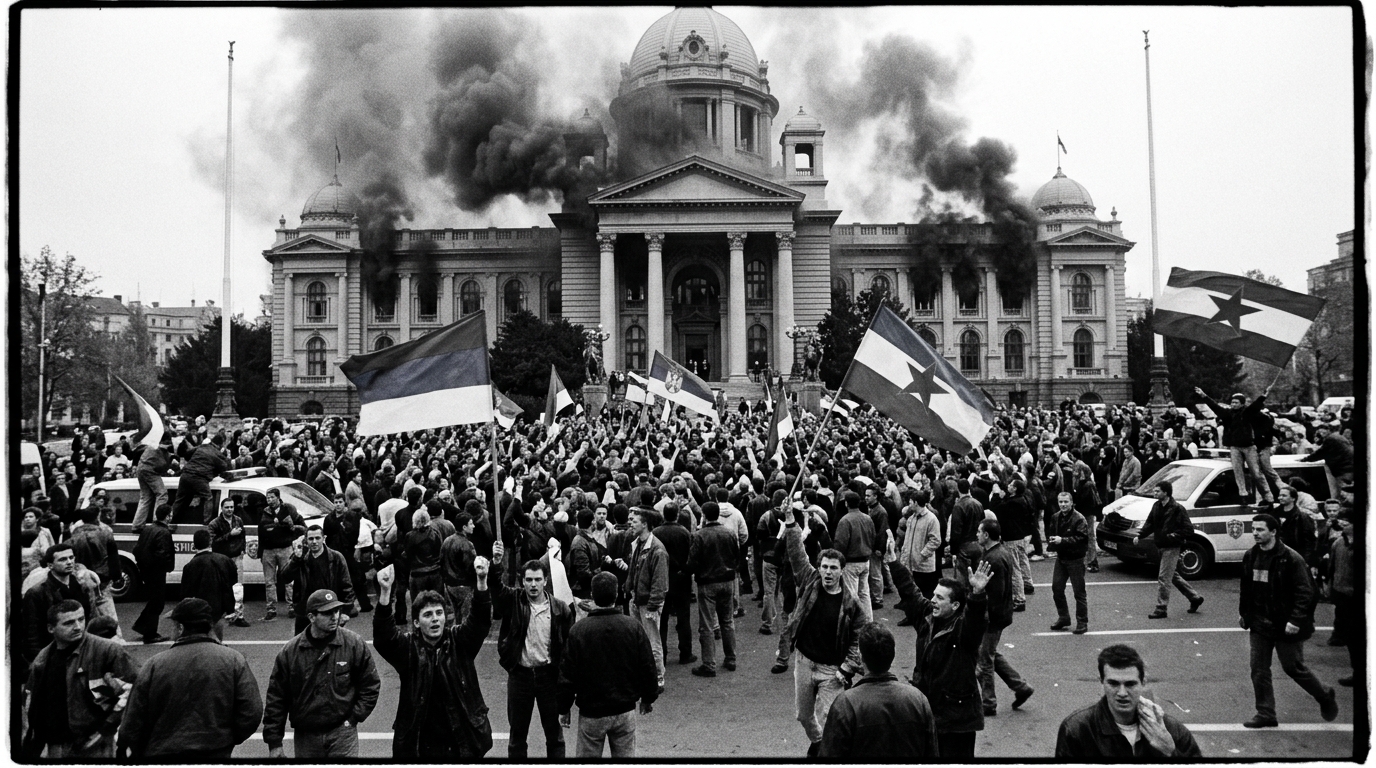
| October 5, 2000 | The March on Belgrade and Storming of Parliament | On this pivotal day, hundreds of thousands of protesters from across Serbia descended on Belgrade. They overwhelmed police blockades and converged on the Federal Parliament (Savezna skupstina). The Parliament building was stormed and set ablaze, along with the state-run television (RTS) headquarters—the primary mouthpiece for regime propaganda, which was also partially burned. Key elements of the police and special forces units began to defect or simply refused to engage the overwhelming crowds, marking a crucial turning point. |
| October 6, 2000 | Milosevic concedes | After being abandoned by the police, the military leadership, and having lost control of the streets, Milosevic addressed the nation on state television. In a short, subdued speech, he effectively admitted defeat, announcing his resignation and acknowledging the new political reality. He initially presented it as stepping aside to avoid further conflict. Later in the day, Vojislav Kostunica was sworn in as the new President of Yugoslavia. |
On the morning of October 5, Belgrade was utterly transformed. What began as a march quickly escalated into a full-blown popular uprising. Protesters, many arriving in convoys from distant cities, used bulldozers and trucks to breach police cordons. The storming of the Federal Parliament (Savezna skupstina) was a visceral act of reclaiming state institutions, while the burning of the state-run television headquarters (RTS)—the primary mouthpiece for Milosevic's regime propaganda—symbolized the end of the fear and disinformation that had sustained his rule for thirteen years. The sight of burning buildings and jubilant crowds in the streets sent an unmistakable message that the regime's authority had evaporated.
Geopolitical Consequences and Aftermath
The swift, largely non-violent ousting of Slobodan Milosevic on October 5, 2000, reverberated immediately across Southeast Europe and had significant international ramifications. For the United States and the European Union, the regime change offered a chance to reintegrate Serbia back into the international community, stabilize a volatile Balkan region, and address the lingering challenges of the post-Yugoslav wars.
- Integration into International Institutions: Serbia, now under democratic leadership, embarked on the long and arduous process of shedding its pariah status. It quickly began re-applying for membership in critical international financial institutions, including the International Monetary Fund (IMF) and the World Bank. These memberships were crucial for unlocking much-needed foreign aid, loans, and investment necessary for economic reconstruction and transition. Political reintegration followed, with Serbia re-establishing diplomatic ties, joining regional initiatives, and seeking closer relations with the EU.
- Cooperation with the ICTY: One of the most contentious and challenging tasks for the new government was cooperation with the International Criminal Tribunal for the former Yugoslavia (ICTY) in The Hague. The Milosevic regime had fiercely resisted any cooperation. The DOS government, however, recognized that full engagement with the Tribunal was a prerequisite for international legitimacy and the lifting of remaining sanctions. This commitment ultimately led to the controversial arrest and extradition of Milosevic himself in June 2001, an act that deeply divided Serbian society but signaled a clear break from the past. Over the subsequent years, many other indicted individuals were apprehended and transferred to The Hague, a process that continues to provoke complex debates about national sovereignty versus international justice.
- Regional Stability and Reconciliation: Milosevic's removal opened a new chapter for regional stability. With the chief instigator of the Balkan wars gone, there was a renewed impetus for reconciliation and cooperation among the former Yugoslav republics. While relations remained complex, particularly concerning Kosovo and Bosnia, the pathway to dialogue and normalized relations became clearer. This was critical for the broader security architecture of Europe.
- Democratic Fragility and Challenges: The transition was far from smooth. The euphoria of October 5th quickly gave way to the harsh realities of governing a country ravaged by war, sanctions, and corruption. The new democratic institutions were fragile, constantly battling against the remnants of the "deep state"—the entrenched intelligence services, elements of the military, organized crime syndicates, and powerful business interests that had thrived under Milosevic. The assassination of Prime Minister Zoran Djindjic in March 2003, widely believed to be orchestrated by elements within the security apparatus and organized crime, served as a stark and tragic reminder that these forces still wielded lethal influence and posed a continuous threat to democratic reforms. His death plunged Serbia into a period of political instability and revealed the profound challenges of dismantling an authoritarian legacy.
- Economic Shock Therapy and Social Discontent: The post-Milosevic governments pursued market-oriented economic reforms, often referred to as "shock therapy." While aimed at revitalizing the economy and attracting foreign investment, these reforms often led to painful consequences, including mass privatizations, factory closures, and rising unemployment. This period of economic upheaval, combined with lingering social inequalities and a persistent struggle against corruption, generated considerable public discontent and fueled a sense of disillusionment with the democratic transition.
- The Future of Kosovo and Montenegro: Milosevic's fall did not resolve the status of Kosovo, which remained under international administration. Its eventual declaration of independence in 2008 continued to be a major point of contention and a source of profound national grievance in Serbia. Furthermore, Montenegro, which had remained part of the Federal Republic of Yugoslavia with Serbia, increasingly pursued its own path, eventually holding a referendum and declaring full independence in 2006, formally dissolving the last vestiges of Yugoslavia.
The revolution did not result in a liberal utopia overnight; rather, it initiated a turbulent, multi-decade period of transition characterized by identity crises, economic restructuring, persistent political factionalism, and a difficult, often painful, reckoning with the legacy of the 1990s wars. It underscored that while removing a dictator is a monumental achievement, building a robust democracy in its wake is an even greater, and often more protracted, challenge.
Analysis of Key Actors and Decisive Actions
The success of the October 5th Revolution relied on the synergy between diverse actors, each playing a critical and often complementary role in undermining Milosevic's authority and mobilizing popular will.
- Slobodan Milosevic: The Ousted Dictator: Milosevic, by 2000, had become an isolated figure, surrounded by a shrinking circle of loyalists. His fundamental miscalculation was believing he could manipulate the September 2000 election as he had done countless times before. His overconfidence and detachment from the popular mood led him to underestimate the depth of public anger and the resolve of the unified opposition. His final acts were desperate attempts to cling to power, ordering security forces to fire on protesters, but these commands were largely ignored, demonstrating the complete erosion of his command authority. His ultimate concession, delivered quietly on state television, reflected a dictator who had run out of options and loyal enforcers.
- Vojislav Kostunica: The Unifying Candidate: Kostunica's role was primarily symbolic but profoundly effective. As the consensus candidate for the DOS coalition, he provided the democratic legitimacy required to challenge Milosevic. His moderate, nationalist-leaning rhetoric—often compared to that of Charles de Gaulle—helped secure votes from those who were disillusioned with the regime's failures but remained suspicious of Western-leaning liberals and the perceived 'traitors' in the opposition. His image as an intellectual, untainted by corruption and aloof from internal opposition squabbles, made him a credible and unifying figure who could appeal across ideological divides. His steadfast refusal to accept the rigged election results lent moral authority to the subsequent protests.
- Zoran Djindjic: The Master Tactician: If Kostunica was the face, Djindjic was the strategic mind behind the revolution. A philosopher by training, Djindjic possessed a pragmatic and ruthless political acumen. He understood that regime change required more than just ballots; it required sustained pressure from the street and, crucially, the neutralizing of the state apparatus. His ability to organize logistics for the October 5th protests, ensuring hundreds of thousands converged on Belgrade, was the engine of the revolution. He effectively managed the diverse and often conflicting interests within the DOS, focusing them on the singular goal of Milosevic's removal. His quote, "He who dares, wins," encapsulated his bold, results-oriented approach. Djindjic’s tactical genius in mobilizing the masses and coordinating diverse elements of the opposition was indispensable.
- The "Otpor!" Movement: The Catalyst for Grassroots Mobilization: This student-led organization utilized non-violent protest techniques, ironic humor, and viral marketing to systematically undermine the regime's authority. Their black-fist logo became the ubiquitous symbol of defiance across Serbia. Otpor! effectively broke the psychological barrier of fear that had long protected Milosevic. By training activists in civil disobedience and maintaining a decentralized structure, they created a resilient movement that the regime struggled to suppress. Their sustained campaign of ridicule and confrontation made the opposition seem strong and the regime appear weak and ridiculous.
- The Security Forces: The Decisive Stand-Down: The refusal of the Serbian police and, crucially, elements of the Special Anti-Terrorist Unit (SAJ) to follow Milosevic’s orders to fire upon the protesters on October 5th remains the most critical military-strategic moment of the revolution. As hundreds of thousands swarmed the capital, the police, observing the sheer magnitude of the citizenry and realizing the futility and moral cost of resisting the popular will, effectively stood down. Many officers reportedly removed their badges or even sided with the protesters. This moment underscored a fundamental principle of state power: a regime's authority ultimately rests on the consent (or at least the compliance) of its enforcers. When the security apparatus loses its will to suppress its own people, even the most entrenched dictator becomes powerless. This passive defection ensured the revolution was largely non-violent and successful.
Trivia and Lesser-Known Facts
- The Miners' Pivotal Role: While the image of crowds storming parliament is iconic, the strike of the Kolubara coal miners was arguably the most significant economic pressure point. By stopping coal production, they threatened to cause a complete electricity blackout across Serbia, a prospect that directly impacted every household and enterprise. This action demonstrated a potent form of non-violent civil disobedience that forced the regime to realize it could no longer keep the country running and severely weakened its control over critical infrastructure. Their bravery in the face of regime intimidation was a moral victory that inspired broader segments of society.
- The "Bulldozer" Revolution: A bulldozer, driven by Ljubisav Djokic (affectionately known as "Joe the Bulldozer" or "Joca") became the enduring iconic image of the day. Djokic, an unassuming construction worker, used his powerful vehicle to clear police blockades and allow masses of protesters to reach the Federal Parliament building. His spontaneous act of defiance symbolized the ordinary citizen's direct challenge to state authority and the sheer determination of the protest movement. The image of the bulldozer breaking through obstacles resonated deeply with a populace tired of being pushed around.
- US Financial and Training Support: While the revolution was undeniably an organic, Serbian-led phenomenon, the US government, through organizations like the National Endowment for Democracy (NED), the International Republican Institute (IRI), and the National Democratic Institute (NDI), had funneled millions of dollars into opposition media outlets (such as Radio B92, ANEM), youth movements (Otpor!), and political parties (DOS) over the preceding years. This support included funding for equipment, communications, and training in non-violent resistance tactics, voter registration drives, and parallel vote counting. This fact remains a contentious point in Serbian nationalist discourse to this day, with some interpreting it as foreign interference rather than merely assistance to democratic forces.
- Milosevic's Last-Ditch Efforts and Isolation: Reports from the time suggest that in the final chaotic hours of October 5th and early morning of October 6th, Milosevic made increasingly desperate attempts to summon the army and special police units to restore order. However, the military leadership, sensing the irreversible shift in political winds and unwilling to initiate a bloody civil conflict against their own citizens, declined to intervene decisively. This refusal effectively left Milosevic isolated in his palace, stripped of the coercive power that had sustained his rule for so long. Even his closest confidantes and family members were reportedly advising him to concede, recognizing the battle was lost.
- The Burning of RTS: The destruction of the state-run Radio Television of Serbia (RTS) building was not merely an act of vandalism but a profoundly symbolic cleansing. For a decade, RTS had been the primary instrument of Milosevic's propaganda, consistently disseminating disinformation, inciting ethnic hatred during the wars, and demonizing the opposition. Its burning represented the literal destruction of the "factory of lies" and a collective rejection of the narrative that had held the population captive. While condemned by some as an act of lawlessness, for many protesters, it was an emotional and necessary act of defiance against a despised symbol of oppression.
The legacy of October 5th remains a central, albeit polarizing, theme in Serbian politics and national identity. To some, it is celebrated as the authentic birth of modern Serbian democracy, a triumph of popular will over tyranny. To others, particularly those who cling to Milosevic-era nationalist narratives, it is viewed as a moment where foreign interference allowed for the dismantling of state sovereignty and a betrayal of national interests. Objectively, it stands as one of the most successful and dramatic instances of non-violent regime change in the late 20th and early 21st century, offering invaluable lessons in the dynamics of civil resistance, the fragility of authoritarian power, and the complex path to democratic transition.
References and Literature
- The Fall of Milosevic - BBC Archives. A comprehensive digital archive detailing the timeline, the protests, and the geopolitical atmosphere surrounding the transition, offering valuable contemporary reporting and analysis. Available at http://news.bbc.co.uk/hi/english/static/events/milosevic/default.stm
- Judah, Tim. "The Serbs: History, Myth and the Destruction of Yugoslavia." Yale University Press, 2008. An essential and highly acclaimed text for understanding the deep historical, cultural, and political currents that fed into Milosevic's rise and fall, and the broader context of the 2000 revolution. Available at https://www.google.com/books/edition/The_Serbs/T1vB8x41S9QC
- Cohen, Roger. "The Fall of a Dictator." The New York Times, October 6, 2000. A compelling retrospective providing vivid on-the-ground reporting of the events as they unfolded on October 5th and its immediate aftermath. Available at https://www.nytimes.com/2000/10/06/world/the-fall-of-a-dictator.html
- Otpor! - Stanford University Archive on Nonviolent Struggle. A valuable academic analysis of the student organization’s tactical deployment of civil resistance, its methodologies, and its impact on the revolution. Available at https://web.stanford.edu/group/nonviolentio/cgi-bin/wp/otpor/
- Roberts, Adam. "Civil Resistance in the East European and Soviet Revolutions." Journal of International Affairs, Vol. 45, No. 1, 1991, pp. 31-51. While predating the Milosevic fall, this provides crucial theoretical and comparative context on the efficacy of non-violent resistance movements in post-communist transitions.
- Engler, Mark and Paul Engler. "This Is An Uprising: How Nonviolent Revolt Is Shaping the Twenty-First Century." Nation Books, 2016. Contains a detailed case study of Otpor! and its influence, placing it within a broader global context of civil resistance movements.
- Pavkovic, Aleksandar. "Serbia since 1989: Politics and Society under Milošević and After." McGill-Queen's University Press, 2007. Offers an in-depth political and social history of Serbia leading up to and immediately following the October 5th revolution, analyzing key political actors and societal shifts.
Footnotes & Explanations
- Initial election results claimed Kostunica had 48% and Milosevic 40%, triggering the demand for a runoff. This official count, however, was widely dismissed as fraudulent by the opposition and international observers, who asserted Kostunica had won outright. ↩
- The destruction of the RTS building was viewed by protesters as a symbolic cleansing of the lies and propaganda broadcast by the state media during the preceding decade of wars and Milosevic's rule. ↩