Key Takeaways
- The 2002 State of the Union address marked a definitive departure from post-Cold War multilateralism toward a policy of preemptive interventionism.
- By grouping Iraq, Iran, and North Korea as an 'Axis of Evil,' the Bush administration signaled that the War on Terror would transcend non-state actors to target sovereign states.
- The speech established the 'Bush Doctrine,' fundamentally altering the parameters of international security and US foreign policy for the next decade.
Historical Context and Origins
The global geopolitical landscape underwent a tectonic shift on September 11, 2001. The immediate aftermath of the terrorist attacks against the United States, orchestrated by Al-Qaeda, a non-state actor with global reach, forced the Bush administration to rapidly transition from a foreign policy that, while engaged, had not fundamentally prioritized the direct threat of terrorism to the homeland, to a militarized, interventionist stance. The initial response was swift and decisive: the invasion of Afghanistan commenced in October 2001, aiming to dismantle Al-Qaeda's base of operations and remove the Taliban regime that harbored them. However, even as the sands of Afghanistan shifted, a growing faction within the administration, heavily influenced by neoconservative thinkers and policymakers in the Pentagon and the Office of the Vice President, began to advocate for a broader definition of the "War on Terror." This perspective argued that the threat was not merely from decentralized terrorist networks but also from sovereign states that harbored terrorists or sought to acquire weapons of mass destruction (WMD) capable of inflicting catastrophic damage on the United States and its allies.
The concept of the "Axis of Evil" itself was not an entirely novel rhetorical device in international relations, but its application in the post-9/11 era was particularly potent. The historical resonance of the "Axis" powers—Nazi Germany, Fascist Italy, and Imperial Japan—during World War II immediately conjured images of a global struggle against malevolent forces bent on domination. By invoking this historical parallel, the Bush administration sought to frame the complex and multifaceted threat of terrorism and proliferation in stark, binary, moralistic terms: good versus evil, civilization versus barbarism. As White House speechwriter David Frum, who is widely credited with coining the term, later explained, the objective was to define a clear, actionable, and morally unambiguous enemy for the American public, extending the scope of the War on Terror beyond the amorphous nature of fighting elusive terrorist cells to confronting identifiable state sponsors. This strategic framing was crucial for building domestic support for potentially protracted and costly military engagements.
Historical Precedents & Context: The Shadow of Containment and the Rise of Preemption
The idea of confronting hostile states was not new to American foreign policy. Throughout the Cold War, the doctrine of "containment" guided US strategy, aiming to prevent the expansion of Soviet influence and communism without necessarily engaging in direct, preemptive warfare. This involved a combination of military deterrence, economic aid, and diplomatic maneuvering. However, the nature of the threat post-9/11 was perceived as fundamentally different. Unlike the ideologically coherent and geographically defined Soviet bloc, the threat from rogue states and non-state actors was seen as more diffuse, insidious, and potentially instantaneous in its destructive capability.
Neoconservative strategists, many of whom had significant influence in the Bush administration, had long advocated for a more assertive and interventionist US foreign policy. They argued that the deterrence strategies of the Cold War were insufficient against regimes that might be willing to use WMDs even at the cost of their own destruction, or that did not adhere to the same logic of mutually assured destruction. Figures like Paul Wolfowitz and Richard Perle had published analyses and articles for years, articulating the need for the United States to assert its global primacy and to act decisively to counter emerging threats, even if those threats had not yet fully materialized. The 9/11 attacks provided a powerful impetus and a political opening to translate these theoretical arguments into concrete policy. The perception that Saddam Hussein's Iraq, Iran, and North Korea were all pursuing WMD programs, coupled with their alleged links to terrorism, presented a seemingly perfect confluence of threats that demanded a unified and forceful response. The "Axis of Evil" speech was thus the culmination of years of intellectual debate and a direct response to the perceived existential threat posed by certain states in the post-9/11 world, marking a significant departure from the established norms of international relations and security.
The State of the Union Address: Delivery and Content
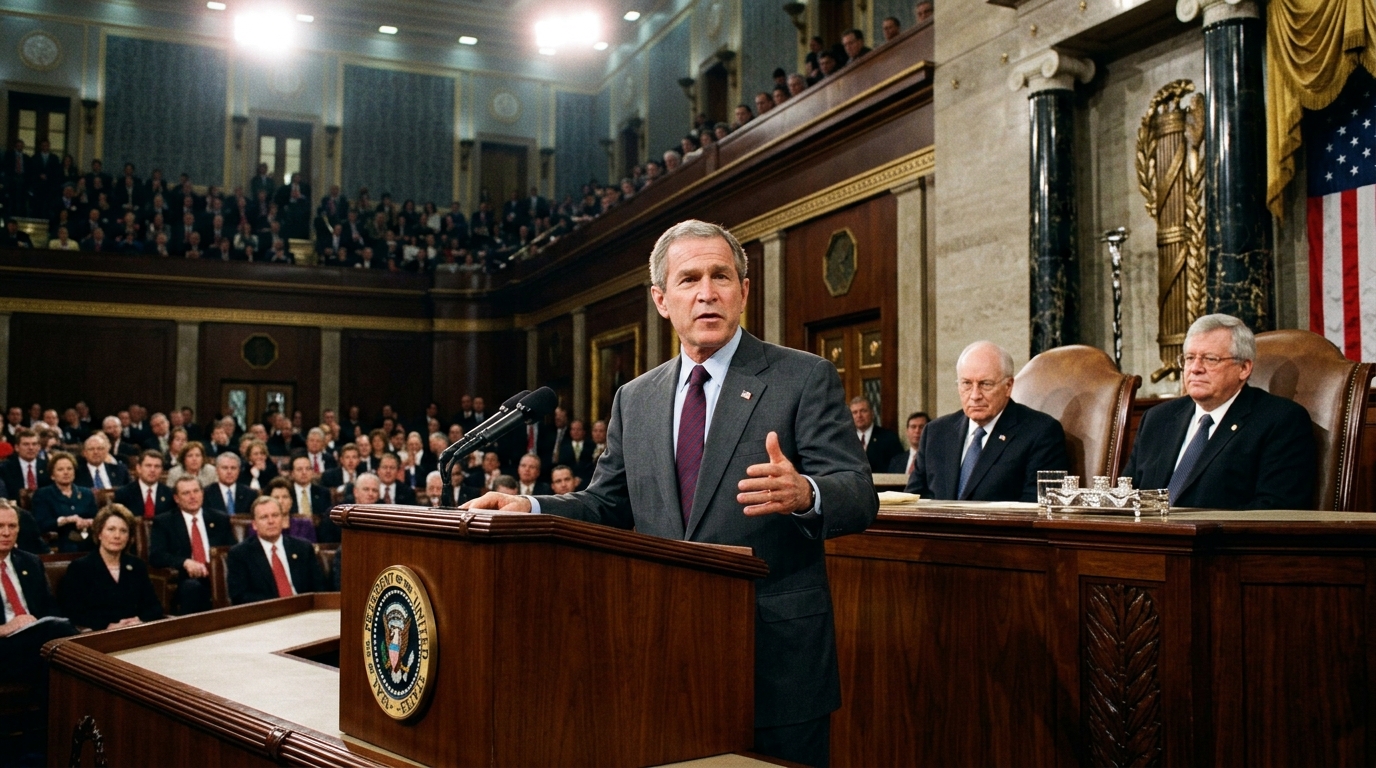
On January 29, 2002, President George W. Bush stood before a joint session of Congress and delivered his first State of the Union address following the September 11th attacks. The speech was delivered in a somber yet resolute tone, reflecting the gravity of the national mood and the administration's newly defined global mission. While the address covered a broad range of domestic and foreign policy issues, including economic recovery, education reform, and the ongoing efforts in Afghanistan, a pivotal segment was dedicated to articulating the evolving threat landscape and the administration's strategy to confront it.
The president meticulously laid out the administration's view that the War on Terror had expanded beyond the immediate dismantling of Al-Qaeda to include a broader confrontation with states that sponsored terrorism and sought to acquire weapons of mass destruction. He spoke of the need to prevent enemies from threatening the United States with "poisons, gas and flames." It was in this context that the now-infamous phrase was introduced:
"States like these, and their terrorist allies, constitute an axis of evil, arming to threaten the peace of the world. By seeking weapons of mass destruction, these regimes pose a grave and growing danger. We are determined to prevent the sponsor of murder and chaos from dominating the world."
The speech then explicitly named the nations constituting this "axis": Iraq, Iran, and North Korea. Bush detailed the specific concerns regarding each country: Saddam Hussein's regime in Iraq, which he accused of developing chemical and biological weapons and seeking nuclear capabilities; Iran, described as a leading state sponsor of terror with its own WMD programs; and North Korea, a nation with a history of proliferation and a secretive nuclear weapons program.
The deliberate choice of these three nations was not arbitrary but reflected specific intelligence assessments and strategic calculations by the Bush administration, though the rationale for their grouping was primarily rhetorical and strategic rather than based on observable geopolitical alignment between the three states. The inclusion of these nations served to consolidate a narrative that linked the specter of WMDs with state-sponsored terrorism, thereby justifying a more aggressive and preemptive foreign policy.
Timeline of Events and Key Moments
The preparation and delivery of the State of the Union address on January 29, 2002, occurred against the backdrop of escalating intelligence reports suggesting these specific nations were pursuing clandestine programs that could jeopardize U.S. national security and global stability. The administration was actively seeking to define the parameters of the War on Terror beyond the initial counter-terrorism operations.
| Date | Event | Significance |
|---|---|---|
| September 11, 2001 | Terrorist Attacks on US | The catalyst for the immediate shift in US foreign policy towards a more interventionist stance. |
| October 7, 2001 | Invasion of Afghanistan | Established the initial model for military intervention in the War on Terror, targeting Al-Qaeda and the Taliban. |
| January 29, 2002 | State of the Union Address | Public articulation of the "Axis of Evil" doctrine, identifying specific state threats to US security. |
| March 2002 | National Security Strategy (NSS) released | Formalized the "Bush Doctrine," including the principle of preemption and the rationale for confronting rogue states. |
| March 20, 2003 | Invasion of Iraq | The first major military application of the "Axis of Evil" and the Bush Doctrine, targeting Saddam Hussein's regime. |
| October 2002 | Iraq WMD inspections intensified | Increased UN weapons inspections in Iraq, leading to further international debate and division. |
| January 2003 | Bush's ultimatum to Saddam Hussein | Escalated diplomatic pressure and rhetoric preceding the invasion of Iraq. |
| February 2003 | Colin Powell's UN Security Council speech | Presented intelligence (later found to be flawed) linking Iraq to WMDs and Al-Qaeda. |
The speech's impact was immediate and far-reaching, fundamentally altering the trajectory of US foreign policy and international relations. The specific segment regarding the "Axis" was a mere fraction of the overall address but contained the seeds of future conflicts and diplomatic crises.
Geopolitical Consequences and Aftermath
The "Axis of Evil" designation had profound, albeit divergent, consequences for each of the named nations, reshaping their relationship with the United States and impacting regional and global security dynamics for years to come.
For Iraq, the rhetorical grouping provided a crucial, albeit controversial, justification for the 2003 invasion. The Bush administration aggressively linked Saddam Hussein’s regime with the post-9/11 threat, portraying Iraq as an immediate danger due to its alleged possession of weapons of mass destruction and its purported ties to terrorist organizations like Al-Qaeda. While extensive post-invasion investigations failed to find stockpiles of WMDs or significant operational links between the Iraqi regime and Al-Qaeda at the time of the invasion, the "Axis of Evil" narrative had already served its purpose in galvanizing domestic and international support, albeit fractured, for military action. The invasion led to the toppling of Saddam Hussein's regime, but it also plunged Iraq into prolonged instability, sectarian violence, and a protracted insurgency, fundamentally altering the political landscape of the Middle East. The war in Iraq became the most significant kinetic manifestation of the Bush Doctrine, demonstrating the administration's willingness to engage in preemptive military intervention against states deemed hostile.
For Iran, the "Axis of Evil" label was received with significant alarm and hostility. The speech effectively closed off any nascent channels of dialogue that had tentatively emerged after Iran offered some limited assistance to the United States in the initial stages of the Afghan campaign. Instead, the designation solidified hardline factions within the Iranian government, reinforcing the narrative that the United States sought regime change and posed an existential threat. In response, Iran accelerated its pursuit of nuclear technology, ostensibly for peaceful energy purposes but increasingly viewed by the international community, and particularly the US, as a clandestine effort to develop nuclear weapons. This led to decades of tense diplomatic standoffs, sanctions, and international negotiations aimed at curbing Iran's nuclear program, a process that continues to be a major flashpoint in global security. The speech arguably contributed to Iran's strategic calculation that developing a nuclear deterrent was essential for its survival against potential US aggression.
For North Korea, the reaction to the "Axis of Evil" designation was arguably the most immediate and volatile. Kim Jong-il’s regime, already highly sensitive to perceived threats from the United States, interpreted the speech as a clear signal of impending regime change. This perception prompted a rapid and decisive response: North Korea withdrew from the Nuclear Non-Proliferation Treaty (NPT) in January 2003 and subsequently announced its possession of nuclear weapons in early 2005. The "Axis of Evil" rhetoric, intended to curb WMD proliferation, paradoxically served as a catalyst for North Korea to accelerate its nuclear and ballistic missile programs, solidifying its status as a nuclear-armed state. This created a persistent security challenge for the United States and its allies in East Asia, leading to years of international sanctions, diplomatic stalemates, and intermittent provocations. The irony was stark: a speech aimed at preventing the spread of WMDs arguably incentivized the very proliferation it sought to contain.
Geopolitical Realignment and Shifting Alliances
The "Axis of Evil" speech, and the subsequent policies it embodied, triggered a significant realignment of global alliances and strategic priorities. While the Bush administration sought to forge a broad international coalition against terrorism, the uncompromising rhetoric and the unilateral tendencies it signaled often alienated key allies. European powers, particularly France and Germany, expressed reservations about the concept of preemption and the unilateral application of US power, leading to significant transatlantic friction over the Iraq War. This divergence highlighted a growing gap in how different nations perceived threats and the appropriate means to address them.
In the Middle East, the invasion of Iraq fundamentally altered the regional balance of power. The removal of Saddam Hussein created a power vacuum that contributed to the rise of sectarian tensions and the emergence of new militant groups. The perceived success of the US intervention in Iraq, at least initially in terms of toppling the regime, emboldened some regional actors and alarmed others, leading to complex and often counterproductive strategic responses.
Furthermore, the focus on Iraq diverted significant US resources and attention away from other pressing security concerns, including the ongoing hunt for Al-Qaeda leadership and the development of nuclear programs in Iran and North Korea. This strategic misallocation of resources is a subject of ongoing debate among historians and foreign policy analysts, with many arguing that the focus on Iraq weakened the broader War on Terror and created new, unforeseen challenges. The "Axis of Evil" narrative, intended to simplify a complex threat, ultimately contributed to a more fragmented and unstable international security environment.
Analysis of Key Actors and Decisive Actions
George W. Bush was the central architect and public face of the "Axis of Evil" doctrine. His rhetorical conviction, deeply rooted in his understanding of good versus evil and his administration's interpretation of the post-9/11 threat, was instrumental in shaping American public opinion and foreign policy. Bush was not merely relaying information; he was defining a new paradigm for American global engagement. His presidency marked a significant departure from the more multilateralist approach that had characterized much of the post-Cold War era, ushering in an era of assertive unilateralism when necessary.
The intellectual architects of this shift were a prominent group of policymakers and thinkers, often referred to as neoconservatives, who held significant sway within the Bush administration. Vice President Dick Cheney was a particularly influential figure, advocating for a robust projection of American power and a willingness to confront threats proactively. Secretary of Defense Donald Rumsfeld championed a swift and decisive military response, emphasizing the need for technological superiority and rapid operational tempo. Deputy Secretary of Defense Paul Wolfowitz was a key proponent of the idea that the United States had a unique role in shaping the global order and preventing the rise of hostile powers. These individuals, alongside others in the National Security Council and the Pentagon, collectively influenced the administration's strategic thinking, pushing for a more interventionist and preemptive approach to national security.
The "Bush Doctrine," of which the "Axis of Evil" speech was a seminal articulation, was largely characterized by several core tenets:
- Preemption: The most significant departure from traditional deterrence theory. The doctrine asserted the United States' right to take preemptive military action against emerging threats, even if they had not yet manifested in an attack. This was a direct response to the perceived inability of traditional containment strategies to address the rapid development of WMDs by hostile states.
- Unilateralism: The administration signaled a willingness to act alone, or with a "coalition of the willing," if necessary, without the explicit approval or consensus of international bodies like the United Nations. This reflected a deep skepticism regarding the efficacy of multilateral institutions when dealing with existential threats.
- Moral Clarity and Regime Change: The doctrine framed international relations in stark moral terms, distinguishing between good and evil states. For regimes deemed "evil," regime change was often presented as the only viable long-term solution to neutralize threats, rather than engaging in protracted diplomacy or containment.
The decision to group Iraq, Iran, and North Korea was a strategic one. While these nations had different political systems, histories, and levels of WMD development, they were united by their perceived hostility towards the United States, their pursuit of WMDs, and their perceived sponsorship of terrorism. This unified grouping simplified a complex threat landscape into a digestible, actionable narrative, enabling the administration to build domestic support for its ambitious foreign policy agenda.
Intelligence Failures and the "Pretext" Debate
A significant and enduring aspect of the "Axis of Evil" speech and its aftermath is the role of intelligence and the subsequent revelations of intelligence failures. The administration's case for the Iraq War, heavily reliant on claims of WMDs, ultimately proved to be based on flawed and misinterpreted intelligence. Sources were often unreliable, assessments were overly politicized, and dissenting voices within the intelligence community were reportedly sidelined or ignored. The speech itself, delivered before the most intense phase of intelligence gathering and analysis for the Iraq invasion, relied on broad assertions that were later found to be unsubstantiated.
The debate over whether the "Axis of Evil" narrative and the subsequent WMD claims were a deliberate pretext for war or a genuine, albeit mistaken, assessment of threat is a complex one. Many critics argue that the administration, driven by its pre-existing desire to remove Saddam Hussein, selectively used intelligence to justify a predetermined course of action. They point to the rush to war and the lack of conclusive evidence as indicators of a politically motivated decision.
Conversely, proponents of the administration's actions maintain that the intelligence available at the time, while imperfect, genuinely indicated a significant threat from Iraq and the other "Axis" members. They argue that the administration acted in good faith based on the best information available and that the failures were a product of the complexities of intelligence gathering in a hostile environment, rather than intentional deception.
Regardless of the intent, the demonstrable intelligence failures surrounding the Iraq War significantly undermined the credibility of the Bush administration's foreign policy and contributed to widespread skepticism about US intelligence capabilities and motives. This had long-term repercussions, making it more difficult for subsequent administrations to garner international support for confronting states with WMD programs, as seen in the ongoing challenges with North Korea and Iran. The legacy of these intelligence failures continues to shape discussions about the justification for war and the responsible use of intelligence in foreign policy decision-making.
Trivia and Lesser-Known Facts
- The Drafting Process and "Axis of Hatred": While David Frum is credited with coining the term "Axis of Evil," his initial draft reportedly used the phrase "Axis of Hatred." The White House, seeking a term with a more direct and impactful historical resonance, opted for "Axis of Evil," a phrase that had been considered by some administration officials in earlier discussions but had not gained traction until Frum’s draft. The alteration was a deliberate rhetorical choice to imbue the enemy with a profound moral depravity.
- The Omitted Fourth: During the internal deliberations leading up to the speech, there was considerable debate about which nations should be included. At various points, countries like Syria, Libya, and even Cuba were considered as potential additions to the list. However, the decision was ultimately made to focus on a core group of three nations that, in the administration's view, represented the most immediate and significant threats due to their pursuit of WMDs and alleged ties to terrorism. Limiting the list to three was seen as crucial for maintaining rhetorical focus and avoiding dilution of the message.
- International Backlash and Nuance: While the "Axis of Evil" rhetoric resonated with a significant portion of the American public in the immediate aftermath of 9/11, it was met with considerable skepticism and criticism from many international allies, particularly in Europe and parts of the Middle East. Leaders like German Chancellor Gerhard Schröder and French President Jacques Chirac expressed strong reservations about the simplistic categorization and the implied threat of preemptive military action. This international backlash highlighted the divergence in perceptions of threat and the preferred methods of addressing it, underscoring the challenges of leading a global coalition with such stark rhetoric.
- The Legacy of the Term in Academia and Pop Culture: The phrase "Axis of Evil" quickly became a cultural and academic touchstone, entering the lexicon of political discourse and sparking numerous studies on the power of language in foreign policy. It became a prime example of how a concise, evocative phrase could shape public perception, influence policy, and create lasting international ramifications. The term is frequently cited in discussions of political rhetoric, national security strategy, and the ethics of interventionism.
- North Korea's "Preemptive Strike" Argument: The inclusion of North Korea was particularly contentious. While the US cited its WMD programs and hostile rhetoric, North Korea responded by withdrawing from the Non-Proliferation Treaty. Some analysts argue that the US threat perception and the rhetoric surrounding the "Axis of Evil" inadvertently provided North Korea with a powerful justification to accelerate its nuclear program as a defensive measure against what it portrayed as an imminent US preemptive strike.
The speech remains a pivotal moment in modern history, a case study in the power of political framing to define a conflict and mobilize a nation, but also a stark illustration of how such framing can limit diplomatic options and contribute to prolonged international instability. By simplifying complex geopolitical challenges into a singular narrative of good versus evil, the Bush administration succeeded in galvanizing domestic support for a transformed foreign policy agenda. However, the long-term repercussions of this rhetoric, particularly its contribution to a decade of protracted conflict in the Middle East and the hardening of positions by nuclear-armed states, continue to be debated and analyzed, shaping the contours of international security and US foreign policy to this day.
References and Literature
- Frum, D. (2003). The Right Man: The Surprise Presidency of George W. Bush. Random House. (Provides an insider's account of the speechwriting process and the administration's thinking).
- Jervis, R. (2003). "Understanding the Bush Doctrine." Political Science Quarterly, 118(3), 393-433. (An in-depth academic analysis of the conceptual shift in US foreign policy articulated by the Bush Doctrine).
- The White House. (2002, January 29). State of the Union Address by President George W. Bush. (The primary source document containing the direct articulation of the "Axis of Evil").
- The White House. (2002, September 20). The National Security Strategy of the United States of America. (The foundational policy document that formally codified the principles of preemption and the confrontation of rogue states).
- Hersh, S. M. (2004). Chain of Command: The Road from 9/11 to Abu Ghraib. Dutton. (While focused on later events, Hersh's work critically examines the intelligence justifications and decision-making processes within the Bush administration).
- Zakaria, F. (2008). The Post-American World. W. W. Norton & Company. (Offers a broader geopolitical context for the shifts in international power dynamics and US foreign policy initiated during this era).
- Engelhardt, T. (2006). The End of Victory Culture: Cold War America and the Disillusionment of Exceptionalism. Basic Books. (Provides historical context for the American tendency towards exceptionalism and its role in shaping foreign policy narratives).