Key Takeaways
- The Singapore Summit marked the first time a sitting U.S. president met with a North Korean leader, fundamentally shifting the diplomatic landscape from decades of hostility and 'strategic patience.'
- The resulting 'Joint Statement' established a broad framework for normalized relations and 'complete denuclearization,' yet its deliberate ambiguity proved to be a critical flaw, leading to subsequent diplomatic deadlocks.
- The meeting catalyzed a period of intense, highly personalized diplomacy that underscored the idiosyncratic nature of the Trump administration's foreign policy approach, prioritizing direct executive engagement over traditional bureaucratic channels.
- The summit represented a significant geopolitical victory for Kim Jong-un, granting him international legitimacy and de facto recognition as an equal to a U.S. President, irrespective of substantive denuclearization progress.
- Subsequent working-level negotiations, most notably the Hanoi Summit, faltered due to irreconcilable differences in interpreting 'denuclearization' and the sequencing of concessions, highlighting the limitations of personalistic diplomacy without detailed preparatory work.
Historical Context and Origins
The Singapore Summit on June 12, 2018, did not occur in a vacuum; it was the culmination of nearly seven decades of Cold War hostility, punctuated by the brutal Korean War (1950-1953) and a subsequent armistice that left the Korean Peninsula in a perpetual state of technical conflict. For generations, relations between the United States and the Democratic People's Republic of Korea (DPRK) had been characterized by a toxic cycle of mutual suspicion, North Korean provocations, and failed diplomatic overtures. The U.S. maintained a robust military presence in South Korea, backed by an extended deterrence posture that included a nuclear umbrella, while North Korea developed its own weapons of mass destruction as a perceived guarantor of regime survival.
By 2017, the geopolitical temperature had reached a boiling point. Kim Jong-un’s regime, having inherited and accelerated his father’s and grandfather’s nuclear ambitions, dramatically ramped up its missile and nuclear testing program. This included several intercontinental ballistic missile (ICBM) tests demonstrating a potential capability to reach the U.S. mainland, and its sixth and most powerful nuclear test, a suspected hydrogen bomb. These actions led to a swift and severe response from the international community, particularly through a series of unprecedented United Nations Security Council (UNSC) sanctions that targeted crucial sectors of North Korea's economy, including its coal, iron, seafood, and textile exports, as well as refined petroleum imports.
In Washington, President Donald Trump adopted a radically different approach from his predecessors' "strategic patience," which had largely involved waiting for North Korea's collapse or a change in behavior through sanctions. Trump's strategy, dubbed "maximum pressure," combined intensified sanctions with aggressive rhetoric. He famously threatened North Korea with "fire and fury like the world has never seen" and mocked Kim Jong-un as "Rocket Man" on a "suicide mission." Kim, in turn, branded Trump a "dotard" and promised to "tame the mentally deranged U.S. dotard with fire." The escalating war of words, coupled with North Korea's rapidly advancing capabilities, raised fears of an imminent military confrontation on the peninsula, prompting contingency planning in regional capitals and Washington.
The thaw began with an unlikely catalyst: the 2018 PyeongChang Winter Olympics in South Korea. South Korean President Moon Jae-in, elected on a platform of inter-Korean engagement and a return to aspects of the "Sunshine Policy," shrewdly leveraged the "Olympic Truce" as a diplomatic opening. He invited North Korea to participate in the Games, an offer Pyongyang unexpectedly accepted. This led to high-level North Korean officials, including Kim Jong-un's sister Kim Yo-jong, attending the opening ceremonies. This symbolic gesture, combined with a joint inter-Korean women's ice hockey team, signaled a readiness for dialogue after years of isolation. This sequence of events—from the re-establishment of a direct communication hotline between the two Koreas, to the unprecedented Inter-Korean Summit at Panmunjom in April 2018, where Kim Jong-un became the first North Korean leader to step into South Korean territory—transformed a period of acute crisis into an unforeseen opportunity for direct executive diplomacy with the United States. South Korea acted as the crucial intermediary, relaying Kim Jong-un's willingness to meet President Trump, a proposal the U.S. president surprisingly accepted without significant preconditions, overriding the skepticism of many of his advisors.
Historical Precedents and the Legacy of Failed Diplomacy
The path to the Singapore Summit was paved with a long, often frustrating, history of attempts to curb North Korea's nuclear ambitions, all of which ultimately failed to achieve lasting denuclearization. Understanding these precedents is crucial to appreciating the unique nature and ultimate challenges of the Trump-Kim approach.
The 1994 Agreed Framework: Clinton's Grand Bargain
The first major diplomatic effort was the 1994 Agreed Framework, negotiated under the Clinton administration. At the time, North Korea had threatened to withdraw from the Nuclear Non-Proliferation Treaty (NPT) amid suspicions of a plutonium reprocessing program at its Yongbyon facility. The framework offered North Korea two light-water nuclear reactors (less suitable for weapons-grade plutonium production) and heavy fuel oil shipments in exchange for freezing and eventually dismantling its graphite-moderated reactors and related facilities.
- Outcome: Initially, it froze North Korea's plutonium program for several years, averting an immediate crisis. However, trust was always tenuous.
- Failure Point: The framework collapsed in 2002 when the U.S. accused North Korea of secretly pursuing a highly enriched uranium (HEU) program, a separate pathway to nuclear weapons. Pyongyang subsequently restarted its plutonium program and withdrew from the NPT in 2003.
The Six-Party Talks: Multilateral Engagement under Bush
Following the collapse of the Agreed Framework and North Korea's withdrawal from the NPT, the Bush administration initiated the Six-Party Talks in 2003, involving the United States, North Korea, South Korea, China, Japan, and Russia. This multilateral format aimed to resolve the nuclear issue through comprehensive negotiations.
- Outcome: The talks produced several joint statements, most notably the 2005 agreement where North Korea committed to abandoning all nuclear weapons and existing nuclear programs in exchange for security assurances, economic cooperation, and steps toward normalizing relations.
- Failure Point: Despite initial progress, the talks repeatedly stalled over verification protocols and North Korea's refusal to fully disclose its nuclear programs. Pyongyang conducted its first nuclear test in 2006, further complicating the negotiations, which ultimately fizzled out by 2009.
The "Leap Day Deal": Obama's Fleeting Hope
In 2012, under the Obama administration, a brief diplomatic window opened. Known as the "Leap Day Deal," it involved North Korea agreeing to a moratorium on nuclear and long-range missile tests, as well as uranium enrichment activities, in exchange for 240,000 metric tons of food aid.
- Outcome: A short-lived agreement that offered a glimmer of hope for renewed dialogue.
- Failure Point: The deal collapsed within weeks when North Korea attempted to launch a satellite, which the U.S. and its allies viewed as a disguised long-range missile test, violating the spirit of the agreement.
These successive failures underscored several recurring challenges: a profound lack of trust, North Korea's consistent strategic obfuscation, a fundamental disagreement on the definition and sequencing of denuclearization, and the persistent internal divisions within U.S. administrations regarding the optimal approach (engagement vs. pressure). The Trump-Kim summit, by opting for a direct, top-down, and highly personalized approach, sought to bypass these traditional pitfalls, yet it ultimately encountered its own unique set of obstacles rooted in the very ambiguities it created. The question remained whether a single summit, driven by individual chemistry, could overcome decades of deep-seated geopolitical antagonism and complex technical issues that had foiled more structured diplomatic efforts.
Timeline of Events and Key Moments
The path to the Singapore Summit was fraught with sudden shifts, cancellations, and intense behind-the-scenes diplomacy, reflecting the unconventional nature of the Trump administration's foreign policy.
| Phase | Date/Time | Key Event | Description |
|---|---|---|---|
| Initial Overture | March 8, 2018 | South Korean envoys relay Kim's invitation | South Korean National Security Advisor Chung Eui-yong announces Kim Jong-un's willingness to meet Trump and pause nuclear/missile tests. |
| U.S. Acceptance | March 8, 2018 | Trump accepts Kim's invitation | President Trump, to the surprise of many, accepts the invitation immediately. |
| Pre-Summit Diplomacy | April – May 2018 | Mike Pompeo's secret trips to Pyongyang | Then-CIA Director Mike Pompeo (soon to be Secretary of State) makes two secret visits to North Korea to lay groundwork, meeting Kim Jong-un. |
| Inter-Korean Progress | April 27, 2018 | Panmunjom Inter-Korean Summit | Kim Jong-un and Moon Jae-in meet, issuing the Panmunjom Declaration for denuclearization and peace. |
| Summit Cancellation | May 24, 2018 | Trump cancels summit | Citing North Korea's "tremendous anger and open hostility," Trump abruptly cancels the June 12 summit. |
| Reinstatement | May 26 – June 1, 2018 | Urgent diplomatic efforts | South Korean President Moon Jae-in and Kim Jong-un hold a surprise second inter-Korean summit; high-level U.S. and DPRK officials meet in Singapore and New York. |
| Final Confirmation | June 1, 2018 | Trump reaffirms summit | After meeting North Korean envoy Kim Yong-chol at the White House, Trump confirms the summit is back on. |
| Arrival | June 10–11, 2018 | Leaders arrive in Singapore | Trump and Kim Jong-un arrive separately in Singapore, holding individual meetings with Prime Minister Lee Hsien Loong. |
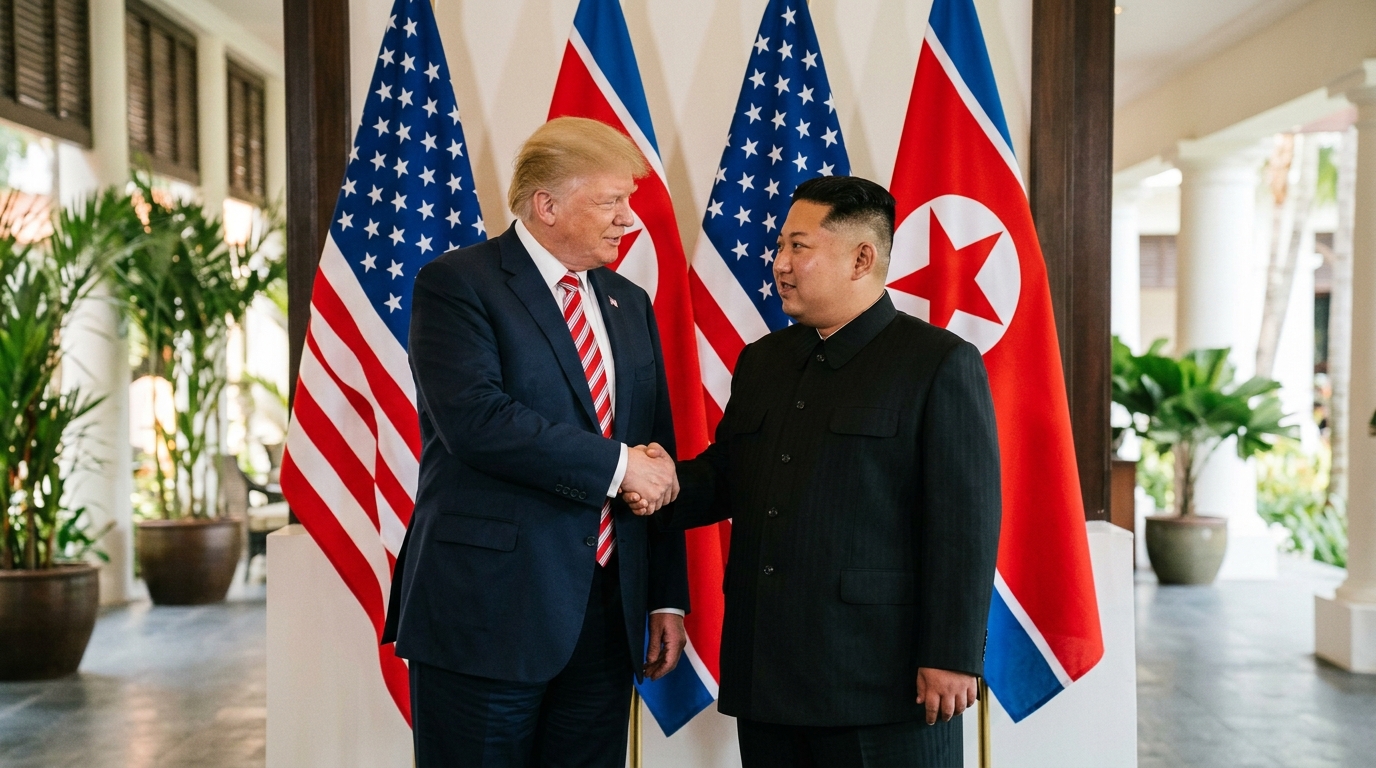
| Summit Day | June 12, 2018, 9:04 AM SGT | Historic Handshake | Donald Trump and Kim Jong-un meet for the first time at the Capella Hotel, Sentosa Island, for a historic handshake. |
| Negotiation | June 12, 2018 | One-on-one, bilateral talks, working lunch | Leaders hold a private 45-minute meeting, followed by expanded bilateral talks with aides, and a working lunch. |
| Document Signing | June 12, 2018, 1:40 PM SGT | Joint Statement Signed | Trump and Kim sign a "Joint Statement" committing to denuclearization and security guarantees. |
| Departure | June 12–13, 2018 | Press conferences, return to home capitals | Trump holds a lengthy press conference; Kim departs shortly after. |
The most iconic image of the day was the handshake at the Capella Hotel on Sentosa Island. Against a backdrop of alternating U.S. and North Korean flags, the two leaders, symbols of seven decades of mutual antagonism, met face-to-face. The handshake, a moment carefully choreographed for maximum symbolic impact, lasted for approximately 13 seconds, a testament to the weight of the occasion. Inside the conference room, the initial 45-minute one-on-one session with only interpreters present set a surprisingly cordial tone. President Trump later described building a strong rapport with Kim, emphasizing a vision of economic prosperity for North Korea if it chose to denuclearize. Kim Jong-un, in turn, acknowledged the "past" that had held back progress and expressed a desire for a "new beginning."
The expanded bilateral session included key advisors from both sides. For the U.S., Secretary of State Mike Pompeo, National Security Advisor John Bolton (a vocal skeptic of North Korea), and Chief of Staff John Kelly were present. North Korea's delegation included Kim Yong-chol (Vice Chairman of the Central Committee of the Workers' Party of Korea), Ri Yong-ho (Foreign Minister), and No Kwang-chol (Minister of the People's Armed Forces). The working lunch that followed featured a carefully curated fusion menu, intended to symbolize a bridging of cultures and diplomatic approaches. The entire day was a masterclass in political theater, designed to project an image of breakthrough and reconciliation to a global audience hungry for peace.
Geopolitical Consequences and Aftermath
The immediate aftermath of the summit was met with a spectrum of reactions, from cautious optimism to profound skepticism. Enthusiasts, particularly within the Trump administration and in South Korea, heralded the meeting as a groundbreaking triumph of personal diplomacy that successfully averted a potential regional war. President Trump famously declared that there was "no longer a nuclear threat from North Korea." Critics, however, pointed out that the Joint Statement was dangerously vague, lacking specific commitments, timelines, or mechanisms for verifiable denuclearization.
"President Trump committed to provide security guarantees to the DPRK and Chairman Kim Jong-un reaffirmed his firm and unwavering commitment to complete denuclearization of the Korean Peninsula." — Extract from the Singapore Joint Statement
The consequences of this broad and ambiguous language were profound and quickly became apparent:
- Diplomatic Deadlock: The Hanoi Summit and Beyond: The term "complete denuclearization of the Korean Peninsula" proved to be a critical point of contention. North Korea consistently interpreted this phrase broadly, to include not only the dismantling of its own nuclear weapons but also the eventual removal of the U.S. nuclear umbrella over South Korea and Japan, and potentially the withdrawal of U.S. troops from the region. The U.S., conversely, primarily focused on the unilateral, verifiable, and irreversible denuclearization (CVID) of North Korea's existing nuclear arsenal and missile programs. This fundamental difference in interpretation meant that crucial working-level negotiations, tasked with fleshing out the Singapore agreement, became mired in defining the sequencing and scope of denuclearization and corresponding reciprocal measures. The most significant of these follow-up efforts was the second Trump-Kim summit in Hanoi, Vietnam, in February 2019. In Hanoi, the two sides failed to reach any agreement, as North Korea offered to dismantle its Yongbyon nuclear complex in exchange for comprehensive sanctions relief, while the U.S. demanded more extensive denuclearization steps (including other undisclosed sites) before offering significant economic concessions. The summit abruptly ended without a joint statement, exposing the limitations of personalistic diplomacy without detailed preparatory work and a shared understanding of core terms.
- Regional Shifts and Alliance Strains: South Korea, under President Moon Jae-in, found itself in a precarious position. Having played a pivotal role in initiating the diplomatic thaw, Seoul was keen to maintain momentum for inter-Korean rapprochement and peace. However, the lack of concrete progress on denuclearization from the U.S. side, coupled with the Trump administration's unilateral decision-making (e.g., suspending joint military exercises with South Korea as a gesture to Kim Jong-un, much to Seoul's consternation), strained the alliance. Japan, a key U.S. ally and a direct target of North Korean missiles, expressed considerable concern over the lack of progress on ballistic missile issues and the abduction of Japanese citizens by North Korea, feeling that its security interests were not adequately addressed by the U.S.-DPRK dialogue.
- Normalization Ambiguities and North Korea's Strategic Gains: For Kim Jong-un, the summit was a monumental strategic victory, regardless of denuclearization progress. Simply by sitting at a table as an equal partner to the leader of the world's preeminent superpower, Kim achieved a long-held North Korean goal: the normalization of the DPRK as a legitimate state actor. This dramatically elevated his international standing, solidified his regime's internal legitimacy, and effectively ended North Korea's "pariah" status on the global stage. While sanctions remained in place, the diplomatic engagement provided the regime with breathing room, allowing it to continue refining its nuclear and missile capabilities in relative peace, without the immediate threat of military action. The promise to "build a lasting and stable peace regime" remained aspirational, as the legal technicality of the Korean War's end was never addressed through a formal peace treaty, leaving the peninsula in an unstable armistice.
- Impact on Sanctions Regime: Post-Singapore, while the core UN sanctions remained, the "maximum pressure" campaign lost much of its momentum. China and Russia, often ambivalent about strict enforcement, now had diplomatic cover to advocate for sanctions relief in exchange for North Korean gestures, complicating U.S. efforts to maintain a unified front.
In essence, the Singapore Summit lowered immediate tensions and opened a channel for direct communication, but its foundational ambiguity and the subsequent failure to bridge the definitional gap on "denuclearization" led to a prolonged diplomatic deadlock. North Korea continued to develop its nuclear and missile programs, albeit without conducting nuclear tests or ICBM launches during the immediate post-summit period, while the U.S. gained little tangible progress on its core demand for verifiable disarmament.
Analysis of Key Actors and Decisive Actions
The trajectory of the Singapore Summit and its aftermath was largely shaped by the contrasting styles and motivations of the principal actors, whose actions and inactions defined the diplomatic landscape.
Donald Trump: The Transactional Diplomat
President Trump approached the summit with a unique blend of business acumen, showmanship, and a profound distrust of traditional diplomatic processes. He viewed the summit through the lens of a "dealmaker," believing that his personal charisma and direct engagement could achieve what decades of conventional diplomacy had failed to accomplish.
- Approach: He deliberately bypassed traditional bureaucratic frameworks, often sidelining State Department experts and even his own National Security Council staff (most notably John Bolton, who advocated a "Libya model" of denuclearization, which North Korea viewed as a threat to regime survival). His strategy was to project "personal chemistry" with Kim Jong-un, believing that a direct, top-down agreement could incentivize North Korea to abandon its arsenal in exchange for international legitimacy and economic growth. He saw the summit itself as a victory, regardless of the granular details.
- Decisive Actions: His abrupt acceptance of Kim's invitation, his initial cancellation of the summit, and his subsequent reinstatement demonstrated his highly personalized and unpredictable decision-making. His willingness to make unilateral concessions, such as suspending large-scale joint military exercises with South Korea (a move that surprised and reportedly angered the Pentagon and Seoul), further highlighted his idiosyncratic approach, prioritizing the optics of peace over alliance coherence or strategic deterrence.
- Implications: While this approach undeniably opened a channel that had been closed for decades, it came at a cost. The lack of detailed groundwork and expert input created a vague agreement that left the U.S. with less leverage when working-level negotiations stalled. Trump's emphasis on personal rapport also meant that diplomatic progress became heavily reliant on the relationship between two leaders, making it vulnerable to shifts in political will or domestic pressures.
Kim Jong-un: The Strategic Pragmatist
For Chairman Kim, the Singapore Summit was a shrewd strategic maneuver executed with remarkable pragmatism. He recognized an unprecedented opportunity in Trump's unconventional diplomacy and seized it to advance core North Korean objectives that transcended immediate denuclearization.
- Approach: Kim portrayed himself as a rational, reform-minded leader willing to engage with the outside world, a stark contrast to his father and grandfather. His key objective was regime survival, which he believed hinged on two pillars: a credible nuclear deterrent and international recognition. The summit delivered significantly on the latter. He used the diplomatic opening to gain breathing room from "maximum pressure" and to demonstrate to his internal audience that he could stand as an equal to the American president.
- Decisive Actions: Kim's surprising invitation to meet Trump, relayed through South Korea, was a calculated risk that paid off. His willingness to pause nuclear and long-range missile tests (though continuing short-range missile development) created a conducive environment for dialogue without fundamentally altering his strategic posture. His persistent adherence to a broad interpretation of "denuclearization of the Korean Peninsula" allowed him to frame concessions (like dismantling Yongbyon) as significant while maintaining his overall nuclear program. His visits to China before and after the summit also underscored his strategic alignment with Beijing, ensuring an alternative power base.
- Implications: By simply sitting at the table, Kim effectively broke North Korea’s "pariah" status and gained a de facto acknowledgment of his regime's legitimacy and his country's nuclear power status, irrespective of giving up a single nuclear warhead. This diplomatic victory helped consolidate his power domestically and created fissures in the international sanctions regime, allowing him to navigate the geopolitical landscape more effectively.
Other Key Actors:
- Moon Jae-in (South Korean President): The indispensable "driver" of the peace process, Moon skillfully leveraged the PyeongChang Olympics and inter-Korean dialogue to create the conditions for the U.S.-DPRK summit. His "Sunshine Policy" revival aimed to build trust and reduce tensions, though his efforts were ultimately constrained by the divergence between U.S. and North Korean denuclearization demands.
- Mike Pompeo (U.S. Secretary of State): As then-CIA Director, Pompeo conducted secret pre-summit visits to Pyongyang, becoming the primary U.S. negotiator. His role was to balance Trump's transactional impulses with the need for substantive outcomes, though he often found himself caught between Trump's personal diplomacy and the State Department's traditional demands for verifiable disarmament.
- John Bolton (U.S. National Security Advisor): A staunch hawk, Bolton was deeply skeptical of North Korea's intentions and the summitry approach. His advocacy for a "Libya model" (complete, verifiable, irreversible denuclearization prior to any concessions) was seen as provocative by Pyongyang and created internal tension within the U.S. negotiating team. His influence was often at odds with Trump's desire for a quick deal.
Domestic Reactions and International Perceptions
The 2018 Singapore Summit elicited a wide range of reactions globally, reflecting diverse national interests and ideological perspectives.
U.S. Domestic Reaction
In the United States, the summit was met with sharply polarized responses:
- Republican Support: President Trump's base and many Republicans hailed the summit as a historic breakthrough, crediting Trump's unconventional approach for achieving what no other president had. They praised him for engaging directly with Kim, lowering tensions, and potentially averting war. The sight of an American president meeting a North Korean leader was seen as a bold, decisive move.
- Democratic Criticism: Democrats and many foreign policy experts expressed deep skepticism. They argued that Trump had legitimized a brutal dictator without securing concrete, verifiable concessions on denuclearization. Concerns were raised about the vagueness of the joint statement, the lack of a clear roadmap, and the potential for North Korea to exploit the diplomatic opening to buy time for further weapons development. Critics also pointed to the erosion of traditional diplomatic norms and alliances.
- Media Polarization: The media landscape mirrored this divide, with conservative outlets largely applauding the summit as a success, while liberal-leaning outlets focused on the lack of tangible results and the perceived propaganda victory for Kim Jong-un.
South Korea
For South Koreans, the summit evoked a complex mix of hope and apprehension:
- Hopes for Peace: President Moon Jae-in and a significant portion of the South Korean public expressed immense hope that the summit would lead to a lasting peace on the peninsula and potentially unlock opportunities for inter-Korean economic projects and family reunions. The images of their leaders shaking hands, after decades of frozen relations, were deeply moving for many.
- Concerns: However, there were also concerns about the durability of the agreement and the possibility of being sidelined if U.S.-DPRK relations progressed without full consideration of South Korea's specific security needs and reunification aspirations. The suspension of U.S.-ROK joint military exercises, for example, raised questions about alliance solidarity.
Japan
Japan, a frontline state in North Korea's missile tests, remained cautiously optimistic but largely skeptical:
- Security Concerns: Prime Minister Shinzo Abe cautiously welcomed the dialogue but consistently emphasized the need for "complete, verifiable, and irreversible denuclearization" and the resolution of North Korea's short- and medium-range missile programs, which pose a direct threat to Japan.
- Abduction Issue: Japan also pressed for the resolution of the issue of Japanese citizens abducted by North Korea in the 1970s and 1980s, a deeply emotional domestic issue that remained largely unaddressed in the broader denuclearization talks.
China and Russia
Both China and Russia, traditional allies of North Korea and permanent members of the UN Security Council, generally welcomed the summit:
- Support for Dialogue: They saw the summit as a positive step towards de-escalation and stability on the Korean Peninsula, aligning with their long-standing advocacy for dialogue over confrontation.
- Sanctions Relief Advocacy: Following the summit, both countries increasingly pushed for easing UN sanctions on North Korea, arguing that reciprocal measures were necessary to incentivize Pyongyang's denuclearization. This stance often put them at odds with the U.S., which insisted on maintaining maximum pressure until substantive denuclearization occurred. China, in particular, played a crucial role as Kim Jong-un's primary external lifeline, hosting him multiple times before and after the Singapore summit, solidifying its geopolitical influence over the peninsula.
International Bodies
International organizations like the United Nations and the International Atomic Energy Agency (IAEA) noted the diplomatic progress but maintained a pragmatic outlook:
- UN: The UN Secretary-General welcomed the dialogue but stressed the importance of concrete, verifiable steps towards denuclearization in line with Security Council resolutions.
- IAEA: The IAEA, tasked with monitoring nuclear activities, reiterated its readiness to resume its verification mission in North Korea once political agreements allowed, underscoring the technical challenges of denuclearization that extended beyond high-level political declarations.
In summary, while the Singapore Summit was universally acknowledged as a historic event that shifted the diplomatic paradigm, its substantive outcomes were viewed through varied lenses, largely shaped by each nation's geopolitical interests, threat perceptions, and domestic political landscapes. The euphoria of the initial meeting quickly gave way to the complexities of implementation, exposing the inherent challenges of translating a broad political declaration into verifiable disarmament.
Trivia and Lesser-Known Facts
Beyond the high-stakes negotiations and diplomatic pronouncements, several lesser-known details and symbolic gestures illuminated the unique dynamics of the Singapore Summit.
- The Venue and Its Name: The Capella Hotel, located on the secluded Sentosa Island, was chosen for its strategic isolation and inherent security advantages, allowing for stringent control over access and media. The name "Sentosa," meaning "peace and tranquility" in Malay, was a deliberate and hopeful choice by the Singaporean government to imbue the meeting with a symbolic aspiration for harmony after decades of conflict. The island had a previous life as a British military fortress, ironically transforming from a place of defense to a stage for peace.
- The "Unveiling" Video: Perhaps one of the most unconventional diplomatic tools ever deployed, President Trump showcased a four-minute, Hollywood-style promotional video to Chairman Kim. Produced by the U.S. National Security Council, the video, titled "A Story of Opportunity," depicted a vision of a modernized, thriving North Korea—complete with high-speed trains, gleaming skyscrapers, and luxury resorts—provided the regime chose to pursue peace and denuclearization. It was replete with soaring music and dramatic voiceovers, resembling a movie trailer more than a diplomatic briefing. This unprecedented use of visual messaging was an attempt by Trump to appeal directly to Kim's aspirations for his country's economic future, bypassing traditional security-centric arguments.
- The Fusion Menu: The summit luncheon featured a carefully crafted fusion menu, blending Western favorites with Korean culinary elements. Dishes included beef short rib confit, sweet and sour crispy pork, oiseon (stuffed cucumber), and daegu jorim (braised cod fish with radish). This gastronomic diplomacy was intended to symbolize the hybrid nature of the diplomatic endeavor itself – a blending of cultures and approaches in pursuit of a common goal, however tenuous. Dessert included tarte tatin and a special "Häagen-Dazs ice cream, vanilla, chocolate, and raspberry."
- The Presidential Limousine Tour ("The Beast"): In a highly unusual and intimate gesture, President Trump reportedly gave Kim Jong-un a peek into the interior of "The Beast," his custom-built, armored presidential limousine. This extraordinary breach of typical head-of-state protocol was a telling moment, underscoring Trump's emphasis on personal chemistry and his willingness to employ unconventional tactics to build rapport. It was a visual demonstration of power and access, perhaps intended to impress Kim and symbolize a level of trust and openness.
- Security Measures: Singapore implemented an extraordinary security apparatus for the summit. This included deploying elite forces, such as Nepalese Gurkha contingent officers, to secure the venues and routes. Airspace restrictions were imposed, and naval patrols were enhanced around Sentosa Island. The security bill alone for Singapore was estimated to be around S$20 million (US$15 million), a cost the Singaporean government absorbed to facilitate the historic meeting.
- The Pen Incident: Another minor but telling detail involved the signing of the joint statement. Kim Jong-un's sister, Kim Yo-jong, provided him with a pen from her own bag for the signing, indicating a meticulous concern for protocol and perhaps a reluctance to use a pen provided by the host or the U.S. side. This small moment highlighted the deep-seated mistrust and the careful choreography of every detail by the North Korean delegation.
- Gifts and Mementos: Beyond the formal documents, there were reports of gifts exchanged. President Trump reportedly gave Kim Jong-un an engraved silver Colt pistol, a relatively rare gesture in modern diplomacy and one that raised eyebrows given the context. Kim Jong-un's gifts were less publicized but were understood to include North Korean cultural items.
These "trivia" elements reveal the highly personal, often unconventional, and meticulously orchestrated nature of the Singapore Summit. They offer insights into the leaders' personalities, their strategic calculations, and the delicate balance of power and symbolism inherent in such a historic, yet ultimately inconclusive, diplomatic encounter.
References and Literature
- The U.S. Department of State Archive - The official text of the Joint Statement signed on June 12, 2018, providing the foundational document for subsequent analysis.
- Council on Foreign Relations: The Singapore Summit - A reputable source for in-depth analyses of the geopolitical implications, the failure of subsequent working-level negotiations, and the broader context of U.S. foreign policy toward North Korea.
- The Great Successor: The Divinely Perfect Destiny of Brilliant Comrade Kim Jong Un by Anna Fifield (PublicAffairs, 2019) - A comprehensive and insightful account of Kim Jong-un’s rise to power, his strategic thinking, and his navigation of international relations during the Trump era, providing crucial context for his motivations at the summit.
- Trump and the North Korean Nuclear Issue (Journal of Indo-Pacific Affairs, Vol. 1, No. 1, 2018) - An academic breakdown of the "Maximum Pressure" campaign, its effectiveness, and the unprecedented shift toward personalistic summitry as a primary diplomatic tool.
- Fear: Trump in the White House by Bob Woodward (Simon & Schuster, 2018) - Offers an insider's perspective on the internal deliberations and conflicts within the Trump administration regarding North Korea policy and the summit preparations, particularly highlighting the role of advisors like John Bolton.
- The Art of the Deal by Donald J. Trump and Tony Schwartz (Random House, 1987) - While predating his presidency, this book provides insight into Trump's "dealmaker" philosophy that heavily influenced his approach to the summit and his belief in personal negotiation.
- The Two Koreas: A Contemporary History by Don Oberdorfer and Robert Carlin (Basic Books, 2013) - Provides essential historical background on inter-Korean relations and previous U.S.-DPRK diplomatic efforts, offering a long-term perspective on the challenges of denuclearization.
Footnotes & Explanations
- This document officially refers to the "denuclearization of the Korean Peninsula," a term that North Korea interprets as including the removal of the U.S. nuclear umbrella over South Korea. ↩
- The summit was the first meeting between a sitting U.S. President and a North Korean leader, though former President Bill Clinton visited Pyongyang in 2009 after leaving office. ↩