Key Takeaways
- The conflict arose from overlapping territorial claims along the undefined Himalayan border, exacerbated by the colonial legacy of the McMahon Line and Aksai Chin.
- The granting of asylum to the 14th Dalai Lama by India in 1959 and the implementation of India's 'Forward Policy' heightened tensions, leading to a swift Chinese offensive in October 1962.
- The war ended with a unilateral Chinese ceasefire and withdrawal, resulting in a humiliating defeat for India, the collapse of Nehru's non-aligned idealism, and the cementing of the Sino-Pakistani alliance.
In the autumn of 1962, the world's attention was overwhelmingly captured by the Cuban Missile Crisis, a perilous nuclear standoff in the Caribbean that brought humanity to the brink of thermonuclear war. Yet, simultaneously, on the opposite side of the globe, another geopolitically seismic event was unfolding on the rugged, oxygen-depleted heights of the Himalayas.
The Sino-Indian War of 1962, though lasting just one month, shattered the post-colonial dream of Afro-Asian solidarity, transformed the strategic landscape of Asia, and dealt a devastating blow to the political prestige of Indian Prime Minister Jawaharlal Nehru. Occurring at altitudes exceeding 14,000 feet, the war remains one of the most remarkable and logistically challenging high-altitude conflicts in modern military history.
Historical Context and Origins
To understand the outbreak of hostilities in October 1962, one must look to the cartographic ambiguities inherited from the British Empire and the fundamentally different state-building paths chosen by post-colonial India and the newly established People's Republic of China (PRC).
The Imperial Cartographic Legacy
The borders between British India, Tibet, and Xinjiang were never definitively demarcated by treaty. In the Western Sector, the barren, high-altitude desert of Aksai Chin remained a zone of cartographic confusion.
The British Indian administration vacillated between different boundary definitions:
- The Johnson Line (1865): Placed Aksai Chin within Kashmir (and thus, later, India). This line was never presented to or accepted by the Chinese Qing dynasty.
- The Macartney-MacDonald Line (1899): Proposed a compromise that placed most of Aksai Chin under Chinese sovereignty. While the Qing government did not formally respond, this line was treated by many as the de facto boundary for decades.
Following independence in 1947, India adopted the more expansive Johnson Line as its official boundary, publishing maps that claimed Aksai Chin as part of Jammu and Kashmir. For China, however, Aksai Chin was a vital strategic corridor connecting Xinjiang with Tibet.
In the Eastern Sector, the British had drawn the McMahon Line during the Simla Conference of 1914. While Tibet signed the convention, the Republic of China rejected it, refusing to ratify a treaty that recognized Tibetan treaty-making authority or severed territory from the Chinese sphere of influence. When the Indian Republic was founded, it asserted the McMahon Line as its sovereign northern border in what was then the North-East Frontier Agency (NEFA, now Arunachal Pradesh) 1.
| Sector | Region A | Region B | Defining Feature | Notes |
|---|---|---|---|---|
| Western Sector | Xinjiang / Tibet | Kashmir / India | Aksai Chin | Vital Road Link to Tibet |
| Eastern Sector | Tibet / China | Assam / India | McMahon Line | Disputed but administratively held |
The Tibetan Catalyst and the Collapse of "Hindi-Chini Bhai Bhai"
In the early 1950s, relations between New Delhi and Beijing appeared cordial. Jawaharlal Nehru, a champion of pan-Asian anti-imperialism, promoted the slogan “Hindi-Chini Bhai Bhai” (Indians and Chinese are brothers). In 1954, the two nations signed the Panchsheel Agreement (Five Principles of Peaceful Coexistence), in which India formally recognized Chinese sovereignty over Tibet, relinquishing extra-territorial privileges inherited from the British.
However, the geopolitical consensus began to unravel almost immediately. In the mid-1950s, China constructed the National Highway 219 (G219) through Aksai Chin to secure military transit into Tibet. India only discovered the existence of this road in 1957 through Chinese press reports and subsequent patrol missions, sparking intense domestic outrage in New Delhi 2.
The situation reached a boiling point in March 1959. Following a brutal Chinese crackdown on the Tibetan uprising, the 14th Dalai Lama fled Lhasa and crossed into India. Nehru’s decision to grant him political asylum—combined with India's sympathy for Tibetan refugees—convinced Mao Zedong and the Chinese leadership that India was actively conspiring with Western imperialists and Tibetan rebels to destabilize Chinese rule in Lhasa.
The Forward Policy
Faced with domestic criticism for being soft on China, Nehru's government initiated the Forward Policy in late 1961. Drafted by the director of the Intelligence Bureau, B.N. Mullik, and supported by Defense Minister V.K. Krishna Menon, the policy directed the Indian Army to establish small, forward military outposts in disputed areas along the border, even behind existing Chinese positions.
The fundamental premise of the Forward Policy was a strategic miscalculation: Indian leadership believed that China would not risk a major war and would back down when faced with a physical Indian presence.
Instead of deterring Beijing, the policy of placing isolated, poorly supplied patrols in close proximity to the battle-hardened People's Liberation Army (PLA) provided the Chinese leadership with a clear casus belli and a tactical advantage 3.
Timeline of Events and Key Moments
The escalation from sporadic border skirmishes to full-scale war was swift, peaking in a lightning Chinese campaign across the high-altitude theaters of NEFA and Ladakh.
[Late 1961] [Sept 1962] [Oct 20, 1962] [Nov 14-21, 1962] [Nov 21, 1962] India starts Thag La Ridge Simultaneous PLA Second PLA phase; China declares "Forward Policy" -------> skirmish occurs -----> massive offensive ----> Indian front collapses -> unilateral ceasefire
Pre-War Escalation: The Thag La Ridge (September 1962)
The immediate spark occurred in the Eastern Sector near the trijunction of India, Bhutan, and Tibet. In June 1962, Indian forces established an outpost called Dhola Post, located north of the coordinates defining the McMahon Line on some maps, but south of the local crest line (Thag La Ridge) that India claimed as the true geographical boundary.
By September, Chinese forces occupied positions on Thag La Ridge, looking down on the Indian garrison. Skirmishes broke out, resulting in casualties on both sides. On October 12, Nehru famously declared to reporters that he had ordered the Indian Army to "free our territory" of Chinese intruders, a statement Beijing interpreted as a formal declaration of intent to attack.
October 20, 1962: The First Chinese Offensive
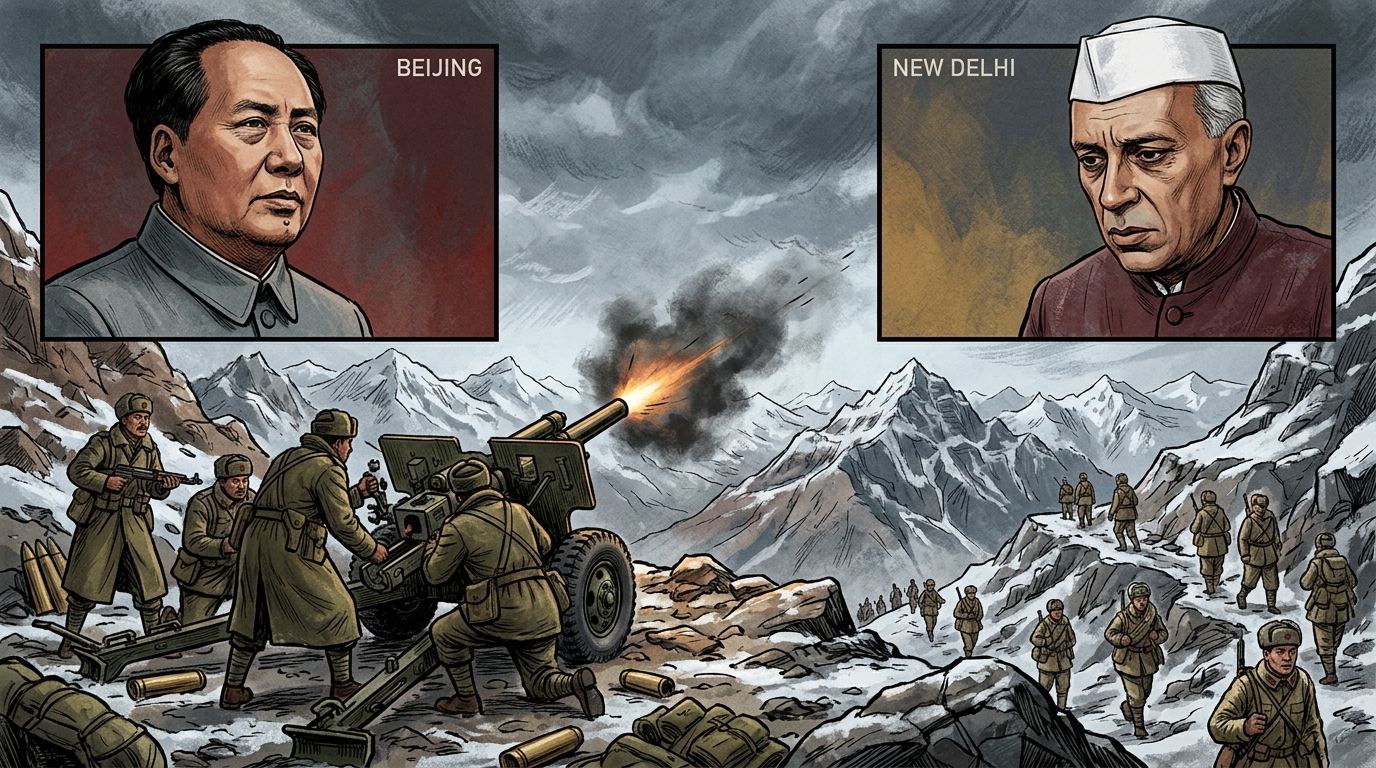
On the morning of October 20, 1962, the PLA launched a massive, coordinated, and synchronized offensive across both the Eastern and Western Sectors.
- The Eastern Theater (NEFA): The Chinese forces, utilizing superior high-altitude training and pack-mule logistics, bypassed the main Indian defensive nodes. They quickly overran the Dhola Post and Khinzemane. The highly respected 7th Indian Infantry Brigade under Brigadier John Dalvi was decimated within days, and Dalvi himself was captured. On October 24, the strategic monastery town of Tawang fell to the Chinese.
- The Western Theater (Ladakh): In Ladakh, the PLA systematically liquidated the isolated outposts established under the Indian Forward Policy in the Galwan Valley, Chip Chap Valley, and the Pangong Lake region. Unlike in the East, Indian troops in Ladakh fought tenacious defensive battles, but were heavily outnumbered and outgunned.
Following these initial victories, Premier Zhou Enlai sent a letter to Nehru proposing a negotiated settlement based on mutual withdrawal of troops 20 kilometers from the "Line of Actual Control" (LAC). Nehru, under intense pressure from an outraged Indian public and parliament, rejected the proposal, demanding a return to the status quo ante of September 8, 1962.
Phase Two and the November Collapse
After a three-week operational pause to build supply lines, the PLA resumed its offensive on November 14, targeting the remaining Indian defenses.
- The Battle of Rezang La (November 18): In the Western Sector near Chushul, the C Company of the 13th Kumaon Regiment, consisting of 120 men led by Major Shaitan Singh, held a crucial pass at Rezang La. In a legendary last stand, the company fought to the last man in sub-zero temperatures, repelling successive waves of Chinese infantry. Nearly 114 Indian soldiers were killed, but they inflicted massive casualties on the PLA, successfully halting the Chinese advance toward the vital Chushul airfield [^4].
"The Kumaonis fought with magnificent courage... Major Shaitan Singh, though mortally wounded, continued to move from post to post, encouraging his men, until he succumbed to his injuries. The defense of Rezang La remains one of the greatest defensive actions in military history." — Military Analyst and Historian Lt. Gen. (Retd.) S.L. Menezes
- The Sela-Bomdila Catastrophe (Eastern Sector): In NEFA, the Indian military command structure collapsed under the weight of panic and poor operational decisions. The 4th Infantry Division, commanded by Major General A.S. Pathania, withdrew from its fortified positions at Sela Pass without offering a coordinated fight. This triggered a chaotic retreat, allowing the PLA to swiftly capture Bomdila and advance to the foothills of Assam, virtually at the edge of the plains of the Brahmaputra River.
CHINESE ADVANCE (EASTERN SECTOR) [Tibet Border] -> [Thag La Ridge] -> [Tawang] -> [Sela Pass] -> [Bomdila] -> [Edge of Assam Plains]
By mid-November, the Indian state was gripped by panic. The civilian population of Tezpur in Assam began evacuating, and Nehru took the desperate step of writing two secret letters to US President John F. Kennedy, requesting immediate American military intervention, including the deployment of US-piloted fighter jets to defend Indian cities 5.
Unilateral Ceasefire (November 21, 1962)
Just as the Indian defense apparatus faced complete collapse, the Chinese government announced a unilateral ceasefire on November 21, 1962.
Beijing declared that its forces would withdraw 20 kilometers behind the positions they held prior to November 7, 1959 (effectively the Chinese-defined LAC). While China retained control of Aksai Chin, it voluntarily withdrew its troops from the conquered territories of NEFA (now Arunachal Pradesh), returning to the north of the McMahon Line.
Geopolitical Consequences and Aftermath
The strategic landscape of Asia was fundamentally altered in the wake of the 31-day war. The conflict reverberated far beyond the high-altitude passes of the Himalayas.
Consequences of the 1962 War
- Indian Defense
- Diplomatic Shift
- Communist Bloc
| Indian Defense | Diplomatic Shift | Communist Bloc |
|---|---|---|
| Army Modernization | End of Non-Alignment | Sino-Soviet Split |
| Intelligence Reform | Sino-Pakistani Axis | Maoist Hegemony |
The Destruction of Nehruvian Idealism
The war dealt a fatal blow to Jawaharlal Nehru’s prestige and his vision of a non-aligned India acting as a moral arbiter on the world stage. Nehru’s health declined rapidly after the defeat, and he passed away in May 1964.
His close political ally, Defense Minister V.K. Krishna Menon, was forced to resign amid intense criticism over the military's lack of preparedness, inadequate winter clothing, outdated weaponry, and systemic intelligence failures.
The Rise of the Beijing-Islamabad Axis
The conflict accelerated a major diplomatic realignment in South Asia. Observing India's vulnerability, Pakistan—previously a Western-aligned state—sought closer ties with the People's Republic of China.
In March 1963, Pakistan and China signed a border agreement, under which Pakistan ceded the Shaksgam Valley (part of disputed Kashmir) to China. This laid the foundation for an enduring "all-weather" strategic alliance designed to contain Indian power.
[China (Beijing)] / \ / \ (Strategic Alliance / CPEC) / \ [India (New Delhi)] <---> [Pakistan (Islamabad)] (Tense Border)
Military Modernization and Intelligence Reform
The humiliating defeat prompted a comprehensive overhaul of the Indian Armed Forces. The Henderson Brooks-Bhagat Report, a highly classified internal inquiry into the military debacle, pointed to critical failures in high-level command, political interference in military appointments, and flawed intelligence.
Consequently, India:
- Abandoned its opposition to military aid, accepting arms shipments from both the United States and the Soviet Union.
- Initiated a massive expansion and modernization of its armed forces, creating specialized mountain divisions trained specifically for high-altitude warfare.
- Established the Research and Analysis Wing (R&AW) in 1968 to overhaul foreign intelligence gathering.
- Developed the Special Frontier Force (SFF), a paramilitary unit composed primarily of Tibetan refugees, trained for covert operations behind Chinese lines.
The Sino-Soviet Split and Global Communism
The war solidified the deep ideological and strategic rift between Moscow and Beijing. During the initial phases of the conflict, the Soviet Union, occupied with the Cuban Missile Crisis, offered lukewarm rhetorical support to China.
However, once the Caribbean crisis subsided, Soviet Premier Nikita Khrushchev criticized Mao’s offensive against a non-aligned fraternal state like India, subsequently offering substantial military and technical assistance to New Delhi (including the transfer of MiG-21 fighter jet technology) 6.
Mao utilized the conflict to demonstrate that China would not follow Moscow’s line of peaceful coexistence with capitalist states, positioning Beijing as the true leader of the revolutionary Third World.
Analysis of Key Actors and Decisive Actions
The outcome of the 1962 war was not merely a product of geographical logistics; it was deeply shaped by the personal calculations and flaws of the primary leaders involved.
| Leader / Actor | Strategic Objective | Key Miscalculation / Decisive Action | Outcome / Legacy |
|---|---|---|---|
| Mao Zedong (China) | Secure Aksai Chin; humiliate India; deter Western-Soviet influence; consolidate domestic power after the Great Leap Forward. | Timed the invasion to coincide with the Cuban Missile Crisis to minimize superpower intervention. | Achieved a decisive military and psychological victory; secured the G219 highway. |
| Jawaharlal Nehru (India) | Defend territorial integrity without provoking full-scale war; maintain non-aligned moral leadership. | Implemented the "Forward Policy" while ignoring warnings from senior army commanders about the lack of preparedness. | Suffered complete political and personal devastation; forced to ask for Western military aid. |
| V.K. Krishna Menon (India) | Reorganize Indian defense manufacturing; maintain civilian supremacy over the military. | Promoted political favorites (like Gen. B.M. Kaul) over experienced field commanders; underestimated the Chinese threat. | Forced to resign in disgrace; widely blamed for India's defense failure. |
| Zhang Guohua (PLA General) | Execute a rapid, decisive strike to shatter Indian frontline morale and force a retreat. | Utilized infiltration tactics, bypassing strongpoints to cut off Indian retreat routes. | Successfully executed the offensive with minimal PLA casualties; reinforced PLA high-altitude tactics. |
Mao Zedong: The Cold Calculator
For Mao, the war was a calculated political tool. Internally, China was recovering from the catastrophic economic fallout of the Great Leap Forward, which had resulted in widespread famine.
By launching a short, successful war against India, Mao diverted domestic discontent, asserted absolute control over Tibet, and punished Nehru for what he saw as Indian meddling in Tibet's affairs. Mao famously compared the offensive to "knocking India down to the negotiating table."
Jawaharlal Nehru: The Tragic Idealist
Nehru's foreign policy was built on the premise that a clash between Asia's two largest emerging nations was fundamentally irrational and therefore unlikely. This optimism led him to ignore numerous warnings from senior military staff, such as General K.S. Thimayya, who pointed out that the Indian Army was vastly unprepared to fight a modern war in the Himalayas.
Nehru's reliance on the advice of Intelligence Bureau Chief B.N. Mullik and Lieutenant General B.M. Kaul (a relative and political favorite who was appointed to command the newly created IV Corps in NEFA) led to a dysfunctional command hierarchy that fractured under stress.
Trivia and Lesser-Known Facts
- The Cuban Missile Crisis Coincidence: Mao Zedong meticulously timed the October 20 offensive to coincide with the height of the Cuban Missile Crisis. Knowing that both the United States and the Soviet Union would be preoccupied with avoiding a nuclear exchange, Mao correctly calculated that neither superpower would be able to intervene militarily on India's behalf during the critical first phase of the war.
- The Non-Use of the Indian Air Force: One of the most controversial decisions of the war was India’s refusal to deploy its combat aircraft (the Indian Air Force, or IAF) for offensive missions. Fearing that China would respond by bombing major northern Indian cities like Calcutta, New Delhi, and Guwahati, the Nehru government limited the IAF strictly to transport and supply missions. Military historians argue that the offensive use of the IAF could have disrupted Chinese supply lines and turned the tide in NEFA, given the PLA's lack of close air support and vulnerable logistical choke points [^7].
- The Internment of Chinese-Indians: In the wake of the Chinese invasion, the Indian government passed the Defence of India Act in 1962, which permitted the arrest and detention of any person of Chinese descent. Approximately 3,000 Chinese-Indians, mostly from the vibrant community in Calcutta (Kolkata), were rounded up and sent to a disused World War II internment camp in Deoli, Rajasthan, where many were held for years without trial.
- The Heroism of Jaswant Singh Rawat: During the Battle of Nuranang in NEFA (November 17, 1962), Rifleman Jaswant Singh Rawat of the 4th Garhwal Rifles single-handedly held off the advancing PLA for nearly 72 hours with the help of two local Monpa tribal girls, Sela and Nura. He set up weapons at different positions to create the illusion of a large garrison. When the Chinese discovered the ruse, Rawat was killed. Today, he is revered as a patron saint by Indian soldiers stationed at the border, and his post (Jaswant Garh) remains a permanent memorial where his boots are polished daily.
References and Literature
- The India-China Border Dispute: An Overview - A contemporary analysis from 1963 published by Foreign Affairs detailing the immediate aftermath and strategic fallout of the conflict.
- Maxwell, Neville. India's China War. London: Jonathan Cape, 1970. - A highly controversial and deeply detailed historical account that argues India's Forward Policy was the primary catalyst for the Chinese offensive.
- Hoffmann, Steven A. India and the China Crisis. University of California Press, 1990. - An authoritative scholarly study analyzing the decision-making processes, intelligence failures, and diplomatic maneuvers of both governments during 1962.
- The Henderson Brooks-Bhagat Report - The official, still-classified Indian military inquiry into the failures of the 1962 war (leaked sections available online).
Footnotes & Explanations
- Neville Maxwell, India's China War (London: Jonathan Cape, 1970), pp. 74–76. ↩
- Steven A. Hoffmann, India and the China Crisis (University of California Press, 1990), pp. 38–42. ↩
- B.N. Mullik, My Years with Nehru: The Chinese Betrayal (Allied Publishers, 1971), pp. 220–225. ↩
- Lt. Gen. (Retd.) S.L. Menezes, Fidelity & Honour: The Active and Retired Soldiers' Story (Oxford University Press, 1999), pp. 512–514. ↩
- "Letters from Prime Minister Nehru to President Kennedy, November 19, 1962," John F. Kennedy Presidential Library and Museum, National Security Files, Country Files: India. ↩
- Lorenz M. Lüthi, The Sino-Soviet Split: Cold War in the Communist World (Princeton University Press, 2008), pp. 223–226. ↩
- Air Chief Marshal (Retd.) P.C. Lal, My Years with the IAF (Lancer Publishers, 1986), pp. 102–105. ↩