Key Takeaways
- The Berlin Wall was erected overnight on August 13, 1961, under the codename 'Operation Rose' to halt the massive brain drain from East Germany.
- The crisis brought the United States and the Soviet Union to a direct military standoff at Checkpoint Charlie in October 1961, showcasing the high stakes of Cold War diplomacy.
- While the Wall severely curtailed human freedom and split families, it paradoxically stabilized the geopolitical borders of Europe, preventing a hot war between nuclear superpowers.
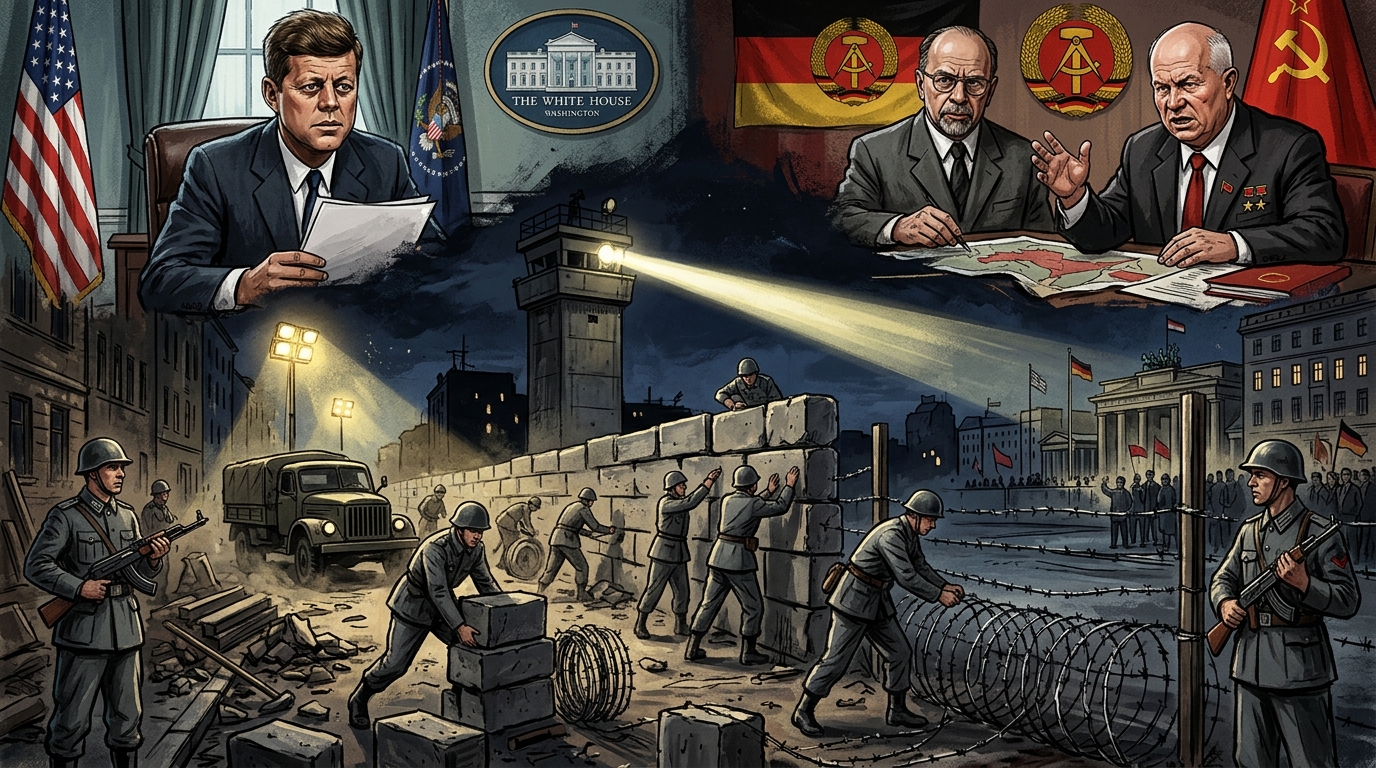
In the early hours of August 13, 1961, the city of Berlin was abruptly severed in two. Under the cover of darkness, thousands of East German soldiers, police officers, and combat groups of the working class (Kampfgruppen der Arbeiterklasse) began tearing up streets, stringing miles of barbed wire, and erecting concrete posts along the border separating the Soviet sector from the Western-aligned sectors of West Berlin.
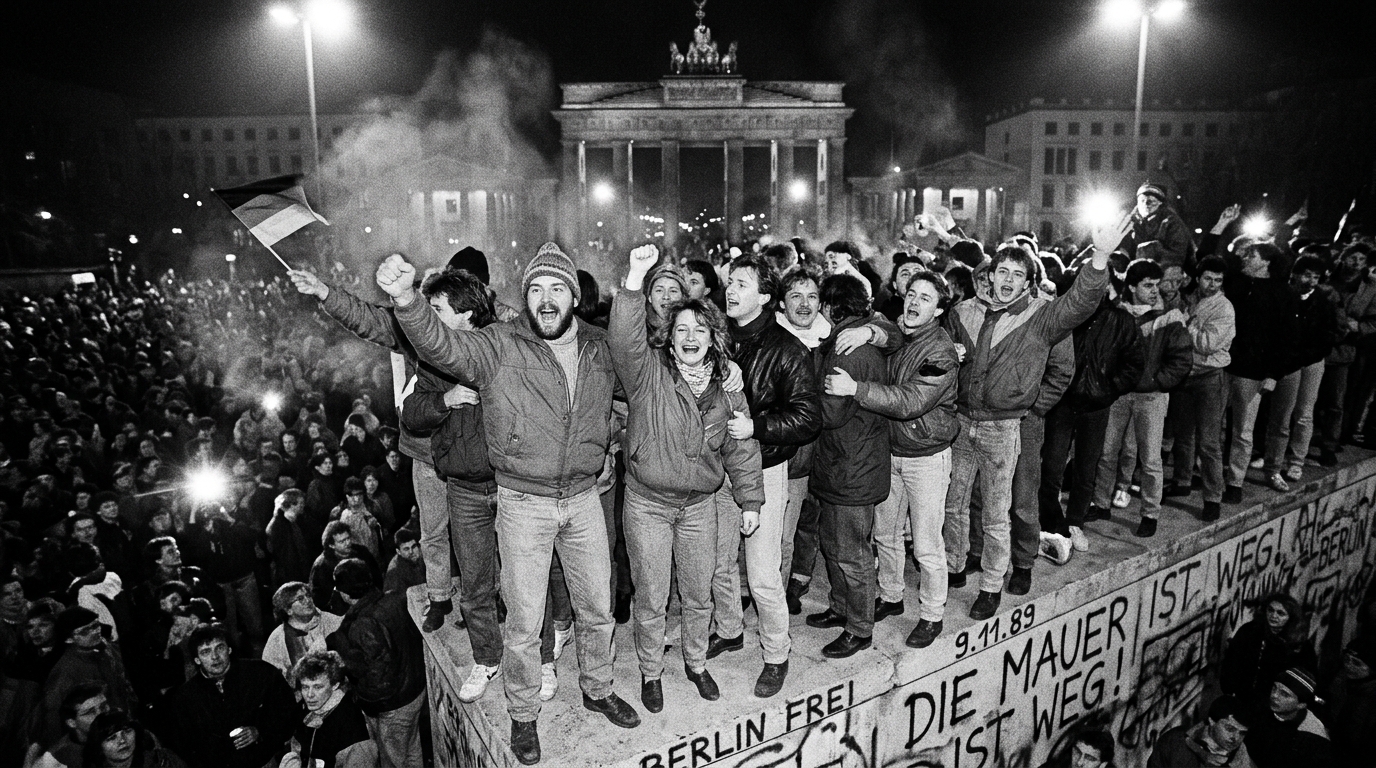
This sudden, surgical operation—codenamed "Operation Rose"—instantly disrupted the lives of millions of Berliners. It severed transit lines, divided families, and physically institutionalized the ideological divide of the Cold War. The Berlin Wall became the most potent and tragic symbol of the Iron Curtain, transforming a volatile geopolitical flashpoint into a frozen, heavily militarized stalemate that would endure for nearly three decades.
Historical Context and Origins
To understand why the German Democratic Republic (GDR) resorted to such an extreme measure, one must examine the complex geopolitical landscape of post-World War II Europe. Following the defeat of Nazi Germany in 1945, the Allied powers—the United States, Great Britain, France, and the Soviet Union—divided the defeated nation into four zones of occupation. Berlin, located deep within the Soviet occupation zone, was similarly partitioned into four sectors.
- Soviet Occupation Zone (East Germany)
As the wartime alliance disintegrated into Cold War hostility, the Western zones coalesced into the Federal Republic of Germany (FRG, or West Germany) in May 1949, while the Soviet zone was reconstituted as the German Democratic Republic (GDR, or East Germany) in October of the same year.
The "Berlin Loophole" and Republikflucht
While the inner-German border between East and West Germany was progressively fortified and closed in 1952, Berlin remained an anomaly. Under the four-power agreements, citizens of Berlin enjoyed relatively free movement across the sectoral boundaries within the city. This created a unique demographic loophole: any East German citizen who wished to flee the communist regime could simply travel to East Berlin, board a subway or walk into West Berlin, register at a refugee camp, and be flown out to West Germany1.
This phenomenon, known in the East as Republikflucht ("flight from the republic"), posed an existential threat to the GDR. The demographic drain was not merely quantitative but qualitative. The individuals fleeing were disproportionately young, well-educated, and highly skilled—doctors, engineers, academics, and skilled industrial workers. Between 1949 and 1961, approximately 2.5 to 3 million East Germans fled to the West, representing nearly one-sixth of the total population2.
| Year | Refugee Count | Notes |
|---|---|---|
| 1951 | 165,000 | |
| 1953 | 331,000 | Year of the East German Uprising |
| 1955 | 252,000 | |
| 1957 | 261,000 | |
| 1959 | 143,000 | |
| 1960 | 199,000 | |
| 1961 | 340,000 | Projected/Actual annualized rate before August |
This massive "brain drain" crippled the East German economy, hindered industrial production, and undermined the ideological legitimacy of the Socialist Unity Party (SED), led by First Secretary Walter Ulbricht. The GDR was hemorrhaging its future, and the socialist experiment was on the verge of systemic collapse.
The Diplomatic Standoff: Khrushchev’s Ultimatum
The Berlin crisis was not merely a local German issue; it was a global flashpoint. In November 1958, Soviet Premier Nikita Khrushchev issued an ultimatum to the Western powers, demanding that they withdraw their forces from West Berlin within six months and allow it to become a demilitarized, "free city." If they refused, Khrushchev threatened to sign a separate peace treaty with East Germany, which would hand control of the access routes to West Berlin over to the GDR—thereby forcing the West to recognize the East German state and potentially allowing the GDR to choke off West Berlin's access.
The Western powers, led by the United States, refused to capitulate. For the West, maintaining West Berlin as an outpost of democracy and capitalism deep inside the communist bloc was non-negotiable. The geopolitical stakes were raised even higher with the election of President John F. Kennedy in 1960. During the tense Vienna Summit in June 1961, Khrushchev attempted to bully the young American president, reiterating his threats over Berlin. Kennedy, however, remained firm, declaring that the US would defend its rights in Berlin at any cost, including military conflict3.
Timeline of Events and Key Moments
The physical separation of Berlin was executed with meticulous planning and absolute secrecy. Below is a detailed timeline of the critical moments leading up to, during, and immediately following the fateful night of August 13, 1961.
1961 Chronology
| Date | Event |
|---|---|
| June 15 | Ulbricht's famous press conference ("Niemand hat die Absicht...") |
| July 25 | JFK's televised speech outlining the "Three Essentials" |
| Aug 12 (16:00) | Ulbricht signs the border closure decree |
| Aug 13 (01:00) | "Operation Rose" begins; barbed wire deployed |
| Aug 15 | Soldier Conrad Schumann leaps to freedom |
| Oct 27-28 | Military standoff at Checkpoint Charlie |
June 15, 1961: Ulbricht’s Famous Denial
During a press conference in East Berlin, a West German journalist, Annamarie Doherr, asked Walter Ulbricht if the formation of a "free city" would mean the establishment of a state boundary at the sector border. Ulbricht replied with a statement that would go down in history as one of the most brazen political lies:
"I understand your question to mean that there are people in West Germany who want us to mobilize the construction workers of the capital of the GDR to build a wall, yes? No one has the intention of erecting a wall!" ("Niemand hat die Absicht, eine Mauer zu errichten!")[^4]
This was the first time the word "Wall" (Mauer) had been publicly used in this context, inadvertently revealing the very plan Ulbricht was secretly lobbying Moscow to approve.
July 25, 1961: Kennedy’s "Three Essentials" Speech
Recognizing the growing threat to Berlin, President John F. Kennedy delivered a televised address to the American public. He requested a dramatic increase in defense spending and outlined the "Three Essentials" of US policy regarding Berlin:
- The continued presence of Allied forces in West Berlin.
- The right of free access to West Berlin for Allied forces and Western civilians.
- The political and economic viability, security, and self-determination of West Berlin.
Crucially, Kennedy’s speech drew a red line around West Berlin, signaling to Moscow that while the US would fight to defend the Western sectors, it would not actively contest Soviet actions within East Berlin or East Germany.
August 12, 1961: The Order is Given
In the afternoon, Walter Ulbricht signed the formal decree to close the border, following final authorization from Moscow. That evening, senior East German officials gathered at a secluded garden party north of Berlin to maintain an illusion of normalcy. At midnight, the military command center under Erich Honecker (then the SED Central Committee Secretary for Security) ordered the mobilization of military and security forces.
August 13, 1961: "Operation Rose"
- 01:00 AM: East German border police (Grenzpolizei), transport police (Trapo), and military units of the National People’s Army (Nationale Volksarmee or NVA) took up positions along the 156-kilometer (97-mile) boundary surrounding West Berlin.
- 02:00 AM: Heavy equipment arrived at key transit points. Workers began tearing up paving stones, digging trenches, and stringing miles of barbed wire along the sector borders.
- Morning: Berliners woke up to a city divided. Subway (U-Bahn) and suburban railway (S-Bahn) lines connecting East and West Berlin were severed. Westerners were turned back at the border; East Germans were forbidden from crossing unless they possessed special, rarely granted permits.
August 15, 1961: The Leap of Conrad Schumann
As the temporary barbed-wire barriers were being replaced by solid concrete blocks, a 19-year-old East German border guard named Conrad Schumann was stationed at the corner of Bernauer Straße and Ruppiner Straße.
` [ WEST BERLIN ]
(Schumann's jump) _ <- West Berliners cheering \ | | ~~~~~~~~~~~~\~~~~~~~~~~~| | <-- Low barbed-wire coil (Klingendraht) \ |_| \ [Conrad Schumann] \ O_ <-- Threw away his machine gun /| / \
[ EAST BERLIN ] <-- Covered by East German Stasi officers `
Sensing his hesitation, West Berliners on the other side of the street shouted, "Komm rüber!" ("Come over!"). Photographed by Peter Leibing, Schumann leaped over the low coil of barbed wire, discarded his PPS-43 submachine gun, and climbed into a waiting West Berlin police vehicle. This photograph instantly became an iconic image of the Cold War, symbolizing the human yearning for freedom.
October 27–28, 1961: The Standoff at Checkpoint Charlie
The crisis reached its military zenith at Checkpoint Charlie, the designated crossing point for Allied personnel and foreign diplomats. Following a dispute where East German guards tried to verify the identity of a US diplomat—violating Allied rights of free transit—US General Lucius Clay ordered ten M48 Patton tanks to face the checkpoint.
In response, Nikita Khrushchev authorized the deployment of an equal number of Soviet T-54/55 tanks directly opposite them, just 100 yards apart. For 16 hours, the world stood on the brink of a direct military clash between nuclear-armed superpowers. A single misfire could have initiated World War III. Through backchannel communications between Kennedy and Khrushchev, a mutual, step-by-step withdrawal was arranged, defusing the immediate crisis.
CHECKPOINT CHARLIE
Location: Friedrichstraße, Berlin
| West Berlin | East Berlin |
|---|---|
| US Tank | Soviet Tank |
| US Tank | Soviet Tank |
| US Tank | Soviet Tank |
| US Tank | |
| US Tank | |
| US Tank |
Border Status: Active (Separating West Berlin and East Berlin)
Geopolitical Consequences and Aftermath
The construction of the Berlin Wall had profound, long-lasting consequences for international relations, European security, and the lives of ordinary citizens. Far from being a mere local boundary, it reshaped the entire Cold War dynamic.
Consolidation of the East German State
For the German Democratic Republic, the construction of the Wall was a highly successful, albeit brutal, tactical success. By plugging the "Berlin loophole," the GDR immediately halted the devastating brain drain.
- Economic Stabilization: With its skilled workforce locked inside the country, the East German economy stabilized. The 1960s saw a modest economic rise in East Germany, which eventually became the most prosperous and industrially advanced nation within the Council for Mutual Economic Assistance (Comecon).
- Political Security: The Wall removed the threat of immediate demographic collapse, allowing the SED regime to consolidate its totalitarian control over the population through the Ministry for State Security (the Stasi).
Stabilization of the Cold War Borders
Paradoxically, while the Berlin Wall was a humanitarian tragedy, it served as a stabilizing factor in European geopolitics.
- De-escalation of the Berlin Question: For years, Berlin had been an unstable flashpoint that threatened to drag the superpowers into war. The Wall effectively closed the issue. West Berlin remained free, while East Berlin was secure under Soviet control.
- Formalization of the Division: The Wall made the division of Europe concrete. It signaled that the United States accepted Soviet hegemony in Eastern Europe as a geopolitical reality, provided the Soviet Union did not infringe upon Western rights in West Berlin or Western Europe.
The Evolution of the Border System
What began as a crude fence of barbed wire and cinder blocks evolved over nearly thirty years into a highly sophisticated, multi-tiered defensive system. By the late 1970s, the border had developed into the "fourth-generation" wall (Grenzmauer 75), consisting of:
- L-shaped concrete slabs: Reinforced concrete segments measuring 3.6 meters (11.8 feet) high, designed to withstand vehicular ramming.
- The Death Strip (Todesstreifen): A cleared area of raked sand to reveal footprints, flanked by wire fences, anti-vehicle ditches, and bed-of-nails obstacles known as "Stalin's Grass."
- Watchtowers and Patrols: Over 300 watchtowers staffed by armed guards, complemented by dog runs and automated tripwire alarms.
- The "Shoot-to-Kill" Order (Schiessbefehl): Border guards were instructed to use any means necessary, including lethal force, to prevent escapes, resulting in the deaths of at least 140 individuals trying to cross the Wall between 1961 and 1989[^5].
Cross-Section of the Border System (Grenzmauer 75)
- West Berlin
- Outer Wall
- Death Strip
- Signal Fence
- Inner Wall
- East Berlin
Analysis of Key Actors and Decisive Actions
The Berlin Wall was not the result of an inevitable historical force, but rather the product of deliberate choices made by key political leaders, each operating under distinct pressures, strategic calculations, and ideological frameworks.
| Key Actor | Primary Motivation | Decisive Actions | Strategic Outcome |
|---|---|---|---|
| Walter Ulbricht (GDR) | State survival; halting economic collapse and Republikflucht. | Lobbying Khrushchev; execution of "Operation Rose". | Preserved the GDR; established hardline domestic control. |
| Nikita Khrushchev (USSR) | Strengthening the Soviet bloc; countering Western influence without initiating war. | Approving the Wall; deploying tanks at Checkpoint Charlie. | Neutralized the Berlin loophole; stabilized the Soviet sphere. |
| John F. Kennedy (USA) | Defending West Berlin's freedom; avoiding thermonuclear war. | Establishing the "Three Essentials"; refusing military intervention in East Berlin. | Maintained Allied presence; showcased the moral failure of communism. |
Walter Ulbricht: The Mastermind of Separation
Walter Ulbricht, the dogmatic leader of East Germany's Socialist Unity Party, was the true driver behind the construction of the Wall. For years, he had pressed Moscow for permission to close the border, arguing that the Soviet Union’s reputation was bound to the success of East German socialism, which was being systematically bled dry by the open border. Ulbricht’s tactical brilliance lay in his ability to frame his domestic catastrophe as a security threat to the entire Soviet bloc, eventually convincing a hesitant Khrushchev that there was no alternative to physical containment.
Nikita Khrushchev: The Pragmatic Gambler
Nikita Khrushchev was caught in a difficult geopolitical dilemma. He wanted to push the Western Allies out of Berlin to solidify the Soviet grip on Eastern Europe, yet he was highly aware of the risks of nuclear war.
For Khrushchev, approving the Wall was a pragmatic compromise. It allowed him to rescue the East German state without directly challenging Western military forces. By placing the Wall strictly on East German territory, Khrushchev ensured that the Allies would have no legal ground under international law to launch a military counteroffensive, successfully neutralizing the Berlin crisis while shifting the blame for the division entirely onto the GDR.
John F. Kennedy: Containment and Moral Victory
For President John F. Kennedy, the Berlin crisis was an intense test of leadership following the foreign policy debacle of the Bay of Pigs invasion in early 1961. Kennedy chose a policy of realistic containment over ideological crusade. His decision not to dismantle the Wall by force was based on a calculated assessment of risk:
"It's not a very nice solution, but a wall is a hell of a lot better than a war."[^6]
By ensuring the security of West Berlin, Kennedy preserved a crucial democratic enclave. Furthermore, he transformed the tragedy of the Wall into a major propaganda defeat for the Soviet Union. On June 26, 1963, Kennedy visited West Berlin and delivered his famous "Ich bin ein Berliner" speech, turning the Wall into a monument to the failure of the communist system:
"Freedom has many difficulties and democracy is not perfect, but we have never had to put a wall up to keep our people in, to prevent them from leaving us."[^7]
Trivia and Lesser-Known Facts
- The Displaced Apartment Windows of Bernauer Straße: Along Bernauer Straße, the sector boundary ran directly along the building facades. The sidewalk was in West Berlin, but the buildings themselves were in East Berlin. In the initial days of August 1961, residents attempted to escape by leaping from their windows onto mattresses and sheets held by West Berliners below. The East German Stasi quickly boarded up, then bricked shut, these windows, and eventually demolished the buildings entirely to create a clear line of sight for the guards.
- The Ghost Stations (Geisterbahnhöfe): Several subway and suburban train lines originating in West Berlin ran through sections of East Berlin territory on their route. Rather than stopping, these trains were forced to slow down and pass through darkened, heavily guarded East Berlin stations known as Geisterbahnhöfe. Armed East German border guards patrolled the dim platforms to prevent any East German citizens from jumping onto the passing Western trains.
- The S-Bahn Boycott: The S-Bahn (suburban railway system) throughout all of Berlin, including the Western sectors, was operated by the East German state railway (Deutsche Reichsbahn). Following the construction of the Wall, West Berlin political leaders, led by Mayor Willy Brandt, called on citizens to boycott the S-Bahn to deny transit revenue to the GDR regime, shouting: "The S-Bahn driver earns the money for the barbed wire!"
- The Exclave of Steinstücken: Steinstücken was a tiny West Berlin enclave located just outside the city limits, entirely surrounded by East German territory. Following the construction of the Wall, the 200 residents of Steinstücken were isolated. To secure the enclave and protect its citizens, the US military established a permanent outpost there, flying in soldiers by helicopter until a narrow access road was negotiated with East Germany in 1971.
References and Literature
- Taylor, Frederick. The Berlin Wall: A World Divided, 1961-1989. New York: HarperCollins, 2006. - A comprehensive and highly detailed historical account of the planning, construction, and eventual fall of the Berlin Wall.
- Gaddis, John Lewis. The Cold War: A New History. New York: Penguin Books, 2005. - An essential text examining the Berlin Wall within the broader geopolitical context of superpower rivalry.
- The Berlin Wall Memorial / Gedenkstätte Berliner Mauer - The official historical repository and museum dedicated to the documentation of the Berlin Wall, its victims, and its structural evolution.
- Foreign Affairs: "The Berlin Crisis and the Wall" (October 1961 Issue) - Archival analysis written during the height of the crisis, capturing contemporary diplomatic perspectives and strategic responses.
---
Footnotes & Explanations
- Frederick Taylor, The Berlin Wall: A World Divided, 1961-1989 (New York: HarperCollins, 2006), 45-48. ↩
- Hope M. Harrison, Driving the Soviets up the Wall: Soviet-East German Relations, 1953-1961 (Princeton: Princeton University Press, 2003), 98. ↩
- John Lewis Gaddis, The Cold War: A New History (New York: Penguin Books, 2005), 114-115. ↩
- Walter Ulbricht, Press Conference, East Berlin, June 15, 1961. Documented in the German Federal Archives (Bundesarchiv). ↩
- "Victims of the Wall," Gedenkstätte Berliner Mauer, accessed October 2020. ↩
- John F. Kennedy, quoted in Arthur M. Schlesinger Jr., A Thousand Days: John F. Kennedy in the White House (Boston: Houghton Mifflin, 1965), 394. ↩
- John F. Kennedy, "Ich bin ein Berliner" Speech, West Berlin, June 26, 1963. National Archives and Records Administration (NARA). ↩