Key Takeaways
- The Gulf of Tonkin incident of August 1964 involved two distinct naval confrontations—one real and one highly disputed—between US destroyers and North Vietnamese torpedo boats.
- President Lyndon B. Johnson used the alleged second attack to quickly secure the Gulf of Tonkin Resolution from Congress, granting him unilateral military authority in Southeast Asia.
- Declassified documents and historical consensus later revealed that the second incident on August 4, 1964, never actually occurred, exposing a profound credibility gap in US foreign policy.
The Gulf of Tonkin incident of August 1964 represents one of the most critical turning points in twentieth-century geopolitical history. It served as the official catalyst for the rapid escalation of United States military involvement in the Vietnam War, transforming a localized, low-intensity counterinsurgency campaign into a massive, direct conventional conflict. The events of August 2 and 4, 1964, and the subsequent political fallout in Washington, D.C., illustrate the complex intersections of military intelligence, executive power, and Cold War containment strategies.
By analyzing this pivotal moment, we can observe how ambiguous military data was converted into an absolute mandate for war. The resulting congressional resolution not only altered the trajectory of Southeast Asia but also fundamentally reshaped the executive-legislative dynamics of American war-making power, leaving a legacy of skepticism that would define US public consciousness for decades.
Historical Context and Origins
To understand the escalation in the Gulf of Tonkin, one must examine the broader geopolitical environment of the early 1960s. Under the prevailing Domino Theory, the United States foreign policy establishment believed that if South Vietnam fell to communism, the rest of Southeast Asia would inevitably follow 1. Following the defeat of French colonial forces at Dien Bien Phu in 1954 and the subsequent division of Vietnam along the 17th parallel, the United States gradually increased its support for the anti-communist Republic of Vietnam (South Vietnam) against the communist Democratic Republic of Vietnam (North Vietnam) and its southern insurgent ally, the Viet Cong.
The Geopolitical Landscape (1964)
| Feature | North Vietnam | South Vietnam |
|---|---|---|
| Official Name | Democratic Republic of Vietnam | Republic of Vietnam |
| Primary Goal | Reunification | Containment |
| External/Support Status | Supports Viet Cong Insurgency | Supported by USA (Advisors & Logistics) |
When Lyndon B. Johnson assumed the presidency in November 1963 following the assassination of John F. Kennedy, the situation in South Vietnam was deteriorating rapidly. The South Vietnamese government was highly unstable, suffering from chronic political infighting and successive military coups. Johnson was deeply concerned that the loss of South Vietnam would severely damage US credibility abroad and jeopardize his domestic agenda, the "Great Society," by exposing him to politically devastating charges of being "soft on communism."
To counter North Vietnamese support for the southern insurgency, the US military initiated clandestine operations known as OPLAN 34A 2. Authorized by the Joint Chiefs of Staff and executed by South Vietnamese forces with American logistical and intelligence assistance, OPLAN 34A involved covert maritime raids, sabotage, and commando drops inside North Vietnam.
Concurrently, the United States Navy conducted DESOTO patrols. These were highly specialized intelligence-gathering missions carried out by US destroyers equipped with sophisticated electronic monitoring gear. The primary objective of the DESOTO patrols was to collect signals intelligence (SIGINT) by tracking North Vietnamese coastal radar installations, communication networks, and naval defense capabilities.
Crucially, while the DESOTO patrols and OPLAN 34A raids were technically separate programs operated under different command structures, North Vietnamese commanders viewed them as highly coordinated, aggressive violations of their sovereign territory. The Gulf of Tonkin, a semi-enclosed body of water bordered by North Vietnam, South China, and the island of Hainan, became a highly volatile theater where covert offensive operations and overt intelligence-gathering patrols overlapped.
Timeline of Events and Key Moments
The crisis unfolded over a series of intense days in early August 1964, characterized by operational confusion, political maneuvering, and communication breakdowns.
- August 2, 1964: First Incident
- August 3, 1964: Reinforcements Ordered
- August 4, 1964: The "Phantom" Second Incident
- August 5, 1964: Retaliation & Resolution
August 2, 1964: The First Confrontation
The destroyer USS Maddox (DD-731), under the operational command of Captain John J. Herrick, was conducting a DESOTO patrol in the Gulf of Tonkin. On the night of July 30–31, South Vietnamese commando boats operating under OPLAN 34A had shelled North Vietnamese military installations on the nearby islands of Hon Me and Hon Ngu.
On the afternoon of August 2, as the Maddox cruised through international waters roughly 28 miles off the North Vietnamese coast, it detected three North Vietnamese P-4 Soviet-built torpedo boats approaching at high speed. Believing the fast-attack craft intended to launch torpedoes, Captain Herrick ordered the Maddox to fire three warning shots.
The North Vietnamese boats responded by launching torpedoes and firing 14.5mm machine guns. The Maddox altered course to evade the torpedoes and returned heavy fire with its 5-inch guns. Within minutes, US Navy F-8 Crusader jets scrambled from the nearby aircraft carrier USS Ticonderoga arrived to assist, strafing the North Vietnamese boats.
The brief engagement resulted in one North Vietnamese torpedo boat heavily damaged and disabled, with the other two damaged but fleeing toward the coast. The Maddox emerged virtually unscathed, suffering only a single 14.5mm bullet hole in its superstructure and no casualties.
August 3, 1964: Escalating the Presence
In Washington, President Johnson and Secretary of Defense Robert McNamara held emergency meetings to discuss the incident. Rather than withdrawing the vessel to avoid further confrontation, Johnson ordered the destroyer USS C. Turner Joy (DD-951) to reinforce the Maddox.
The President issued instructions to continue the DESOTO patrols, asserting the right of the United States Navy to operate freely in international waters. He also issued a stern warning to Hanoi, stating that any further unprovoked attacks on US vessels would carry "grave consequences."
August 4, 1964: The Non-Existent Attack
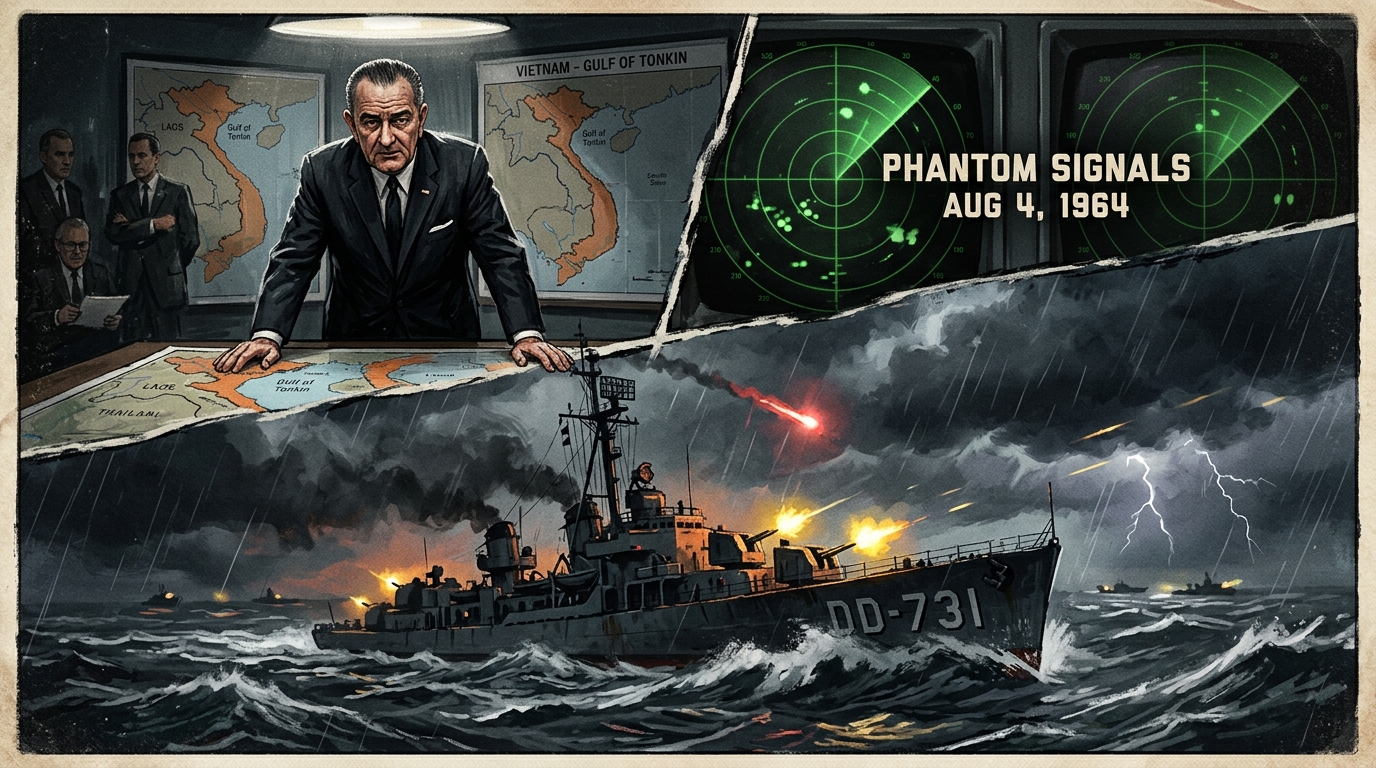
On the night of August 4, the Maddox and the C. Turner Joy were patrolling in deep darkness, amid rough seas, high waves, and heavy thunderstorms that severely degraded radar and sonar capabilities. Armed with intelligence reports indicating that another North Vietnamese attack was imminent, radar operators on both ships began detecting what they believed to be multiple fast-approaching hostile vessels.
For over two hours, the destroyers performed evasive maneuvers and fired hundreds of rounds of ammunition at targets that appeared on their radar screens. Sonar operators on the Maddox reported hearing the distinctive "pinging" of incoming torpedoes—up to 22 torpedoes were reported during the chaotic engagement.
However, almost immediately after the firing ceased, doubts began to surface. Commander Herrick, analyzing the reports on the ground, realized that the chaotic tactical picture did not add up. At 1:27 PM Washington time (early morning in the Gulf of Tonkin), Herrick sent an urgent, top-secret cable to the Pentagon:
"Review of action makes many recorded contacts and torpedoes fired appear doubtful. Freak weather effects on radar and overeager sonarmen may have accounted for many reports. No actual visual sightings by Maddox. Suggest complete evaluation before any further action taken." [[^3]]
Despite Herrick's clear warning, the chain of command in Washington was already moving at a rapid pace toward military retaliation.
August 5, 1964: The Decision to Retaliate
Secretary of Defense Robert McNamara presented the reports of the second attack to President Johnson as an established, indisputable fact. While McNamara received Herrick's clarifying cables expressing deep skepticism, he chose to focus on selected intelligence reports, including highly classified intercept communications from the National Security Agency (NSA). These intercepts, which actually referred to the battle of August 2, were misconstrued—either through genuine error or deliberate omission—as orders for an active attack on August 4 4.
Before a thorough investigation could be conducted to verify if any North Vietnamese boats were actually present, President Johnson ordered retaliatory airstrikes against North Vietnamese naval bases. Under Operation Pierce Arrow, US Navy bombers flew 64 sorties, destroying or damaging an estimated 25 North Vietnamese patrol boats and wiping out a major coal storage depot at Vinh.
On the night of August 4 (Washington time), President Johnson went on national television to announce the airstrikes, telling the American public:
"The challenge that we face in Southeast Asia today is the challenge of a deliberate aggression against the United States of America... Renewed hostile actions against United States ships on the high seas in the Gulf of Tonkin have today required me to order the military forces of the United States to take action in reply."
Geopolitical Consequences and Aftermath
The immediate geopolitical result of the incident was the passage of the Gulf of Tonkin Resolution (officially the Southeast Asia Resolution, Public Law 88-408) by the United States Congress on August 7, 1964.
The Gulf of Tonkin Resolution (Aug 7, 1964)
Core Resolution: "The Congress approves and supports the determination of the President, as Commander in Chief, to take all necessary measures to repel any armed attack against the forces of the United States and to prevent further aggression."
Resulting Implications:
- Unilateral Executive War-Making Power ("Blank Check")
The resolution passed nearly unanimously: the House of Representatives approved it 416-0, and the Senate passed it 88-2. The only two dissenting senators were Wayne Morse of Oregon and Ernest Gruening of Alaska, both of whom argued that the resolution violated constitutional principles of war-making powers and represented a dangerous abdication of congressional authority.
The resolution granted President Johnson the authority to:
- Take "all necessary measures to repel any armed attack against the forces of the United States and to prevent further aggression."
- Assist any member or protocol state of the Southeast Asia Collective Defense Treaty (SEATO) requesting assistance in defense of its freedom.
Effectively, the resolution functioned as a "blank check" for the executive branch, allowing the President to wage a full-scale war in Vietnam without ever seeking a formal declaration of war from Congress.
The Escalation to Full-Scale War
Armed with this sweeping legislative authority, the Johnson administration rapidly escalated the conflict. In March 1965, the United States initiated Operation Rolling Thunder, a sustained, multi-year aerial bombardment campaign against North Vietnam.
Simultaneously, the first official US ground combat troops—the 9th Marine Expeditionary Brigade—landed at Da Nang. By the end of 1965, there were over 184,000 American military personnel deployed in South Vietnam; by 1968, that number peaked at more than 536,000.
| Year | US Military Personnel in South Vietnam |
|---|---|
| 1963 | 16,300 (Advisors) |
| 1964 | 23,300 |
| 1965 | 184,300 (Introduction of Combat Units) |
| 1966 | 385,300 |
| 1967 | 485,600 |
| 1968 | 536,100 (Peak Deployment) |
The rapid escalation drew North Vietnam's principal allies, the Soviet Union and the People's Republic of China, deeper into the proxy conflict. Both communist superpowers increased their logistical, financial, and military aid to Hanoi, providing advanced surface-to-air missiles, fighter aircraft, and thousands of military technicians to counter the American onslaught.
The Credibility Gap and Domestic Fallout
As the war dragged on with mounting casualties and no clear end in sight, the circumstances surrounding the Gulf of Tonkin incident became a focal point of anti-war dissent and investigative journalism. In 1971, Daniel Ellsberg leaked the Pentagon Papers, a top-secret Department of Defense study of US political and military involvement in Vietnam 5.
The papers revealed that the Johnson administration had systematically lied to both Congress and the public, detailing how the administration had drafted the Gulf of Tonkin Resolution months before the incident even took place, waiting for a suitable pretext to introduce it.
The revelation of this deception created a profound "credibility gap" between the American public and their government, shattering the post-World War II consensus on foreign policy. In response to the growing public outcry and constitutional concerns, Congress repealed the Gulf of Tonkin Resolution in January 1971.
To prevent future executive overreach, Congress passed the War Powers Resolution of 1973 over President Richard Nixon's veto 6. This act placed strict limits on the President's ability to commit US forces to hostile situations abroad without explicit congressional authorization, a direct legislative reaction to the perceived executive manipulation of the Gulf of Tonkin incident.
Analysis of Key Actors and Decisive Actions
The escalation of the conflict in the Gulf of Tonkin was not an inevitable historical event, but the direct result of deliberate decisions made by key leaders operating under intense political pressure and flawed strategic frameworks.
` KEY ACTORS AND INFLUENCES
[ Lyndon B. Johnson ] [ Robert McNamara ] - Demanded decisive action - Screened incoming SIGINT data - Feared "soft on communism" label - Misrepresented sketchy evidence - Protected "Great Society" agenda - Demanded rapid options \ / \ / v v [ Decisive Escalation & Congressional Resolution ] `
Lyndon B. Johnson
President Johnson’s actions during the crisis were heavily shaped by domestic political calculations. Facing an upcoming presidential election in November 1964 against the highly conservative Republican nominee Barry Goldwater—who accused Johnson of being weak in foreign affairs—the President felt compelled to project strength and decisiveness.
By launching immediate retaliatory airstrikes and securing a near-unanimous congressional resolution, Johnson effectively neutralized Goldwater's main line of attack. However, in doing so, he locked himself and the country into a commitment trap. Johnson believed he could manage the escalation incrementally, but the introduction of combat troops quickly created its own momentum, eventually forcing him to abandon his bid for re-election in 1968.
Robert McNamara
As Secretary of Defense, Robert McNamara applied a highly technocratic, managerial approach to the military operation. He relied heavily on statistical metrics, communications intelligence, and rapid response cycles.
McNamara’s critical failure during the crisis was his lack of analytical skepticism. When presented with the highly ambiguous, conflicting data from the August 4 patrol, he filtered out the dissenting views—such as Commander Herrick's qualifying cables—and presented the President with a simplified, certain narrative of North Vietnamese aggression. McNamara’s desire for operational efficiency overrode the necessity of verification, leading to a profound intelligence failure that altered the course of global history.
The North Vietnamese Command
From the perspective of Hanoi, the US Navy patrols were not innocent transits in international waters. To the North Vietnamese leadership, the presence of the USS Maddox in close proximity to the OPLAN 34A coastal raids was a clear act of coordinated hostility.
Their decision to attack the Maddox on August 2 was a tactical defense of their territorial claims and a warning to the United States to cease its support for South Vietnamese sabotage missions. However, North Vietnamese commanders did not launch an attack on August 4; they were actively trying to avoid further conflict after the damage sustained two days prior.
Trivia and Lesser-Known Facts
- Shooting at Whales: President Johnson himself quickly grew highly skeptical of the second attack. Only days after signing the Gulf of Tonkin Resolution, he privately remarked to his press secretary, Bill Moyers:
- The Future Admiral's View: Commander James Stockdale, who would later become a highly decorated Admiral, Vice Presidential candidate, and Vietnam Prisoner of War, was flying an F-8 Crusader jet over the Maddox and C. Turner Joy on the night of August 4. When asked what he saw from his cockpit, Stockdale recalled:
- The Ghost of the "AN/SPS-40" Radar: Many military historians point to a technical phenomenon known as "temperature inversion" or "ducting" in the Gulf of Tonkin. This atmospheric condition can cause radar signals to bounce off warm air layers, projecting false reflections onto radar screens that look identical to high-speed surface craft. This, combined with high waves and overeager sonar operators listening to their own ship's propellers, created the perfect technical illusion of a multi-boat attack.
- The Declassified Truth: In 2005, the National Security Agency declassified an extensive historical study written by NSA historian Robert J. Hanyok. The study concluded that the NSA had deliberately distorted intelligence reports during the crisis. Hanyok wrote that the agency's analysts had made critical translation errors and selectively forwarded intercepted communications to the White House to make it look as though an attack had occurred on August 4, when the raw data actually showed the North Vietnamese were merely trying to salvage their boats from the August 2 engagement.
References and Literature
- The Gulf of Tonkin Incident and High Inflation - An academic review of the economic consequences of the Tonkin escalation on US domestic policy.
- The Gulf of Tonkin Resolution (August 7, 1964) - The official records and digitized historical documents held at the National Archives and Records Administration (NARA).
- The Pentagon Papers (Gravel Edition) - The landmark declassified Department of Defense study detailing the history of US decision-making in Vietnam.
- Spartacus Educational: The Gulf of Tonkin Incident - A highly detailed historical breakdown of the primary source transmissions and timeline of events.
---
Footnotes & Explanations
- For an analysis of the Domino Theory and its influence on early Cold War foreign policy, see the National Security Council papers on Southeast Asia (NSC 5405). ↩
- OPLAN 34A was a highly classified program of covert operations against North Vietnam, initiated under President Kennedy and expanded under President Johnson. ↩
- Cable from Commander, Task Group 72.1 (Herrick) to Commander in Chief Pacific (CINCPAC), August 4, 1964. ↩
- Hanyok, Robert J. "Skunks, Bogies, Silent Hounds, and the Flying Fish: The Gulf of Tonkin Mystery, 2 to 4 August 1964," Cryptologic Quarterly, National Security Agency, Vol. 19/20, 2005. ↩
- The Pentagon Papers: The Defense Department History of United States Decisionmaking on Vietnam, Boston: Beacon Press, 1971. ↩
- The War Powers Resolution (50 U.S.C. 1541–1548) was passed by Congress in November 1973 to reassert legislative control over foreign military deployments. ↩