Key Takeaways
- The 2008 conflict marked the first time post-Soviet Russia engaged in a full-scale cross-border military offensive against a sovereign state, signaling a dramatic shift in its foreign policy.
- The war shattered the 'frozen conflict' paradigm, replacing diplomacy with a strategy of enforced regional hegemony and direct military intervention.
- The international response revealed a profound divide between Western efforts at integration, particularly NATO expansion, and Russian red lines concerning its perceived sphere of influence.
- The conflict served as a critical precursor to future Russian military interventions, including the annexation of Crimea and the full-scale invasion of Ukraine, demonstrating Moscow's willingness to use force to achieve geopolitical objectives.
Historical Context and Origins
The roots of the 2008 conflict are deeply embedded in the collapse of the Soviet Union and the subsequent re-emergence of nationalisms and long-suppressed ethnic grievances. When Georgia, a nation with a rich and complex history stretching back millennia, gained independence in 1991, the euphoria of newfound sovereignty was quickly overshadowed by internal strife. The status of autonomous entities like South Ossetia and Abkhazia, which had enjoyed varying degrees of autonomy within the Georgian Soviet Socialist Republic, became immediate flashpoints.
Georgian nationalism, particularly under its first president, Zviad Gamsakhurdia, adopted a platform often summarized by the slogan "Georgia for Georgians." This rhetoric, while appealing to many ethnic Georgians, alienated minority populations and exacerbated existing ethnic tensions. In South Ossetia, an ethnically distinct group, predominantly Orthodox Christian but with linguistic and cultural ties to North Ossetia within Russia, aspirations for greater autonomy or even unification with their northern kin clashed violently with Tbilisi's drive for a unitary state. The ensuing "War of 1991–1992" in South Ossetia, marked by intense fighting and ethnic cleansing from both sides, resulted in a fragile ceasefire mediated by Russia. A similar, even more devastating conflict unfolded in Abkhazia, leading to a de facto independence from Georgia supported by Russia.
For fifteen years, these territories remained "frozen conflicts." Russia maintained a presence through peacekeeping forces under the Commonwealth of Independent States (CIS) mandate. However, these forces were viewed by Tbilisi as inherently biased—serving more as a "security umbrella" for the separatist authorities in Tskhinvali (South Ossetia) and Sukhumi (Abkhazia) than as neutral arbiters. Russia’s practice of issuing passports to residents of these regions further solidified their ties to Moscow and undermined Georgian sovereignty, creating a convenient pretext for future intervention under the guise of protecting its citizens.
The geopolitical atmosphere darkened significantly following the 2003 Rose Revolution, a bloodless popular uprising that brought Mikheil Saakashvili, a charismatic, Western-educated leader, to power. Saakashvili’s platform was explicitly pro-Western, aiming for deep integration with Euro-Atlantic structures, including NATO membership, and the unwavering restoration of Georgia's territorial integrity. This agenda, coupled with his successful reintegration of the Adjara region in 2004, alarmed Moscow. Russia viewed this trajectory with profound suspicion, perceiving the encroachment of Western security architecture into the Caucasus, a region historically central to Russian imperial and Soviet strategic depth, as an existential threat to its national security. Moscow considered the former Soviet republics, particularly those bordering Russia, as its "near abroad," a sphere of privileged interests where it believed it had a right to exert influence and where Western presence was unwelcome. The 2008 Bucharest NATO summit's declaration that Georgia "will become a member of NATO" further intensified Russia's sense of encirclement and determination to halt the process.
Historical Precedents & Context of Russian Influence
The Russian presence and influence in the Caucasus, and specifically over Georgia and its autonomous regions, are not merely post-Soviet phenomena but are deeply rooted in centuries of imperial expansion and geopolitical maneuvering. For the Russian Empire, control over the Caucasus was vital for securing its southern borders and projecting power into the Middle East. Georgia, a Christian kingdom surrounded by Muslim empires, often sought protection from its powerful northern neighbor, leading to its gradual annexation by Russia in the early 19th century.
During the Soviet era, Moscow meticulously managed ethnic relations and administrative divisions in the Caucasus, often redrawing borders and granting various levels of autonomy to different groups. South Ossetia and Abkhazia, designated as autonomous administrative units within Soviet Georgia, were creations of this policy. While these designations aimed to diffuse ethnic tensions and provide some recognition to distinct groups, they also served as convenient levers for Moscow to exert influence over Tbilisi. The Soviet system, by fostering a sense of distinct identity for these groups, unintentionally laid the groundwork for future separatist movements once central authority waned.
Following the collapse of the USSR, Russia strategically leveraged these historical connections and administrative legacies. Its peacekeeping operations in South Ossetia and Abkhazia were portrayed internationally as efforts to maintain stability, but from Tbilisi's perspective, they were a deliberate ploy to perpetuate instability and prevent Georgia's full consolidation of statehood. The issuance of Russian passports to residents of the breakaway regions, starting in the early 2000s, was a particularly potent tool. It created a legal basis for Russia to claim the right to "protect its citizens" abroad, a justification that would later be explicitly invoked in 2008 and subsequently in Ukraine. This long game of cultivating ties, providing economic support, and maintaining a military presence in the breakaway regions established a clear precedent for Russia's interventionist foreign policy in its near abroad, transforming frozen conflicts into instruments of strategic leverage.
Timeline of Events and Key Moments
The descent into open war was characterized by a rapid escalation of artillery duels, mounting casualties, and ultimately, a catastrophic failure of diplomacy. The weeks leading up to August 7 were fraught with increasing skirmishes, provocations, and a steady buildup of forces on both sides, creating an incredibly tense and volatile environment.
| Date |
Russian President Dmitry Medvedev announced the start of a military operation in response to Georgia's actions, framing it as a "peace enforcement" measure and protection of Russian citizens. The 58th Army of the Russian Armed Forces, already positioned near the Roki Tunnel, rapidly mobilized and crossed into South Ossetia. The initial days saw intense ground combat, with Georgian forces initially making headway into Tskhinvali before being met with overwhelming Russian firepower.
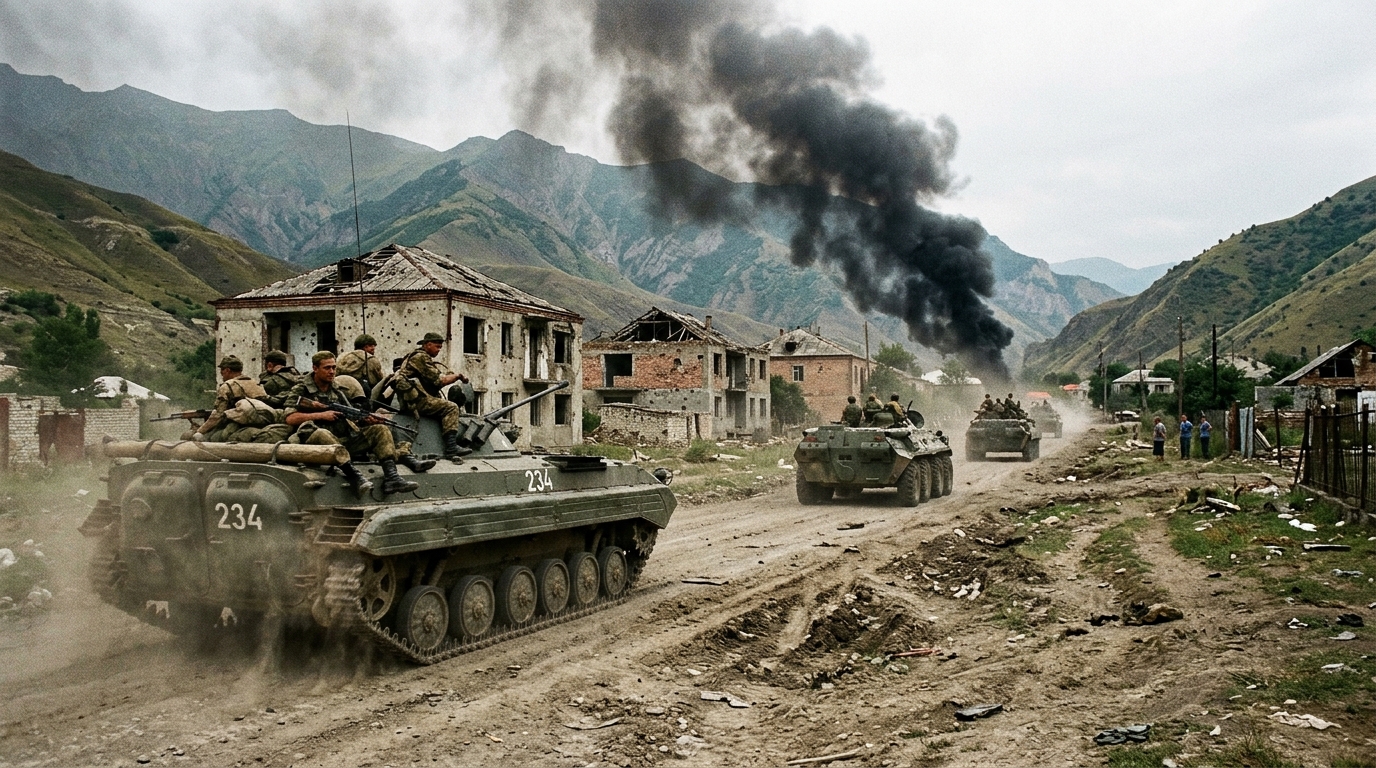
The "Five Days" were characterized by the tactical superiority of the Russian 58th Army, which utilized its massive air and artillery advantage to disintegrate the Georgian command-and-control infrastructure. Russian air power, though initially encountering some difficulties due to outdated intelligence and air defense systems, soon established dominance, striking deep into Georgian territory, including military bases near Gori and the vicinity of Tbilisi's international airport. A Russian naval blockade was imposed on Georgia's Black Sea coast, effectively paralyzing its maritime trade and preventing any resupply attempts. By August 12, Russian forces, spearheaded by armored columns, were positioned within striking distance of the Georgian capital, Tbilisi, having advanced far beyond the disputed territories. While the immediate objective of "peace enforcement" was achieved, the deeper strategic goal of deterring Georgia's Euro-Atlantic aspirations and demonstrating Russia's regional dominance was also powerfully underscored by this rapid and decisive advance.
Geopolitical Consequences and Aftermath
The repercussions of the war were structural, profound, and permanent, reshaping regional security dynamics and signalling a definitive end to the post-Cold War era of cooperation between Russia and the West. By recognizing South Ossetia and Abkhazia as independent states on August 26, 2008, Russia not only contravened international law regarding Georgia's territorial integrity but also signaled an end to its adherence to the existing European security architecture. This act effectively detached 20% of Georgia's internationally recognized territory from Tbilisi's control, establishing Moscow's military presence and political influence as irreversible facts on the ground.
- Redrawing the Map: The formal recognition of South Ossetia and Abkhazia by Russia (and a handful of other states) was an unprecedented challenge to the post-1991 international order. It created two new, unrecognized states effectively under Russian military and economic patronage. This move was a clear message that Russia was prepared to unilaterally alter borders in its "near abroad" when it perceived its interests, or those of its 'citizens' (passport holders), to be threatened. For Georgia, it meant the permanent loss of these territories and the ongoing challenge of housing and supporting hundreds of thousands of internally displaced persons (IDPs) who were forced out of their homes during and after the conflicts of the 1990s and 2008.
- Military Modernization and the "Serdyukov Reforms": Although the Russian military achieved its objectives, the war exposed significant operational deficiencies. Problems included outdated equipment, poor logistics, inadequate command-and-control systems, and a lack of interoperability between units. These shortcomings spurred the comprehensive "Serdyukov Reforms," named after then-Defense Minister Anatoly Serdyukov. These reforms, initially met with resistance from conservative elements within the military, focused on streamlining the armed forces, professionalizing the officer corps, reducing personnel numbers, and investing heavily in modernizing equipment, training, and logistical capabilities. The 2008 war, therefore, served as a crucial catalyst for the transformation of the Russian military into a more agile, technologically advanced, and expeditionary force, capabilities that would be dramatically demonstrated in subsequent interventions in Crimea (2014) and Syria (2015).
- The "Medvedev Doctrine": The conflict solidified a new, assertive Russian foreign policy posture. On August 31, 2008, President Dmitry Medvedev articulated what came to be known as the "Medvedev Doctrine." This doctrine laid out five core principles: (1) The supremacy of international law, though interpreted through Russia's lens; (2) The multi-polar nature of the world, rejecting a unipolar American dominance; (3) Russia's right to protect its citizens wherever they may be; (4) The defense of Russia's "privileged sphere of influence" and traditional areas of interest; and (5) The protection of its security interests along its borders. This was a clear declaration that Moscow would defend its perceived sphere of influence and preemptively counter perceived threats, even through military means, marking a return to Great Power politics and a rejection of the liberal international order established after the Cold War. It effectively signaled that Russia would contest any further expansion of Western institutions, particularly NATO, into the post-Soviet space.
"The events of August 2008 were not a localized clash but a systemic rupture. It proved that Russia was willing to break the international order to protect its regional interests, and it signaled a far more assertive, even aggressive, foreign policy that would have profound implications for global stability." – Anonymous Western Diplomatic Observer
International Response and Diplomacy
The international community's response to the Russo-Georgian War was immediate but largely disjointed, highlighting the deep divisions within the Euro-Atlantic security framework regarding Russia's place and intentions. The United States, under President George W. Bush, condemned Russia's actions as a violation of Georgia's sovereignty and territorial integrity. Secretary of State Condoleezza Rice played a crucial role in expressing U.S. support for Georgia, though direct military intervention was not on the table. The U.S. provided humanitarian aid and logistical support, and symbolically dispatched naval vessels to Georgia's Black Sea coast after the cessation of hostilities, underscoring its commitment to its ally. However, Washington's focus on the war in Iraq and Afghanistan limited its capacity for a robust military response.
European Union nations were also divided. While countries like the Baltic states and Poland, with their own histories of Russian domination, strongly condemned Moscow's aggression, others, particularly Germany and France, adopted a more cautious approach, prioritizing diplomatic engagement and economic ties with Russia. French President Nicolas Sarkozy, then holding the rotating EU presidency, emerged as the key mediator. Sarkozy undertook shuttle diplomacy, traveling to both Tbilisi and Moscow to broker a ceasefire. The resulting six-point peace plan, signed on August 12, called for:
- No recourse to the use of force.
- Final cessation of hostilities.
- Free access for humanitarian assistance.
- Georgian forces to return to their permanent bases.
- Russian forces to return to their positions prior to the start of hostilities.
- An international mechanism to ensure stability and security in the conflict zones.
While the ceasefire halted the fighting, Russia's subsequent refusal to fully withdraw its forces to pre-August 7 lines and its recognition of South Ossetia and Abkhazia fundamentally undermined the spirit of the agreement. The EU, through the Independent International Fact-Finding Mission on the Conflict in Georgia (IIFFMCG), led by Ambassador Heidi Tagliavini, produced a comprehensive report in 2009 that concluded, controversially, that Georgia had started the war with its large-scale military operation into South Ossetia, while also criticizing Russia's disproportionate response and ongoing occupation.
NATO condemned Russia's actions but faced its own internal divisions. The promise of future membership for Georgia and Ukraine at the Bucharest Summit earlier in 2008 had been a major flashpoint, signaling to Moscow an unacceptable expansion of the alliance. The war underscored the very real risks associated with extending NATO's security umbrella to states bordering Russia, effectively putting Georgia's membership aspirations on hold indefinitely due to the principle that states with unresolved territorial conflicts cannot join the alliance. The broader international response highlighted the limits of collective security mechanisms when confronted by a determined state actor willing to challenge established norms and utilize force to achieve its objectives, particularly when that state is a nuclear power and a permanent member of the UN Security Council.
Analysis of Key Actors and Decisive Actions
The Russo-Georgian War was a crucible for the leaders involved, each facing immense pressure and making decisions with profound consequences.
Mikheil Saakashvili
Saakashvili’s decision to launch a kinetic operation in South Ossetia on the night of August 7–8 remains one of the most debated actions in modern geopolitics. Proponents argue he was goaded into a "trap" laid by Russian provocateurs, citing months of escalating cross-border shelling, attacks on Georgian peacekeepers, and intelligence reports of significant Russian military buildup near the Roki Tunnel. They contend that Saakashvili believed he had a limited window to restore Georgia's territorial integrity before a full-scale Russian invasion, and that he anticipated a less decisive, more drawn-out response from Moscow, perhaps hoping for stronger international intervention. Critics—including the independent EU-sponsored Tagliavini Commission—suggest that while Russia may have actively provoked and prepared for the conflict, the final decision to use heavy artillery on civilian-populated areas of Tskhinvali was a catastrophic miscalculation. This move, regardless of intent, provided Moscow with the casus belli it desired, enabling it to frame its counter-offensive as a "peace enforcement operation" and the protection of Russian citizens from Georgian aggression. Saakashvili's misjudgment stemmed from an overestimation of Georgia's military capabilities, an underestimation of Russia's willingness to engage in full-scale warfare, and perhaps a misreading of the level of international support Georgia would receive in a direct confrontation with Russia.
Dmitry Medvedev and Vladimir Putin
At the time of the conflict, the division of labor between then-President Dmitry Medvedev and Prime Minister Vladimir Putin was a focal point of intense speculation, giving rise to the concept of Russia's "tandemocracy." While Medvedev, as the constitutional head of state and commander-in-chief, performed the public role of the state face of the operation and lead negotiator, many Western analysts argued that the strategic directives—specifically the decision to launch a massive counter-offensive and drive deep into Georgian territory—emanated from the Kremlin's inner sanctum, where Putin exercised significant, if not ultimate, influence over the military establishment and national security policy. Putin, who was in Beijing for the Olympic opening ceremony when the war broke out, quickly returned to Russia and was seen in televised meetings with military commanders, projecting an image of being firmly in charge. This dual leadership structure allowed Medvedev to maintain a veneer of legality and diplomacy while Putin guided the more aggressive military and geopolitical aspects of the response. The conflict ultimately served to solidify Putin’s dominant role in Russian politics, even from the Prime Minister's office, reinforcing the perception that he was the ultimate arbiter of Russia's strategic direction.
Socio-Economic and Humanitarian Aftermath
The Russo-Georgian War of 2008 left a profound and lasting scar on Georgia, both in terms of human cost and socio-economic impact. While the overall death toll was comparatively low for a modern conflict (estimates generally place it in the hundreds, including civilians and military personnel from all sides), the humanitarian consequences were severe. Thousands were injured, and approximately 192,000 people were displaced from their homes, particularly from South Ossetia and the Kodori Gorge in Abkhazia. While many eventually returned, a significant portion became internally displaced persons (IDPs), with tens of thousands still living in temporary settlements or without permanent housing years later. This exacerbated Georgia's existing IDP problem from the conflicts of the 1990s.
The war caused extensive damage to infrastructure within the conflict zones and in areas of Georgia proper targeted by Russian air and ground forces. Towns like Gori and Poti suffered significant destruction. Beyond the immediate physical damage, the long-term economic impact on Georgia was substantial. The conflict disrupted trade routes, particularly through its Black Sea ports, and severely damaged investor confidence. Georgia's tourism industry, a vital source of revenue, took a significant hit. International aid, while crucial for immediate relief and reconstruction, could not fully offset the economic costs of territorial loss and ongoing instability.
In the breakaway regions of South Ossetia and Abkhazia, the situation also remained dire. Despite Russian recognition and financial support, these regions remained isolated and economically underdeveloped. Their economies became heavily reliant on subsidies from Moscow, with limited opportunities for independent growth or international trade. The de facto borders, often referred to as "occupation lines" by Georgia, restricted the movement of people and goods, severing traditional economic ties and hindering reconciliation efforts. The humanitarian situation in these regions was further complicated by limited access for international organizations and a lack of clear legal frameworks for property rights and returnees. The unresolved status of these territories continues to be a major obstacle to Georgia's development and stability, perpetuating a state of uncertainty and grievance for all involved.
Trivia and Lesser-Known Facts
- Cyber Warfare: The conflict is widely cited by security analysts as the first war in history to feature significant, synchronized cyberattacks targeting a nation’s government and media infrastructure before the first physical shots were fired. Georgian government websites, news portals, and banking systems were hit by denial-of-service (DoS) attacks, some originating from Russian IP addresses, creating chaos and hindering Georgia's ability to communicate internally and externally. This marked a watershed moment in understanding the integrated nature of modern warfare, where digital battles precede or accompany kinetic ones.
- The Roki Tunnel: This critical piece of infrastructure, a strategically vital mountain tunnel connecting North Ossetia (Russia) with South Ossetia, served as the primary artery for Russian armor and troop movement into the conflict zone. Despite being an obvious and high-value target for Georgian air strikes, its robust construction and Russia's immediate prioritization of its defense made a successful, decisive attack impossible. Its uninterrupted use allowed Russia to rapidly deploy overwhelming force, demonstrating its profound strategic importance in the conflict.
- Casualty Discrepancies and Propaganda: The number of civilian deaths remains a point of intense contention and was heavily manipulated for propaganda purposes. While initial Russian reports claimed thousands had died, citing a "genocide" against Ossetians, subsequent independent investigations, including those by Human Rights Watch and the Tagliavini Commission, placed the overall civilian death toll in the hundreds (e.g., around 162 Georgian civilians and 48 South Ossetian civilians), significantly lower than the figures used by Moscow to justify the "peace enforcement" operation. This illustrates how information warfare and casualty figures became crucial tools in shaping international opinion during and after the conflict.
- The "Peacekeepers" as Combatants: A unique aspect of the conflict was the transformation of Russian "peacekeeping" forces, ostensibly neutral arbiters, into active combatants. These forces, stationed in South Ossetia and Abkhazia since the 1990s, were rapidly reinforced and engaged directly against Georgian troops. This blurred the lines between peacekeeping and military intervention, drawing sharp criticism from Georgia and many international observers who viewed Russia's peacekeeping mandate as a thinly veiled cover for maintaining influence and supporting separatists.
- The Role of the Black Sea Fleet: Beyond the land invasion, Russia utilized its Black Sea Fleet to impose a naval blockade on Georgia's coast. While largely symbolic due to Georgia's limited naval capabilities, the fleet did engage in some skirmishes, sinking a Georgian patrol boat. More importantly, its presence highlighted Russia's ability to project power across multiple domains and effectively isolate Georgia from sea-based supply lines or potential international assistance.
References and Literature
- The Independent International Fact-Finding Mission on the Conflict in Georgia (IIFFMCG) - A comprehensive, neutral report commissioned by the EU analyzing the legal and tactical origins of the conflict, its conduct, and its immediate aftermath. It remains a foundational document for understanding the events of August 2008.
- Ronald D. Asmus, "A Little War that Shook the World" - A detailed historical account focusing on the diplomatic failures, the lead-up to the conflict, and the broader geopolitical implications for NATO-Russia relations and the concept of a transatlantic security community.
- Foreign Affairs: The Georgia-Russia Conflict - A collection of academic essays and analyses providing context on the broader implications for NATO-Russia relations in the 2000s, often updated with retrospective insights.
- Human Rights Watch Report: Up in Flames: Humanitarian Law Violations and Civilian Victims in the Conflict in Georgia - A detailed examination of alleged war crimes and violations of international humanitarian law by all parties during the conflict, focusing on civilian casualties and displaced populations.
- Thomas de Waal, "The Caucasus: An Introduction" - While not solely about the 2008 war, this book provides essential historical and ethnographic context for the region, illuminating the deep-seated ethnic and political dynamics that underpinned the conflict.
Footnotes & Explanations
- The Tagliavini Commission Report, 2009. ↩
- Asmus, R.D., 2010. A Little War That Shook the World. Palgrave Macmillan. ↩
- Council on Foreign Relations archives, 2008. Various articles and analyses on the conflict. ↩
- Human Rights Watch, "Up in Flames: Humanitarian Law Violations and Civilian Victims in the Conflict in Georgia," 2009. ↩
- De Waal, T., 2010. The Caucasus: An Introduction. Oxford University Press. ↩