Key Takeaways
- The September 2023 offensive marked the definitive end of the de facto Nagorno-Karabakh Republic, which had functioned since the early 1990s, restoring full Azerbaijani sovereignty over the territory.
- The total exodus of over 100,000 ethnic Armenians, representing nearly the entire population of the enclave, created a demographic shift that effectively ended centuries of Armenian presence in the region, triggering a major humanitarian crisis.
- The crisis underscored the failure of the Russian peacekeeping mission, fundamentally altering Russia's influence in the South Caucasus and signaling a dramatic shift in the regional security architecture.
- The events highlighted the limitations of international diplomacy and the geopolitical isolation of Armenia, forcing a critical re-evaluation of its foreign policy and security alliances.
Historical Context and Origins
The roots of the Nagorno-Karabakh conflict are as complex as they are tragic, spanning over a century of competing national narratives, geopolitical machinations, and deep-seated ethno-nationalist grievances. Situated within the internationally recognized borders of Azerbaijan but historically populated by an ethnic Armenian majority, the region became a focal point of intense inter-ethnic and political tension during the tumultuous dissolution of the Russian Empire and the subsequent formation of the Soviet Union.
The Tsarist Legacy and Early Soviet Decisions: The first major flare-up occurred in 1918-1920, following the collapse of the Russian Empire, when both newly independent Armenia and Azerbaijan laid claim to the mountainous region. This nascent conflict, characterized by inter-ethnic violence and pogroms, was temporarily quelled by the Red Army's re-conquest of the South Caucasus. In the early 1920s, the Soviet government, under the direct influence of Joseph Stalin's nationalities policy, made the fateful decision to place the Nagorno-Karabakh Autonomous Oblast (NKAO) within the Azerbaijan Soviet Socialist Republic in 1923, despite its overwhelming Armenian population. This decision, aimed at appeasing Turkey and fostering regional stability within the Soviet system, remained a source of profound grievance for the Armenian population for decades, who viewed it as an artificial excision from their historical homeland and a demographic threat. Moscow's 'divide and rule' strategy sowed the seeds of future conflict, ensuring that the regional populations nurtured historical memories of injustice under the veneer of Soviet internationalism.
The First Nagorno-Karabakh War (1988–1994): As the Soviet Union began its terminal decline in the late 1980s, these dormant tensions erupted into open warfare. The Armenian population of Karabakh petitioned Moscow for unification with Armenia, leading to widespread protests and eventually armed clashes. With the formal collapse of the USSR in 1991, Armenia and Azerbaijan declared independence, transforming a regional dispute into an international conflict. The First Nagorno-Karabakh War was brutal and protracted. Equipped with weaponry from the disintegrating Soviet military, ethnic Armenian forces, supported by Armenia, not only secured control over the NKAO but also occupied seven surrounding Azerbaijani districts, creating a substantial buffer zone. By the time a Russian-mediated ceasefire was signed in 1994, an estimated 30,000 people had died, and over a million had been displaced – predominantly Azerbaijanis from Nagorno-Karabakh and the surrounding territories, and Armenians from Azerbaijan.
This created a "frozen conflict," characterized by the existence of the unrecognized "Republic of Artsakh" (the Armenian designation for Nagorno-Karabakh) and the ongoing threat of renewed hostilities. For nearly thirty years, the region existed in a state of suspended animation, with the status quo largely maintained by the OSCE Minsk Group co-chaired by France, Russia, and the United States. However, this diplomatic format, while preventing full-scale war, failed to achieve a lasting peace settlement, as Armenia insisted on the right to self-determination for Karabakh Armenians, while Azerbaijan demanded the restoration of its territorial integrity.
The 2020 Second Nagorno-Karabakh War: The balance of power shifted decisively following the 2020 Second Nagorno-Karabakh War. Azerbaijan, having systematically modernized its military with significant investment in advanced drone technology (notably Turkish-made Bayraktar TB2s), precision-guided munitions, and sophisticated command-and-control systems, launched a large-scale offensive. Bolstered by unwavering Turkish political and military support, Azerbaijan achieved significant battlefield successes, reclaiming large swaths of the occupied territories, including the strategically vital city of Shusha. The war, lasting 44 days, exposed the Armenian military's technological inferiority and strategic vulnerabilities. A Russian-brokered ceasefire agreement, signed on November 9, 2020, halted the fighting but fundamentally altered the regional map. It stipulated the return of several districts to Azerbaijan, the deployment of 2,000 Russian peacekeepers along the new contact line and the Lachin Corridor (the sole road connecting Nagorno-Karabakh to Armenia), and left the Armenian-controlled enclave as a rump state, significantly reduced in size and connected to Armenia only by the narrow, Russian-patrolled Lachin Corridor. This fragile peace set the stage for the final dissolution in 2023.
Historical Precedents and Geopolitical Context
The 2023 events in Nagorno-Karabakh are not an isolated incident but rather the latest, and perhaps most definitive, chapter in a long history of imperial contestation, ethnic cleansing, and irredentist claims in the South Caucasus. Understanding the deeper historical precedents and the shifting geopolitical context is crucial for grasping the magnitude of the 2023 flight.
Imperial Shadows and Ethnic Engineering: The South Caucasus has historically been a crossroads of empires – Persian, Ottoman, and Russian – each leaving an indelible mark on its demographic and political landscape. The 19th and early 20th centuries saw the systematic incorporation of the region into the Russian Empire, leading to significant population movements, including the resettlement of Armenians from Persia and the Ottoman Empire into newly acquired territories. These demographic shifts were often part of imperial strategies to create loyal populations in strategic borderlands. The arbitrary drawing of administrative borders by the early Soviet Union, particularly Stalin's decision on Nagorno-Karabakh, served to institutionalize ethnic grievances rather than resolve them. This form of "ethnic engineering" under various imperial powers created a mosaic of peoples whose national aspirations were often in direct conflict, setting a precedent for future territorial disputes.
The Principle of Self-Determination vs. Territorial Integrity: A core tension underlying the Nagorno-Karabakh conflict, and indeed many post-Soviet 'frozen conflicts,' is the clash between the international legal principle of territorial integrity (upheld by Azerbaijan and most of the world) and the right to self-determination (invoked by the Armenians of Nagorno-Karabakh). This dichotomy has plagued international diplomacy for decades, with no universally accepted framework for resolution when these principles directly contradict. The 2023 outcome decisively favored territorial integrity, setting a potentially troubling precedent for other de facto states and ethnic enclaves worldwide, suggesting that self-determination can be overridden by military force if great powers are unwilling or unable to intervene.
Lessons from Other Frozen Conflicts: The Nagorno-Karabakh scenario shares parallels with other frozen conflicts in the post-Soviet space, such as Transnistria (Moldova), Abkhazia, and South Ossetia (Georgia). In each case, a localized ethno-territorial dispute became entrenched with the backing of an external power (often Russia), creating unrecognized entities. However, the 2023 events starkly differentiate Nagorno-Karabakh: unlike Transnistria or Abkhazia, where the de facto entities persist under Russian patronage, the Nagorno-Karabakh Republic faced complete dissolution and an almost total demographic shift. This outcome highlights the precariousness of external guarantees and the limits of international recognition for such entities.
Shifting Geopolitical Sands: The 2023 offensive was also enabled by a fundamental realignment of regional and global power dynamics. Russia, traditionally the primary security guarantor for Armenia and the key mediator, found itself bogged down in the Ukraine War. This diversion of military and diplomatic resources severely curtailed Moscow's ability and willingness to uphold the fragile 2020 ceasefire. Conversely, Turkey's growing assertiveness as a regional power, combined with its strong "one nation, two states" alliance with Azerbaijan, provided Baku with crucial diplomatic cover, military assistance, and strategic depth. The West, preoccupied with Ukraine and facing energy security concerns that favored oil-rich Azerbaijan, maintained a largely non-interventionist stance, limiting its response primarily to humanitarian appeals. This confluence of factors created a unique window of opportunity for Azerbaijan to achieve its long-held strategic objective.
The 2023 flight thus serves as a powerful historical marker, demonstrating how deeply ingrained historical grievances, combined with evolving geopolitical realities and shifts in the balance of power, can lead to sudden and irreversible demographic and political transformations, often with devastating humanitarian consequences.
Timeline of Events and Key Moments
The collapse of the breakaway republic was not a singular event, but the culmination of months of deteriorating conditions and a rapid, decisive military operation.
| Phase | Date Range | Key Events and Details |
|---|
Historical Context and Origins
The roots of the Nagorno-Karabakh conflict are as complex as they are tragic, spanning over a century of competing national narratives, geopolitical machinations, and deep-seated ethno-nationalist grievances. Situated within the internationally recognized borders of Azerbaijan but historically populated by an ethnic Armenian majority, the region became a focal point of intense inter-ethnic and political tension during the tumultuous dissolution of the Russian Empire and the subsequent formation of the Soviet Union. The 2023 events, culminating in the complete dissolution of the self-proclaimed Republic of Artsakh and the mass exodus of its Armenian population, represent the definitive end of a century-long struggle for self-determination and the tragic victory of territorial integrity.
The Tsarist Legacy and Early Soviet Decisions: The first major flare-up occurred in 1918-1920, following the collapse of the Russian Empire, when both newly independent Armenia and Azerbaijan laid claim to the mountainous region. This nascent conflict, characterized by inter-ethnic violence, reciprocal pogroms, and military confrontations, was temporarily quelled by the Red Army's re-conquest of the South Caucasus. The subsequent Sovietization of the region led to a series of administrative decisions that profoundly shaped the future trajectory of the conflict. In the early 1920s, the Soviet government, under the direct influence of Joseph Stalin's nationalities policy, made the fateful decision to place the Nagorno-Karabakh Autonomous Oblast (NKAO) within the Azerbaijan Soviet Socialist Republic in 1923, despite its overwhelming Armenian population (approximately 95% at the time). This controversial move, driven by a complex mix of factors including the desire to appease newly formed Soviet Turkey, maintain regional stability within the Soviet system, and prevent the consolidation of a potentially irredentist Armenian state, remained a source of profound grievance for the Armenian population for decades. Yerevan viewed it as an artificial excision from their historical homeland and a deliberate attempt to dilute their demographic and cultural presence over time. Moscow's 'divide and rule' strategy, while temporarily suppressing overt conflict, inadvertently sowed the seeds of future ethno-political strife, ensuring that both regional populations nurtured distinct and often conflicting historical memories of injustice under the veneer of Soviet internationalism.
The First Nagorno-Karabakh War (1988–1994): As the Soviet Union began its terminal decline in the late 1980s, these dormant tensions erupted into open warfare. The Armenian population of Karabakh, emboldened by Gorbachev's policies of Glasnost and Perestroika, petitioned Moscow for unification with Armenia. This led to widespread protests, inter-ethnic clashes in both Armenia and Azerbaijan (most notably the Sumgait and Baku pogroms against Armenians, and retaliatory actions against Azerbaijanis), and eventually escalated into a full-scale armed conflict. With the formal collapse of the USSR in 1991, Armenia and Azerbaijan declared independence, transforming a localized ethnic dispute into an international war. The First Nagorno-Karabakh War was brutal and protracted. Both sides, leveraging weaponry from the disintegrating Soviet military and attracting foreign fighters, engaged in fierce battles. Ethnic Armenian forces, supported by the Republic of Armenia, not only secured control over the NKAO but also occupied seven surrounding Azerbaijani districts, creating a substantial buffer zone often referred to as the "security belt." By the time a Russian-mediated ceasefire was signed in Bishkek in May 1994, an estimated 30,000 people had died, and over a million had been displaced – predominantly Azerbaijanis from Nagorno-Karabakh and the surrounding territories, and Armenians from various parts of Azerbaijan. This established the "Republic of Artsakh," an unrecognized de facto state, and created a "frozen conflict" that would define regional geopolitics for nearly three decades.
For nearly thirty years, the region existed in a state of suspended animation, with the status quo largely maintained by the OSCE Minsk Group co-chaired by France, Russia, and the United States. This diplomatic format, while successful in preventing full-scale war for a long period, ultimately failed to achieve a lasting peace settlement. Armenia and the Karabakh Armenians insisted on the right to self-determination, demanding guarantees for the security and political autonomy of the Armenian population. Azerbaijan, conversely, steadfastly demanded the unconditional restoration of its territorial integrity and the return of all occupied territories, viewing the Armenian presence as an illegal occupation. The core contradiction between these two fundamental principles proved insurmountable for international mediators. Sporadic border clashes, sniper fire, and minor escalations became routine, reminding the world of the unresolved nature of the conflict.
The 2020 Second Nagorno-Karabakh War: The balance of power shifted decisively following the 2020 Second Nagorno-Karabakh War, often dubbed the "44-day war." Azerbaijan, having systematically modernized its military over the preceding decade with significant investment in advanced drone technology (notably Turkish-made Bayraktar TB2s and Israeli loitering munitions), precision-guided artillery, and sophisticated command-and-control systems, launched a large-scale offensive on September 27, 2020. Bolstered by unwavering Turkish political and military support, including reported Syrian mercenaries, Azerbaijan achieved significant battlefield successes, exploiting Armenia's outdated Soviet-era military doctrine and equipment. Key achievements included the capture of substantial territories in the south and the strategically vital, culturally significant city of Shusha. The war, lasting 44 days, exposed the Armenian military's technological inferiority and strategic vulnerabilities. A Russian-brokered ceasefire agreement, signed on November 9, 2020, halted the fighting. The terms were harsh for Armenia: it stipulated the return of several occupied districts to Azerbaijan, the deployment of 2,000 Russian peacekeepers along the new contact line and the Lachin Corridor (the sole road connecting Nagorno-Karabakh to Armenia), and effectively reduced the Armenian-controlled enclave to a rump state, significantly diminished in size and economically isolated. This fragile peace, overseen by a Russia increasingly distracted by its own geopolitical ambitions elsewhere, set the unavoidable stage for the final dissolution in 2023.
Intelligence Failures and International Neglect
The swift and decisive nature of Azerbaijan's "anti-terrorist operation" in September 2023, coupled with the near-total collapse of international resistance or intervention, has raised significant questions about intelligence failures and the broader international community's neglect of the escalating crisis in Nagorno-Karabakh.
Failure to Read the Warning Signs: For months leading up to the September offensive, numerous indicators pointed towards an imminent Azerbaijani military action.
- The Lachin Corridor Blockade: From December 2022, Azerbaijan's effective blockade of the Lachin Corridor, ostensibly by "eco-activists" but widely understood as state-orchestrated, systematically deprived the enclave's 120,000 inhabitants of essential supplies. This created a profound humanitarian crisis, documented by international organizations like Human Rights Watch and the International Crisis Group, and widely reported by media outlets. The blockade served as a clear prelude, testing international reaction and depleting the civilian population's resilience and the separatist forces' logistical capacity. Despite repeated calls from the European Parliament, the United States, and even a provisional ruling by the International Court of Justice (ICJ) for Azerbaijan to ensure unimpeded passage, the blockade persisted.
- Military Build-Up and Rhetoric: Throughout 2023, Azerbaijan continued its military modernization efforts, conducted large-scale exercises, and intensified its aggressive rhetoric, consistently referring to the remaining Armenian forces in Karabakh as "illegal armed formations" that must disarm. Official statements from Baku explicitly rejected any notion of an independent status for Nagorno-Karabakh, insisting on full reintegration.
- Diplomatic Impasse: The various attempts at diplomatic engagement, including EU-mediated talks, yielded no breakthrough. Azerbaijan had consistently shown a lack of interest in any solution that preserved Armenian autonomy, effectively sidelining the OSCE Minsk Group process. Armenia, under Prime Minister Pashinyan, signaling its increasing geopolitical isolation, had even recognized Azerbaijan's territorial integrity, implicitly including Nagorno-Karabakh, further reducing any perceived international leverage for the separatists.
The Role (or Absence) of Russian Peacekeepers: A critical aspect of the international neglect was the role of the 2,000 Russian peacekeepers deployed under the 2020 ceasefire agreement. Their mandate was to ensure the security of the Lachin Corridor and the Armenian population. However, during the nine-month blockade, they largely failed to uphold their responsibilities, allowing the humanitarian crisis to unfold. During the September offensive itself, Russian peacekeepers remained largely passive, confined to their bases, observing the Azerbaijani military operations without intervening. This inaction was a clear signal to Baku that Moscow, preoccupied with the war in Ukraine and potentially seeking to punish Yerevan for its perceived pivot towards the West, would not oppose a decisive military solution. The international community, fully aware of Russia's mandate, seemed content to cede responsibility to a power that proved unwilling to act.
Western Indifference and Prioritization: Western powers, including the United States and the European Union, while issuing condemnations and calls for restraint, ultimately demonstrated a limited appetite for direct intervention or robust diplomatic pressure.
- EU's Energy Dependence: European nations had deepened energy ties with Azerbaijan following Russia's invasion of Ukraine, seeking alternative gas supplies. This economic dependency likely tempered any stronger response.
- US Distraction: The United States, heavily invested in supporting Ukraine, had limited diplomatic bandwidth and strategic focus on the South Caucasus beyond rhetorical support for Armenia.
- France's Limited Influence: While France expressed strong solidarity with Armenia, its influence in the region was insufficient to unilaterally alter the course of events.
The cumulative effect of these factors was a profound sense of abandonment felt by the Armenians of Nagorno-Karabakh. The international system, designed to prevent such outcomes, effectively failed, either by misreading the clear intentions of one party, by being unwilling to act, or by being strategically distracted. This neglect served as a tacit green light for Azerbaijan, confirming that the geopolitical cost of its military solution would be minimal.
Timeline of Events and Key Moments
The collapse of the breakaway republic was not a singular event but the culmination of months of deteriorating conditions and a rapid, decisive military operation. The events unfolded with breathtaking speed, leaving little time for international intervention or effective resistance.
| Phase | Date Range | Key Events and Details |
| Phase | Date Range | Key Events and Details |
|---|---|---|
| The Blockade | Dec 2022 – Sept 2023 | Azerbaijan imposes a de facto blockade on the Lachin Corridor. This measure, purportedly by "eco-activists" protesting illegal mining, effectively cut off Nagorno-Karabakh from Armenia, its sole source of humanitarian supplies and external contact. The blockade evolved from initial road closures to the establishment of a formal Azerbaijani checkpoint in April 2023, defying ICJ rulings for unimpeded passage. This led to severe shortages of food, medicine, and fuel, sparking a profound humanitarian crisis and systematically weakening the local Armenian population and its defense forces. International observers, including the UN and EU, consistently called for its lifting, but without effect. |
| The Escalation | Sept 19, 2023 | On September 19, Azerbaijan launched a "local anti-terrorist operation" targeting Armenian military positions and infrastructure within Nagorno-Karabakh. The offensive began with heavy artillery fire and drone strikes on military targets, including air defense systems, command posts, and ammunition depots. Azerbaijani forces then initiated ground incursions. The rapid and overwhelming nature of the attack, combined with the technological superiority demonstrated by Azerbaijan (precision-guided munitions, drone swarms), quickly overwhelmed the ethnic Armenian defense forces. Russian peacekeepers, despite their presence, did not intervene. |
| The Capitulation | Sept 20, 2023 | Within twenty-four hours of the offensive's initiation, the separatist authorities in Stepanakert announced their acceptance of a Russian-mediated ceasefire. This agreement effectively amounted to an unconditional surrender, demanding the complete disarmament and disbandment of all ethnic Armenian fighters, the withdrawal of all military equipment, and the discussion of the region's future within the framework of Azerbaijani law. This swift capitulation reflected the overwhelming military imbalance, the humanitarian catastrophe, and the absolute geopolitical isolation of the Artsakh government. |
| The Exodus | Sept 24 – Oct 2023 | The overwhelming defeat and fears of ethnic cleansing or reprisal led to a mass flight of nearly the entire ethnic Armenian population of Nagorno-Karabakh towards Armenia. Within days, over 100,600 people, roughly 85% of the population, crossed into Armenia, predominantly via the Lachin Corridor. This rapid exodus created a significant humanitarian crisis, putting immense strain on Armenia's infrastructure and resources. The international community scrambled to provide emergency aid and assistance for the displaced, who arrived with little more than what they could carry. |
The Blockade: Asphyxiation Strategy
From December 2022 to September 2023, Azerbaijan implemented a de facto blockade on the Lachin Corridor, the only road connecting Nagorno-Karabakh to Armenia. This measure, initially justified by Azerbaijan as a protest by "eco-activists" against alleged illegal mining by Armenians, quickly evolved into a comprehensive strategy of isolating the enclave. While Azerbaijan denied it was a blockade, its actions effectively cut off all traffic, including humanitarian aid, food, fuel, and medical supplies.
- Humanitarian Catastrophe: The nine-month blockade led to a severe humanitarian crisis. Hospitals struggled with dwindling supplies, pharmacies ran out of essential medicines, and food rationing became widespread. International organizations, including the International Committee of the Red Cross (ICRC), struggled to deliver aid due to restrictions imposed by Azerbaijani authorities. The prolonged deprivation significantly weakened the civilian population's resilience and morale, rendering them vulnerable.
- International Reaction: The international community, including the United Nations, the European Union, and the United States, issued numerous calls for Azerbaijan to lift the blockade and ensure the free movement of people and goods. The International Court of Justice (ICJ) issued a provisional order in February 2023, obligating Azerbaijan to take all measures to ensure unimpeded movement along the Lachin Corridor. However, these calls and rulings were largely ignored by Baku, which continued to assert its sovereignty and control over the route, establishing a formal border checkpoint in April 2023.
- Strategic Precursor: The blockade served as a strategic precursor to the military offensive. It tested international resolve, demonstrated the geopolitical isolation of Nagorno-Karabakh, and depleted the defensive capabilities and morale of the local Armenian forces. By effectively 'asphyxiating' the enclave, Azerbaijan created conditions where a swift military operation would face minimal resistance.
The Escalation: "Local Anti-Terrorist Operation"
On September 19, 2023, Azerbaijani forces initiated what they termed a "local anti-terrorist operation" targeting Armenian military positions and infrastructure within Nagorno-Karabakh. This offensive marked a significant departure from previous skirmishes, characterized by its scale, intensity, and strategic precision.
- Tactical Superiority: The operation began with an intensive barrage of artillery fire, rocket strikes, and drone attacks. Utilizing lessons learned from the 2020 war and its continued military modernization, Azerbaijan deployed advanced Turkish-made Bayraktar TB2 drones and Israeli loitering munitions to neutralize key targets, including air defense systems, radar stations, communication nodes, and command centers. This effectively crippled the Artsakh defense forces' ability to coordinate a response.
- Ground Incursions: Following the initial aerial and artillery bombardment, Azerbaijani ground forces launched rapid incursions into the enclave, quickly seizing strategic heights and positions. The Armenian defense forces, exhausted by the prolonged blockade, undersupplied, and facing overwhelming technological and numerical superiority, were unable to mount a sustained or coordinated resistance. Many positions were overrun within hours.
- Russian Inaction: Crucially, the 2,000 Russian peacekeepers stationed in Nagorno-Karabakh, whose mandate included ensuring regional stability and the security of the population, remained largely passive. They did not intervene to protect the Armenian population or halt the Azerbaijani advance, reinforcing the perception that Russia was either unwilling or unable to fulfill its role as a security guarantor.
The Capitulation: Unconditional Surrender
Within just twenty-four hours of the offensive's initiation, facing catastrophic losses, a dire humanitarian situation, and no prospect of external aid, the separatist authorities in Stepanakert announced their acceptance of a Russian-mediated ceasefire. This agreement effectively amounted to an unconditional surrender.
- Terms of Surrender: The ceasefire agreement stipulated the complete disarmament and disbandment of all ethnic Armenian fighters, the withdrawal of all military equipment, and the commencement of discussions on the "reintegration" of Nagorno-Karabakh into Azerbaijan, effectively under Baku's full sovereignty and law. For the Artsakh leadership, this was a desperate move to prevent further loss of life and an even greater catastrophe.
- Isolation and Desperation: The rapid capitulation underscored the absolute geopolitical isolation of the Artsakh government and the utter failure of its defense strategy. Without Armenia's direct military intervention (which Pashinyan had explicitly ruled out to safeguard Armenia's own borders) and with Russia's non-intervention, the enclave had no remaining leverage.
- Civilian Impact: The ceasefire terms, particularly the demand for disarmament, instilled widespread fear among the Armenian population, who had long viewed Azerbaijani rule with deep mistrust and concerns over their physical safety and cultural heritage. This immediate fear directly contributed to the subsequent mass exodus.
The Exodus: A Forced Displacement
The overwhelming defeat and widespread fears of ethnic cleansing, repression, or retribution under Azerbaijani rule led to an immediate and mass flight of nearly the entire ethnic Armenian population of Nagorno-Karabakh towards Armenia.
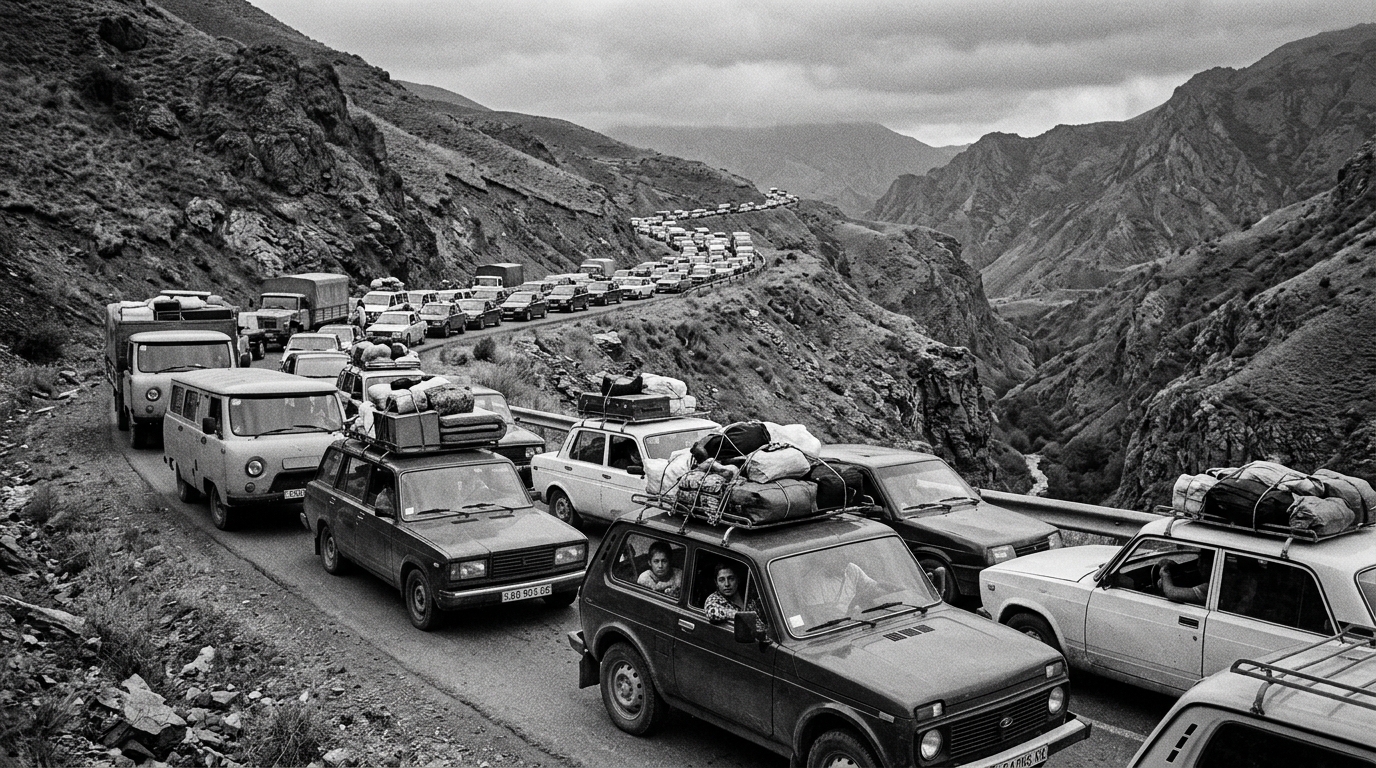
- Scale and Speed: Starting on September 24, just days after the ceasefire, and continuing over several weeks, over 100,600 people – roughly 85% of the enclave's pre-offensive population – crossed into Armenia, predominantly via the Lachin Corridor. The roads were choked with vehicles, often overflowing with families and their meager belongings.
- Humanitarian Crisis: This rapid exodus created a massive humanitarian crisis in Armenia. The influx of tens of thousands of refugees, many traumatized and with urgent needs for food, shelter, and medical care, placed immense strain on Armenia's infrastructure and resources. The Armenian government, supported by international aid organizations, scrambled to provide emergency assistance.
- End of an Era: The flight of the Armenians from Nagorno-Karabakh marked a profound demographic shift, effectively ending a centuries-old Armenian presence in the region. Culturally and historically significant sites, including ancient churches and monasteries, were left behind, raising international concerns about their preservation under Azerbaijani administration.
The Dissolution: Formal End of Artsakh
The final phase of the conflict's resolution was the formal dissolution of the self-proclaimed Republic of Artsakh.
- Presidential Decree: On September 28, 2023, Samvel Shahramanyan, the President of the Republic of Artsakh, signed a decree declaring that the republic would cease to exist by January 1, 2024. This official act formalized the end of the de facto state that had governed Nagorno-Karabakh for over three decades.
- Azerbaijani Reintegration: Azerbaijan immediately announced plans for the "reintegration" of the territory, including establishing administrative structures, restoring infrastructure, and conducting a census. While Baku offered guarantees of rights for those Armenians who chose to stay, the overwhelming majority had already fled, demonstrating a profound lack of trust.
- New Reality: The dissolution marked a definitive end to the conflict's political dimension, at least regarding the status of Nagorno-Karabakh. The territory was brought under full Azerbaijani sovereignty, profoundly altering the geopolitical map of the South Caucasus and leaving a legacy of displacement, trauma, and unresolved questions about justice and historical memory.
Geopolitical Consequences and Aftermath
The fall of Nagorno-Karabakh in 2023 has fundamentally and irreversibly altered the security landscape of the South Caucasus, triggering a cascade of geopolitical consequences that extend far beyond the immediate region. The event has redefined power dynamics, challenged existing alliances, and created new vulnerabilities and opportunities for various regional and international actors.
Marginalization of Russia's Role: Primarily, the crisis delivered a devastating blow to Russia's long-standing role as the primary security guarantor and power broker in the South Caucasus. The perceived inability (or unwillingness) of Russian peacekeepers to protect the Armenian population during the September offensive caused a catastrophic rupture in Armenian-Russian relations. Armenia, traditionally a staunch ally and member of the Collective Security Treaty Organization (CSTO) led by Moscow, now views Russia's security guarantees as unreliable, if not entirely defunct. This has led to a significant re-evaluation of Armenia's foreign policy orientation, including exploring closer ties with Western security frameworks. For Russia, the events signal a diminished capacity to project influence in its own backyard, a direct consequence of its strategic preoccupation with the war in Ukraine and potentially a calculated decision to punish Armenia for its democratic reforms and attempts to diversify its foreign policy. The withdrawal of Russian peacekeepers in April 2024 further cemented this decline in Russian influence.
Azerbaijan's Ascendancy and Regional Power Projection: For Azerbaijan, the victory represents the completion of the "restoration of territorial integrity," a central pillar of President Ilham Aliyev’s domestic political legitimacy and a decades-long national objective. Azerbaijan has emerged as the dominant regional power, buoyed by its military success, substantial oil and gas revenues, and a strong strategic alliance with Turkey. This ascendancy empowers Baku to pursue its remaining strategic goals, most notably the establishment of the Zangezur Corridor, a proposed transport route through southern Armenia connecting mainland Azerbaijan to its exclave of Nakhchivan and further to Turkey. This corridor remains a potential flashpoint, as its implementation under Azerbaijani control would further isolate Armenia from Iran and potentially disrupt regional trade routes.
Armenia's Existential Crisis and Geopolitical Reorientation: For Armenia, the consequences are existential and multi-faceted. The influx of over 100,000 refugees – nearly the entire population of the enclave – has put immense strain on the Armenian state’s already fragile social and economic infrastructure. Beyond the immediate humanitarian challenge, the country faces profound demographic, psychological, and economic integration issues. Domestically, Prime Minister Nikol Pashinyan has faced significant backlash, with critics accusing his administration of failing to protect the Armenians of Karabakh and of moving too quickly to align with Western security frameworks at the expense of traditional ties. Despite these criticisms, Pashinyan's government appears committed to a geopolitical pivot, deepening engagement with the European Union (e.g., EU monitoring mission, financial assistance) and the United States, while distancing itself from Russia. This reorientation seeks to diversify Armenia's security and economic partnerships, but it comes with inherent risks, potentially aggravating tensions with both Russia and Azerbaijan.
Turkey's Growing Influence: Turkey's role as Azerbaijan's strategic ally proved crucial to Baku's success. Ankara provided extensive military training, advanced drone technology, and unwavering diplomatic support, effectively shifting the military balance of power in the region. This outcome solidifies Turkey's growing influence in the South Caucasus, aligning with its broader neo-Ottoman and Pan-Turkic foreign policy objectives. A stronger Turkish-Azerbaijani axis creates a new geopolitical reality, potentially challenging Iranian interests in the region and limiting Russia's traditional sphere of influence. The proposed Zangezur Corridor is a key element of this broader Turkish vision, aiming to establish an overland trade route connecting Turkey directly to the Turkic states of Central Asia.
The West's Limited Role and Humanitarian Concerns: The United States and the European Union were largely spectators to the events, issuing condemnations and calls for restraint but offering no meaningful security guarantees or intervention. While this reflects a prioritization of the Ukraine conflict and an underlying dependence on Azerbaijani energy resources, it also exposes the limitations of Western diplomacy in complex, rapidly evolving crises where their core strategic interests are not directly threatened. The West's role has largely been confined to providing humanitarian aid to Armenia and attempting to facilitate a comprehensive peace treaty between Armenia and Azerbaijan, focusing on border delimitation and regional connectivity. There are ongoing international discussions regarding the protection of Armenian cultural and religious heritage sites left behind in Nagorno-Karabakh, with UNESCO potentially playing a monitoring role, though Azerbaijan has been resistant to external oversight.
Regional Security Architecture and Future Instability: The dissolution of the Nagorno-Karabakh Republic marks the definitive end of the post-1994 "frozen conflict" era. The South Caucasus is now characterized by a new, more volatile power dynamic, with Azerbaijan as the clear regional hegemon. While the core territorial dispute over Nagorno-Karabakh is resolved, new potential flashpoints remain, particularly surrounding border demarcation between Armenia and Azerbaijan, and the Zangezur Corridor. The risk of future military escalation remains high, especially if a comprehensive peace treaty fails to materialize or if Azerbaijan continues to press demands on Armenia. The events of 2023 have reshaped the map, but not necessarily guaranteed long-term peace or stability, leaving a legacy of mistrust, unaddressed grievances, and the profound trauma of displacement.
Analysis of Key Actors and Decisive Actions
The 2023 events were the culmination of strategic planning, calculated risks, and the interplay of various actors, each pursuing their distinct objectives within a shifting geopolitical landscape.
Ilham Aliyev (Azerbaijan): Architect of Victory President Ilham Aliyev's strategy was marked by long-term patience, meticulous military build-up, and ruthless efficiency. Following the 2020 war, Aliyev expertly utilized the post-ceasefire period to consolidate military gains, solidify economic energy partnerships with the European Union, and deepen its military-industrial alliance with Turkey. His government systematically prepared the ground for the 2023 offensive:
- Military Modernization: Continuous investment in advanced weaponry, particularly drones and precision-guided munitions, which proved decisive in both 2020 and 2023. This technological superiority rendered Armenian defenses largely obsolete.
- Diplomatic Isolation of Artsakh: By consistently framing the conflict as an issue of territorial integrity and rejecting any form of autonomy for Karabakh Armenians, Aliyev gradually eroded international support for the de facto republic. His government skillfully presented the blockade of the Lachin Corridor as a measure to combat illegal activities, deflecting stronger international condemnation.
- Leveraging Geopolitics: Aliyev recognized and exploited Russia's preoccupation with Ukraine and the West's focus on energy security. He understood that this window of opportunity, with Russia weakened and the West distracted, might not last, prompting the decisive action in September 2023.
- Domestic Legitimacy: The "restoration of territorial integrity" became the cornerstone of Aliyev's domestic political legitimacy, uniting the population behind his leadership and silencing dissent. The swift victory further cemented his position as a strong leader who delivered on national promises.
Nikol Pashinyan (Armenia): Caught in a Vice Prime Minister Nikol Pashinyan, who came to power through the 2018 Velvet Revolution, found himself in an increasingly untenable geopolitical vice. His government inherited the unresolved Karabakh conflict and the aftermath of the devastating 2020 war.
- Difficult Choices: Following the 2020 defeat, Pashinyan embarked on a controversial "peace agenda," which included the explicit recognition of Azerbaijan’s territorial integrity, implicitly including Nagorno-Karabakh. While framed as a pragmatic path toward a long-term peace treaty with Baku and a means to safeguard Armenia's own borders, this decision simultaneously stripped the Nagorno-Karabakh leadership of any diplomatic leverage and effectively signaled that Armenia would no longer militarily intervene on their behalf. This was a painful concession, deeply unpopular among nationalist factions and the Armenian diaspora.
- Security Dilemma: Pashinyan's attempts to diversify Armenia's security partners, including seeking closer ties with the EU and the US, were perceived as a betrayal by Russia, leading to a breakdown in traditional security arrangements. Armenia's inability to secure alternative, robust security guarantees left it acutely vulnerable.
- Domestic Backlash: The 2023 events triggered significant domestic unrest and calls for Pashinyan's resignation. He was accused by critics of betraying the Armenians of Karabakh and mishandling the crisis. Despite these pressures, Pashinyan has largely managed to retain power, emphasizing the need for Armenia to secure its own sovereignty and pursue a path of genuine peace.
Turkey: The Strategic Enabler Turkey's role was pivotal, operating primarily as Azerbaijan's steadfast strategic ally and military patron.
- Military Assistance: Turkey provided crucial military training, advanced drone technology (Bayraktar TB2s were instrumental in both 2020 and 2023), and intelligence sharing, significantly enhancing Azerbaijan's military capabilities and operational effectiveness.
- Diplomatic Backing: Ankara offered unwavering diplomatic and political support to Baku, effectively deterring stronger international condemnation or intervention. President Recep Tayyip Erdoğan consistently affirmed Turkey's solidarity with Azerbaijan, framing the conflict through the "one nation, two states" doctrine.
- Regional Ambitions: Turkey's involvement aligns with its broader geopolitical ambitions in the South Caucasus, aiming to expand its influence eastward and establish a direct land corridor (the Zangezur Corridor) connecting to the Turkic states of Central Asia.
Russia: The Retreating Hegemon Russia's role was complex and ultimately self-defeating for its long-term influence in the region.
- Peacekeeper Ineffectiveness: Despite the presence of 2,000 Russian peacekeepers, they remained largely inactive during the Lachin Corridor blockade and the 2023 offensive. This inaction was widely interpreted as either an inability or unwillingness to uphold their mandate, severely damaging Russia's credibility as a reliable security partner for Armenia.
- Strategic Preoccupation: Russia's full-scale invasion of Ukraine in February 2022 fundamentally shifted its strategic priorities. Diverted military resources, diplomatic bandwidth, and a desire to avoid opening another front or alienate Azerbaijan (a key energy partner and a route for sanctions circumvention) likely influenced Moscow's passive stance.
- Punishment for Armenia: Some analysts suggest Russia's inaction was partly a punitive measure against Pashinyan's government for its democratic reforms and attempts to pivot towards the West, eroding Moscow's traditional grip on Yerevan. This perceived abandonment has driven Armenia further from Russia's orbit.
The International Community (EU, US, France): Limits of Diplomacy The major Western powers and international organizations struggled to exert meaningful influence over the unfolding crisis.
- Diplomatic Rhetoric: The EU, US, and France issued numerous condemnations of the blockade and the offensive, urging de-escalation and humanitarian access. However, these calls were largely unheeded by Azerbaijan.
- Humanitarian Response: Their most concrete response was the provision of humanitarian aid to Armenia following the mass exodus and attempts to establish an international monitoring presence for cultural heritage.
- Geopolitical Constraints: Western powers were constrained by their preoccupation with Ukraine, a reluctance to confront Azerbaijan (given its role as an energy supplier), and the lack of a clear unified strategy. The OSCE Minsk Group, the long-standing diplomatic format, had become effectively defunct after the 2020 war.
The decisive actions taken by Aliyev, coupled with the geopolitical vulnerabilities of Armenia and the strategic calculations or limitations of other major actors, converged to produce the irreversible outcome of the 2023 flight and the dissolution of the Nagorno-Karabakh Republic.
"The Republic of Nagorno-Karabakh has ceased to exist, not just as a state, but as a space of Armenian presence that had endured for generations. Its end signifies a profound trauma, an ethnic cleansing that the international community watched unfold in real-time." – Anonymous observer, September 2023.
Socio-Economic Aftermath and Humanitarian Crisis
The 2023 flight from Nagorno-Karabakh unleashed a profound socio-economic and humanitarian crisis, primarily impacting Armenia but also reshaping the demography and future prospects of the Karabakh region itself. The speed and scale of the displacement left little room for preparation, leading to immediate and long-term challenges.
The Refugee Influx in Armenia: The arrival of over 100,600 ethnic Armenians from Nagorno-Karabakh, representing almost the entire population of the former enclave, constituted a massive demographic shock for Armenia. A country of approximately 2.8 million people, Armenia experienced an overnight population increase of over 3.5%, primarily in its southern Syunik province and the capital, Yerevan.
- Immediate Needs: The refugees arrived with little more than what they could carry, many suffering from trauma, exhaustion, and health issues exacerbated by the nine-month blockade. Immediate humanitarian needs included:
- Long-Term Integration Challenges: Beyond emergency aid, Armenia faces the daunting task of integrating these displaced persons into its society and economy.
Demographic and Economic Transformation of Nagorno-Karabakh: The nearly complete exodus of the ethnic Armenian population from Nagorno-Karabakh has fundamentally altered the demographic landscape of the region, ending centuries of continuous Armenian presence.
- "De-Armenianization": The rapid flight effectively achieved the "de-Armenianization" of the territory, leaving behind deserted towns and villages, and culturally significant sites empty of their traditional caretakers. This has been widely condemned by human rights groups and international scholars as a form of ethnic cleansing, even if not immediately violent.
- Azerbaijani Reintegration and Repopulation: Azerbaijan now faces the task of reintegrating the territory, which it refers to as "Karabakh," and potentially repopulating it with Azerbaijanis displaced during the First Nagorno-Karabakh War, or with new settlers. This process will involve massive infrastructure development, demining operations, and the establishment of new administrative structures.
- Cultural Heritage at Risk: A significant international concern revolves around the fate of the numerous Armenian cultural and religious heritage sites, including ancient monasteries (e.g., Dadivank, Gandzasar) that now fall under Azerbaijani control. While Azerbaijan has pledged to protect them, there are widespread fears of cultural erasure or alteration, as seen in previous instances. International calls for UNESCO monitoring have met with Azerbaijani resistance.
- Economic Prospects: For Azerbaijan, gaining control over Karabakh offers economic opportunities in agriculture, mining, and potentially tourism, but requires substantial investment to rebuild and integrate the devastated region.
International Humanitarian Response: The international community, including the UNHCR, the UN Office for the Coordination of Humanitarian Affairs (OCHA), the European Union, and various NGOs, mobilized to provide emergency assistance to Armenia. This included financial aid, essential supplies, and technical expertise. However, the scale of the needs continues to outstrip resources, highlighting the limitations of reactive humanitarian efforts in preventing mass displacement.
The socio-economic and humanitarian aftermath of the 2023 flight is a stark reminder of the devastating human cost of unresolved conflicts. It leaves Armenia with a profound national trauma and significant challenges for the foreseeable future, while Azerbaijan gains territorial control but inherits a region devoid of its historic population and laden with complex questions of reconciliation and historical memory.
Long-Term Geopolitical Realignment and Future Implications
The 2023 dissolution of the Nagorno-Karabakh Republic and the subsequent flight of its Armenian population represent a pivotal geopolitical realignment in the South Caucasus, with profound long-term implications for regional stability, international relations, and the future of both Armenia and Azerbaijan.
Redrawing the Map of the South Caucasus: The most immediate and tangible implication is the definitive redrawing of the geopolitical map. Azerbaijan has achieved its maximalist goal of restoring territorial integrity, becoming the dominant regional power. This reshapes traditional power balances and challenges the post-Soviet order that had sustained "frozen conflicts" for decades.
- Azerbaijani Hegemony: Azerbaijan's military and diplomatic victory establishes its clear regional hegemony. This position enables Baku to press forward with its remaining strategic objectives, particularly the Zangezur Corridor. This proposed route through Armenia's Syunik province would connect mainland Azerbaijan to its exclave of Nakhchivan and, critically, onward to Turkey. While Azerbaijan frames it as a transit route to facilitate regional trade, Armenia views it with suspicion, fearing it could undermine its sovereignty and cut off its border with Iran. The terms and nature of this corridor's establishment remain a significant potential flashpoint.
- Armenia's Vulnerability: Armenia is now geographically smaller, significantly more vulnerable, and faces an existential security dilemma. Its traditional alliance with Russia has crumbled, necessitating a rapid and uncertain pivot towards the West. This reorientation is not without risks, as it could further provoke Moscow and fuel Azerbaijani assertiveness. Armenia's long-term survival and stability will depend on its ability to build new, reliable security partnerships, consolidate its democratic institutions, and integrate its large refugee population.
Impact on Regional Alliances and Great Power Competition:
- Decline of Russian Influence: The events confirmed Russia's declining influence in the South Caucasus. Moscow's inability to protect its Armenian ally demonstrates its strategic overstretch due to Ukraine and a calculated decision to prioritize other interests. This retreat creates a vacuum that other powers are eager to fill.
- Ascendance of Turkish Influence: Turkey's strategic partnership with Azerbaijan is now solidified, expanding Ankara's geopolitical footprint eastward. This aligns with President Erdoğan's vision of a broader Turkic world stretching to Central Asia. The Zangezur Corridor, if realized under Turkish-Azerbaijani terms, would be a major victory for this expansionist vision, creating a land bridge that bypasses Iran and Russia.
- Iranian Concerns: Iran views the potential Zangezur Corridor and the increased Turkish-Azerbaijani proximity with deep apprehension. Tehran fears being cut off from Armenia, its only land link to Europe that bypasses Turkey, and worries about the rise of pan-Turkic nationalism along its northern border. This could lead to increased Iranian engagement in the South Caucasus, potentially destabilizing the region further.
- Western Engagement: The EU and the US are now faced with a challenging calculus. While keen to see a stable and peaceful South Caucasus, their leverage is limited. Their engagement will likely focus on promoting a comprehensive peace treaty between Armenia and Azerbaijan, border delimitation, and supporting Armenia's democratic development and economic resilience. However, the West's ability to provide credible security guarantees to Armenia remains questionable, especially without a direct military presence.
Legacy of Ethnic Cleansing and Humanitarian Law: The 2023 flight, characterized by the swift and almost total removal of an ethnic group from their historic homeland, raises serious questions under international humanitarian law concerning ethnic cleansing. While Azerbaijan denies this, the rapid, forced displacement of over 100,000 people under threat of force, following a prolonged blockade, meets many definitions of such actions.
- Precedent for Future Conflicts: This outcome could set a dangerous precedent for other de facto states and ethnic enclaves worldwide, suggesting that military force, if sufficiently overwhelming and unchecked by international powers, can successfully override principles of self-determination and even lead to mass displacement.
- Justice and Accountability: The lack of accountability for the humanitarian crisis and displacement will be a long-term source of grievance and a challenge for international justice. Questions remain about the fate of Armenian cultural heritage and the possibility of return for the displaced, though the latter appears highly unlikely.
The Future of Armenian-Azerbaijani Relations: Despite the end of the Nagorno-Karabakh dispute, the underlying animosity and mistrust between Armenia and Azerbaijan remain profound. A genuine, lasting peace treaty will be difficult to achieve, burdened by generations of conflict, trauma, and competing national narratives. The risk of future border skirmishes, territorial claims, and proxy conflicts remains high. For peace to take hold, there will need to be genuine reconciliation, transparent border demarcation, and enforceable guarantees for minority rights and regional connectivity, none of which appear imminent.
In summary, the 2023 events represent not merely the end of a protracted conflict but a tectonic shift in the South Caucasus, ushering in an era of Azerbaijani dominance, diminished Russian influence, expanded Turkish power, and an increasingly isolated, vulnerable Armenia grappling with an existential crisis. The region's stability will depend on how these new power dynamics are managed, whether diplomacy can genuinely avert future conflicts, and if justice and humanitarian concerns can find any meaningful resolution in the aftermath of such a dramatic demographic upheaval.
Trivia and Lesser-Known Facts
- The Symbolism of Shusha: The capture of the city of Shusha (Azerbaijani: Şuşa, Armenian: Shushi) in 2020 and its subsequent transformation into the "cultural capital of Azerbaijan" served as a primary ideological and emotional foundation for the 2023 offensive. For Azerbaijan, it was a symbol of victory and national pride; for Armenians, a profound cultural and historical loss.
- The Ghost City: Stepanakert, once a bustling regional capital for Armenians, became largely deserted overnight. Most residents fled to the border town of Goris in Armenia with only what they could carry in their vehicles, transforming the once vibrant city into a poignant symbol of forced displacement.
- Monastery Preservation: Much of the international discourse during and after the flight centered on the potential destruction or desecration of centuries-old Armenian monasteries and churches, such as Dadivank, Gandzasar, and Amaras. There was a scramble for UNESCO oversight and international guarantees for their protection, highlighting the deep cultural and religious dimensions of the conflict.
- The Russian Factor's Irony: The most striking irony of the 2023 collapse was the presence of 2,000 Russian peacekeepers who, despite their explicit mandate to ensure security and peace, stood by largely inert as the Azerbaijani operation took place. This inaction signaled the definitive end of the "Erivan-Moscow" security umbrella and profoundly damaged Armenian trust in Russia.
- The Azerbaijani Return: Concurrently with the Armenian exodus, Azerbaijan initiated plans to resettle its own internally displaced persons (IDPs), who had fled Nagorno-Karabakh and the surrounding territories during the First Karabakh War in the early 1990s. This includes ambitious urban planning projects and the construction of "smart villages" in the territories retaken in 2020.
- Lachin Corridor's Symbolic End: The Lachin Corridor, a lifeline for three decades and specifically protected by Russian peacekeepers since 2020, transformed from a corridor of humanitarian aid to a single-lane escape route for an entire population, symbolizing the end of a chapter.
References and Literature
- The Crisis in Nagorno-Karabakh (Council on Foreign Relations) - An in-depth policy brief on the historical and political factors leading to the 2023 collapse, offering geopolitical analysis.
- De Waal, Thomas (2013). Black Garden: Armenia and Azerbaijan through Peace and War. New York University Press. - Considered the foundational text for understanding the deep historical and cultural roots of the conflict, offering a balanced perspective on both narratives.
- Human Rights Watch Reports on the Lachin Corridor - Comprehensive documentation regarding the humanitarian impact of the blockade on the civilian population in 2023, including testimonies and legal analysis.
- International Crisis Group Reports on Nagorno-Karabakh - Provides detailed analyses and policy recommendations on the conflict's escalation and its regional implications.
- The New York Times: "Azerbaijan’s Swift Takeover of Nagorno-Karabakh" - A comprehensive journalistic breakdown of the final military operations, international reactions, and the ensuing humanitarian crisis.
- UNHCR Updates on the Nagorno-Karabakh Refugee Response - Official reports and data concerning the displacement of ethnic Armenians to Armenia and the humanitarian response efforts.
Footnotes & Explanations
- The phrase "local anti-terrorist operation" was the official designation used by the Azerbaijani Ministry of Defense to describe its military offensive on September 19, 2023. ↩
- The total number of displaced persons officially exceeded 100,600 as per the Armenian government’s UNHCR registration data in October 2023, representing nearly the entire ethnic Armenian population of Nagorno-Karabakh. ↩