Key Takeaways
- The INF Treaty represented the first arms control agreement in history to mandate the actual destruction of an entire class of existing nuclear weapon systems, specifically land-based missiles with ranges between 500 and 5,500 kilometers.
- It served as the definitive turning point in the late Cold War, shifting the relationship between the superpowers from existential confrontation to unprecedented diplomatic engagement and cooperation.
- The agreement pioneered intrusive on-site inspection protocols, setting a new gold standard for future nuclear non-proliferation and verification regimes and building critical trust between former adversaries.
- The treaty profoundly impacted European security, removing a category of weapons that had fueled intense public fear and threatened to turn the continent into a nuclear battlefield.
- It demonstrated the political will of both Ronald Reagan and Mikhail Gorbachev to overcome ideological differences and domestic opposition in pursuit of a common goal: reducing the risk of nuclear war.
Historical Context and Origins
The geopolitical atmosphere of the early 1980s was characterized by a profound deterioration in East-West relations, reaching a nadir reminiscent of the Cuban Missile Crisis for many observers. The détente of the 1970s had crumbled under the weight of several critical events. The Soviet invasion of Afghanistan in December 1979, ostensibly to support a communist government, was widely perceived in the West as an aggressive expansionist move that shattered the illusion of a more cooperative Soviet foreign policy. This was compounded by the imposition of martial law in Poland in December 1981 to suppress the burgeoning Solidarity independent trade union movement, highlighting the Kremlin's continued willingness to use force to maintain its ideological grip on Eastern Europe.
Crucially, from a military-strategic perspective, the deployment of new Soviet SS-20 Saber intermediate-range ballistic missiles (IRBMs) across Eastern Europe and in Soviet Asia profoundly destabilized the European security landscape. These mobile, triple-warhead missiles were capable of hitting any target in Western Europe with precision and minimal warning, dramatically altering the tactical balance. The SS-20s were a significant upgrade from older, less accurate Soviet systems like the SS-4 and SS-5, representing a formidable threat.
The Nuclear Predicament in Europe: Escalation and the "Euromissile Crisis"
In response to the SS-20 threat, NATO initiated its "Dual-Track" policy in December 1979. This decision, a complex balancing act, proposed two parallel courses of action: first, to seek negotiations with the Soviet Union for the reduction of intermediate-range nuclear forces (INF) in Europe; and second, if negotiations failed, to deploy U.S. Pershing II ballistic missiles and BGM-109G Gryphon ground-launched cruise missiles (GLCMs) in Western Europe as a counter-measure. The Pershing II was particularly alarming to Moscow due to its short flight time (estimated 6-10 minutes to reach targets in the Western Soviet Union, including Moscow), its high accuracy, and its perceived ability to carry out a "decapitating" first strike. The GLCMs, while slower, were stealthier and could be deployed from mobile launchers, complicating Soviet defense.
For the Soviet leadership, particularly the military establishment, the deployment of these new U.S. missiles presented an existential threat that fundamentally altered the nuclear deterrent calculus. They argued that the Pershing IIs were effectively strategic weapons, not intermediate, given their ability to strike Soviet command and control centers. This perception fueled a vigorous propaganda campaign in the Soviet Union and among European peace movements, painting the U.S. as the aggressor.
Simultaneously, the U.S. "Star Wars" initiative (the Strategic Defense Initiative, or SDI), announced by President Reagan in 1983, placed immense economic and technological strain on the Soviet economy. SDI, envisioned as a space-based missile defense shield, threatened to neutralize the Soviet Union's most potent leverage – its vast ballistic missile arsenal – and trigger a new, highly expensive arms race in space that the technologically stagnant Soviet economy could ill afford. The combination of the "Euromissiles" and SDI created a profound sense of insecurity and heightened Cold War tensions to alarming levels, with many fearing an inevitable nuclear confrontation.
Early Arms Control Efforts and the Path to Impasse
Before the INF Treaty, arms control efforts between the U.S. and USSR had primarily focused on strategic nuclear weapons (intercontinental ballistic missiles, ICBMs, and submarine-launched ballistic missiles, SLBMs) through the Strategic Arms Limitation Treaties (SALT I and SALT II).
- SALT I (1972): This landmark agreement set quantitative limits on ICBM and SLBM launchers and prohibited the deployment of nationwide anti-ballistic missile (ABM) systems. While it codified "mutual assured destruction" (MAD) as the bedrock of deterrence, it did not address qualitative improvements or MIRV (Multiple Independently Targetable Reentry Vehicle) technology, nor did it touch upon intermediate-range missiles.
- SALT II (1979): Signed by President Carter and Soviet leader Leonid Brezhnev, SALT II aimed to establish more comprehensive quantitative and qualitative limits on strategic offensive weapons. However, its ratification by the U.S. Senate was derailed by the Soviet invasion of Afghanistan in December 1979. The treaty was never officially ratified but was largely observed by both sides for several years.
These earlier treaties, while significant, demonstrated several limitations. They tended to set ceilings rather than mandate reductions, and they consistently sidestepped the thorny issue of tactical and intermediate-range nuclear weapons, particularly those deployed in Europe. The "Euromissile Crisis" vividly exposed this gap in arms control, creating a dangerous and potentially escalatory situation where a localized conflict could rapidly escalate to global nuclear war due to the presence of these rapidly deployable, short-flight-time systems. The breakdown of SALT II and the hardening of positions after Afghanistan led to a period of heightened rhetoric and a virtual freeze in high-level superpower dialogue, making the prospect of a breakthrough on INF seem remote.
The Changing of the Guard: Gorbachev's "New Thinking"
The transition of power in Moscow in March 1985, which brought Mikhail Gorbachev to the General Secretaryship, provided the catalyst for change. Gorbachev, representing a younger generation of Soviet leaders, inherited a nation in profound crisis. The Soviet economy was suffering from chronic stagnation, inefficiency, and corruption, unable to compete with the West's technological advancements. The war in Afghanistan was a costly drain on resources and morale.
Gorbachev recognized that the Soviet Union could not maintain its superpower status while locked in an unsustainable arms race that crippled its domestic reform efforts, known as Perestroika (restructuring) and Glasnost (openness). He understood that a fundamental shift in Soviet foreign policy, embracing cooperation over confrontation, was essential to secure the breathing room needed for internal reforms. His "New Thinking" posited that universal human interests, particularly the prevention of nuclear war, transcended class struggle and ideological differences. This ideological pivot, combined with a pragmatic assessment of Soviet capabilities, made Gorbachev receptive to radical disarmament proposals, including the "zero option" initially proposed by Reagan, which many in Moscow had previously dismissed as a propaganda ploy. This intellectual and political courage laid the groundwork for the unprecedented negotiations that would follow.
Timeline of Events and Key Moments
The road to the Washington signing was paved by several high-stakes diplomatic encounters that recalibrated the expectations of both the Kremlin and the White House, culminating in a series of dramatic concessions and breakthroughs.
| Date | Event | Significance |
|---|---|---|
| December 1979 | NATO Dual-Track Decision | Initiated the deployment of U.S. Pershing II and GLCM missiles in Europe while simultaneously seeking arms control negotiations with the USSR. This decision sparked the "Euromissile Crisis" and set the stage for INF talks. |
| November 1981 | Reagan's "Zero Option" Proposal | President Reagan proposed eliminating all U.S. and Soviet land-based intermediate-range missiles, initially viewed by Moscow as a propaganda tactic due to the asymmetry of deployed systems. |
| March 1983 | Reagan Announces SDI ("Star Wars") | The Strategic Defense Initiative was unveiled, fundamentally shifting the strategic arms debate and intensifying Soviet concerns about a new arms race in space, adding pressure on Moscow to negotiate. |
| November 1985 | Geneva Summit (Reagan-Gorbachev) | First meeting between Reagan and Gorbachev. While no concrete agreements were reached on arms control, it established a crucial personal rapport and mutual understanding that future negotiations were possible. Both leaders committed to accelerating arms control talks. |
| October 1986 | Reykjavik Summit | A "breakthrough failure" where both leaders came remarkably close to deep cuts in strategic arsenals and the "zero option" for INF, only for talks to collapse over Reagan's refusal to abandon SDI. However, it cemented the INF "zero option" as a viable path. |
| February 1987 | Gorbachev Unlinks INF from SDI | Gorbachev publicly announced that the Soviet Union was prepared to conclude a separate INF treaty, dropping his previous demand that it be linked to limits on SDI. This removed a major obstacle to the treaty. |
| May 1987 | Rust’s Flight into Red Square | Mathias Rust, a West German amateur pilot, landed his Cessna in Moscow's Red Square. This massive security embarrassment allowed Gorbachev to purge conservative hardliners from the Soviet military establishment, strengthening his hand in pushing for the treaty. |
| April–September 1987 | Intense Geneva Negotiations | Teams of experts worked tirelessly in Geneva to hammer out the intricate details of missile definitions, ranges, and, most critically, the unprecedented on-site inspection protocols. |
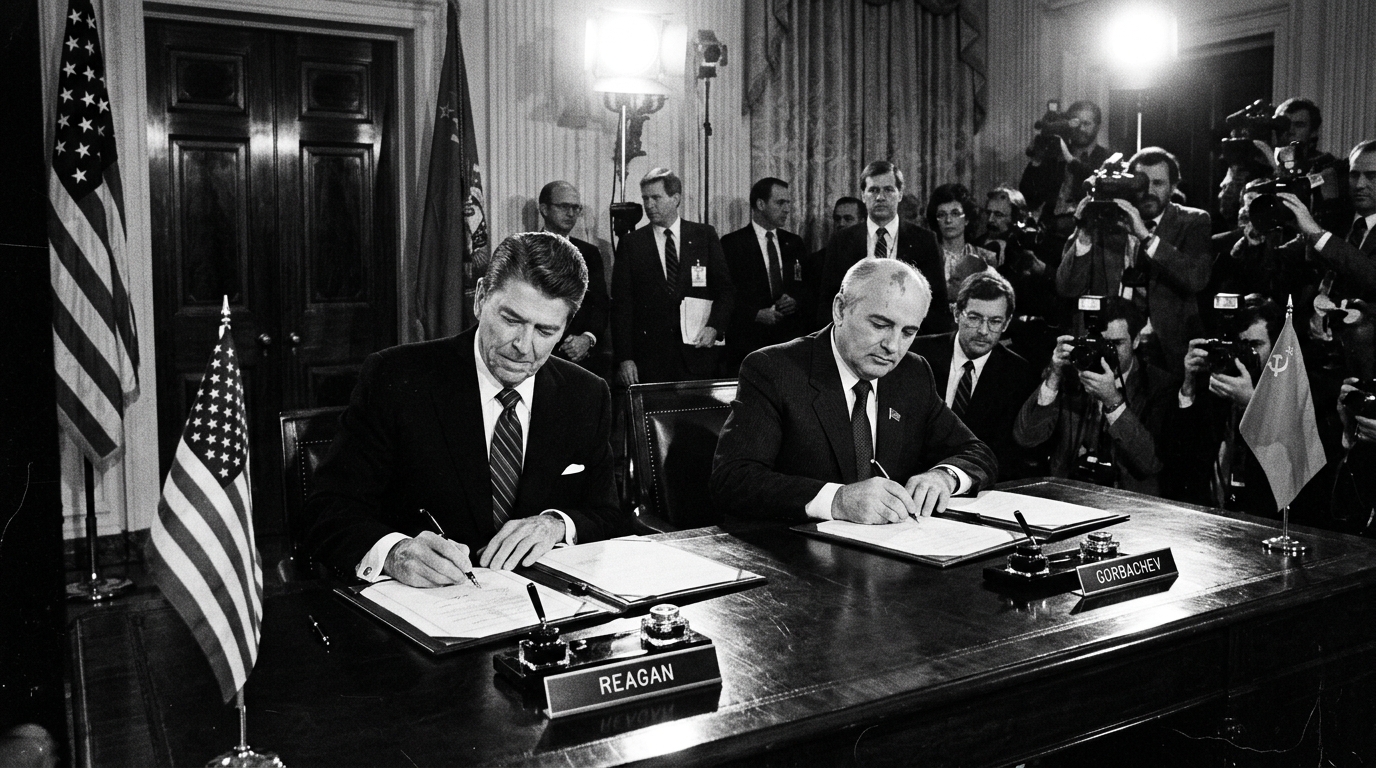
| December 8, 1987 | INF Treaty Signing in Washington, D.C. | Formalization of the total elimination of land-based missiles with ranges of 500–5,500 km, signed by President Reagan and General Secretary Gorbachev. |
| June 1, 1988 | Treaty Enters into Force | Following ratification by the U.S. Senate and the Presidium of the Supreme Soviet, the treaty officially became international law, commencing the destruction phase. |
| June 1991 | Completion of Destructions | The U.S. and USSR officially completed the verified destruction of 2,692 missiles, launchers, and associated equipment, marking a historic achievement in disarmament. |
The Reykjavik Summit: A Breakthrough Failure
The Reykjavik Summit in October 1986 proved to be the pivotal, albeit initially frustrating, moment on the road to the INF Treaty. Hosted in the neutral capital of Iceland, the two leaders engaged in extraordinary, unscripted discussions that went far beyond the pre-negotiated agendas. Over two intense days, Reagan and Gorbachev explored breathtaking proposals for deep cuts, including the total elimination of all strategic ballistic missiles within ten years, and, critically, the "zero option" for intermediate-range missiles in Europe.
The summit ultimately failed to produce an agreement because Gorbachev insisted on linking any strategic arms reduction to a complete ban on the development and testing of SDI outside the laboratory, a condition Reagan staunchly refused. Reagan, a firm believer in the defensive potential of SDI, would not budge. Despite the immediate collapse of the talks and the disappointment of many observers, Reykjavik was a "breakthrough failure." It demonstrated to both leaders, and to the world, that radical disarmament was not just a theoretical possibility but an achievable goal if political will was present. The extensive discussions on the "zero option" for INF, in particular, created a concrete framework and mutual understanding that made the eventual treaty possible, signaling a profound shift from the confrontational dynamics of the early 1980s.
Following the summit in Iceland, the negotiations moved back to Geneva, where teams of technical experts labored to resolve the complex definitional and verification issues. The eventual breakthrough occurred when Gorbachev, driven by his "New Thinking" and domestic reform agenda, conceded to the U.S. demand for "on-site inspection"—a measure long resisted by the Soviet Union as an infringement on sovereignty and state secrecy. This unprecedented concession, made possible in part by the political fallout from Mathias Rust's flight, infuriated traditionalists within the Soviet Politburo and the powerful military-industrial complex, but it paved the way for the treaty's successful conclusion.
The Mechanics of Verification: Trust, But Verify in Practice
The INF Treaty revolutionized arms control verification by introducing the most intrusive inspection regime ever devised up to that point. Previous treaties largely relied on "national technical means" (NTM), such as satellite imagery, radar, and signals intelligence, for verification. The INF Treaty, however, recognized that for an agreement involving the destruction of existing, mobile, and potentially concealable weapon systems, NTMs alone would be insufficient to build confidence.
The core principle of INF verification was encapsulated in President Reagan's famously adapted Russian proverb: "Doverai, no proverai"—"Trust, but verify." This principle translated into a complex, multi-layered system designed to ensure complete compliance:
- Baseline Inspections: Immediately after the treaty entered into force, both sides conducted extensive baseline inspections at all declared missile operating bases, support facilities, and production plants. This established an initial inventory and allowed inspectors to familiarize themselves with the facilities.
- Destruction Inspections: On-site inspections were conducted at the designated destruction sites as missiles and their launchers were dismantled or blown up. Inspectors verified the identity of the weapons and oversaw their destruction to ensure they could never be reassembled or repurposed.
- Short-Notice Inspections (SNI): This was the most innovative and intrusive element. For a period of thirteen years, each side had the right to conduct short-notice (within 36 hours), quota-limited inspections at various declared sites (including former operating bases, production facilities, and storage depots) without prior announcement. This mechanism was designed to deter any attempts at clandestine retention, production, or testing of prohibited missiles.
- Continuous Portal Monitoring (CPM): Perhaps the most remarkable aspect of verification was the agreement for permanent, continuous monitoring at a key missile production facility on each side.
Challenges and Successes of Implementation
Implementing such an intrusive verification regime was not without its challenges. Both American and Soviet inspectors faced cultural barriers, logistical hurdles, and the inherent sensitivities of operating within the national security apparatus of a former adversary. Detailed protocols had to be established for everything from the types of equipment inspectors could bring, to access routes, to communication procedures.
Despite these difficulties, the verification regime was a resounding success. It built unprecedented levels of confidence between the two superpowers. The presence of inspectors at sensitive sites, often sharing meals and conversing with their counterparts, slowly eroded decades of suspicion and hostility. The experience gained from INF verification proved invaluable, laying the groundwork for even more ambitious arms control treaties, such as the Conventional Armed Forces in Europe (CFE) Treaty and the Strategic Arms Reduction Treaties (START I and II), which incorporated and refined many of the INF's innovative inspection methodologies. The INF Treaty demonstrated that even the most formidable ideological barriers could be overcome through transparency and mutual commitment to peace.
Geopolitical Consequences and Aftermath
The INF Treaty served as the "great thaw" of the Cold War, fundamentally altering the strategic landscape and superpower dynamics. By removing an entire class of missiles that held the European continent hostage, the treaty significantly reduced the likelihood of a localized European conflict escalating rapidly into a global nuclear exchange.
- European Security Architecture: The removal of intermediate-range systems, particularly the SS-20s, which had been a source of immense anxiety for Western European nations, signaled to both NATO and Warsaw Pact countries that the superpowers were capable of self-restraint and genuine de-escalation. It eased public fears across Europe, which had been gripped by anti-nuclear protests during the "Euromissile Crisis." The treaty transformed the political climate, allowing for increased dialogue and cooperation between East and West European states, ultimately contributing to the erosion of the Iron Curtain.
- Verification Standards: The treaty established the principle of "trust but verify" not merely as a slogan, but as a robust operational framework. It created a powerful precedent for transparency, on-site inspections, and continuous monitoring that would later inform the Conventional Armed Forces in Europe (CFE) Treaty (1990), which drastically reduced conventional forces in Europe, and the Strategic Arms Reduction Treaties (START I in 1991 and START II in 1993), which aimed for deep cuts in strategic nuclear arsenals. These successive treaties built upon the INF's success, demonstrating that comprehensive disarmament was possible through verifiable means.
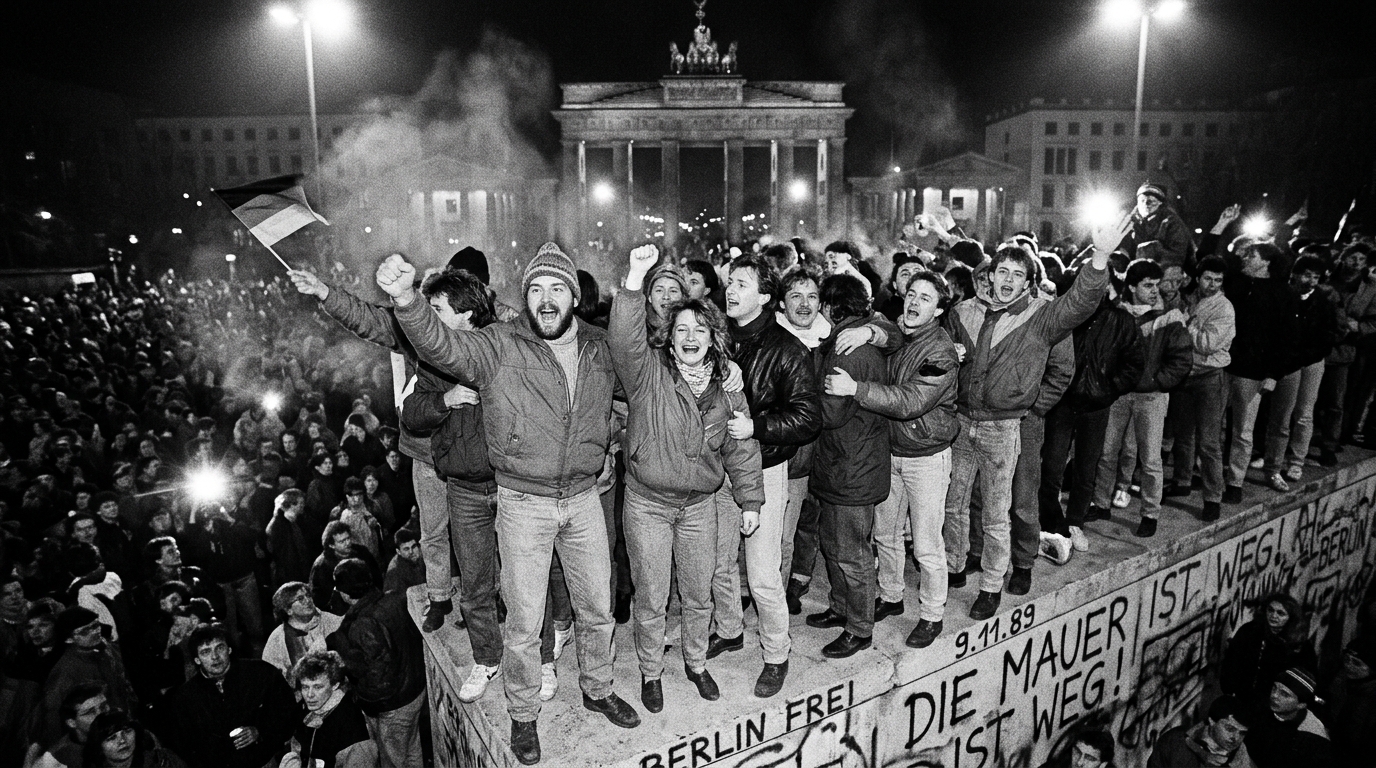
- The End of Bipolarity and Accelerated Cold War Conclusion: By acknowledging the economic imperative of disarmament and the futility of an endless arms race, the treaty inadvertently signaled that the Soviet Union’s ability to project power through nuclear dominance was nearing its end. Gorbachev's willingness to make significant concessions, including asymmetric reductions and intrusive verification, underscored the Soviet Union's internal weakness and its desire for rapprochement. The treaty accelerated the internal political transformations of the Eastern Bloc, fostering an environment where dissent could flourish without the immediate threat of Soviet military intervention. The INF Treaty can be seen as a crucial step that paved the way for the fall of the Berlin Wall in 1989 and the eventual dissolution of the Soviet Union in 1991. It dramatically lowered the ideological temperature, fostering an environment where the tectonic plates of geopolitical power could shift more peacefully.
- Shifting Nuclear Doctrine: The elimination of intermediate-range missiles forced both sides to re-evaluate their nuclear doctrines. For NATO, it meant a greater reliance on conventional deterrence and the remaining tactical and strategic nuclear forces. For the Soviet Union, it meant moving away from a strategy that relied heavily on these systems to threaten Western Europe, prompting a re-think of its overall military posture.
Domestic and International Reception
The INF Treaty, while celebrated globally as a diplomatic triumph, faced significant domestic and international skepticism and opposition from various quarters.
In the United States
President Reagan, despite his staunch anti-communist credentials, faced criticism from both conservative hardliners and some within the military establishment.
- Conservative Opposition: Many conservatives, including prominent figures like Senator Jesse Helms and influential think tanks, viewed the treaty with deep suspicion. They argued that it rewarded Soviet aggression, weakened NATO's deterrent posture, and was inherently unbalanced, as the Soviet Union would retain its numerical superiority in short-range missiles (below 500 km range) and strategic systems. They also worried about the reliability of Soviet compliance and the potential for cheating. Some saw it as a concession that undermined Reagan's "peace through strength" philosophy.
- Congressional Debate: The treaty underwent a rigorous ratification process in the U.S. Senate. Debates focused heavily on verification mechanisms, potential loopholes, and the implications for NATO's flexible response strategy. Despite reservations, Secretary of State George Shultz and other administration officials successfully argued that the intrusive verification provisions were unprecedented and effective, ultimately securing overwhelming bipartisan support for ratification in May 1988 (93-5 vote).
In the Soviet Union
Mikhail Gorbachev encountered even more entrenched opposition from within the Soviet system, particularly from the military and the Party apparatus.
- Military Resistance: The Soviet General Staff, deeply conservative and accustomed to secrecy, strongly resisted the concept of on-site inspections, viewing them as an unacceptable infringement on Soviet sovereignty and national security. They also resented the asymmetric nature of the treaty, which required the USSR to destroy nearly twice as many missiles as the U.S. (1,846 vs. 846). Many military leaders believed Gorbachev was making too many concessions and weakening Soviet defense capabilities.
- Party Hardliners: Ideological hardliners within the Politburo and the Communist Party viewed Gorbachev's "New Thinking" and his willingness to negotiate with the "imperialists" as a betrayal of socialist principles. They feared that Perestroika and Glasnost were undermining the Party's authority and weakening the Soviet Union from within. The INF Treaty became a symbol of this perceived ideological retreat.
- Public Opinion: While there was some internal dissent, Glasnost allowed for a more open, albeit controlled, public discussion. Many Soviet citizens, weary of the arms race and the economic burden it imposed, welcomed the treaty as a step towards peace and an opportunity for domestic improvement.
Among European Allies
The reaction in Western Europe was generally positive, though not without nuance.
- Relief and Support: Governments and populations that had endured years of "Euromissile" anxiety, with the threat of nuclear war on their doorstep, largely welcomed the treaty. It was seen as a significant de-escalation and a vindication of the "dual-track" decision.
- Concerns about "Decoupling": Some European strategists expressed concerns about "decoupling," fearing that the removal of U.S. intermediate-range missiles might weaken the link between U.S. strategic deterrence and European defense. Without these missiles, they worried that the U.S. might be less willing to risk its own territory in a European conflict. However, these concerns were largely outweighed by the overwhelming desire for reduced nuclear tensions.
Analysis of Key Actors and Decisive Actions
The success of the INF Treaty was as much a product of individual character and political will as it was of structural geopolitical pressure and economic necessity. The dynamic between Ronald Reagan and Mikhail Gorbachev was central.
Ronald Reagan entered the presidency as a staunch anti-communist, famously labeling the Soviet Union an "evil empire." His initial approach was "peace through strength," leading to a significant military buildup. Yet, beneath this hawkish exterior, Reagan remained deeply unsettled by the prospect of nuclear annihilation. His belief that nuclear weapons were immoral and his personal conviction that "a nuclear war cannot be won and must never be fought" drove his surprising willingness to engage Gorbachev in unprecedented disarmament talks. His advisors, particularly Secretary of State George P. Shultz and Chief Arms Negotiator Paul Nitze, played crucial roles in bridging the gap between his anti-Soviet rhetoric and his desire for disarmament. Nitze, a veteran arms control negotiator, championed the "zero option" and understood the technical complexities, while Shultz provided the diplomatic acumen and courage to navigate the political pitfalls, both domestically and internationally. Reagan's unwavering commitment to SDI also inadvertently served as a powerful bargaining chip, pushing the Soviets to the table. His willingness to engage Gorbachev, despite heavy criticism from his own conservative base, demonstrated a pragmatic shift from solely "peace through strength" to "peace through negotiation," ultimately defying expectations.
"We are here to sign a treaty that is a major milestone in the history of nuclear arms control. It is a beginning, but a very important one. We have listened to the hopes of humanity and acted to fulfill them." — Ronald Reagan, Washington D.C., December 8, 1987.
Mikhail Gorbachev, conversely, acted with remarkable political courage and strategic foresight. He understood that the Soviet Union’s stagnation was partly due to its bloated military expenditures, which consumed an unsustainably large portion of its GDP. His domestic reform agendas, Perestroika and Glasnost, required a less confrontational foreign policy to redirect resources and intellectual energy inwards. By agreeing to the asymmetric reductions required by the "zero option"—where the Soviets were required to destroy a significantly higher number of missiles than the Americans—he took a massive political risk. His Foreign Minister, Eduard Shevardnadze, became a trusted and instrumental figure in implementing Gorbachev's "New Thinking" in diplomacy, often clashing with the more conservative elements of the Soviet military and party apparatus. Gorbachev's decision to decouple INF from SDI, and his eventual concession on intrusive on-site verification, demonstrated his revolutionary break from past Soviet dogmas and his genuine commitment to a new era of international relations. His personal chemistry with Reagan, forged at Geneva and Reykjavik, was also a critical factor in overcoming entrenched bureaucratic resistance on both sides.
"There is no more important task for the Soviet Union and the United States than to end the arms race... the INF Treaty is the first step on this long road, a major breakthrough for peace and for humanity." — Mikhail Gorbachev, Washington D.C., December 8, 1987.
Long-Term Legacy and Modern Relevance
The INF Treaty stands as a monumental achievement in arms control, a testament to what is possible when adversarial powers commit to de-escalation. Its legacy is multifaceted:
- Pioneering Disarmament: It definitively proved that entire classes of deployed nuclear weapons could be eliminated, not just limited. This set a powerful precedent for future reductions in strategic arsenals under START.
- Verification Gold Standard: The treaty's intrusive verification regime became the benchmark for subsequent arms control agreements. The principle of "trust but verify" evolved into a sophisticated, multi-layered system that built confidence and transparency between nuclear powers.
- Catalyst for Cold War's End: By significantly reducing a major source of East-West tension in Europe, the INF Treaty fostered an environment conducive to broader détente, accelerating the political transformations that led to the collapse of Soviet-style communism and the end of the Cold War.
- The Power of Political Will: The treaty demonstrated that even ideologically opposed leaders, facing immense domestic pressure, could achieve breakthroughs when driven by a shared commitment to preventing nuclear catastrophe.
The Treaty's Demise and Lessons Learned
Despite its historic success, the INF Treaty ultimately met its demise. On August 2, 2019, the United States officially withdrew from the treaty, citing years of alleged violations by Russia, specifically the development and deployment of the 9M729 missile (NATO designation: SSC-8). Russia denied these accusations and, in turn, accused the U.S. of non-compliance, particularly regarding its deployment of missile defense systems in Europe which Moscow claimed could be repurposed for offensive capabilities.
The collapse of the INF Treaty has had significant implications:
- New Arms Race Concerns: Its abrogation fueled fears of a new arms race, particularly in Europe, as states are no longer bound by the prohibition on intermediate-range land-based missiles.
- Erosion of Arms Control Regime: It represents a major blow to the international arms control architecture, signaling a return to a less regulated environment regarding certain categories of nuclear weapons.
- Lessons for Future Treaties: The demise of INF underscores the challenges of maintaining arms control agreements in a rapidly evolving geopolitical landscape. It highlights the need for robust compliance mechanisms, adaptability to new technologies, and sustained political commitment from all parties, even as global power dynamics shift. The historical success of the INF Treaty remains a powerful reminder of the imperative for dialogue and cooperation in preventing proliferation and maintaining global stability.
Trivia and Lesser-Known Facts
- The Mathias Rust Factor: In May 1987, a young West German amateur pilot named Mathias Rust landed a Cessna 172 light aircraft in Moscow's Red Square, having flown undetected through vast swathes of Soviet air defense territory. This monumental security embarrassment crippled the influence of the Soviet military establishment, leading to a swift purge of hardline generals and marshals, including Defense Minister Sergei Sokolov. This weakening of military opposition significantly made it easier for Gorbachev to pursue the treaty and make concessions, particularly on verification, without being blocked by traditionalists.
- The Asymmetry of Disarmament: The treaty was inherently asymmetrical in terms of the number of missiles destroyed. The Soviet Union destroyed 1,846 missiles (including SS-20s, SS-4s, and SS-5s), while the United States destroyed 846 (Pershing IIs and GLCMs). This reflected the fact that the USSR had deployed a greater density and variety of intermediate-range systems in the European theater, and the "zero option" specifically targeted these numbers. Despite this quantitative difference, the qualitative impact of removing the Pershing IIs was immense for Soviet security concerns.
- The Persistence of Technology: Despite the treaty’s success, the verification regime was so robust that it required the creation of specialized "short-notice" inspection teams, which operated for thirteen years, well after the initial destruction phase. These teams conducted over 2,500 inspections to monitor for any clandestine manufacturing attempts or retention of prohibited systems, far exceeding typical arms control monitoring durations and demonstrating an extraordinary level of mutual trust and commitment.
- The Role of Walk-in-the-Woods: In 1982, during early, stalled INF negotiations in Geneva, U.S. negotiator Paul Nitze and Soviet negotiator Yuli Kvitsinsky famously took a "walk in the woods" where they outlined an unofficial, creative compromise for INF reductions. Although their proposal was ultimately rejected by both Washington and Moscow at the time, it demonstrated that imaginative, off-the-record discussions between individuals could break impasses and build mutual understanding, influencing the spirit of later, more successful talks.
- Missile Mementos: As a symbolic gesture of the new era of cooperation, sections of destroyed Pershing II and SS-20 missiles were exchanged between the two countries. A segment of an SS-20 missile, signed by Gorbachev, was gifted to Reagan and is now on display at the Reagan Presidential Library.
References and Literature
- Arms Control Association - The INF Treaty - A comprehensive breakdown of the treaty's history, the specific missiles destroyed, and the impact of the inspection protocols.
- The Reagan-Gorbachev Summits: A History - Official documentation from the U.S. National Archives detailing the diplomatic correspondence leading to the treaty, including memos, telegrams, and photographs.
- The Dead Hand: The Untold Story of the Cold War Arms Race and Its Dangerous Legacy by David E. Hoffman - A Pulitzer Prize-winning account that provides an in-depth look at the internal Soviet and American deliberations surrounding nuclear disarmament, offering rich detail on the INF negotiations.
- Reykjavik: How a Failed Summit Set the Stage for the INF Treaty by Ken Adelman - An insider's analysis of the pivotal 1986 summit from the perspective of a key Reagan administration advisor.
- The Cold War: A New History by John Lewis Gaddis - A concise yet comprehensive overview of the Cold War, placing the INF Treaty within the broader context of superpower relations and the eventual dissolution of the Soviet Union.
- Gorbachev: His Life and Times by William Taubman - A detailed biography of Mikhail Gorbachev, exploring his motivations and challenges in pursuing arms control and Perestroika.
- Reagan and Gorbachev: How the Cold War Ended by Jack F. Matlock Jr. - An account by Reagan's ambassador to the Soviet Union, offering unique insights into the personal dynamics and diplomatic strategies that shaped the treaty.