Key Takeaways
- The Ten-Day War (June 27 – July 7, 1991) was the first military conflict in the dissolution of Yugoslavia, pitting the Slovenian Territorial Defense against the Yugoslav People's Army (JNA).
- Slovenia's strategic preparation, particularly the creation of the Maneuver Structure of National Defense (MSNZ), neutralized the JNA's technological superiority through asymmetric warfare.
- The conflict ended with the Brioni Accord, brokered by the European Community, which led to the ultimate withdrawal of federal forces and set a precedent for the disintegration of the federation.
Historical Context and Origins
The Ten-Day War (Desetdnevna vojna), which took place between June 27 and July 7, 1991, represents the opening salvo of the Yugoslav Wars—a series of violent conflicts that devastated the Western Balkans throughout the 1990s. While the war in Slovenia was brief and resulted in relatively low casualties compared to the subsequent conflicts in Croatia, Bosnia and Herzegovina, and Kosovo, its geopolitical significance cannot be overstated. It shattered the illusion of Yugoslav unity and demonstrated the structural fragility of the Socialist Federal Republic of Yugoslavia (SFRY) in the post-Cold War era.
The roots of the conflict lay in the complex constitutional, economic, and nationalistic friction that intensified after the death of Yugoslavia’s long-standing leader, Josip Broz Tito, in 1980 1. Yugoslavia was a highly decentralized federation of six republics and two autonomous provinces. Tito’s unique system of "Brotherhood and Unity," backed by a powerful security apparatus and a balanced distribution of federal power, had successfully suppressed ethnic nationalism for decades. However, the economic crises of the 1980s—characterized by runaway inflation, massive foreign debt, and structural stagnation—reopened deep-seated regional disparities.
Slovenia, the northernmost and most economically developed republic, grew increasingly dissatisfied with the federal system. With only about 8% of Yugoslavia's population, Slovenia produced approximately 20% of the country's Gross Domestic Product (GDP) and a third of its exports. Slovenian policymakers and intellectuals argued that their republic was disproportionately subsidizing the less-developed southern regions of the federation while receiving little political influence in return.
At the same time, a powerful intellectual and cultural liberalization was taking place in Ljubljana. The publication of the "Slovenian National Program" in the journal Nova revija in 1987 (specifically Contribution 57) articulated a demand for democracy, pluralism, and sovereignty 2. This civil society movement was further galvanized by the 1988 JBTZ trial, in which three journalists of the alternative weekly magazine Mladina (including future Defense Minister Janez Janša) and a JNA sergeant-major were court-martialed by the Yugoslav military for exposing classified military plans. The trial, conducted in Serbian rather than Slovenian, sparked massive public protests and unified the Slovenian public against the Yugoslav People's Army (Jugoslovenska narodna armija — JNA).
Concurrently, the rise of Slobodan Milošević in Serbia fundamentally altered the federal balance. Milošević utilized populist grievances to launch the "Anti-Bureaucratic Revolution," successfully centralizing power by stripping Vojvodina, Kosovo, and Montenegro of their autonomy. His vision of a highly centralized Yugoslavia, dominated by Serbia under the principle of "one man, one vote," directly threatened the decentralized, confederal vision championed by Slovenia and Croatia.
The breaking point arrived in January 1990 during the 14th Extraordinary Congress of the League of Communists of Yugoslavia in Belgrade. The Slovenian delegation, led by Milan Kučan, proposed democratic reforms, the abolition of the party's monopoly on power, and a transformation of the state into a loose confederation. When these proposals were systematically voted down by the Serbian-dominated majority, the Slovenian delegation walked out, followed by the Croatians. This event marked the functional death of the federal ruling party.
DECAY OF THE YUGOSLAV FEDERATION
- Death of Josip Broz Tito (May 1980)
- Economic Crises & Debt (1980s Structural Stagnation)
- Rise of Slobodan Milošević (Centralization & Nationalism)
- LCY 14th Congress Collapse (Slovenian Walkout, Jan 1990)
- Dec. 1990 Plebiscite: 88.5% vote for Sovereign Slovenia
In April 1990, Slovenia held its first free, multi-party elections, won by the democratic coalition DEMOS, while the reform-communist Milan Kučan was elected president. On December 23, 1990, Slovenia held a national plebiscite on independence. The results were overwhelming: 93.2% of the electorate participated, with 88.5% of all eligible voters voting in favor of a sovereign and independent state. The Slovenian parliament set a six-month deadline to negotiate a peaceful disassociation from Yugoslavia or declare unilateral independence.
Recognizing that the federal authorities and the JNA might use force to prevent secession, Slovenia secretly prepared for war. In May 1990, when the JNA ordered the disarmament of the local Territorial Defense (Teritorialna obramba — TO) forces across Yugoslavia, Slovenian authorities secretly resisted. Under the guidance of Janez Janša (Minister of Defense) and Igor Bavčar (Minister of Internal Affairs), Slovenia established a clandestine military structure known as the Manevrska struktura narodne zaščite (Maneuver Structure of National Defense — MSNZ) 3. This parallel command structure allowed the Slovenian government to retain control over about 30% of their TO weaponry and systematically acquire modern anti-tank and anti-aircraft weapons (such as German Armbrust and Soviet Strela-2 missiles) through international black markets.
Timeline of Events and Key Moments
The confrontation officially began when the Slovenian Assembly passed the Basic Constitutional Charter on Independence and Sovereignty on June 25, 1991, one day earlier than originally announced. This tactical deception caught the federal authorities off guard. The next day, June 26, public celebrations were held in Ljubljana, during which Milan Kučan famously declared:
"Tonight dreams are allowed. Tomorrow is a new day."
Slovenian security forces immediately seized control of all 67 international border crossings, customs posts, and air traffic control facilities along the borders with Italy, Austria, and Hungary, replacing federal flags and signs with those of the newly declared Republic of Slovenia.
The federal response was swift. The Federal Executive Council, led by Prime Minister Ante Marković, met in Belgrade and issued a decree ordering the JNA and the Federal Secretariat of Internal Affairs to secure the state borders and restore federal authority in Slovenia. The JNA high command, led by Federal Secretary of Defense General Veljko Kadijević and Chief of Staff General Blagoje Adžić, viewed this as a limited police action to secure borders and intimidate the Slovenian leadership into submission, rather than a full-scale invasion.
| Date | Event |
|---|---|
| June 25 | Slovenia declares independence. TO seizes borders. |
| June 26 | JNA forces mobilize; Federal Executive Council orders border seizure. |
| June 27 | First clashes; JNA helicopters downed; TO blockades barracks. |
| June 28 | Airstrikes on Brnik Airport; TO captures JNA border posts. |
| June 29 | EC "Troika" initiates peace negotiations in Zagreb. |
| June 30 | TO solidifies blockades; JNA units face desertions. |
| July 01 | Battle of Krakovo Forest; JNA columns neutralized. |
| July 02 | Heavy fighting at Holmec and Gederovci. |
| July 03 | JNA armored columns halt; Belgrade shifts strategic focus. |
| July 04 | TO allows surrounded JNA troops to withdraw to barracks. |
| July 07 | Brijuni Accord signed; 3-month moratorium agreed. |
June 27: Outbreak of Hostilities
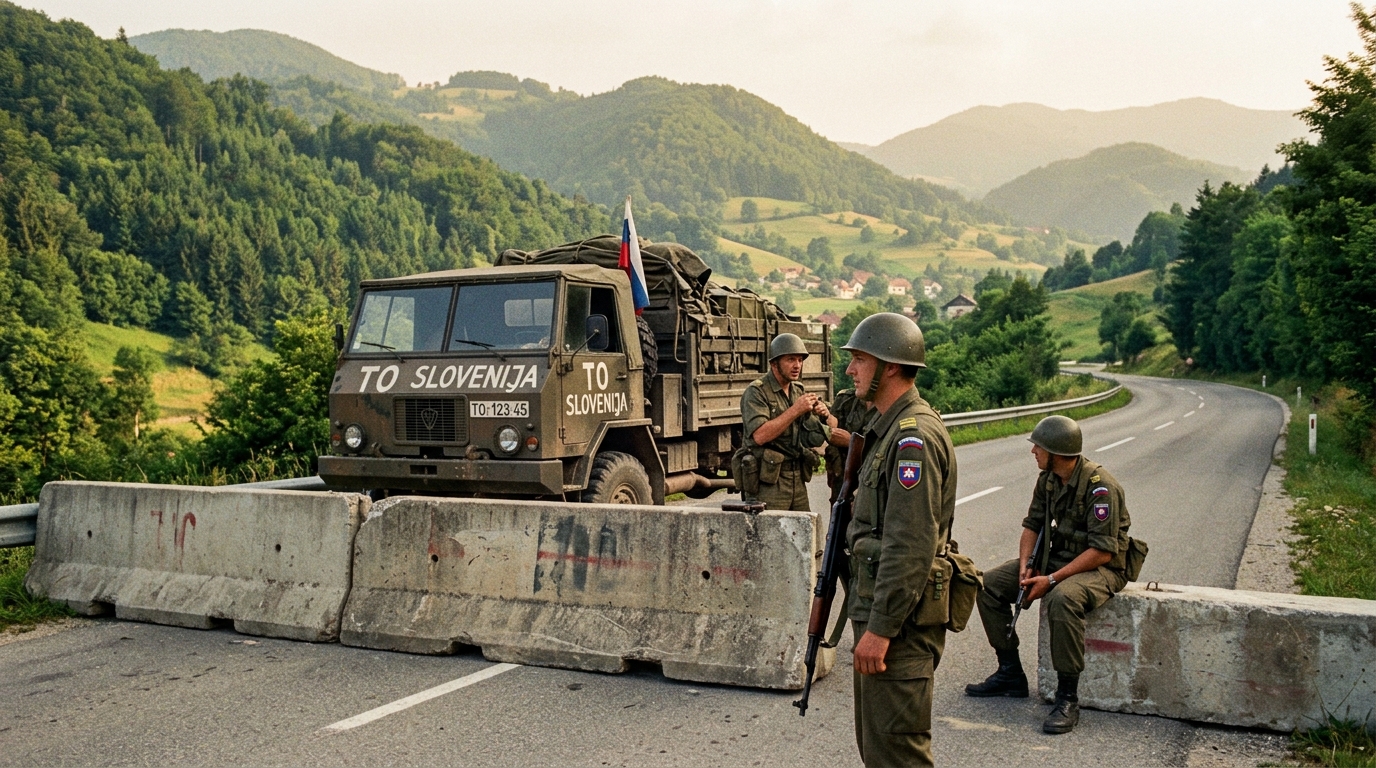
In the early hours of June 27, armored units of the JNA's 5th Military District, based in Croatia and Slovenia, began their advance toward Slovenia's borders. The Slovenian TO and police executed a pre-arranged defense plan based on asymmetric warfare. They erected barricades using civilian trucks, buses, and heavy machinery, blockaded JNA garrisons inside Slovenia to prevent them from receiving reinforcements or supplies, and cut off water, electricity, and telephone lines to military facilities.
The first shots were fired near Divača, where JNA troops forced a passage through a barricade. By afternoon, the situation escalated. In Ljubljana, the TO shot down two JNA Gazelle helicopters using shoulder-fired anti-aircraft missiles. One of the helicopters, piloted by Toni Mrlak—an ethnic Slovene who was secretly planning to defect to the Slovenian forces—crashed in the suburb of Rožna Dolina, killing all on board. This incident brought home the grim reality of the conflict to the civilian population.
June 28: Escalation and Airstrikes
The fighting intensified as the JNA deployed air support. Yugoslav Air Force (JRZ) MiG-21 and J-21 Jastreb jets launched airstrikes on several targets, including Brnik Airport (Ljubljana's international airport), where several civilian aircraft and foreign journalists' vehicles were destroyed, and various television and radio transmitters (such as those at Krim and Kum) to disrupt Slovenian communications.
Despite the air superiority, the JNA ground forces found themselves in an operational nightmare. Young conscripts, representing various ethnic groups from across Yugoslavia, had been told they were going to defend the country against external NATO aggression. Finding themselves fighting local civilians and well-organized TO forces, their morale collapsed. Slovenian forces captured several JNA border posts, taking hundreds of prisoners.
June 29 – June 30: Diplomatic Interventions and Gridlock
As news of the conflict reached Western Europe, the European Community (EC) moved quickly to prevent a wider Balkan war. A diplomatic delegation known as the "Troika"—comprising the foreign ministers of Luxembourg (Jacques Poos), Italy (Gianni De Michelis), and the Netherlands (Hans van den Broek)—arrived in Zagreb. They brokered a cease-fire agreement that included a three-month freeze on the implementation of Slovenian and Croatian independence. However, the cease-fire was repeatedly violated on the ground, as neither the JNA nor the Slovenian TO fully trusted the other side to halt movements.
July 1 – July 3: Decisive Engagements
The turning point of the military campaign occurred during the first days of July. The JNA attempted to relieve its blockaded units by sending armored columns from Croatia. A major armored column of the JNA's Varadin Corps was ambushed and neutralized by the TO at Krakovo Forest (Krakovski gozd) 4. Using specialized anti-tank infantry tactics, the Slovenians immobilized the lead and rear vehicles, trapping the column on a narrow road surrounded by dense forest.
Simultaneously, heavy fighting occurred at border crossings such as Holmec (on the Austrian border) and Gederovci. The Slovenian TO systematically overwhelmed isolated JNA border garrisons. Facing high desertion rates—particularly among Slovene, Croat, and Albanian conscripts—and facing logistical isolation, entire JNA units surrendered.
On July 3, a massive JNA armored column that had set out from Belgrade to reinforce the front was halted near the Croatian-Slovenian border due to mechanical failures, low morale, and political hesitation in Belgrade. It became clear to the JNA leadership that occupying Slovenia would require a massive, destructive invasion that would alienate the international community and require resources Belgrade was increasingly reluctant to spend on a republic without a significant Serbian population.
July 4 – July 7: De-escalation and the Brijuni Accord
By July 4, the Slovenian TO had established complete control over all border crossings, and most JNA units inside Slovenia were either captured or safely blockaded within their barracks. Negotiations resumed on the Brijuni Islands off the coast of Istria, Croatia.
On July 7, 1991, the Brijuni Accord (or Brioni Agreement) was signed by representatives of the Republic of Slovenia, the Republic of Croatia, the federal Yugoslav government, and the EC Troika. The terms of the agreement stipulated:
- An immediate cessation of all hostilities.
- A three-month suspension of Slovenia's and Croatia's declaration of independence.
- The return of all border control and customs revenues to federal authorities (nominally, though practically managed by Slovenia).
- The unblocking of all JNA barracks.
- The deployment of an European Community Monitor Mission (ECMM) to oversee the implementation of the agreement.
Geopolitical Consequences and Aftermath
The Ten-Day War was a stunning military and political victory for Slovenia. Despite the nominal three-month moratorium on independence, the conflict effectively severed Slovenia's ties with the rest of Yugoslavia. On July 18, 1991, the federal Presidency of Yugoslavia, under pressure from Slobodan Milošević, voted to withdraw all JNA forces and equipment from Slovenia within three months. The last JNA soldier left the port of Koper on the night of October 25-26, 1991.
CASUALTY COMPARISON (TEN-DAY WAR)
| Category | Figure |
|---|---|
| JNA Fatalities | 44 |
| Slovenian TO/Pol | 19 |
| Foreign Civilians | 12 |
| Wounded (Total) | ~328 |
| JNA Prisoners | ~4,700 |
The human cost of the war was remarkably low compared to the devastation that followed in the rest of the region. A total of 44 JNA soldiers, 19 Slovenian TO fighters and policemen, and 12 foreign citizens (mostly truck drivers caught at blockades) lost their lives. Approximately 328 people were wounded, and around 4,700 JNA troops were taken prisoner by Slovenian forces, most of whom were quickly repatriated.
The geopolitical consequences of the war, however, altered the course of European history:
- The Shift in Belgrade's Strategy: The swift abandonment of Slovenia by the Serbian leadership, led by Milošević, revealed a calculated shift in Belgrade's war aims. Milošević and his allies abandoned the concept of preserving the entire Yugoslav federation. Instead, they focused on a "Greater Serbia" or a consolidated rump Yugoslavia, which meant retaining control over territories in Croatia and Bosnia and Herzegovina that had substantial Serbian populations [^5]. Because Slovenia was ethnically homogenous (over 90% Slovene), Milošević saw no geopolitical value in wasting military strength to keep it within the federation. This pivot cleared the way for the far more destructive wars in Croatia and Bosnia.
- The Precedent of Unilateral Secession: The success of Slovenia's unilateral declaration of independence and subsequent defense set a powerful precedent. It demonstrated that international recognition could be achieved through a combination of domestic determination, military resistance, and clever public relations. Croatia immediately followed Slovenia's path, but without the benefit of ethnic homogeneity or geographical isolation from Serbia's direct military reach.
- The Role of the European Community: The Ten-Day War was the first major foreign policy test for the European Community (the precursor to the European Union) following the end of the Cold War. Jacques Poos famously proclaimed: "This is the hour of Europe, not the hour of the Americans." However, the EC’s initial insistence on preserving Yugoslavia’s territorial integrity quickly fragmented. Germany, led by Chancellor Helmut Kohl and Foreign Minister Hans-Dietrich Genscher, broke ranks with its allies and advocated for the rapid diplomatic recognition of Slovenia and Croatia, arguing that self-determination was a fundamental democratic right. In December 1991, Germany unilaterally announced its intention to recognize both republics, forcing the rest of the EC to follow suit in January 1992.
- Slovenia's Westward Integration: Free from the burden of the wider Yugoslav conflicts, Slovenia embarked on a rapid political and economic transition. It established a stable parliamentary democracy, adopted a market economy, and reoriented its trade toward Western Europe. This successful transition culminated in Slovenia becoming the first former Yugoslav republic to join both NATO and the European Union in May 2004, and the Eurozone in 2007.
Analysis of Key Actors and Decisive Actions
The outcome of the Ten-Day War was shaped by the actions, miscalculations, and strategic decisions of several key players.
| Key Actor | Role/Position | Strategic Goals | Primary Impact/Outcome |
|---|---|---|---|
| Milan Kučan | President of the Slovenian Presidency | Secure Slovenian independence; minimize casualties; gain Western diplomatic recognition. | Managed the transition to independence with strategic patience; successfully mobilized domestic unity and gained crucial European diplomatic support. |
| Slobodan Milošević | President of the Republic of Serbia | Consolidate Serbian power; maintain a Serb-dominated state; cut loose non-Serb regions. | Effectively allowed Slovenia to leave the federation to focus military resources on retaining parts of Croatia and Bosnia. |
| Janez Janša | Slovenian Minister of Defense | Reorganize and lead the Territorial Defense (TO); execute asymmetric defense strategy. | Successfully weaponized the TO and MSNZ, neutralizing the JNA's armored units through defensive barricades and tactical isolation. |
| Veljko Kadijević | JNA General & Federal Secretary of Defense | Preserve Yugoslavia; enforce federal authority; avoid a total civil war. | Hesitated to deploy full military power; miscalculated the Slovenian will to resist and the JNA's internal structural cohesion. |
Milan Kučan: The Architect of Political Pragmatism
As the leader of Slovenia's transition from a communist republic to an independent democratic state, Milan Kučan demonstrated exceptional political skill. He understood that Slovenia could not win a prolonged war of attrition against the JNA. Therefore, his strategy focused on internationalizing the conflict. By allowing foreign journalists free access to the battlefields and organizing daily, professional press conferences in English, Kučan's government framed the conflict as a struggle between a young, peace-loving democracy and a brutal, outdated communist military regime. This public relations victory was crucial in shifting Western public opinion and forcing European leaders to intervene.
Slobodan Milošević: The Pragmatic Nationalist
For Slobodan Milošević, the conflict in Slovenia was a tactical distraction. While he publicly supported the federal government’s efforts to maintain the state’s borders, his private actions indicated a willingness to let Slovenia go. During a secret meeting with Milan Kučan in early 1991, Milošević reportedly agreed that Serbia would not oppose Slovenian independence, provided Slovenia did not interfere with Serbian territorial ambitions in Croatia and Bosnia 6. Milošević’s control over the Serbian representatives in the federal presidency allowed him to block the JNA from declaring a state of emergency, which would have authorized a massive, unrestricted military assault on Slovenia.
Janez Janša and Igor Bavčar: The Defense Planners
The military defense of Slovenia was largely planned by Defense Minister Janez Janša and Interior Minister Igor Bavčar. Janša analyzed the JNA’s operational doctrines and identified its key vulnerability: its heavy reliance on armored vehicles and predictable routes of advance.
By utilizing the MSNZ to conceal weapons and training TO units in anti-tank tactics, Janša created a highly mobile, decentralized force. The decision to use civilian infrastructure (such as blockading JNA exits with municipal garbage trucks and city buses) and cutting off the barracks' utilities effectively neutralized the JNA's heavy armor without requiring Slovenian forces to launch high-risk offensive assaults on fortified military bases.
Trivia and Lesser-Known Facts
- The Propaganda War and the "Holmec Incident": The war featured a intense propaganda battle. Austrian television broadcast footage from the Holmec border crossing on June 28, showing three JNA soldiers holding a white sheet surrendering, followed by gunfire. In the late 1990s, accusations arose that Slovenian TO forces had executed these surrendering soldiers (which would constitute a war crime). However, subsequent international and domestic investigations concluded that the soldiers had dropped to the ground to seek cover from crossfire, and all three survived the battle unharmed [^7].
- The "Billion-Dinar" Heist: Prior to declaring independence, the Slovenian government quietly pulled its funds out of the Yugoslav central banking system. To prevent Belgrade from freezing its assets, Slovenia secretly printed its own temporary currency vouchers, known as "tolar coupons," which were kept in storage and introduced immediately after the war to stabilize the domestic economy and prevent hyperinflation.
- The Defection of JNA Pilots: Throughout the ten days of fighting, several JNA pilots of Slovene and Croat origin refused to fly combat missions or actively sought ways to defect. Some deliberately dropped their bombs in empty fields or forests rather than targeting Slovenian infrastructure. The shoot-down of Toni Mrlak's Gazelle helicopter remains one of the most tragic and debated friendly-fire incidents of the war, as Mrlak was in active communication with Slovenian authorities about defecting with his aircraft.
- The "Border-Post" Economy: During the conflict, Slovenian border guards allowed tourists and cross-border workers to pass through certain crossings even while JNA forces were blockaded just hundreds of meters away. At some points along the Austrian border, Slovenian TO soldiers were seen buying food and cigarettes in Austria, carrying them back across the border to their defensive positions, and paying with Western German Marks (DEM), which had effectively replaced the Yugoslav Dinar as the local currency of choice.
References and Literature
- The Dissolution of Yugoslavia and the Slovenian War of Independence - An academic analysis detailing the constitutional disputes, the role of the DEMOS coalition, and the military strategy of the Ten-Day War.
- Silber, Laura, and Allan Little. "Yugoslavia: Death of a Nation." Penguin Books, 1997. - Widely considered the definitive journalistic account of the breakup of Yugoslavia, featuring detailed interviews with Milan Kučan, Slobodan Milošević, and JNA commanders.
- Janša, Janez. "The Making of the Slovenian State: 1988-1992: Collapse of Yugoslavia." Mladinska Knjiga, 1994. - A first-hand memoir by Slovenia's wartime Defense Minister, outlining the secret creation of the MSNZ and the military operations of the Ten-Day War.
- Gow, James. "The Serbian Project and Its Adversaries: A Strategy of War." C. Hurst & Co. Publishers, 2003. - A comprehensive analysis of the military doctrines, the structural failure of the JNA, and the transition of the conflict from Slovenia to Croatia and Bosnia.
Footnotes & Explanations
- See Laura Silber and Allan Little, Yugoslavia: Death of a Nation (Penguin Books, 1997), pp. 48-55, for an overview of Tito's legacy and the structural issues of the post-1980 presidency. ↩
- Nova revija, Issue 57 (1987), outline of the Slovenian National Program. ↩
- Janez Janša, The Making of the Slovenian State: 1988-1992: Collapse of Yugoslavia (Mladinska Knjiga, 1994), pp. 112-118. ↩
- Detailed tactical maps and operational reports of the Krakovo Forest ambush can be found in the Ministry of Defence of the Republic of Slovenia, War for Slovenia 1991: Operational Documents (Ljubljana, 2001). ↩
- James Gow, The Serbian Project and Its Adversaries: A Strategy of War (C. Hurst & Co., 2003), pp. 62-65. ↩
- Silber and Little, Yugoslavia: Death of a Nation, pp. 114-116. ↩
- Report of the Helsinki Monitor of Slovenia on the Holmec Incident, published in Delo, June 1999. ↩