Key Takeaways
- The collapse of the Soviet Union created a power vacuum in the North Caucasus, leading Dzhokhar Dudayev to declare Chechen independence in 1991.
- The New Year's Eve assault on Grozny in 1994 exposed severe systemic deficiencies within the post-Soviet Russian military, resulting in catastrophic armored losses.
- The conflict concluded with the 1996 Khasavyurt Accord, which de facto granted Chechnya self-governance and marked a humiliating defeat for Boris Yeltsin's administration.
Historical Context and Origins
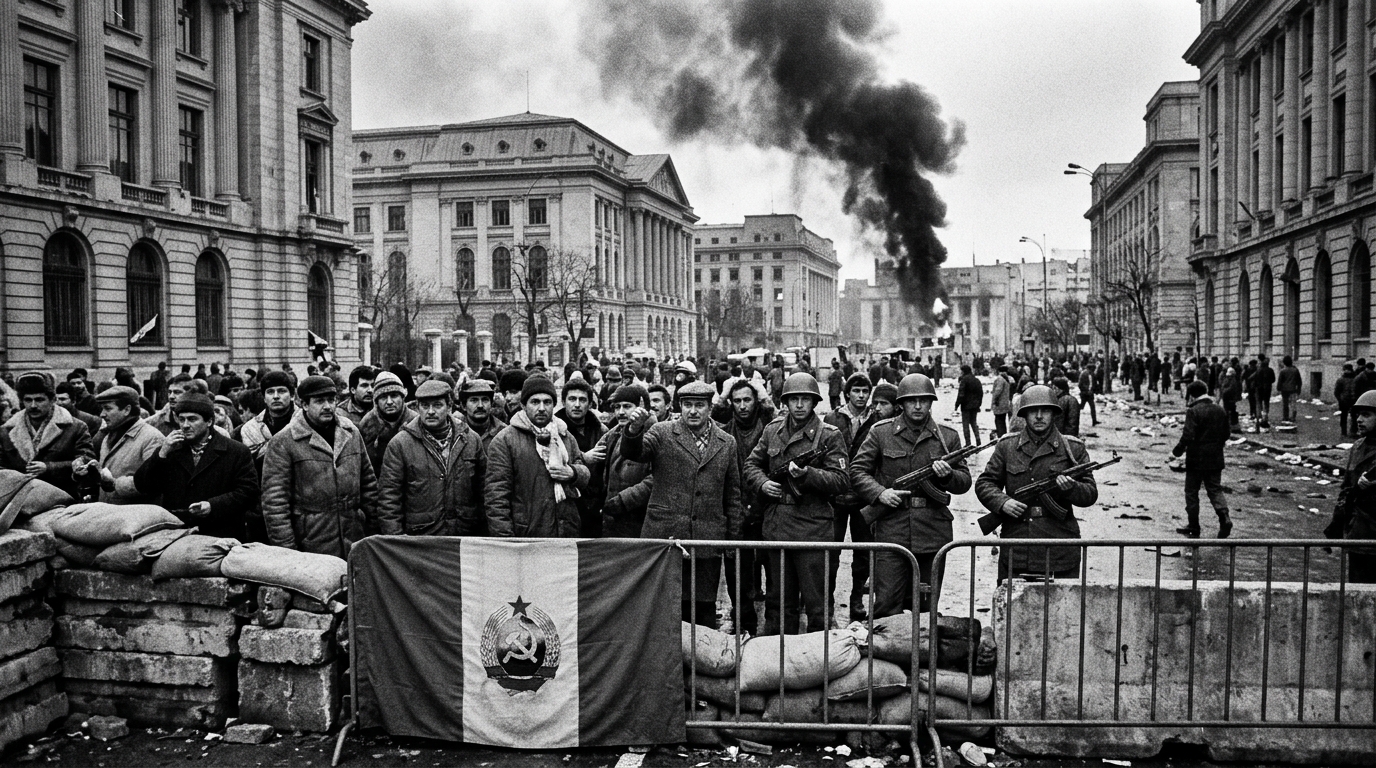
The dissolution of the Soviet Union in December 1991 did not merely redraw the international boundaries of Eurasia; it reignited centuries-old ethno-nationalist aspirations and administrative disputes within the newly formed Russian Federation. At the epicenter of this geopolitical instability was the North Caucasus, a region historically resistant to imperial Russian expansion and Soviet hegemony. The First Chechen War (1994–1996) emerged directly from this historical friction, catalyzed by the sudden collapse of Soviet central authority and the rise of a highly assertive Chechen nationalist movement.
To comprehend the intensity of the Chechen resistance, one must look back to the historical trauma of 1944. Under the orders of Joseph Stalin and Lavrentiy Beria, the entire Chechen and Ingush population was forcibly deported to Central Asia during Operation Lentil, resulting in the deaths of over a third of the population.1 Though rehabilitated and allowed to return by Nikita Khrushchev in 1957, the collective memory of this existential threat remained deeply embedded in the Chechen consciousness.
In late 1991, as the Soviet Union fractured, Dzhokhar Dudayev, a charismatic former Soviet Air Force major general, seized the momentum. Dudayev, who had command experience with strategic nuclear bombers in Estonia, dissolved the local Soviet-era parliament and was elected President of the newly declared Chechen Republic of Ichkeria (CRI) in October 1991. Shortly thereafter, he declared Chechnya’s unilateral independence from both the Soviet Union and the Russian Soviet Federative Socialist Republic.
| Sequence | Event |
|---|---|
| 1 | Collapse of the Soviet Union (1991) |
| 2 | Dudayev Declares Chechen Independence |
| 3 | Russian Political Instability (1993) |
| 4 | Failed Covert Actions & Opposition Coups |
| 5 | Full-Scale Russian Military Intervention |
For Moscow, the secession of Chechnya presented both a strategic and a constitutional crisis. President Boris Yeltsin, grappling with domestic rivals, economic collapse, and a fragile transition to market capitalism, feared that Chechen independence would trigger a domino effect across other ethnic republics within Russia, such as Tatarstan and Dagestan. Furthermore, Chechnya sat astride vital oil pipeline infrastructure connecting Baku to the Black Sea, making its control central to Russia’s energy politics.
Throughout 1992 and 1993, Moscow attempted to resolve the issue through economic blockades, political isolation, and the covert funding of anti-Dudayev Chechen opposition factions. By late 1994, these political maneuvers had failed. A disastrous, covertly backed assault on Grozny by Chechen opposition forces—supported by active-duty Russian military mercenaries recruited by the Federal Counterintelligence Service (FSK)—on November 26, 1994, ended in a humiliating rout. Dozens of Russian servicemen were captured and paraded on television by Dudayev's government. This public embarrassment pushed Yeltsin’s inner circle, particularly the hawkish "Party of War" consisting of Defense Minister Pavel Grachev, Interior Minister Viktor Yerin, and FSK Director Sergei Stepashin, to advocate for a direct military intervention.
On December 11, 1994, Boris Yeltsin signed Decree No. 2169, ordering Russian military and internal forces to "restore constitutional order" in Chechnya.
Timeline of Events and Key Moments
The Initial Invasion and Tactical Miscalculations
The Russian campaign was envisioned by Defense Minister Pavel Grachev as a swift, surgical intervention that would last no longer than a few weeks. Grachev famously boasted that a single airborne regiment could seize Grozny in a matter of hours.2 This hubris ignored critical intelligence assessments and the severe degradation of the post-Soviet Russian armed forces, which suffered from systemic underfunding, low morale, and a total lack of training in urban warfare.
On December 11, 1994, Russian forces advanced toward Grozny in three primary columns from the north, east, and west:
- The Northern Column, commanded by General Konstantin Pulikovsky, made the fastest progress but lacked coordinated flank protection.
- The Western Column, led by General Eduard Vorobyov, stalled immediately due to mass civilian protests and passive resistance along the border with Ingushetia. Vorobyov ultimately resigned in protest, calling the invasion "an absolute madness."
- The Eastern Column was ambushed by Chechen fighters in the dense forests and villages, severely delaying its approach.
By mid-December, the Russian advance had devolved into a sluggish, highly destructive artillery campaign that targeted Chechen settlements, causing massive civilian casualties and galvanizing the local population—many of whom had previously been indifferent or opposed to Dudayev's regime—to take up arms.
Chronology of the First Chechen War
| Date | Event |
|---|---|
| Dec 11, 1994 | Russian forces cross into Chechnya. |
| Dec 31, 1994 – Jan 1, 1995 | Disastrous New Year's Eve assault on Grozny. |
| Jan – Feb 1995 | Heavy bombardment and capture of Grozny ruins. |
| June 1995 | Budyonnovsk hospital hostage crisis. |
| April 21, 1996 | President Dzhokhar Dudayev is assassinated. |
| August 1996 | Operation 'Zero': Chechen fighters retake Grozny. |
| August 31, 1996 | Signing of the Khasavyurt Accord. |
The New Year’s Eve Assault on Grozny (December 31, 1994)
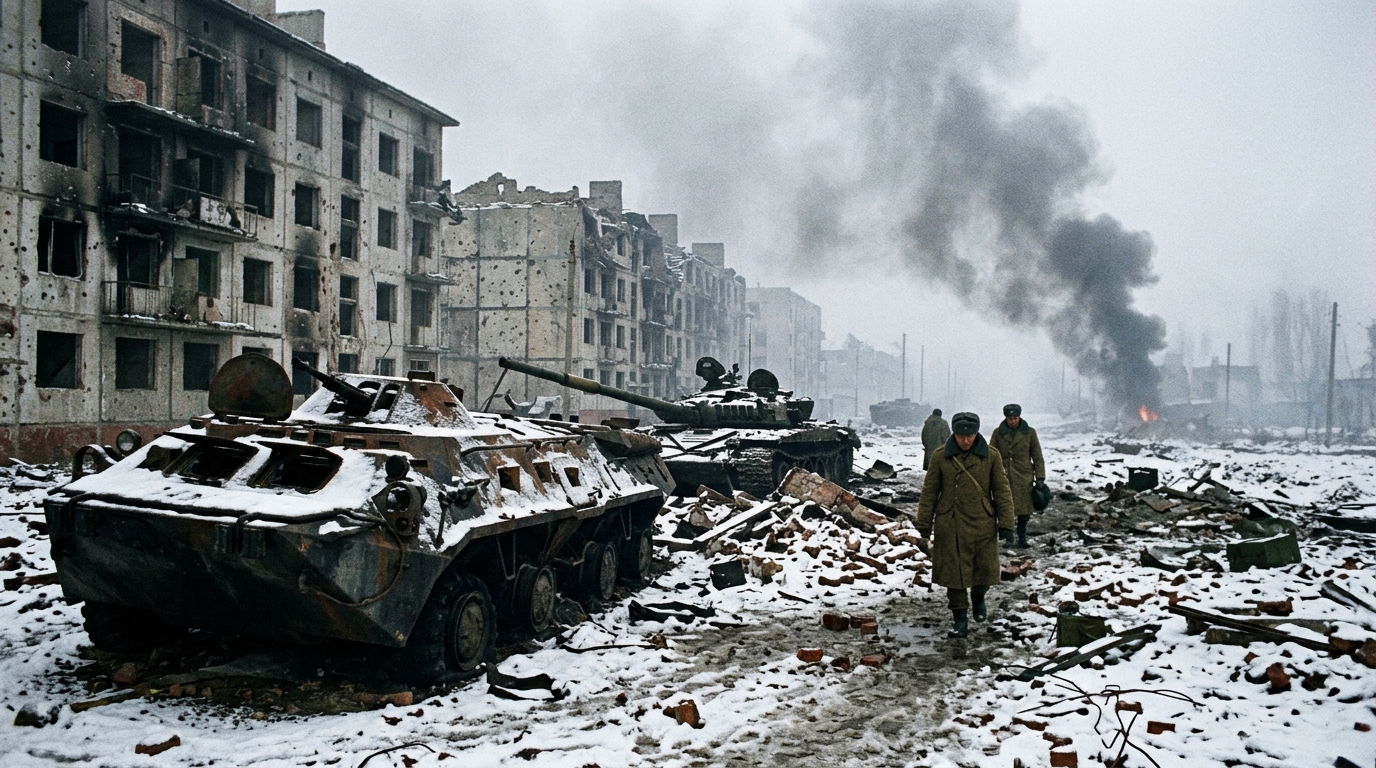
The assault on the Chechen capital, Grozny, began on the morning of December 31, 1994, and is recorded as one of the most catastrophic urban military operations in modern history. Designed to overwhelm the defenders through a multi-axis armored thrust, the plan sent columns of tanks and armored personnel carriers (APCs) directly into the heart of the city without infantry dismounts or adequate reconnaissance.
The 131st "Maikop" Motor Rifle Brigade and the 81st Guard Motor Rifle Regiment were ordered to secure the central railway station and the Presidential Palace. Unaware of the layout of the city and operating with outdated maps, the armored columns drove deep into narrow streets lined with multi-story concrete buildings.
| Terrain Level | Primary Asset | Tactics/Objectives |
|---|---|---|
| Rooftops / Upper Floors | Snipers / Machine Gunners | Suppress Russian infantry |
| Street / Alleys | RPG Teams (3-4 men) | Target lead and rear vehicles to trap column; destroy remainder |
| Cellars / Basements | RPG Teams | Exploit thin bottom armor of vehicles |
The Chechen Chief of Staff, Colonel Aslan Maskhadov, a former Soviet artillery officer, had organized a highly decentralized, mobile defense. Chechen fighters, organized into highly flexible "hunter-killer" teams of three to four men (an RPG gunner, a machine gunner, and a sniper), waited until the Russian columns were deep within the urban canyons.
- The Ambush: Chechen fighters disabled the lead and rear vehicles of the 131st Maikop Brigade column, trapping the remaining armor in a deadly corridor.
- The Execution: Utilizing the elevation limits of Russian tank barrels, which could neither point high enough to target rooftops nor low enough to hit basements, Chechen RPG teams systematically dismantled the armored vehicles from above and below.
- The Toll: The 131st Brigade was virtually annihilated. Out of 26 tanks, 20 were destroyed; out of 120 APCs, 102 were lost. The brigade commander, Colonel Ivan Savin, and nearly 190 of his men were killed in the vicinity of the Grozny railway station.[^3]
Grozny’s Fall and the Shift to Guerrilla Warfare
Realizing the failure of direct armored assaults, the Russian command shifted to a strategy of attrition and devastating bombardment. For the next two months, Grozny was subjected to one of the most intense artillery and aerial bombardments in Europe since the end of World War II. An estimated 4,000 shells fell on the city every hour during the peak of the bombardment.
By March 1995, Russian forces had finally secured the ruins of Grozny, forcing the Chechen fighters to retreat into the southern mountainous terrain. Here, the conflict transformed into a brutal guerrilla war. The dense forests and rugged peaks of the Caucasus Mountains favored the defenders, who used classic hit-and-run tactics, night ambushes, and improvised explosive devices (IEDs) to inflict continuous casualties on the static Russian garrisons.
The Budyonnovsk Hostage Crisis (June 1995)
As the military campaign stalled, Chechen field commanders sought to bring the war directly to the Russian populace. On June 14, 1995, a group of approximately 150 fighters led by Shamil Basayev crossed the border into the Stavropol Krai region and seized the municipal hospital in the town of Budyonnovsk, taking over 1,500 civilians hostage.
Basayev demanded an immediate end to the war, the withdrawal of Russian troops, and direct negotiations with the Russian government. The crisis ended in a strategic victory for the militants. After two failed, bloody storming attempts by Russian special forces, Prime Minister Viktor Chernomyrdin bypassed Yeltsin to negotiate directly with Basayev on live television. The Russian government agreed to a temporary ceasefire and safe passage for the militants back to Chechnya, demonstrating to the world the severe leverage that asymmetric warfare could exert over the Russian state.
The Assassination of Dzhokhar Dudayev (April 1996)
On April 21, 1996, Russian intelligence achieved a major tactical success. President Dzhokhar Dudayev was assassinated near the village of Gekhi-Chu when his satellite phone signal was intercepted by a Russian reconnaissance aircraft. The signal coordinates were immediately relayed to a Su-25 attack jet, which launched two laser-guided missiles directly at his location.4 While the death of Dudayev was a severe blow to the Chechen nationalist movement, it did not demoralize the resistance. Instead, it decentralized the leadership, allowing more radical and militant commanders, such as Shamil Basayev and Salman Raduyev, to gain prominence over moderate political figures.
Operation "Zero" and the Recapture of Grozny (August 1996)
In August 1996, with the Russian presidential elections concluded and Yeltsin narrowly reelected, Chechen forces launched a surprise counter-offensive to retake Grozny. Code-named Operation "Zero" (and often referred to as the Third Battle of Grozny), the operation was planned and executed by Aslan Maskhadov.
On August 6, 1996, approximately 1,500 to 2,000 Chechen fighters infiltrated the city in small groups. Rather than attempting to hold territory, they bypassed heavily fortified Russian checkpoints and besieged Russian administrative buildings, command centers, and isolated garrisons. Within days, over 12,000 Russian troops inside the city were cut off, surrounded, and running out of ammunition and water. When Russian armored relief columns attempted to enter the city, they were systematically ambushed and destroyed in a repeat of the December 1994 disaster.
Geopolitical Consequences and Aftermath
The military catastrophe of August 1996 forced the Kremlin to accept that a military victory in Chechnya was impossible under the current conditions. Boris Yeltsin appointed General Alexander Lebed, a highly popular former paratrooper commander and national security advisor, with broad plenipotentiary powers to negotiate a settlement.
The Khasavyurt Accord
On August 31, 1996, General Alexander Lebed and Chechen Chief of Staff Aslan Maskhadov signed the Khasavyurt Accord in Dagestan. The agreement officially brought an end to the hostilities and outlined the parameters of future relations between Moscow and Grozny:
- Withdrawal of Forces: All Russian military and interior ministry forces were to completely evacuate Chechnya by January 1997.
- Deferral of Status: The determination of the formal, legal status of the Chechen Republic of Ichkeria was deferred for five years, until December 31, 2001.[^5]
- De Facto Independence: In the interim, Chechnya became a de facto independent state, governed by its own laws, president, and security apparatus.
"We have ended the war. We have agreed on the withdrawal of troops. We have agreed on the principles of our relations. This is a victory of common sense." — General Alexander Lebed, August 1996
The Khasavyurt Accord (1996)
- Immediate Cessation of Hostilities
- Political Status Deferral
- Systemic Collapse of Chechen Statehood (1997-1999)
The Devastated State of Ichkeria
While the Khasavyurt Accord brought a temporary peace, it did not resolve the underlying structural crises. The war had completely destroyed Chechnya's infrastructure, economy, and social fabric. Over 100,000 civilians had been killed, and hundreds of thousands more were displaced as refugees.
Aslan Maskhadov, who was elected President of the CRI in January 1997, proved unable to control the radicalized and heavily armed warlords who had risen to prominence during the war. Shamil Basayev and his Arab ally, Ibn al-Khattab, rejected Maskhadov’s moderate nationalist path in favor of establishing an Islamic emirate across the entire North Caucasus. With no functioning economy, Chechnya descended into a lawless zone characterized by kidnapping, hostage-taking, and warlordism. This internal chaos ultimately culminated in the invasion of Dagestan by Basayev’s forces in August 1999, providing Russia with the casus belli to launch the Second Chechen War.
The Impact on the Russian Federation
For Russia, the defeat in Chechnya was a humiliating blow that exposed the deep rot within its military, political, and intelligence institutions. It signaled to both domestic regional leaders and foreign observers that the once-mighty Russian army was a shadow of its Soviet predecessor.
However, the war also set the stage for a dramatic shift in Russian political leadership. The chaos of the Yeltsin era, exemplified by the disastrous economic reforms and the defeat in Chechnya, created a deep societal craving for order (poryadok). This environment paved the way for the rise of Vladimir Putin, who was appointed Prime Minister in August 1999. Putin used a hardline, uncompromising approach to the North Caucasus to consolidate his power, promising to "waste [the terrorists] in the outhouse." This stance launched his presidency and ushered in a highly centralized, authoritarian phase of modern Russian history.
Analysis of Key Actors and Decisive Actions
The trajectory of the First Chechen War was heavily shaped by the personal calculations, hubris, and strategic decisions of a few key actors. Below is a detailed assessment of their actions and impacts on the outcome of the war.
| Actor | Role | Key Strategic Decisions / Actions | Strategic Impact |
|---|---|---|---|
| Boris Yeltsin | President of the Russian Federation | Signed Decree No. 2169 ordering military intervention; delegated military strategy to defense hawks; bypassed parliament. | Deeply unpopularized his presidency; highlighted the fragility of the Russian state; ultimately forced to concede defeat in 1996 to secure reelection. |
| Dzhokhar Dudayev | President of the Chechen Republic of Ichkeria | Unilaterally declared independence (1991); refused compromises with Moscow; militarized Chechen society. | Unified disparate Chechen clans against a common Russian threat; established the political basis for the Republic of Ichkeria. |
| Pavel Grachev | Russian Minister of Defense | Promised a quick, bloodless victory; ignored intelligence reports; ordered the disastrous New Year's Eve armored assault. | Responsible for the catastrophic tactical failures in Grozny; decimated the morale of the Russian armed forces. |
| Aslan Maskhadov | Chechen Chief of Staff / General | Organized the decentralized urban defense of Grozny; planned and executed the August 1996 counter-offensive; signed the Khasavyurt Accord. | Demonstrated the power of highly flexible, asymmetric tactics against a conventional military; emerged as the moderate political alternative to radical warlords. |
| Shamil Basayev | Chechen Field Commander | Led the Budyonnovsk hospital hostage crisis (1995); advocated for total war and cross-border terrorism. | Shifted the conflict from a nationalist war of independence to a radical, pan-Islamic insurgency; undermined Maskhadov's peace efforts. |
Trivia and Lesser-Known Facts
- The "Alik, take your boys back" Radio Intercept: During the intense fighting for the Grozny railway station on New Year's Eve, Chechen commander Turpal-Ali Atgeriyev used unencrypted radio frequencies to appeal to Russian Colonel Ivan Savin of the 131st Maikop Brigade, pleading with him to withdraw his young conscripts to save their lives. The emotional exchange, recorded by amateur radio operators, remains one of the most haunting audio archives of the conflict.[^6]
- The Myth of the "White Stockings": Throughout the war, a persistent rumor circulated among Russian soldiers and media regarding Baltic female biathletes, dubbed the "White Stockings" (Belye Kolgotki), who were allegedly hired by the Chechens as elite mercenaries and snipers. While highly popularized in Russian propaganda, no credible evidence was ever found to prove their existence.
- Dudayev’s Nuclear Legacy: Before declaring independence, Dzhokhar Dudayev commanded the 326th Heavy Bomber Aviation Division of the Soviet Long-Range Aviation based in Tartu, Estonia. Known for his tactical brilliance and adherence to discipline, he was highly respected by his Soviet peers. When Estonia was seeking independence, Dudayev refused to deploy his bombers to suppress the Estonian national movement, earning him Estonian decorations and paving the way for his return to Chechnya.
- The Grachev-Dudayev Meeting: Just days before the official invasion, on December 6, 1994, Pavel Grachev met with Dzhokhar Dudayev in the Ingush town of Sleptsovskaya. Despite their political differences, both men, as former high-ranking Soviet officers, reportedly understood each other well. Grachev later stated that if political leaders had not intervened, he and Dudayev could have negotiated a peaceful settlement. However, Yeltsin's administration dismissed any compromise.
References and Literature
- Russia's Chechen War - A comprehensive tactical and strategic analysis of the conflict published by the RAND Corporation, detailing the systematic failures of the Russian military.
- A Small Victorious War: The First Chechen War - Foreign Affairs capsule review of the political developments and inner-Kremlin dynamics during the run-up to the 1994 invasion.
- Gall, Carlotta, and Thomas de Waal. Chechnya: Calamity in the Caucasus. New York: New York University Press, 1998. - Widely regarded as the definitive English-language account of the first war, combining deep historical analysis with ground-level reporting.
- Lieven, Anatol. Chechnya: Tombstone of Russian Power. New Haven: Yale University Press, 1998. - An analytical look at the geopolitical implications of the war, examining how a small nation defeated a nuclear superpower.
---
Footnotes & Explanations
- Carlotta Gall and Thomas de Waal, Chechnya: Calamity in the Caucasus (New York: New York University Press, 1998), 56-59. ↩
- Anatol Lieven, Chechnya: Tombstone of Russian Power (New Haven: Yale University Press, 1998), 102. ↩
- RAND Corporation, Russia's Chechen War (Santa Monica: RAND, 1999), 23-25. ↩
- "The Death of Dzhokhar Dudayev," The Moscow Times, April 24, 1996. ↩
- "The Khasavyurt Joint Declaration and Principles for Mutual Relations," signed August 31, 1996 (Official Text, OSCE Archives). ↩
- Radio intercept transcript, "Grozny: The New Year's Eve Tragedy of the 131st Brigade," Russian Military Archive Database. ↩