Key Takeaways
- The 1956 Hungarian Revolution began as a student demonstration and quickly escalated into a national uprising demanding sovereignty, democratic reforms, and the withdrawal of Soviet troops.
- Prime Minister Imre Nagy championed the revolutionary cause, declaring Hungary's neutrality and withdrawing from the Warsaw Pact, which triggered a massive, brutal Soviet military intervention.
- The crushing of the revolution consolidated Soviet hegemony in Eastern Europe but shattered the moral credibility of Western communist parties and demonstrated the limits of Western 'rollback' rhetoric during the Cold War.
Historical Context and Origins
The Hungarian Revolution of 1956 was not an isolated outburst of discontent but the culmination of deep-seated political, economic, and social grievances that accumulated under Soviet dominance following the end of World War II. After the defeat of the Axis powers, the Soviet Union gradually established a satellite state in Hungary, systematically dismantling the country's democratic institutions. By 1949, the Hungarian Working People's Party, led by the hardline Stalinist Mátyás Rákosi, had consolidated absolute power 1.
Rákosi’s regime was characterized by intense terror, forced industrialization, and aggressive agricultural collectivization. The State Protection Authority (Államvédelmi Hatóság, or ÁVH) enforced conformity through a pervasive network of informants, arbitrary arrests, torture, and show trials. Under Rákosi, Hungarian society was thoroughly militarized, and the national economy was restructured to serve Soviet strategic interests, leading to a catastrophic decline in the domestic standard of living.
"We must show our people that we are not afraid of the capitalists, and that we can build socialism without their help, even if it requires sacrifices." — Mátyás Rákosi
The death of Joseph Stalin in March 1953 acted as a catalyst for systemic change throughout the Eastern Bloc. Stalin's successors in Moscow, recognizing the economic and political instability in Hungary, forced Rákosi to relinquish the premiership to Imre Nagy, a reform-minded communist who advocated for a "New Course." Nagy's moderate policies focused on increasing the production of consumer goods, halting forced collectivization, releasing political prisoners, and dismantling the internment camps. This brief period of relative liberalization, however, was short-lived. In 1955, Rákosi and his hardline allies managed to orchestrate Nagy's ouster and subsequent expulsion from the party, accusing him of "right-wing deviation" 2.
The ideological landscape shifted permanently in February 1956, when Soviet leader Nikita Khrushchev delivered his "Secret Speech" ("On the Cult of Personality and Its Consequences") at the 20th Congress of the Communist Party of the Soviet Union. Khrushchev’s denunciation of Stalin’s crimes and the subsequent policy of "de-Stalinization" sent shockwaves through the satellite states. In Poland, protests in Poznań in June 1956 forced Moscow to accept a reformist leadership under Władysław Gomułka. Inspired by the Polish success, Hungarian intellectuals, students, and workers began openly debating political reforms. The Petőfi Circle, a discussion group named after the national poet Sándor Petőfi, became a hub for public criticism of the regime, setting the stage for the explosive events of October 1956.
Timeline of Events and Key Moments
| Date | Key Events |
|---|---|
| Oct 23, 1956 | Student protests in Budapest; Demolition of Stalin's Statue; Armed clashes at Radio Station |
| Oct 24, 1956 | Imre Nagy appointed Prime Minister; First Soviet military deployment to Budapest |
| Oct 28, 1956 | Ceasefire declared; Nagy recognizes the popular uprising; Soviet troops begin withdrawal |
| Nov 01, 1956 | Nagy declares Hungarian neutrality and withdraws from the Warsaw Pact |
| Nov 04, 1956 | Soviet Union launches "Operation Whirlwind"; Heavy bombardment of Budapest; Armed resistance crushed |
October 23: The Spark of Rebellion
On October 23, 1956, a peaceful demonstration organized by university students in Budapest rapidly transformed into a nationwide revolution. The students drafted a list of demands known as the "16 Points," which called for:
- The immediate withdrawal of Soviet troops from Hungarian soil.
- Free, multi-party elections.
- The return of Imre Nagy to the government.
- Freedom of speech, assembly, and the press.
- The removal of the colossal bronze statue of Stalin in the city center.
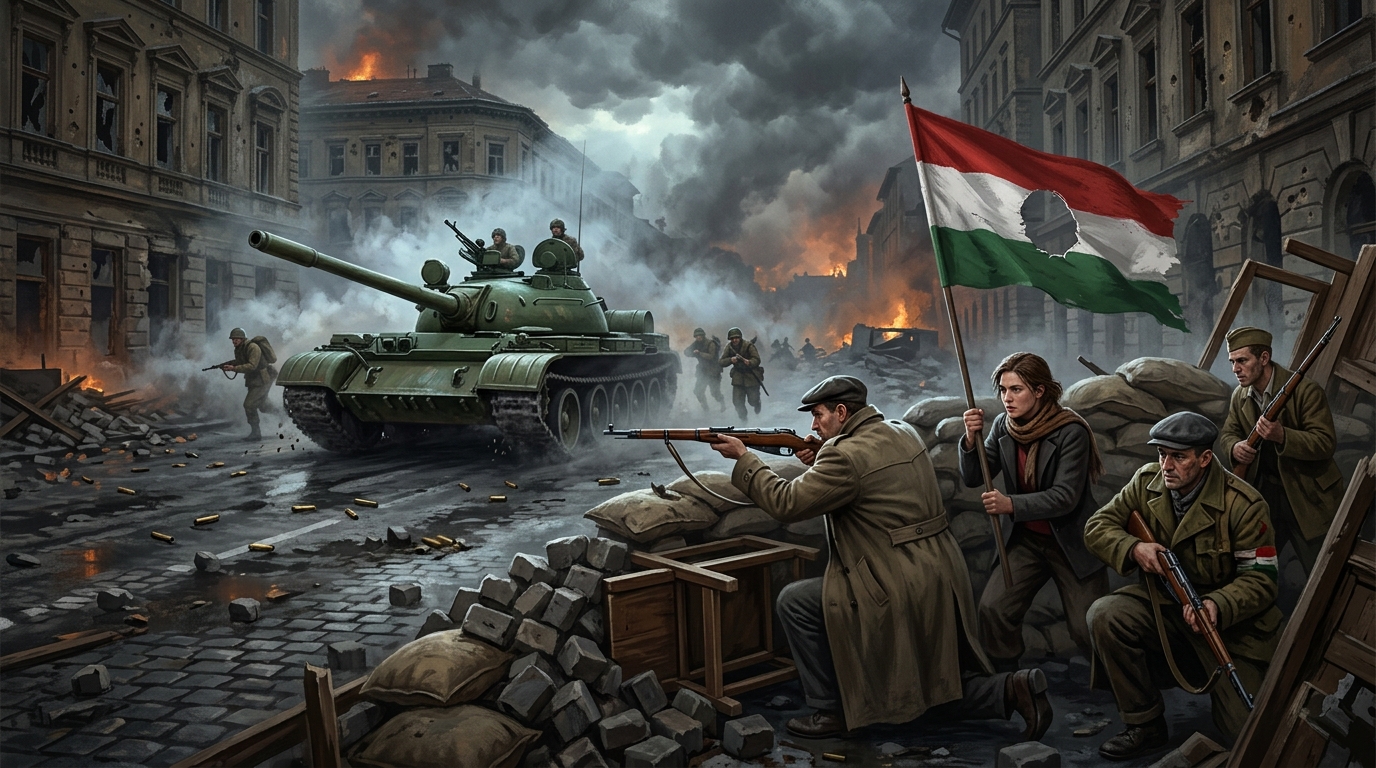
By late afternoon, over 200,000 demonstrators had gathered outside the Parliament building and near the statue of Josef Bem, a Polish general who had fought in the Hungarian Revolution of 1848. The atmosphere was highly charged with nationalist sentiment. Symbols of Soviet domination, such as the communist hammer and sickle, were systematically cut out of the Hungarian flags, leaving a distinctive circular hole that became the emblem of the revolution.
As the sun set, a large crowd gathered at City Park and pulled down the 25-meter-tall Stalin monument, leaving only his bronze boots on the pedestal. Simultaneously, another group of demonstrators marched to the Hungarian Radio building to broadcast their demands. When the ÁVH guards fired into the unarmed crowd, the peaceful protest dissolved into an armed conflict. Workers from the industrial suburbs arrived with weapons seized from local armories and factories, and many Hungarian soldiers dispatched to restore order defected, handing their weapons over to the civilian insurgents.
October 24 – October 28: Escalation and Reform
In a bid to appease the populace, the Central Committee appointed Imre Nagy as Prime Minister in the early hours of October 24. Concurrently, Soviet forces stationed in Hungary were ordered into Budapest to restore order. The arrival of Soviet tanks, however, only served to galvanize the resistance. Street fights erupted across the capital. Utilizing improvised weaponry, such as Molotov cocktails and overturned streetcars as barricades, the "Freedom Fighters" (composed largely of young workers and students) successfully neutralized Soviet armor in the narrow, winding streets of Budapest.
On October 25, a tragic massacre occurred in front of the Parliament building when Soviet tanks and ÁVH forces fired on a peaceful crowd of demonstrators, killing hundreds of civilians. This event, known as the "Bloody Thursday," solidified public hatred for the secret police and pushed the country into full-scale war.
Faced with a nationwide insurrection and the collapse of the state apparatus, Nagy decided to align himself with the popular movement. On October 28, he announced a general ceasefire, declared the uprising to be a "broad democratic national movement" rather than a counter-revolution, and demanded the immediate withdrawal of Soviet troops from Budapest 3.
October 29 – November 3: The Illusion of Freedom
During this brief window of freedom, Soviet forces withdrew from Budapest to nearby airfields, and a sense of euphoria swept through Hungary. Political parties that had been banned since 1948 were re-established, independent newspapers began publication, and the dissolved political police (ÁVH) was officially abolished. The state released thousands of political prisoners, including the revered Cardinal József Mindszenty, who had been imprisoned since 1948.
However, the geopolitical situation changed rapidly. Nikita Khrushchev and the Soviet Presidium initially debated whether to negotiate a peaceful settlement or deploy massive force. The turning point came when Imre Nagy, under immense pressure from the revolutionary councils, announced on November 1 that Hungary was withdrawing from the Warsaw Pact and declaring its absolute neutrality. Nagy appealed directly to the United Nations to guarantee Hungary's sovereignty.
For Moscow, this was an unacceptable breach of the strategic buffer zone established after World War II. Khrushchev, fearing a domino effect that could dismantle Soviet control across Central and Eastern Europe, ordered the military command to prepare for a decisive invasion.
"We should not yield, because it would look like we are weak. We must act quickly and decisively." — Nikita Khrushchev (Soviet Presidium meeting, October 31, 1956)
November 4: Operation Whirlwind
In the pre-dawn hours of November 4, 1956, the Soviet military launched "Operation Whirlwind" (Hadművelet Forgószél), a massive, multi-pronged invasion involving over 17 divisions, 60,000 troops, and 2,500 tanks. At 5:20 AM, Imre Nagy delivered a desperate, dramatic radio address to the nation and the world:
"This is Imre Nagy speaking, the President of the Council of Ministers of the Hungarian People's Republic. In the early hours of this morning, Soviet troops launched an attack against our capital with the obvious intention of overthrowing the lawful, democratic Hungarian government. Our troops are fighting. The government is at its post. I am informing the people of the country and the world of this fact." [[^4]]
The military response was swift and merciless. Under the command of Marshal Ivan Konev, Soviet forces entered Budapest, bypassing the rules of urban engagement by systematically shelling residential buildings, factories, and strongholds where freedom fighters were suspected of hiding. Despite the overwhelming disparity in firepower, Hungarian fighters put up an intense resistance in strongpoints like the Corvin Passage (Corvin Köz) and the industrial district of Csepel.
By November 10, the organized armed resistance was decisively crushed. Nagy and several of his ministers sought political asylum in the Yugoslav Embassy, while Soviet authorities installed János Kádár as the leader of a new "Hungarian Revolutionary Workers'-Peasants' Government."
Geopolitical Consequences and Aftermath
| Category | Metric / Event | Detail / Impact |
|---|---|---|
| Casualties | Hungarian Fatalities | Estimated 2,500 – 3,000 killed, primarily in Budapest. |
| Casualties | Soviet Fatalities | Approximately 700 soldiers killed, 1,200 wounded. |
| Demographics | Refugee Crisis | Over 200,000 Hungarians (approx. 2% of the population) fled to the West. |
| Political Reprisals | Executions & Arrests | 22,900 imprisoned; 341 executed (including Prime Minister Imre Nagy). |
| Global Affairs | Suez Crisis | Concurrent conflict in Egypt distracted Western powers and divided NATO. |
The immediate aftermath of the Hungarian Revolution was marked by severe domestic repression. János Kádár’s new regime, backstopped by Soviet security forces, initiated a wave of reprisals designed to liquidate the revolutionary leadership and terrorize the population into submission. Over 22,000 people were sentenced to prison terms, and hundreds were executed.
Imre Nagy, who had been lured out of the Yugoslav Embassy under a false promise of safe passage by Kádár, was arrested, deported to Romania, and later returned to Budapest for a secret trial. On June 16, 1958, Nagy, military commander Pál Maléter, and journalist Miklós Gimes were executed for treason and buried in unmarked graves in the remote Plot 301 of the New Public Cemetery.
On the international stage, the Hungarian crisis exposed the harsh realities of Cold War geopolitics. The United States, which had spent years broadcasting anti-communist rhetoric through state-funded outlets like Radio Free Europe (RFE) and advocating for the "rollback" of Soviet influence, remained militarily passive. The Eisenhower administration feared that any direct military intervention in Hungary would trigger a nuclear confrontation with the Soviet Union 5.
Furthermore, Western attention was critically divided. On October 29, 1956, Britain, France, and Israel launched a joint military campaign against Egypt to seize control of the Suez Canal. This "Suez Crisis" split the Western alliance, distracted the United Nations Security Council, and provided Khrushchev with a perfect geopolitical cover to crush the Hungarian uprising without fear of a unified, robust Western response.
The suppression of the Hungarian Revolution had a devastating effect on the moral authority of communism globally. Up to this point, many Western intellectuals and political parties had maintained a romanticized view of the Soviet Union. The sight of Soviet tanks rolling through the streets of Budapest, firing on workers and students, shattered these illusions. Western communist parties suffered massive membership defections, and prominent figures, including French philosopher Jean-Paul Sartre, publicly broke with Moscow, condemning the intervention as imperialistic.
Analysis of Key Actors and Decisive Actions
| Political Actor | Primary Objective |
|---|---|
| Nikita Khrushchev | Preservation of Soviet Bloc |
| Imre Nagy | National Sovereignty & Reform |
Relationship: Direct clash of strategic and national interests
The tragedy of the 1956 Hungarian Revolution lies largely in the ideological and strategic incompatibility between two key leaders: Nikita Khrushchev and Imre Nagy.
Imre Nagy: The Reluctant Revolutionary
Imre Nagy was, by all accounts, a dedicated and orthodox communist, but one who believed in "socialism with a human face." He was highly popular among Hungarian peasants due to his role in implementing land reforms after World War II. However, Nagy was not a radical revolutionary by nature; he was a reformer who found himself thrust into the leadership of a spontaneous, radical national uprising.
His decisive actions during the crisis—particularly his declaration of neutrality and withdrawal from the Warsaw Pact—were not part of a pre-planned political strategy. Rather, Nagy was reacting to the rapidly evolving demands of the Hungarian streets. By validating these radical demands, Nagy hoped to maintain control over the situation and prevent further bloodshed. However, in doing so, he crossed a red line that Moscow could not tolerate. Nagy’s ultimate refusal to recant his decisions, even when faced with execution, cemented his status as a national martyr and a symbol of Hungarian independence.
Nikita Khrushchev: The Pragmatic Imperialist
For Nikita Khrushchev, the Hungarian crisis was a severe test of his leadership and the limits of his de-Stalinization policy. Khrushchev’s political survival in Moscow was highly contingent on maintaining the territorial integrity of the Soviet empire. If Hungary were allowed to leave the Warsaw Pact and declare neutrality, it would create a massive breach in the Soviet defense perimeter and invite intense domestic opposition from hardline Stalinists within the Soviet Politburo (such as Vyacheslav Molotov).
Khrushchev’s decision-making process was erratic and deeply influenced by shifting reports from his emissaries in Budapest, Anastas Mikoyan and Mikhail Suslov. Ultimately, Khrushchev prioritized imperial security and geopolitical credibility over his desire to present a peaceful, reformed image of communism to the non-aligned world. The brutal efficiency of the military intervention proved that, despite the rhetoric of the "Khrushchev Thaw," the Soviet Union remained committed to using absolute military force to maintain its hegemony over Eastern Europe.
Trivia and Lesser-Known Facts
- The "Blood in the Water" Match: Just weeks after the revolution was crushed, the Hungarian and Soviet water polo teams faced each other at the 1956 Summer Olympics in Melbourne, Australia. The match was highly charged and violent, culminating in Hungarian player Ervin Zádor being punched in the eye by a Soviet player, leaving the pool colored with blood. Hungary won 4–0 and went on to win the gold medal, while many members of the Hungarian Olympic delegation defected to the West after the games.
- The Empty Boots: After the massive bronze statue of Stalin was pulled down on October 23, the only parts of the monument left standing on the grand pedestal were his giant boots. For the duration of the revolution, Hungarians planted national flags inside the empty boots as a symbol of defiance and a mockery of the cult of personality.
- The Tragedy of Radio Free Europe: In the years following 1956, Radio Free Europe faced severe criticism for its broadcasts during the crisis. Many Hungarian freedom fighters testified that RFE’s Hungarian-language broadcasts had strongly implied that Western military assistance was imminent, encouraging the rebels to keep fighting against impossible odds. Subsequent investigations concluded that while RFE did not explicitly promise military intervention, its highly emotional and supportive rhetoric had indeed created false expectations of Western aid.
- The Role of Khrushchev's Ambassador: The Soviet ambassador to Budapest during the 1956 revolution was Yuri Andropov. The chaos, fear, and ultimate military suppression he witnessed in Budapest deeply traumatized Andropov, shaping his geopolitical outlook. Later, as head of the KGB and eventually as the leader of the Soviet Union in the early 1980s, Andropov’s "Budapest Complex" guided his highly suspicious approach to any form of political liberalization in the Eastern Bloc, including the 1968 Prague Spring and the Polish Solidarity movement.
References and Literature
- Twelve Days: The Story of the 1956 Hungarian Revolution - Victor Sebestyen's highly acclaimed and detailed narrative history of the uprising, utilizing archival sources from Budapest and Moscow.
- Failed Illusions: Moscow, Washington, and the 1956 Hungarian Revolution - Charles Gati's comprehensive geopolitical analysis of the internal and external political maneuvering during the crisis.
- The 1956 Hungarian Revolution: A History in Documents - A detailed primary document collection compiled by the National Security Archive, detailing the internal deliberations of the Soviet Presidium and Western governments.
- The Suez Crisis and the Hungarian Revolution - An archival article in Foreign Affairs analyzing the strategic overlap and geopolitical paralysis caused by the concurrent crises of 1956.
Footnotes & Explanations
- See Victor Sebestyen, Twelve Days: The Story of the 1956 Hungarian Revolution (New York: Pantheon Books, 2006), pp. 12-24, for an in-depth exploration of Rákosi's rise to power and his implementation of Soviet-style terror. ↩
- Charles Gati, Failed Illusions: Moscow, Washington, and the 1956 Hungarian Revolution (Stanford: Stanford University Press, 2006), pp. 43-55, discusses the political rivalry between Rákosi and Imre Nagy and the ideological battles of the mid-1950s. ↩
- National Security Archive, The 1956 Hungarian Revolution: A History in Documents (Budapest: Central European University Press, 2002), Document No. 42: "Nagy's Radio Address of October 28, 1956." ↩
- The transcript of Imre Nagy’s final radio address is preserved in the Hungarian National Archives and has been widely translated; see also the BBC Historical Archives for contemporary audio recordings. ↩
- For an analysis of the United States' policy of "rollback" versus the reality of "containment" during the Eisenhower administration, see Gati, Failed Illusions, pp. 135-150. ↩