Key Takeaways
- The crisis was sparked by Taiwanese President Lee Teng-hui's unofficial visit to Cornell University in 1995, which Beijing viewed as a violation of the One-China principle.
- China conducted a series of ballistic missile tests and live-fire military exercises in the waters surrounding Taiwan to intimidate voters ahead of the island's first direct presidential election in March 1996.
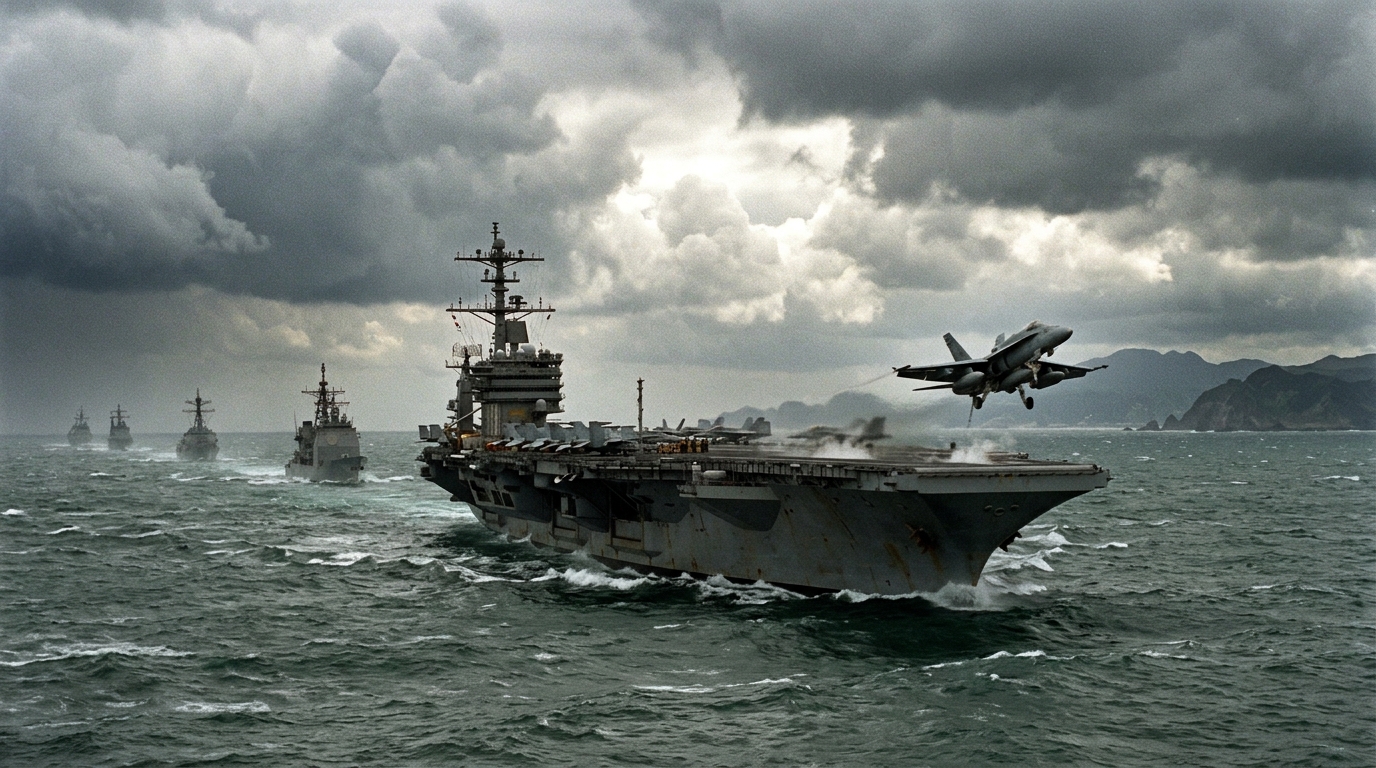
- The United States responded by deploying two aircraft carrier battle groups to the region, representing the largest display of American military projection in East Asia since the Vietnam War.
Historical Context and Origins
The Third Taiwan Strait Crisis (1995–1996) occurred at a critical geopolitical juncture in the post-Cold War era. Following the collapse of the Soviet Union, the global balance of power shifted dramatically, leaving the United States as the sole superpower. Concurrently, the domestic political landscapes of both the People’s Republic of China (PRC) and the Republic of China (ROC, commonly known as Taiwan) were undergoing profound transformations. These shifting dynamics, combined with Washington's delicate policy of "strategic ambiguity," created the conditions for a dangerous military standoff in the waters separating mainland China from Taiwan.
[United States] <--- Strategic Ambiguity ---> [PRC (Beijing)] \ / \ / Taiwan Relations Act One-China Principle \ / \ / v v [Taiwan (Taipei / ROC)] Democratization (1990s) Lee Teng-hui's Pragmatic Diplomacy
To understand the crisis, one must trace the evolution of cross-strait relations and Taiwan's internal political reforms. For decades following the end of the Chinese Civil War in 1949, Taiwan was ruled under martial law by the authoritarian Kuomintang (KMT) regime. This changed in the late 1980s and early 1990s under the leadership of President Lee Teng-hui, Taiwan’s first native-born president. Lee embarked on an ambitious program of democratization, dismantling the autocratic structures of the KMT state and fostering a distinct Taiwanese identity. 1
This domestic democratization was accompanied by what Lee termed "pragmatic diplomacy" (wuxishi waijiao). Recognizing that Taiwan was increasingly isolated internationally due to Beijing's insistence on the "One-China principle," Lee sought to expand Taiwan's informal diplomatic space. He pursued "vacation diplomacy" and transit visits to build ties with Western democracies, a strategy that deeply alarmed Beijing. The Chinese leadership, headed by General Secretary Jiang Zemin, feared that democratization and pragmatic diplomacy were structural precursors to formal Taiwanese independence.
For Beijing, Taiwan was—and remains—a sacred, non-negotiable territory. The Chinese Communist Party (CCP) viewed any international recognition of Taiwan's government as an existential threat to its own domestic legitimacy and territorial integrity. In January 1995, Jiang Zemin issued an eight-point proposal offering cross-strait negotiations on the condition that Taiwan accept the One-China principle. President Lee responded in April 1995 with a six-point counterproposal that emphasized Taiwan's de facto sovereignty and demanded that Beijing renounce the use of force.
The spark that ignited this dry tinder came from the United States. Since normalizing relations with Beijing in 1979, US policy had been governed by the Taiwan Relations Act (TRA) and the Three Joint Communiqués. This framework sought to balance relations with the PRC while maintaining unofficial cultural and commercial ties with Taiwan. In early 1995, President Lee Teng-hui was invited by his alma mater, Cornell University, to deliver a speech.
Initially, the Clinton administration assured Beijing that it would not grant Lee a visa, fearing the diplomatic fallout. However, a bipartisan coalition in the US Congress, driven by Taiwan’s democratic achievements and a growing skepticism toward Beijing’s human rights record following the 1989 Tiananmen Square crackdown, pressured the administration. In May 1995, both the House of Representatives and the Senate passed near-unanimous resolutions demanding that Lee be allowed to enter the United States. Confronted by overwhelming legislative pressure, President Bill Clinton reversed his administration's position and granted Lee a visa for an unofficial private visit. 2
Timeline of Events and Key Moments
The crisis unfolded in distinct phases, beginning with diplomatic protests, escalating to live-fire missile tests, and culminating in a major naval confrontation involving the US Navy.
| Date | Event | Details |
|---|---|---|
| 1995 | ||
| Jun | Lee Teng-hui visits Cornell University | Beijing declares a violation of the One-China principle. |
| Jul–Nov | PLA Missile Wave I & Amphibious Drills | DF-15 missiles launched near Taiwan; military maneuvers in Fujian. |
| Dec | US Navy Sends Initial Response | USS O'Brien transits the Taiwan Strait. |
| 1996 | ||
| Mar | PLA Missile Wave II & US Carrier Deployment | Ballistic missiles bracket Keelung and Kaohsiung ports; Clinton deploys USS Independence & USS Nimitz CSGs. |
| Mar 23 | Taiwan's First Democratic Presidential Election | Lee Teng-hui wins; PLA exercises end. |
The Catalyst: June 1995
In June 1995, Lee Teng-hui arrived in Ithaca, New York. On June 9, he delivered a speech at Cornell University titled "Always in My Heart," in which he praised Taiwan's democratic transition and explicitly referred to the Republic of China on Taiwan as a sovereign democratic entity.
"We are ready to accept the challenge of the future... We hope the international community will treat us with justice and respect, and not ignore the existence of the 21 million people on the Republic of China on Taiwan." — President Lee Teng-hui, Cornell University, June 9, 1995.
Beijing reacted with intense fury. The PRC recalled its ambassador to Washington, halted high-level military dialogues, and suspended cross-strait talks. The Chinese leadership perceived the visit as a coordinated effort by Washington and Taipei to breach the foundational understandings of US-PRC relations.
The First Phase: July–November 1995
To signal its resolve and deter what it saw as a drift toward independence, the People's Liberation Army (PLA) initiated a series of military exercises and missile tests in July 1995.
- July 21–26, 1995: The PLA launched a series of DF-15 (CSS-6) short-range ballistic missiles into targeting areas just 35 to 45 miles north of Taiwan. The tests effectively disrupted commercial aviation and shipping routes in the East China Sea.
- August 1995: The PLA conducted live-fire naval exercises and amphibious landing drills in coastal Fujian province, simulating an invasion of Taiwanese islands.
- November 1995: On the eve of Taiwan's legislative elections, the PLA conducted further large-scale combined-arms exercises, utilizing amphibious assault vehicles, fighter jets, and naval vessels to project maximum psychological pressure on the Taiwanese electorate.
The Clinton administration responded cautiously, urging both sides to avoid provocative actions, while quietly warning Beijing that any attempt to resolve the issue by force would have grave consequences. In December 1995, the US deployed the destroyer USS O'Brien and transit elements through the Taiwan Strait to signal its monitoring capabilities, though this was downplayed as a routine passage.
The Second Phase: March 1996
The crisis reached its peak in March 1996, in the weeks leading up to Taiwan's first-ever direct democratic presidential election, scheduled for March 23. Beijing sought to intimidate Taiwanese voters into rejecting Lee Teng-hui and the KMT, warning that a vote for Lee was a vote for war.
| Location / Zone | Description |
|---|---|
| Taiwan Strait | Central waterway |
| Keelung Target Zone | PLA missile impact area (North) |
| Mainland China | Location of PLA missile bases |
| Taiwan Island | Includes Taipei and Kaohsiung |
| Kaohsiung Target Zone | PLA missile impact area (South) |
- March 8–15, 1996: The PLA launched a second round of ballistic missiles. Crucially, these missiles were fired into target zones located just 19 miles off the northeast port of Keelung and 28 miles off the southwest port of Kaohsiung. This maneuver effectively bracketed the island, creating a de facto shipping blockade of Taiwan's two largest commercial ports. [[^3]]
- March 12–25, 1996: The PLA conducted massive live-fire air and naval exercises near the Penghu Islands in the southern Taiwan Strait, involving over 150,000 troops, dozens of naval vessels, and hundreds of combat aircraft.
The US Response: Carrier Diplomacy
Recognizing that the situation was spiraling toward potential miscalculation, President Clinton, on the advice of Secretary of Defense William Perry and National Security Advisor Anthony Lake, authorized a massive show of US military force.
On March 10, 1996, the United States announced the deployment of the USS Independence (CV-62) Carrier Battle Group, which was stationed in Japan, to the waters east of Taiwan.
To reinforce this deployment, the Pentagon dispatched the USS Nimitz (CVN-68) Carrier Battle Group from its deployment in the Persian Gulf. By mid-March, two US aircraft carriers, accompanied by an armada of cruisers, destroyers, submarines, and support ships, were operating in the vicinity of Taiwan. This was the largest concentration of US naval power in the Asia-Pacific region since the Vietnam War. 4
The presence of the US carrier groups sent an unambiguous message: the United States possessed unmatched military dominance and would not permit the unilateral, forcible subjugation of Taiwan. The PLA, lacking modern radar tracking, advanced anti-ship missiles, or a blue-water navy capable of contesting two US supercarriers, was forced to observe the American deployment from a distance.
De-escalation: Late March 1996
On March 23, 1996, Taiwan held its historic presidential election. Defying Beijing's threats, Taiwanese voters turned out in high numbers. Lee Teng-hui won a decisive victory, capturing 54% of the popular vote in a four-way race.
Having failed to deter the election or swing the electorate toward pro-Beijing candidates, and facing an overwhelming US naval presence, Beijing ended its military exercises shortly after the vote. The carrier battle groups slowly withdrew, and the crisis subsided.
Geopolitical Consequences and Aftermath
The Third Taiwan Strait Crisis had profound, long-lasting consequences for regional security, US-China relations, and the military strategies of all three parties involved.
Taiwan's Identity and Democratic Consolidation
Rather than intimidating Taiwan, Beijing's belligerence consolidated a distinct Taiwanese identity and strengthened its democratic resolve. The crisis demonstrated to the Taiwanese public that democratic practices and military security were deeply intertwined. In the years following 1996, public opinion polls in Taiwan showed a steady decline in support for immediate unification with the mainland and a growing consensus around maintaining the status quo, alongside a rising sense of "Taiwanese" identity as distinct from "Chinese" identity.
The Transformation of the PLA: The Rise of A2/AD
For the Chinese leadership, the crisis was a humiliating reminder of their military inferiority. The ease with which the United States projected power close to China's coast exposed the PLA's structural vulnerabilities. Chinese strategists realized that in a cross-strait conflict, they could not prevent US intervention using their existing arsenal.
This realization catalyzed a massive, decades-long modernization program designed specifically to counter US naval projection. The crisis gave birth to China's Anti-Access/Area-Denial (A2/AD) doctrine. 5 Beijing redirected defense resources toward:
- Developing high-precision, long-range anti-ship ballistic missiles (ASBMs), such as the DF-21D (often dubbed the "carrier killer").
- Procuring advanced conventional submarines (including Kilo-class vessels from Russia) and modern surface combatants equipped with advanced air-defense systems.
- Acquiring modern fighter jets (such as the Su-27 and Su-30) and developing domestic stealth aircraft.
- Expanding cyberwarfare, electronic warfare, and counter-space capabilities to disrupt US command-and-control networks.
| Entity | Relationship | Entity |
|---|---|---|
| U.S. Carrier Battle Group | Target of A2/AD Network | PLA Modernized Forces |
- PLA Modernized Forces
US Strategic Realignment and the Shift to "Strategic Clarity"
For the United States, the crisis demonstrated that the Taiwan Strait remained one of the world's most dangerous flashpoints. While "strategic ambiguity" remained the official policy, the crisis forced Washington to deepen its tacit security cooperation with Taiwan. It also highlighted the critical importance of regional alliances, leading to the 1997 revision of the US-Japan Defense Guidelines, which expanded Japan's logistical role in supporting US forces during regional contingencies.
The table below summarizes the strategic posture shifts of the three primary actors before and after the 1995-1996 crisis:
| Actor | Pre-Crisis Posture (Early 1990s) | Post-Crisis Posture (Late 1990s–Present) |
|---|---|---|
| China (PRC) | Focused on economic reform; limited regional power projection; relied on obsolete Soviet-era military hardware. | Accelerated military modernization; prioritized A2/AD capabilities to deter US carrier operations; heightened focus on amphibious warfare. |
| Taiwan (ROC) | Transitioning from authoritarian KMT rule; seeking international legitimacy through informal diplomacy; defense centered on air superiority. | Consolidated democracy; professionalized military forces; focused on defensive asymmetric capabilities and political resilience. |
| United States | Post-Cold War triumphalism; assumed China’s economic rise would lead to liberalization; maintained flexible strategic ambiguity. | Re-emphasized alliance networks (particularly with Japan); initiated long-term planning for high-intensity maritime conflicts in Asia. |
Analysis of Key Actors and Decisive Actions
The dynamics of the crisis were shaped by the calculated decisions, domestic pressures, and misperceptions of three key leaders.
| Key Figure | Strategy/Context |
|---|---|
| Bill Clinton | Deterrence / Sovereign (Engages via Pragmatic Diplomacy and Naval Diplomacy) |
| Lee Teng-hui | Democratic Mandate |
| Jiang Zemin | Sovereignty / WTO goal |
- Bill Clinton (Deterrence/Sovereign)
- Lee Teng-hui (Democratic Mandate) ↔ Jiang Zemin (Sovereignty/WTO goal)
Lee Teng-hui: The Strategist of Democratic Legitimacy
President Lee Teng-hui operated with a sophisticated understanding of both international and domestic politics. He recognized that Taiwan’s greatest defense against PRC aggression was its democratic legitimacy. By shifting the selection of the president from the National Assembly to a direct popular vote, Lee transformed Taiwan’s status from a disputed territorial remnant of the Chinese Civil War into a self-determining democratic polity.
His Cornell visit was a calculated gamble. While it risked provoking Beijing, it successfully compelled the United States to reaffirm its security commitments under the Taiwan Relations Act. Lee’s cool demeanor during the crisis—famously telling the Taiwanese public that the PLA's missiles were loaded with "blank warheads"—helped prevent panic and solidified his image as a steady leader, securing his landslide electoral victory.
Jiang Zemin: Balancing Nationalism and Modernization
For Jiang Zemin, the crisis was a major test of his leadership. Having assumed the position of General Secretary after the Tiananmen crisis, Jiang needed to secure the loyalty of the PLA high command, which was dominated by hardline nationalists. A weak response to Lee Teng-hui's Cornell visit would have severely undermined his position within the party hierarchy.
However, Jiang also understood that China’s long-term rise depended on economic modernization and integration into the global economy, including its bid to join the World Trade Organization (WTO). Therefore, Jiang’s strategy was one of calibrated coercion:
- He authorized high-visibility military exercises to appease the PLA and signal political resolve.
- He carefully limited the duration and geographical scope of the missile tests to avoid provoking a direct military conflict with the United States.
Once the US carriers arrived, Jiang recognized that further escalation would be counterproductive, choosing to claim domestic success in "warning" Taiwan while de-escalating military operations.
Bill Clinton: From Ambiguity to Decisive Deterrence
The Clinton administration initially mismanaged the lead-up to the crisis by assuring Beijing that Lee Teng-hui would not receive a visa, only to reverse course under domestic political pressure. This mixed signaling led Beijing to believe that Washington was duplicitous, while encouraging Taipei to push the boundaries of US support.
However, when the crisis peaked in March 1996, President Clinton demonstrated decisive leadership. By deploying two carrier battle groups, Clinton executed a classic example of gunboat diplomacy updated for the late 20th century. The deployment restored the credibility of the US deterrent and showed that while Washington did not support formal Taiwanese independence, it would not tolerate the use of force to alter the status quo. This deployment restored a temporary equilibrium to the Taiwan Strait, though it set the stage for a much more challenging security environment in the decades to follow.
Trivia and Lesser-Known Facts
- The Spy Who Saved the Strait: The Taiwanese government's ability to remain calm during the missile tests was largely due to a highly placed double agent within the PLA. Major General Liu Liankun, a senior logistics officer in the Chinese military, provided Taiwanese intelligence with critical details about the missile tests, confirming that the DF-15 missiles carried dummy, non-nuclear warheads and that Beijing had no actual plans to launch an invasion. Liu was unmasked by Beijing in 1999 and executed for treason. [[^6]]
- The Weather Factor: During the March 1996 exercises, the Taiwan Strait was hit by exceptionally poor weather, including rough seas and high winds. This made the PLA’s simulated amphibious landings extremely difficult, highlighting to Chinese commanders how unready they were for a real cross-strait invasion under adverse conditions.
- The Carrier's Silent Companion: While the USS Independence and USS Nimitz were highly visible, the US Navy also deployed at least one nuclear-powered attack submarine (SSN) directly into the Taiwan Strait. This submarine mapped Chinese naval movements and remained undetected by PLA anti-submarine warfare (ASW) assets, demonstrating absolute American undersea dominance.
- The "Secret" Meeting: In the midst of the crisis, National Security Advisor Anthony Lake met secretly with Liu Huaqiu, the director of the Chinese State Council's Foreign Affairs Office, in a secure location in Virginia. This backchannel allowed the US to clearly explain the defensive nature of the carrier deployments, preventing miscalculations that could have led to war.
References and Literature
- The Taiwan Strait Crisis of 1995-1996: Strategic Implications - An in-depth academic analysis of the military maneuvers and strategic assessments of both the US and China during the crisis.
- The Third Taiwan Strait Crisis and Its Aftermath - Foreign Affairs article detailng the intersection of Taiwan's democratic transition and US-PRC diplomatic relations.
- Showdown in the Taiwan Strait: 1995-1996 - Detailed operational timeline of the US carrier deployments and PLA missile tests.
- The Spy Who Told Taiwan Beijing’s Missiles Were Blank - BBC News report on the intelligence operations of Major General Liu Liankun and the espionage history of the crisis.
Footnotes & Explanations
- For a comprehensive account of Taiwan's democratic transition, see Taiwan's Democratization: Forces Behind the New Momentum (1997). ↩
- See the US House Resolution 141 (1995), which urged the administration to welcome President Lee Teng-hui. ↩
- Global Security Archive: Operational Details of the 1996 Missile Exercises. ↩
- U.S. Navy Historical Center: Aircraft Carrier Deployments in the Western Pacific (1995-1996). ↩
- See Department of Defense Office of the Secretary: Military and Security Developments Involving the People's Republic of China (Annual Reports). ↩
- Intelligence History Journal: The Liu Liankun Espionage Case and its Impact on Cross-Strait Intelligence Operations. ↩