Key Takeaways
- The fall of the Srebrenica enclave exposed the structural and operational paralysis of the United Nations Protection Force (UNPROFOR) and its 'Safe Area' mandate.
- Over 8,000 Bosniak men and boys were systematically executed by the Army of Republika Srpska (VRS) under the command of General Ratko Mladić.
- The massacre was legally classified as genocide by both the ICTY and the ICJ, fundamentally shaping post-Cold War international humanitarian law and NATO's intervention strategy.
Historical Context and Origins
The Srebrenica massacre of July 1995 was not an isolated outburst of ethnic violence, but rather the calculated culmination of a long-running geopolitical strategy. To understand how a United Nations-designated "Safe Area" became the site of the worst mass murder on European soil since World War II, one must examine the disintegration of the Socialist Federal Republic of Yugoslavia and the strategic imperatives of the Bosnian Serb leadership.
With Bosnia and Herzegovina’s declaration of independence in March 1992, following a referendum boycotted by most Bosnian Serbs, the country descended into a brutal war. The Serb political leadership, headed by Radovan Karadžić, and supported by the Yugoslav People's Army (JNA) and Serbian President Slobodan Milošević, aimed to carve out a contiguous Serb-dominated state. This self-proclaimed entity, the Republika Srpska, sought direct territorial connection with Serbia proper.
The Strategic Value of Eastern Bosnia
Eastern Bosnia, particularly the Drina River Valley, was of paramount strategic importance to the Serbian leadership. Historically, the region had a majority Bosniak (Bosnian Muslim) population, which interrupted the territorial continuity between Serbia and the Serb-controlled areas of Bosnia. In May 1992, the assembly of the Republika Srpska adopted the "Six Strategic Goals of the Serbian People." The third of these goals explicitly called for:
"The eradication of the Drina River as a border between Serbian states." [^1]
To achieve this, the Army of Republika Srpska (VRS), commanded by General Ratko Mladić, launched a campaign of systematic ethnic cleansing. Towns along the Drina—such as Foča, Višegrad, and Zvornik—fell rapidly to Serb forces, characterized by mass expulsions, executions, and systematic sexual violence. Bosniak survivors fled into localized enclaves, the largest of which was Srebrenica.
The Creation of the "Safe Area"
By early 1993, Srebrenica was a besieged pressure cooker. The enclave's population had swollen from 37,000 to over 55,000 due to the influx of refugees. Cut off from food, clean water, and medical supplies, the town faced a severe humanitarian catastrophe. Bosniak forces within the enclave, led by Naser Orić, conducted desperate counter-raids on surrounding Serb villages to secure food and weapons, actions that further inflamed the hostility of the besieging Serb forces.
In March 1993, French General Philippe Morillon, commander of the United Nations Protection Force (UNPROFOR), visited Srebrenica. Confronted by thousands of desperate refugees, he famously declared to the crowd:
"You are now under the protection of the United Nations... I will never abandon you." [^2]
This symbolic act forced the UN's hand. On April 16, 1993, the UN Security Council passed Resolution 819, declaring Srebrenica and its surroundings a "safe area" free from armed attacks. A subsequent agreement between the warring factions stipulated that Srebrenica would be demilitarized. However, the demilitarization was deeply flawed; while the Bosniak Army of the Republic of Bosnia and Herzegovina (ARBiH) handed over their heavy weapons, they retained light arms, and the VRS never withdrew its heavy artillery from the surrounding heights.
Timeline of Events and Key Moments
The tragedy of July 1995 was preceded by months of deliberate strangulation. In March 1995, Radovan Karadžić issued "Directive 7," a document that laid bare the political intent of the Republika Srpska command. The directive instructed the Drina Corps of the VRS to:
"...complete the physical separation of Srebrenica from Žepa as soon as possible, preventing even communication between individuals in the two enclaves. By planned and well-thought-out combat operations, create an unbearable situation of total insecurity with no hope of further survival or life for the inhabitants of Srebrenica." [^3]
The Fall of the Enclave (July 6–11, 1995)
By mid-1995, the UN peacekeeping presence in Srebrenica consisted of "Dutchbat III," a battalion of approximately 400 Dutch soldiers under the command of Lieutenant Colonel Thom Karremans. Dutchbat was poorly equipped, short on fuel and ammunition, and strategically isolated due to Serbian restrictions on UN supply convoys.
- July 6: The VRS, launching Operation Krivaja 95, began shellfire on the southern edges of the enclave.
- July 8: Dutchbat observation posts began to fall or surrender. When a Dutch armored vehicle retreated under fire, a local Bosniak crowd attempted to block its path, resulting in the death of a Dutch soldier, Raviv van Renssen, who was killed by a hand grenade thrown by a Bosniak refugee who feared the peacekeepers were abandoning them.
- July 9: The VRS advanced rapidly, encountering minimal resistance. Karremans repeatedly requested NATO close air support (CAS), but his requests were bogged down in the complex UN bureaucratic "dual-key" command chain, which required approval from both UN military commanders and political officials, including Yasushi Akashi, the Special Representative of the Secretary-General.
- July 10: Over 10,000 refugees fled north toward the main Dutchbat base in Potočari, just outside the town of Srebrenica.
- July 11: At 14:30, two Dutch F-16 fighters finally conducted limited airstrikes on VRS positions, destroying a tank. However, Mladić threatened to shell the Dutch base and execute the Dutch hostages his forces had captured. The airstrikes were halted. By 16:30, Ratko Mladić, accompanied by Serb television crews, entered the empty streets of Srebrenica.
Chronology of the Fall & Massacre
- July 6-9: VRS launches "Krivaja 95"
- July 11: Fall of Srebrenica Town
- July 12-13: Separation and Deportation
- July 13-17: Systematic Mass Executions
The Terror at Potočari and the Column of Hope (July 12–13)
By the evening of July 11, approximately 25,000 Bosniak refugees, mostly women, children, and the elderly, had gathered around the Dutchbat headquarters in Potočari. Simultaneously, fearing immediate slaughter, a column of between 10,000 and 15,000 Bosniak men and teenage boys assembled in the nearby village of Šušnjari. They attempted to break through the Serb lines on foot through the rugged forests toward Tuzla, a journey of over 100 kilometers through hostile territory. This column became known as the "Column of Death" or the "Column of Hope."
On July 12, VRS troops entered the Potočari compound. Mladić sought to present a benign image to the cameras, distributing sweets to children and promising safety. Behind the scenes, the operation of systematic separation began. Serb forces separated all males between the ages of 12 and 77 from the women and children. The women and children were loaded onto buses and deported to Bosnian government-controlled territory. The separated men were taken to temporary detention sites in nearby Bratunac.
Meanwhile, the column fleeing through the woods was relentlessly ambushed by VRS artillery, anti-aircraft guns, and infantry. Hundreds were killed in the initial ambushes; thousands of others, disoriented, dehydrated, and suffering from hallucinations, surrendered to Serb troops who wore stolen UN uniforms and used captured UN vehicles to lure them out of the forests.
The Executions (July 13–17)
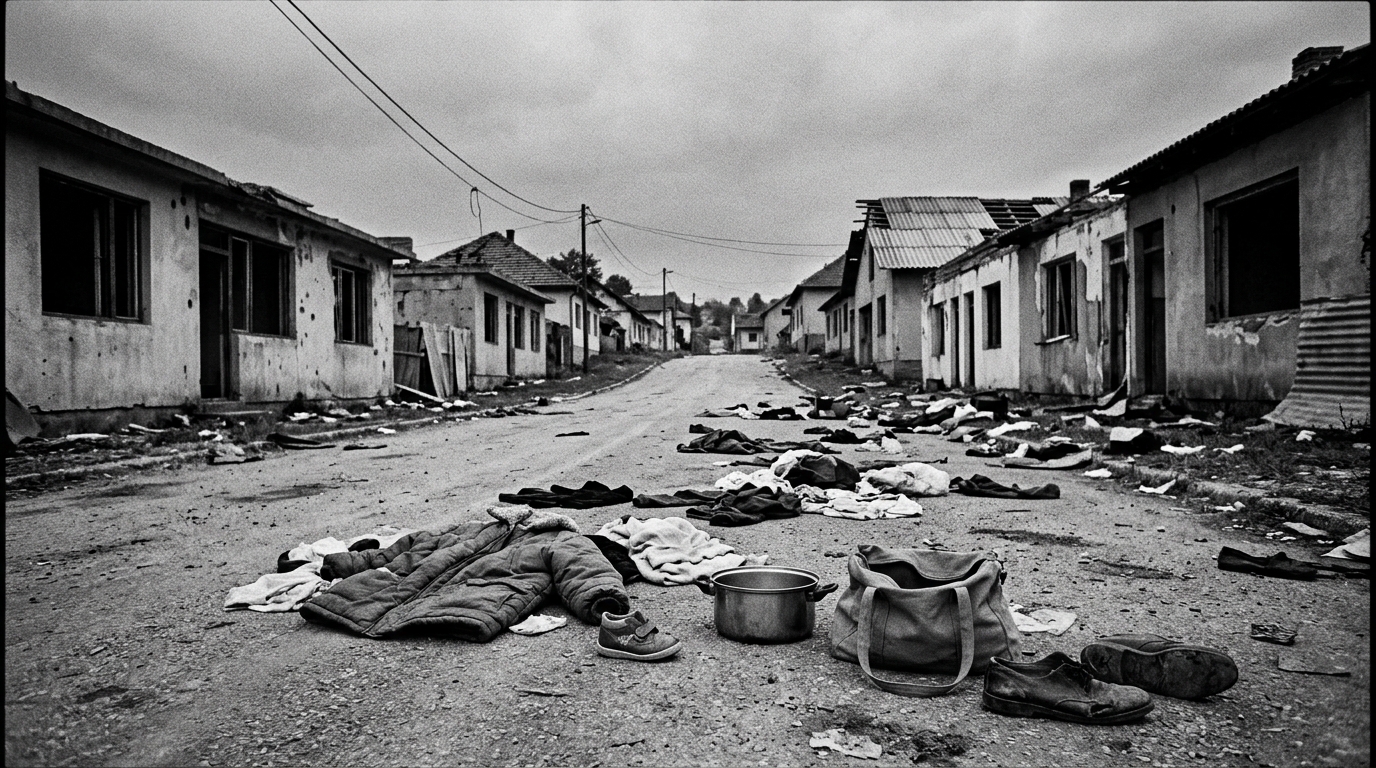
The systematic slaughter of the captured men and boys began on July 13 and was executed with industrial precision. The detainees were transported in overcrowded trucks and buses to various detention sites north of Srebrenica, primarily in the Zvornik municipality. These included schools, gymnasiums, warehouses, and open fields.
- Kravica Warehouse: On July 13, in a warehouse in the village of Kravica, between 1,000 and 1,500 Bosniak prisoners were packed inside. Following an incident in which a prisoner allegedly killed a Serb guard, VRS soldiers opened fire with automatic weapons and threw hand grenades into the building, leaving no survivors.
- Orahovac, Kozluk, and Branjevo Military Farm: Over the next four days, thousands of men were blindfolded, had their hands tied behind their backs, and were transported to remote execution fields. At the Branjevo Military Farm, members of the 10th Sabotage Detachment of the VRS executed approximately 1,200 Bosniaks. Executioners worked in shifts, using automatic rifles to shoot victims in the back of the head before dumping their bodies into pre-dug mass graves.
By July 17, more than 8,000 Bosniak men and boys had been executed.
Map of Primary Execution Sites
- Srebrenica Enclave
Geopolitical Consequences and Aftermath
The Srebrenica massacre was a watershed moment in late 20th-century geopolitics. It shattered the illusion of "peacekeeping" in active conflict zones where there was no peace to keep, and forced a profound reassessment of the international community's security architecture.
The Collapse of UNPROFOR and the Rise of NATO
The failure of the UN in Srebrenica laid bare the structural weaknesses of the organization's peacekeeping capabilities. The "Safe Area" concept, implemented without the military means to defend it, was revealed as a hollow promise. In the words of the 1999 UN report on Srebrenica, written by Secretary-General Kofi Annan:
"Through error, misjudgment and an inability to recognize the scope of the evil confronting us, we failed to do our part to help save the people of Srebrenica from the Serb campaign of mass murder." [^4]
The tragedy catalyzed a massive geopolitical shift. The United States, which had previously resisted direct military involvement on the ground, seized the diplomatic and military initiative. The "dual-key" system that had paralyzed NATO air power was effectively abolished.
Following another Serb mortar attack on the Sarajevo Markale market in August 1995, NATO launched Operation Deliberate Force. This intensive, three-week-long bombing campaign targeted VRS air defense networks, command structures, and heavy weapons positions. Combined with a successful ground offensive by joint Croatian and Bosniak forces in western Bosnia, the military balance of power was permanently altered, forcing Slobodan Milošević and the Bosnian Serb leadership to the negotiating table.
| Bosnia and Herzegovina |
|---|
| Federation of BiH (Bosniak/Croat Majority) |
| Republika Srpska (Serb Majority) |
The Dayton Accords and the Partition of Bosnia
The war was brought to an end by the General Framework Agreement for Peace in Bosnia and Herzegovina, negotiated in Dayton, Ohio, in November 1995. While the Dayton Accords preserved the external borders of Bosnia and Herzegovina, they effectively partitioned the country internally into two highly autonomous entities: the Bosniak-Croat Federation of Bosnia and Herzegovina and the Serb-run Republika Srpska.
Paradoxically, Srebrenica—the site of the genocide—was incorporated into the territory of the Republika Srpska. This political compromise left deep scars, as returning Bosniak survivors had to live under the administration of the very entity that had orchestrated their displacement and the murder of their families.
Judicial Reckoning and International Law
The pursuit of justice for Srebrenica profoundly advanced the development of international criminal law. The International Criminal Tribunal for the former Yugoslavia (ICTY), established by the UN in 1993, spent decades prosecuting the architects of the massacre.
- The Krstić Case (2001): The ICTY ruled for the first time that the crimes committed in Srebrenica constituted genocide. Major General Radislav Krstić, commander of the VRS Drina Corps, was convicted of aiding and abetting genocide.
- The International Court of Justice (ICJ) Ruling (2007): In the case Bosnia and Herzegovina v. Serbia and Montenegro, the ICJ ruled that the acts committed in Srebrenica constituted genocide. It concluded that while Serbia (the Federal Republic of Yugoslavia) was not directly responsible for committing the genocide, it had violated international law by failing to prevent it and by failing to punish the perpetrators.
- The Convictions of Karadžić and Mladić: After years in hiding, both Radovan Karadžić (captured in 2008) and Ratko Mladić (captured in 2011) were sentenced to life imprisonment by the ICTY for genocide, war crimes, and crimes against humanity.
Analysis of Key Actors and Decisive Actions
The Srebrenica tragedy cannot be understood without examining the interplay between local executioners, regional state sponsors, and the paralyzed international community.
| Actor | Key Responsibility / Action | Geopolitical Motivation |
|---|---|---|
| Ratko Mladić | Commander of the VRS; operational designer of the massacre. | Creation of an ethnically homogeneous "Greater Serbia" by erasing Bosniak presence along the Drina. |
| Radovan Karadžić | President of Republika Srpska; issued Directive 7. | Securing political sovereignty for Bosnian Serbs; eliminating enclaves that split Serbian territory. |
| Slobodan Milošević | President of Serbia; provided financial, military, and logistical support to the VRS. | Balancing domestic nationalist pressures while seeking to lift international sanctions against Yugoslavia. |
| Thom Karremans | Commander of Dutchbat III; surrendered control of the enclave. | Protecting his lightly armed, abandoned peacekeepers; operational survival under siege conditions. |
| Bernard Janvier | UNPROFOR Military Commander; repeatedly delayed airstrikes. | Preserving UN "neutrality"; fearing hostage retaliation against French and British troops. |
The Role of Slobodan Milošević
While Milošević sought to distance himself from the actions of the Bosnian Serb leadership in 1995 to secure the lifting of international sanctions, evidence presented at the ICTY demonstrated that the VRS was heavily dependent on Belgrade. The salaries of VRS officers, including Mladić, were paid by Yugoslavia, and Belgrade provided fuel, ammunition, and intelligence. Milošević's tactical pivot at Dayton allowed him to present himself as a peacemaker, yet his initial fueling of nationalist rhetoric and material support created the conditions under which the genocide could occur.
The UN and Dutchbat: Strategic Paralysis
The Dutch peacekeepers of Dutchbat III found themselves in an impossible position, but their conduct remains a subject of intense controversy. Confronted by Mladić's aggressive demands, Colonel Karremans was filmed drinking toast with the Serb general, a picture that came to symbolize the humiliation of the UN.
More critically, when Dutchbat organized the evacuation of their own troops, they assisted the Serbs in separating the refugees, and in some instances, handed over Bosniaks who had sought refuge inside the Dutch base, believing Mladić's assurances of safe transit. In 2019, the Supreme Court of the Netherlands ruled that the Dutch state bore "very limited liability" (estimated at 10% liability) for the deaths of some 350 Bosniak men who were expelled from the Dutch base on July 13, 1995. 5
Trivia and Lesser-Known Facts
- The Lost Photos of Dutchbat: During the fall of the enclave, several Dutch soldiers took photographs documenting the conditions, the separation of men, and the initial presence of VRS troops in Potočari. When the film was sent to a military laboratory in the Netherlands for processing, it was reportedly destroyed by a development error (overdevelopment). This led to decades of conspiracy theories regarding a potential cover-up by the Dutch military, though subsequent investigations concluded it was a genuine accident.
- The Secondary Mass Graves: To cover up the scale of the massacre in the face of growing international pressure, the VRS launched a systematic cover-up operation in the autumn of 1995. Using heavy machinery, they exhumed thousands of bodies from the primary mass graves and transferred them to dozens of "secondary" and "tertiary" graves in highly remote areas. As a result, bodies were torn apart, and forensic teams from the International Commission on Missing Persons (ICMP) often had to use DNA analysis to match bones of a single individual found in graves located miles apart.
- The "Scorpions" Video: For years, the Serbian public was largely skeptical of the scale of the Srebrenica massacre, often viewing reports as Western anti-Serb propaganda. This changed dramatically in 2005 during the trial of Slobodan Milošević, when prosecutors played a video tape captured from a Serbian paramilitary unit known as the Scorpions. The footage showed Serb paramilitaries taunting and then shooting six young, bound Bosniak boys in the back near Trnovo. The video shocked the Serbian public, forcing a major reckoning with the reality of the atrocities.
- The Surviving Enclave of Žepa: Srebrenica's sister enclave, Žepa, fell to the VRS just two weeks later, on July 25, 1995. However, the local UN commander in Žepa, Ukrainian Colonel Mykhailo Bezruchenko, along with local Bosniak commanders, negotiated a successful evacuation of the civilian population, preventing a repeat of the Srebrenica-scale massacre.
References and Literature
- UN General Assembly Report on the Fall of Srebrenica - The definitive, self-critical report issued by UN Secretary-General Kofi Annan in 1999 analyzing the systemic UN failures.
- ICTY Prosecution of Radislav Krstić (Judgment) - The landmark legal document establishing Srebrenica as an act of genocide under international law.
- Honig, Jan Willem, and Both, Norbert. Srebrenica: Record of a War Crime. Penguin Books, 1997. - An early, authoritative account detailing the military and diplomatic failures leading to the enclave's fall.
- The International Commission on Missing Persons (ICMP) DNA Database - Documentation of the scientific effort to identify the victims of Srebrenica using advanced DNA profiling.
Footnotes & Explanations
- Assembly of the Serbian People in Bosnia and Herzegovina, "Decision on Strategic Goals of the Serbian People," May 12, 1992. ↩
- General Philippe Morillon addressing the besieged population of Srebrenica inside the post office building, March 11, 1993. ↩
- President of Republika Srpska Radovan Karadžić, "Directive 7," March 8, 1995. ↩
- Report of the Secretary-General pursuant to General Assembly resolution 53/35: The fall of Srebrenica (A/54/549), November 15, 1999. ↩
- Supreme Court of the Netherlands, State of the Netherlands v. Mothers of Srebrenica Association, Judgment of July 19, 2019 (ECLI:NL:HR:2019:1223). ↩