Key Takeaways
- The resignation marked the first truly voluntary and constitutional transfer of power in Russian history, signaling the end of the turbulent Yeltsin era and its democratic experiments.
- Vladimir Putin's ascent was meticulously orchestrated by the influential 'Family' circle, aiming to safeguard their political and financial interests amidst fears of a resurgent communist opposition.
- The transition heralded a fundamental paradigm shift from the often chaotic, liberalizing tendencies of the 1990s to the centralized, 'vertical of power' state apparatus that would define Russia in the 21st century.
- The strategic timing of the handover provided Putin with a crucial incumbency advantage, positioning him favorably for the upcoming presidential elections and consolidating public support amidst the Second Chechen War.
- The event laid the groundwork for a more assertive and nationalistic Russian foreign policy, moving away from immediate post-Soviet cooperation with the West towards an independent, sovereign trajectory.
Historical Context and Origins
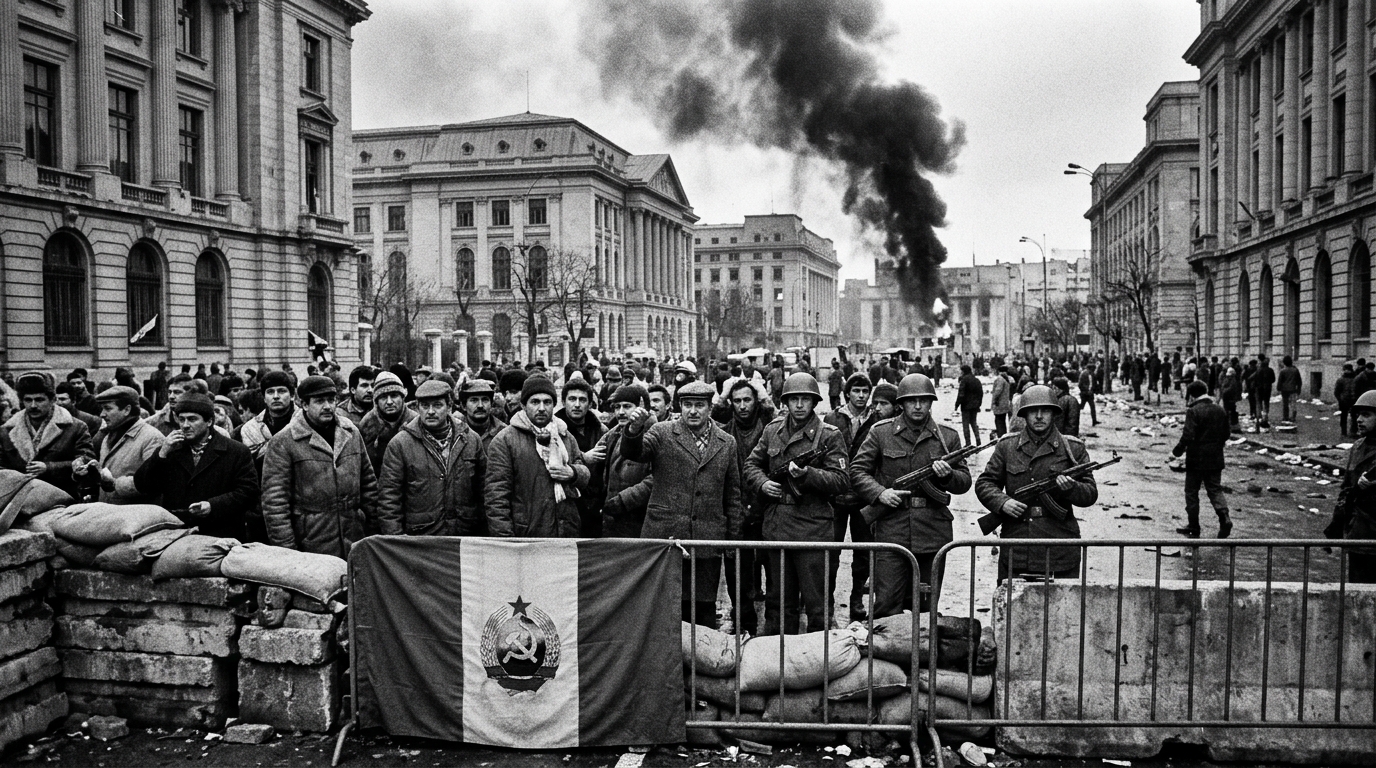
The decade leading up to the events of December 31, 1999, was characterized by profound systemic instability and a dramatic, often chaotic transformation in the Russian Federation. Following the tumultuous collapse of the Soviet Union in 1991, Russia embarked on a rapid and radical transition from a centrally planned command economy to market capitalism and from totalitarian rule to an nascent, often fragile, liberal democracy. This process, championed by President Boris Yeltsin and his reformist government, was marked by "shock therapy" economic policies – rapid liberalization of prices, mass privatization of state assets, and stabilization efforts – that yielded mixed results. While they dismantled the Soviet economic structure, they also led to hyperinflation, massive wealth disparity, and the creation of a new class of powerful oligarchs who acquired state assets at bargain prices, often through corrupt means.
By the late 1990s, the Russian state appeared hollowed out and weakened. The ruble had collapsed catastrophically in the 1998 financial crisis, wiping out the savings of millions of ordinary Russians and dealing a severe blow to Yeltsin’s credibility. The nascent parliamentary system was perpetually gridlocked, riddled with factionalism, and frequently in open conflict with the presidency, culminating in the violent 1993 constitutional crisis where Yeltsin ordered tanks to shell the White House. Against this backdrop of economic hardship and political infighting, power was increasingly concentrated in a narrow circle of influential oligarchs, government officials, and Yeltsin’s close family and advisors, colloquially known as "The Family." This inner circle exerted immense influence over key appointments, policy decisions, and the flow of capital, often blurring the lines between private wealth and state power.
Boris Yeltsin, the first president of the Russian Federation, found his popularity cratering precipitously due to persistent allegations of corruption, widespread public disillusionment with the results of economic reforms, and increasingly visible health concerns that led to frequent disappearances from public life. His second term, beginning in 1996, was plagued by heart problems, which necessitated surgery and long periods of convalescence, fueling uncertainty and a perception of a rudderless state. The search for a successor was not merely a matter of political legacy or smooth democratic transition; for the elite surrounding Yeltsin, it was a profound imperative for their very survival. They desperately required a candidate who possessed the "toughness" and political acumen to maintain the existing power structures, protect their amassed wealth and immunity from future prosecution, while simultaneously offering a facade of reform and stability to a weary populace and a watchful international community.
Vladimir Putin, a former KGB operative and a relatively unknown administrator from St. Petersburg, emerged from obscurity as an unlikely but ultimately perfect candidate for this critical role. His career path had been methodical and largely out of the public eye: after serving in the KGB in Dresden, East Germany, he returned to St. Petersburg to work in Anatoly Sobchak's mayoral administration, where he gained experience in economic affairs and managing foreign investment. He moved to Moscow in 1996, joining the Kremlin administration, eventually rising to become the head of the Federal Security Service (FSB) in 1998 and then Secretary of the Security Council. His promotion to Prime Minister in August 1999, replacing Sergei Stepashin, came as a surprise to many, but it was a carefully calculated move by "The Family" to position him as the heir apparent. His background in the security services suggested an ability to restore order, his relatively clean public image offered a contrast to the tainted Yeltsin era, and his perceived lack of strong political alliances made him seem controllable to the oligarchs who backed him.
Historical Precedents and Constitutional Framework
The 1999 transfer of power, while legally compliant with the 1993 Russian Constitution, represented a stark departure from both Soviet and Imperial Russian traditions of succession, yet it also subtly invoked elements of past autocratic practices. Historically, Russia had no consistent democratic mechanism for transferring supreme authority. Tsarist successions were often dynastic, occasionally fraught with palace coups, or dictated by imperial will. The Soviet Union, while having a veneer of constitutional processes, saw power change hands primarily through internal Party machinations, often after the death of the incumbent leader (e.g., Lenin, Stalin, Brezhnev, Andropov, Chernenko), followed by a period of collective leadership that eventually yielded to a single dominant figure. The idea of a sitting leader voluntarily resigning and constitutionally handing power to a designated successor was unprecedented.
The 1993 Russian Constitution, adopted in the aftermath of a violent confrontation between Yeltsin and the parliament, vested significant power in the presidency. Article 92, Paragraph 3, specifically states: "In all cases when the President of the Russian Federation is unable to perform his duties, they shall be temporarily performed by the Chairman of the Government of the Russian Federation." This provision allowed for Yeltsin's resignation to seamlessly elevate Prime Minister Putin to the position of Acting President, endowing him with all the powers of the presidency, albeit temporarily, until new elections could be held. This constitutional pathway was critical to ensuring the legality and legitimacy of the transition, both domestically and internationally, preventing a power vacuum or a repeat of the 1993 crisis.
The elevation of Putin to Acting President provided a profound political advantage. An acting president, unlike a mere prime minister, commands the full apparatus of the state, including the military, security services, and the administrative bureaucracy. This endowed Putin with immediate legitimacy and the ability to issue decrees and conduct policy, demonstrating decisive leadership on issues like the ongoing war in Chechnya. Crucially, it transformed him from a little-known prime minister into the undisputed incumbent head of state, leveraging the psychological benefits of stability and continuity in a nation desperate for both. The swiftness of the transition, coming just months after his appointment as Prime Minister, demonstrated the efficacy of this constitutional design in ensuring continuity, while also highlighting its potential for a carefully orchestrated transfer of power rather than a truly open democratic contest. The choice of New Year's Eve, a time when public attention is divided, further minimized immediate political fallout and critical scrutiny, allowing the new order to settle.
Timeline of Events and Key Moments
The trajectory toward the New Year’s resignation was fast-paced and dramatically accelerated by a confluence of political calculations and external events, most notably the outbreak of the Second Chechen War. This conflict proved to be a critical catalyst, generating a "rally-around-the-flag" effect that significantly bolstered Putin’s approval ratings and positioned him as the strong leader Russia supposedly needed.
| Date | Event | Description and Significance |
|---|---|---|
| August 9, 1999 | Yeltsin fires Prime Minister Sergei Stepashin and appoints Vladimir Putin as acting PM. | Stepashin, initially considered a potential successor, was deemed too indecisive by the 'Family.' Putin's appointment, his fourth Prime Minister in less than two years, was met with little fanfare initially. It was orchestrated by Yeltsin's chief of staff, Alexander Voloshin, and other members of 'The Family' to test Putin's mettle and prepare him for the presidential succession. Yeltsin, in his televised announcement, explicitly called Putin his "successor." |
| September 1999 | A series of apartment bombings in Russia leads to a hardened stance on Chechnya, cementing Putin’s "strongman" image. | Devastating bombings in Buynaksk, Moscow, and Volgodonsk killed hundreds and sowed widespread panic. While the perpetrators were never definitively proven, Russian authorities, led by Putin, swiftly blamed Chechen separatists. Putin's infamous promise to "rub out" terrorists "in the outhouse" resonated deeply with a public tired of instability and perceived weakness. This aggressive rhetoric provided popular support for the launch of the Second Chechen War, which he oversaw with uncompromising resolve. |
| October 1999 | Russian forces launch a full-scale invasion of Chechnya. | Following the apartment bombings and cross-border incursions by Chechen militants, Russia initiated a large-scale military operation. Putin, as Prime Minister, took a highly visible and assertive role in directing the war effort, distinguishing himself from Yeltsin's earlier, largely failed military campaign in the First Chechen War. This demonstration of decisive leadership greatly enhanced his public image as a strong national leader capable of restoring order and defending Russia's territorial integrity. |
| December 19, 1999 | Parliamentary elections result in a strong showing for the Unity party, signaling public support for Putin. | The newly formed Unity party, explicitly created to support Putin and led by Emergency Situations Minister Sergei Shoigu, performed unexpectedly well in the State Duma elections, securing the second-largest number of seats. Its success, achieved in just a few months, was attributed directly to its association with Putin and his popularity, particularly his firm stance on Chechnya. This electoral outcome provided crucial evidence that Putin had widespread public backing and consolidated his political position ahead of a presidential bid. |
| December 29, 1999 | Yeltsin records his resignation address in the Kremlin. | The decision to resign and the recording of the farewell speech were kept in strict secrecy, known only to a very tight circle of advisors, including Alexander Voloshin, Valentin Yumashev, and Anatoly Chubais. The carefully crafted speech sought to explain his decision as one for the good of Russia, acknowledging his failures but also expressing hope for the future under a new, more energetic leader. |
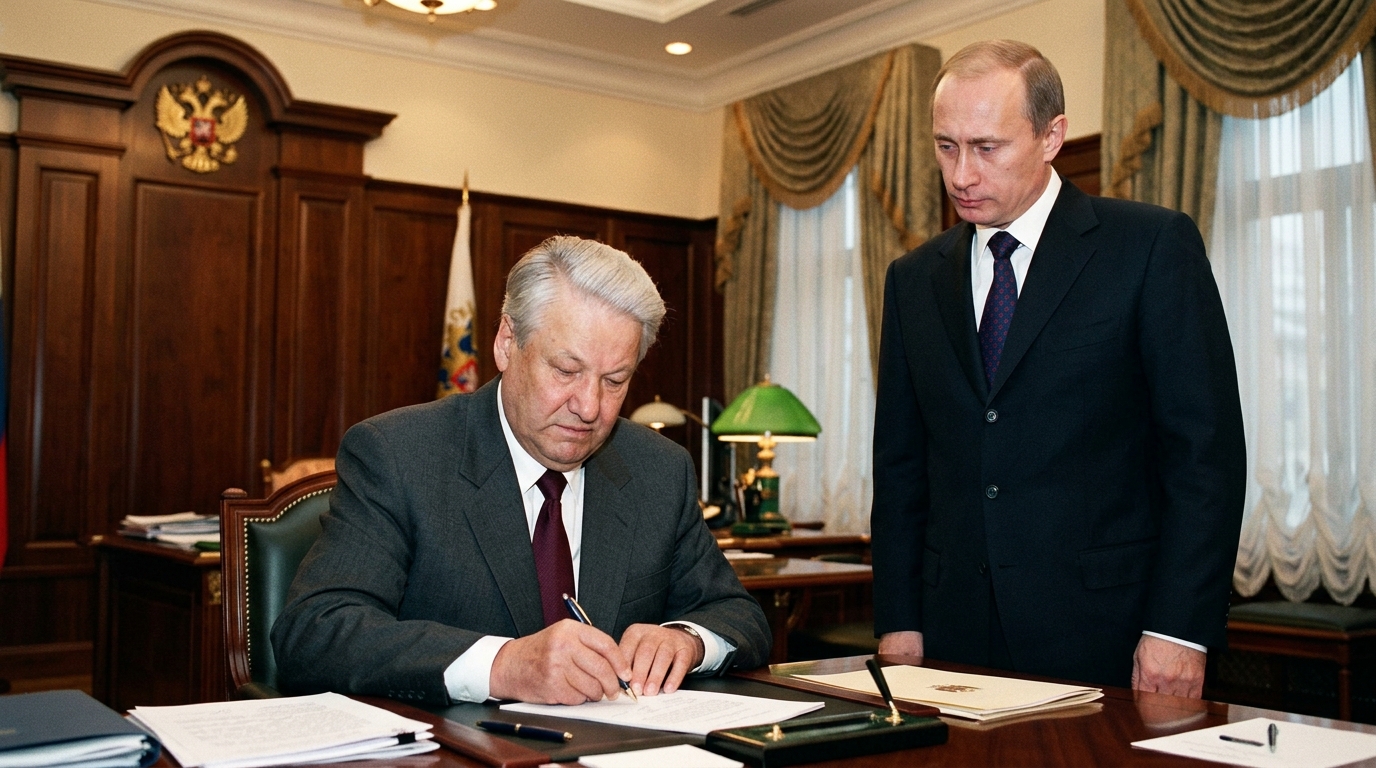
| December 31, 1999 | Yeltsin announces his resignation on national television at noon; Putin becomes Acting President. | At precisely 12:00 PM Moscow time, Yeltsin delivered his address, televised across all eleven time zones of the Russian Federation. He famously stated, "I am retiring. I have done everything I could." With tears in his eyes, he asked for forgiveness from the Russian people. Immediately after the broadcast, Putin officially assumed the role of Acting President, marking a monumental, though expected, shift in Russian political leadership. |
Geopolitical Consequences and Aftermath
The transition of power on the eve of the new millennium signaled the definitive end of the "liberal" or "democratic" experiment in post-Soviet Russia that had defined the Yeltsin era. Geopolitically, the ascension of Vladimir Putin marked an immediate and discernible shift toward a more nationalistic, statist, and ultimately assertive foreign policy. While the West initially viewed Putin with cautious optimism – a view encouraged by his pragmatic and seemingly pro-Western rhetoric in early interactions with figures like Bill Clinton, Tony Blair, and Gerhard Schröder – the reality of his governance involved a rigorous and systematic consolidation of power domestically.
This consolidation, often termed the "vertical of power," entailed a significant curtailment of the autonomy of regional governors and a forceful reining in of the influence of media oligarchs and powerful business magnates. Putin moved swiftly to centralize control over Russia's vast natural resources, particularly its energy sector, which had largely been privatized and controlled by a handful of oligarchs during the 1990s. This process not only strengthened the state's economic leverage but also ensured that economic power served political objectives. The free press, which had experienced a brief flourishing in the 1990s, was gradually brought under state control, with key independent media outlets like NTV taken over. These domestic actions, while seemingly internal, had profound geopolitical implications, signaling a Russia less interested in adopting Western liberal democratic norms and more focused on restoring state strength and sovereignty.
Furthermore, the resignation ensured that the transition was managed legally within the framework of the 1993 Constitution, providing an essential veneer of legitimacy and stability. However, it also established a powerful precedent for personalistic rule, where the incumbent's strategic choice of successor could bypass the uncertainties of a truly open electoral contest. The timing of the early election, moved up from summer to March 2000, severely limited the campaign time for any genuine opposition, further solidifying Putin's advantage.
The international community, still largely preoccupied with the "Y2K" bug, the ongoing post-Cold War peace dividend, and the intricacies of European integration and NATO expansion, largely underestimated the profound extent to which this change would redefine Russia's role in global affairs over the next two decades. Western leaders initially perceived Putin as a stable partner, a technocrat who could bring order to Russia and integrate it further into the global economy. Many held onto the hope that he would continue Yeltsin's democratic trajectory, albeit with a firmer hand. However, Putin's emphasis on state sovereignty, his strong objections to NATO expansion, and his willingness to use military force (as demonstrated in Chechnya) soon revealed a different strategic calculus. This shift gradually transformed Russia from a perceived junior partner or struggling democracy into a resurgent, revisionist power determined to assert its interests on the world stage, often in direct challenge to Western hegemony. The seeds of future geopolitical tensions, including those that would later erupt in Georgia, Ukraine, and Syria, were arguably sown in this pivotal transition of power.
Analysis of Key Actors and Decisive Actions
The transfer of power on New Year's Eve 1999 was a masterclass in political maneuvering, orchestrated by a select few individuals and driven by a complex web of motivations.
The role of Boris Yeltsin cannot be overstated as the architect of his own departure and the decisive force behind Putin's ascent. By choosing the timing, he bypassed the democratic uncertainty and the potential for a divisive, protracted election campaign. His health was a major factor; frequent heart problems and episodes of illness made it increasingly difficult for him to govern effectively. More critically, he was deeply concerned about his legacy and, perhaps more urgently, the security of his family and close associates – "The Family." Yeltsin sought a successor who would guarantee him immunity from prosecution for potential corruption allegations and ensure the continued well-being of those who had supported him during his tumultuous decade in power. In his emotional farewell address, he spoke of his desire to leave a strong, stable Russia, but also acknowledged his personal weariness and the need for a younger, more energetic leader. His decision to hand over the reins to Putin was the ultimate act of self-preservation for his inner circle, securing their future while simultaneously attempting to frame it as a sacrifice for the nation.
Vladimir Putin, conversely, played a masterful game of understated ambition and strategic positioning. His rise from the St. Petersburg mayor's office to the heights of the Kremlin was characterized by a meticulous lack of public charisma, which, in the context of 1999 Russia, was perceived not as weakness but as professional, sober, and disciplined. He presented himself as a "technocrat" rather than a politician, a distinction that allowed him to bridge the gap between the remnants of the Soviet security apparatus and the new Russian financial elite. His background in the KGB appealed to those longing for order, while his economic pragmatism reassured those wary of a return to communism. The Second Chechen War became his proving ground; his tough rhetoric and decisive military action tapped into a deep vein of national pride and a desire for strong leadership after years of perceived national humiliation and internal weakness. He skillfully leveraged the public's fear and desire for stability, projecting an image of unwavering resolve. Putin's calculated strategy was to remain loyal to Yeltsin and "The Family" until the moment of transfer, earning their trust while building his own independent base of popular support.
Other key actors in this drama included Anatoly Chubais, a leading architect of privatization and a prominent liberal reformist, who, despite ideological differences, played a significant role in identifying and promoting Putin as the acceptable candidate for both the reformist and security factions. Alexander Voloshin, Yeltsin's chief of staff, was instrumental in managing the day-to-day operations of the Kremlin and in orchestrating the political maneuvering that paved the way for Putin. Boris Berezovsky, an influential and controversial oligarch, also initially championed Putin, believing him to be a figure they could control. However, Berezovsky, along with other "Family" members, soon discovered that Putin, once in power, had his own agenda and was far from a puppet. The dynamic between Putin and these oligarchs rapidly shifted, leading to the eventual exile or imprisonment of those who challenged the new president's authority.
"I have taken a decision. I have thought about this for a long time. Today, on the last day of the outgoing century, I am retiring," Boris Yeltsin said in his address to the nation, his voice heavy with emotion, concluding a decade of chaos and ushering in an unforeseen future. "I ask for your forgiveness for unfulfilled dreams and for not justifying your hopes." This deeply personal appeal aimed to both legitimize his choice of successor and close the book on his often-controversial presidency.
Socio-Economic Aftermath and Public Opinion
The immediate socio-economic aftermath of Putin's ascension was characterized by a palpable sense of relief and a yearning for stability among the Russian populace. The 1990s had been a period of profound social dislocation: hyperinflation had decimated savings, mass privatization had created vast inequality, and crime rates had soared. The 1998 financial crisis, in particular, had left many ordinary Russians feeling betrayed and impoverished. Into this volatile environment stepped Putin, promising order, strong state control, and an end to the chaos.
Public opinion, as captured in early polls, reflected a mix of cautious optimism and genuine hope for a new beginning. Many Russians, weary of the erratic and often ailing Yeltsin, welcomed the relatively youthful (47 at the time) and seemingly decisive new leader. His background in the security services, far from being a liability, resonated with a populace that longed for law and order. His uncompromising stance on the Second Chechen War, despite its brutal nature, generated a powerful wave of patriotic sentiment and a sense that Russia was finally restoring its dignity and strength after years of perceived humiliation on the international stage. The narrative of national rejuvenation and a firm hand at the helm quickly took root.
Economically, Putin's early years benefited significantly from an unexpected stroke of luck: rising global oil prices. Russia, a major oil and gas exporter, saw its state coffers swell, providing the resources needed to stabilize the economy, pay back international debt, and implement long-delayed social programs. This economic turnaround, though partly coincidental, was largely attributed by the public to Putin's leadership, reinforcing his image as a capable manager and a national savior. He moved to reassert state control over key strategic sectors, particularly energy, by gradually reining in or co-opting the oligarchs who had dominated these industries. Figures like Boris Berezovsky and Vladimir Gusinsky, who owned influential media empires, were among the first to be targeted, with their assets eventually falling under state or state-aligned control. This process solidified the "vertical of power" not just politically but also economically.
However, this consolidation came at a cost to democratic development. While economic stability improved, the nascent civil society organizations and independent media outlets that had emerged in the 1990s faced increasing pressure and suppression. The space for political opposition dwindled, and regional autonomy was systematically curtailed. The early 2000s under Putin saw a significant increase in the influence of the siloviki – individuals from security and military backgrounds – within the government and state-owned corporations. This shift gradually transformed Russia into a more centralized, state-dominated society, moving away from the pluralistic, if chaotic, experiments of the Yeltsin era towards a more authoritarian model of governance. The promise of order and prosperity was delivered, but often at the expense of political freedoms and democratic institutions, setting the stage for the Russia of today.
Trivia and Lesser-Known Facts
- The Presidential Nuclear Briefcase: At the moment of the broadcast, a quiet, almost ceremonial handover of the Cheget (the Russian nuclear briefcase, one of three in existence) took place behind the scenes. This physical transfer symbolized the ultimate executive authority and responsibility for Russia's nuclear arsenal being passed from Yeltsin to Putin, underscoring the gravity of the change in leadership. It was not merely a symbolic gesture but a crucial step in ensuring national security continuity.
- The "Successor" Hunt: Before Putin was selected, the Kremlin vetted several other candidates, including prominent liberal reformers like Boris Nemtsov and former Prime Minister Sergei Stepashin. Nemtsov was reportedly deemed too independent and genuinely liberal, posing a threat to the "Family's" interests. Stepashin, while a former security services chief, was perceived as too soft and indecisive. Putin's perceived lack of a strong independent power base and his background in intelligence, suggesting loyalty and discretion, made him the ideal choice for those orchestrating the transition.
- The New Year's Eve Broadcast: The timing of the announcement on December 31st at noon Moscow time meant that, due to Russia's vast eleven time zones, many citizens across the country heard the news while already deep into their New Year's Eve festivities or preparing for them. This lent the event a surreal, almost dreamlike atmosphere, contributing to its historic impact. The emotional tone of Yeltsin's speech, including his tearful apology, was designed to evoke a sense of finality and a new beginning.
- Early Interaction: One of Putin's first official acts as Acting President, just hours after Yeltsin's broadcast, was to sign a decree granting Boris Yeltsin and his family lifelong immunity from prosecution and providing state funding for their security, medical care, and housing. This decisive move cemented the understanding that the new president would protect his predecessor, fulfilling a key condition of the power transfer and showcasing Putin's loyalty while signaling a clean break from the past.
- Putin's Initial Public Image: Early polls in late 1999 and early 2000 showed that a significant portion of the Russian public knew very little about Vladimir Putin personally. His popularity was primarily tied to his perceived competence, his strong stance on Chechnya, and his association with a desire for stability and national renewal, rather than any pre-existing political platform or public persona. This "blank slate" allowed the Kremlin to shape his image effectively.
- The "Operation Successor": The entire process of identifying, grooming, and elevating Putin was reportedly referred to by Kremlin insiders as "Operation Successor." It involved a carefully coordinated effort by Yeltsin's chief of staff, Alexander Voloshin, and other members of "The Family" to test potential candidates, control media narratives, and ensure a seamless, constitutional transition that protected their interests.
Modern Historiographical Debates
The 1999 New Year's Eve transfer of power remains a focal point for modern historiographical debates concerning Russia's post-Soviet trajectory. Historians and political scientists continue to grapple with its long-term implications, often divided along several key lines of interpretation.
One school of thought views the event as the "end of Russia's democratic experiment" and the beginning of a slide towards authoritarianism. Proponents of this view argue that while the transfer was constitutional, it was fundamentally undemocratic in its spirit. They highlight the pre-selection of a successor by an elite "Family" and the manipulation of the political calendar (early elections) to ensure Putin's victory. For scholars like Masha Gessen or Anna Politkovskaya (whose work is cited below), Putin's rise symbolized the triumph of the siloviki and the security apparatus over civil society and liberal institutions, effectively stifling nascent democratic tendencies that emerged in the 1990s. They point to the subsequent dismantling of independent media, the re-centralization of power, and the suppression of political opposition as direct consequences of this initial, carefully managed transition.
Conversely, another perspective argues that the transfer was a necessary act of "stabilization and national restoration." This viewpoint, often echoed in official Russian narratives and by some Western realists, suggests that Russia in 1999 was on the brink of collapse – economically, politically, and socially. Yeltsin's resignation and Putin's ascent, therefore, prevented further chaos and possible disintegration, restoring order and state capacity after a decade of tumultuous, often failed, liberal reforms. From this angle, Putin was not an anti-democratic force but a pragmatist responding to the deep-seated popular desire for strength and stability. Scholars like Richard Sakwa often explore the complex interplay between democratic rhetoric and the inherent challenges of state-building in post-Soviet Russia, arguing that Putin capitalized on a legitimate public demand for a strong hand to navigate the crises of the time.
A third interpretative lens focuses on the "continuity versus rupture" debate. Was Putin a radical departure from Yeltsin, or did he represent a more effective continuation of the realpolitik that defined the later Yeltsin years? Some historians argue that the seeds of Putin's authoritarianism and statist foreign policy were already present in Yeltsin's second term, particularly after the 1993 constitutional crisis and the First Chechen War. Putin, in this view, simply accelerated and systematized existing trends rather than introducing entirely new ones. Others emphasize the stark break, noting Putin's background in the security services and his explicit rejection of aspects of Yeltsin's legacy, particularly the perceived weakness and deference to the West.
Finally, debates also center on the role of external factors versus internal dynamics. To what extent did Western policies (e.g., NATO expansion, perceived indifference to Russian economic hardship) contribute to a sense of national grievance that Putin was able to exploit? Or was Russia's trajectory primarily driven by internal historical legacies, economic structures, and the specific motivations of its elite? These historiographical discussions highlight the ongoing relevance and complexity of understanding this pivotal moment in Russian history, the full implications of which continue to unfold on the global stage.
References and Literature
- Brown, Archie. The Rise and Fall of Communism. HarperCollins, 2009. (Provides broader context of Soviet collapse and post-Soviet transitions.)
- Gessen, Masha. The Man Without a Face: The Unlikely Rise of Vladimir Putin. Riverhead Books, 2012. (A critical biography offering insights into Putin's background and early career.)
- Goldman, Marshall I. The Piratization of Russia: Russian Reform Goes Awry. Routledge, 2003. (Details the economic chaos and privatization issues during the Yeltsin era.)
- McFaul, Michael. Russia's Unfinished Revolution: From Gorbachev to Putin. Stanford University Press, 2001. (Analyzes the challenges of Russia's transition and the political developments leading to Putin's rise.)
- Politkovskaya, Anna. Putin's Russia: Life in a Failing Democracy. Henry Holt and Company, 2005. (A critical investigative look at the early period of Putin’s consolidation of power and its impact on Russian society.)
- Sakwa, Richard. Putin and the Rise of Russia. Routledge, 2008. (Offers an academic examination of Putin's presidency within the broader historical context of Russian state-building.)
- Shevtsova, Lilia. Yeltsin's Russia: Myths and Reality. Carnegie Endowment for International Peace, 1999. (An in-depth academic examination of the institutional shifts and challenges during the 1990s, particularly relevant for the context of Yeltsin's struggles.)
- The Russian Presidential Archives (Official Records). http://kremlin.ru (Primary source documents relating to the 1999 administrative transitions and official statements.)
- Volkov, Vadim. Violent Entrepreneurs: The Use of Force in the Making of Russian Capitalism. Cornell University Press, 2002. (Explores the role of organized crime and force in the shaping of Russia's market economy in the 1990s.)
- Yeltsin, Boris. Midnight Diaries. PublicAffairs, 2000. (Yeltsin's own memoirs, providing his perspective on his presidency and the decision to resign.)
Footnotes & Explanations
- The "Family" refers to the informal but highly influential network of relatives, powerful business oligarchs, and close associates of the Yeltsin presidency who exerted significant control over government appointments, economic policy, and access to state resources. Key figures included Boris Berezovsky, Anatoly Chubais, Alexander Voloshin, and Yeltsin's daughter, Tatyana Dyachenko. ↩
- The 1998 Russian financial crisis, also known as the "Ruble crisis" or "Russian flu," saw the Russian government default on its domestic debt, a massive devaluation of the ruble, and a significant economic downturn. It largely destroyed the nascent middle class's savings, exacerbated poverty, and severely weakened Boris Yeltsin's political capital and public trust. ↩
- The siloviki (from Russian sila, meaning "force") is a term referring to politicians and government officials from the security services, military, or law enforcement agencies who came to prominence in Russia, particularly under Vladimir Putin. They represent a distinct and influential faction within the Russian political establishment, often prioritizing state control, national security, and order. ↩