Key Takeaways
- The assassination represented a profound rupture in the Israeli democratic process, driven by intense internal ideological polarization and religious extremism.
- Rabin’s death effectively signaled the irreversible end of the 'Oslo era,' as the critical trust and political courage required for final status negotiations proved impossible to fully reconstitute.
- The event catalyzed a decisive rightward shift in Israeli politics, fundamentally altering the national discourse on peace, security, and territorial concessions, and contributing to the prolonged stagnation of the peace process.
- It exposed severe systemic intelligence failures within Israel's security apparatus, leading to significant reforms and a national reckoning regarding political incitement.
- The assassination remains a potent symbol of the dangers of religious-nationalist extremism and its capacity to derail geopolitical progress.
Historical Context and Origins
To fully grasp the magnitude and devastating impact of the assassination of Yitzhak Rabin on November 4, 1995, one must first immerse themselves in the charged, often volatile, geopolitical and domestic landscape of Israel and the Middle East in the early 1990s. The region was emerging from decades of conflict, punctuated by wars and the ongoing First Intifada (1987-1993), a popular Palestinian uprising against Israeli occupation. This period was characterized by a fundamental reevaluation of security paradigms and political possibilities.
The global geopolitical shifts following the end of the Cold War, particularly the diminished Soviet influence in the Middle East, created a window for renewed peace efforts. This culminated in the US-Soviet sponsored Madrid Conference in October 1991, which brought together Israel, Syria, Lebanon, Jordan, and Palestinian representatives for direct negotiations. While Madrid established a framework, it was the secret back-channel negotiations in Oslo, Norway, that ultimately broke the diplomatic deadlock. These clandestine talks, initiated in late 1992, led to the signing of the Declaration of Principles on Interim Self-Government Arrangements (Oslo I Accords) on the White House lawn on September 13, 1993. This landmark agreement saw the mutual recognition of Israel and the Palestine Liberation Organization (PLO), with the PLO renouncing terrorism and Israel recognizing the PLO as the representative of the Palestinian people. It also set out a phased transfer of authority to a Palestinian Interim Self-Government Authority (PISGA) in the West Bank and Gaza Strip.
For the Labor-led government under Prime Minister Rabin, himself a decorated military general who had commanded forces in the Six-Day War, Oslo was a pragmatic, if painful, necessity. Rabin's famous phrase, "We are tired of wars. We are tired of fighting. We are tired of the constant pain," encapsulated a broad public yearning for an end to the protracted conflict. For Rabin and his Foreign Minister Shimon Peres, the accords represented a chance to end the cycle of violence, achieve a secure future for Israel as a democratic, Jewish state, and avert a demographic time bomb by separating from the Palestinians. His credibility as a security hawk gave him a unique authority to make concessions that few other Israeli leaders could have contemplated without being branded as weak.
However, for a significant segment of Israeli society, particularly the national-religious right and the settler movement, the Oslo Accords were not a path to peace but a profound betrayal of divine mandate and national destiny. The "Land of Israel" (Eretz Yisrael), encompassing the West Bank (Judea and Samaria), was considered an inalienable legacy, granted by God to the Jewish people. Ceding control of any part of this land, especially to the PLO which many viewed as a terrorist organization, was not merely a tactical error; it was seen as a mortal sin, a violation of religious law (Halakha), and an existential threat to the nation. This ideological conviction was deeply rooted in messianic Zionist thought, which gained significant traction after the 1967 Six-Day War.
The atmosphere in Israeli cities, particularly Jerusalem and Tel Aviv, became increasingly toxic and polarized in the two years following Oslo I, and even more so after Oslo II in September 1995, which detailed the expansion of Palestinian self-rule. Anti-Oslo protests grew in size and intensity. Extremist rabbis, some with significant followings within the national-religious sector, began issuing religious edicts—most notably the concept of din rodef (law of the pursuer) and moser (informer)—which suggested that anyone who ceded Jewish land to the enemy, or collaborated with an enemy that sought to harm Jews, was liable to be killed under religious law. This dangerous rhetoric, initially confined to the fringes of the Yeshiva world, progressively infiltrated mainstream political discourse. Opposition politicians, including Benjamin Netanyahu, then leader of the Likud party, frequently addressed large crowds where inflammatory signs depicting Rabin in an SS uniform, as a traitor, or draped in a Keffiyeh, were prominently displayed. While Netanyahu consistently condemned violence, the cumulative effect of this demonizing language was to create an environment where the Prime Minister was delegitimized and, to some, marked as an enemy of the people, making him a legitimate target in the eyes of radicalized individuals.
Timeline of Events and Key Moments
The descent into the tragedy of November 4, 1995, occurred not in isolation but as a culmination of rapidly escalating tensions and events throughout 1995, following the initial euphoria and then deepening divisions surrounding the Oslo Accords.
| Date | Event | Description |
|---|---|---|
| September 13, 1993 | Signing of Oslo I Accords | Israeli government and PLO mutually recognize each other, agreeing to a phased transfer of authority and interim self-rule for Palestinians. This sparks both hope and intense opposition within Israel. |
| February 25, 1994 | Hebron Massacre | Baruch Goldstein, an Israeli extremist settler, murders 29 Palestinian worshippers in Hebron. This act of terror further inflames tensions and radicalizes elements on both sides. |
| July 1, 1994 | Yasser Arafat's Return to Gaza | PLO Chairman Yasser Arafat returns to the Palestinian territories, symbolizing the new era of self-rule but also solidifying opposition perceptions of Oslo as a betrayal. |
| September 28, 1995 | Signing of the Oslo II Accords | A follow-up agreement that significantly extended Palestinian self-rule in the West Bank and Gaza. This was a major trigger for heightened right-wing and religious-nationalist anger and protests. |
| October 5, 1995 | Massive Anti-Oslo Protest in Jerusalem | One of the largest and most volatile demonstrations against the peace process, featuring a mock funeral for Rabin, inflammatory banners (e.g., "Rabin is a Traitor"), and chants of "Rabin, Peres, Arafat are murderers." Opposition leader Benjamin Netanyahu was present and spoke at this rally. |
| October 1995 | Yigal Amir's Stalking Begins | Yigal Amir, a law student and religious extremist, begins actively stalking Yitzhak Rabin with the explicit intent to assassinate him. He attempts to approach Rabin at several events, but fails. |
| November 4, 1995 (Day of Assassination) | Peace Rally at Kings of Israel Square, Tel Aviv | A massive rally, estimated at over 100,000 people, organized by the Labor Party and peace movements to demonstrate public support for the Oslo Accords and counter the growing anti-peace sentiment. |
| 9:15 PM | Rabin Concludes Speech | Rabin delivers an emotional speech, emphasizing the importance of peace and unity. He then joins Peres and others in singing "Shir LaShalom" (Song for Peace). |
| 9:30 PM | Rabin Descends Steps | Rabin, accompanied by bodyguards and entourage, walks down the steps from the stage towards his official armored car. |
| 9:31 PM | Yigal Amir Fires Shots | As Rabin approaches his vehicle, Yigal Amir emerges from the crowd, fires three shots at the Prime Minister's back with a Beretta pistol. Two bullets fatally wound Rabin. |
| 9:35 PM | Rabin Rushed to Hospital | Critically wounded, Rabin is rushed to Ichilov Hospital (Tel Aviv Sourasky Medical Center), barely 300 meters from the square. |
| 11:14 PM | Rabin Pronounced Dead | Dr. Mordechai Ravid, the director of Ichilov Hospital, announces to the world that Prime Minister Yitzhak Rabin has succumbed to his wounds. Shimon Peres is appointed Acting Prime Minister. |
The rally at Kings of Israel Square (subsequently renamed Rabin Square) was intended to be a decisive show of force for the peace camp, a public affirmation that a silent majority supported the government’s efforts despite the vocal opposition. Rabin, a man famously pragmatic and not given to overt displays of emotion, sang the "Song for Peace" (Shir LaShalom) on stage with visible effort, his hand intertwined with Peres' and Arafat's representatives in a poignant moment of unity. The images of him with the song lyrics, later found blood-stained in his jacket pocket, became an iconic and haunting symbol of the era. Moments after stepping off the stage, in an egregious lapse of security, he was mortally wounded by a single individual driven by ideological zeal.
The Anatomy of a Security Failure: The Shamgar Commission and its Findings
The assassination of a sitting Prime Minister on Israeli soil, a nation renowned for its sophisticated security apparatus, sent shockwaves not only through its society but also through its intelligence agencies. The immediate aftermath led to a national reckoning and the swift establishment of the Shamgar Commission of Inquiry, headed by former Supreme Court President Meir Shamgar. Its mandate was to investigate the failures that led to Rabin's murder. The findings of the commission, published in March 1996, were damning and pointed to systemic, multi-layered deficiencies within the Shin Bet (Israel's internal security agency).
The commission uncovered several critical lapses:
- Failure to Identify the Threat: Yigal Amir was a known extremist within certain religious-nationalist circles. He had publicly expressed intentions to kill Rabin and had been active in anti-Oslo protests. Crucially, a Shin Bet informant, Avishai Raviv (codenamed "Champagne"), had been embedded within Amir's radical group. Raviv had reportedly warned his handlers about Amir's dangerous rhetoric and even his acquisition of a weapon. However, these warnings were either dismissed, underestimated, or not adequately disseminated up the chain of command. The Shin Bet's focus had been primarily on Palestinian terror groups, and the threat of Jewish extremism was significantly downplayed.
- Inadequate Risk Assessment: Despite the escalating public incitement against Rabin, and specific threats made by various groups and individuals, the Shin Bet's risk assessment for the Prime Minister remained surprisingly low. The security detail did not perceive a credible, immediate threat from Jewish extremists. This assessment was a critical misjudgment, colored by an institutional bias that struggled to conceptualize an internal, religiously motivated Jewish assassin targeting the nation's leader.
- Operational Security Lapses: On the night of the rally, there were glaring operational failures:
The Shamgar Commission concluded that while the individual responsibility lay with Yigal Amir, the systemic failures of the Shin Bet created the conditions that made the assassination possible. The report was highly critical of the Shin Bet's director, Carmi Gillon, who subsequently resigned. The commission recommended sweeping reforms, including a fundamental reorientation of threat assessment to include Jewish extremism, enhanced training for security personnel, stricter adherence to operational protocols, and improved intelligence gathering and sharing within Israel's security establishment. The assassination thus became a catalyst for a profound introspection and overhaul within Israeli security services, forever changing how internal threats were perceived and managed.
Geopolitical Consequences and Aftermath
The ripples of the three shots fired in Tel Aviv on that fateful November night extended far beyond Israel’s borders, changing the trajectory of the Middle East indefinitely. The geopolitical landscape, already complex and fraught, became even more volatile and resistant to the kind of bold diplomacy that Rabin had pioneered.
- The Collapse of Trust and Momentum: Rabin's assassination utterly destroyed the fragile optimism of the "Oslo generation." His unique credibility, born of a distinguished military career, had allowed him to sell painful concessions to a skeptical Israeli public. With his death, the peace process lost its most formidable and trusted advocate. Israelis who had supported the process became profoundly fearful of the internal backlash and the potential for further violence, leading to a general hardening of positions. Palestinians, on the other hand, saw the murder as chilling proof that Israel was fundamentally incapable of adhering to peace agreements due to the extremist pressures within its own society. The mutual trust between Israeli and Palestinian leadership, painstakingly built over years of secret talks, evaporated almost overnight, replaced by suspicion and fear. Yasser Arafat, who had forged an unlikely partnership with Rabin, lost his primary interlocutor and a partner who shared his vision, however contested, for a two-state future.
- The 1996 Election and the Rightward Shift: The immediate political vacuum left by Rabin was filled by Shimon Peres, then Foreign Minister, who assumed the role of Acting Prime Minister. Peres, a brilliant diplomat and architect of the Oslo Accords, lacked Rabin's "security hawk" image and public trust on military matters. Despite a temporary "rally around the flag" effect, Peres struggled to maintain the peace process amidst renewed Palestinian terror attacks, which surged in 1996 following the assassination of Yahya Ayyash ("the Engineer"), a prominent Hamas bomb-maker, by Israel. In the snap elections called for May 1996, Peres, who ran on a platform of continued peace, failed to capture the public mood. Benjamin Netanyahu, leader of the Likud party, campaigned on a platform of "Peace with Security," emphasizing that the Oslo process had led to increased terror and compromised Israel's safety. His narrow victory by less than one percent of the vote signaled a decisive transition to a more skeptical, cautious, and ultimately hawkish era in Israeli governance. This election result fundamentally altered the course of negotiations, prioritizing security and rejecting further unilateral withdrawals or significant territorial concessions without reciprocal Palestinian actions.
- Institutional and Societal Shift: Beyond immediate politics, the assassination had profound long-term implications for Israeli society and its institutions. It forced a national re-evaluation of Israel's internal security architecture, leading to the Shamgar Commission's critical report and subsequent reforms within the Shin Bet. Furthermore, the event solidified a "culture of protest" in Israel, but with a heightened awareness of its potential for violence. Political rhetoric, especially concerning core national security issues, became more scrutinized under the shadow of what happened in Rabin Square. The assassination also deepened the ideological chasm within Israeli society, particularly between secular and religious-nationalist camps, leaving a lasting scar on the national psyche regarding the fragility of its democracy and the extreme consequences of internal divisions.
- International Repercussions: The international community, especially the United States under President Bill Clinton, was devastated by the assassination. Rabin was seen as a courageous statesman committed to peace, and his death was a severe blow to global efforts to resolve the Israeli-Palestinian conflict. World leaders, including President Clinton, gathered in Jerusalem for Rabin's funeral, a powerful demonstration of global solidarity and grief. However, the international community's ability to drive the peace process forward was significantly hampered by the loss of Rabin's leadership and the subsequent shift in Israeli political priorities. The assassination made international actors more acutely aware of the internal ideological battle within Israel, highlighting the immense challenges in negotiating a lasting peace when domestic extremism could derail even the most promising efforts.
"I have served in the army for 27 years. I have fought as long as there was no chance for peace. I believe that now there is a chance for peace, a great chance, and we must take advantage of it." — Yitzhak Rabin, in his final speech, moments before his assassination. These words serve as a poignant epitaph to a vision tragically cut short.
Analysis of Key Actors and Decisive Actions
The assassination was not merely a singular act of violence but the tragic intersection of complex political, social, and ideological currents, personified by three central figures: Yitzhak Rabin, Yigal Amir, and Benjamin Netanyahu.
Yitzhak Rabin: The Pragmatic Visionary Yitzhak Rabin embodied the "New Jew"—the Sabra (native-born Israeli), the soldier-statesman whose life was inextricably linked with Israel's wars and its struggle for existence. His illustrious military career began in the Palmach, the elite fighting force of the Yishuv, and culminated as the Chief of Staff during the Six-Day War in 1967, a victory that indelibly shaped Israel's geopolitical landscape. This unparalleled military pedigree was his greatest political asset; it gave him the unique credibility and authority to ask for concessions for peace that few other leaders could have requested from a security-conscious Israeli public. His transformation from an uncompromising military leader to a pragmatic dove of peace was gradual but profound. He understood that while Israel could win wars, it could not indefinitely maintain control over millions of Palestinians without compromising its democratic and Jewish character. Rabin's vision was not based on utopian ideals but on a cold, hard assessment of demographic realities and strategic necessities. His decision to negotiate with the PLO, an organization he had spent decades fighting, was a testament to his strategic pragmatism and immense political courage. He prioritized the security and long-term viability of Israel above all else, seeing "land for peace" not as a compromise of principles but as a vital security imperative. His decisive action in pursuing the Oslo Accords, often against strong internal opposition and personal discomfort, was a gamble on the future of his nation, a gamble tragically interrupted.
Yigal Amir: The Radicalized Avenger Yigal Amir, by stark contrast, was a product of a specific, radicalized subculture within the Israeli national-religious right. Born into a religious Yemenite family and raised in the settlement of Herzliya, Amir was a law student at Bar-Ilan University and a former combat soldier. His radicalization was fueled by a potent cocktail of religious fundamentalism, extreme nationalism focused on preserving "Greater Israel," and a deep-seated belief that Rabin was a moser (informer/traitor) and rodef (pursuer) who was giving away divinely mandated Jewish land. Amir's ideology was shaped by the teachings of extremist rabbis who manipulated Halakhic principles like din rodef to justify political assassination. These teachings, which framed any territorial concession in Judea and Samaria as an existential threat to the Jewish people, provided him with a religious and moral framework for his actions. He saw himself not as a murderer but as a savior of the nation, acting on divine command to prevent a perceived catastrophe. His methodical planning, stalking of Rabin, and execution of the assassination were a deliberate attempt to derail a geopolitical shift through tactical violence, illustrating the dangerous power of messianic nationalism when it interfaces with political grievance and is enabled by systemic security failures.
Benjamin Netanyahu: The Opposition Leader in a Climate of Incitement As the leader of the opposition Likud party, Benjamin Netanyahu occupied an intensely complex and controversial position in the period leading up to the assassination. He was the most vocal and prominent political opponent of the Oslo Accords, arguing vehemently that they jeopardized Israel's security by empowering the PLO and encouraging terrorism. He frequently addressed and often led massive anti-Oslo protests where inflammatory imagery—such as Rabin depicted as a Nazi or in a keffiyeh, or calls for his death—was prevalent. While Netanyahu consistently and unequivocally disavowed violence, he was criticized for not doing enough to condemn the extremist rhetoric at these rallies. Critics argued that his presence and participation, even if he did not utter the inciting words himself, lent legitimacy to a climate of incitement that contributed to the radicalization of individuals like Amir. Following the assassination, Netanyahu faced the daunting task of navigating a country engulfed in grief, mourning a leader whom his political camp had spent years relentlessly undermining. This required him to adopt a more statesmanlike, albeit cautious and often defensive, posture in his later premiership. His actions and rhetoric in the pre-assassination period remain a central point of historical and political debate, highlighting the heavy responsibility of political leaders in shaping public discourse and preventing the escalation of ideological conflicts into violence.
Legacy and Historiographical Debates
The assassination of Yitzhak Rabin left an indelible scar on the Israeli national psyche and fundamentally altered the trajectory of the Israeli-Palestinian conflict. Its legacy is complex, multifaceted, and continues to be debated vigorously by historians, political scientists, and the Israeli public itself.
One central debate revolves around whether Rabin's assassination truly "killed" the peace process, or merely stalled an already faltering one. Proponents of the "killed the peace process" argument contend that Rabin was the only Israeli leader with the security credentials, political courage, and public trust necessary to make the painful concessions required for a final status agreement. They argue that his unique ability to bridge the divide between security and peace, coupled with his pragmatic relationship with Yasser Arafat, was irreplaceable. His death removed the critical momentum, personal trust, and strategic vision that were essential to navigate the most contentious issues: Jerusalem, borders, settlements, and refugees. Without him, the argument goes, the political will on both sides eroded, and the path to a two-state solution became exponentially more difficult.
Conversely, some historians and analysts suggest that the Oslo process was already facing significant challenges and perhaps even structural flaws that might have led to its eventual collapse, regardless of Rabin’s fate. They point to the ongoing terror attacks by Hamas and Islamic Jihad, which frequently undermined Israeli public confidence in the peace process; the lack of a clear, shared vision for the end-game between Israel and the PLO; and the deep-seated resistance within both societies to the concessions demanded by a final agreement. They argue that while Rabin's death was a profound tragedy, it exacerbated existing weaknesses rather than being the sole cause of the peace process's demise. From this perspective, the assassination was a symptom of the profound polarization, not necessarily the root cause of the future stagnation.
Another significant aspect of the legacy is the role of political extremism in a democratic society. Rabin's assassination served as a stark warning about the dangers of unchecked political incitement and the manipulation of religious ideology for violent ends. It forced Israelis to confront the uncomfortable truth that internal violence, born of ideological hatred, could pose as great a threat to the nation's democratic foundations as external enemies. This led to a national soul-searching about the boundaries of free speech, the responsibility of religious leaders, and the potential for a "culture of protest" to escalate into something far more sinister. The event continues to shape political discourse, with accusations of incitement frequently resurfacing in moments of high political tension.
The assassination also fundamentally reshaped Israeli politics. It solidified the rightward shift that began in the mid-1990s, with Benjamin Netanyahu's victory in 1996 symbolizing a new era of hawkish governance. The "Peace with Security" mantra became the dominant political paradigm, making any significant territorial concessions far more difficult to achieve. For many, Rabin's death became a symbol of a lost opportunity, a road not taken, perpetually haunting discussions about peace in the Middle East.
Finally, the assassination serves as a powerful reminder of the fragility of peace and the profound impact a single act of violence can have on history. Rabin's vision of a secure, democratic Israel living alongside a Palestinian state remains an aspiration, its achievement complicated by the legacy of November 4, 1995. The annual memorial ceremonies in Rabin Square are not just acts of remembrance, but often serve as political rallies, embodying the ongoing struggle within Israel over its identity, its future, and its relationship with its neighbors. The debates continue, reflecting the unresolved trauma and the enduring questions raised by the killing of a king.
Trivia and Lesser-Known Facts
- The Song of Peace: The lyrics of Shir LaShalom (Song for Peace), which Rabin sang just minutes before his death, were found in his jacket pocket, stained with his blood. This simple sheet of paper became an iconic, haunting symbol of the era, representing the fragility of peace and the brutal reality of its loss.
- The Security Flaw: The perpetrator, Yigal Amir, had been identified by a secret service informant (Avishai Raviv, codenamed "Champagne") as a potential danger, and Raviv had reported Amir's increasingly violent rhetoric. However, the Shin Bet did not adequately follow up on these warnings, a critical oversight that led directly to the resignation of the head of Shin Bet, Carmi Gillon. The incident highlighted a systemic intelligence failure to perceive Jewish extremism as a serious internal threat.
- The Rabin Center: The site where the assassination occurred, Kings of Israel Square, was quickly renamed "Rabin Square." Today, it remains a focal point for Israeli political demonstrations, vigils, and memorials, representing both the trauma of the past and the unresolved aspirations for the future of peace. The Yitzhak Rabin Center, located in Tel Aviv, serves as a national institution dedicated to preserving his legacy, promoting democracy, and fostering tolerance through educational programs.
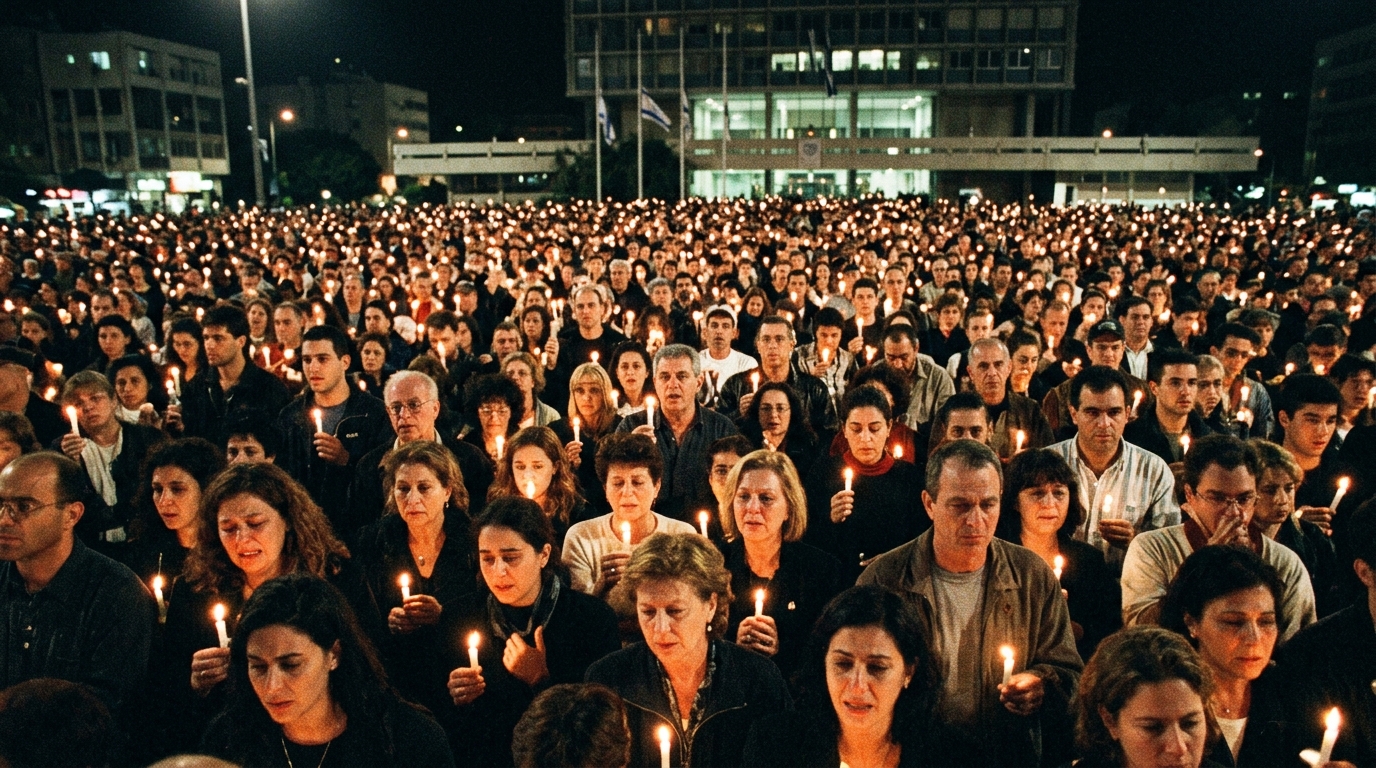
- Public Reaction - The "Candle Children": The outpouring of national grief was immense and immediate. Thousands of young Israelis, many of whom had only known Rabin as Prime Minister and a figure associated with the hope of peace, flocked to Rabin Square. They lit memorial candles, sang peace songs, and wrote messages, creating an impromptu memorialization process that lasted for months. These young people, often referred to as "Rabin's Candle Children," were exposed to the fragility of their democracy and the intensity of political division in a profoundly formative way.
- The "Din Rodef" and Its Fallout: The use of din rodef (law of the pursuer) by extremist rabbis to justify Rabin's assassination caused a deep schism within the religious community and wider Israeli society. It sparked intense debates about the boundaries of religious authority in a democratic state and the dangers of misinterpreting religious law for political violence. Several prominent rabbis were investigated for their potential role in inciting the murder.
- The Aftermath for Amir: Yigal Amir was swiftly arrested at the scene and never expressed remorse for his actions, consistently maintaining that he acted on divine command. He was convicted of murder and sentenced to life imprisonment plus six years. His brother, Hagai Amir, and his friend, Dror Adani, were also convicted as accomplices. Yigal Amir remains incarcerated and has been denied parole on multiple occasions, becoming a symbol of radical extremism.
- The US Role: President Bill Clinton had invested heavily in the Oslo peace process and developed a close relationship with Rabin. He personally attended Rabin's funeral in Jerusalem, delivering a moving eulogy and declaring, "Shalom, chaver" (Goodbye, friend), encapsulating the deep personal and political loss felt by the international community.
References and Literature
- The Rabin Assassination: A Historical Review - Official archives, educational materials, and research from the Yitzhak Rabin Center regarding his life, legacy, and the assassination.
- In the Name of God: The Assassination of Yitzhak Rabin by Hagai Segal - A detailed investigation into the radicalization of the extreme right-wing in Israel and the ideological underpinnings of the assassination.
- Killing a King: The Assassination of Yitzhak Rabin and the Remaking of Israel by Dan Ephron - A comprehensive narrative account of the events leading up to November 4, 1995, exploring the lives of Rabin and Amir in parallel.
- The Oslo Accords and Their Discontents - Various scholarly articles and analyses in Foreign Affairs and other academic journals detailing the complexities, challenges, and eventual breakdown of the peace process post-1995.
- Rabin: 20 Years Later - An Oral History - A collection of interviews and reflections from key figures and witnesses to the Oslo process and its aftermath.
- The Shamgar Commission Report - The official report of the Commission of Inquiry into the Assassination of Prime Minister Yitzhak Rabin, detailing security failures and recommendations. (Accessible via Knesset archives or similar government portals).
- Yitzhak Rabin: Soldier, Leader, Statesman by Itamar Rabinovich - A biographical account offering insights into Rabin's political and personal evolution.
Footnotes & Explanations
- Shamgar Commission Report (1996), "State Commission of Inquiry Regarding the Assassination of Prime Minister Yitzhak Rabin." ↩
- Ephron, Dan. Killing a King: The Assassination of Yitzhak Rabin and the Remaking of Israel. W. W. Norton & Company, 2015. ↩
- Segal, Hagai. In the Name of God: The Assassination of Yitzhak Rabin. Am Oved, 1996. (Hebrew original: BiShem HaShem). ↩
- Rabinovich, Itamar. Yitzhak Rabin: Soldier, Leader, Statesman. Yale University Press, 2017. ↩
- Analysis of public opinion polling in Israel, 1993-1996, indicating the shift in voter sentiment and the decline in support for the peace process following the assassination and subsequent terror waves. ↩