Key Takeaways
- Operation Neptune Spear marked a paradigm shift in counter-terrorism, showcasing the potency of integrated intelligence and special operations while challenging traditional notions of warfare.
- The raid exposed profound fissures in the US-Pakistan strategic partnership, igniting a diplomatic crisis and questioning Islamabad’s commitment to combating militant havens within its borders.
- The elimination of Osama bin Laden symbolized a pivotal moment in the post-9/11 'Global War on Terror,' providing closure for many, yet simultaneously sparking intricate legal, ethical, and sovereignty debates.
- The recovered 'Abbottabad Documents' offered unparalleled insights into Al-Qaeda's inner workings, shaping subsequent counter-terrorism strategies and intelligence priorities for years to come.
Historical Context and Origins
The profound trauma of the September 11, 2001, terrorist attacks irrevocably shaped American foreign policy and national security priorities for the ensuing decade. Al-Qaeda, under the leadership of Osama bin Laden, had demonstrated an unprecedented capability to project terror onto the global stage, triggering a massive, multifaceted global effort to dismantle its networks and bring its mastermind to justice. Following the attacks, the United States, supported by international allies, launched Operation Enduring Freedom, invading Afghanistan to depose the Taliban regime that had harbored Al-Qaeda and to capture or kill bin Laden.
Despite the swift removal of the Taliban from power and sustained military operations, Osama bin Laden remained maddeningly elusive. Initial intelligence suggested he was cornered in the Tora Bora cave complex in eastern Afghanistan in late 2001, but a combination of strategic miscalculations, reliance on local proxies, and a daring escape allowed him to slip away across the porous border into Pakistan's Federally Administered Tribal Areas (FATA). For years thereafter, intelligence agencies operated on the prevailing assumption that bin Laden was secreted away in the rugged, ungoverned tribal regions along the Afghanistan-Pakistan border—a notoriously difficult and hostile terrain for any sustained intelligence or military operations. This assumption significantly hampered the hunt, as resources were primarily directed towards these mountainous redoubts, chasing ghosts in a vast, complex landscape.
However, by 2010, the Central Intelligence Agency (CIA) had begun to critically re-evaluate its long-held assumptions. A persistent, methodical shift in intelligence strategy began to bear fruit, moving away from broad regional sweeps to a more focused, human intelligence (HUMINT) and signals intelligence (SIGINT) driven approach. This reorientation focused on tracking Al-Qaeda’s trusted couriers, recognizing that even the most isolated leader would require communication with his network. The breakthrough came with the meticulous tracking of one of bin Laden's most trusted couriers, Abu Ahmed al-Kuwaiti, whose alias had appeared in interrogation reports as early as 2002. For years, the lead remained cold, but by 2007, U.S. intelligence identified his true name, Ibrahim Saeed Ahmed, and by 2009, they had identified an area in northern Pakistan where he operated.
After years of painstaking surveillance, intercepting sporadic phone calls, and utilizing a complex web of intelligence assets, the trail led not to a remote cave in the mountains, but unexpectedly, to a massive, custom-built compound in the relatively affluent city of Abbottabad, Pakistan. Abbottabad, a known garrison town, is home to the Pakistan Military Academy, Pakistan's equivalent of West Point, located less than a mile from the compound. This incongruity immediately raised red flags. The sheer scale and security measures of the three-story structure—its high, concrete walls topped with barbed wire, two security gates, and an unusual refusal to connect to internet or telephone services for over five years—convinced CIA Director Leon Panetta and his team that the site was not just a militant hideout, but potentially the residence of the world's most wanted man. The compound’s design actively defied local building norms, suggesting a deliberate attempt at isolation and concealment for someone of immense value.
The decision-making process within the Obama administration was fraught with tension and moral complexity. The intelligence, while compelling, was never 100% certain that bin Laden was inside; estimates ranged from 60% to 95%. This uncertainty, coupled with the immense political and strategic risks, led to intense debates among military and intelligence advisors. Two primary options emerged: a surgical drone strike or a high-risk special operations raid. A drone strike, while minimizing direct American casualties and avoiding overt violation of Pakistani sovereignty, carried significant drawbacks. It would likely destroy the compound, making positive identification of bin Laden's remains difficult, and critically, incinerate any valuable intelligence materials. A special operations raid carried out by elite U.S. Navy SEALs, on the other hand, offered the possibility of positive identification, recovery of crucial intelligence ("pocket litter"), and a more precise operation, but at a far greater risk to American lives and the potential for a catastrophic diplomatic incident with Pakistan if things went wrong. President Obama, fully aware that the mission represented a significant gamble for his presidency and U.S.-Pakistan relations, ultimately chose the raid, signaling a clear preference for actionable intelligence and definitive confirmation over a potentially inconclusive aerial bombardment.
Timeline of Events and Key Moments
The execution of Operation Neptune Spear was a testament to extraordinary human courage, meticulous planning, and precision timing, navigating immense pressure and unforeseen complications. The operation was designed to be swift, decisive, and leave no trace, minimizing exposure and the risk of escalation.
| Phase | Description | Key Details |
|---|---|---|
| Intelligence Genesis | Decades-long hunt for Osama bin Laden following the 1998 embassy bombings and 9/11 attacks. | Identification of Abu Ahmed al-Kuwaiti as a key courier, leading to a focus on his movements from 2007 onwards. |
| Compound Discovery | CIA surveillance identifies the Abbottabad compound as a potential high-value target. | Analysis of compound's unique security features (high walls, lack of internet/phone) and its location near Pakistan Military Academy in 2010. |
| Planning & Preparation | Extensive intelligence analysis, scenario planning, and intensive training for the mission. | Construction of full-scale mock-ups of the compound at Camp Alpha (Bagram, Afghanistan) and Area 51 (Nevada). SEAL Team Six (DEVGRU) conducted repeated rehearsals, simulating various contingencies including helicopter crashes. Legal review and rules of engagement established. |
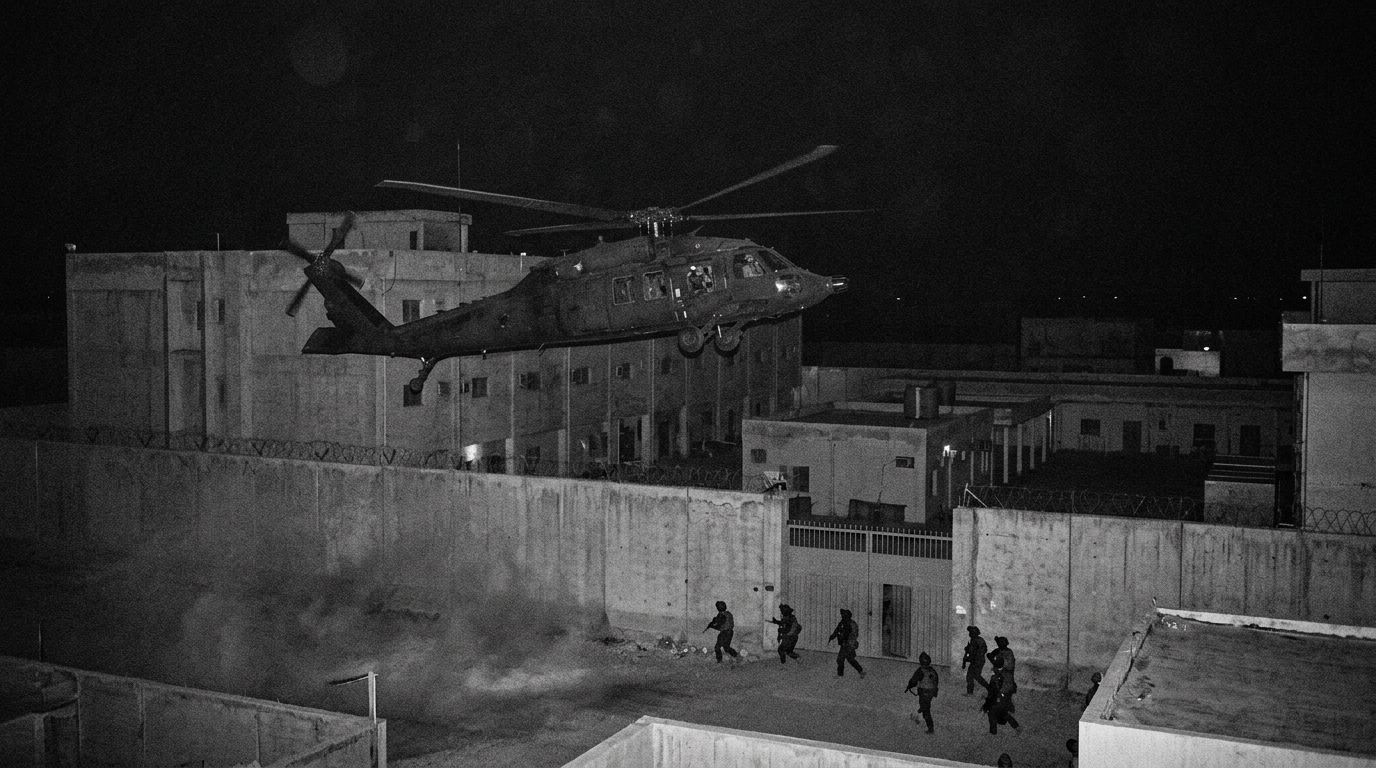
| Infiltration | Two modified MH-60 Black Hawk helicopters, accompanied by two MH-47 Chinook support aircraft, departed from Jalalabad, Afghanistan, into Pakistani airspace. | The Black Hawks utilized stealth technology and flew at low altitude to evade Pakistani radar. The journey covered approximately 150 miles over rugged terrain, maintaining radio silence. |
| The Breach & Crash | One modified MH-60 Black Hawk suffered a "vortex ring state" crash upon entering the compound. The team swiftly adapted, securing the site. | The helicopter's tail rotor clipped a wall, and reduced lift due to higher-than-expected temperatures and confined space (hot-and-high conditions) caused it to settle hard, destroying the tail section. No serious injuries. The SEALs destroyed the downed helicopter, switching to the remaining Black Hawk and the backup Chinook. |
| Engagement & Clearing | The SEAL team breached the compound, systematically clearing the guest house, outbuildings, and eventually the main three-story residence. | Teams used explosives and brute force to gain entry. The operation proceeded room by room, encountering limited resistance. Multiple individuals, including women and children, were encountered and secured. |
| Identification & Elimination | Bin Laden was identified on the third floor of the main residence, where he was killed. | The team confronted bin Laden in his bedroom. Following established rules of engagement, which allowed for lethal force against any armed or resisting target, bin Laden was shot. Positive identification was made by a SEAL, confirmed by a second SEAL, and later via DNA. |
| Intelligence Gathering | The team spent approximately 40 minutes collecting hard drives, flash drives, documents, and other materials. | The collection process was rapid and efficient, prioritizing electronic media and papers deemed valuable. This "grab bag" approach yielded an unprecedented intelligence haul, later known as the "Abbottabad Documents." |
| Exfiltration | The team, along with bin Laden's body and collected intelligence, departed for Afghanistan. | The remaining functional Black Hawk and the backup MH-47 Chinook extracted the SEALs, intelligence, and bin Laden's body. The downed helicopter was destroyed with explosives to prevent technology capture. |
| Confirmation & Announcement | President Obama announced bin Laden's death to the world. | On May 1, 2011, from the East Room of the White House, President Obama confirmed to a waiting world that Osama bin Laden had been killed, marking a pivotal moment in the War on Terror. |
"Justice has been done." — President Barack Obama, in his address to the nation on May 1, 2011, capturing the sense of resolution and vengeance fulfilled for a nation that had endured the specter of bin Laden for a decade.
Geopolitical Consequences and Aftermath
The fallout from the Abbottabad raid was immediate, seismic, and multifaceted, reverberating through international relations and domestic politics for years. For the United States, it was a moment of profound national catharsis, representing the culmination of a decade-long promise to bring the architect of 9/11 to justice. Domestically, the successful execution of such a high-stakes, high-risk mission provided President Obama with a significant boost to his security credentials. It validated his willingness to authorize decisive military action, countering prior criticisms regarding his perceived hesitancy in foreign policy and demonstrating the effectiveness of intelligence-led special operations. The public reaction was overwhelmingly positive, uniting a polarized nation, albeit temporarily, in a shared sense of victory and closure.
For Pakistan, the raid was nothing short of a profound national humiliation and a significant blow to its international standing. The revelation that the world's most wanted terrorist had been living for years in a custom-built compound, less than a mile from its premier military academy and within a secure garrison town, led to widespread accusations. Both within and outside of Pakistan, questions arose regarding the complicity or at the very least, severe incompetence, of elements within the Pakistani intelligence apparatus (the ISI) and military establishment. The idea that bin Laden could operate so brazenly without the knowledge of powerful state actors was difficult for many to accept, leading to theories ranging from deliberate state sponsorship to profound intelligence failures.
This triggered a period of deep mistrust and severe strain in the already fraught strategic partnership between Washington and Islamabad. The U.S. temporarily suspended a significant portion of its military aid to Pakistan and intensified surveillance of Pakistani military activities. Pakistan, in turn, retaliated by temporarily closing vital ground supply routes for NATO forces into Afghanistan, further complicating the war effort. The raid exacerbated a pre-existing trust deficit, forcing both nations to grapple with the implications of an ally operating unilaterally on sovereign territory, with long-term consequences for intelligence sharing and counter-terrorism cooperation. Pakistani public opinion was inflamed, oscillating between anger at the U.S. violation of sovereignty and shame over their military's perceived failure to detect bin Laden or the American incursion.
Furthermore, the mission fundamentally altered international law debates regarding the "right to hunt" terrorists. The U.S. assertion that it possessed the right to conduct unilateral military operations on the soil of a sovereign state—even a nominal ally—when that state was demonstrably unable or unwilling to address a clear and present security threat to the U.S., set a contentious precedent. This doctrine, sometimes referred to as the "unable or unwilling" standard, raised significant questions about national sovereignty, the limits of self-defense, and the future conduct of counter-terrorism operations. While some international legal scholars viewed it as a legitimate extension of self-defense in the context of non-state actors operating across borders, others condemned it as a dangerous erosion of international norms, particularly when applied against nominal allies.
Analysis of Key Actors and Decisive Actions
The success of Operation Neptune Spear was a symphony of coordinated effort, relying on the seamless intersection of high-level intelligence, unwavering political resolve, and unparalleled tactical excellence. Each component was indispensable, and any weakness could have spelled catastrophic failure.
- The Intelligence Community: The analysts at the CIA, particularly those in the Counterterrorism Center (CTC) and the specialized Bin Laden Unit, displayed extraordinary patience and forensic meticulousness. After years of chasing speculative leads and sifting through mountains of data, their decision to shift focus to bin Laden's most trusted courier, Abu Ahmed al-Kuwaiti, proved to be the pivotal breakthrough. This "courier-focused" methodology[^1], born out of repeated frustrations, avoided premature action and allowed for the slow, painstaking accumulation of evidence that ultimately led to the Abbottabad compound. Key figures like Michael Leiter, then Director of the National Counterterrorism Center, and John Brennan, President Obama’s Homeland Security Advisor, played crucial roles in synthesizing intelligence and presenting it to the President. CIA Director Leon Panetta's unwavering belief in the intelligence and his articulate presentation of the risks and rewards to the National Security Council were also critical in building consensus. The intelligence collected from the compound itself, known as the "Abbottabad Documents," provided an unprecedented "goldmine" of information, shaping U.S. counter-terrorism strategy for years thereafter.
- The Obama Administration: President Barack Obama faced an immense burden of responsibility. The intelligence assessment, while strong, was not absolute, leaving a significant margin of uncertainty. Vice President Joe Biden was reportedly skeptical of the mission's viability, favoring a more cautious approach, while Secretary of State Hillary Clinton famously advocated for the raid, recognizing the high reward. Secretary of Defense Robert Gates also expressed reservations about the operational risks. The President's leadership was characterized by a meticulous review of intelligence, intense questioning of his advisors, and a clear understanding that he alone would "own" the potential success or devastating failure of the mission. His willingness to authorize a high-stakes, unilateral raid into the territory of a nuclear-armed nominal ally underscored his resolve and commitment to national security, cementing his image as a decisive commander-in-chief.
- The Navy SEALs: The performance of SEAL Team Six (DEVGRU, the Naval Special Warfare Development Group), the elite unit tasked with the raid, was exemplary, even under extreme duress. Their rigorous training, conducted on full-scale mock-ups of the compound, prepared them for multiple contingencies. The unexpected crash of one of the specialized MH-60 Black Hawk helicopters, caused by a "vortex ring state" combined with challenging environmental factors[^2], could have derailed the entire mission. Instead, the SEALs demonstrated an astonishing ability to adapt instantaneously, secure the crash site, destroy the damaged aircraft, and continue with the primary objective. Their discipline in maintaining composure, prioritizing intelligence collection alongside the elimination of the target, and executing a complex extraction under fire solidified their reputation as the pinnacle of special operations forces. Their swift, precise action minimized civilian casualties within the compound and ensured the mission's primary objectives were met without significant compromise.
The 'Abbottabad Documents' and Al-Qaeda's Evolution
The true strategic victory of Operation Neptune Spear extended far beyond the symbolic killing of Osama bin Laden. The treasure trove of digital and physical materials recovered from the compound—hard drives, flash drives, handwritten journals, and letters, collectively dubbed the "Abbottabad Documents"—provided an unparalleled window into the inner workings of Al-Qaeda. This intelligence goldmine offered granular details regarding the organization's structure, its declining financial networks, its communication strategies, its future operational plans, and crucially, its ideological differences with emergent jihadi groups.
The documents revealed a bin Laden increasingly isolated and frustrated, struggling to exert control over a fragmented and evolving global jihadist movement. He was concerned about Al-Qaeda's public image, attempting to steer affiliates away from indiscriminate attacks against Muslim civilians, which he viewed as counterproductive to their broader goals. The documents showed his growing concern about the rise of regional affiliates and the need to re-establish a unified command structure. They also highlighted the profound logistical challenges Al-Qaeda faced, particularly in securing funding and maintaining secure communications in the face of relentless counter-terrorism pressure.
These insights significantly shaped U.S. counter-terrorism strategy in the years that followed. They provided critical understanding of Al-Qaeda's leadership succession plans, allowing for targeted operations against key figures like Ayman al-Zawahiri, bin Laden's successor. The documents illuminated Al-Qaeda's internal debates about strategy and ideology, offering a roadmap for exploitation by intelligence agencies. This intelligence was instrumental in pivoting counter-terrorism efforts from solely focusing on Al-Qaeda central to understanding and combating the burgeoning threat of its regional franchises and the rise of more extreme offshoots, such as the Islamic State of Iraq and Syria (ISIS), which ironically, bin Laden himself criticized for its brutality. The intelligence collected from Abbottabad thus helped anticipate the next phase of the jihadi threat, transforming how the U.S. approached counter-terrorism for the next decade.
Legal, Ethical, and Sovereignty Debates
The Abbottabad raid, while lauded as a counter-terrorism success, ignited complex and enduring legal, ethical, and sovereignty debates that continue to influence international discourse on armed conflict and state intervention.
From a legal standpoint, the core of the debate centered on Pakistan's national sovereignty versus the U.S.'s right to self-defense. Pakistan vehemently condemned the raid as a violation of its sovereignty and territorial integrity, arguing that it was a unilateral act of aggression by one state against another. The U.S., however, invoked the principle of self-defense, articulated in Article 51 of the UN Charter, arguing that Pakistan was "unwilling or unable" to eliminate a terrorist threat originating from its territory that posed an ongoing danger to the United States. This "unwilling or unable" doctrine is highly contentious, as it suggests a permissive legal framework for states to conduct military operations in other sovereign territories without consent, provided the host state fails to address non-state actor threats. Critics argue that this doctrine lacks clear international legal precedent and could be abused, leading to a breakdown of established international norms.
Ethically, questions arose regarding the killing of Osama bin Laden rather than his capture. U.S. officials maintained that the rules of engagement allowed for lethal force against an armed or resisting target, and that bin Laden was killed in a firefight. However, some critics argued that efforts should have been made to capture him for trial, consistent with principles of international justice. The decision to bury bin Laden at sea, while justified by the U.S. as preventing a pilgrimage site and adhering to Islamic tradition, also sparked ethical discussions about transparency and the handling of human remains in such sensitive operations.
The raid also exposed the moral hazard inherent in strategic partnerships where trust is compromised. The U.S. decision to keep Pakistan completely in the dark, fearing leaks, highlighted a deep lack of confidence in its ally's commitment or capability. This breach of trust had profound implications for future cooperation, demonstrating that national security interests could, at times, supersede diplomatic courtesies and alliance commitments, creating a precedent for similar unilateral actions in the future. The Abbottabad raid thus stands as a watershed moment, not only for counter-terrorism but for the complex interplay of international law, state sovereignty, and the ethical dilemmas inherent in confronting non-state threats in a globalized world.
Trivia and Lesser-Known Facts
- Operation Name Evolution: The mission was initially given the highly controversial code name "Operation Geronimo" by some within the military, evoking the famous Apache leader. This was quickly changed to "Operation Neptune Spear" by the Joint Special Operations Command (JSOC) due to cultural sensitivities and concerns about potential offense to Native American communities.
- The "Vortex Ring State": The crash of the first helicopter was a complex aerodynamic event. The modified MH-60 Black Hawk, designed for stealth, lacked the customary downwash-preventing devices. Coupled with higher-than-expected ambient temperatures inside the compound's high walls (which thinned the air, reducing lift) and the pilot's attempt to hover in a confined space, the helicopter settled into its own recirculating downwash, causing it to lose lift unexpectedly and crash-land, destroying its tail section.
- Stealth Technology: The two Black Hawks used in the raid were highly modified, previously unknown stealth variants. Their advanced radar-absorbing materials and noise-reduction technologies allowed them to penetrate Pakistani airspace largely undetected. The destruction of one of these helicopters necessitated its rapid demolition to prevent the recovery and reverse-engineering of its classified technology. The tail section of the crashed helicopter, however, was later recovered by Pakistan and reportedly handed over to China, sparking intelligence concerns.
- Intelligence Goldmine, Not Just Papers: The materials retrieved from the compound—dubbed the "Abbottabad Documents"—were not just paper files. They included over 100 flash drives, 10 hard drives, 11 smartphones, and numerous video and audio recordings, providing an unprecedented digital insight into Al-Qaeda’s operations and bin Laden’s personal thoughts.
- The Dog's Role: A Belgian Malinois military working dog named Cairo was part of the SEAL team. Cairo was reportedly involved in perimeter security and could have been used to track anyone attempting to flee. His presence underscored the multifaceted tactical planning of the mission.
- The Cover Story: To explain the destruction of the helicopter and the noise of the raid, a cover story was prepped in case of public exposure. The plan was to claim a joint U.S.-Pakistani operation that went awry, with the helicopter suffering a crash during an anti-terrorism mission.
- Forensic Confirmation: While visual identification by the SEALs was immediate, bin Laden's identity was later confirmed through DNA testing, utilizing samples taken from the body and comparing them to DNA from his deceased sister, whose tissue samples were held by the U.S. government. This was a critical step for absolute confirmation.
- The Burial at Sea: Bin Laden’s body was transported to the USS Carl Vinson in the Arabian Sea. Following Islamic traditions, his body was washed, wrapped in a white shroud, and placed in a weighted bag. A Muslim officer onboard recited religious rites, and the body was then gently placed into the sea within 24 hours of his death. This was a deliberate choice to prevent the creation of a permanent shrine for his followers.
References and Literature
- The Hunt for bin Laden by Peter Bergen - A comprehensive account of the decade-long search for Osama bin Laden, offering unparalleled insights from intelligence officials and firsthand accounts leading up to the Abbottabad raid.
- CIA Official Archives on Operation Neptune Spear - Declassified documents, official chronologies, and historical analyses released by the CIA, detailing the intelligence cycle, planning, and execution of the raid.
- Foreign Affairs: The Abbottabad Implications - A collection of academic and policy analyses on how the raid fundamentally impacted U.S.-Pakistan strategic relations, international sovereignty norms, and the evolving nature of counter-terrorism.
- No Easy Day: The Autobiography of a Navy SEAL by Mark Owen (Matt Bissonnette) - A controversial but detailed first-person account from one of the SEAL team members involved in the raid, offering tactical specifics and personal reflections.
- Obama's Wars by Bob Woodward - Provides extensive background on the Obama administration's decision-making process regarding the Afghanistan surge and the hunt for bin Laden.
- Wikipedia: Death of Osama bin Laden - A detailed technical and historical overview of the timeline, participants, and immediate aftermath of the raid, drawing from publicly available sources.
Footnotes & Explanations
- This refers to the CIA’s "courier-focused" intelligence methodology developed after years of dead-end leads, prioritizing human intelligence and painstaking surveillance. ↩
- The term "vortex ring state" describes a dangerous aerodynamic condition where a helicopter settles into its own downwash. Combined with high temperatures (reducing air density) and the confined space of the compound, it caused the aircraft to lose lift unexpectedly. ↩