Key Takeaways
- The crisis marked the permanent breakdown of diplomatic relations between the United States and the Islamic Republic of Iran, establishing a foundational enmity that persists to this day.
- The failure of Operation Eagle Claw fundamentally altered U.S. military strategic planning, leading to the creation of the United States Special Operations Command (USSOCOM) and enhancing inter-service coordination.
- The event cemented the concept of the 'Great Satan' in Iranian revolutionary rhetoric, shaping domestic legitimacy and foreign policy for decades while consolidating hardline clerical power within Iran.
- The prolonged hostage situation and perceived U.S. impotence significantly contributed to Jimmy Carter's 1980 election defeat, ushering in the Reagan era.
- The crisis showcased the limitations of conventional diplomacy when confronting ideologically driven, non-state or revolutionary actors, foreshadowing future geopolitical challenges.
Historical Context and Origins
To understand the seismic events that unfolded in Tehran on November 4, 1979, one must look beyond the immediate catalyst of the Shah’s medical admission. The crisis was not an isolated incident but the boiling point of decades of accumulated resentment, geopolitical maneuvering, and deep-seated ideological conflict between the United States and Iran. For nearly three decades, the U.S. had been the principal foreign patron of the Pahlavi dynasty, largely seeing Iran as a crucial bulwark against Soviet expansion in the oil-rich Persian Gulf and a key player in its "Twin Pillars" strategy for regional stability, alongside Saudi Arabia.
This strategic alignment, however, came at a considerable cost to Iranian national sentiment. The pivotal moment in this fraught relationship was the 1953 CIA-backed coup d'état, known as Operation Ajax. This covert operation, initiated by the U.S. and the UK, successfully orchestrated the overthrow of Iran's immensely popular, democratically elected Prime Minister, Mohammad Mossadegh. Mossadegh's sin, in the eyes of Washington and London, was his decision to nationalize the Anglo-Iranian Oil Company, reclaiming Iran's sovereign control over its vast oil resources. The coup reinstated the young Shah, Mohammad Reza Pahlavi, to absolute power, reversing Iran's nascent democratic aspirations and leaving a deep scar on the national consciousness – a profound sense of betrayal and a lasting suspicion of Western intervention.
Throughout the 1960s and 1970s, the Shah, backed by immense U.S. military and economic aid, embarked on an ambitious program of modernization known as the "White Revolution." This included land reform, women's suffrage, and industrial expansion, often at a rapid pace that disrupted traditional societal structures. While some reforms were progressive, they were implemented top-down, without genuine democratic participation, and often benefited a select elite. Crucially, the Shah’s secularizing policies alienated the powerful traditional religious establishment, which saw its influence eroded and its values challenged. Simultaneously, his heavy-handed use of the SAVAK (Sazman-e Ettela'at va Amniyat-e Keshvar), his brutal secret police, crushed dissent from both secular intellectuals and religious leaders, leading to widespread human rights abuses and the imprisonment or exile of countless political opponents. The perception grew that the Shah was a puppet of the West, particularly the United States, enriching himself and his family while suppressing his own people.
By 1978, the simmering discontent erupted into the Iranian Revolution, a broad-based, populist movement fueled by mass protests, strikes, and revolutionary fervor. The charismatic and uncompromising leadership of Ayatollah Ruhollah Khomeini, who had been exiled for his anti-Shah rhetoric since 1964, directed the movement from abroad, first from Iraq and then from France. Khomeini masterfully articulated the grievances of various factions – the religious conservatives, the secular left, the urban poor, and the middle class – coalescing them around a powerful anti-imperialist, anti-Shah, and increasingly anti-American message. His vision of an Islamic government resonated deeply across Iranian society.
When the Shah finally fled Iran in January 1979, the vacuum was swiftly filled by revolutionary forces. The U.S. government, then under President Jimmy Carter, found itself in an unenviable position. Paralysed by shifting intelligence reports, internal debates, and a desire to maintain a strategic foothold in the region without alienating the new, unpredictable regime, Washington initially struggled to define its relationship with the emerging Islamic theocracy. There was a desperate hope among some U.S. policymakers that a moderate government could eventually emerge from the revolutionary chaos. However, the decision by President Carter to allow the ailing Shah to enter the United States for cancer treatment in October 1979 proved to be the spark that ignited the tinderbox. For the revolutionaries, it was irrefutable evidence, confirming their fears of a lingering American imperial shadow, a prelude to another U.S.-backed coup aimed at restoring the monarchy. The memory of 1953 was fresh and potent, and the stage was set for an unprecedented confrontation.
Timeline of Events and Key Moments
The crisis unfolded over a period that tested the resolve of two nations, the patience of the world, and the very fabric of American foreign policy. It was a prolonged ordeal marked by diplomatic efforts, military blunders, and profound human drama.
| Date | Event | Significance |
|---|---|---|
| Oct 22, 1979 | Shah Mohammad Reza Pahlavi enters U.S. for medical treatment | The immediate catalyst that infuriated Iranian revolutionaries, who saw it as a provocative act and potential precursor to a coup. |
| Nov 1, 1979 | Iranian Prime Minister Mehdi Bazargan meets Zbigniew Brzezinski in Algiers | Photo of meeting fuels revolutionary anger, seen as collusion between the provisional government and the "Great Satan." |
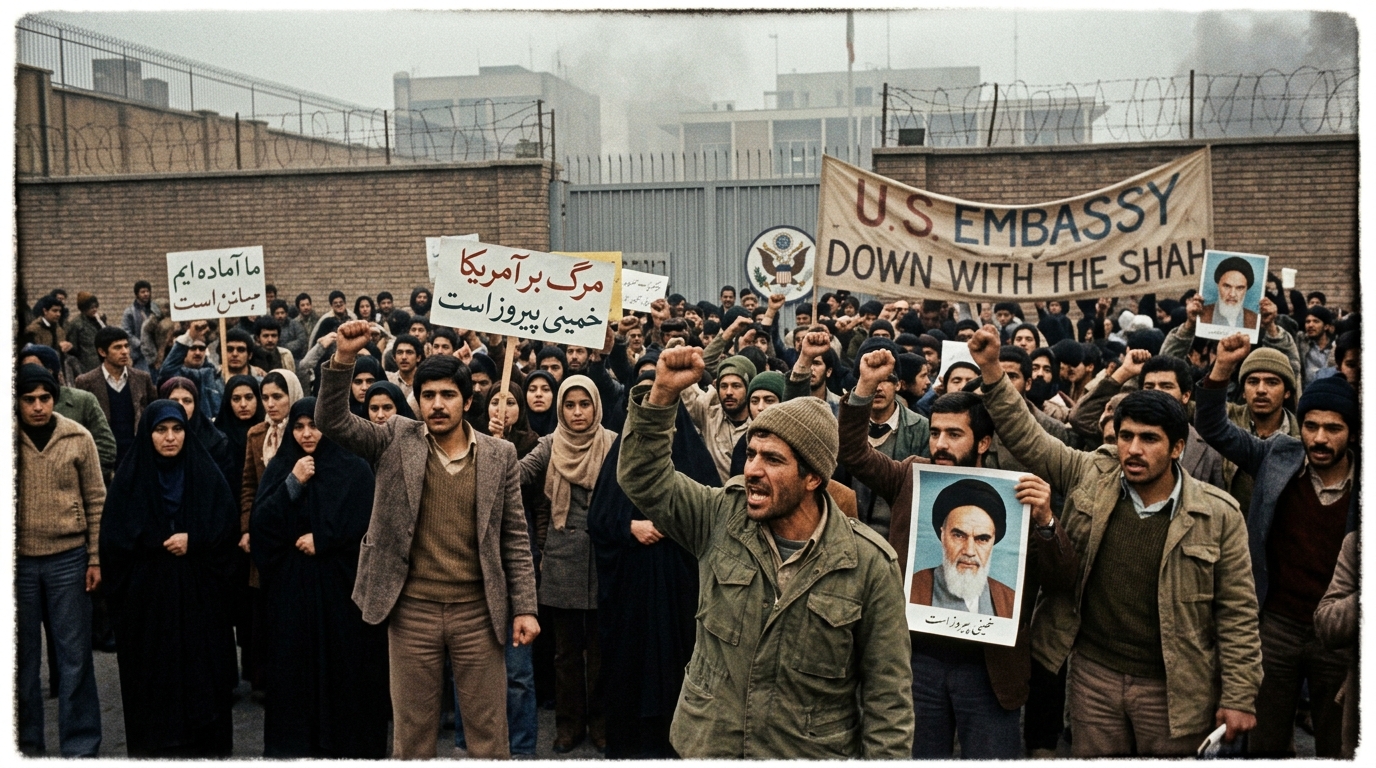
| Nov 4, 1979 | U.S. Embassy in Tehran stormed | Militant students, later known as the "Muslim Student Followers of the Imam’s Line," seize 66 Americans, holding 52 for the full duration. |
| Nov 6, 1979 | Bazargan's provisional government resigns | Demonstrates the weakening of moderate forces and the consolidation of power by revolutionary hardliners, including Ayatollah Khomeini. |
| Nov 14, 1979 | U.S. freezes Iranian assets in American banks | A major economic retaliation, setting a precedent for future sanctions warfare. |
| Nov 17-20, 1979 | Thirteen female and African-American hostages released | A propaganda move by Khomeini to portray the revolution as anti-imperialist, not anti-humanitarian, targeting "oppressors" not "oppressed minorities." |
| Dec 1979 | Constitutional referendum in Iran | Establishes the Islamic Republic with Khomeini as Supreme Leader, solidifying his absolute authority. |
| Jan 1980 | Six Americans escape Tehran with Canadian help (The "Canadian Caper") | Covert operation by the CIA and Canadian government provides a rare moment of success amidst the crisis. |
| Apr 7, 1980 | U.S. severs diplomatic relations with Iran | A decisive step by President Carter, indicating a hardening stance and the failure of initial diplomatic overtures. |
| Apr 24-25, 1980 | Operation Eagle Claw (Desert One) | Failed rescue attempt results in eight U.S. servicemen deaths and the destruction of three aircraft, a major blow to American prestige. |
| July 27, 1980 | Shah dies in Egypt | Removes one core demand of the hostage-takers (his return for trial), but does not immediately lead to hostage release as other demands emerge. |
| Sep 22, 1980 | Iraq invades Iran, starting the Iran-Iraq War | Shifts Iran's priorities, creating a new geopolitical dynamic that eventually pushes Iran towards resolving the hostage crisis. |
| Nov 4, 1980 | Ronald Reagan wins U.S. Presidential Election | The crisis significantly contributes to Carter's defeat, with the public eager for a new, tougher approach. |
| Jan 19, 1981 | Algiers Accords signed | Diplomatic agreement mediated by Algeria, outlining terms for hostage release, including unfreezing assets and non-intervention. |
| Jan 20, 1981 | Hostages released after 444 days | Occurs exactly as Ronald Reagan is inaugurated, a final symbolic slight to the outgoing Carter administration and a dramatic end to the ordeal. |
The hostage-takers, calling themselves the "Muslim Student Followers of the Imam’s Line," were a relatively small group of radical students from Tehran University. While they initially claimed autonomy, their actions were swiftly and strategically endorsed by Ayatollah Khomeini. Khomeini famously dubbed the United States the "Great Satan," effectively transforming the seizure of the embassy from a student radical act into a state-sanctioned geopolitical weapon. For 444 days, the world watched in astonishment as a global superpower was held in check by a revolutionary movement, forcing Washington to engage in complex, back-channel negotiations while the public mood in America grew increasingly hawkish and frustrated. The crisis became a daily ordeal, profoundly impacting U.S. domestic politics and international standing.
Intelligence Failures and Policy Miscalculations
A crucial antecedent to the crisis was a cascade of intelligence failures and policy miscalculations by the United States that spanned decades, intensifying in the lead-up to the revolution. For years, U.S. intelligence agencies, particularly the CIA, had become overly reliant on the Shah's government as their primary source of information within Iran. This relationship fostered a dangerous echo chamber, wherein the Shah's optimistic self-assessments and carefully curated reports were often accepted at face value, masking the widespread discontent brewing beneath the surface.
The U.S. intelligence community consistently overestimated the Shah's stability and popularity while underestimating the deep-seated grievances against his regime. Warnings from more independent analysts about the Shah's authoritarianism, the growing strength of the religious opposition, and the potential for revolutionary upheaval were frequently dismissed or downplayed. The State Department, often advocating for a more nuanced engagement with various Iranian factions, found its counsel outweighed by the National Security Council and Pentagon's focus on strategic stability and military cooperation with the Shah.
A critical misjudgment was the failure to comprehend the ideological potency and organizational capacity of Ayatollah Khomeini's movement. U.S. analysts, largely secular in their outlook, struggled to grasp the popular appeal of a religious figure and the revolutionary zeal he commanded. They often viewed religious opposition as archaic and incapable of seizing power, a fundamental misreading of Iranian society. When Khomeini moved from Iraq to France in late 1978, his access to international media amplified his message, yet American intelligence still failed to fully appreciate the depth of his popular support or the revolutionary storm he was orchestrating.
Furthermore, the U.S. lacked a coherent and flexible strategy for dealing with a post-Shah Iran. Policy options ranged from supporting a military coup to attempting to cultivate a relationship with moderate elements of the emerging revolutionary government. This indecision, coupled with a delayed recognition of the revolution's irreversible momentum, meant that when the Shah finally fled, Washington was left with few viable alternatives and no strong allies within the new power structure. The decision to admit the Shah to the U.S. for medical treatment, though made on humanitarian grounds, was a profound diplomatic miscalculation, demonstrating a clear lack of understanding of the revolutionary mindset and the historical trauma of the 1953 coup. This act, more than any other, validated the revolutionaries' narrative of persistent American imperial interference and provided the ultimate justification for the embassy takeover.
Geopolitical Consequences and Aftermath
The aftermath of the Iran Hostage Crisis fundamentally reorganized Middle Eastern geopolitics and sent shockwaves through international relations. The United States officially severed all diplomatic ties with Iran on April 7, 1980, a rupture that has lasted for over four decades and continues to define the fraught relationship between the two nations. This diplomatic vacuum created an environment of mistrust and hostility, where communication is indirect and potential for miscalculation remains high.
Within Iran, the crisis proved to be a critical period for the consolidation of the Islamic Republic. Ayatollah Khomeini masterfully used the anti-American fervor generated by the embassy takeover to rally popular support and systematically purge moderate elements from his own revolutionary government. Figures like Prime Minister Mehdi Bazargan, who favored a more pragmatic approach to international relations, were sidelined or forced to resign. The crisis solidified the power of the clerical hardliners, effectively transforming the provisional government into a truly theocratic state with Khomeini at its undisputed apex as the Supreme Leader. It cemented the ideological foundation of the Islamic Republic, framing its identity in terms of resistance against perceived Western imperialism and specifically, the "Great Satan." This ideological posture has since influenced Iranian domestic and foreign policy, justifying support for various proxy groups and challenging the existing regional order.
For the United States, the crisis precipitated a significant shift in its Middle East policy. The "Twin Pillars" strategy, which relied on Iran and Saudi Arabia to maintain regional stability, lay in ruins. Washington pivoted more decisively towards Saudi Arabia and other Gulf monarchies, increasing military aid and strategic cooperation. This realignment contributed to the militarization of the Gulf region and laid the groundwork for future U.S. interventions. The crisis also fostered a deep-seated distrust of revolutionary movements and a strong emphasis on intelligence gathering in volatile regions.
Furthermore, the spectacularly failed rescue attempt, Operation Eagle Claw, exposed critical vulnerabilities and systemic deficiencies within the U.S. military apparatus. The subsequent "Holloway Report" (formally titled the Report of the Special Operations Review Group) delivered a scathing assessment, highlighting the glaring lack of inter-service coordination, inadequate training for joint operations, overly complex command structures, and insufficient specialized equipment. These findings directly led to a massive reorganization of how special operations forces were structured and trained. The most significant outcome was the creation of the United States Special Operations Command (USSOCOM) in 1987 and the establishment of the Joint Special Operations Command (JSOC), designed to ensure seamless cooperation and command across different branches of the military for complex, high-stakes missions. This institutional reform fundamentally altered U.S. military strategic planning and capabilities, making future special operations forces far more integrated and effective.
On the international stage, the crisis underscored the limitations of traditional diplomacy when facing non-state actors or regimes fueled by intense ideological or religious zeal. It revealed the vulnerability of diplomatic missions and personnel and highlighted the growing complexity of international terrorism and state-sponsored radicalism. The crisis initiated an era of increased security for embassies worldwide and prompted a re-evaluation of how nations protect their diplomatic interests in politically volatile regions.
Analysis of Key Actors and Decisive Actions
The Iran Hostage Crisis was a crucible that revealed the strengths and weaknesses of its principal actors, their ideologies, and their decision-making under immense pressure.
Jimmy Carter and the "Rose Garden" Strategy
President Jimmy Carter's handling of the crisis was perhaps the defining challenge of his presidency. His approach was characterized by a focus on "quiet diplomacy," a deep moral imperative to ensure the safe return of the hostages without further loss of life, and a cautious avoidance of military escalation that could endanger the captives or ignite a wider regional conflict. Carter's administration grappled with internal divisions, particularly between Secretary of State Cyrus Vance, who advocated for sustained diplomatic efforts, and National Security Advisor Zbigniew Brzezinski, who pushed for more assertive, including military, options. Vance’s principled resignation after the failed rescue mission underscored these deep policy disagreements.
Carter's refusal to campaign vigorously for re-election while the hostages remained in captivity—the so-called "Rose Garden" strategy—was intended to convey seriousness and focus on the crisis. However, it was widely perceived by the American electorate as a sign of passivity and impotence. His constant updates from the White House, while intended to reassure, inadvertently highlighted the duration and insolubility of the crisis. Carter's restraint, while perhaps aimed at preventing a wider war and protecting the hostages, left him vulnerable to criticisms of weakness and indecisiveness, which Ronald Reagan exploited masterfully during the 1980 campaign. The public yearned for decisive action and a restoration of American pride, sentiments that Carter, constrained by the realities of the situation, found difficult to project.
Ayatollah Ruhollah Khomeini
Ayatollah Ruhollah Khomeini viewed the crisis not merely as a diplomatic incident but as a foundational event in the divine struggle between the oppressed (Iran) and the oppressors (the United States). He brilliantly utilized the hostages as a political weapon to achieve several crucial objectives:
- Consolidate Revolutionary Legitimacy: By portraying the U.S. as the "Great Satan" and the source of all Iran's problems, he galvanized nationalist and religious fervor, uniting disparate revolutionary factions under his banner.
- Purge Moderates: The anti-American sentiment allowed Khomeini to systematically discredit and remove liberal, secular, and more pragmatic elements within his own revolutionary government (such as Prime Minister Mehdi Bazargan and later President Abolhassan Banisadr) who sought to normalize relations with the West.
- Establish Theocratic Authority: The crisis reinforced the narrative that only a pure Islamic government, led by the clergy, could truly protect Iran from foreign domination, thereby solidifying his absolute authority as Supreme Leader.
- Force Global Recognition: By keeping the hostages, he ensured that Iran stayed on the center stage of global politics, forcing Western powers to negotiate on his terms and acknowledge the legitimacy of the new Islamic Republic.
"America is the Great Satan, the great oppressor, and the source of all evil. We must show them that the revolution will not be dictated to by the masters of the world." — Ayatollah Ruhollah Khomeini
Zbigniew Brzezinski and Cyrus Vance
The internal policy debates within the Carter administration were personified by the stark differences between National Security Advisor Zbigniew Brzezinski and Secretary of State Cyrus Vance. Brzezinski, a hardline geopolitical strategist, advocated for a more confrontational approach, including the use of force, believing that American credibility was at stake. He was a primary architect and proponent of Operation Eagle Claw. Vance, a career diplomat, emphasized patient negotiation and the humanitarian aspect, fearing that military action would endanger the hostages and alienate international allies. His deep opposition to the rescue mission led to his resignation, a highly unusual and significant act, just before the mission's failure became public. This internal conflict weakened the administration's ability to present a unified front and highlighted the profound dilemma of balancing national honor with human lives.
The Algiers Accords and the Hostage Release
The eventual resolution of the crisis, after 444 agonizing days, came through a complex and protracted diplomatic process facilitated primarily by the neutral government of Algeria. Negotiations intensified in the latter half of 1980, catalyzed by several factors: the death of the Shah (removing one of Iran's core demands), the consolidation of hardline power in Tehran (allowing for more decisive leadership), and crucially, the outbreak of the Iran-Iraq War in September 1980. The devastating war shifted Iran's priorities, as the nascent Islamic Republic suddenly faced an existential threat and desperately needed access to its frozen assets and international legitimacy.
The Algiers Accords, signed on January 19, 1981, were the culmination of these intense diplomatic efforts. The agreement stipulated several key provisions:
- Hostage Release: Iran pledged to immediately release the 52 American hostages.
- Asset Unfreezing: The United States agreed to unfreeze approximately $8 billion in Iranian assets held in American banks, which had been frozen since November 1979.
- Claims Settlement: Both countries agreed to establish an Iran-U.S. Claims Tribunal at The Hague to arbitrate outstanding financial claims between the two governments and their citizens, preventing endless litigation.
- Non-Intervention: The U.S. pledged not to interfere, directly or indirectly, in Iran's internal affairs.
- Arms Embargo: The U.S. implicitly agreed to drop any claims for military equipment purchased by the Shah's regime but not delivered, a point of contention given the ongoing war.
The precise timing of the release was highly symbolic and designed to deliver a final, deliberate slight to the outgoing Jimmy Carter administration. The hostages were released into U.S. custody literally minutes after Ronald Reagan was sworn in as President on January 20, 1981. This choreographed timing was a calculated act by Khomeini to deny Carter any credit for the resolution, further humiliating him on his last day in office, and signaling a new, uncompromising era in Iranian foreign policy. For the American public, it was a moment of immense relief, though overshadowed by a pervasive sense of national injury that would linger for years.
Socio-Political and Psychological Impact
The Iran Hostage Crisis left an indelible mark on the socio-political fabric of both the United States and Iran, and its psychological toll on the hostages themselves was profound.
In the United States, the crisis ignited a potent mixture of national frustration, patriotic fervor, and anti-Iranian sentiment. The daily televised updates, particularly from ABC News's The Iran Crisis: America Held Hostage (which evolved into Nightline), brought the ordeal directly into American living rooms, creating a sense of collective humiliation and helplessness. This constant media coverage amplified public demands for decisive action and contributed significantly to a shift in the American political mood. There was a palpable longing for a return to perceived American strength and resolve, which Ronald Reagan skillfully tapped into during his 1980 presidential campaign. The crisis is widely regarded as a key factor in Carter's landslide defeat. It fostered a deep-seated suspicion of foreign regimes perceived as hostile and contributed to a more hawkish, interventionist stance in U.S. foreign policy.
For the hostages, the experience was a severe psychological trauma. Held in isolation, subjected to mock executions, psychological manipulation, and often kept blindfolded and bound, they endured immense stress. Their return was met with a hero's welcome, but many struggled with post-traumatic stress disorder (PTSD) and other long-term psychological effects. Their ordeal became a cautionary tale about the dangers faced by diplomatic personnel and the complexities of international crises.
In Iran, the crisis had an equally significant, though very different, socio-political impact. It galvanized the revolutionary spirit, fostered a strong sense of national unity against an external "enemy," and solidified the ideological underpinnings of the Islamic Republic. The image of the U.S. as the "Great Satan" became a cornerstone of Iranian state propaganda and identity, shaping educational curricula, public discourse, and foreign policy for decades. The crisis also fostered a culture of revolutionary martyrdom and resistance, which would be further intensified by the brutal Iran-Iraq War that immediately followed. It allowed the new regime to deflect internal criticism by focusing on the external threat, cementing its control over the narrative and suppressing dissenting voices.
Trivia and Lesser-Known Facts
- The Length of Captivity: While 52 hostages were held for the full 444 days, some hostages—including 13 women and African-American staff—were released relatively early, in November 1979. This was a calculated propaganda move by Khomeini to demonstrate that the revolution was against American "imperialism" and not against women or minorities. One additional hostage, the Vice Consul Richard Queen, was released in July 1980 due to a serious medical condition (multiple sclerosis).
- The Secret Escape (The "Canadian Caper"): In one of the few bright spots of the crisis, six American diplomats who had evaded capture during the embassy storming found refuge at the Canadian and British embassies. The CIA, in conjunction with the Canadian government, orchestrated a daring covert operation to smuggle them out of Tehran in January 1980. Led by CIA operative Tony Mendez, the operation involved providing the Americans with fake Canadian passports and disguising them as a film crew scouting locations for a fictional science fiction movie titled "Argo." This incredible story was later dramatized in the Academy Award-winning film Argo.
- Media Impact and the Birth of Nightline: The crisis profoundly influenced American journalism. The ABC News program The Iran Crisis: America Held Hostage, hosted by Ted Koppel, began as a nightly update on the crisis. Its immense popularity and the public's insatiable demand for information quickly led to its evolution into Nightline, pioneering the format of the late-night news and discussion program and helping to establish the concept of the 24-hour news cycle.
- Economic Sanctions as a Weapon: The U.S. decision to freeze approximately $8 billion in Iranian assets in American banks (November 1979) was an unprecedented use of financial power. This move served as a direct precursor and foundational model for the sophisticated "sanctions warfare" that has become a staple of U.S. foreign policy in the decades since, against countries like Cuba, Iraq, North Korea, and Russia.
- The "Yellow Ribbons" Campaign: The crisis popularized the symbol of the yellow ribbon in the United States, tied around trees and poles, signifying hope for the safe return of loved ones held captive. This tradition, rooted in an old folk song, gained widespread national prominence during the 444 days and has since been used in various contexts to symbolize remembrance or hope for the return of absent personnel, particularly military.
- The Iran-Iraq War's Influence: The outbreak of the Iran-Iraq War in September 1980, less than a year after the embassy seizure, significantly altered Iran's calculus regarding the hostages. Facing a full-scale invasion and desperate for financial resources and an end to international isolation, the Iranian government became more amenable to negotiations, ultimately accelerating the path to the Algiers Accords.
References and Literature
- The 444 Days: A History of the Iran Hostage Crisis - Official archives providing primary documentation on the diplomatic failures and successes of the Carter administration, including declassified cables and memos.
- Guests of the Ayatollah: The First Battle in America's War with Militant Islam by Mark Bowden - The definitive journalistic account of the 444-day ordeal, blending harrowing personal testimonies of the hostages with comprehensive historical and geopolitical analysis.
- The Eagle Claw Debacle (Air Force Historical Research Agency) - A detailed technical assessment of the military failures during the failed rescue mission, offering critical insights into the lessons learned for U.S. special operations doctrine and inter-service coordination.
- Foreign Affairs: The Iran Hostage Crisis and its Legacy - Academic analysis of the long-term impact of the crisis on U.S. policy in the Middle East, including articles dissecting the ideological shifts in both nations.
- The Shah's Last Ride: The Story of the Exile, the Illness, and the Death of Iran's Indomitable Monarch by William Shawcross - Provides essential context on the Shah's life, his final days, and the pivotal decision to admit him to the U.S., which served as the crisis's spark.
- America's Great Game: The CIA's Secret Interventions in Iran and Afghanistan by Hugh Wilford - Offers deeper historical context on the 1953 coup and subsequent U.S. involvement in Iran, framing the roots of Iranian anti-American sentiment.
Footnotes & Explanations
- The Holloway Report, officially titled Report of the Special Operations Review Group, was an internal U.S. government document detailing the operational failures of the Iranian rescue mission, commissioned by the Joint Chiefs of Staff. ↩
- Historical analysis confirms that the Algerian-brokered Algiers Accords were the primary diplomatic vehicle that secured the final release of the hostages, a complex negotiation spanning months. ↩