Key Takeaways
- The Dayton Accords successfully ended three and a half years of devastating inter-ethnic warfare in Bosnia and Herzegovina, halting the worst conflict in Europe since World War II.
- The agreement established a highly complex, decentralized state structure divided into two primary entities—the Federation of Bosnia and Herzegovina and Republika Srpska—held together by a weak central government.
- U.S.-led 'bulldozer diplomacy,' spearheaded by Richard Holbrooke under the Clinton administration, demonstrated a paradigm shift in post-Cold War Western military and diplomatic intervention.
Historical Context and Origins
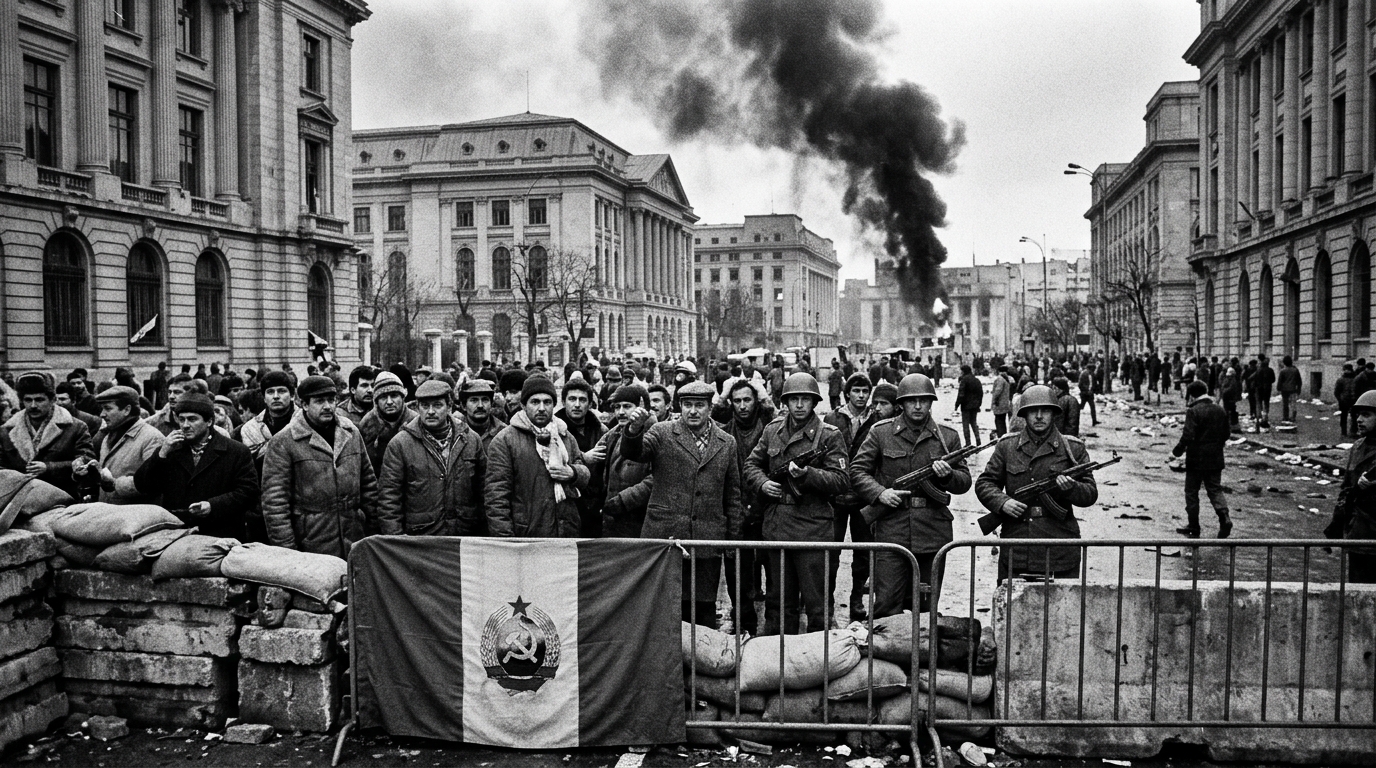
The disintegration of the Socialist Federal Republic of Yugoslavia in the early 1990s unleashed a wave of ethno-nationalism that plunged the Western Balkans into violent conflict. Following the declarations of independence by Slovenia and Croatia in 1991, the multi-ethnic Republic of Bosnia and Herzegovina faced an existential dilemma. Home to a diverse population of Bosniaks (Bosnian Muslims), Orthodox Serbs, and Catholic Croats, the republic held a referendum on independence in late February and early March 1992. The referendum, boycotted by the vast majority of Bosnian Serbs, passed overwhelmingly. On April 6, 1992, the European Community recognized Bosnia's independence, triggering an immediate and highly organized armed uprising by Bosnian Serb paramilitaries backed by the Yugoslav People's Army (JNA) 1.
What followed was three and a half years of brutal warfare characterized by siege tactics, mass expulsions, systematic sexual violence, and ethnic cleansing on a scale unseen in Europe since the fall of the Third Reich. The capital, Sarajevo, was subjected to the longest siege in modern military history. Bosnian Serb forces, organized as the Army of Republika Srpska (VRS) under the command of General Ratko Mladić and political leadership of Radovan Karadžić, quickly seized control of over 70 percent of Bosnian territory.
Throughout the conflict, international diplomatic efforts repeatedly floundered. A succession of peace initiatives—including the Carrington-Cutileiro Plan (1992), the Vance-Owen Peace Plan (1993), the Owen-Stoltenberg Plan (1993), and the European Contact Group proposal (1994)—failed because they either validated territorial gains achieved through violence or were rejected by one or more of the warring factions 2. The United Nations Protection Force (UNPROFOR), hampered by a weak mandate and a lack of political will from member states, proved unable to protect designated "safe areas."
- Yugoslavia Disintegration (1991)
The geopolitical calculus shifted dramatically in the summer of 1995. In July, Bosnian Serb forces overran the UN-declared safe area of Srebrenica, systematically executing over 8,000 Bosniak men and boys. This atrocity, combined with a second deadly marketplace shelling in Sarajevo in August, shattered Western diplomatic paralysis.
Concurrently, a successful joint offensive by the Croatian Army (Operation Storm) and the Army of the Republic of Bosnia and Herzegovina (ARBiH) rolled back Bosnian Serb territorial holdings in western Bosnia. Recognizing a window of opportunity where military realities on the ground matched diplomatic objectives, the United States, under the administration of President Bill Clinton, launched a decisive diplomatic offensive. NATO initiated Operation Deliberate Force, a sustained aerial bombardment campaign against VRS positions, which forced the Bosnian Serb leadership to accept a negotiated settlement 3.
Timeline of Events and Key Moments
The road to the Dayton Accords was paved by intensive shuttle diplomacy conducted in August and September 1995 by U.S. Assistant Secretary of State Richard Holbrooke. Holbrooke secured a critical mandate: Slobodan Milošević, the President of the Federal Republic of Yugoslavia (Serbia and Montenegro), would represent the Bosnian Serb interests, sidelining the indicted war criminals Karadžić and Mladić.
The Preliminary Frameworks (September 1995)
- September 8, 1995: In Geneva, the foreign ministers of Bosnia, Croatia, and Yugoslavia agreed to basic principles. They formally accepted that Bosnia and Herzegovina would continue its legal existence within its present borders but would be structured into two entities: the Federation of Bosnia and Herzegovina and Republika Srpska.
- September 26, 1995: In New York, the parties agreed on the constitutional principles of the future state, including a tripartite presidency, a bicameral parliament, and a constitutional court.
- October 12, 1995: A nationwide ceasefire took effect, providing the necessary stability to convene direct negotiations.
The Dayton Proximity Talks (November 1–21, 1995)
The U.S. government selected the Wright-Patterson Air Force Base near Dayton, Ohio, as the venue for the peace conference. The location was intentionally chosen for its isolation, secure perimeter, and Spartan atmosphere, which prevented delegates from escaping to the media or avoiding one another.
- November 1, 1995: The conference officially opened. The three main signatories were Alija Izetbegović (President of the Presidency of Bosnia and Herzegovina), Franjo Tuđman (President of Croatia), and Slobodan Milošević (representing Yugoslavia and the Bosnian Serbs). The negotiations were mediated by Richard Holbrooke, alongside Carl Bildt representing the European Union, and Igor Ivanov representing the Russian Federation.
- November 2–10, 1995: Initial talks focused on the constitutional structure and international monitoring. The atmosphere was highly tense, characterized by deep-seated mutual suspicion. Holbrooke utilized "proximity talks," physically moving between the delegations' quarters to broker compromises, occasionally utilizing maps projected onto computer screens to resolve territorial disputes.
- November 11–15, 1995: Territorial allocation (the "51-49" formula) became the central battleground. The status of Sarajevo—whether it should be divided or remain a unified city—and the width of the Posavina corridor connecting the eastern and western halves of Republika Srpska were major sticking points.
- November 18–20, 1995: The conference teetered on the brink of collapse. Izetbegović resisted proposals that partitioned Sarajevo or left isolated Bosniak enclaves like Goražde without a secure access land corridor. In a series of dramatic late-night sessions, Milošević made key concessions, agreeing to yield the high ground around Sarajevo and transfer the entire capital to the Federation, in exchange for adjustments elsewhere.
- November 21, 1995: At 11:40 AM, President Bill Clinton announced from Washington that an agreement had been reached. The leaders initialed the General Framework Agreement for Peace (GFAP) in a ceremony at Dayton [[^4]].
| Date (1995) | Key Event / Milestone | Geopolitical Outcome |
|---|---|---|
| August 30 | Launch of NATO's Operation Deliberate Force | Degraded Bosnian Serb military infrastructure; forced willingness to negotiate. |
| September 8 | Geneva Principles signed | Accepted the two-entity division within a sovereign Bosnia. |
| October 12 | Nationwide ceasefire | Halted active hostilities, enabling diplomatic mobilization. |
| November 1 | Dayton Negotiations commence | Gathered Izetbegović, Tuđman, and Milošević under strict U.S. supervision. |
| November 21 | Initialing of the GFAP at Dayton | Officially concluded the draft treaty, setting boundaries and governance. |
| December 14 | Signing of the Treaty in Paris | Formally enacted the peace agreement in the presence of global leaders. |
The Paris Signing (December 14, 1995)
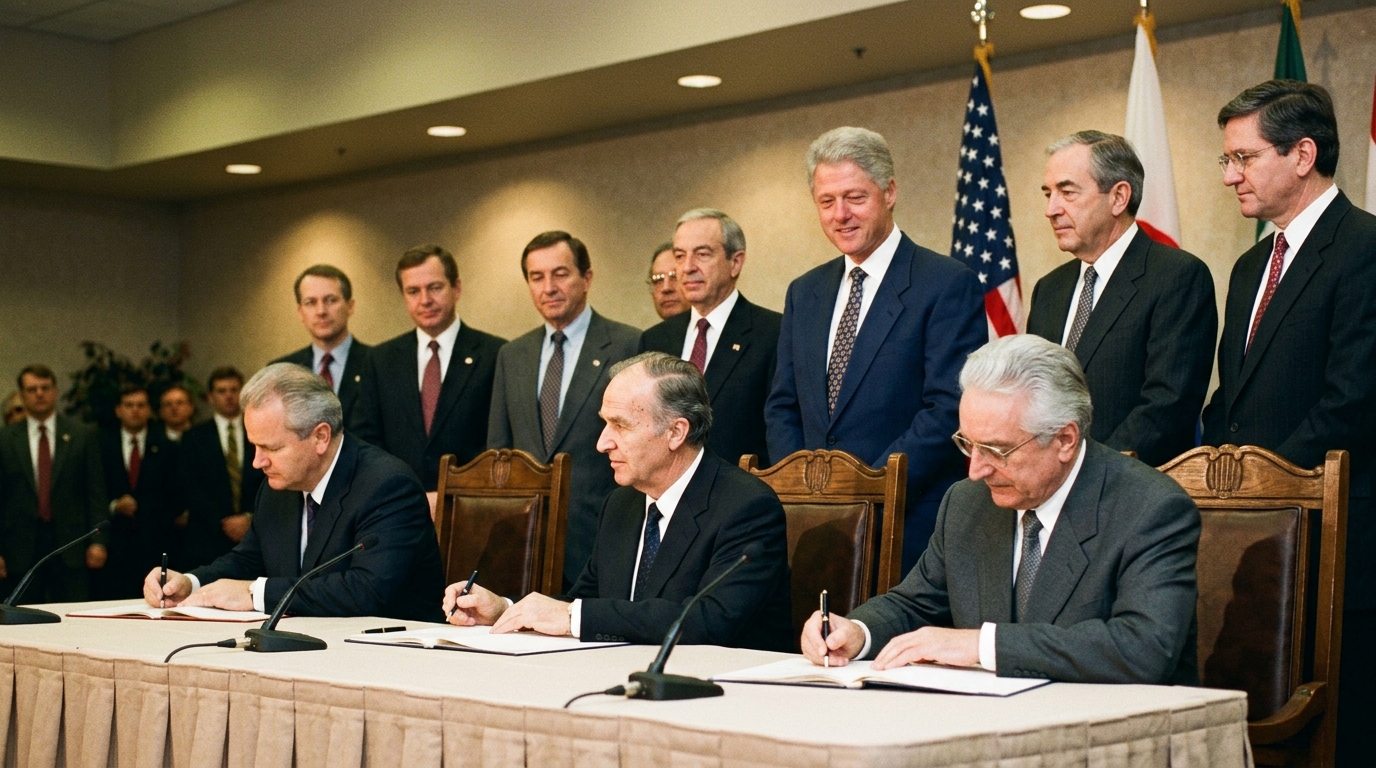
The initialed agreement was formally signed at the Élysée Palace in Paris on December 14, 1995. The signing was witnessed by global leaders, including U.S. President Bill Clinton, French President Jacques Chirac, British Prime Minister John Major, German Chancellor Helmut Kohl, and Russian Prime Minister Viktor Chernomyrdin.
- Dayton Proximity Talks (Nov 1–21, 1995)
- Initialing of GFAP at Wright-Patterson AFB (Nov 21, 1995)
- Formal Signing of the Paris Peace Treaty (Dec 14, 1995)
Geopolitical Consequences and Aftermath
The Dayton Peace Agreement succeeded in its primary humanitarian objective: it immediately and permanently stopped the killing. However, the constitutional architecture it imposed created one of the most complex, decentralized, and institutionally paralyzed states in the world.
The Constitutional Blueprint (Annex 4)
Annex 4 of the GFAP served as the new Constitution of Bosnia and Herzegovina. It established a state structure characterized by extreme consociationalism, designed to protect the collective rights of the three "constituent peoples" (Bosniaks, Croats, and Serbs) at the expense of individual civic citizenship.
- Two Entities: The country was split into the Federation of Bosnia and Herzegovina (primarily Bosniak and Croat, occupying 51% of the territory) and the Republika Srpska (primarily Serb, occupying 49%). A third unit, the Brčko District, was established in 1999 as a self-governing neutral condominium to resolve a dispute over a strategic northern corridor.
- Tripartite Presidency: The executive branch consists of three members: one Bosniak and one Croat elected from the Federation, and one Serb elected from the Republika Srpska. The presidency rotates its chair every eight months.
- Bicameral Legislature: The Parliamentary Assembly comprises the House of Representatives and the House of Peoples. Legislation requires the consent of both houses, and delegates can invoke the "Vital National Interest" (VNI) veto, allowing any ethnic group to block a law it deems detrimental to its community.
"The constitution established at Dayton was designed to end a war, not to govern a country in the long term." [[^5]]
The Office of the High Representative (OHR)
To oversee the civilian aspect of the transition, the agreement created the Office of the High Representative (Annex 10). Because local ethnic political elites routinely blocked reforms, the Peace Implementation Council (PIC) expanded the OHR's mandate in 1997 through the Bonn Powers. These powers granted the High Representative the authority to bypass the Bosnian parliament, impose binding legislation, and summarily dismiss elected officials or civil servants deemed to be violating the Dayton Accords. While this interventionist tool broke political deadlocks, it also fostered a form of international protectorate, weakening the development of native democratic accountability.
| State of Bosnia & Herzegovina |
|---|
| Federation of BiH (51% Territory) |
| - Primarily Bosniak & Croat |
| - Decentralized into 10 Cantons |
| Republika Srpska (49% Territory) |
| - Primarily Serb |
| - Highly Centralized Structure |
Military Transition and International Security
The military implementation was swift and effective. Annex 1-A established the mandate for a NATO-led multinational force. On December 20, 1995, the UNPROFOR mission officially handed over control to the Implementation Force (IFOR), comprising 60,000 heavily armed troops. IFOR successfully separated the warring factions, established a demilitarized Zone of Separation (ZOS), and oversaw the transfer of territories. In December 1996, IFOR transitioned into the smaller Stabilization Force (SFOR), which was eventually replaced in 2004 by the European Union-led EUFOR Althea mission.
Analysis of Key Actors and Decisive Actions
The realization of the Dayton Agreement was heavily dictated by the personalities, political constraints, and strategic calculations of the primary negotiators.
Richard Holbrooke and "Bulldozer Diplomacy"
U.S. Assistant Secretary of State Richard Holbrooke was the architect of the negotiations. His diplomatic style, often termed "bulldozer diplomacy," combined aggressive persuasion, intellectual coercion, and the implicit threat of U.S. military power. Holbrooke recognized that the regional leaders were highly pragmatic political actors who responded to leverage rather than moral suasion. He utilized the momentum of NATO airstrikes and the Croatian ground offensive to force the parties to the table. His strategy of focusing on the three regional presidents—Milošević, Tuđman, and Izetbegović—deliberately bypassed local extremist voices, streamline decision-making.
Slobodan Milošević: The Pragmatic Autocrat
As the President of the Federal Republic of Yugoslavia, Slobodan Milošević was the critical link to the Bosnian Serbs. Eager to lift the crippling UN economic sanctions imposed on Belgrade, Milošević was willing to abandon the maximalist territorial claims of the Bosnian Serb leadership in Pale. At Dayton, he systematically sidelined Radovan Karadžić, accepting crucial territorial concessions—including the unification of Sarajevo under Federation control—without consulting the Bosnian Serb delegation. His primary objective was to position himself as an indispensable peacemaker to secure his own regime's survival in Serbia.
| Leader | Goal | Action |
|---|---|---|
| Slobodan Milošević | Lift economic sanctions on Yugoslavia | Sidelined Bosnian Serb hardliners; conceded Sarajevo. |
| Franjo Tuđman | Consolidate Croatian territory (Eastern Slavonia) | Supported the Federation split; prioritized Croat interests. |
| Alija Izetbegovic | Preserve Bosnia's sovereign integrity | Accepted internal ethnic partition to end the genocide. |
Alija Izetbegović: The Reluctant Signatory
Representing the internationally recognized Bosnian government, Alija Izetbegović faced the most painful ethical and political dilemmas. He sought a unified, democratic, multi-ethnic state. However, the military reality forced him to accept a highly decentralized, ethnically partitioned country. Izetbegović fiercely contested any constitutional mechanisms that would allow the eventual secession of Republika Srpska. His reluctant consent to the Dayton framework was driven by a grim realization that continuing the war, despite recent military gains, risked further demographic destruction of the Bosniak population.
Franjo Tuđman: The Strategic opportunist
The Croatian President, Franjo Tuđman, arrived at Dayton from a position of immense military strength. Having cleared Krajina of Serb forces during Operation Storm, Tuđman used his leverage to secure the peaceful integration of Eastern Slavonia back into Croatia (agreed via the Erdut Agreement in parallel to Dayton) 6. He maintained a dual policy: supporting the Federation of Bosnia and Herzegovina to maintain his alliance with the United States, while simultaneously securing autonomous protections for the Bosnian Croats within that federation.
Bill Clinton: The Domestic Imperative
For President Bill Clinton, the escalation of the Bosnian War in 1995 had become a major domestic political liability and a threat to the credibility of NATO and U.S. leadership in post-Cold War Europe. With the 1996 presidential election approaching, Clinton authorized Holbrooke's high-risk diplomatic mission and committed up to 20,000 American troops to the subsequent peacekeeping force, asserting America’s role as the indispensable security guarantor in Europe.
Trivia and Lesser-Known Facts
- The Lost Original Treaty: After the formal signing in Paris, the original Bosnian copy of the Dayton Agreement was lost. In 2008, Alija Izetbegović’s former associate, Željko Komšić, revealed that the copy signed by Izetbegović had vanished from the state presidency archives. It was eventually recovered in 2017 when police arrested a former politician's driver who was attempting to sell it on the black market in Pale.
- The Spartan Barracks Effect: Richard Holbrooke deliberately chose the Hope Hotel quarters at Wright-Patterson Air Force Base because the rooms were basic, identical, and close to one another. He wanted the presidents to feel the claustrophobia of their environment, writing in his memoirs that the "leveling effect" of the military barracks prevented any single delegation from feeling superior.
- The "Napkin Map" Diplomacy: At a dinner during the talks, Franjo Tuđman drew a map of the future Balkans on the back of a menu (often referred to as the "napkin map") for a British politician. The drawing showed Bosnia and Herzegovina divided cleanly down the middle between Croatia and Serbia, revealing the underlying partitionist desires of the neighboring states.
- The Brčko Dispute Decided by a Coin Flip? The status of the strategic Brčko corridor was so intractable that it threatened to derail the final day of negotiations. Unable to reach a compromise, the parties agreed at the last minute to leave the issue to international arbitration. A popular rumor persisted that the negotiators seriously contemplated flipping a coin to decide its fate before choosing the arbitration panel that eventually created the Brčko District.
References and Literature
- To End a War - Richard Holbrooke's definitive personal memoir of the diplomatic strategy and behind-the-scenes negotiations that led to the Dayton Accords.
- The Death of Yugoslavia - Allan Little and Laura Silber's comprehensive journalistic account and accompanying documentary detailing the political fragmentation of Yugoslavia.
- The Dayton Peace Accords: Text of the Agreement - The official, digitized text of the General Framework Agreement for Peace in Bosnia and Herzegovina, hosted by the U.S. Department of State.
- Balkan Tragedy: Chaos and Dissolution after the Cold War - Susan L. Woodward's critical scholarly analysis of the structural, economic, and political causes of the war and its international settlement.
Footnotes & Explanations
- Silber, Laura, and Allan Little. Yugoslavia: Death of a Nation. Penguin Books, 1997. ↩
- Burg, Steven L., and Paul S. Shoup. The War in Bosnia-Herzegovina: Ethnic Conflict and International Intervention. M.E. Sharpe, 1999. ↩
- Daalder, Ivo H. Getting to Dayton: The Making of America's Bosnia Policy. Brookings Institution Press, 2000. ↩
- Holbrooke, Richard. To End a War. Random House, 1998. ↩
- Bieber, Florian. Post-War Bosnia: Ethnicity, Inequality and Public Sector Governance. Palgrave Macmillan, 2006. ↩
- Ramet, Sabrina P. The Three Yugoslavias: State-Building and Legitimation, 1918–2005. Indiana University Press, 2006. ↩