Key Takeaways
- The crisis was triggered by the secret deployment of Soviet medium- and intermediate-range ballistic missiles in Cuba, discovered by US aerial reconnaissance in October 1962.
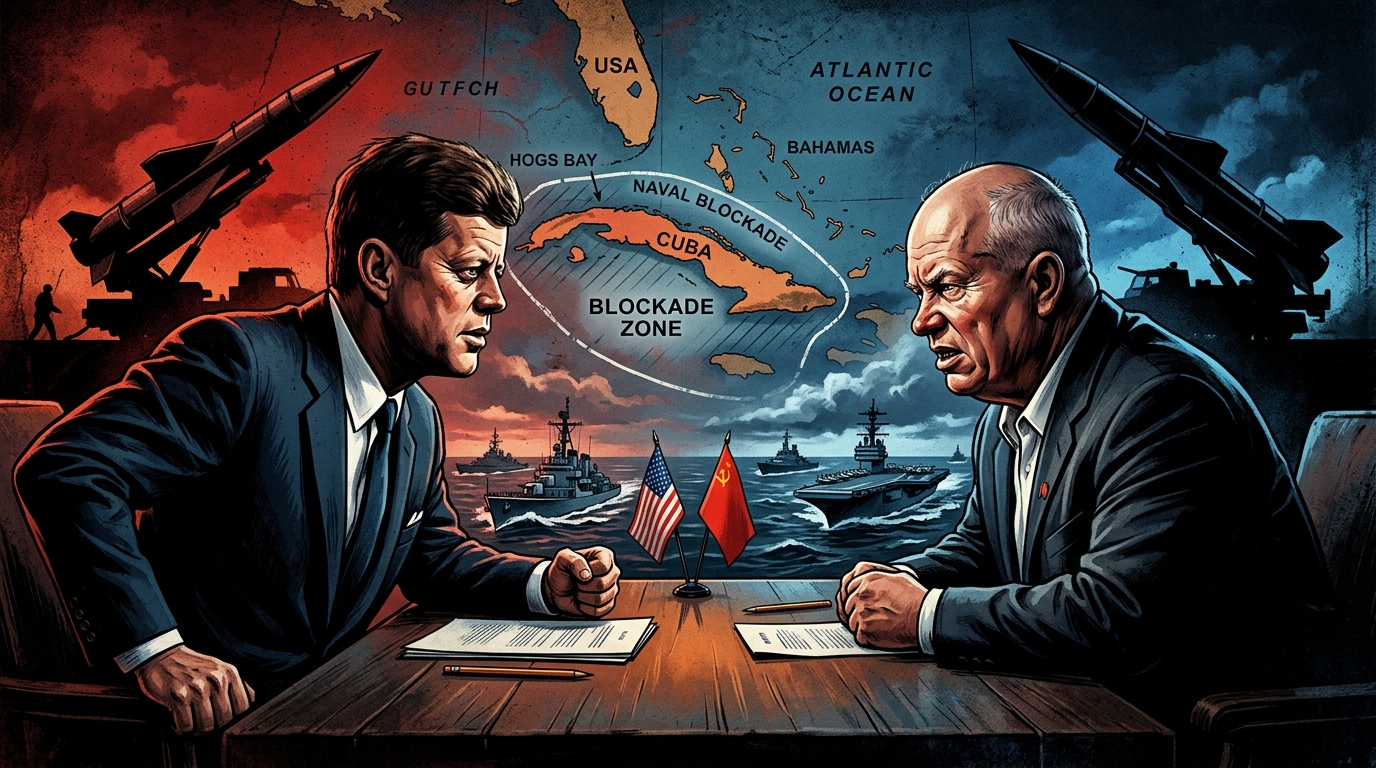
- President John F. Kennedy opted for a naval 'quarantine' rather than an immediate military invasion, opening a window for intensive, high-stakes back-channel diplomacy.
- The standoff was resolved through a secret compromise: the USSR dismantled its Cuban missiles in exchange for a public US pledge not to invade Cuba and a private agreement to withdraw US Jupiter missiles from Turkey.
Historical Context and Origins
The Cuban Missile Crisis of October 1962 did not occur in a vacuum. It was the explosive convergence of several geopolitical trends: the intensification of the global Cold War, the revolutionary transformation of Cuba, and the strategic imbalance in nuclear strike capabilities between the United States and the Soviet Union.
Following the end of the Second World War, the ideological chasm between Western democratic capitalism and Eastern bloc communism hardened into a global struggle for dominance. By the early 1960s, the Cold War had shifted from the divided continent of Europe to the developing world. In January 1959, Fidel Castro’s 26th of July Movement successfully overthrew the US-backed dictatorship of Fulgencio Batista in Cuba 1. Initially, Castro was not an avowed Marxist-Leninist, but his radical agrarian reforms and nationalization of US-owned assets rapidly alienated Washington.
In response, the Eisenhower administration began planning covert actions to depose Castro, plans which culminated in the disastrous Bay of Pigs invasion in April 1961 under the newly inaugurated President John F. Kennedy 2. The failure of the invasion, coupled with ongoing CIA sabotage operations under the umbrella of Operation Mongoose, convinced Castro that a direct US military invasion was imminent. Seeking a powerful protector, Castro turned decisively toward the Soviet Union.
"We have a sovereign right to defend ourselves... We will not allow ourselves to be intimidated." — Fidel Castro, responding to US covert operations and threats.
For Soviet Premier Nikita Khrushchev, Castro’s vulnerability presented a golden opportunity. Khrushchev faced mounting pressure at home and within the communist bloc, particularly from a rising China, which accused Moscow of being soft on Western imperialism. Furthermore, Khrushchev was acutely aware of the "missile gap"—not the one of campaign rhetoric, but the actual, overwhelming US superiority in nuclear delivery vehicles. By 1962, the United States possessed approximately 5,000 strategic nuclear warheads compared to the USSR’s roughly 300. More provocatively from the Soviet perspective, the US had deployed intermediate-range Jupiter nuclear missiles to Italy and Turkey, placing Moscow within a 15-minute flight time of American nuclear warheads 3.
By deploying medium-range (MRBM) and intermediate-range (IRBM) ballistic missiles to Cuba, Khrushchev aimed to achieve two objectives with a single stroke:
- Deter any future US invasion of Cuba, thereby preserving the first communist outpost in the Western Hemisphere.
- Redress the strategic nuclear imbalance by placing American cities within range of Soviet missiles without having to wait for the slow, expensive development of the Soviet intercontinental ballistic missile (ICBM) program.
In May 1962, Khrushchev initiated Operation Anadyr—a highly secretive military deployment of over 40,000 Soviet troops, dozens of nuclear-capable missiles, and their associated warheads to Cuba. The deployment was designed to be completed under a shroud of absolute secrecy, to be presented to the world as a fait accompli after the US midterm elections in November 1962.
Timeline of Events and Key Moments
The crisis officially began for the United States on the morning of October 16, 1962, when National Security Advisor McGeorge Bundy presented President Kennedy with high-altitude reconnaissance photographs taken by a U-2 spy plane two days earlier. The images, analyzed by the National Photographic Interpretation Center (NPIC), clearly showed the construction of Soviet medium-range ballistic missile launch sites near San Cristóbal, Cuba 4.
THE THIRTEEN-DAY TIMELINE
| Date | Event |
|---|---|
| Oct 14 | U-2 flight captures missile sites in Cuba. |
| Oct 16 | JFK notified; ExComm is formed. |
| Oct 22 | JFK delivers televised address; Quarantine announced. |
| Oct 24 | Quarantine line takes effect; Soviet ships halt. |
| Oct 26 | Khrushchev's first conciliatory letter arrives. |
| Oct 27 | "Black Saturday" (U-2 shot down; secret negotiations). |
| Oct 28 | Khrushchev publically agrees to withdraw missiles. |
The Formation of ExComm (October 16–21)
President Kennedy immediately convened a group of top national security advisors, which became known as the Executive Committee of the National Security Council (ExComm). For nearly a week, this group met in absolute secrecy to deliberate on the US response. The debates within ExComm reflected a profound divide:
- The Joint Chiefs of Staff and Military Hawks: Strongly advocated for a massive preemptive airstrike to destroy the missile sites, followed by a full-scale ground invasion of Cuba. They argued that any delay would allow the missiles to become operational, threatening tens of millions of American lives.
- The Diplomatic and Moderate Faction: Led by Secretary of Defense Robert McNamara and Attorney General Robert F. Kennedy, this group feared that an airstrike would inevitably kill Soviet personnel, forcing a military retaliation by Khrushchev in West Berlin or against US missile bases in Turkey. This, they warned, would rapidly escalate into a global thermonuclear war.
McNamara proposed an alternative: a naval blockade of Cuba. To avoid the legal definition of a blockade as an act of war under international law, Kennedy termed the action a "quarantine"—a selective block of offensive military equipment designed to buy time for diplomatic negotiations.
The Crisis Goes Public (October 22–25)
On the evening of October 22, President Kennedy delivered a dramatic, televised address to the nation. He revealed the existence of the Soviet missiles in Cuba, announced the implementation of the naval quarantine, and warned that any nuclear missile launched from Cuba against any nation in the Western Hemisphere would be regarded as an attack by the Soviet Union on the United States, requiring a full retaliatory response.
"It shall be the policy of this nation to regard any nuclear missile launched from Cuba against any nation in the Western Hemisphere as an attack by the Soviet Union on the United States, requiring a full retaliatory response upon the Soviet Union." — President John F. Kennedy, October 22, 1962 [^5]
The world held its breath. On October 24, the quarantine line took effect. A fleet of US warships positioned themselves around Cuba, prepared to intercept Soviet vessels. As several Soviet cargo ships carrying military equipment approached the quarantine line, they suddenly slowed, stopped, and turned back toward Soviet ports. While this brought a momentary sigh of relief in Washington—prompting Secretary of State Dean Rusk to famously remark, "We're eyeball to eyeball, and I think the other fellow just blinked"—the operational missiles already inside Cuba remained a mortal threat.
The Climax: "Black Saturday" (October 26–27)
On the evening of October 26, Khrushchev sent a long, highly personal, and emotional letter to Kennedy. He suggested a potential compromise: the Soviet Union would remove its missiles from Cuba if the United States promised never to invade the island and to lift the quarantine.
However, the next morning, October 27—a day that would become known as "Black Saturday"—the crisis escalated to its most dangerous point. A second, much more formal and aggressive letter arrived from Khrushchev, demanding that the United States also dismantle its Jupiter missile sites in Turkey as a condition for the removal of Soviet missiles from Cuba.
Simultaneously, a series of military incidents threatened to trigger an unauthorized escalation:
- A U-2 spy plane, piloted by USAF Major Rudolf Anderson, was shot down over Cuba by a Soviet-operated surface-to-air missile (SAM) battery. Anderson was killed instantly. The US Joint Chiefs of Staff demanded immediate retaliatory airstrikes against the SAM sites, which Kennedy postponed.
- Another U-2 plane accidentally strayed into Soviet airspace over Siberia due to a navigational error, prompting Soviet fighters to scramble and US fighters to escort the spy plane back, narrowly avoiding an aerial skirmish.
- In the Sargasso Sea, a US destroyer dropped signaling depth charges on a submerged Soviet submarine, B-59. Unbeknownst to the US military, the submarine was armed with a tactical nuclear torpedo and was out of contact with Moscow. The captain, believing war had already begun, ordered the launch of the nuclear weapon. The launch was blocked only because the brigade chief of staff, Vasily Arkhipov, refused to give the mandatory third signature required to authorize the launch [^6].
Geopolitical Consequences and Aftermath
The resolution of the Cuban Missile Crisis on October 28, 1962, was widely celebrated as a triumph of American resolve and Kennedy’s cool-headed statesmanship. However, the true nature of the resolution—and the profound systemic adjustments it triggered—unfolded over the subsequent months and years, fundamentally altering the architecture of the Cold War.
The Implementation of the Compromise
Following the secret agreement brokered by Robert Kennedy and Anatoly Dobrynin, the Soviet Union quickly dismantled the nuclear launch facilities, crated the MRBMs and IRBMs, and shipped them back to the USSR. In return, the United States formally lifted the naval quarantine and publicly pledged never to launch a military invasion of Cuba.
The secret component of the agreement was also fulfilled. In early 1963, the Kennedy administration quietly ordered the removal of all Jupiter missiles from Turkey and Italy. To preserve JFK’s domestic political reputation and avoid showing weakness to NATO allies, the removal was publicly framed as a scheduled modernization program, replacing obsolete land-based missiles with highly survivable, submarine-launched Polaris missiles.
Institutionalizing Crisis Management: The Hot Line and Treaties
The terrifying realization that a localized conflict could spiral out of control due to communication delays led to immediate structural reforms. During the peak of the crisis, it had taken up to twelve hours for formal diplomatic messages to be transmitted, translated, and analyzed by the opposing leadership.
To bridge this dangerous gap, the "Hot Line" agreement was signed in Geneva on June 20, 1963. This established a direct, 24-hour teleprinter link between the White House and the Kremlin, allowing for instantaneous communication during future crises.
| Location | Connection | Location |
|---|---|---|
| White House (Washington) | Direct Teleprinter Link | Kremlin (Moscow) |
Furthermore, the crisis acted as a catalyst for nuclear arms control. On August 5, 1963, the United States, the Soviet Union, and the United Kingdom signed the Limited Test Ban Treaty (LTBT), which prohibited the testing of nuclear weapons in the atmosphere, in outer space, and underwater 7. This was a crucial first step in a long process of nuclear diplomacy that would eventually lead to the Treaty on the Non-Proliferation of Nuclear Weapons (NPT) in 1968 and the Strategic Arms Limitation Talks (SALT) in the 1970s.
Impact on Global Alliances and Leadership
The crisis had profound domestic and international political ramifications for all three leaders involved:
- In Washington: Kennedy’s prestige soared. He successfully silenced his domestic right-wing critics who had accused him of weakness since the Bay of Pigs. However, this success reinforced a dangerous and mistaken belief in the efficacy of "flexible response" and gradual military escalation, which would later draw the United States deeply into the Vietnam War.
- In Moscow: Khrushchev’s capitulation was viewed with deep resentment by the Soviet military-industrial complex and hardliners within the Politburo. They felt humiliated by the public retreat and the perceived asymmetry of the deal. This loss of prestige was a major contributing factor to Khrushchev's ouster from power in October 1964, replaced by Leonid Brezhnev, who initiated a massive expansion of the Soviet Union's ICBM arsenal to ensure the USSR would never again be forced to back down due to nuclear inferiority.
- In Havana: Fidel Castro felt deeply betrayed by Khrushchev. The Soviet leader had negotiated the removal of the missiles, the IL-28 bombers, and Soviet troops without consulting or informing the Cuban government. This betrayal led to a temporary cooling of Soviet-Cuban relations and drove Castro to pursue a more independent foreign policy, actively supporting leftist revolutionary movements in Latin America and Africa to secure his own global leverage.
Analysis of Key Actors and Decisive Actions
The resolution of the Cuban Missile Crisis is often cited as a masterclass in crisis management, but it also highlights how close humanity came to accidental annihilation due to miscalculation, cognitive biases, and bureaucratic inertia.
| Leader | Primary Objectives | Key Decisions | Strategic Legacy |
|---|---|---|---|
| John F. Kennedy | Prevent Soviet missiles from becoming operational; avoid global nuclear war; maintain US credibility. | Imposed naval quarantine; resisted military calls for immediate airstrikes; initiated back-channel negotiations. | Solidified doctrine of "flexible response"; demonstrated the power of offering an adversary a face-saving exit. |
| Nikita Khrushchev | Protect revolutionary Cuba; balance the strategic nuclear deficit; gain leverage in Berlin. | Authorized Operation Anadyr; agreed to withdraw missiles in exchange for non-invasion pledge and Jupiter removal. | Undermined his domestic political standing; initiated the transition of Soviet policy toward strategic nuclear parity. |
| Fidel Castro | Prevent a US invasion; preserve the Cuban socialist revolution; gain geopolitical agency. | Accepted Soviet missiles; ordered Cuban air defenses to fire on US aircraft; advocated a preemptive nuclear strike. | Exposed the dangers of proxy states escalating superpower conflicts; pursued independent revolutionary paths. |
John F. Kennedy: The Evolution of Restraint
Kennedy's performance during the crisis represented a significant evolution from his previous foreign policy missteps. Having read Barbara Tuchman's The Guns of August (which detailed how European leaders stumbled blindly into World War I), Kennedy was obsessed with avoiding "miscalculation." He resisted the near-unanimous pressure from his military advisors—including General Curtis LeMay, who claimed that the quarantine was "almost as bad as the appeasement at Munich" 8—to launch an immediate airstrike.
Instead, Kennedy systematically analyzed how his actions would be perceived by Khrushchev. He recognized that cornering a nuclear-armed adversary with no honorable path of retreat was an invitation to catastrophe. By utilizing the naval quarantine and providing Khrushchev with a face-saving exit (the public non-invasion pledge and the secret Jupiter missile removal), Kennedy demonstrated a sophisticated understanding of coercive diplomacy.
Nikita Khrushchev: The High-Stakes Gambler
Khrushchev’s decision to deploy missiles to Cuba was a characteristic gamble that underestimated American intelligence capabilities and political resolve. He believed that Kennedy was young, weak, and intellectually incapable of taking decisive action, a perception formed during their tense confrontation at the Vienna Summit in June 1961.
However, when confronted with the quarantine and the reality of US military readiness, Khrushchev demonstrated pragmatism. Unlike many of his subordinates, he recognized that once the crisis had peaked, the preservation of human life and the survival of the Soviet state outweighed any ideological or strategic gains. His emotional letter on October 26 revealed a leader deeply terrified of the forces he had unleashed:
"If you have not lost your self-control and clearly understand what this might lead to, then, Mr. President, we and you ought not now to pull on the ends of the rope in which you have tied the knot of war, because the more the two of us pull, the tighter that knot will be tied." — Nikita Khrushchev, in his letter to JFK, October 26, 1962 [^9]
Fidel Castro: The Uncompromising Revolutionary
Fidel Castro’s role in the crisis was marked by ideological fervor and national pride. For Castro, the missiles were a legitimate means of self-defense against a predatory imperialist neighbor. He resented being used as a pawn in superpower chess and grew increasingly frustrated as Moscow and Washington negotiated the fate of his country over his head.
At the height of the crisis on October 27, Castro sent a letter to Khrushchev (the "Armageddon Letter") suggesting that if the United States invaded Cuba—an act he believed was imminent—the Soviet Union should launch a preemptive nuclear strike against the US mainland, even if it meant the total destruction of Cuba 10. This letter horrified Khrushchev and underscored the immense danger of giving tactical control of nuclear weapons to regional allies driven by revolutionary zeal.
Trivia and Lesser-Known Facts
While the broad contours of the Cuban Missile Crisis are well known, historical archives released decades later have revealed several shocking details that illustrate how close the world came to the precipice of war:
- The Crucial Role of Vasily Arkhipov: On October 27, 1962, the Soviet submarine B-59 was hunted by US Navy destroyers in international waters. The US ships dropped "practice" depth charges to force the submarine to surface. Deprived of air conditioning, with carbon dioxide levels rising, and out of contact with Moscow, the submarine's captain, Valentin Savitsky, believed that war had already broken out and ordered the arming of a 10-kiloton nuclear torpedo. To launch the weapon, the captain, the political officer (Ivan Maslennikov), and the second-in-command (Vasily Arkhipov) all had to agree. Arkhipov was the lone dissenter, calmly persuading the captain to surface and await instructions from Moscow, thereby single-handedly preventing a nuclear exchange.
- The US Missiles in Turkey Were Already Obsolete: The Jupiter missiles deployed in Turkey, which became a central bargaining chip in the crisis, were liquid-fueled, highly vulnerable, and already considered obsolete by the US military. Because they took hours to fuel and were exposed to the open air, they were highly susceptible to a preemptive strike. Kennedy had actually ordered their removal prior to the crisis, but the State Department had delayed implementation due to delicate negotiations with the Turkish government.
- The "Trollope Ploy": One of the most brilliant diplomatic maneuvers of the crisis was suggested by Robert Kennedy and Ted Sorensen. On October 27, when ExComm was faced with two contradictory letters from Khrushchev—one conciliatory (October 26) and one aggressive (October 27)—they decided to simply ignore the second letter and publicly respond only to the first, proposing a deal based entirely on the Soviet offer to withdraw missiles in exchange for a US non-invasion pledge. This maneuver, known as the "Trollope Ploy," broke the diplomatic deadlock.
- Operational Soviet Nukes in Cuba: For decades, American intelligence believed that the nuclear warheads for the Soviet missiles had not yet arrived in Cuba when the quarantine was established. However, during a conference in Havana in 1992, former Soviet military officials revealed that 92 tactical nuclear warheads (designed for battlefield defense against an invading force) were already present in Cuba and fully operational. Had Kennedy ordered a ground invasion, US forces would have faced immediate tactical nuclear strikes, making a global thermonuclear war almost inevitable [^11].
References and Literature
- The Cuban Missile Crisis, October 1962 - Official historical repository from the Office of the Historian, US Department of State.
- The National Security Archive: Cuban Missile Crisis - Comprehensive digital collection of declassified documents, audio recordings, and photographs from George Washington University.
- Allison, Graham, and Philip Zelikow. Essence of Decision: Explaining the Cuban Missile Crisis. New York: Longman, 1999. - The definitive academic work analyzing the decision-making processes of the US and Soviet governments during the crisis.
- Fursenko, Aleksandr, and Timothy Naftali. One Hell of a Gamble: Khrushchev, Castro, and Kennedy, 1958-1964. New York: W. W. Norton & Company, 1997. - A detailed history based on unprecedented access to Soviet and Cuban archives.
---
Footnotes & Explanations
- Aleksandr Fursenko and Timothy Naftali, One Hell of a Gamble: Khrushchev, Castro, and Kennedy, 1958-1964 (New York: W. W. Norton & Company, 1997), 12-15. ↩
- Piero Gleijeses, "Ships in the Night: The CIA, the White House and the Bay of Pigs," Journal of Latin American Studies 27, no. 1 (1995): 1–42. ↩
- Philip Nash, The Other Missiles of October: Eisenhower, Kennedy, and the Jupiters, 1957-1963 (Chapel Hill: University of North Carolina Press, 1997), 89-94. ↩
- Graham Allison and Philip Zelikow, Essence of Decision: Explaining the Cuban Missile Crisis (New York: Longman, 1999), 78-81. ↩
- John F. Kennedy, "Radio and Television Report to the American People on the Soviet Military Build-up in Cuba," October 22, 1962, Public Papers of the Presidents of the United States. ↩
- Svetlana Savranskaya, "The Soviet Cuban Missile Crisis: Castro, Mikoyan, Khrushchev, and the Kennedy Administration," National Security Archive Electronic Briefing Book No. 397 (2012). ↩
- "Limited Test Ban Treaty," U.S. Department of State, Office of the Historian. ↩
- Robert F. Kennedy, Thirteen Days: A Memoir of the Cuban Missile Crisis (New York: W. W. Norton & Company, 1969), 31. ↩
- Letter from Premier Khrushchev to President Kennedy, October 26, 1962, Department of State, Central Files. ↩
- Letter from Fidel Castro to Nikita Khrushchev, October 27, 1962, Cuban State Archives. ↩
- James G. Blight, Bruce J. Allyn, and David A. Welch, Cuba on the Brink: Castro, the Missile Crisis, and the Soviet Collapse (Lanham: Rowman & Littlefield, 2002), 234-240. ↩