Key Takeaways
- The Cuban Revolution transformed Cuba from a US-dependent, mafia-influenced capitalist playground into the first communist state in the Western Hemisphere.
- Fidel Castro's 26th of July Movement utilized highly effective guerrilla warfare in the Sierra Maestra combined with urban sabotage and propaganda to dismantle Fulgencio Batista's corrupt military regime.
- The revolution fundamentally altered Cold War dynamics, leading directly to the Bay of Pigs invasion, the Cuban Missile Crisis, and decades of hostile US-Cuba relations.
On New Year’s Day in 1959, the dictator General Fulgencio Batista boarded an airplane in the dead of night, fleeing Havana for the Dominican Republic with millions of dollars in plundered state funds. His departure marked the collapse of a corrupt military regime and the triumph of a ragtag guerrilla army led by a charismatic young lawyer, Fidel Castro Ruz.
The Cuban Revolution of 1959 did not merely replace one Latin American strongman with another; it shattered the geopolitical architecture of the Western Hemisphere. By establishing a revolutionary socialist state just ninety miles off the coast of Florida, Castro and his lieutenants—most notably the Argentine doctor Ernesto "Che" Guevara and Fidel's younger brother Raúl Castro—challenged decades of United States hegemony. The events of the late 1950s in Cuba set the stage for some of the most perilous confrontations of the Cold War, permanently altering global diplomacy and the nature of revolutionary insurgencies worldwide.
Historical Context and Origins
To understand the sudden collapse of the Cuban state in 1958, one must analyze the deep structural imbalances that characterized post-colonial Cuba. Since gaining independence from Spain in 1898, Cuba’s sovereignty had been heavily circumscribed by the United States. Under the Platt Amendment, incorporated into the Cuban Constitution until 1934, Washington retained the unilateral right to intervene militarily in Cuban domestic affairs1. This interventionist framework fostered a neocolonial relationship in which American corporations came to dominate the island's economy.
By the 1950s, US interests controlled:
- Over 90% of Cuba’s telephone and electricity services.
- Approximately 50% of its public railways.
- Around 40% of its lucrative raw sugar production.
The Cuban economy was highly vulnerable, dictated by the price fluctuations of a single cash crop: sugar. While Havana was celebrated globally as a glittering capital of tourism, gambling, and nightlife—heavily influenced by American organized crime syndicates led by figures like Meyer Lansky—the rural interior suffered from chronic underdevelopment, seasonal unemployment, systemic illiteracy, and a lack of basic healthcare.
- United States Hegemony / Platt Amendment Legacy
The political catalyst for the revolution occurred on March 10, 1952. Facing imminent defeat in the scheduled presidential elections, General Fulgencio Batista, who had previously ruled Cuba as president and behind-the-scenes strongman, executed a swift, bloodless military coup. Batista suspended the progressive Constitution of 1940, dissolved the Cuban Congress, and established a dictatorial regime. This subversion of democratic institutions alienated the middle class, radicalized the student movement, and convinced a generation of young reformers that peaceful political change was impossible.
Among these radicalized reformers was Fidel Castro, a charismatic lawyer and political candidate for the reformist Partido Ortodoxo. Recognizing that legal channels of protest were closed, Castro began organizing an underground revolutionary network known simply as "The Movement."
Timeline of Events and Key Moments
The road to the revolutionary triumph of 1959 was marked by military disasters, miraculous survival, and a highly sophisticated propaganda campaign that turned a small band of rural guerrillas into a national myth.
The Moncada Barracks Assault (July 26, 1953)
On July 26, 1953, Castro led approximately 135 armed rebels in a daring but ill-fated assault on the Moncada Barracks in Santiago de Cuba, the nation's second-largest military garrison. The goal was to spark a popular uprising in the impoverished Oriente province. The attack failed catastrophically; over sixty rebels were executed by Batista’s forces, and Fidel and Raúl Castro were captured.
At his trial, Castro delivered a brilliant, self-authored four-hour defense speech, which concluded with the famous phrase:
"Condemn me, it does not matter. History will absolve me!"[^2]
This speech, smuggled out of prison and printed as a pamphlet, outlined a moderate reformist agenda—including land redistribution, industrialization, and educational reform—that transformed Castro into a national political figure.
Exile, Mexico, and the Granma Expedition (1955–1956)
Amnestied by Batista in 1955 in an attempt to appease public pressure, Castro fled to Mexico to regroup. It was in Mexico City that the Cuban exiles founded the 26th of July Movement (M-26-7) and met Ernesto "Che" Guevara, an ideological Marxist seeking a laboratory for Latin American revolution.
| Step | Event |
|---|---|
| 1 | Mexico: M-26-7 Founded |
| 2 | Granma Expedition (Nov 1956) |
| 3 | Ambush at Alegría de Pío |
| 4 | Sierra Maestra Retreat |
On November 25, 1956, eighty-two heavily armed men crowded onto the Granma, a dilapidated 60-foot leisure yacht designed for only twelve passengers. After a tumultuous, storm-tossed voyage, the expedition landed in a swampy area near Las Coloradas in eastern Cuba on December 2.
The landing was a disaster. Batista's military had been alerted; three days later, at Alegría de Pío, the rebels were surprised and decimated by government troops. Fewer than twenty men, including Fidel, Raúl, and Che Guevara, survived the initial onslaught and escaped into the rugged, impenetrable peaks of the Sierra Maestra mountains.
The Guerrilla War in the Sierra Maestra (1957–1958)
Ensconced in the mountains, Castro’s small force began a classic asymmetric war of attrition. They relied on three critical pillars:
- Peasant Support: The guerrillas won the loyalty of the local guajiros (peasants) by implementing rudimentary land reforms, establishing schools, and offering medical care.
- The Urban Underground: Led by figures like Frank País in Santiago de Cuba, the urban wing of the M-26-7 conducted sabotage, strikes, and assassinations, keeping Batista’s security forces divided and exhausted.
- Global Propaganda: In February 1957, New York Times journalist Herbert Matthews climbed the Sierra Maestra and interviewed Castro. Matthews' glowing reports depicted Castro as a romantic, democratic Robin Hood, shattering Batista’s claims that the rebels had been wiped out and severely damaging the dictator's international legitimacy[^3].
- Sierra Maestra Guerrillas (Fidel, Raúl, Che)
The Collapse of the Regime (Summer–December 1958)
In May 1958, Batista launched Operación Verano (Operation Summer), sending over 10,000 troops to crush the estimated 300 guerrillas in the mountains. The offensive failed spectacularly. Batista’s army—composed largely of conscripts with low morale—struggled in the mountain terrain, suffered heavy desertions, and was decisively defeated at the Battle of El Jigüe.
By August, Castro launched a counter-offensive. He dispatched two columns westward, led by Che Guevara and Camilo Cienfuegos, to cut the island in half. In late December 1958, Guevara’s forces attacked the city of Santa Clara. On December 29, Guevara’s guerrillas derailed an armored train carrying government reinforcements and ammunition, a decisive blow that broke the spirit of the military command.
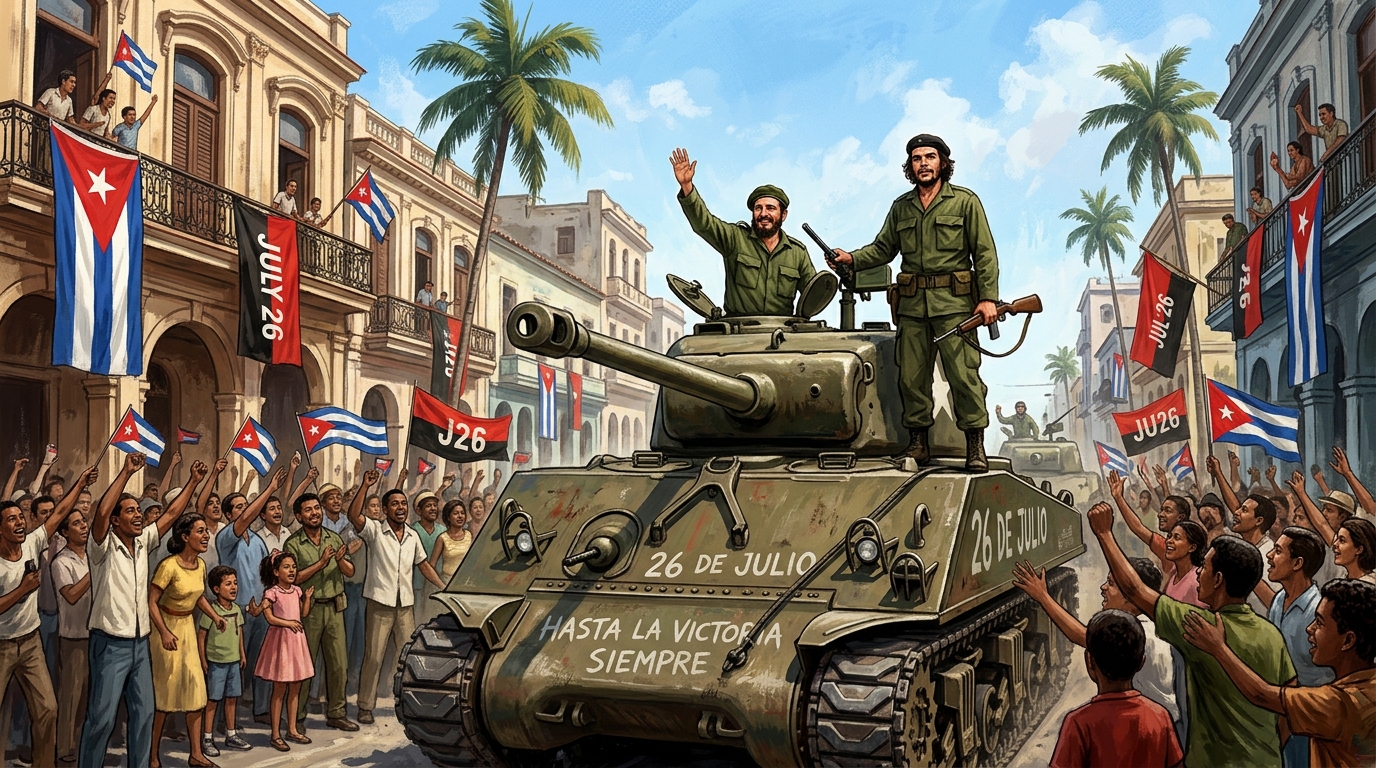
Upon hearing of the fall of Santa Clara, Batista realized his position was untenable. He fled the country on January 1, 1959. Fidel Castro entered Santiago de Cuba uncontested, and his forces marched into Havana on January 8, greeted by jubilant crowds.
Geopolitical Consequences and Aftermath
The triumph of the Cuban Revolution triggered a tectonic shift in global geopolitics. Cuba quickly transitioned from a traditional US client state into a revolutionary vanguard that challenged the bipolar architecture of the Cold War.
The Rupture of US-Cuban Relations
Initially, the United States adopted a cautious, wait-and-see approach, recognizing the new government on January 7, 1959. However, tensions escalated rapidly. In May 1959, Castro signed the First Agrarian Reform Law, which limited landholdings and nationalized foreign-owned estates—predominantly American sugar plantations.
- Agrarian Reform Law (1959)
In response to US economic pressure, including the cutting of the Cuban sugar quota, Cuba established diplomatic and economic relations with the Soviet Union in February 1960. When US-owned oil refineries in Cuba refused to process Soviet crude oil, Castro nationalized them. By the end of 1960, the Eisenhower administration had imposed a partial trade embargo on Cuba, which eventually evolved into a total economic, financial, and commercial blockade by February 1962 under President John F. Kennedy.
The Birth of a Socialist State
On April 16, 1961, following a CIA-sponsored bombing raid on Cuban airfields, Castro publicly declared the "socialist character" of the Cuban Revolution. The following day, a brigade of CIA-trained Cuban exiles landed at the Bay of Pigs (Playa Girón) in a disastrous attempt to spark a counter-revolutionary uprising. The invasion was crushed by Castro's forces within seventy-two hours, cementing his prestige and pushing Cuba firmly into the Soviet orbit.
This alignment culminated in the Cuban Missile Crisis of October 1962, when the deployment of Soviet medium-range nuclear missiles on Cuban soil brought the United States and the Soviet Union to the brink of nuclear war4. The resolution of the crisis, which involved the removal of the missiles in exchange for a US promise not to invade Cuba, guaranteed the survival of Castro’s socialist state.
| Key Milestone | Date | Major Geopolitical Outcome |
|---|---|---|
| Agrarian Reform Law | May 17, 1959 | Outlawed foreign land ownership; triggered friction with Washington. |
| Mikoyan's Visit to Havana | February 1960 | Established formal trade agreements with the USSR. |
| Bay of Pigs Invasion | April 17, 1961 | Solidified Soviet-Cuban alliance; Castro declared Cuba a socialist state. |
| Cuban Missile Crisis | October 1962 | Brought the world to the brink of nuclear war; secured Cuba from US invasion. |
Analysis of Key Actors and Decisive Actions
The success of the Cuban Revolution was not inevitable; it was the product of a unique convergence of personalities, ideological flexibility, and institutional failures.
Fidel Castro: The Master Strategist
Fidel Castro’s political genius lay in his ability to maintain a broad coalition of support. During the armed struggle, he downplayed Marxist rhetoric, presenting himself as a democratic nationalist committed to restoring the 1940 Constitution. This tactical moderation allowed him to win the support of the urban middle class, wealthy anti-Batista industrialists, and international public opinion. Once in power, however, Castro systematically marginalized moderate allies, consolidated control over the armed forces, and built a highly centralized, single-party state around his personal authority.
Che Guevara: The Ideologue and Military Tactician
Ernesto "Che" Guevara provided the revolution with its ideological backbone. Unlike Castro, who was primarily a pragmatic nationalist during the 1950s, Guevara was an ardent Marxist-Leninist who viewed the Cuban struggle as part of a broader global conflict against American imperialism. Politically, Guevara’s execution of the battle of Santa Clara demonstrated the efficacy of highly mobile guerrilla columns (focos) acting as a catalyst for urban collapse—a doctrine he later popularized as foquismo5.
Fulgencio Batista: Institutional Decay and Strategic Blunders
Fulgencio Batista’s regime collapsed from the inside out. His reliance on brutal counter-insurgency tactics—including public torture and executions carried out by the infamous Military Intelligence Service (SIM)—alienated the urban middle class and fractured the military elite. By March 1958, the United States, embarrassed by Batista’s human rights record, imposed an arms embargo on the regime. This move devastated the morale of the Cuban armed forces, who realized their patron had abandoned them.
Trivia and Lesser-Known Facts
- The Kidnapping of Juan Manuel Fangio: In February 1958, members of the 26th of July Movement kidnapped the five-time Formula One world champion Juan Manuel Fangio from his hotel in Havana. The goal was not money, but global publicity to show that Batista did not control the country. Fangio was treated well and released unharmed 29 hours later, famously declaring afterward: "The kidnappers were my friends."
- The "Fake" Guerrilla Army: During Herbert Matthews’ famous 1957 interview in the Sierra Maestra, Castro used theatrical deception to make his forces seem much larger than they were. He had the same small group of soldiers march past Matthews’ camp multiple times, carrying different weapons, and staged fake messengers arriving with "reports" from other non-existent columns.
- The CIA’s Mixed Signals: In the mid-1950s, the US government was deeply divided over Castro. While some sectors viewed him as a communist threat, the CIA’s Havana station actually funneled small amounts of cash (estimated at several thousand dollars) to the 26th of July Movement’s urban underground prior to 1958, viewing them as a democratic alternative to Batista’s corrupt dictatorship.
- The Rebel Beards: The iconic beards of the guerrillas, known as los barbudos, began as a practical necessity in the Sierra Maestra due to a lack of shaving cream and razors. Eventually, the beard became a powerful symbol of revolutionary commitment; rebels swore not to shave until the tyranny of Batista was overthrown.
References and Literature
- Thomas, Hugh. (2001). Cuba: The Pursuit of Freedom. London: Penguin Books. - An exhaustive, authoritative history of Cuba from the colonial era through the revolution.
- Guevara, Ernesto "Che". (1961). Guerrilla Warfare. Monthly Review Press. - The seminal text detailing the military strategy used by the revolutionaries in the Sierra Maestra.
- Matthews, Herbert L. (1957). "With Castro in the Sierra Maestra." The New York Times. - The historic series of articles that brought Fidel Castro's guerrilla movement to global attention.
- Sweig, Julia E. (2002). Inside the Cuban Revolution: Fidel Castro and the Urban Underground. Harvard University Press. - A detailed academic analysis of the critical role played by the urban wing of the 26th of July Movement.
Footnotes & Explanations
- Hugh Thomas, Cuba: The Pursuit of Freedom (London: Penguin Books, 2001), pp. 410-415. ↩
- Fidel Castro, History Will Absolve Me (Havana: Editorial de Ciencias Sociales, 1975 edition). ↩
- Herbert L. Matthews, "With Castro in the Sierra Maestra," The New York Times, February 24, 1957. ↩
- Graham Allison and Philip Zelikow, Essence of Decision: Explaining the Cuban Missile Crisis (Longman, 1999), pp. 78-92. ↩
- Ernesto "Che" Guevara, Guerrilla Warfare (New York: Monthly Review Press, 1961). ↩