Key Takeaways
- The Good Friday Agreement (officially the Belfast Agreement) marked a pivotal moment, transitioning Northern Ireland from three decades of intense sectarian conflict ('The Troubles') to a fragile but functional democratic power-sharing state.
- The treaty successfully addressed the deeply entrenched, competing aspirations of Unionists and Nationalists through innovative institutional reforms, robust cross-border cooperation, and the foundational principle of consent.
- Sustained international involvement, particularly from the United States under President Bill Clinton, alongside tireless mediation efforts by figures like Senator George Mitchell, acted as an essential catalyst for bridging the deep-seated mistrust and historical animosities between the warring parties.
- The Agreement established a unique political framework balancing self-determination, British sovereignty, and Irish national identity, leading to the creation of the Northern Ireland Assembly, the North-South Ministerial Council, and the British-Irish Council.
- While largely ending systemic violence, the implementation of the Agreement faced significant challenges, including paramilitary decommissioning, police reform, and persistent political instability, which continue to shape Northern Irish politics today.
Historical Context and Origins
The conflict in Northern Ireland, euphemistically known as "The Troubles," was a devastating thirty-year ethno-political struggle that formally began in the late 1960s, though its roots delve much deeper into centuries of complex Anglo-Irish history. At its core, the conflict pitted primarily Protestant Unionists—who fervently favored maintaining Northern Ireland’s place within the United Kingdom and identified as British—against Catholic Nationalists and Republicans—who sought the reunification of the island of Ireland and identified as Irish. This binary, however, oversimplifies a nuanced conflict involving socio-economic grievances, identity politics, and state repression.
The bedrock of the conflict was laid by the 17th-century Plantations, which saw large-scale settlement of Protestant Scots and English in Ulster, fundamentally altering the demographic and cultural landscape. This historical trajectory culminated in the 1921 partition of Ireland, following the War of Independence and the subsequent Anglo-Irish Treaty. The six north-eastern counties remained part of the United Kingdom, forming Northern Ireland, a state specifically designed to ensure a permanent Protestant, Unionist majority. The newly formed state saw decades of systemic discrimination against its Catholic, Nationalist minority in areas such as housing, employment, and electoral gerrymandering, solidifying a sense of disenfranchisement and alienation.
By the 1960s, inspired by the Civil Rights Movement in the United States, a non-violent campaign for civil rights emerged in Northern Ireland, demanding an end to discrimination. These peaceful protests were often met with brutal repression by the Royal Ulster Constabulary (RUC) and loyalist mobs, escalating tensions. Events like the Battle of the Bogside in Derry (1969) and the deployment of the British Army, initially welcomed by some Catholics, quickly degenerated into a full-scale military occupation. The Bloody Sunday massacre in January 1972, where British paratroopers killed 14 unarmed civil rights marchers, proved a catastrophic turning point, fueling the resurgence of the Provisional Irish Republican Army (IRA) and ushering in an era of intense paramilitary violence from both republican and loyalist groups (such as the Ulster Volunteer Force – UVF, and Ulster Defence Association – UDA). This period saw the cyclical deployment of violence, retaliation, and counter-retaliation, leading to the suspension of Northern Ireland's devolved government and the imposition of Direct Rule from Westminster in 1972.
Previous attempts at peace, such as the Sunningdale Agreement in 1973, which sought to establish a power-sharing executive and a Council of Ireland, collapsed within months due to a widespread loyalist general strike and an inability to gain sufficient cross-community consent. This failure underscored the immense difficulty of achieving political reconciliation without addressing the deeply rooted fears and aspirations of both communities.
By the 1990s, the death toll had tragically surpassed 3,500, with tens of thousands more injured or traumatized. Economic stagnation, exacerbated by ongoing violence and political instability, and pervasive social segregation had turned Northern Ireland into a deeply fractured society. However, amidst the despair, a crucial shift began to emerge within nationalist politics. The origins of the 1998 breakthrough can be traced to clandestine talks between John Hume, the visionary leader of the Social Democratic and Labour Party (SDLP), and Gerry Adams, the president of Sinn Féin, in the late 1980s. These secret dialogues, initially fraught with controversy, laid the intellectual groundwork for a strategy that argued peace could only be achieved if republican violence was definitively abandoned in favor of a democratic, pan-Irish political solution that respected the principle of consent. This shift from "Armalite and ballot box" to a predominant focus on political negotiation marked a tentative but ultimately transformative step towards peace.
The Road to Negotiation: From Back-Channels to Public Talks
The journey to the Good Friday Agreement was not a linear path but a tortuous series of incremental steps, often shrouded in secrecy, marked by breakthroughs and devastating setbacks. It began with the courage of individuals willing to engage with former enemies, even at great personal and political risk.
The initial, groundbreaking dialogue between John Hume and Gerry Adams in the late 1980s and early 1990s was pivotal. Hume, a Nobel Peace laureate, consistently argued that the core of the conflict was the denial of self-determination to the Irish people and that violence was counterproductive. Adams, representing the political wing of the republican movement, was searching for a credible political route to republican objectives. Their joint statements, though initially condemned by Unionists and some elements of the British establishment, began to sketch out a framework where the principle of consent (Northern Ireland’s status determined by its people) could coexist with the pursuit of a united Ireland.
This unofficial engagement paved the way for more formal, albeit still cautious, intergovernmental discussions. The British and Irish governments, recognizing the futility of a purely military solution, began exploring political avenues. A significant milestone was the Downing Street Declaration in December 1993, jointly issued by British Prime Minister John Major and Irish Taoiseach Albert Reynolds. This declaration affirmed the right of the people of Northern Ireland to self-determination, acknowledging that Northern Ireland would remain part of the UK until a majority wished otherwise. Crucially, it also stated that the British government had "no selfish strategic or economic interest" in Northern Ireland and would uphold any democratic decision by its people. For republicans, it offered an assurance that a united Ireland was not ruled out; for unionists, it reaffirmed the principle of consent. It also extended an invitation to Sinn Féin to join political talks, provided the IRA ended its violence.
Responding to the declaration, the Provisional IRA announced a "complete cessation of military operations" in August 1994, followed shortly by a similar ceasefire from loyalist paramilitaries (the Combined Loyalist Military Command) in October 1994. These ceasefires were momentous, creating an unprecedented space for political dialogue. However, the path remained precarious. Mistrust ran deep, particularly among Unionists who doubted the sincerity of the IRA's commitment to peace, demanding decommissioning of weapons before Sinn Féin could enter substantive talks. This pre-condition, often referred to as "the Armalite in the corner," became a major stumbling block.
The peace process suffered a severe blow in February 1996 when the IRA ended its ceasefire with a massive bombing in Canary Wharf, London, killing two people and causing extensive damage. This act of violence, intended to pressure the British government, led to a period of renewed sporadic violence and stalled political progress.
It was against this backdrop that former U.S. Senator George J. Mitchell was appointed by President Bill Clinton to chair multi-party talks. Mitchell, an experienced diplomat known for his patience and tenacity, sought to establish ground rules that could bring all parties, including Sinn Féin, to the table. In January 1996, his report, known as the Mitchell Principles, outlined six core principles of non-violence and democracy that all participants in negotiations had to explicitly commit to. These included:
- Total disarmament of all paramilitary organizations.
- Renunciation of violence for political objectives.
- Agreement to abide by the terms of any agreement.
- Reliance exclusively on peaceful and democratic means.
- An end to all punishment killings and beatings.
- Acceptance of democratic and peaceful methods for removing any weapons.
These principles became the entry ticket to the talks. Following a second, renewed IRA ceasefire in July 1997, and with the election of Tony Blair's Labour government in the UK and Bertie Ahern's Fianna Fáil government in Ireland, Sinn Féin was finally admitted to the multi-party talks in September 1997. The stage was set, but the deepest divisions still had to be overcome within the negotiating room.
Timeline of Events and Key Moments
The trajectory toward the Belfast Agreement was characterized by fits and starts, punctuated by ceasefire breaches and intensive diplomatic intervention. The final stages were a grueling marathon of political will and compromise, pushing all participants to their absolute limits.
| Year | Month/Date | Milestone Event | Significance |
|---|---|---|---|
| 1993 | Dec 15 | Downing Street Declaration | Joint statement by PM Major and Taoiseach Reynolds, offering a framework for peace and inviting Sinn Féin into talks if violence ceased. |
| 1994 | Aug 31 | IRA Ceasefire | The first major step in creating space for political negotiation, a "complete cessation of military operations." |
| 1994 | Oct 13 | Loyalist Ceasefire | Combined Loyalist Military Command announces a ceasefire, reciprocating the IRA's move. |
| 1996 | Jan 22 | Mitchell Principles Published | Former US Senator George Mitchell set the fundamental rules for inclusion in talks, demanding commitment to non-violence and disarmament. |
| 1996 | Feb 9 | Canary Wharf Bombing | The IRA ends its ceasefire, demonstrating its capacity for violence and stalling political progress for over a year. |
| 1997 | May 1 | Tony Blair Elected UK PM | The Labour Party victory provided a fresh, committed mandate for peace efforts, with Blair prioritizing Northern Ireland. |
| 1997 | Jul 19 | Second IRA Ceasefire | The IRA reinstates its ceasefire, allowing Sinn Féin to enter the multi-party talks under the Mitchell Principles. |
| 1997 | Sep 15 | Sinn Féin Enters Talks | Following the IRA ceasefire, Sinn Féin officially joins the multi-party negotiations in Belfast. |
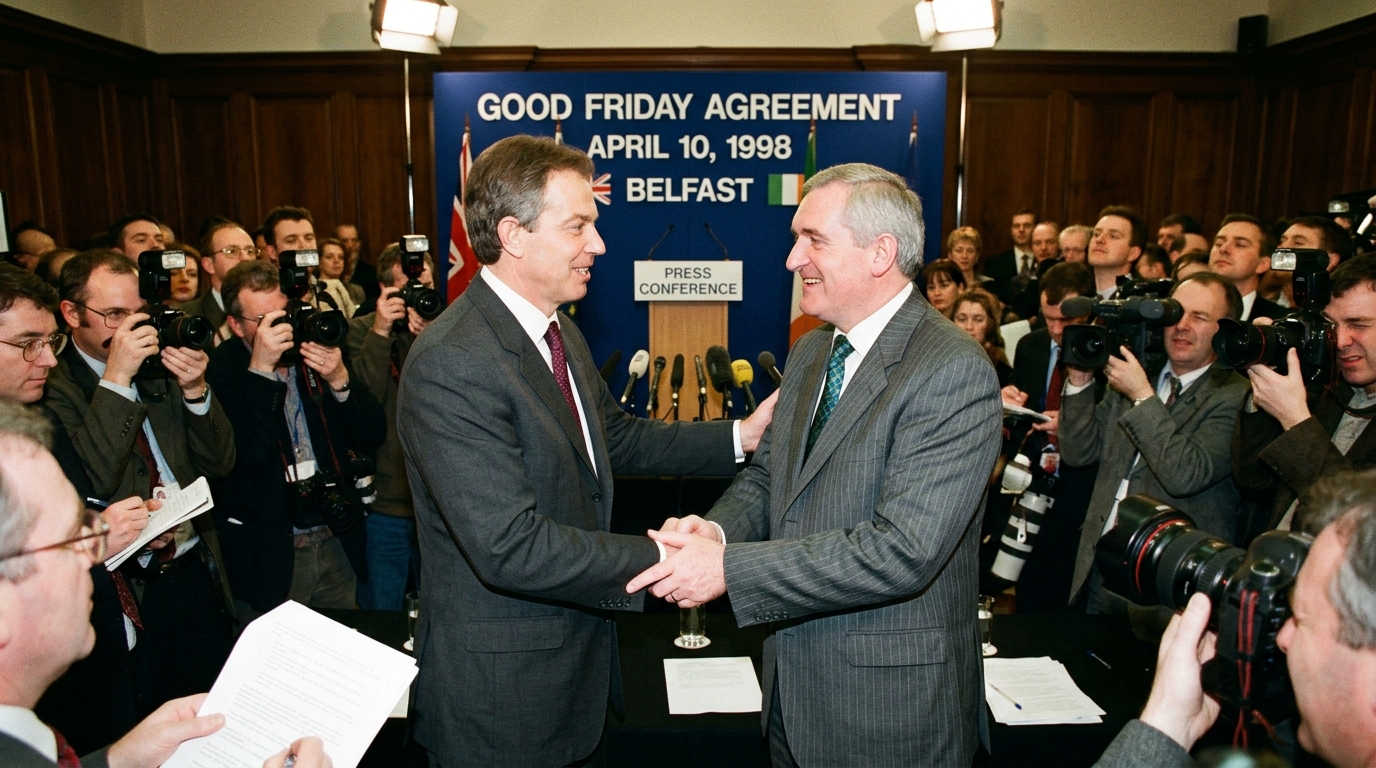
| 1998 | Apr 10 | The Good Friday Agreement Signed | After intense, round-the-clock negotiations, the landmark peace treaty is signed in Belfast, known as the Belfast Agreement or Good Friday Agreement. |
| 1998 | May 22 | Referenda Across Ireland | Massive public support for the treaty, with 71.1% in Northern Ireland and 94.4% in the Republic of Ireland voting in favor. |
| 1998 | Jul 1 | First Northern Ireland Assembly Election | Voters elect members to the new power-sharing Northern Ireland Assembly, marking the beginning of devolution. |
The negotiations reached a fever pitch in the week leading up to April 10, 1998. With the deadline looming—Easter Friday, a symbolic date—the talks became an endurance test. US President Bill Clinton maintained constant telephone contact with the lead negotiators, including Tony Blair and Bertie Ahern, often calling directly into the talks venue at Castle Buildings, Stormont, urging compromise and offering assurances. George Mitchell, acting as the independent chairman, famously locked the parties in the room, proclaiming, "I'm not letting you out until we have an agreement." His calm authority and unwavering commitment were instrumental in navigating the complex web of distrust and competing demands. The final hours were marked by a desperate push to bridge the remaining gaps on issues like decommissioning, prisoner releases, and the structure of the new institutions, ultimately leading to the momentous handshake and the signing of the agreement.
Geopolitical Consequences and Aftermath
The Good Friday Agreement fundamentally redefined the relationship between the United Kingdom and the Republic of Ireland, transforming it from one burdened by historical grievance and territorial dispute to a partnership of equals within a shared European framework. It created a complex but innovative political architecture, often referred to as the "three strands," designed to accommodate diverse identities and aspirations.
- Strand One: Devolution within Northern Ireland: The agreement established a new Northern Ireland Assembly, a democratically elected body with legislative and executive powers, marking a shift of power from Westminster to Belfast. This Assembly was designed on a principle of mandatory power-sharing, ensuring that both Unionist and Nationalist parties participated in the Executive, proportional to their electoral strength. Key decisions often required cross-community consent, preventing either bloc from unilaterally imposing its will. This institutional reform was intended to create an inclusive governance system where both traditions felt represented and respected.
- Strand Two: North-South Cooperation: The creation of the North-South Ministerial Council established formal mechanisms for cooperation between the Northern Ireland Executive and the Government of the Republic of Ireland on issues of mutual interest. This institutionalized cross-border collaboration in areas like agriculture, education, health, and tourism, fostering practical unity while respecting political boundaries. It provided Nationalists with a tangible link to the Republic and allowed Unionists to participate in pragmatic cooperation without compromising their British identity.
- Strand Three: East-West Relations: The British-Irish Council was established, comprising representatives from the British and Irish governments, the devolved administrations of Northern Ireland, Scotland, and Wales, and the Channel Islands and Isle of Man. This body aimed to foster broader cooperation and consultation on issues affecting the islands, recognizing the diverse relationships within the British Isles.
A crucial geopolitical consequence was the Republic of Ireland's constitutional amendment. By signing the agreement, the Republic formally removed Articles 2 and 3 from its constitution, which had previously laid a territorial claim over Northern Ireland. These were replaced with a new Article 2, recognizing the right of every person born on the island of Ireland to be part of the Irish nation, and a new Article 3, expressing the aspiration for a united Ireland to be achieved only by peaceful means and with the consent of the majority of the people of Northern Ireland. This represented a profound and symbolic shift, moving from a post-colonial territorial claim to a recognition of self-determination and partnership.
The agreement also ushered in critical reforms aimed at addressing the injustices of the past and building a more equitable future:
- Paramilitary Disarmament: A cornerstone of the agreement, the process of decommissioning weapons proved to be one of the most contentious and drawn-out aspects. The Independent International Commission on Decommissioning (IICD), chaired by General John de Chastelain, oversaw this complex and often opaque process. Delays in IRA decommissioning, particularly, led to repeated political crises and suspensions of the Northern Ireland Assembly, as Unionists refused to share power with Sinn Féin while the IRA retained its arsenal. It wasn't until 2005 that the IRA formally announced the full decommissioning of its weapons, a significant step forward that enabled greater political stability.
- Human Rights and Policing Reform: The agreement mandated the creation of the Northern Ireland Human Rights Commission and significant reforms to policing. The Patten Report (Independent Commission on Policing for Northern Ireland), published in 1999, recommended fundamental changes to the Royal Ulster Constabulary (RUC), a force widely distrusted by Nationalists. This led to the creation of the Police Service of Northern Ireland (PSNI) in 2001, designed to be impartial, representative of both communities, and accountable. These reforms, including changes to symbols, emblems, and recruitment practices, were deeply controversial within loyalist communities but were essential for building trust among Nationalists.
- Prisoner Release: A highly sensitive but essential part of the peace process was the early release of paramilitary prisoners who belonged to organizations observing ceasefires. This measure, while painful for victims' families, was deemed critical for securing the commitment of paramilitary groups to the peace process.
The broader geopolitical consequence was the stabilization of a historically volatile border region, allowing for regional economic integration and increased cross-border trade and investment, often referred to as the "peace dividend." It also served as a global template for conflict resolution, emphasizing that sustainable peace requires not only political structural change but also a long-term commitment to reconciliation, institution-building, and addressing underlying socio-economic inequalities. The involvement of the European Union, both through funding and providing a common institutional framework for the UK and Ireland, was also a quiet but crucial factor in enabling cooperation and reducing the perceived zero-sum nature of the conflict.
Analysis of Key Actors and Decisive Actions
The success of the 1998 talks was contingent upon a remarkable synergy and willingness to take political risks by a diverse group of leaders, both international and local. Their decisive actions and often difficult compromises ultimately delivered the agreement.
- Tony Blair (UK Prime Minister): Unlike his predecessor, John Major, whose government was weakened by internal divisions and reliant on Unionist votes, Blair entered office in May 1997 with a massive mandate and a clear commitment to Northern Ireland. He famously declared, "I feel the hand of history upon our shoulder," signaling his personal investment and determination to resolve the conflict. Blair invested immense time and political capital, spending significant periods in Northern Ireland, directly engaging with all parties, including Sinn Féin. His willingness to speak directly to Adams and McGuinness, and to push the boundaries of what was politically acceptable in London, was crucial. He also understood the importance of the American connection, fostering a close working relationship with Bill Clinton.
- Bertie Ahern (Irish Taoiseach): Ahern, who became Taoiseach in June 1997, provided the necessary diplomatic bridge, working tirelessly to ensure the Republic of Ireland’s national goals were addressed (particularly the aspiration for unity and cross-border bodies) without triggering insurmountable Unionist alienation. His steady, pragmatic, and understated approach proved crucial during the final, frantic hours of negotiation. Ahern was skilled at managing republican expectations while simultaneously reassuring Unionists about the Republic's commitment to the principle of consent. He also ensured a broad consensus within the Republic for the constitutional changes required by the agreement.
- Bill Clinton (U.S. President): Clinton’s involvement was unprecedented and absolutely critical. He recognized that for peace to last, it required not only political structures but also an "economic peace dividend"—jobs, investment, and hope for a better future. He aggressively promoted U.S. investment in Northern Ireland and appointed George Mitchell as a special economic envoy. More importantly, Clinton provided invaluable international legitimacy and political cover for the parties to make difficult compromises. His constant telephone diplomacy, personal appeals to leaders, and symbolic visits to Northern Ireland demonstrated unwavering U.S. commitment, applying pressure and encouragement in equal measure. His role helped bridge the trust deficit between the warring factions and provided a crucial external guarantee for the process.
- George J. Mitchell (U.S. Special Envoy & Chairman of Talks): Mitchell's contribution was indispensable. Appointed by Clinton, his calm demeanor, integrity, and relentless patience as chairman of the multi-party talks earned him respect across the deeply divided communities. He famously enforced strict adherence to the Mitchell Principles and, during the final days, literally locked the negotiators in the building until an agreement was reached. His skill in drafting compromise language and his ability to see beyond entrenched positions were pivotal in guiding the parties to consensus. His "Mitchell Review" later helped break deadlocks in the implementation phase.
- John Hume (Leader of the SDLP): A Nobel Peace laureate, Hume was the architect of the non-violent nationalist strategy, consistently advocating for a political path and engaging in courageous, often controversial, dialogue with Sinn Féin and the IRA when others refused. His long-term vision of a shared island, achieved through democratic means and consent, formed a fundamental pillar of the agreement.
- Gerry Adams (President of Sinn Féin): Adams's leadership was instrumental in transforming Sinn Féin from a pariah party linked to terrorism into a legitimate political force committed to democratic engagement. His ability to bring the republican movement, including the IRA, to the negotiating table and secure their commitment to the ceasefire and eventually decommissioning, required immense authority and political risk within his own community.
- David Trimble (Leader of the Ulster Unionist Party - UUP): Trimble's decision to lead his party into negotiations with Sinn Féin, despite widespread skepticism and fierce opposition from hardline Unionists (most notably Ian Paisley's DUP), demonstrated immense political courage. He endured significant internal party strife and personal attacks but recognized the necessity of compromise for peace. His commitment to the agreement, ultimately earning him a shared Nobel Peace Prize with John Hume, was a defining moment for mainstream Unionism.
- Other Key Figures: While often overshadowed, numerous other individuals played crucial roles, including Seamus Mallon (SDLP Deputy Leader), Mo Mowlam (UK Secretary of State for Northern Ireland), and various civil servants and back-channel facilitators whose tireless work underpinned the public negotiations. Even figures like Ian Paisley, who initially rejected the agreement, later became a symbol of its eventual success by entering power-sharing with Sinn Féin in 2007.
"Peace is not just the absence of conflict; it is the presence of justice." – This sentiment, often cited during the drafting of the agreement, reflected a profound shift toward human rights-based governance, legal equality, and a commitment to addressing the legacy of the past. The Agreement was not merely a ceasefire but a framework for creating a more just and equitable society.
Challenges of Implementation and Enduring Legacy
The signing of the Good Friday Agreement was a monumental achievement, but it marked the beginning, not the end, of the peace process. The subsequent years were characterized by significant challenges in implementing its complex provisions, underscoring the fragility of peace and the deep-seated nature of sectarian divisions.
Initial Hurdles and Assembly Suspensions: One of the most persistent difficulties was the issue of paramilitary decommissioning. Unionists, particularly the Ulster Unionist Party (UUP) under David Trimble, insisted on verifiable IRA disarmament before entering into power-sharing with Sinn Féin. The IRA, initially reluctant to surrender weapons, viewed decommissioning as a surrender and insisted on political progress first. This "chicken and egg" scenario led to repeated crises and suspensions of the Northern Ireland Assembly. Between 2002 and 2007, the Assembly was suspended four times, with Direct Rule from London reimposed, highlighting the inherent instability of the nascent power-sharing institutions. The IRA's eventual announcement of full decommissioning in 2005, and photographic evidence to prove it, was a crucial turning point, paving the way for the St Andrews Agreement in 2006 and the subsequent formation of a stable, mandatory power-sharing executive between the Democratic Unionist Party (DUP) and Sinn Féin in 2007.
Other early controversies included the "on-the-runs" scheme, which granted conditional amnesties to republican and loyalist fugitives, and allegations of IRA intelligence gathering at Stormont, further eroding trust.
Dissident Republicanism and Loyalist Paramilitary Activity: While the mainstream IRA and loyalist paramilitaries largely adhered to the ceasefires, the Agreement did not eradicate all violence. Dissident republican groups, such as the Real IRA and Continuity IRA, rejected the peace process, continuing to carry out sporadic bombings and attacks, notably the Omagh bombing in August 1998, which killed 29 people and highlighted the brutal opposition to peace. Similarly, loyalist paramilitaries, though often declared on ceasefire, continued to be involved in organized crime, drug dealing, and occasional sectarian intimidation, perpetuating a climate of fear in some working-class areas. These groups remain a persistent threat, albeit greatly diminished in scope compared to the Troubles.
Sectarian Division and Parading Disputes: Despite the political agreement, deep-seated sectarian divisions persist within Northern Irish society. "Peace walls" continue to segregate communities in Belfast and Derry, symbolic of enduring mistrust. Annual parading seasons, particularly those of the Orange Order, often lead to highly contentious disputes, particularly at flashpoints like Drumcree and Ardoyne, reigniting tensions and occasionally leading to violent confrontations between marchers, residents, and police.
Brexit and its Destabilizing Impact: The most significant recent challenge to the Good Friday Agreement's legacy has been Brexit. The UK's departure from the European Union created an unprecedented dilemma: how to avoid a hard border on the island of Ireland (a core tenet of the GFA) while respecting the integrity of the UK single market. The resulting Northern Ireland Protocol, designed to keep Northern Ireland aligned with some EU single market rules and avoid a hard border, effectively created a trade border in the Irish Sea. This has been vehemently opposed by Unionists, who perceive it as undermining Northern Ireland's place within the UK and creating an economic barrier with Great Britain. The Protocol led to political instability, including the DUP boycotting the power-sharing institutions for extended periods (2017-2020, and again from 2022-2024), demonstrating the fragility of the power-sharing arrangements when a fundamental aspect of the Agreement's underpinnings (the UK-EU relationship) is disrupted.
Unresolved Issues and Dealing with the Past: A lasting legacy is the unresolved issue of dealing with the past. The Agreement provided for a more peaceful future but offered few clear mechanisms for addressing the thousands of unresolved deaths, injuries, and injustices from the Troubles. Successive attempts to create bodies for truth, reconciliation, and justice have met with political resistance and controversy. The UK government's recent "Legacy Act" (2023), which offers conditional immunity from prosecution for Troubles-era crimes in exchange for cooperation, has been widely condemned by victims' groups, all major political parties in Northern Ireland, and the Irish government, as it is seen to prioritize perpetrators over victims' rights.
The Enduring Legacy: Despite these persistent challenges, the Good Friday Agreement stands as a testament to political innovation and the power of dialogue. Its most profound legacy is the virtual cessation of systemic political violence. It has provided Northern Ireland with a framework for democratic governance, enabling previously unthinkable power-sharing between bitter adversaries. It has also fostered reconciliation initiatives, supported a growing peace economy, and normalized relations between the UK and the Republic of Ireland. While the peace remains "fuzzy" and contingent, regularly tested by political crises and external shocks, the Agreement firmly steered Northern Ireland away from outright conflict and towards a future where political aspirations are pursued through ballots, not bullets. It remains a dynamic, evolving, and often contested document, but one that undeniably altered the trajectory of Northern Ireland for the better.
Trivia and Lesser-Known Facts
- The Gendered Peace: While the dominant narrative often focuses on male political leaders, the Northern Ireland Women's Coalition (NIWC) played a vital, though often understated, role. This cross-community, feminist political party, formed in 1996, successfully campaigned for a seat at the multi-party talks. Monica McWilliams and Pearl Sagar, its representatives, ensured that issues of equality, inclusion, education, and reconciliation were central to the discussions, helping to embed human rights and social justice principles into the final text. Their presence brought a crucial dimension of civil society to the negotiating table.
- The Date and Name: While signed on April 10, 1998, the "Good Friday" moniker was almost a coincidence of the calendar. Negotiations had dragged on for days beyond their expected deadline, extending through what is known as Holy Week in the Christian tradition, culminating on Good Friday. The official name is the "Belfast Agreement," reflecting the city where it was signed.
- Constitutional Flexibility: The Agreement is famously ambiguous regarding the "final status" of Northern Ireland. This ambiguity was not a weakness but a deliberate strength, allowing both Unionists and Nationalists to interpret the path toward their respective goals (maintaining the Union or achieving a united Ireland) without immediate confrontation, provided these goals were pursued through peaceful, democratic means and consent. It created a "settlement" rather than a "solution," acknowledging that historical aspirations would continue but violence would not.
- The "Washington 3": The behind-the-scenes role of a small group of senior American figures—Nancy Soderberg (National Security Council), George Mitchell, and Senator Edward Kennedy—who constantly liaised between the White House and the various parties, providing diplomatic support, economic incentives, and moral encouragement, was crucial. They were often referred to informally as the "Washington 3."
- "Chimp, Chimp, Cheerio": During the final, exhausted hours of negotiation, George Mitchell reportedly grew frustrated with one of the party leaders who kept leaving the room for consultations. Mitchell, wanting to keep everyone focused, allegedly quipped, "Chimp, chimp, cheerio!" – a playful yet firm reminder to stay at the table.
- Ian Paisley's Absence: While David Trimble courageously signed the agreement on behalf of the UUP, the DUP, led by Ian Paisley, initially refused to participate in the final stages of the negotiations and unequivocally rejected the Agreement. Paisley famously declared it a "sell-out." However, less than a decade later, Paisley would lead the DUP into a power-sharing executive with Sinn Féin, serving as First Minister alongside Martin McGuinness as Deputy First Minister, a truly remarkable and unforeseen outcome.
- The Referendum Majority: The overwhelming public support in the referenda was a critical endorsement. The 71.1% "Yes" vote in Northern Ireland was particularly significant, as it represented a genuine cross-community consensus, indicating that a substantial proportion of Unionists also voted in favor, recognizing the alternative was likely a return to violence.
References and Literature
- CAIN Web Service (Conflict Archive on the INternet) (https://cain.ulster.ac.uk/) - The definitive digital repository for academic research, primary documents, and detailed statistics on the Northern Irish conflict and peace process. Essential for any serious study.
- Mitchell, George J. (1999). Making Peace. Alfred A. Knopf. - A compelling and insightful personal memoir from the chairman of the negotiations, detailing the logistical, political, and psychological pressures he navigated during the peace process.
- The Good Friday Agreement (UK Government Official Archives) (https://assets.publishing.service.gov.uk/government/uploads/system/uploads/attachment_data/file/136618/agreement.pdf) - The full text and foundational legal documents governing the 1998 transition, crucial for understanding its legal and political framework.
- Kee, Robert (2009). The Troubles: A Concise History. Penguin Books. - A widely acclaimed and comprehensive historical overview of the socio-political dynamics of 20th-century Ireland, providing essential background to the conflict.
- Coogan, Tim Pat (2000). The Troubles: Ireland's Ordeal 1966-1996 and the Search for Peace. Palgrave Macmillan. - A detailed historical account offering a largely nationalist perspective on the conflict.
- McKittrick, David & McVea, David (2012). Making Sense of the Troubles. Penguin Books. - An accessible and widely respected chronological account of the conflict, offering balanced perspectives.
- Patterson, Henry (1997). The Politics of Illusion: A Political History of Northern Ireland from Partition to Present. Serif. - Provides a critical analysis of Northern Irish politics from a Unionist perspective.
- Whyte, John (1990). Interpreting Northern Ireland. Oxford University Press. - A classic work exploring the different conceptual approaches to understanding the conflict.
- Northern Ireland Human Rights Commission. (https://www.nihrc.org/) - Official website detailing the ongoing work stemming from the Agreement's human rights provisions.
- Police Service of Northern Ireland (PSNI). (https://www.psni.police.uk/) - The successor to the RUC, showcasing the transformation in policing mandated by the Agreement.
Footnotes & Explanations
- This refers to the Belfast Agreement signed on April 10, 1998, also known as the Good Friday Agreement. Its official legal title within the United Nations treaty series is 'Agreement between the Government of the United Kingdom of Great Britain and Northern Ireland and the Government of Ireland'. ↩
- The Patten Report was a direct result of the Agreement, specifically the 'Independent Commission on Policing for Northern Ireland,' aimed at fundamentally transforming the Royal Ulster Constabulary into the Police Service of Northern Ireland (PSNI) to ensure impartiality, accountability, and community representation. ↩
- The Northern Ireland Protocol, enacted as part of the UK-EU Withdrawal Agreement post-Brexit, maintains Northern Ireland within the EU's single market for goods and applies some EU customs rules, necessitating checks on goods moving from Great Britain to Northern Ireland. ↩