Key Takeaways
- The Bay of Pigs invasion was a disastrously planned and executed paramilitary operation designed by the CIA to overthrow Fidel Castro's government without revealing direct US military involvement.
- President John F. Kennedy's decisions to cancel critical air support, aimed at preserving 'plausible deniability,' doomed the invasion force (Brigade 2506) to quick defeat by superior Cuban forces.
- The debacle profoundly altered Cold War dynamics, consolidating Castro's domestic power, humiliating the United States globally, and directly triggering the Cuban Missile Crisis of 1962.
Historical Context and Origins
The roots of the 1961 Bay of Pigs invasion (known in Cuba as La Batalla de Girón) lay in the rapid transformation of Cuban politics following the fall of the US-backed dictator Fulgencio Batista on January 1, 1959. Fidel Castro’s nationalist revolution initially garnered cautious optimism from some observers in Washington. However, this swiftly dissolved as Castro's provisional government embarked on a radical restructuring of the Cuban economy and political landscape.
Historically, Cuba had existed under the profound economic and political hegemony of the United States since the Spanish-American War of 1898 and the implementation of the Platt Amendment 1. By 1959, American corporations controlled over 90 percent of Cuba's telephone and electricity services, approximately 50 percent of its public railways, and nearly 40 percent of its lucrative sugar production.
| Sequence | Event |
|---|---|
| 1 | Batista Regime Collapses (Jan 1959) |
| 2 | Castro Initiates Agrarian & Industrial Reforms |
| 3 | US Imposes Economic Sanctions & Sugar Quotas |
| 4 | Cuba Establishes Trade/Military Ties with USSR |
| 5 | CIA Drafts Covert Paramilitary Invasion Plan |
When Castro's government introduced the Agrarian Reform Law of May 1959, which limited land ownership and nationalized foreign-held estates, tensions flared. The United States government, led by President Dwight D. Eisenhower, viewed these developments through the zero-sum lens of the Cold War. Washington interpreted Cuban land reform and the expropriation of American properties not as nationalist sovereignty, but as an intolerable encroachment of Soviet-style communism in the Western Hemisphere.
By early 1960, the diplomatic rupture was accelerating:
- February 1960: Cuba signed a trade agreement with the Soviet Union, securing Soviet crude oil in exchange for Cuban sugar.
- June 1960: US-owned oil refineries in Cuba (including Texaco and Esso) refused to refine Soviet crude. In response, Castro nationalized the refineries.
- July 1960: President Eisenhower retaliated by slashing the Cuban sugar quota to the US, striking at the heart of Cuba's export economy.
- August–October 1960: Castro's regime nationalized all American-owned banks, industrial plants, and commercial enterprises.
Convinced that Cuba was becoming a Soviet client state within the American sphere of influence, President Eisenhower formally approved a Central Intelligence Agency (CIA) directive on March 17, 1960, titled "A Program of Covert Action Against the Castro Regime" 2.
The Evolution of the CIA Plan
The CIA’s Directorate of Plans, led by Richard M. Bissell Jr., was tasked with organizing, training, and equipping Cuban exiles who had fled the island after the revolution. This paramilitary group, eventually designated Brigade 2506, was secretly trained at remote bases in Guatemala (Camp Trax) and Nicaragua, with the logistical support of regional dictators Miguel Ydígoras Fuentes and Luis Somoza Debayle.
The initial military concept designed under the Eisenhower administration was a guerrilla-style operation. It envisioned a landing near the colonial city of Trinidad, Cuba, situated at the foot of the Escambray Mountains. Trinidad offered a population known for counter-revolutionary sentiment and a direct escape route into the mountains, where the exiles could wage a protracted guerrilla war if the initial landing faltered.
However, when John F. Kennedy assumed the presidency in January 1961, the political calculations shifted. Kennedy, though eager to appear tough on communism after his hawkish campaign rhetoric, was highly sensitive to the diplomatic fallout of an overt US invasion. He demanded that the operation be modified to make it less spectacular, quieter, and conducted under the cover of darkness to maintain "plausible deniability" 3.
To satisfy Kennedy's requirements, Bissell and the CIA planners relocated the landing site 100 miles west to the Bay of Pigs (Bahía de Cochinos). This change proved fatal to the operation's strategic backup plan. Unlike Trinidad, the Bay of Pigs was a swampy, isolated inlet surrounded by the Zapata Peninsula. It offered no viable escape routes into the Escambray Mountains, which were now separated from the landing zone by 80 miles of impassable swampland and hostile territory. The operation was transformed from a flexible guerrilla insertion into a rigid, all-or-nothing amphibious assault.
Timeline of Events and Key Moments
The execution of the Bay of Pigs invasion unfolded over five tumultuous days in April 1961, characterized by operational friction, intelligence failures, and agonizing political vacillation in Washington.
April 15, 1961: The Preliminary Airstrikes
The operation began with an attempt to neutralize Castro’s modest air force, which consisted of a handful of aging British-made Hawker Sea Furies, B-26 Marauders, and Lockheed T-33 jet trainers.
Early on April 15, eight CIA-supplied B-26 bombers, painted with false Cuban military markings to simulate a defection within Castro's ranks, took off from Puerto Cabezas, Nicaragua. The bombers struck military airfields at Campo Libertad, San Antonio de los Baños, and Santiago de Cuba.
While the CIA claimed the strikes had destroyed the majority of Castro’s air assets, the assessment was highly inaccurate. Castro, anticipating such a move, had dispersed his operational aircraft and placed decoys on the runways. Crucially, several T-33 jets and Sea Furies survived intact.
The political fallout was immediate. At the United Nations, Cuban Foreign Minister Raúl Roa accused the United States of launching a naked act of aggression. The US Ambassador to the UN, Adlai Stevenson, unaware of the CIA's covert operation, denied US involvement and displayed a photograph of a "defector" B-26. When the deception was exposed hours later, an embarrassed Stevenson demanded that Washington halt further military escalations. Alarmed by the diplomatic blowback, President Kennedy ordered the cancellation of a vital second wave of airstrikes scheduled to coincide with the landing on April 17.
April 16, 1961: Castro’s Ideological Shift
During a mass funeral for the victims of the April 15 airstrikes, Fidel Castro delivered a fiery, historic address to an armed crowd of militia members. For the first time, Castro publicly declared the socialist character of the Cuban Revolution:
"What they cannot forgive us is that we are here at their noses, and that we have made a socialist revolution right under the very nose of the United States!" [^4]
By framing the impending battle as a defense of national sovereignty and socialism against imperialist aggression, Castro galvanized public sentiment and ensured total mobilization of both the regular Revolutionary Armed Forces (FAR) and the local peasant militias.
April 17, 1961: The Landing at Playa Girón and Playa Larga
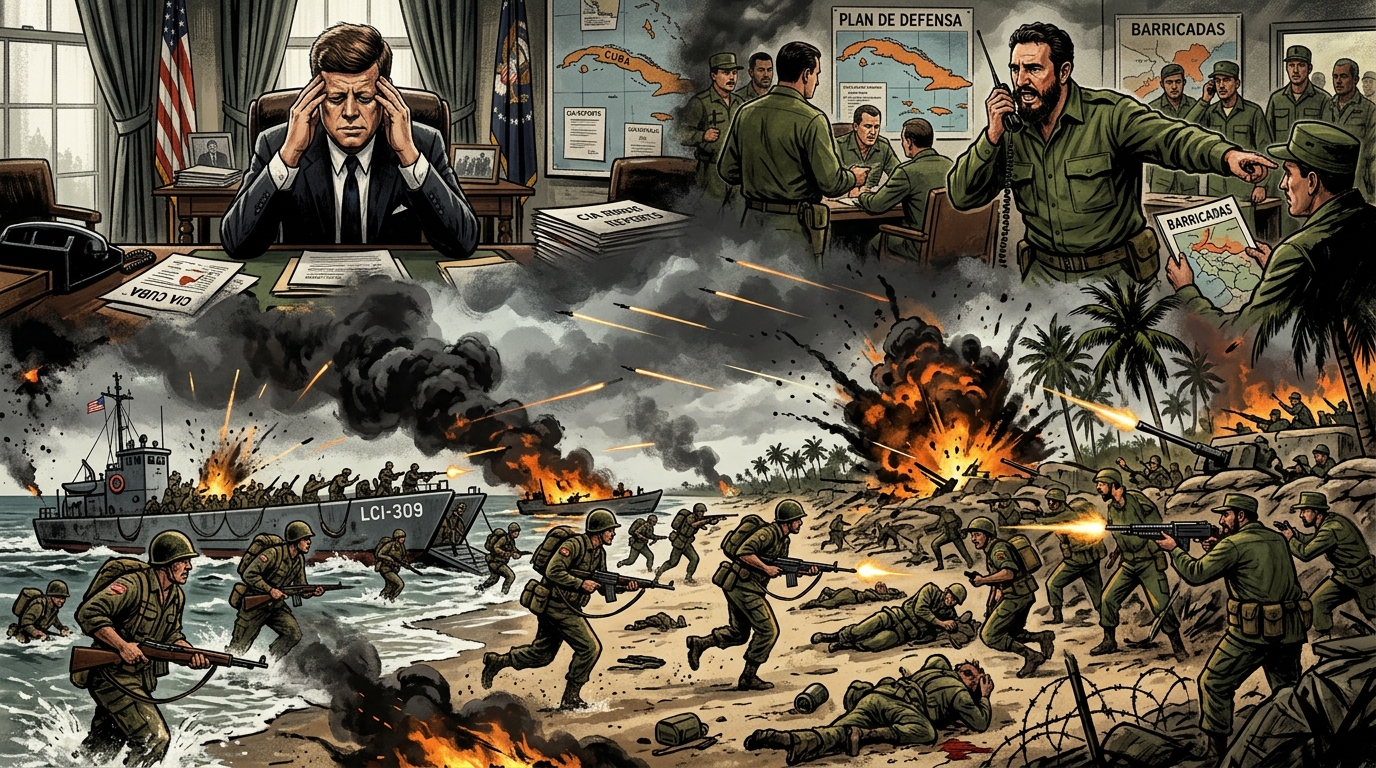
Just after midnight, the ships carrying Brigade 2506—including the command vessels Houston and Río Escondido—anchored off the southern coast of Cuba. The force of approximately 1,400 men was divided into landing parties targeting two primary beaches: Playa Girón (Red Beach) and Playa Larga (Blue Beach).
- Bay of Pigs Landing (Playa Girón & Playa Larga)
From the outset, the landings faced severe tactical complications:
- Environmental Obstacles: Razor-sharp coral reefs, which CIA intelligence had misidentified in aerial reconnaissance photographs as seaweed, damaged the hulls of the landing crafts and disabled outboard motors.
- Early Detection: The element of surprise was quickly lost. Local militia members spotted the invaders and alerted military headquarters in Havana via telephone lines that the CIA had failed to cut.
- Cuban Air Superiority: At dawn, Castro’s surviving air force took to the skies. The nimble Cuban T-33 jets and Sea Furies dominated the airspace. They targeted the vulnerable transport ships, successfully sinking the Houston (carrying the 5th Battalion and vital infantry gear) and setting the Río Escondido on fire. The loss of these ships deprived the Brigade of its ten-day reserve of ammunition, heavy equipment, and communications gear.
April 18, 1961: The Cuban Counter-Offensive
Fidel Castro personally assumed operational command of the defense, coordinating troop movements from a sugar mill near the front lines. The Cuban government deployed over 20,000 regular troops and mobilization militias, equipped with Soviet-supplied T-34 tanks, SU-100 tank destroyers, and heavy 122mm artillery.
The invaders of Brigade 2506, dug into defensive positions around Playa Girón, fought tenaciously. However, they were heavily outnumbered, low on ammunition, and exposed to continuous artillery bombardment. Attempts by exile-flown B-26s from Nicaragua to provide close air support were largely thwarted by Cuban air defense and superior T-33 fighters.
April 19, 1961: Collapse and Defeat
By the morning of April 19, the Brigade's situation was desperate. Under intense pressure from military advisers, President Kennedy authorized a one-hour window of air cover. Six unmarked US Navy jet fighters from the aircraft carrier USS Essex were dispatched to protect the exile B-26 bombers.
However, a critical timezone misunderstanding between the Pentagon and the CIA base in Nicaragua resulted in the US Navy fighters arriving an hour too late. Deprived of protection, two exile B-26s were shot down, killing four American National Guard pilots who had volunteered for the mission 5.
With no ammunition, no air support, and their backs to the sea, the remaining members of Brigade 2506 collapsed. At 2:00 PM, commander Manuel Artime ordered a retreat into the swamps, but there was nowhere to run. By 5:30 PM, the fighting ceased.
| Metric / Outcome | Brigade 2506 (Exiles) | Cuban Government Forces |
|---|---|---|
| Total Personnel engaged | ~1,400 landed | ~20,000+ regular & militia |
| Killed in Action | 104–118 | 176 (official) up to 500+ (estimated) |
| Captured / Prisoner | 1,189 | N/A |
| Air Support | B-26 bombers (heavily degraded) | T-33s, Sea Furies, B-26s |
| Heavy Armor | 5 M4 Sherman tanks | Soviet T-34 tanks, SU-100s |
Geopolitical Consequences and Aftermath
The political and strategic shockwaves of the failed invasion immediately reshaped the landscape of international relations, profoundly intensifying the Cold War.
The Domestic and International Humiliation of the US
For the newly inaugurated Kennedy administration, the Bay of Pigs was an unmitigated disaster. It exposed the United States to international condemnation for violating international law and the charter of the Organization of American States (OAS). European allies questioned the strategic competence and judgment of the young American president, while the Soviet Union seized the opportunity to portray the US as an imperialist aggressor defeated by a determined, sovereign nation.
Domestically, Kennedy acted quickly to contain the political damage. He famously accepted sole responsibility for the failure during a press conference on April 21, stating:
"There's an old saying that victory has a hundred fathers and defeat is an orphan... I am the responsible officer of the government." [^6]
Behind the scenes, Kennedy was furious with the joint chiefs of staff and the CIA. He forced the resignation of legendary CIA Director Allen Dulles, Deputy Director of Plans Richard Bissell, and Deputy Director Charles Cabell. The President ordered the creation of the Taylor Committee, led by General Maxwell Taylor, to conduct an exhaustive investigation into the military and intelligence shortcomings of the operation.
- Failure at Bay of Pigs 1961
The Consolidation of Castro's Regime
In Cuba, the victory at Playa Girón served as the ultimate legitimizing myth of the Cuban Revolution. It transformed Fidel Castro into an iconic David figure who had successfully slain the American Goliath. The regime used the threat of imminent American invasion to justify:
- The systematic suppression of internal dissent and political opposition.
- The merging of the 26th of July Movement with other political factions to form the unified Communist Party of Cuba.
- The complete nationalization of the remaining private sectors of the Cuban economy.
Any domestic counter-revolutionary movements, particularly those operating in the Escambray Mountains, were systematically hunted down and eliminated by the emboldened state apparatus 7.
The Path to the Cuban Missile Crisis
The most dangerous consequence of the Bay of Pigs invasion was its direct role in instigating the Cuban Missile Crisis of October 1962.
Fidel Castro remained convinced that the United States would inevitably launch a direct, full-scale military invasion to overthrow his government. This fear was well-founded: following the Bay of Pigs, the Kennedy administration authorized Operation Mongoose, a massive, multi-million dollar covert program designed by the CIA and coordinated by Robert F. Kennedy to sabotage the Cuban economy and assassinate Castro.
To deter future American aggression, Soviet Premier Nikita Khrushchev proposed the secret deployment of medium-range and intermediate-range ballistic nuclear missiles in Cuba during the spring of 1962. Khrushchev reasoned that the missiles would protect Cuba from an invasion while simultaneously correcting the strategic imbalance caused by the US deployment of Jupiter nuclear missiles in Turkey and Italy. Castro readily accepted the proposal, setting the stage for the most dangerous nuclear standoff of the Cold War.
Analysis of Key Actors and Decisive Actions
The failure of the Bay of Pigs was not the result of a single tactical error, but rather a cascading series of planning assumptions, intelligence failures, and institutional pathologies.
THE CATASTROPHE OF GROUPTHINK
| CIA Intelligence Gaps | Kennedy's Political Vetos | The Popular Uprising Myth |
|---|---|---|
| • Confused coral reefs with seaweed | • Canceled second airstrike wave | • Expected spontaneous rebellion |
| • Ignored 80-mile swamp barrier | • Restricted air cover parameters | • Underrated Castro's popularity |
| • Overestimated exile troop morale | • Prioritized deniability over win | • Failed to assess Cuban military |
John F. Kennedy: The Dilemma of Deniability
President Kennedy was caught in a profound conflict between the momentum of a military operation inherited from a legendary predecessor and his own geopolitical instincts. Kennedy feared that an overt US-led invasion would ruin relations with Latin American countries, alienate European allies, and trigger a Soviet counter-move in Berlin.
However, in his attempt to balance military success with diplomatic deniability, Kennedy compromised both. His decision to cancel the second wave of airstrikes on April 15 was arguably the single most decisive factor in the invasion's failure. By leaving Castro’s air force operational, Kennedy condemned the landing vessels, transport ships, and infantry of Brigade 2506 to systematic destruction.
His refusal to authorize direct US military intervention once the landing collapsed, while logically consistent with his desire to prevent a broader war with the Soviet Union, sealed the fate of the exiles on the beaches of Playa Girón.
Fidel Castro: Tactical Mastery and Direct Leadership
In contrast to the indecision in Washington, Fidel Castro displayed decisive, aggressive leadership. Recognizing the gravity of the threat, he did not delegate the defense of the island to his subordinates. He personally mobilized Cuba’s armed forces, deployed the militia immediately, and took command of the battle from the forward headquarters in Central Australia.
Castro's strategic decision to prioritize the destruction of the supply ships Houston and Río Escondido rather than attacking the landed infantry proved masterly. By cutting off the Brigade's supply lines, he starved the invaders of ammunition and heavy weaponry, ensuring their surrender within 72 hours.
The CIA: Groupthink and Bureaucratic Momentum
The CIA’s Directorate of Plans operated under a profound confirmation bias, which later became a classic textbook case of "groupthink" 8. Having successfully orchestrated covert coups in Iran (1953) and Guatemala (1954), the agency suffered from institutional hubris.
The CIA planners made several deeply flawed assumptions:
- They assumed that the landing of Brigade 2506 would automatically trigger a massive, spontaneous popular uprising across Cuba. This ignored the fact that Castro still enjoyed immense popularity among the working-class and peasant populations following his social reforms.
- They failed to recognize the efficiency and loyalty of Castro's newly formed security forces and military intelligence.
- They believed that if the invasion ran into trouble, President Kennedy would ultimately be forced to authorize direct US military intervention (such as US Navy air strikes or Marines) to prevent a public American defeat. This was a critical miscalculation of Kennedy's resolve.
Trivia and Lesser-Known Facts
- The Origin of Brigade 2506: The name of the exile invasion force, "Brigade 2506," was chosen in honor of Albert Ferrer, a popular member of the training camp who had tragically died in a training accident in Guatemala. His membership number was 2506, and the brigade adopted it to honor his memory.
- The Timezone Blunder: The failure of the US Navy air cover on April 19 was caused by a simple but devastating timezone error. The Pentagon was operating on Eastern Standard Time (EST), while the CIA base in Nicaragua was operating on local time, which was one hour behind. This led to the B-26 bombers arriving an hour before their US Navy jet escorts took off from the USS Essex.
- The Alabama Air National Guard: Although President Kennedy insisted that no American military personnel be directly involved in the fighting, several pilots from the Alabama Air National Guard were secretly recruited by the CIA to train the exile pilots in Nicaragua. On the final day of the invasion, four of these American pilots—Thomas "Pete" Ray, Leo Baker, Riley Shamburger, and Wade Gray—flew combat missions and were killed when their B-26s were shot down by Cuban forces.
- The Price of Liberation: In December 1962, following months of intense negotiations led by American lawyer James B. Donovan (famous for the Soviet spy swap dramatized in Bridge of Spies), the Cuban government released 1,113 captured members of Brigade 2506. In exchange, the United States paid $53 million in private donations of food, baby formula, and medical supplies to Cuba.
- First Shot Fired: The very first shot of the invasion was not fired by a Cuban exile, but by a CIA operative named Grayston Lynch. Lynch was aboard one of the landing boats guiding the exiles toward Playa Girón. When a Cuban militia patrol jeep spotted them and turned its headlights onto the water, Lynch opened fire with his automatic weapon, officially beginning the battle.
References and Literature
- Declassified CIA Documents on the Bay of Pigs - Official declassified agency histories, reports, and internal critiques regarding the planning and execution of the operation.
- The National Security Archive: Bay of Pigs Chronology - A highly detailed collection of primary source documents, memos, and transcripts compiled by George Washington University.
- Wyden, Peter. Bay of Pigs: The Untold Story. Simon and Schuster, 1979 - A seminal, comprehensive narrative history detailing the decision-making process of both the Kennedy administration and the CIA.
- Schlesinger, Arthur M. A Thousand Days: John F. Kennedy in the White House. Houghton Mifflin, 1965 - A firsthand account of the crisis from inside the Kennedy administration, offering insight into the political calculations and post-mortem analysis.
Footnotes & Explanations
- The Platt Amendment of 1901 permitted unilateral US military intervention in Cuba and heavily restricted Cuban foreign policy, setting the stage for decades of deep nationalist resentment. ↩
- This covert program laid the foundation for the creation of Brigade 2506, utilizing bases in Guatemala and Nicaragua. ↩
- "Plausible deniability" was a central tenet of Cold War covert operations, designed to allow a government to deny responsibility for an action if it was exposed. ↩
- Fidel Castro, Speech at the funeral of the victims of the air raids, Havana, April 16, 1961. ↩
- These pilots were part of the Alabama Air National Guard, recruited by the CIA due to their experience flying B-26 bombers. ↩
- President John F. Kennedy, Press Conference, Washington D.C., April 21, 1961. ↩
- The suppression of these counter-revolutionary movements is referred to in Cuban historiography as the "Clean-up of the Escambray" (Lucha Contra Bandidos). ↩
- The term "groupthink" was popularized by research psychologist Irving Janis, who used the Bay of Pigs invasion as his primary case study of how highly intelligent groups can make disastrous decisions. ↩