Key Takeaways
- The 1969 border conflict on the Ussuri River marked the violent zenith of the Sino-Soviet split, shifting the Cold War from a binary confrontation to a complex triangular dynamic.
- The tactical clashes on Zhenbao (Damansky) Island escalated into a strategic crisis that prompted Soviet leadership to seriously consider a preemptive nuclear strike on China.
- The crisis ultimately drove China toward a historic rapprochement with the United States, fundamentally altering the global balance of power during the late Cold War.
Historical Context and Origins
The armed clashes on the Ussuri River in March 1969 were not an isolated border skirmish, but rather the explosive culmination of a decade of deteriorating relations between the world’s two largest communist powers. To understand the violence at Zhenbao Island (known to the Soviets as Damansky Island), one must examine the deep-seated ideological, historical, and strategic rifts that defined the Sino-Soviet split.
The geopolitical partnership between the Union of Soviet Socialist Republics (USSR) and the People's Republic of China (PRC), codified in the 1950 Treaty of Friendship, Alliance, and Mutual Assistance, was built on fragile foundations. Following the death of Joseph Stalin in 1953, the ideological consensus began to fracture. Nikita Khrushchev’s 1956 "Secret Speech," which denounced Stalin’s cult of personality, and his subsequent policy of "peaceful coexistence" with the capitalist West, were viewed by Mao Zedong as a betrayal of Marxist-Leninist orthodoxy 1. Mao accused the Soviet leadership of slipping into "revisionism," while Moscow increasingly viewed Mao’s radical domestic policies, such as the Great Leap Forward, as reckless and economically ruinous.
Beyond ideology lay the unresolved issue of the Sino-Soviet border, a sprawling frontier stretching over 4,300 kilometers. This boundary was largely defined by 19th-century treaties negotiated between the declining Qing Dynasty and the expansionist Russian Empire—most notably the Treaty of Aigun (1858) and the Treaty of Peking (1860). The PRC viewed these agreements as "Unequal Treaties" imposed upon a weakened China through imperialist coercion 2. While Beijing did not immediately demand the return of all territories ceded under these treaties, it insisted that the Soviet Union acknowledge their unjust origins as a prerequisite for formal border negotiations.
Specifically, the water boundaries along the Amur (Heilong) and Ussuri (Wusuli) rivers were highly contested. Under international law, river boundaries are typically demarcated by the thalweg—the middle of the main navigation channel. If this principle were applied, numerous river islands, including Zhenbao, would fall under Chinese sovereignty. However, the Soviet Union asserted that the boundary ran along the Chinese riverbank, effectively claiming sole ownership of the waterways and the islands within them 3.
WESTERN BANK (PRC) ~~~~~~~~~~~~~~~~~~~~~~~~ ~~~~~~~~~~~~~~~~~~~~~~~~ [Thalweg / Main Channel] [ Zhenbao / Damansky Island ] ~~~~~~~~~~~~~~~~~~~~~~~~ EASTERN BANK (USSR)
By the mid-1960s, both nations had begun militarizing the border. Leonid Brezhnev, who assumed power in Moscow in 1964, reinforced Soviet troop strength in the Far East and Mongolia, deploying motorized rifle divisions, advanced armor, and tactical nuclear systems. Concurrently, China’s domestic political landscape was convulsed by the Cultural Revolution, launched in 1966. The radicalization of Chinese society fostered an intense xenophobic and anti-Soviet atmosphere. Soviet diplomats were harassed in Beijing, and Chinese patrol activity along the border grew increasingly assertive, setting the stage for a military confrontation.
Timeline of Events and Key Moments
The escalating tensions manifested initially as non-lethal confrontations on the frozen waters of the Ussuri River during the winter of 1968–1969. Soviet and Chinese border guards engaged in physical altercations, wielding wooden sticks and iron bars on the ice. These "shoving matches" quickly escalated into organized operations.
The Ambush of March 2, 1969
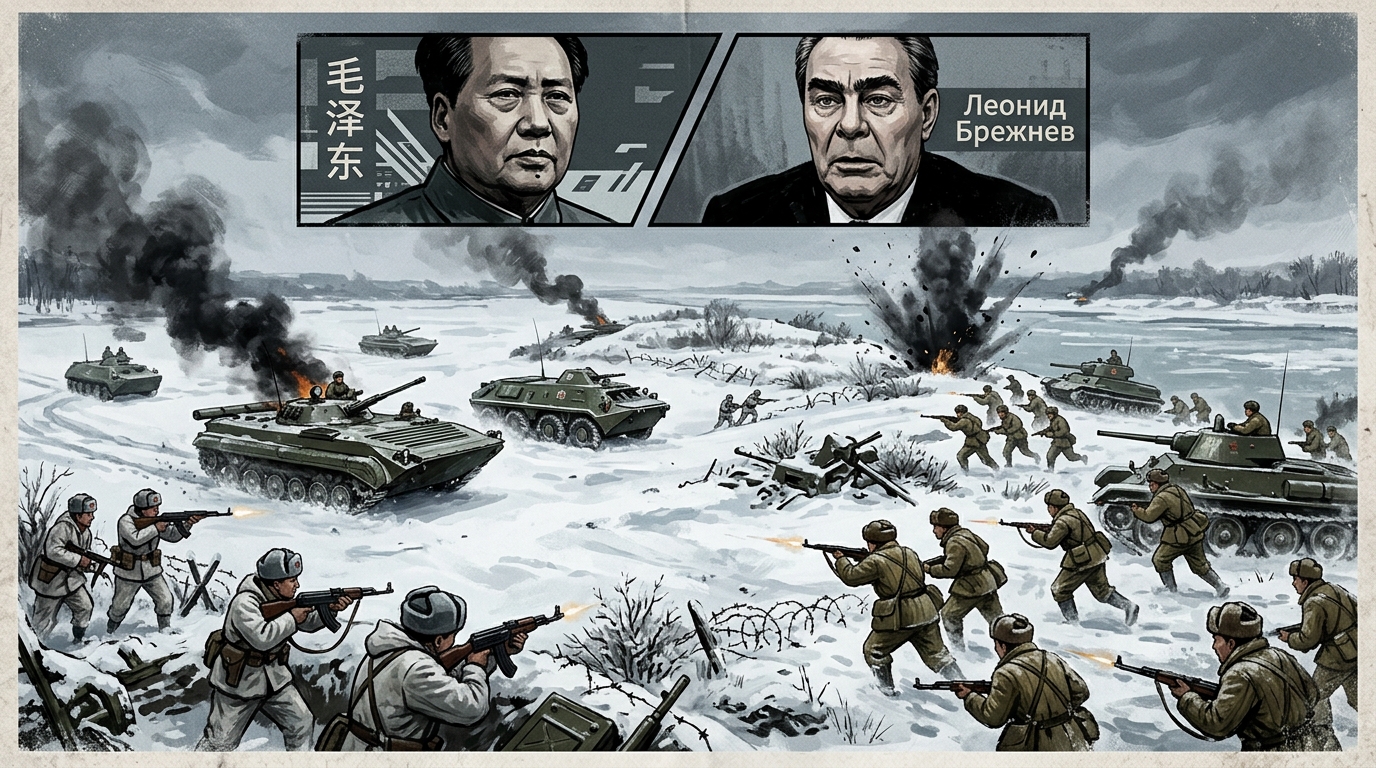
On the night of March 1–2, 1969, under the cover of darkness and a heavy snowstorm, approximately 300 soldiers of the Chinese People’s Liberation Army (PLA), clad in winter camouflage, crossed the frozen channel and established concealed positions on Zhenbao Island.
On the morning of March 2, Soviet observers at the Nizhne-Mikhailovka border outpost detected a Chinese patrol of about 30 men advancing toward the island. Senior Lieutenant Ivan Strelnikov led a detachment of Soviet border guards to intercept them, intending to deliver the standard verbal protest. As Strelnikov and his men approached the Chinese line, PLA forces opened fire at close range, killing Strelnikov and several of his men instantly 4.
A fierce firefight ensued. The remaining Soviet forces, reinforced by Senior Lieutenant Vitaly Bubenin and an armored personnel carrier (BTR-60) from a neighboring outpost, mounted a counterattack. Bubenin managed to flank the Chinese positions, inflicting heavy casualties, but was himself wounded. The clash lasted for approximately two hours, resulting in the deaths of 31 Soviet border guards and an estimated 39 Chinese soldiers before the PLA forces withdrew from the island.
"The Chinese side demands that the Soviet government immediately stop its provocations and encroachment on Chinese territory... Otherwise, the Soviet government must bear full responsibility for all the grave consequences." — Official Chinese Ministry of Foreign Affairs Statement, March 3, 1969
The Escalation of March 15, 1969
Following the March 2 incident, both sides reinforced their positions. The Soviet leadership, stung by the tactical surprise and the loss of its border guards, mobilized regular Red Army units, including heavy artillery and the newly developed T-62 main battle tanks. The Chinese massed infantry and anti-tank units along the western bank.
On the morning of March 15, the conflict resumed on a far larger scale. A Chinese force estimated at regiment strength (approx. 2,000 soldiers) launched an assault to secure Zhenbao Island. The Soviet forces, commanded by Colonel Demokrat Leonov, attempted to repel the Chinese infantry using a platoon of T-62 tanks. This ended in disaster for the Soviets: Leonov’s lead tank was disabled by a Chinese landmine, and Colonel Leonov was killed by sniper fire as he attempted to escape the stricken vehicle 5.
With Soviet infantry taking heavy losses and the Chinese threatening to overrun the island, the Soviet military command took a decisive and escalatory step. At 17:00, acting without direct authorization from the Politburo in Moscow (which was paralyzed by indecision), Major General Vadim Matrosov ordered a massive artillery bombardment.
For 10 minutes, Soviet BM-21 "Grad" multiple rocket launchers—a highly classified weapon system at the time—along with 122mm howitzers, pulverized the Chinese troop concentrations and logistics lines on the western bank of the river. The devastating barrage decimated the PLA forces and destroyed their gun emplacements, effectively ending the Chinese assault and forcing a retreat.
March 2, 1969: PLA Ambush -> Soviet counterattack (Bubenin) -> PLA retreat. March 15, 1969: Mass PLA assault -> Soviet T-62 tank lost -> Soviet "Grad" rocket barrage -> High casualties. Summer 1969: Xinjiang border skirmishes (Tielieketi) -> Diplomatic overtures.
The Xinjiang Clashes and the Brink of Nuclear War
While the Ussuri River fell quiet as the spring thaw turned the ice into impassable water, the theater of conflict shifted westward. Throughout the summer of 1969, minor clashes erupted along the border in Central Asia. The most serious of these occurred on August 13, 1969, at Tielieketi (Terekty) in China's Xinjiang region. A Soviet force, supported by armored personnel carriers and helicopters, bypassed and wiped out a Chinese patrol of nearly 30 soldiers, demonstrating the Soviet military's tactical superiority in open terrain 6.
By late August, the world faced the genuine prospect of a full-scale war between the two nuclear-armed states. Soviet diplomats made discreet inquiries to Western governments, including the United States, to gauge how Washington would react to a preemptive Soviet strike against China’s fledgling nuclear test facilities at Lop Nor.
Geopolitical Consequences and Aftermath
The Ussuri River conflict was a watershed moment in 20th-century diplomacy. Its primary consequence was the collapse of the monolithic bloc of global communism, which fundamentally reordered the strategic landscape of the Cold War.
The Realignment of Global Power
The threat of a Soviet invasion or nuclear strike forced Mao Zedong to reassess China's foreign policy. Recognizing that China could not withstand a simultaneous confrontation with both the United States and the Soviet Union, Mao opted for a radical geopolitical pivot.
The Nixon administration, guided by National Security Advisor Henry Kissinger, recognized the strategic opportunity presented by the Sino-Soviet split. Washington signaled to Moscow that a nuclear strike on China would not be tolerated, effectively acting as an indirect deterrent. This paved the way for "triangular diplomacy." Through secret channels, the US and China initiated a rapprochement that culminated in Henry Kissinger’s secret visit to Beijing in 1971 and President Richard Nixon's historic meeting with Mao in 1972 7.
[United States] / \ Rapprochement Cold War (1972) Containment / \ [China] <---Conflict---> [USSR] (1969)
This realignment isolated the Soviet Union, forcing Moscow to wage a two-front strategic struggle: defending its western flank against NATO while maintaining a massive, expensive military footprint along its eastern border with China. To counter this encirclement, Brezhnev pursued a policy of détente with the West, leading to the Strategic Arms Limitation Talks (SALT).
Defusing the Crisis: The Kosygin-Zhou Meeting
The immediate threat of war was defused on September 11, 1969. Following the funeral of Vietnamese leader Ho Chi Minh in Hanoi—where both Soviet and Chinese delegations had pointedly ignored each other—Soviet Premier Alexei Kosygin made an unannounced stopover at Beijing Capital International Airport.
On the tarmac, Kosygin met with Chinese Premier Zhou Enlai. The two leaders agreed to freeze troop movements, establish hotlines, and reopen formal border negotiations, effectively stepping back from the brink of war 8.
Analysis of Key Actors and Decisive Actions
The escalation and eventual de-escalation of the 1969 crisis were driven by the distinct political calculations and psychological states of the leadership in Beijing and Moscow.
| Dimension | China (Mao Zedong) | Soviet Union (Leonid Brezhnev) |
|---|---|---|
| Primary Objective | Internal political consolidation; defying "social imperialism." | Defense of territorial integrity; maintaining regional hegemony. |
| Military Strategy | Localized infantry ambush; asymmetric attrition. | Heavy artillery dominance; deployment of advanced armor/rockets. |
| Geopolitical Pivot | Rapprochement with the United States. | Seeking détente with NATO to avoid two-front pressure. |
| Key Negotiator | Zhou Enlai (Pragmatic diplomatic engagement). | Alexei Kosygin (Airport diplomacy to prevent escalation). |
Mao Zedong and the Domestic Utility of Conflict
For Mao, the border conflict served a critical domestic purpose. In 1969, the Cultural Revolution had descended into factional chaos, severely damaging China's economy and social fabric. By provoking a controlled military crisis with the Soviet "social-imperialists," Mao succeeded in rallying the Chinese population around a common external threat. The national emergency allowed him to deploy the PLA to restore order domestically and consolidate his grip on power during the Ninth National Congress of the Chinese Communist Party in April 1969.
Leonid Brezhnev and the Soviet Command Structure
The Soviet reaction reflected the insecurity of the Brezhnev leadership. The "Brezhnev Doctrine," which asserted the USSR's right to intervene in any socialist country deviating from the Moscow line (as demonstrated in Czechoslovakia in 1968), made Moscow highly sensitive to Chinese defiance.
However, the Soviet decision-making process during the March 15 clash revealed dangerous systemic vulnerabilities. The failure of the Politburo to provide clear instructions to local commanders led to a temporary tactical vacuum, which was only filled when local military officers took the initiative to unleash the BM-21 Grad rocket launchers. While militarily effective, this unauthorized escalation highlighted how easily localized border incidents could spiral out of control in a nuclear-armed world.
Trivia and Lesser-Known Facts
- The Battle for the Sunken T-62 Tank: During the March 15 clash, a state-of-the-art Soviet T-62 tank was disabled and sank through the river ice. Recognizing the intelligence value of this secret technology, both sides fought a weeks-long covert battle to recover it. Soviet snipers and artillery targeted anyone attempting to reach the vehicle, and the Soviets even tried to destroy it with mortars. However, Chinese divers successfully retrieved the tank under cover of darkness. It was dismantled, studied, and now sits as a prized exhibit in the Military Museum of the Chinese People's Revolution in Beijing [[^9]].
- Propaganda on Ice: Prior to the lethal clashes, both sides engaged in bizarre psychological warfare. Soviet border guards erected large mirrors along the riverbank to reflect sunlight back into the eyes of Chinese patrols. The Chinese responded by using megaphones to broadcast Maoist slogans and ideological lectures across the frozen river in Russian, to which the Soviets replied by playing Western jazz and pop music to drown out the broadcasts.
- The Nuclear "Green Light" Inquiry: When the Soviet Union informally sounded out the United States about a joint or condoned strike against China's nuclear program, the Nixon administration leaked the inquiry to the press. This public disclosure served a dual purpose: it signaled to Moscow that the US would not be complicit, and it warned Beijing of the imminent danger, accelerating the diplomatic thaw between Washington and Beijing.
References and Literature
- The Sino-Soviet Border Conflict (1969) - Detailed digital archive collection and analysis by the Woodrow Wilson International Center for Scholars.
- Mao’s China and the Cold War - Comprehensive historical work by Chen Jian analyzing China's foreign policy shifts during the Mao era.
- The Cold War: A New History - John Lewis Gaddis’s foundational text detailing the strategic impact of the Sino-Soviet split on global affairs.
- Beyond Damansky: The Soviet-Chinese Border War of 1969 - Academic analysis from Foreign Affairs detailing the military strategies and outcomes of the Ussuri River clashes.
---
Footnotes & Explanations
- Chen Jian, Mao's China and the Cold War (Chapel Hill: University of North Carolina Press, 2001), 85-87. ↩
- For a detailed examination of the treaty history, see the Wilson Center Digital Archive on the Sino-Soviet Border Conflict. ↩
- John Lewis Gaddis, The Cold War: A New History (New York: Penguin Press, 2005), 141-143. ↩
- Dmitry Ryabushkin, The Damansky Island Myths and Reality (Moscow: AST, 2004), 45-48. ↩
- Ibid., 112. ↩
- Lyle J. Goldstein, "Return to Zhenbao Island: Who Won the Sino-Soviet Border War of 1969?", The Journal of Military History 65, no. 4 (2001): 985-997. ↩
- Henry Kissinger, On China (New York: Penguin Press, 2011), 211-215. ↩
- Vladislav M. Zubok, A Failed Empire: The Soviet Union in the Cold War from Stalin to Gorbachev (Chapel Hill: University of North Carolina Press, 2007), 215-218. ↩
- "The Captured Soviet T-62 Tank," Military Museum of the Chinese People's Revolution, Beijing, Exhibit Record. ↩