Key Takeaways
- Operation Storm (Operacija Oluja) was the largest European land offensive since World War II, shifting the balance of power in the Yugoslav Wars.
- The military offensive effectively dissolved the self-proclaimed Republic of Serbian Krajina (RSK) and reintegrated its territory into Croatia.
- The operation triggered a massive humanitarian crisis, resulting in the flight of an estimated 150,000 to 250,000 ethnic Serbs from their ancestral lands.
On the morning of August 4, 1995, a massive artillery barrage echoed across a 630-kilometer front stretching from the Danube to the Adriatic Sea. This bombardment marked the commencement of Operation Storm (Operacija Oluja), a lightning military offensive launched by the Croatian Armed Forces (HV). Within eighty-four hours, the self-proclaimed Republic of Serbian Krajina (RSK)—which had occupied nearly a third of Croatia’s territory since 1991—was utterly dissolved.
Operation Storm remains the largest European land offensive since the Second World War. While celebrated in Croatia as a decisive victory that secured national sovereignty and restored territorial integrity, the operation is viewed in Serbia as a tragic campaign of ethnic cleansing. It resulted in the flight and forced displacement of over 200,000 ethnic Serbs, permanently altering the demographic and geopolitical landscape of the Western Balkans.
Historical Context and Origins
The roots of the 1995 offensive lie in the violent disintegration of the Socialist Federal Republic of Yugoslavia. In 1990, nationalist political movements gained traction across the federation's republics. In Croatia, the victory of the center-right, nationalist Croatian Democratic Union (HDZ), led by the former general and historian Franjo Tuđman, raised immediate alarms among the substantial ethnic Serb minority residing in Croatia's borderlands (the Krajina). 1
Historically settled along the old Austro-Hungarian military frontier, the Krajina Serbs feared a resurgence of the fascist, anti-Serb sentiments associated with the World War II-era Ustaše regime. Exploiting these anxieties, local Serb leaders, supported by the Belgrade regime of Slobodan Milošević and the Yugoslav People's Army (JNA), initiated the "Log Revolution" in August 1990. They blocked major transport corridors, declared autonomy, and systematically expelled ethnic Croats from the region.
- Disintegration of Yugoslavia (1990-1991)
By December 1991, the rebels formally proclaimed the Republic of Serbian Krajina (RSK), with its capital in Knin. The conflict escalated into full-scale war, characterized by intense ethnic violence, urban destruction, and the displacement of approximately 220,000 Croats. In early 1992, a United Nations-brokered ceasefire—the Vance Plan—was signed. It established United Nations Protected Areas (UNPAs) manned by the UN Protection Force (UNPROFOR) to monitor the ceasefire and initiate the demilitarization of the RSK.
However, the Vance Plan resulted in a frozen conflict. The RSK leadership refused to allow the return of Croatian refugees and rejected political reintegration into Croatia. Conversely, Zagreb utilized this breathing room to modernize its military. Under the guidance of retired American military officers working for the private military contractor Military Professional Resources Inc. (MPRI), the Croatian Army transformed from a disorganized militia into a highly disciplined, western-style fighting force. 2
By 1995, the international community's patience with the Serb rebellions in both Croatia and Bosnia had eroded. The fall of the UN safe areas of Srebrenica and Žepa in July 1995, followed by the massacre of thousands of Bosniaks, galvanized Western leaders. Fearing a similar catastrophe in the besieged Bihać pocket of northwestern Bosnia, which was surrounded by Bosnian Serb and RSK forces, Western powers—most notably the United States—became increasingly receptive to a decisive military intervention by Croatia.
Timeline of Events and Key Moments
The execution of Operation Storm was characterized by rapid tactical movements, overwhelming force concentration, and a near-total collapse of the RSK's defensive apparatus.
| Date | Event |
|---|---|
| August 3, 1995 | Geneva peace negotiations collapse as RSK leaders reject the reintegration terms. |
| August 4, 1995 | 05:00 - HV launches offensive across a 630km front; NATO airstrikes target RSK radars. |
| August 5, 1995 | HV forces enter Knin; the Croatian flag is raised atop the historic Knin Fortress. |
| August 6, 1995 | HV links up with the Bosnian Army (ARBiH) at the Bihać border, lifting the 3-year siege. |
| August 7, 1995 | Major combat operations conclude; the RSK 21st Kordun Corps formally surrenders. |
August 3, 1995: The Failure of Diplomacy
In a last-ditch effort to avert war, representatives of the Croatian government and the RSK leadership met in Geneva. The international mediators presented the Z-4 Plan, which offered the Krajina Serbs unprecedented autonomy within Croatia, including their own parliament, currency, flag, and police force. Blinded by assurances from Belgrade and expecting a protracted stalemate, RSK President Milan Martić refused to consider the plan. Zagreb, having already finalized military preparations, declared the peace talks dead.
August 4, 1995: The Onslaught Begins
At precisely 05:00 CET, the Croatian Army, comprising over 130,000 active troops and reservists, launched a multi-pronged assault under the command of General Zvonimir Červenko. The offensive was divided into several operational groups:
- Sector South: Tasked with capturing the rebel stronghold of Knin. This sector was commanded by Major General Ante Gotovina.
- Sector North: Directed toward Kordun and Banovina, regions adjacent to the Bosnian border.
Simultaneously, NATO aircraft launched precision strikes against RSK surface-to-air missile sites and air defense radars, disabling the rebels' early-warning networks. Within hours, the HV breached the outer lines of the RSK's Army of Serbian Krajina (SVK), which was heavily outnumbered and suffered from low morale and desertion.
August 5, 1995: The Fall of Knin
By the morning of August 5, Croatian forces had bypassed strongpoints and infiltrated the rugged terrain of Mount Dinara. At 09:43, troops of the 4th and 7th Guards Brigades entered the largely deserted city of Knin. The raising of a giant Croatian flag atop the medieval Knin Fortress symbolized the end of the RSK.
"The operation was executed with surgical precision. The speed of the advance surprised even our own planners. The enemy's lines did not just break; they dissolved." — General Janko Bobetko, former Chief of the General Staff [[^3]]
Fearing an imminent humanitarian catastrophe and direct military retribution, Milan Martić issued an official evacuation order (Order No. 2-3113/95) at 16:45 on August 5. This order directed the civilian population of the southern sectors to evacuate toward southern Bosnia and Yugoslavia, initiating a mass exodus.
August 6–7, 1995: Collapse and Link-Up
As tens of thousands of Serb civilians and retreating soldiers choked the narrow roads leading to Bosnia, the HV continued its rapid advance. On August 6, Croatian forces reached the border with Bosnia and Herzegovina near the town of Rakovica, linking up with the 5th Corps of the Army of the Republic of Bosnia and Herzegovina (ARBiH). This move successfully broke the three-year-long siege of the Bihać pocket.
By August 7, the remaining pockets of Serb resistance in Kordun and Banovina were eliminated. On August 8, the commander of the RSK's 21st Kordun Corps, Colonel Čedomir Bulat, formally surrendered his entire command—including weapons, tanks, and personnel—to Croatian General Petar Stipetić near Glina.
Geopolitical Consequences and Aftermath
The rapid success of Operation Storm dramatically altered the geopolitical landscape of Southeast Europe, bringing an end to the four-year territorial stalemate in Croatia and paving the way for the resolution of the wider Bosnian War.
| Metric / Aspect | Details of the Aftermath |
|---|---|
| Territorial Reintegration | Approximately 10,400 square kilometers (18.4% of Croatia's landmass) restored to Zagreb's control. |
| Demographic Shift | An estimated 150,000 to 250,000 ethnic Serbs fled, reducing the Serb minority in Croatia from 12.2% (1991) to 4.5% (2001). |
| Strategic Realignment | Lifted the siege of Bihać, enabled joint HV-ARBiH campaigns in western Bosnia (Operation Mistral), forcing Serbs to negotiate. |
| Human Costs | Hundreds of civilian casualties (estimates range from 600 to 2,000 depending on source), with thousands of homes systematically burned. |
The Humanitarian Crisis and Mass Displacement
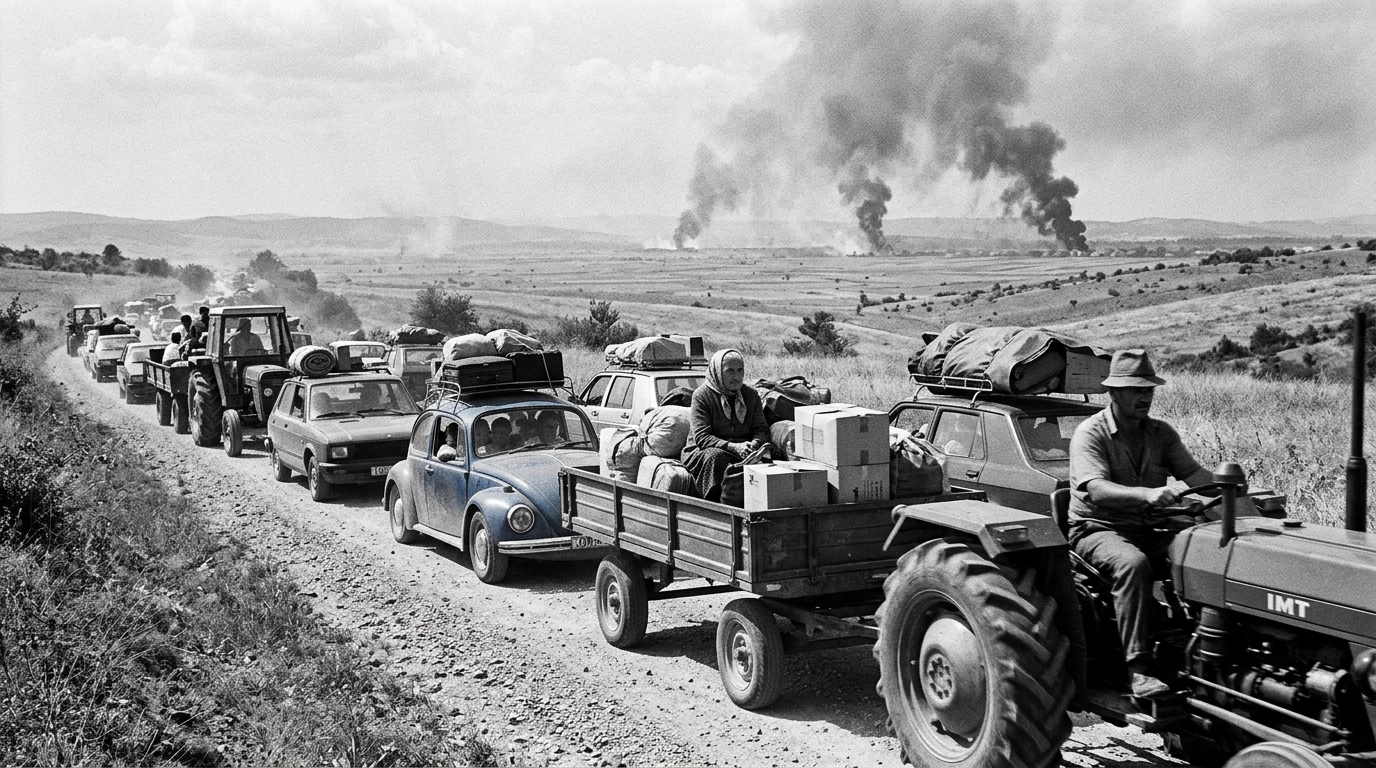
The most visible and tragic consequence of Operation Storm was the displacement of the region's ethnic Serb population. A column of tractors, cars, and horse-drawn carriages stretched for tens of miles along the dusty roads of northern Bosnia. Exposed to heat, lack of water, and occasional attacks by Croatian aircraft and vengeful civilian mobs, the refugees eventually arrived in Serbia and the Serb-controlled territories of Bosnia.
For those who chose to stay behind—mostly the elderly, infirm, and isolated communities—the aftermath of the operation was marked by widespread human rights abuses. Human rights organizations, including Human Rights Watch and Amnesty International, documented the systematic looting and burning of thousands of Serb-owned homes to prevent the return of refugees. Furthermore, summary executions of remaining civilians occurred in villages such as Grubori, Varivode, and Gošić. 4
The Path to the Dayton Accords
From a geopolitical perspective, Operation Storm broke the back of the Greater Serbian project envisioned by Milošević. By neutralizing the RSK, the Croatian Army was freed to operate inside western Bosnia alongside the Bosnian government forces. The joint offensive (Operation Mistral and Operation Sana) in late August and September 1995 recaptured vast swathes of Bosnian territory from the Bosnian Serb Army (VRS).
This shift in the military balance of power, combined with intensive NATO airstrikes (Operation Deliberate Force), forced the Bosnian Serb leadership and Slobodan Milošević to the negotiating table. The resulting Dayton Peace Agreement in November 1995 officially ended the Bosnian War, cementing the borders and administrative divisions of the region.
Analysis of Key Actors and Decisive Actions
The dramatic collapse of the Republic of Serbian Krajina cannot be attributed solely to the tactical superiority of the Croatian Army. It was the product of a complex interplay of political opportunism, strategic miscalculations, and geopolitical realpolitik.
| Franjo Tuđman (Nationalist State-Building) | Slobodan Milošević (Realpolitik & Regime Survival) |
|---|---|
| Modernized HV with US help | Abandoned RSK to lift sanctions |
| Determined to integrate territory | Consolidated power in Belgrade |
| "Brioni Transcript" controversy | Sacrificed Krajina Serbs |
Franjo Tuđman: The Architect of Croatian Statehood
For Croatian President Franjo Tuđman, the reintegration of the Krajina was the ultimate test of his presidency and the legitimacy of the Croatian state. Tuđman recognized that a sovereign country could not function with its central transit routes blocked and a foreign entity occupying its core.
However, Tuđman's legacy remains deeply polarized due to his nationalist rhetoric. In the lead-up to the offensive, during a meeting with his military command on the island of Brijuni on July 31, 1995, Tuđman discussed the strategy to be employed against the Serbs:
"We have to inflict such a blow that the Serbs will practically disappear—that is, that those we do not reach immediately will have to capitulate within a few days." [[^5]]
This statement, recorded in the Brioni Transcripts, became the centerpiece of subsequent war crimes prosecutions, with prosecutors arguing it proved a premeditated plan for ethnic cleansing.
Slobodan Milošević: The Silent Abandonment
Perhaps the most critical factor in the rapid fall of the RSK was the calculated inaction of Serbian President Slobodan Milošević. Despite his earlier rhetoric of defending "all Serbs in one state," Milošević had come to view the Krajina Serbs as a political liability that prevented the lifting of crippling UN sanctions against the Federal Republic of Yugoslavia.
When the Croatian offensive began, the JNA and Serbian forces remained entirely passive. Milošević’s state-controlled media downplayed the significance of the attack, and the Serbian political elite offered nothing more than rhetorical condemnation. Milošević prioritized the consolidation of his own power in Belgrade and his standing with Western negotiators, effectively abandoning Milan Martić and the Krajina Serbs to their fate. 6
The Role of the ICTY and International Justice
The aftermath of Operation Storm led to a long legal battle at the International Criminal Tribunal for the former Yugoslavia (ICTY) in The Hague. The tribunal indicted several senior Croatian officers, including General Ante Gotovina, General Ivan Čermak, and General Mladen Markač, charging them with crimes against humanity and violations of the laws or customs of war.
In April 2011, the ICTY Trial Chamber found Gotovina and Markač guilty, sentencing them to 24 and 18 years in prison respectively. The court ruled that they had participated in a Joint Criminal Enterprise (JCE) aimed at the permanent removal of the Serb population through unlawful shelling and the destruction of property.
However, in a dramatic turn of events, the ICTY Appeals Chamber acquitted both generals on all counts in November 2012. The appeals judges ruled that there was no evidence of a systematic plan to deport the Serb minority or that the artillery shelling of Knin was unlawful. The ruling was celebrated as a supreme vindication in Croatia, while it was condemned in Serbia as proof of the tribunal’s bias. 7
Trivia and Lesser-Known Facts
- The MPRI Connection: While the U.S. government denied direct military involvement, the Clinton administration gave a "nod and a wink" to the private military firm MPRI to assist Croatia. The firm’s training in "democracy transition" and "military management" was widely recognized as a cover for teaching the HV the modern NATO doctrine of AirLand Battle.
- The French UNPROFOR Casualties: During the opening hours of the offensive, several UN observation posts were caught in the crossfire. Two French peacekeepers were killed and several others wounded by Croatian shelling in Sector North, sparking temporary diplomatic friction between Paris and Zagreb.
- The "Train of Freedom": Just three weeks after the operation's conclusion, on August 26, 1995, Franjo Tuđman boarded the "Train of Freedom" (Vlak slobode) from Zagreb to Split via Knin. The train ride symbolized the physical reunification of Croatia, which had been split in two for four years.
- Operation Summer '95: The foundation for Operation Storm was actually laid weeks earlier during Operacija Ljeto '95 (Operation Summer '95). Croatian forces had captured the strategic towns of Bosansko Grahovo and Glamoč inside Bosnia, effectively surrounding Knin from three sides and cutting off its primary supply routes to Banja Luka.
References and Literature
- The Fall of the Western Krajina - Foreign Affairs article analyzing the strategic and diplomatic dimensions of the 1995 offensive.
- Yugoslavia: Death of a Nation - BBC documentary series and accompanying book detailing the political maneuvers of Tuđman and Milošević during the war.
- The Prosecutor v. Ante Gotovina et al. (IT-06-90) - Official case information sheet and judgments from the International Criminal Tribunal for the former Yugoslavia.
- Operation Storm: The Reintegration of Croatia's Krajina Region - GlobalSecurity detailed analysis of military maneuvers, logistics, and troop allocations during the conflict.
---
Footnotes & Explanations
- Goldstein, Ivo. Croatia: A History. McGill-Queen's University Press, 1999, pp. 220-224. ↩
- Avant, Deborah D. The Market for Force: The Consequences of Privatizing Security. Cambridge University Press, 2005, pp. 98-101. ↩
- Bobetko, Janko. Sve moje bitke (All My Battles). Zagreb: Private Edition, 1996, p. 431. ↩
- Human Rights Watch. Croatia: Impunity for Abuses Committed During "Operation Storm". Vol. 8, No. 13(D), August 1996. ↩
- ICTY Trial Chamber Judgment, The Prosecutor v. Ante Gotovina, Ivan Čermak and Mladen Markač, Case No. IT-06-90-T, 15 April 2011, para. 1983. ↩
- Silber, Laura, and Allan Little. Yugoslavia: Death of a Nation. TV Books, 1997, pp. 356-359. ↩
- ICTY Appeals Chamber Judgment, The Prosecutor v. Ante Gotovina and Mladen Markač, Case No. IT-06-90-A, 16 November 2012. ↩