Key Takeaways
- The fall of Saigon on April 30, 1975, marked the official end of the Vietnam War, resulting in the collapse of the Republic of Vietnam (South Vietnam) and the reunification of the country under communist rule.
- The final offensive by the People's Army of Vietnam (PAVN) bypassed negotiated settlements, capitalizing on the rapid withdrawal of American financial and military support following the 1973 Paris Peace Accords.
- Operation Frequent Wind became the largest helicopter evacuation in history, symbolizing the limits of American power and initiating the 'Vietnam Syndrome' that influenced US foreign policy for decades.
Historical Context and Origins
The roots of the Fall of Saigon lie in the complex decolonization process of French Indochina following World War II. The defeat of French forces at the Battle of Dien Bien Phu in 1954 led to the Geneva Accords, which temporarily partitioned Vietnam along the 17th parallel.1 In the North, the Democratic Republic of Vietnam (DRV) established a communist state under the revolutionary leadership of Ho Chi Minh. In the South, the Republic of Vietnam (RVN) emerged as an anti-communist state heavily backed by the United States as part of its global containment strategy against the spread of communism during the Cold War.
Geneva Accords (1954): Partition at 17th Parallel
Conflict & Intervention
- National Liberation Front (Viet Cong) Insurgency
By the mid-1960s, local communist insurgents in the South, known as the Viet Cong (National Liberation Front), supported by the regular North Vietnamese Army (PAVN), threatened to overthrow the Saigon government. This prompted direct American military intervention. At its peak in 1969, more than 500,000 American troops were deployed in Vietnam. However, the unconventional nature of the conflict, high casualties, and growing domestic unrest in the United States made the war increasingly unsustainable.
The turning point in American involvement came with the 1968 Tet Offensive. Although a tactical military defeat for the communist forces, it was a profound psychological and political victory that shattered the American public's belief that the war was being won. Under President Richard Nixon, the US initiated a policy of "Vietnamization"—gradually transferring combat responsibilities to the Army of the Republic of Vietnam (ARVN) while withdrawing US troops.2
In January 1973, the United States, North Vietnam, South Vietnam, and the Viet Cong signed the Paris Peace Accords. The treaty mandated:
- The complete withdrawal of all remaining US combat forces.
- The release of American prisoners of war.
- A ceasefire in place between North and South Vietnamese forces.
- The establishment of a National Council of National Reconciliation to organize free elections.
Crucially, the accords allowed PAVN troops to remain in their positions within South Vietnamese territory. While President Nixon secretly assured South Vietnamese President Nguyen Van Thieu that the US would respond with air power to any major northern violation of the treaty, the domestic political landscape in Washington shifted dramatically. The Watergate scandal forced Nixon's resignation in August 1974, elevating Vice President Gerald Ford to the presidency.
Concurrently, an inflation-weary and war-fatigued US Congress drastically slashed military and economic aid to South Vietnam. In 1974, military aid was cut from an requested $1.4 billion to $700 million.3 This reduction severely crippled the ARVN's operational capacity, leaving its forces short of fuel, ammunition, spare parts, and air support, while the Soviet Union and the People's Republic of China continued to supply Hanoi with heavy artillery, tanks, and anti-aircraft systems.
Timeline of Events and Key Moments
The final campaign that led to the collapse of South Vietnam was initially envisioned by Hanoi as a multi-year offensive. However, the rapid deterioration of ARVN forces transformed a limited probe into a swift, conventional conquest.
The Phuoc Long Province Campaign (December 1974 – January 1975)
In late 1974, North Vietnamese General Tran Van Tra launched a limited offensive against Phuoc Long Province, situated along the Cambodian border, to test both ARVN's defensive capabilities and the likelihood of American intervention. By January 6, 1975, the province capital had fallen. The United States did not react militarily. This inaction signaled to Hanoi that the Ford administration was politically paralyzed and unable to re-engage in the conflict.
The Campaign in the Central Highlands (March 1975)
Emboldened by the American silence, North Vietnamese General Van Tien Dung launched the "Ho Chi Minh Campaign." On March 10, PAVN forces struck Ban Me Thuot, a strategically vital city in the Central Highlands.4 The city fell in just two days.
In response, President Nguyen Van Thieu made a catastrophic strategic decision. Fearing his forces would be cut off, he ordered a chaotic, unplanned retreat from the northern provinces and Central Highlands, intending to consolidate his army to defend the southern redoubts around Saigon. This retreat, known as the "Column of Tears," quickly degenerated into a rout as civilian refugees mixed with retreating soldiers under constant PAVN artillery bombardment.
The Collapse of Hue and Da Nang (Late March 1975)
The panic spread rapidly. The historic imperial city of Hue fell with little resistance on March 25. On March 29, Da Nang, South Vietnam's second-largest city and a major former US military base, fell amidst scenes of absolute chaos as desperate soldiers and civilians fought to board the last departing planes and boats.
| Date (1975) | Key Event / Battle | Outcome |
|---|---|---|
| January 6 | Fall of Phuoc Long Province | North Vietnamese victory; US shows no military reaction. |
| March 10–12 | Battle of Ban Me Thuot | PAVN captures the strategic hub; President Thieu orders a general retreat. |
| March 25 | Fall of Hue | The historic imperial capital is captured by PAVN forces. |
| March 29 | Fall of Da Nang | Complete collapse of ARVN defense in the northern provinces. |
| April 9–21 | Battle of Xuan Loc | ARVN's 18th Division makes a heroic last stand but is ultimately overwhelmed. |
| April 21 | Resignation of Nguyen Van Thieu | Thieu resigns, denouncing the US, and flees into exile. |
| April 29–30 | Operation Frequent Wind | Mass helicopter evacuation of Americans and South Vietnamese from Saigon. |
| April 30 | Fall of Saigon | PAVN tanks breach the Independence Palace; unconditional surrender of South Vietnam. |
The Battle of Xuan Loc (April 9 – 21, 1975)
The last major defensive line before Saigon was established at Xuan Loc, a crucial crossroads town situated 40 miles northeast of the capital. Here, the ARVN 18th Division, commanded by Brigadier General Le Minh Dao, put up a fierce, desperate resistance against overwhelming odds. For nearly two weeks, the division repulsed waves of PAVN assaults, inflicting heavy casualties. However, bypassed by other communist units and facing encirclement, the defenders were eventually forced to withdraw. The road to Saigon was now wide open.
The Abdication of Power and the Final Evacuation
On April 21, President Nguyen Van Thieu resigned during a bitter, televised address to the nation, accusing the United States of betrayal:
"The United States did not keep its promise to help us fight for freedom... It is an inhumane act by an untrustworthy ally." [^5]
Thieu was replaced by Vice President Tran Van Huong, who soon handed power to General Duong Van "Big" Minh, a figure favored by some who hoped he could negotiate a coalition government with the North. Hanoi, however, had no interest in negotiation; their forces had already encircled Saigon with over 100,000 troops.
On April 28, PAVN artillery began shelling Tan Son Nhut Air Base, rendering fixed-wing evacuations impossible. This triggered the immediate execution of Operation Frequent Wind, the emergency helicopter evacuation of American citizens and thousands of "at-risk" South Vietnamese who had worked for the US military or government.
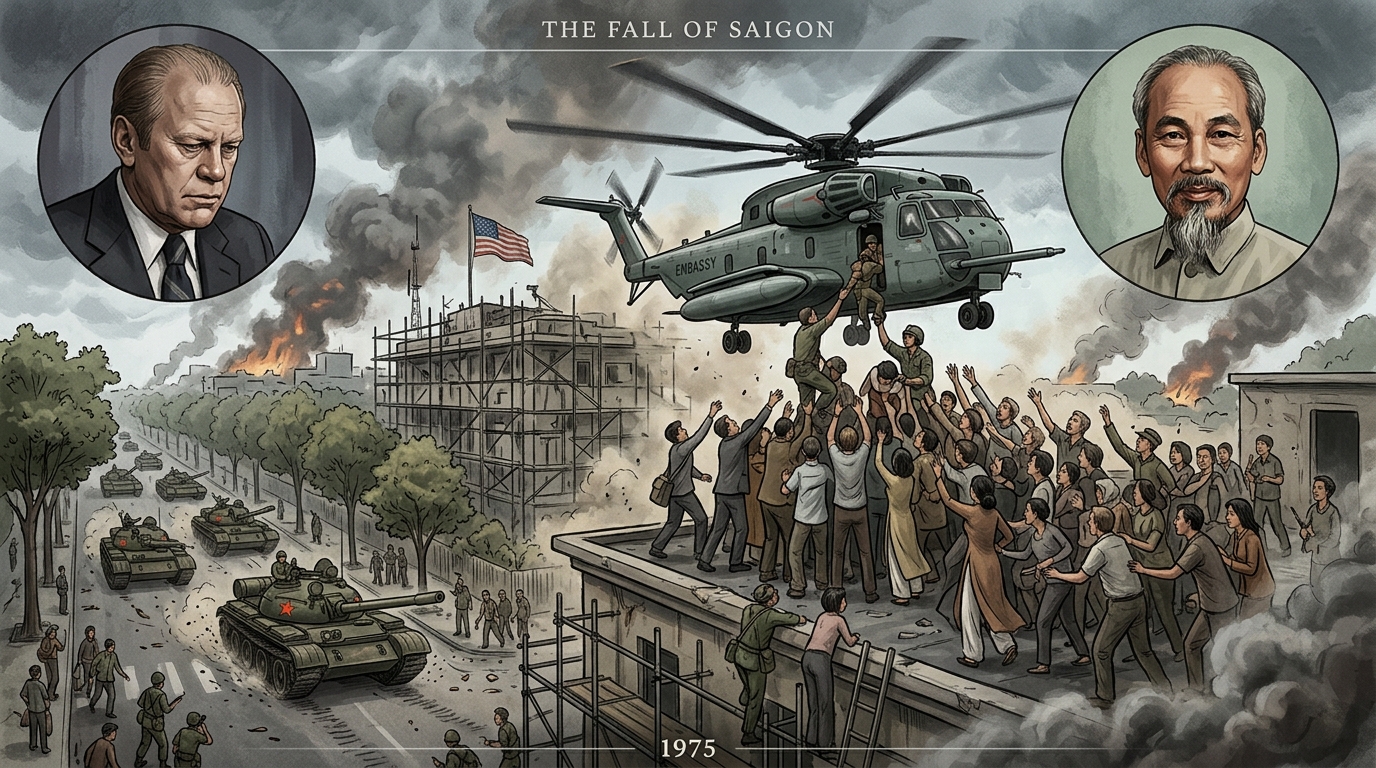
Throughout April 29 and into the morning of April 30, a continuous stream of CH-53 Sea Stallion and UH-1 Huey helicopters flew shuttle missions from the US Embassy compound and Tan Son Nhut to US Navy warships waiting off the coast. Images of desperate Vietnamese climbing the ladder to a rooftop helicopter pickup point at 22 Gia Long Street (often misidentified as the US Embassy, but actually a USAID apartment building) became iconic symbols of the retreat.
- April 28: Tan Son Nhut Air Base - Shelling Halts Fixed-Wing Flights
- April 29: Operation Frequent Wind Is Activated
- April 30 (07:53 AM): Last US Marine Helicopter Departs
- April 30 (11:30 AM): PAVN Tanks Enter Independence Palace
At 07:53 AM on April 30, the last helicopter carrying US Marines from the embassy roof departed. A few hours later, at approximately 11:30 AM, PAVN Tank 843 crashed through the wrought-iron gates of the Independence Palace. General Duong Van Minh surrendered unconditionally, announcing over the national radio: "I declare the Saigon government... completely dissolved at all levels." 6
Geopolitical Consequences and Aftermath
The fall of Saigon was a watershed event of the late 20th century, profoundly altering the global geopolitical landscape, reshaping American domestic politics, and bringing immense social changes to Indochina.
Regional Reunification and the Indochinese Crisis
Following the military conquest, Saigon was officially renamed Ho Chi Minh City, and on July 2, 1976, the country was formally reunited as the Socialist Republic of Vietnam. The new regime moved swiftly to implement socialist transformation in the south:
- Private property was nationalized, and agricultural collectivization was enforced.
- Hundreds of thousands of South Vietnamese military officers, civil servants, and intellectuals were sent to brutal "re-education camps" [^7], where they endured hard labor, political indoctrination, and malnutrition.
- The socioeconomic upheaval triggered a massive refugee crisis. Over the next two decades, up to two million people fled the country by sea. These "Boat People" faced perilous journeys across the South China Sea, plagued by pirates, storms, and dehydration, with hundreds of thousands perishing before reaching refugee camps in Hong Kong, Thailand, Malaysia, or eventual resettlement in Western countries.
Fall of Saigon (1975)
- Reunification as Socialist Republic of Vietnam
- Establishment of Re-education Camps
- Exodus of the "Boat People" Refugee Crisis
The fall of South Vietnam also triggered a domino effect across neighboring countries in Southeast Asia, though not precisely as American policymakers had feared. In Cambodia, the US-backed government of Lon Nol fell to the radical Khmer Rouge under Pol Pot on April 17, 1975, leading to the Cambodian Genocide. In Laos, the communist Pathet Lao took complete control of the government in December 1975. However, instead of a unified communist bloc, the region soon dissolved into intra-communist warfare, culminating in the Cambodian-Vietnamese War of 1978 and the Sino-Vietnamese War of 1979.
The "Vietnam Syndrome" in the United States
For the United States, the defeat in Vietnam was a devastating psychological blow that shattered the myth of American military invincibility and sparked a deep crisis of national confidence. The conflict had cost the lives of over 58,000 Americans and up to three million Vietnamese.8
This trauma produced what historians and political scientists termed the "Vietnam Syndrome"—a deep-seated public and political reluctance to commit US military forces to overseas conflicts unless there was a clear, vital national interest, a defined exit strategy, and strong domestic consensus. This caution heavily influenced American foreign policy for nearly two decades, limiting direct military interventions during the Carter and Reagan administrations (such as avoiding major ground deployments in Central America or the Middle East) until the decisive victory in the 1991 Gulf War, which President George H.W. Bush famously declared had "kicked the Vietnam Syndrome once and for all." 9
Analysis of Key Actors and Decisive Actions
The outcome of the Vietnam War was shaped by several critical figures whose strategic decisions—or failures—determined the speed and nature of the war's final chapter.
Ho Chi Minh
Although Ho Chi Minh died in September 1969, six years before the fall of Saigon, his nationalist vision and revolutionary doctrine remained the ideological engine of the North's victory. His insistence on the indivisibility of Vietnam and his strategy of protracted war designed to exhaust American political will laid the foundation for the final offensive. The renaming of Saigon to Ho Chi Minh City was the ultimate tribute to his enduring influence over the North's military and political apparatus.
President Gerald Ford
President Gerald Ford was dealt an exceptionally weak hand upon taking office in August 1974. Bound by the War Powers Resolution of 1973—which limited the president's ability to commit US forces to combat without congressional approval—and facing an overwhelmingly anti-war Democratic majority in Congress, Ford found his diplomatic and military options severely constrained.
When Ford appealed to Congress in early April 1975 for $722 million in emergency military aid for South Vietnam, his request was flatly rejected. During a speech at Tulane University on April 23, 1975, Ford publicly acknowledged the reality of the situation:
"Today, America can regain the sense of pride that existed before Vietnam. But it cannot be achieved by refighting a war that is finished as far as America is concerned." [^10]
Ford's primary contribution was managing the final evacuation, ensuring that thousands of American citizens and South Vietnamese allies were successfully rescued under extremely hazardous conditions.
Ambassador Graham Martin
The last US Ambassador to South Vietnam, Graham Martin, played a controversial role in the final months. Haunted by the personal loss of his adopted son in the war, Martin was fiercely committed to the survival of South Vietnam. He repeatedly refused to plan for an early evacuation, fearing that any visible preparations would trigger a nationwide panic, collapse the South Vietnamese economy, and undermine President Thieu's government.
While Martin's reluctance prevented premature panic, it also delayed critical logistical arrangements, resulting in the frantic, last-minute chaos of Operation Frequent Wind. Despite his stubbornness, Martin remained in the embassy until the very end, personally coordinating the departure of thousands of refugees before being ordered to board an evacuation helicopter by President Ford himself.
- Ambassador G. Martin (Reluctance to Panic)
Trivia and Lesser-Known Facts
- The Secret Radio Code: To signal the immediate start of the evacuation to American personnel scattered throughout Saigon, Armed Forces Radio played a unique, pre-arranged signal on a loop: the announcement that "the temperature in Saigon is 105 degrees and rising," followed immediately by the playing of Bing Crosby's recording of the song "White Christmas".
- The Mid-Air Helicopter Disposals: During Operation Frequent Wind, so many South Vietnamese military helicopters flew out to the waiting ships of the US Seventh Fleet that the flight decks became completely congested. To clear space for incoming aircraft carrying more refugees, US sailors had to push dozens of serviceable UH-1 Huey helicopters, worth millions of dollars, directly over the side into the South China Sea.
- The Heroic Flight of Major Buang-Ly: One of the most remarkable stories of the evacuation involved Major Buang-Ly of the South Vietnamese Air Force. Realizing his family was in mortal danger, he loaded his wife and five children into a small, two-seat Cessna O-1 Bird Dog observation plane. He took off under fire, flew out to sea, and located the aircraft carrier USS Midway. Lacking radio contact, he dropped a note wrapped in a pistol belt onto the carrier's deck that read: "Can you move these helicopter to the other side, I can land on your runway... Please rescue me." The carrier's commanding officer, Captain Lawrence Chambers, ordered the flight deck cleared, pushing several helicopters overboard to allow the tiny plane to make a flawless landing without a tailhook.
- The Fate of Tank 843: The North Vietnamese Type 59 tank (numbered 843) that crashed through the gates of the Independence Palace is preserved today as a National Treasure in the Military History Museum in Hanoi. However, historical records reveal that another tank, Tank 390, actually crashed through the main gate first, while Tank 843 had become stuck on a side gate. The official narrative was later corrected to recognize both crews for their historic roles.
References and Literature
- The Paris Peace Accords of 1973 - The official diplomatic treaty that initiated the withdrawal of US combat forces from Vietnam.
- Snepp, Frank (1977). Decent Interval: An Insider's Account of Saigon's End - A highly detailed, first-hand account of the political and intelligence failures surrounding the fall of Saigon by the CIA's chief strategy analyst in Vietnam.
- Herring, George C. (2002). America's Longest War: The United States and Vietnam, 1950-1975 - A comprehensive academic study analyzed by foreign policy scholars, detailing the systemic strategic errors and political dimensions of the conflict.
- The Gerald R. Ford Presidential Library and Museum - Declassified government documents, diplomatic cables, and presidential audio recordings from the final days of the Vietnam War in April 1975.
Footnotes & Explanations
- See the Geneva Conference of 1954, which established the provisional military demarcation line along the 17th parallel. ↩
- President Richard Nixon officially outlined the "Vietnamization" doctrine during a speech in Guam on July 25, 1969. ↩
- George C. Herring, America's Longest War: The United States and Vietnam, 1950-1975 (New York: McGraw-Hill, 2002), p. 320. ↩
- General Van Tien Dung, Our Great Spring Victory: An Account of the Liberation of South Vietnam (Hanoi: Foreign Languages Publishing House, 1977), p. 45. ↩
- Excerpt from President Nguyen Van Thieu's televised resignation address, April 21, 1975. ↩
- Broadcast by President Duong Van Minh over the Radio Saigon network, 11:30 AM, April 30, 1975. ↩
- Scholars estimate that between 100,000 and 300,000 former South Vietnamese military and civil personnel were detained in these camps. ↩
- Congressional Research Service report on US military casualty statistics. ↩
- President George H.W. Bush, speech to the American Legislative Exchange Council, March 1, 1991. ↩
- President Gerald R. Ford, Address at Tulane University, New Orleans, Louisiana, April 23, 1975. ↩