Key Takeaways
- The Euromaidan protests represented a fundamental civilizational shift in Ukraine, moving away from post-Soviet integration toward European integration and democratic values.
- The sudden reversal of the EU Association Agreement by Viktor Yanukovych catalyzed a dormant civil society, leading to a permanent transformation of Ukraine's political identity and a clear Western orientation.
- The crisis underscored the irreconcilable strategic objectives of the Russian Federation and the collective West regarding the status of the post-Soviet space, escalating into direct military intervention by Moscow.
- The Revolution of Dignity fundamentally reshaped Ukraine's domestic political landscape, strengthening civil society, initiating crucial reforms, and fostering a robust national identity.
Historical Context and Origins
The roots of the 2013 Euromaidan protests extend far deeper than the immediate political maneuvering of the early 2010s, tapping into centuries of Ukrainian identity formation and geopolitical struggle. Since its nominal independence from the Soviet Union in 1991, Ukraine remained trapped in a precarious geopolitical tug-of-war. Its unique position as a vast European nation, bordering both a resurgent Russia and the expanding European Union, created inherent tensions. Caught between a burgeoning internal desire for liberal democracy, European integration, and rule of law, and a legacy of economic dependency, institutional corruption, and the lingering influence of Russian imperial nostalgia, Ukraine’s post-Soviet political trajectory was inherently unstable and often contradictory.
Ukraine's path to statehood has historically been fraught with external domination, from the Polish-Lithuanian Commonwealth to the Russian Empire and the Soviet Union. The national memory of events like the Holodomor (the man-made famine of 1932-33) and persistent Russification policies instilled a deep-seated desire for genuine sovereignty and self-determination. The initial euphoria of independence in 1991 was gradually dampened by the challenges of state-building in a post-Soviet context: rampant corruption, the rise of powerful oligarchs, and a persistent "multi-vector" foreign policy that often sought to balance between Moscow and the West without fully committing to either.
Following the 2004 Orange Revolution, which had been ignited by widespread electoral fraud and a popular desire for democratic change, there was a tentative expectation that Ukraine would solidify its path toward the European Union. Millions took to the streets in a mostly peaceful protest against a rigged presidential election, successfully overturning the results and bringing pro-Western Viktor Yushchenko to power. However, the subsequent years were marked by internecine political squabbles between Orange Revolution leaders, infighting, and a failure to implement deep systemic reforms. This stagnation led to public disillusionment and inadvertently paved the way for the return of Viktor Yanukovych, the very figure the Orange Revolution had initially rejected.
By the time Yanukovych secured the presidency in 2010, the country was primed for conflict. His administration systematically dismantled many of the democratic gains of the previous decade, consolidating power in the hands of his "family" (an inner circle of loyalists and relatives) and imprisoning key political opponents, most notably former Prime Minister Yulia Tymoshenko, under charges widely seen as politically motivated. This created a profound sense of grievance among significant portions of the population, particularly the youth and residents of Western and Central Ukraine, who viewed Yanukovych's rule as a regression towards authoritarianism and a reversal of the country's European aspirations.
By 2013, the EU Association Agreement—a comprehensive treaty that would have integrated Ukraine into the European economic sphere, facilitating trade, travel, and democratic reforms—was seen by much of the Ukrainian public not merely as a technical trade agreement, but as a profound symbolic and practical exit from the "Russian world" (Russkiy Mir). It represented a final break from the post-Soviet sphere of influence and a commitment to European democratic values and institutions. The negotiations had been long and arduous, and public anticipation for its signing at the Vilnius Summit in November 2013 was high. When Yanukovych, bowing to intense pressure and lucrative financial promises from the Kremlin, abruptly halted the agreement on November 21, 2013, he spectacularly miscalculated the resilience and depth of feeling of a younger, pro-European demographic that viewed the pivot to Moscow as a profound betrayal of national sovereignty and future prospects. This single decision ignited the dormant civil society and triggered the events that would become known as the Euromaidan, or the Revolution of Dignity.
Timeline of Events and Key Moments
The trajectory of the protests, later known as the "Revolution of Dignity," was defined by a rapid escalation from peaceful student demonstrations to a state-wide uprising, marked by increasing brutality from state forces and extraordinary resilience from the protesters.
| Phase | Date Range | Key Event Description |
|---|---|---|
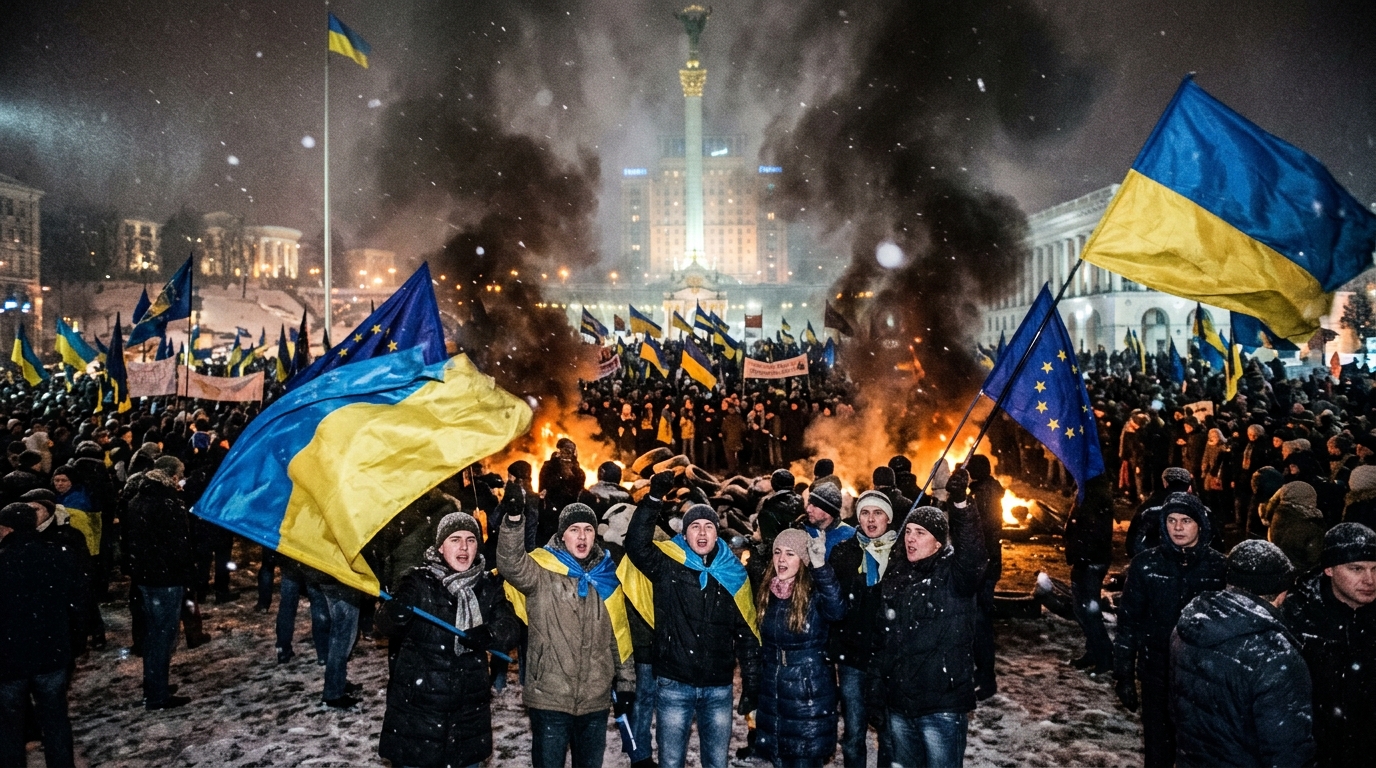
| Inception | Nov 21, 2013 | The Ukrainian Cabinet of Ministers officially suspends preparations for signing the EU Association Agreement, citing economic risks. Within hours, students and activists gather on Kyiv's Maidan Nezalezhnosti (Independence Square) in peaceful protest, initially numbering in the hundreds. |
| Escalation | Nov 30, 2013 | In the early morning hours, riot police (Berkut) brutally attack and disperse peaceful student protesters sleeping on Maidan, beating them severely and using stun grenades. Images and videos of the violence go viral, galvanizing widespread public outrage and swelling the protest numbers exponentially. |
| Expansion | Dec 1-8, 2013 | On December 1, over 500,000 people flood Kyiv's streets in response to the police brutality. Protesters occupy Kyiv City Hall and the Trade Unions Building. On December 8, the "March of Millions" sees an estimated 1 million people protesting. That day, a statue of Vladimir Lenin in central Kyiv is symbolically toppled, signifying a definitive break from the Soviet past. |
| Government Siege | Dec 9, 2013 - Jan 15, 2014 | Police attempt to clear barricades around government buildings but are pushed back. Protesters consolidate their hold on Maidan, setting up a self-sustaining city with medical aid, kitchens, and security. Yanukovych holds talks with Putin, receiving a $15 billion loan and gas discounts, further fueling suspicions of a complete pivot to Moscow. |
| Confrontation | Jan 16, 2014 | The Verkhovna Rada (Ukrainian parliament), dominated by Yanukovych's Party of Regions, hastily passes a series of draconian "Dictatorship Laws" aimed at suppressing protests. These laws severely restrict freedom of speech, assembly, and internet usage, criminalizing many forms of peaceful protest. Their undemocratic passage through a show of hands, rather than a proper vote, further enrages the opposition. |
| First Fatalities | Jan 19-22, 2014 | The "Dictatorship Laws" trigger renewed, more violent clashes on Hrushevskoho Street near the parliament building. Protesters use Molotov cocktails and stones against Berkut forces, who respond with rubber bullets, tear gas, and live ammunition. Serhiy Nigoyan and Mykhailo Zhyznevsky are among the first protesters killed by live rounds, marking a tragic turning point. |
| The Climax | Feb 18-20, 2014 | The protests reach their deadly peak. On February 18, security forces launch a full-scale assault on Maidan, attempting to clear the square. Fires erupt in the Trade Unions Building. On February 20, government snipers open fire on unarmed protesters, killing dozens in broad daylight. Over 100 individuals, later known as "The Heavenly Hundred," perish during these three days. |
| Collapse | Feb 21-22, 2014 | Amidst international condemnation and escalating violence, a deal is brokered between Yanukovych and opposition leaders, mediated by EU foreign ministers. However, the deal fails to appease the Maidan, which demands Yanukovych's immediate resignation. Yanukovych flees Kyiv to Kharkiv, then to Russia, effectively abandoning his post. The parliament votes to remove him from power and schedules snap elections. |
The brutality of the state response was the primary accelerant for the movement. The decision to send the Berkut special police units to beat peaceful protesters on the night of November 30th backfired spectacularly. What began as a relatively niche protest for European integration among students and intellectuals transformed into a mass uprising against police violence, government corruption, and authoritarianism. Each act of repression by the government only served to deepen public resolve and broaden the base of support for the Euromaidan.
Geopolitical Consequences and Aftermath
The Euromaidan protests and their immediate aftermath fundamentally altered the European security architecture, ushering in an era of renewed geopolitical confrontation between Russia and the West. The departure of Viktor Yanukovych effectively neutralized Russian soft-power influence and the prospect of Ukraine joining Russia's Customs Union, forcing Moscow to pivot from political subversion to overt military intervention.
- The Loss of Influence and Russia's Response: For Vladimir Putin, the success of the Euromaidan was viewed not as an organic expression of popular will, but as a "color revolution" orchestrated by Western intelligence agencies aimed at undermining Russia's sphere of influence. The Kremlin's loss of a client state in Kyiv was deemed intolerable and a direct threat to Russia's security and historical narrative. This perceived existential threat led directly to the annexation of Crimea in March 2014. Using "little green men" (unmarked Russian soldiers) and a hastily organized, internationally unrecognized referendum, Russia seized the peninsula, home to its Black Sea Fleet. Simultaneously, Russia began covertly supporting separatist movements in eastern and southern Ukraine, leading to the outbreak of war in the Donbas region. This intervention marked the first major redrawing of European borders by force since World War II and a dramatic escalation of the conflict.
- Transatlantic Strained Relations and Sanctions: The USA and EU found themselves largely in a reactive mode, struggling to calibrate a response that would both support Ukrainian sovereignty and deter further Russian aggression without provoking a full-scale regional conflict. This marked the beginning of a new era of sanctions-based diplomacy, with the West imposing escalating economic penalties on Russian individuals, companies, and key sectors of its economy. These sanctions aimed to punish Russia for its actions and deter future aggression, yet they also highlighted the limitations of economic leverage in altering Russia's strategic calculus. Transatlantic unity, while initially strong, faced challenges over the long term, particularly concerning the economic costs of sanctions and differing strategic priorities among member states.
- Institutional Reform and National Awakening in Ukraine: Post-Euromaidan Ukraine entered a period of painful but necessary structural reforms, driven by a new government and immense pressure from civil society and international partners. These reforms aimed to dismantle the corrupt oligarchic system, align its military, economy, and judiciary with European standards, and strengthen democratic institutions. The conflict in Donbas, initially a significant destabilizer, paradoxically served as a powerful catalyst for national unity and military reform. Volunteer battalions emerged, consolidating into a more professional army capable of defending the country. This period fostered a profound national awakening, further widening the cultural and political gap between Kyiv and Moscow and solidifying Ukraine's pro-Western orientation.
"The revolution in Ukraine was not about geopolitics; it was about the dignity of a people who refused to be treated as a vassal state of a collapsing empire. It was about choosing a future of freedom over subservience, and that choice came at an immense cost." — Anonymous analyst, late 2014.
The geopolitical consequences extended beyond Ukraine, prompting NATO to bolster its eastern flank, reassess its deterrence posture, and recognize Russia as a direct threat rather than a strategic partner. Energy security became a paramount concern for Europe, spurring diversification efforts away from Russian gas. The events of 2013-2014 fundamentally reset East-West relations, replacing a fragile post-Cold War peace with an overt, if initially limited, confrontation that would dramatically escalate in the years to come.
Analysis of Key Actors and Decisive Actions
The standoff on the Maidan and the subsequent geopolitical fallout involved complex power dynamics between entrenched domestic elites, the mobilized Ukrainian populace, and powerful external actors.
- Viktor Yanukovych: His fatal flaw was the reliance on a "multi-vector" foreign policy that ultimately satisfied no one. For years, he attempted to leverage the prospect of EU integration to extract better terms from Russia (lower gas prices, loans) and vice-versa. This transactional approach prioritized personal and oligarchic gain over long-term national strategic direction. By abruptly halting the EU Association Agreement, he alienated his pro-European constituents while simultaneously failing to fully appease Russia, who still viewed Ukraine with suspicion. When the crisis hit its zenith, with intense pressure from Moscow, a surging protest movement, and dwindling support among his own elites, he was left with no credible allies. His decision to employ brutal force against peaceful protesters, culminating in the sniper attacks, sealed his fate and eroded any legitimacy he might have retained. His ultimate flight to Russia exposed the hollowness of his regime and left a power vacuum that Russia swiftly exploited.
- Vladimir Putin: His approach was characterized by a deep-seated belief that Ukraine lacked legitimate statehood and was an artificial construct, inherently part of Russia's historical and geopolitical sphere. He viewed any move towards the EU or NATO as an unacceptable encroachment on Russia's vital security interests. The economic pressure applied on Yanukovych—a combination of threats (trade wars, energy cut-offs) and incentives ($15 billion loan, gas price discount)—was seen by Putin not as an infringement on Ukrainian sovereignty, but as a legitimate exercise of Russia's regional hegemony and a defense against perceived Western interference. His swift reaction post-Yanukovych's flight—the annexation of Crimea and the instigation of conflict in Donbas—demonstrated a clear willingness to use military force to achieve strategic objectives, fundamentally challenging the post-Cold War international order. Putin underestimated the depth of Ukrainian national identity and its determination to resist, but he successfully secured key strategic objectives, at least temporarily, by preventing Ukraine from fully consolidating its Western pivot.
- The United States and the EU: Western involvement was largely limited to diplomatic support, mediation efforts, and ultimately, economic sanctions. Key figures like US Assistant Secretary of State Victoria Nuland and EU High Representative for Foreign Affairs Catherine Ashton were present on the ground in Kyiv, engaging with both government and opposition figures, and issuing calls for de-escalation and a peaceful political resolution. Their efforts aimed to support democratic principles, human rights, and Ukraine's sovereign choice. However, their influence was often overstated by Kremlin propaganda, which sought to portray the Euromaidan as a "Western-backed coup" rather than an indigenous popular uprising. The West's response was constrained by a desire to avoid direct military confrontation with Russia and a lack of a unified, proactive strategy for dealing with a resurgent, revisionist Russia. While they offered financial aid and technical support to the new Ukrainian government, the direct security guarantees and robust military assistance that Ukraine would eventually require were not immediately forthcoming.
- Ukrainian Civil Society and Opposition Leaders: The true driving force of the Euromaidan was the self-organizing Ukrainian civil society. Students, activists, intellectuals, and ordinary citizens, organized through social media and word-of-mouth, maintained the protest movement for months through harsh winter conditions. They established a sophisticated infrastructure on Maidan, providing security, medical care, food, and communication. Opposition political leaders, including Vitali Klitschko (UDAR party), Arseniy Yatsenyuk (Fatherland party), and Oleh Tyahnybok (Svoboda party), played important roles in channeling popular demands, negotiating with the government, and representing the movement on the international stage. However, they often struggled to keep pace with the radicalization of the Maidan itself, which frequently rejected compromises as insufficient and demanded bolder action. The resilience and self-sacrifice of the average protester proved to be the most decisive factor in Yanukovych's ultimate downfall.
Historical Precedents & Context
To fully grasp the magnitude of the Euromaidan protests, it is crucial to understand Ukraine's deep and often tragic historical struggle for self-determination against larger imperial powers. This struggle has forged a distinct national identity, constantly striving for independence and a European orientation, often in defiance of Moscow.
- Kievan Rus' and the Origins of Identity: Both Ukraine and Russia trace their cultural and political origins to Kievan Rus', a powerful medieval state. However, the subsequent fragmentation and eventual subjugation of Ukrainian lands under various foreign powers (Polish-Lithuanian Commonwealth, Ottoman Empire, Habsburg Monarchy, and ultimately the Russian Empire) led to distinct paths of development. While Russia centralized power and embraced an autocratic model, parts of Ukraine, particularly in the west, experienced elements of European legal traditions and political thought through their ties to Poland.
- Russian Imperial Domination and Suppression: From the 17th century onwards, much of Ukraine fell under Russian imperial control. This period was characterized by consistent efforts to suppress Ukrainian language, culture, and any nascent political autonomy. Policies of Russification aimed to assimilate Ukrainians into the broader Russian identity, denying the existence of a separate Ukrainian nation. The Holodomor, the genocidal famine engineered by Stalin in the 1930s, which disproportionately targeted Ukrainian peasants, remains a profoundly traumatic national memory, widely viewed as an attempt to crush Ukrainian national identity and resistance. These historical experiences instilled a deep distrust of Russian intentions and a powerful yearning for genuine sovereignty.
- The Soviet Legacy and "Multi-Vector" Policy: After a brief period of independence following the Russian Revolution, Ukraine was absorbed into the Soviet Union. While it enjoyed formal status as a Soviet Republic, real power remained in Moscow. The collapse of the USSR in 1991 offered Ukraine its first sustained period of independence in centuries. However, the legacy of Soviet rule—including deeply entrenched corruption, an economy reliant on Russia for energy and markets, and a powerful pro-Russian political faction—complicated its post-independence trajectory. The "multi-vector" foreign policy adopted by successive Ukrainian governments, attempting to balance relations with both Russia and the West, was often a pragmatic necessity given these internal divisions and external pressures. Yet, it also reflected a reluctance to make a definitive civilizational choice, a choice the Euromaidan ultimately forced.
- The Orange Revolution (2004) as a Precursor: The Euromaidan was not Ukraine's first "color revolution." The 2004 Orange Revolution against electoral fraud showcased the potential of Ukrainian civil society and a widespread desire for democratic change and a European path. While its immediate political outcomes were mixed, it demonstrated to both Moscow and Kyiv that a significant portion of the Ukrainian population viewed its future as distinct from Russia. It also provided a blueprint for mass mobilization and non-violent resistance that would be refined and tragically escalated during the Euromaidan. The failures of the Orange Revolution to deliver deep reforms also taught activists lessons about the need for sustained vigilance and radical demands.
- The Russkiy Mir (Russian World) Ideology: Vladimir Putin's rhetoric and policies towards Ukraine are deeply rooted in the Russkiy Mir ideology, which posits a transnational Russian civilization encompassing ethnic Russians and Russian speakers, united by a shared history, culture, and Orthodox faith, with Moscow as its spiritual and political center. From this perspective, Ukraine is an inseparable part of this "Russian world," and its independent pro-Western orientation is seen as an artificial construct, a betrayal, or a hostile foreign plot. This ideological framework justified Moscow's intense pressure on Yanukovych and later its military interventions, framing them as a defense of historical Russian lands and people, rather than an aggression against a sovereign state.
The Euromaidan, therefore, was not merely a protest against a corrupt government's policy reversal; it was a culmination of centuries of identity struggle, a decisive rejection of historical subjugation, and a declaration of Ukraine's intent to determine its own future as a sovereign European nation, even at immense human cost.
Socio-Economic Aftermath and Domestic Transformation
The Euromaidan Revolution and the subsequent Russian aggression fundamentally reshaped Ukraine's domestic landscape, initiating a period of profound socio-economic transformation, national consolidation, and significant challenges.
- Economic Reorientation and Challenges: The immediate economic aftermath was severe. The annexation of Crimea and the conflict in Donbas led to the loss of significant industrial capacity, particularly in coal mining and heavy manufacturing. Ukraine's GDP contracted sharply in 2014-2015. The traditional economic ties with Russia were severed, forcing Ukraine to reorient its trade towards the EU and other international markets. While challenging, this shift ultimately proved beneficial in the long run, diversifying Ukraine's economy and integrating it more deeply into global supply chains. International financial assistance from the IMF, EU, and other partners became crucial for stabilizing the economy and supporting reforms, albeit often with stringent conditions.
- Humanitarian Crisis and Internal Displacement: The conflict in Donbas created a significant humanitarian crisis, leading to over 1.5 million internally displaced persons (IDPs) who fled their homes in the war-torn eastern regions. This put immense strain on social services and infrastructure in other parts of Ukraine. The ongoing conflict also resulted in thousands of casualties, both military and civilian, leaving a generation grappling with the trauma of war.
- Strengthening of Civil Society and Volunteer Movements: One of the most remarkable outcomes of the Euromaidan was the explosion of civil society engagement. Volunteer movements emerged spontaneously and rapidly, filling critical gaps in government services, particularly in supporting the military. These volunteers provided everything from medical supplies and protective gear to food, logistics, and psychological support for soldiers and IDPs. This robust volunteerism demonstrated the power of self-organization and significantly strengthened the social fabric, fostering a sense of shared responsibility and national solidarity. These groups often transitioned into watchdog organizations, pressuring the government for transparency and accountability in the post-Maidan era.
- Military Reform and National Awakening: Prior to 2014, the Ukrainian military was underfunded, poorly equipped, and riddled with corruption, reflecting years of neglect and Russian infiltration. The war in Donbas, initially a devastating blow, became a catalyst for rapid and comprehensive military reform. Drawing on the volunteer spirit, Ukraine rebuilt its armed forces, improving training, equipment, and command structures, with significant Western support. This transformation was accompanied by a powerful national awakening, where Ukrainians, regardless of their native language or region, increasingly identified as citizens of a sovereign nation defending its independence. Military service, once avoided, became a point of national pride.
- Anti-Corruption Efforts and Judicial Reform: The Euromaidan's core demands included an end to systemic corruption. Post-Maidan governments, under intense public and international pressure, launched a series of ambitious anti-corruption reforms. New institutions were created, such as the National Anti-Corruption Bureau (NABU) and the High Anti-Corruption Court. While these efforts faced significant resistance from entrenched interests and political elites, they marked a genuine attempt to address a deeply rooted problem. Judicial reform, aiming to increase independence and transparency, also became a priority, albeit a slow and challenging one.
- Political Landscape Transformation: The Party of Regions, Yanukovych's political base, crumbled after his flight. The political spectrum shifted, with a significant decline in overtly pro-Russian parties and a consolidation of pro-European forces. New political parties and figures emerged, often with a reformist agenda, although the influence of oligarchs remained a persistent challenge. The electoral process became more genuinely competitive, albeit still vulnerable to patronage and disinformation. The Maidan also fundamentally altered the relationship between citizens and the state, empowering civil society to act as a powerful check on government power.
In essence, the Euromaidan and its aftermath initiated a painful but necessary process of de-Sovietization and de-Russification, compelling Ukraine to confront its past and definitively chart a future rooted in European democratic values. This transformation, while incomplete and fraught with ongoing conflict, laid the groundwork for a more resilient and unified Ukrainian state.
Trivia and Lesser-Known Facts
- The 'Automaidan': The protest featured a unique and innovative form of civil disobedience known as the Automaidan. Protesters organized large car convoys to block access to the homes of high-ranking officials (including Yanukovych's opulent Mezhyhirya residence and the homes of his cronies) to pressure them into resignation or to highlight their illicit wealth. These convoys were also used to deliver supplies to the Maidan and counter government attempts to block roads.
- Public Financing: The movement was arguably the most crowdsourced revolution in history. Millions of Ukrainian hryvnias, along with international donations, were collected from ordinary citizens through online platforms, cash donations, and collection points. These funds were meticulously managed by volunteer committees, covering everything from food, medical supplies, and legal aid for detained protesters to warm clothing, generators, and sound equipment. This widespread financial support highlighted the depth of public commitment.
- The "Dictatorship Laws": On January 16, 2014, the Verkhovna Rada passed a set of draconian anti-protest laws designed to crush the Euromaidan. These laws were adopted in an undemocratic show of hands, rather than a proper electronic vote, bypassing parliamentary procedure. They criminalized driving in convoys of more than five cars, wearing helmets or masks at protests, setting up tents, and restricted free speech and internet usage. Ironically, these repressive measures backfired spectacularly, enraging the public further and sparking more violent confrontations.
- The "Kitchen" of the Maidan: The occupied Trade Unions building (Будинок профспілок) served as the central logistics and command hub for the Maidan. Its ground floor housed a massive, constantly running kitchen, feeding thousands of protesters daily with food donated by Kyiv residents, local businesses, and farmers. This logistical feat, managed entirely by volunteers, demonstrated the incredible level of social cohesion and organizational capacity within the movement. The building also housed a medical station, sleeping quarters, and press centers, becoming a symbolic heart of the revolution until it was set ablaze during the deadly clashes in February.
- The Role of Music and Art: Music played a vital role in sustaining morale and unity on the Maidan. Pianos, donated by citizens, became ubiquitous symbols of peace and creativity amidst the chaos. Famous Ukrainian and international musicians performed for free, and protest songs became anthems. Artists painted barricades, created installations, and produced powerful visual messages that galvanized support and documented the revolution.
- International Support and 'Euromaidan' Abroad: While centered in Kyiv, the Euromaidan movement inspired solidarity protests and support groups among the Ukrainian diaspora and sympathetic individuals worldwide. Cities from Toronto to London saw "Euromaidan" rallies, raising awareness and funds, and lobbying their governments to support the protesters' demands. This international dimension underscored the global resonance of the struggle for democratic values and self-determination.
References and Literature
- Serhii Plokhy, "The Gates of Europe: A History of Ukraine" - A masterful and comprehensive historical overview of Ukraine’s struggle for independence and its complex relationship with its neighbors.
- Andrew Wilson, "Ukraine Crisis: What It Means for the West" - Provides a sharp and prescient analysis of the geopolitical stakes involving Russia, Ukraine, and the EU, offering crucial context to the post-Maidan conflict.
- Timothy Snyder, "The Road to Unfreedom: Russia, Europe, America" - Offers a broader intellectual and historical framework, connecting the Euromaidan to contemporary challenges to democracy and the rise of Russian authoritarianism.
- The Kyiv Post (Archives 2013-2014) - A invaluable primary source for daily, on-the-ground reporting during the Revolution of Dignity, capturing the evolving narrative and public sentiment.
- Council on Foreign Relations: Ukraine's Conflict - Offers detailed analyses of the geopolitical and security consequences post-2013, including the ongoing war in Donbas and Western policy responses.
- Masha Gessen, "The Future Is History: How Totalitarianism Reclaimed Russia" - While primarily about Russia, this book provides essential context for understanding the Kremlin's motivations and its perception of the Euromaidan.