Key Takeaways
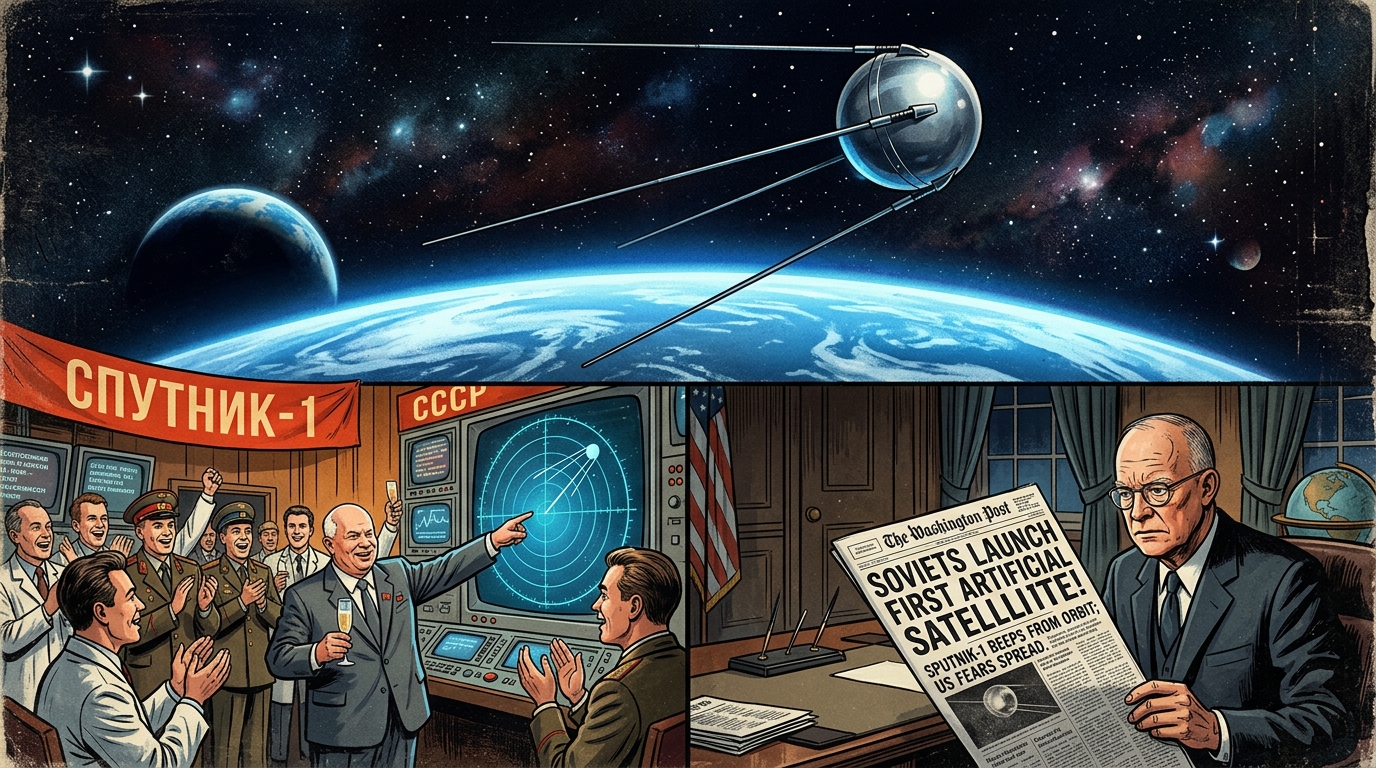
- The launch of Sputnik-1 on October 4, 1957, shattered the American assumption of technological superiority and triggered a profound psychological crisis in the West.
- The event transformed outer space from a scientific frontier into a critical arena of Cold War geopolitical and military competition.
- Sputnik directly catalyzed systemic reforms in the United States, leading to the creation of NASA, DARPA, and a massive federal investment in STEM education.
Historical Context and Origins
The geopolitics of the mid-1950s were defined by a tense, bipolar standoff. Following the end of the Second World War, the United States and the Soviet Union scrambled to secure the remnants of Nazi Germany’s advanced weapons programs. The most coveted prize was the rocketry technology developed at Peenemünde, spearheaded by Wernher von Braun and his team of V-2 engineers. While the United States captured von Braun and the bulk of his senior staff through Operation Paperclip 1, the Soviet Union seized key manufacturing facilities, blueprints, and hundreds of technicians, integrating them into their own nascent rocket programs under the brilliant, initially anonymous leadership of Sergei Korolev.
As the Cold War deepened, both superpowers recognized that traditional strategic bombers were becoming increasingly vulnerable to advanced air defense systems. The development of thermonuclear weapons in the early 1950s created an urgent requirement for a delivery mechanism that could strike from across the globe in a matter of minutes. The answer was the Intercontinental Ballistic Missile (ICBM).
In parallel with this military-industrial buildup, international scientific bodies organized the International Geophysical Year (IGY), scheduled from July 1, 1957, to December 31, 1958. The IGY was designed to foster global scientific collaboration in studying Earth's physical phenomena. In 1954, the International Council of Scientific Unions passed a resolution calling for artificial satellites to be launched during the IGY to map the Earth’s atmosphere.
Both superpowers seized this opportunity to cloak their military missile developments in the respectable garb of scientific exploration:
- The United States announced its intention to launch a scientific satellite in July 1955. To preserve a strictly peaceful, civilian image, President Dwight D. Eisenhower’s administration chose Project Vanguard, run by the US Navy, rather than the military-derived Redstone rocket program advocated by Wernher von Braun’s US Army team [^2].
- The Soviet Union responded days later with its own pledge to launch a satellite. Under the direction of Sergei Korolev, the Soviets bypassed complex, multi-layered bureaucratic approval processes. Korolev convinced the Soviet leadership, led by First Secretary Nikita Khrushchev, that a simple satellite could be mounted on the massive R-7 Semyorka ICBM then under development.
The stage was set for a race that would transcend terrestrial borders, transforming the silent void of outer space into the ultimate theater of ideological theater and geopolitical competition.
Timeline of Events and Key Moments
The road to orbit was paved with secret engineering triumphs, bureaucratic missteps, and public spectacles that captivated the global audience.
- 1954-1955: Superpowers commit to launching satellites during the IGY
- Aug 1957: Soviet R-7 successfully flies as the world's first true ICBM
- Oct 4, 1957: Sputnik-1 launched; global tracking begins
- Nov 3, 1957: Sputnik-2 launched carrying the dog Laika
- Dec 6, 1957: Vanguard TV3 explodes on the launchpad ("Flopnik")
- Jan 31, 1958: Explorer 1 successfully launches, discovering the Van Allen Belts
The Birth of the "Simple Satellite"
Originally, the Soviet Union planned to launch a highly sophisticated, heavy scientific laboratory in space, known internally as "Object D." However, progress on the scientific instrumentation was sluggish. Fearing that the Americans would beat them to the finish line, Korolev made a decisive pivot in early 1957. He ordered the creation of Prosteyshiy Sputnik-1 (Simple Satellite-1, or PS-1).
PS-1 was stripped of complex scientific instruments. It was designed to be a simple, pressurized sphere made of highly polished aluminum-magnesium alloy, carrying two radio transmitters, four external whip antennas, and a silver-zinc battery. Its sole purpose was to successfully enter orbit and broadcast a signal that could be received by radio enthusiasts worldwide.
October 4, 1957: The Beep Heard 'Round the World
At 22:28 Moscow time, the massive R-7 rocket lifted off from the Tyuratam test range (later renamed the Baikonur Cosmodrome) in the Kazakh Soviet Socialist Republic. The launcher performed flawlessly, injecting the 83.6-kilogram (184-pound) sphere into an elliptical low Earth orbit.
Within hours, the steady, rhythmic beep... beep... beep... of Sputnik’s radio transmitter on 20 and 40 MHz frequencies was picked up by amateur radio operators, scientific tracking stations, and military listening posts across the globe.
"We did not realize how much this launch meant to the world. We thought it was just a scientific experiment, but when we saw the reaction in the West, we realized we had handed the party a tremendous propaganda weapon." — Sergei Korolev, reflecting on the immediate aftermath of the launch.
The Autumn of American Discontent
The reaction in the United States was nothing short of a psychological earthquake. For over a decade, Americans had lived with the secure assumption that their scientific, technological, and industrial base was peerless. Sputnik-1 shattered this complacency overnight.
The media stoked fears that if the Soviet Union could place a satellite in orbit over US territory, they could easily drop nuclear warheads on American cities with absolute impunity. The physical presence of the satellite—which could be seen with the naked eye under the right conditions as it caught the sunlight—brought the Cold War directly into the backyards of everyday citizens.
| Specification | Details |
|---|---|
| Diameter | 58 cm (23 in) |
| Weight | 83.6 kg (184.3 lbs) |
| Orbital Period | 96.2 minutes |
| Power Source | 3 Silver-Zinc Batteries |
The crisis deepened on November 3, 1957, when the Soviets launched Sputnik-2. This satellite was dramatically heavier (508 kilograms) and carried the first living passenger into orbit: a stray dog named Laika. The sheer payload weight of Sputnik-2 proved beyond doubt that Soviet booster rockets were far more powerful than anything the United States possessed.
The "Flopnik" Disaster
Desperate to restore national prestige, the Eisenhower administration succumbed to public pressure and authorized the broadcast of the Navy's first orbital attempt on December 6, 1957. The launch of the Vanguard TV3 rocket was broadcast live to millions of expectant Americans.
Two seconds after liftoff, the booster lost thrust, settled back onto the launchpad, and exploded in a spectacular fireball. The tiny satellite was thrown clear, its transmitters still beeping mockingly in the wreckage. The international press mercilessly labeled the disaster "Flopnik," "Kaputnik," and "Stayputnik," marking a low point in American technological prestige.
The US Responds
Recognizing the failure of the Vanguard program, the Department of Defense finally unleashed Wernher von Braun’s Army Ballistic Missile Agency. Utilizing a modified Redstone rocket (the Juno I), the United States successfully placed its first satellite, Explorer 1, into orbit on January 31, 1958. While much smaller than Sputnik, Explorer 1 carried a sophisticated scientific payload designed by James Van Allen, which discovered the radiation belts surrounding the Earth—a major scientific achievement of the IGY 3.
Geopolitical Consequences and Aftermath
The geopolitical ripples of Sputnik-1 fundamentally altered the structure of international relations, security doctrines, and domestic politics in both the East and the West.
1. The Myth of the "Missile Gap"
The most immediate political impact in the United States was the creation of the "missile gap" narrative. Democratic politicians, notably Senators Lyndon B. Johnson and John F. Kennedy, used the Sputnik crisis to launch stinging attacks against the Eisenhower administration. They accused the President of neglecting national defense, allowing the Soviet Union to amass a superior arsenal of ICBMs.
Although classified intelligence from U-2 spy planes showed that the United States maintained a massive overall nuclear and strategic advantage, Eisenhower could not reveal this highly sensitive source of information to the public. The "missile gap" became a central campaign issue in the 1960 presidential election, paving the way for John F. Kennedy's victory.
2. Institutional Revolutions in Washington
To prevent another technological surprise, the US government embarked on a rapid restructuring of its military, scientific, and educational systems:
- The Creation of DARPA: In February 1958, the Department of Defense established the Advanced Research Projects Agency (ARPA), later renamed DARPA, to coordinate high-risk, high-reward scientific research and development.
- The Foundation of NASA: On July 29, 1958, President Eisenhower signed the National Aeronautics and Space Act, consolidating the nation's disparate space programs under a new, civilian-led agency: the National Aeronautics and Space Administration (NASA).
- The National Defense Education Act (NDEA): Recognizing that the space race was fundamentally a battle of intellects, the US government passed the NDEA in September 1958. This landmark legislation poured over a billion dollars (equivalent to tens of billions today) into the American education system, prioritizing sciences, mathematics, engineering, and foreign languages.
Sputnik-1 Launch (Oct 1957)
- U.S. Public and Political Panic
3. Space Law and "Freedom of Space"
Paradoxically, the launch of Sputnik-1 was a legal victory for the United States. Eisenhower was deeply concerned about the legality of flying spy satellites over sovereign nations. International law did not define where national airspace ended and outer space began.
By allowing Sputnik to orbit over US territory without lodging a formal diplomatic protest, the United States and the international community established a vital legal precedent: "freedom of space." This precedent established that sovereign airspace does not extend into orbit, clearing the legal path for the subsequent US satellite reconnaissance programs, such as Project Corona 4.
4. Propaganda and Soft Power
For Nikita Khrushchev, Sputnik was a godsend. He utilized the triumph to project an image of the Soviet Union as a dynamic, modern superpower that had risen from the ashes of World War II to surpass the capitalist West. This narrative was incredibly potent in the decolonizing nations of Asia, Africa, and Latin America, where many leaders viewed Soviet planning as a faster, more reliable path to industrialization than Western capitalism.
Analysis of Key Actors and Decisive Actions
The dramatic trajectory of the early Space Race was shaped by the highly contrasting styles, philosophies, and strategic goals of the key leaders and designers involved.
| Historical Figure | Role / Position | Core Strategy & Decisive Actions | Historical Impact |
|---|---|---|---|
| Dwight D. Eisenhower | President of the United States | Prioritized fiscal responsibility and a civilian-led space track to avoid military escalation and establish space-overflight precedents. | Kept a calm public demeanor despite political attacks; systematically built the legal and institutional foundations (NASA) that won the Moon. |
| Nikita Khrushchev | First Secretary of the CPSU | Recognized the asymmetric value of rocket diplomacy; heavily funded space achievements to bluff about Soviet military supremacy. | Successfully projected Soviet soft power globally, but committed the USSR to a high-stakes, resource-intensive technological competition it could not sustain. |
| Sergei Korolev | Soviet Chief Designer (Secret) | Bypassed bureaucratic red tape; pivoted from complex scientific packages to a simple design (PS-1) to ensure victory in reaching orbit first. | Architect of the early Soviet space triumphs; his anonymity protected him from Western espionage but limited his public prestige. |
| Wernher von Braun | Director of Development, ABMA | Advocated for using existing military boosters (Redstone) to launch a satellite; continuously pushed for long-term manned spaceflight programs. | Rescued American prestige with the launch of Explorer 1; later designed the Saturn V rocket that landed Apollo astronauts on the Moon. |
Nikita Khrushchev: The Pragmatic Showman
Khrushchev’s geopolitical strategy was built on projection and leverage. Knowing that the Soviet economy was smaller and less technologically diversified than the American one, he used Sputnik to construct a grand illusion of absolute military parity, if not superiority.
Khrushchev understood that in the thermonuclear era, actual war was suicidal; therefore, the appearance of military superiority was almost as valuable as the reality. By aggressively promoting space achievements, he successfully kept the West off balance throughout the late 1950s and early 1960s.
Dwight D. Eisenhower: The Hidden Hand
President Eisenhower's strategy during the Sputnik crisis is often studied as a prime example of his "Hidden-Hand" style of leadership. Under intense public pressure to declare a national emergency, Eisenhower remained outwardly unperturbed. His primary goal was to prevent military spending from spiraling out of control, which he believed would bankrupt the American economy and create a "garrison state."
Eisenhower’s decision to prioritize the civilian Vanguard project, although a public relations disaster in the short term, proved to be a masterful long-term play. It successfully separated the peaceful exploration of space from the military development of ICBMs and firmly established the international law of orbital overflight, which was essential for strategic reconnaissance.
Trivia and Lesser-Known Facts
- Polished to Perfection: Sputnik’s highly reflective exterior was not just for show. The aluminum-magnesium casing was meticulously polished to a mirror finish to help engineers track the spacecraft visually using telescopes from Earth, and to control the internal temperature by reflecting solar radiation.
- The HAM Radio Strategy: The radio frequencies used by Sputnik-1 (20 and 40 MHz) were deliberately chosen so they could be easily received by commercial and amateur radio operators around the globe. This was a calculated move to prevent the Western powers from claiming that the Soviet launch was a hoax.
- The Secret "Chief Designer": During his lifetime, Sergei Korolev's identity was kept a closely guarded state secret to prevent American assassination attempts. In Soviet media, he was referred to only as "The Chief Designer." When the Nobel Prize committee wrote to Moscow wishing to award the designer of Sputnik, Khrushchev replied that the achievement belonged to "all the Soviet people," refusing to name Korolev to preserve the secret [^5].
- The Final Descent: Sputnik-1 did not stay in orbit forever. After its batteries died on October 26, 1957, the silent metal sphere continued to orbit the Earth for another two months. On January 4, 1958, after completing 1,440 orbits and traveling approximately 70 million kilometers, it re-entered the Earth's atmosphere and burned up.
References and Literature
- Sputnik and the Soviet Space Challenge - A comprehensive historical account of the Soviet rocket program under Sergei Korolev, written by Asif A. Siddiqi.
- The Sputnik Challenge - An in-depth analysis of the domestic political, educational, and social impact of Sputnik on the United States, written by Robert A. Divine.
- NASA Historical Reference Collection: Sputnik - Official archives, documents, and timelines maintained by the NASA History Division on the dawn of the Space Age.
- The Cold War: A New History - John Lewis Gaddis’s authoritative work on the geopolitical strategies of the superpower rivalry, including the role of technological prestige.
---
Footnotes & Explanations
- Operation Paperclip was the secret joint intelligence program in which more than 1,600 German scientists, engineers, and technicians were taken from former Nazi Germany to the U.S. for government employment. ↩
- Wernher von Braun’s proposal to launch a satellite using a modified Redstone rocket, known as Project Orbiter, was repeatedly rejected by the Pentagon in favor of the Navy's civilian-oriented Vanguard. ↩
- Explorer 1's cosmic ray detector, designed by Dr. James Van Allen, discovered the belts of highly energetic charged particles trapped by Earth's magnetic field, which were subsequently named the Van Allen Radiation Belts. ↩
- Project Corona was a series of American photographic surveillance satellites run by the CIA with assistance from the US Air Force between 1959 and 1972, providing vital intelligence on Soviet nuclear installations. ↩
- This anonymity deeply frustrated Korolev, who felt he was being denied his rightful place in global scientific history, a recognition he only received posthumously after his death in 1966. ↩