Key Takeaways
- The conflict represents the most significant escalation in the Israeli-Palestinian theater since the 1948 Arab-Israeli War, leading to unprecedented levels of destruction and loss of life.
- Israel's 'Swords of Iron' campaign fundamentally shifted the regional security paradigm, testing the limits of international humanitarian law and generating global diplomatic tensions.
- The war has catalyzed a profound reassessment of the viability of the two-state solution within the context of regional normalization efforts, highlighting the enduring centrality of the Palestinian question.
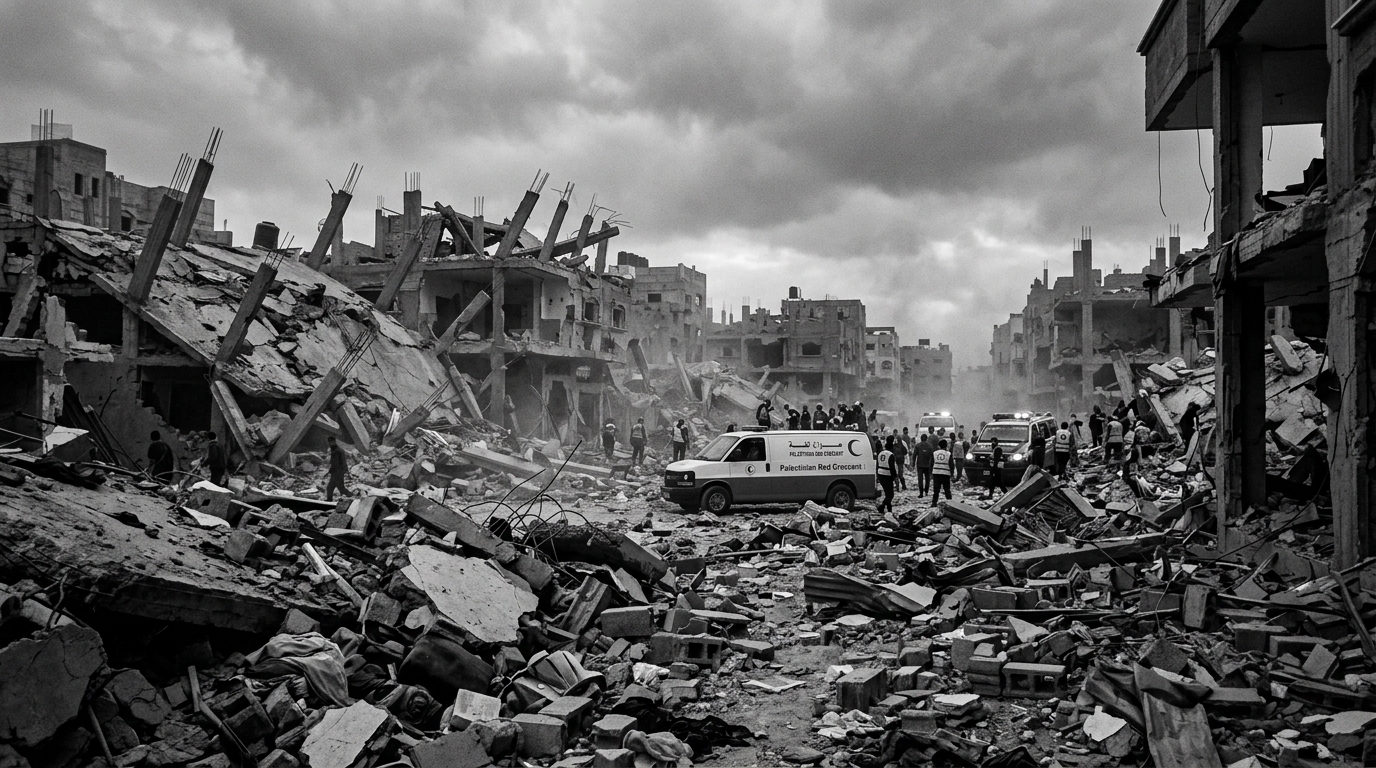
- The humanitarian impact on Gaza has been catastrophic, leading to widespread displacement, famine, and the near-total collapse of civilian infrastructure and healthcare systems.
Historical Context and Origins
The Gaza War of 2023-2024, an event of profound geopolitical and human consequence, is not an isolated incident but rather the culmination of a century-long struggle over land, identity, and sovereignty in the Levant. Its roots delve deep into the collapse of the Ottoman Empire, the subsequent British Mandate for Palestine, and the foundational events of the 20th century that shaped the modern Middle East.
Following the 1948 Arab-Israeli War, known as the Nakba (catastrophe) to Palestinians and the War of Independence to Israelis, the Gaza Strip became a densely populated refuge for hundreds of thousands of Palestinians displaced from their homes. Administered by Egypt until 1967, it remained a distinct entity within the broader Palestinian narrative. The 1967 Six-Day War saw Israel occupy Gaza, along with the West Bank, East Jerusalem, and the Golan Heights, initiating decades of military rule and settlement construction.
The First Intifada (1987-1993), a popular uprising against Israeli occupation, witnessed the emergence of Hamas (Harakat al-Muqawamah al-Islamiyah – Islamic Resistance Movement). Founded by Sheikh Ahmed Yassin and other Palestinian Muslim Brotherhood activists, Hamas offered a religiously motivated alternative to the secular Palestine Liberation Organization (PLO), advocating armed resistance for the liberation of all historic Palestine and the establishment of an Islamic state. Its rise coincided with the Oslo Accords (1993-1995), which established the Palestinian Authority (PA) as an interim self-governing body but ultimately failed to lead to a permanent peace agreement or Palestinian statehood, fostering disillusionment and strengthening radical factions.
The Israeli disengagement from Gaza in 2005, a unilateral withdrawal of Israeli settlements and military presence, was presented by Israel as a step towards reducing friction and enhancing security. However, it created a power vacuum. The subsequent 2006 Palestinian legislative elections, deemed free and fair by international observers, resulted in a surprise victory for Hamas, challenging the long-dominant Fatah movement. This democratic outcome, rejected by Israel and the United States, led to an international aid boycott. By 2007, a violent internecine struggle between Hamas and Fatah culminated in Hamas's forceful takeover of Gaza, solidifying its de facto control over the strip while the PA retained administrative authority in the West Bank. This division fractured Palestinian political unity and deepened the socio-economic isolation of Gaza.
In response to Hamas's takeover, Israel, with Egyptian cooperation, imposed a comprehensive land, air, and sea blockade on Gaza. Ostensibly aimed at preventing Hamas from acquiring weaponry and materials that could be used for attacks, the blockade crippled Gaza’s economy, stifled its development, and transformed it into what many observers describe as an "open-air prison." This status quo was punctuated by recurring, intense cycles of violence:
- Operation Cast Lead (2008-2009): A major Israeli offensive following sustained rocket fire from Gaza, leading to significant casualties and international condemnation.
- Operation Pillar of Defense (2012): Targeted assassinations of Hamas military leaders and extensive aerial bombardment, again in response to rocket attacks.
- Operation Protective Edge (2014): A 50-day conflict involving a ground invasion, triggered by rocket fire and the abduction/murder of three Israeli teenagers, resulting in massive destruction and thousands of Palestinian casualties.
- Operation Guardian of the Walls (2021): Sparked by tensions in Jerusalem and rocket fire, showcasing Hamas's improved rocket capabilities.
Each conflict reinforced a cycle of destruction, reconstruction, and renewed tension, with no political resolution in sight. The regional landscape prior to October 2023 was further complicated by the Abraham Accords (2020), a series of normalization agreements between Israel and several Arab states, including the UAE, Bahrain, Sudan, and Morocco. From Hamas's perspective, these accords sidelined the Palestinian issue, seemingly validating Israel's strategy of bypassing Palestinian leadership to forge regional alliances. This perception, coupled with ongoing Israeli settlement expansion in the West Bank, increasing settler violence, and escalating tensions around Jerusalem's holy sites (particularly Al-Aqsa Mosque), created a potent mix of grievances and a sense among militant factions that their objective of statehood was becoming increasingly unattainable through diplomatic or political means. Hamas leadership reportedly concluded that a dramatic, high-impact action was necessary to reassert the Palestinian cause on the international agenda and disrupt the regional status quo.
Timeline of Events and Key Moments
The descent into the Gaza War of 2023-2024 was both rapid and extraordinarily violent, fundamentally altering the trajectory of the Israeli-Palestinian conflict. The primary phases of the conflict's initiation and progression can be summarized as follows:
| Phase | Timeframe | |
| Initial Homicide | Oct 7, 2023 | Hamas launches Operation 'Al-Aqsa Flood,' a multi-pronged assault involving thousands of rockets and hundreds of ground infiltrators who systematically breached the Gaza border. Militants attacked numerous Israeli communities ("Gaza envelope"), military bases, and civilians at the Nova music festival. The attack resulted in approximately 1,200 deaths, primarily civilians, and over 240 individuals taken hostage into Gaza. This constituted the deadliest day for Jews since the Holocaust. |
| Mobilization & Retaliation | Oct 8, 2023 | Israel officially declares a state of war, initiating 'Operation Swords of Iron.' Prime Minister Netanyahu vows to dismantle Hamas's military and governing capabilities. A massive call-up of Israeli reservists begins, and the Israel Defense Forces (IDF) initiate retaliatory airstrikes across the Gaza Strip, targeting Hamas infrastructure and leadership. Israel also imposes a "complete siege" on Gaza, cutting off electricity, fuel, food, and water. |
| Intensified Air Campaign | Oct - Nov 2023 | |
| Ground Entry | Late Oct 2023 |