Key Takeaways
- The siege of Vukovar was a pivotal campaign in the Croatian War of Independence, shifting international opinion and exposing the structural collapse of the Yugoslav People's Army (JNA).
- Despite overwhelming military superiority, JNA and Serb paramilitary forces faced prolonged, highly organized urban resistance from vastly outnumbered Croatian defenders.
- The fall of the city on November 18, 1991, led to the Ovčara massacre and accelerated international recognition of Croatia, prompting the implementation of the UN-brokered Vance Plan.
Historical Context and Origins
The Siege of Vukovar in the autumn of 1991 represents one of the most violent and politically transformative chapters in the dissolution of the Socialist Federal Republic of Yugoslavia (SFRY). To understand the outbreak of hostilities in this Eastern Slavonian town, one must trace the convergence of systemic constitutional collapse, the rise of ethno-nationalist ideologies, and local demographic anxieties.
The Decoy of Yugoslav Unity
Following the death of Josip Broz Tito in 1980 1, the delicate institutional balance designed to suppress ethnic nationalism within the Yugoslav federation rapidly deteriorated. The rotating federal presidency proved highly ineffective at managing a deepening economic crisis, soaring inflation, and mounting external debt. These structural vulnerabilities provided a fertile breeding ground for nationalist politicians who sought to mobilize historical grievances.
In Serbia, the rise of Slobodan Milošević to the presidency of the League of Communists of Serbia in 1987, and later to the state presidency, signaled a shift toward a centralist, Serb-dominated federal model. The intellectual justification for this shift was heavily influenced by the 1986 Memorandum of the Serbian Academy of Sciences and Arts (SANU), which argued that Serbs were victimized and marginalized within the Titoist federal framework 2. Milošević leveraged this sentiment through the "Anti-Bureaucratic Revolution," consolidating Serbian control over the autonomous provinces of Kosovo and Vojvodina, as well as the Republic of Montenegro, effectively securing a four-vote bloc within the eight-member federal presidency.
In response to growing Serbian hegemony, Croatia and Slovenia pushed for a decentralization of the state into a loose confederation. In May 1990, Croatia held its first multi-party democratic elections, resulting in a decisive victory for the nationalist Croatian Democratic Union (HDZ), led by former general and historian Franjo Tuđman. Tuđman’s platform emphasized Croatian sovereignty, cultural revival, and a transition to a market economy. However, his administration’s symbolic measures—such as the reintroduction of traditional Croatian emblems—provoked deep anxiety among Croatia’s ethnic Serb minority, who associated these symbols with the Second World War-era Ustaše regime.
| Sequence | Historical Event |
|---|---|
| 1 | 1980: Death of Tito |
| 2 | Deepening Economic Crisis |
| 3 | Rise of Nationalism (Milošević) |
| 4 | 1990: HDZ Victory in Croatia (Tuđman) |
| 5 | Rebellion in SAO Krajina & Eastern Slavonia |
The Log Revolution and local Demographics
By late summer 1990, armed Serb rebels, supported logistically and financially by Belgrade, initiated the "Log Revolution" (Balvan revolucija) in the Dalmatian hinterland around Knin, declaring the establishment of the Serb Autonomous Oblast (SAO) of Krajina. This rebellion quickly spread to other regions of Croatia with significant Serb populations, including Banovina, Kordun, Lika, and Eastern Slavonia.
Vukovar, a prosperous industrial port city situated on the right bank of the Danube River, possessed a highly complex demographic profile. According to the 1991 census, the municipality of Vukovar had a total population of approximately 84,000, of which 43.8% were Croats, 37.5% were Serbs, and the remainder comprised various minorities including Hungarians, Ruthenians, and self-identified Yugoslavs. Unlike the ethnically homogenous Serb villages in the Krajina, Eastern Slavonia was highly integrated, with high rates of intermarriage.
This demographic balance made Eastern Slavonia a highly contested territory. For Croatian authorities, losing Eastern Slavonia meant losing fertile land, vital oil fields near Đeletovci, and control over the Danube border. For the planners of a "Greater Serbia," the incorporation of Eastern Slavonia was essential to secure the eastern border along the Danube and establish a contiguous territory linking Serbia proper with the rebel SAO Krajina.
Timeline of Events and Key Moments
The transition from political skirmishes to open, industrial-scale warfare in Eastern Slavonia occurred rapidly between the spring and autumn of 1991.
Pre-Siege Escalation (May – August 1991)
The catalyst for direct military confrontation in the region was the Borovo Selo killings on May 2, 1991. Following the capture and detention of two Croatian policemen in the Serb-majority village of Borovo Selo (immediately north of Vukovar), a rescue party of Croatian special police was ambushed. The resulting gun battle left 12 Croatian policemen and three Serb paramilitaries dead 3. This incident marked the point of no return; it demonstrated that the local Serb militias were well-armed and that the Yugoslav People's Army (JNA), which intervened ostensibly as a "buffer force," was increasingly acting to protect Serb positions and disarm Croatian forces.
On June 25, 1991, Croatia and Slovenia formally declared their independence from Yugoslavia. Almost immediately, the JNA embarked on a full-scale intervention. While a brief conflict in Slovenia ended with the JNA’s withdrawal, the war in Croatia escalated into a multi-theater conflict. By July, JNA forces, cooperating with Serb paramilitary groups such as Vojislav Šešelj’s "White Eagles" and Željko Ražnatović’s (Arkan) "Serb Volunteer Guard," began clearing Croat-majority villages in Eastern Slavonia, driving the civilian population toward Vukovar.
The Ring Closes (August 25 – September 1991)
The systematic siege of Vukovar began on August 25, 1991, when the JNA and associated paramilitary units launched a coordinated infantry and armored assault, supported by heavy artillery and the Yugoslav Air Force.
The defense of Vukovar was organized under the leadership of Mile Dedaković (codenamed "Jastreb" / Falcon) and his deputy Branko Borković ("Mladi Jastreb"). The defending force, known as the 204th Vukovar Brigade, was a patchwork of local police officers, National Guard (ZNG) volunteers, and members of the Croatian Defence Forces (HOS). Outnumbered at least ten-to-one, the defenders faced a force of over 36,000 JNA soldiers and paramilitaries, equipped with hundreds of tanks, heavy artillery pieces, and complete air superiority.
The Siege of Vukovar (Fall 1991)
| Axis | Forces Involved | Direction/Action |
|---|---|---|
| Northern Axis | JNA & Paramilitaries (Borovo Selo) | Advancing toward city |
| Eastern Axis | Heavy JNA Artillery (from Vojvodina) | Bombardment across the Danube |
| Southern Axis | JNA Armored Columns (Negoslavci) | Advancing toward city |
Defense
- Vukovar City: Defended by ZNG (Croatian National Guard) forces
During September, the JNA attempted rapid armored breakthroughs along the main access roads. On the northern approaches, specifically along Trpinjska Cesta (the Trpinja Road), Croatian defenders utilized highly effective urban guerrilla tactics. Armed with light anti-tank weapons like the M80 Zolja and RPG-7s, small mobile units destroyed dozens of JNA tanks and armored personnel carriers. The road became known as the "Tank Graveyard" (groblje tenkova), causing a severe blow to the morale of the conscript-heavy JNA.
The War of Attrition (October 1991)
Realizing that direct armored assaults were yielding unsustainable casualties, the JNA changed its doctrine under the command of General Života Panić. The army resorted to a strategy of total encirclement and relentless bombardment, designed to reduce the city to rubble and starve out the defenders.
By mid-October, Vukovar was completely isolated. The last humanitarian and supply corridor, the "corridor of salvation" through the nearby village of Bogdanovci, was cut off. The city was subjected to an average of 8,000 to 12,000 artillery shells, rockets, and bombs daily.
"We are operating in conditions of absolute devastation. We have no electricity, no running water, and our medical supplies are virtually exhausted. Every day we amputate limbs in the dark." — Excerpt from a report by Dr. Vesna Bosanac, Director of the Vukovar Hospital.
The civilian population, numbering around 15,000 remaining residents (both Croats and Serbs), spent months living in damp, unhygienic basements. The Vukovar Hospital, marked clearly with Red Cross flags, was targeted systematically by artillery, forcing doctors to move patients into overcrowded underground corridors.
The Fall and the Ovčara Massacre (November 1991)
By early November, the defensive perimeter had fractured into isolated pockets of resistance. The defenders were physically exhausted, lacked ammunition, and had no hope of relief from the main Croatian Army, which was tied down on other fronts.
On November 18, 1991, the organized defense of Vukovar collapsed. Small groups of defenders attempted to break out through the surrounding minefields toward Croatian-held Vinkovci, while others surrendered to the JNA.
The aftermath of the surrender was marked by severe war crimes. On November 20, JNA forces under the command of Major Veselin Šljivančanin and local Serb paramilitaries bypassed international observers, including the European Community Monitor Mission (ECMM), and evacuated approximately 400 people from the Vukovar Hospital.
Of these, at least 264 wounded soldiers, civilians, and medical staff were taken to the nearby Ovčara agricultural farm. They were beaten, tortured, and subsequently executed in groups of ten, before being buried in a mass grave using bulldozers 4. Similar atrocities took place at other locations, including the Velepromet warehouse facility, while thousands of survivors were forced into transit camps in Serbia (such as Sremska Mitrovica and Stajićevo) or ethnically cleansed from the region.
Geopolitical Consequences and Aftermath
The fall of Vukovar was a catastrophic military defeat for Croatia, yet it represented a profound strategic victory that altered the entire geopolitical trajectory of the Yugoslav Wars.
Shift in International Perceptions
Prior to the siege, Western powers were highly reluctant to support the dissolution of Yugoslavia. The United States and major European Union member states favored the preservation of a unified Yugoslav state to avoid regional instability.
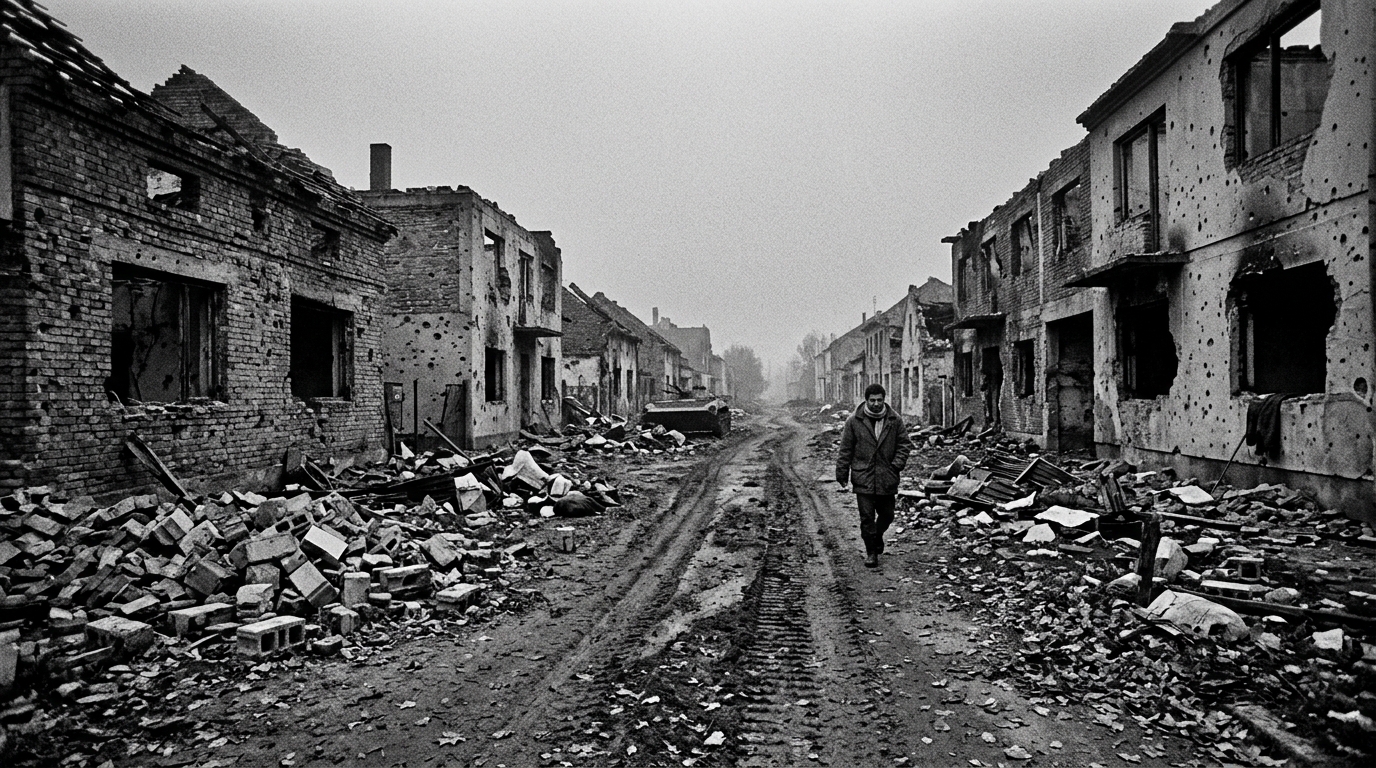
However, the three-month siege, broadcast globally by international war correspondents, radically changed this perspective. The images of a European city completely reduced to ruins—evoking comparisons to Stalingrad or Warsaw in World War II—eroded any remaining international legitimacy for the JNA and Belgrade.
- Ruins of Vukovar Broadcast Globally
- Loss of Belgrade's Diplomatic Legitimacy
- Decisive Shift in European Public Opinion
- Germany Pressures EC for Diplomatic Recognition
Germany, led by Chancellor Helmut Kohl and Foreign Minister Hans-Dietrich Genscher, broke ranks with its allies and pressed for the immediate recognition of Croatian and Slovenian independence. On January 15, 1992, the European Community formally recognized Croatia, a move that was followed by UN membership in May 1992. The defense of Vukovar had bought Croatia the necessary time to organize its armed forces, secure international sympathy, and formalize its statehood.
The Vance Plan and UNPROFOR
The exhaustion of both sides after the fall of Vukovar led to diplomatic breakthroughs. In January 1992, the Vance Plan (brokered by United Nations Special Envoy Cyrus Vance) was signed in Sarajevo by representatives of Croatia, Serbia, and the JNA.
The Vance Plan resulted in:
- An immediate ceasefire along the existing frontlines.
- The deployment of a UN peacekeeping force: the United Nations Protection Force (UNPROFOR).
- The establishment of four United Nations Protected Areas (UNPAs): Sectors North, South, East, and West.
| UNPROFOR Sector | Geographic Location | Key Cities Included | Post-War Reintegration Method |
|---|---|---|---|
| Sector North | Kordun, Banovina | Glina, Petrinja | Military Action (Operation Storm, 1995) |
| Sector South | Lika, Northern Dalmatia | Knin, Benkovac | Military Action (Operation Storm, 1995) |
| Sector West | Western Slavonia | Okučani, Pakrac | Military Action (Operation Flash, 1995) |
| Sector East | Eastern Slavonia, Baranja | Vukovar, Ilok | Peaceful Diplomatic Reintegration (1995–1998) |
Vukovar and Eastern Slavonia were designated as Sector East. Although the Vance Plan stopped the heavy fighting, it effectively frozen the conflict, leaving Eastern Slavonia under the control of the self-proclaimed Republic of Serbian Krajina (RSK) for several years.
Peaceful Reintegration: The Erdut Agreement
Unlike the western and southern occupied territories of Croatia, which were recovered through decisive military operations in 1995 (Operations Flash and Storm), Eastern Slavonia was reintegrated through diplomatic channels.
Following the signing of the Dayton Agreement in 1995, Croatian and local Serb representatives signed the Erdut Agreement on November 12, 1995 5. This agreement established a transitional UN administration (UNTAES) led by Jacques Paul Klein. Over a two-year transition period, UNTAES successfully oversaw:
- The demilitarization of the region.
- The gradual return of displaced refugees.
- The establishment of a multi-ethnic police force.
- The reintegration of the administrative, monetary, and educational systems into the Republic of Croatia, completed on January 15, 1998.
Analysis of Key Actors and Decisive Actions
The outcome of the Siege of Vukovar was shaped by the highly contrasting strategic calculations of political leaders and the tactical adjustments made by military commanders on the ground.
GEOPOLITICAL LEADERS
- Franjo Tuđman (Croatia)
- Slobodan Milošević (Serbia)
Slobodan Milošević and the JNA's Doctrine
For Slobodan Milošević, the siege of Vukovar was a double-edged sword. On one hand, the conflict allowed him to mobilize Serbian public opinion against "fascist resurgence" in Croatia and solidify control over the federal military apparatus.
On the other hand, the protracted siege exposed the deep structural rot of the JNA. Built as a multi-ethnic army designed to repel a foreign invasion (following the Titoist doctrine of Total National Defense), the JNA was doctrinally and psychologically unprepared for a civil war:
- Draft evasion and desertion rates in Serbia proper were extraordinarily high, sometimes reaching 50–80% in urban areas like Belgrade.
- The JNA high command, led by Defense Minister Veljko Kadijević, suffered from a lack of clear strategic direction, caught between preserving a socialist Yugoslavia and fighting for a nationalist Serbian state.
- To compensate for the lack of reliable infantry, the JNA increasingly relied on ultra-nationalist paramilitary organizations, which were highly effective at terrorizing civilians but lacked military discipline and created severe command-and-control challenges.
Franjo Tuđman and the "Vukovar Sacrifice" Controversy
President Franjo Tuđman operated under a strategy of asymmetric defense. Recognizing that Croatia could not match the JNA in open conventional warfare, he prioritized securing international recognition and a diplomatic solution.
This strategy led to one of the most persistent controversies of the war: the accusation that Tuđman deliberately sacrificed Vukovar to secure international sympathy and recognition. Proponents of this theory point to the Croatian government’s refusal to send significant reinforcements or break the siege, as well as the arrest and temporary detention of defense commanders Mile Dedaković and Branko Borković by Croatian military police after they retreated from the fallen town.
However, historical analysis suggests a more nuanced reality. In autumn 1991, the infant Croatian military was critically short of weapons, ammunition, and logistics. An attempt to launch a counter-offensive to break the siege in October 1991 was repulsed with heavy losses. Sending Croatia’s limited reserves into Eastern Slavonia would have risked exposing the defense of Zagreb and other critical sectors, suggesting that the decision to prioritize other fronts was a calculated military necessity rather than a cynical political sacrifice.
Tactical Leadership: Blago Zadro
At the tactical level, the defense of Vukovar was defined by innovative decentralized command. A prominent figure was Blago Zadro, a local community leader who commanded the defense of the Borovo Naselje district.
Without formal military training, Zadro organized highly successful defensive lines along Trpinjska Cesta. He developed tactical innovations such as:
- Allowing JNA tank columns to enter deep into narrow residential streets before attacking the lead and rear vehicles, trapping the entire column.
- Using sewer networks and basements to redeploy forces rapidly behind enemy lines.
- Strictly prohibiting his men from retreating, maintaining high morale through personal example.
Zadro's death on October 16, 1991, when he was cut down by machine-gun fire while coordinate defense lines, marked a significant turning point in the psychological resilience of the local defenders.
Trivia and Lesser-Known Facts
- The Yellow Boots (Žute čizme): Many of the defenders of Vukovar wore distinct high-top yellow leather boots manufactured by the local Borovo shoe factory. These boots, originally designed for agricultural work, became an iconic symbol of the defense and, tragically, a target for Serb paramilitaries during the post-surrender selections, as wearing them identified individuals as active combatants.
- The Air Supply Fleet: Lacking an air force, Croatia utilized the Samostalni zrakoplovni vod Osijek (Osijek Independent Air Platoon), which operated biplanes such as the Antonov An-2 (originally used for crop-dusting). These wood-and-canvas aircraft flew night missions over Vukovar, dropping supplies, medicines, and improvised bombs made from gas cylinders and boilers filled with explosives.
- Siniša Glavašević and Radio Vukovar: Siniša Glavašević was a Croatian journalist and publicist who remained in the besieged city, providing daily radio broadcasts that served as the primary source of information for the outside world. His emotional final broadcast on November 18 ended with the words: "And where are you, my city?" Glavašević was captured, tortured, and executed at Ovčara on November 20, 1991. His body was exhumed from the mass grave in 1997.
- The Water Tower (Vukovarski vodotoranj): Built in 1968, the 50-meter-tall water tower in the Mitnica district became the ultimate symbol of the city's defiance. Hit by more than 600 artillery projectiles during the siege, it refused to collapse. Every night, a local defender named Ivica Ivanika climbed the damaged structure under heavy shellfire to raise the Croatian flag, which was visible to JNA positions across the Danube.
References and Literature
- The Death of Yugoslavia (Laura Silber and Allan Little) - A comprehensive, highly acclaimed account of the dissolution of Yugoslavia and the ensuing wars.
- ICTY Case IT-95-13a: Mrkšić, Radić and Šljivančanin (The Vukovar Hospital Case) - Official judicial archives of the International Criminal Tribunal for the former Yugoslavia detailing the events surrounding the fall of the city and the Ovčara massacre.
- Balkan Battlegrounds: A Military History of the Yugoslav Conflict, 1990-1995 (Central Intelligence Agency) - An extensive military-strategic analysis of the battle tactics, logistics, and campaigns of the Yugoslav wars.
- The Erdut Agreement (United Nations Peacemaker Database) - Full text and analysis of the basic agreement on the region of Eastern Slavonia, Baranja, and Western Sirmium.
Footnotes & Explanations
- Tito's death on May 4, 1980, removed the singular unifying authority that had suppressed ethnic and nationalist rivalries through the "Brotherhood and Unity" doctrine. ↩
- The SANU Memorandum (September 1986) asserted that the borders of post-WWII republics were drawn arbitrarily to weaken Serbia. ↩
- The Borovo Selo incident of May 2, 1991, is widely considered by military historians to be the point where local ethnic clashes transformed into an organized inter-ethnic war. ↩
- The exhumation of the Ovčara mass grave began in 1996 under the supervision of the ICTY, confirming 200 distinct sets of remains, with several dozens still listed as missing. ↩
- The Erdut Agreement was signed on November 12, 1995, parallel to the Dayton Accords, avoiding a planned Croatian military offensive (Operation Danube) that would have likely resulted in massive casualties and direct Russian-Serbian intervention. ↩