Key Takeaways
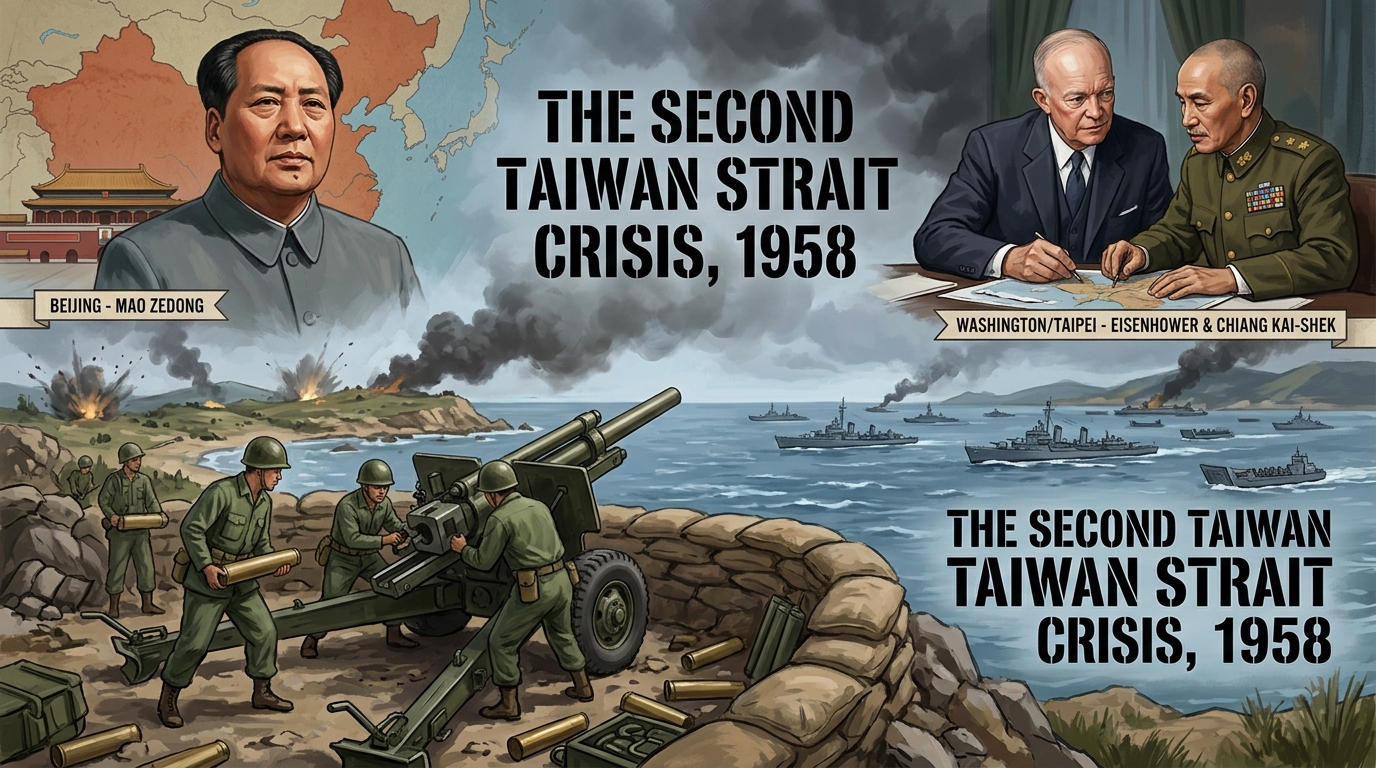
- The crisis was triggered on August 23, 1958, when the Chinese People's Liberation Army (PLA) initiated an intense artillery bombardment of the Nationalist-held islands of Quemoy and Matsu.
- The United States, under President Dwight D. Eisenhower, responded by deploying the U.S. Seventh Fleet to escort Taiwanese supply convoys, asserting its commitment to the Sino-American Mutual Defense Treaty.
- The standoff brought the world to the brink of nuclear war, as top U.S. military officials prepared contingency plans involving tactical nuclear strikes against mainland China before a diplomatic resolution was reached.
The summer of 1958 brought the international community to the precipice of a potentially cataclysmic nuclear conflict in the narrow waters separating mainland China from the island of Taiwan. The Second Taiwan Strait Crisis, also known as the 1958 Taiwan Strait Crisis, represented the zenith of Cold War "brinkmanship"—a strategic maneuver where both sides pushed events to the brink of active disaster to force the other to back down. At the center of this volatile geopolitical storm stood three towering figures of the mid-20th century: Mao Zedong, the revolutionary Chairman of the Chinese Communist Party; Chiang Kai-shek, the resolute President of the Republic of China (ROC); and Dwight D. Eisenhower, the American President and former Supreme Allied Commander, who sought to contain the global spread of communism without triggering a third world war.
By examining the ideological underpinnings, the tactical military maneuvers, and the secret diplomatic backchannels that defined this confrontation, historians can discern how close the world came to a tactical nuclear exchange. The crisis remains a textbook example of how local territorial disputes can quickly become global existential threats when processed through the binary lens of Cold War alignment.
Historical Context and Origins
To understand the sudden outbreak of hostility in August 1958, one must examine the unresolved legacy of the Chinese Civil War (1945–1949). Following the defeat of the Nationalist Kuomintang (KMT) forces by Mao Zedong’s Chinese Communist Party (CCP), Chiang Kai-shek evacuated the remnants of his government, military, and roughly two million refugees to the island province of Taiwan. While the People's Republic of China (PRC) was proclaimed in Beijing on October 1, 1949, Chiang's ROC maintained its capital in Taipei, asserting that it remained the sole legitimate government of all of China.
A crucial geographical anomaly of this division lay in the "offshore islands" of Quemoy (Kinmen) and Matsu 1. Unlike Taiwan and the Pescadores (Penghu) islands, which lie approximately 100 miles across the Taiwan Strait, Quemoy and Matsu are situated directly within the geographic embrace of mainland China's Fujian Province. Quemoy is located a mere two miles from the port city of Xiamen, while Matsu lies just off the mouth of the Min River near Fuzhou. For Chiang Kai-shek, these heavily fortified outposts were not merely defensive bastions; they were stepping stones, vital launchpads for his long-held dream of a military campaign to "reclaim the mainland." Conversely, for Mao Zedong, the Nationalist presence on these islands was an intolerable insult, a physical blockade of PRC ports, and an unfinished piece of the civil war.
The First Taiwan Strait Crisis (1954–1955) had already demonstrated the explosive potential of this arrangement. That conflict had culminated in the PRC seizing the Yijiangshan and Tachen Islands, prompting the United States to sign the Sino-American Mutual Defense Treaty with the ROC in December 1954. However, the treaty contained a deliberate geographic ambiguity: while it explicitly bound the United States to defend Taiwan and the Pescadores, it did not clearly state whether Washington was obligated to defend the offshore islands of Quemoy and Matsu. To complement this treaty, the U.S. Congress passed the Formosa Resolution in January 1955, granting President Eisenhower the discretionary authority to employ U.S. armed forces to protect the offshore islands if he deemed their defense essential to the security of Taiwan itself.
By 1958, several domestic and international pressures converged to reignite the conflict:
- The Great Leap Forward: Domestically, Mao Zedong launched his radical social and economic reorganization program, the Great Leap Forward, in May 1958. To mobilize the Chinese peasantry and enforce ideological conformity, Mao required an external threat, a "common enemy" that could foster national unity and justify intense domestic labor mobilization [[^2]].
- Sino-Soviet Divergence: Internationally, ideological cracks were appearing in the Sino-Soviet Alliance. Soviet Premier Nikita Khrushchev had embarked on a policy of "peaceful coexistence" with the capitalist West, a trajectory that Mao viewed as revisionist and weak. By manufacturing a crisis in the Taiwan Strait, Mao could challenge Moscow's leadership, force the Soviet Union to honor its defensive commitments, and demonstrate that Beijing would not have its foreign policy dictated by Moscow.
- The Middle East Crisis: In July 1958, the United States landed marines in Lebanon to stabilize the pro-Western government following a nationalist coup in Iraq. Mao sought to utilize this moment of American distraction in the Middle East to test Western resolve in East Asia, believing that the United States would be reluctant to engage in a two-front geopolitical confrontation.
Timeline of Events and Key Moments
The fuse was officially lit on the afternoon of August 23, 1958. At precisely 17:30, the artillery batteries of the PLA’s Fujian Front opened a devastating, coordinated bombardment of the Quemoy island group. Over the course of the first two hours, more than 57,000 artillery shells rained down on the tiny archipelago, targeting military headquarters, communication centers, and supply depots. The initial barrage succeeded in killing three deputy commanders of the ROC Kinmen Defense Command, including prominent generals, and severing underwater communication cables to Taiwan.
Key Timeline of the 1958 Crisis
| Date | Event |
|---|---|
| Aug 23 | PLA opens massive artillery barrage on Quemoy (Kinmen). |
| Aug 24 | PRC air forces engage ROC planes; naval blockade begins. |
| Sep 04 | Beijing declares a 12-nautical-mile territorial sea limit. |
| Sep 07 | US Seventh Fleet begins escorting ROC supply convoys. |
| Sep 24 | ROC Sabres use AIM-9 Sidewinder missiles to defeat PRC MiGs. |
| Oct 06 | PRC announces a temporary, unilateral ceasefire. |
| Oct 25 | Mao establishes the "odd-day, even-day" shelling protocol. |
The Blockade and the Aerial Standoff
In the days that followed, the PRC expanded its military operations to include air and naval forces, seeking to enforce a total blockade of Quemoy. The objective was clear: starve the Nationalist garrison of food, ammunition, and medical supplies until surrender became the only viable option. PLA naval vessels, primarily torpedo boats, patrolled the waters around the islands to intercept Nationalist transport ships.
The air space above the Taiwan Strait became a chaotic battleground. The ROC Air Force, flying American-supplied F-86 Sabre jet fighters, clashed repeatedly with the PLA's Soviet-built MiG-15 and MiG-17 fighters. In these high-speed dogfights, the Nationalists held a distinct qualitative edge, bolstered by superior pilot training and, crucially, classified American technology.
The American Response and Nuclear Deterrence
President Eisenhower realized that allowing Quemoy and Matsu to fall under the pressure of a military blockade would severely damage U.S. credibility in Asia and potentially trigger a psychological collapse within Chiang Kai-shek's regime on Taiwan. He immediately ordered the mobilization of the U.S. military:
"We are not going to keep the peace by running away from our commitments." — President Dwight D. Eisenhower, National Security Council meeting, August 1958
The U.S. Navy assembled the largest armada of naval vessels since World War II under the command of the Seventh Fleet. Six aircraft carriers—including the USS Saratoga, USS Midway, and USS Ranger—along with heavy cruisers, destroyers, and support ships were deployed to the Taiwan Strait.
On September 4, 1958, Beijing announced a unilateral expansion of its territorial waters to 12 nautical miles, a claim designed to legally encompass Quemoy and Matsu and declare American naval movements in the area as violations of Chinese sovereignty. Washington flatly rejected this claim. On September 7, U.S. warships began directly escorting ROC supply convoys. To avoid direct combat with the PRC, American commanders ordered their ships to stop three nautical miles from the Quemoy beaches—the traditional limit of territorial waters—allowing the Nationalist landing craft to complete the final, perilous leg of the journey under the protection of U.S. radar and fire support systems 3.
Behind the scenes, the military planning in Washington was chillingly clinical. The Joint Chiefs of Staff, led by General Nathan Twining, drafted contingency plans that assumed any full-scale Chinese invasion of the offshore islands would have to be met with American tactical nuclear weapons. The plans proposed targeting PLA airbases in Fujian Province with low-yield nuclear warheads to eliminate their air capacity. While Eisenhower remained deeply reluctant to cross the nuclear threshold, he authorized the deployment of nuclear-capable Matador cruise missiles to Taiwan and ensured that tactical nuclear artillery pieces were sent to the region, utilizing "strategic ambiguity" to keep Beijing guessing about his ultimate intentions.
Geopolitical Consequences and Aftermath
By late September 1958, it had become clear to Chairman Mao that the blockade of Quemoy had failed. The combination of U.S. naval escorts, advanced ROC military technology, and the credible threat of American nuclear retaliation made a conventional assault or starvation campaign untenable without risking a catastrophic war with a superpower—a war that the Soviet Union was highly reluctant to support.
On October 6, 1958, Chinese Defense Minister Peng Dehuai announced a unilateral one-week ceasefire on the condition that the United States stop escorting ROC supply ships. Although the U.S. did not formally agree to such terms, it did suspend escort duties when the shelling stopped. This ceasefire was later extended, but on October 25, the PRC introduced one of the most unusual military arrangements in modern history: the "odd-day, even-day" bombardment schedule.
[Odd-Numbered Days] [Even-Numbered Days] Shelling Active Ceasefire in Effect (Artillery fires leaflets/ (Supplies allowed to land; occasional explosives) garrisons reinforced)
Under this protocol, the PLA would only shell the islands on odd-numbered calendar days, allowing the Nationalists to safely unload supply ships, reinforce their garrisons, and conduct routine operations on even-numbered days. This bizarre ritual transformed a highly volatile international crisis into a controlled, symbolic theater of war. The shells fired on odd days were increasingly filled not with high explosives, but with propaganda leaflets, a situation that persisted in varying intensities until the United States and the PRC formally established diplomatic relations in January 1979 4.
The long-term geopolitical consequences of the crisis were profound:
1. The Widening Sino-Soviet Split
The 1958 crisis served as a critical catalyst for the eventual rupture of the Sino-Soviet Alliance. Soviet Premier Nikita Khrushchev was deeply alarmed by Mao's unilateral actions, which had brought the Soviet Union to the brink of a nuclear confrontation with the United States without prior consultation. During a tense visit to Beijing in 1959, Khrushchev criticized Mao's adventurous foreign policy, while Mao accused Khrushchev of "capitulationism" in the face of Western imperialism. In 1959, the Soviet Union tore up its agreement to assist China in developing an atomic bomb, and by 1960, Soviet technicians were entirely withdrawn from the PRC.
2. Constraints on Chiang Kai-shek
While the United States had defended Taiwan's territorial integrity, Secretary of State John Foster Dulles traveled to Taipei in October 1958 to extract a major diplomatic concession from Chiang Kai-shek. In a joint communiqué issued on October 23, Chiang publicly renounced the use of military force as the primary means to liberate the mainland, committing instead to rely on political and ideological struggle. This effectively ended any immediate prospect of a Nationalist invasion of mainland China, aligning ROC policy with the defensive containment strategy preferred by Washington.
3. Consolidation of the Status Quo
The crisis solidified the geographical status quo of the Taiwan Strait that remains in place today. Quemoy and Matsu remained under Taipei's administration, serving as highly militarized symbols of the ongoing division of China. The crisis demonstrated that while Beijing would not tolerate a formal declaration of independence by Taiwan, the United States would not permit the forcible integration of Taiwan or its key outposts into the PRC.
Analysis of Key Actors and Decisive Actions
The resolution of the Second Taiwan Strait Crisis without a global war was the result of a complex interplay of calculation, miscalculation, and strategic posturing among the three principal leaders.
| LEADER | STRATEGIC MOTIVATION & CRITICAL DECISION |
|---|---|
| Mao Zedong | Utilized "noose theory" to tie U.S. forces down; initiated bombardment to test alliances and mobilize domestic labor for the Great Leap Forward. |
| Chiang Kai-shek | Attempted to force direct U.S. military involvement in the civil war by stationing 1/3 of his troops on highly vulnerable offshore islands. |
| Dwight Eisenhower | Executed "strategic ambiguity" and brinkmanship; deployed massive naval force while restraining Chiang's offensive ambitions. |
Mao Zedong: The Master of Controlled Chaos
Mao's behavior during the 1958 crisis can be explained by his unique "noose theory" (taoshou lun). Mao viewed the U.S. military bases and defense commitments around China's periphery not as points of strength, but as ropes or "nooses" that the Americans had voluntarily placed around their own necks 5. By tugging on the rope at Quemoy, Mao believed he could force the United States to commit massive resources to defend a militarily indefensible position, thereby retaining the strategic initiative.
Mao's decision to halt the bombardment and implement the odd-day, even-day system was a brilliant, face-saving political maneuver. He realized that a full blockade was impossible without attacking American warships, which would trigger a war he could not win. By transitioning to symbolic shelling, Mao kept the "noose" tight enough to prevent Taiwan from claiming total victory, kept the United States tied down, and maintained a state of permanent mobilization within China without crossing the red line into general war.
Chiang Kai-shek: Leveraging the Offshore Islands
Chiang Kai-shek's primary strategic goal was to entangle the United States so deeply in the defense of the offshore islands that any attack on them would automatically trigger a joint ROC-U.S. war against the PRC, which Chiang hoped would lead to the collapse of Mao's regime. To achieve this, Chiang made a highly risky military decision: he stationed nearly one-third of his entire military forces—over 100,000 troops—on Quemoy and Matsu.
By concentrating such a massive portion of his combat power on these vulnerable islands, Chiang made them "too big to fail." He effectively stripped the United States of its strategic flexibility, forcing Eisenhower to defend the islands because their loss would mean the destruction of a significant portion of the ROC army and the potential collapse of the Nationalist government. Although Chiang was ultimately forced to renounce the military reconquest of the mainland, his gambit successfully preserved ROC sovereignty over Quemoy and Matsu.
Dwight D. Eisenhower: The Art of Strategic Ambiguity
President Eisenhower's handling of the crisis represents a masterful display of crisis management under the shadow of nuclear weapons. Eisenhower was acutely aware of the military vulnerability of Quemoy and Matsu, famously noting that "the place is militarily indefensible in the long run" if subjected to a sustained mainland assault. However, he also understood the psychological dimensions of international relations:
"We must not permit ourselves to be bullied into surrender of positions which, though minor in themselves, are nevertheless key outposts of the free world." — President Dwight D. Eisenhower, Radio and Television Address to the American People, September 11, 1958
Eisenhower navigated this dilemma through a dual-track strategy of deterrence and restraint. On one hand, he deployed a massive naval force, authorized nuclear planning, and deliberately left open the possibility that the United States would use atomic weapons to defend the islands, effectively deterring a Chinese invasion. On the other hand, he firmly restrained Chiang Kai-shek, refusing to allow Nationalist aircraft to bomb the mainland artillery batteries, which would have escalated the conflict beyond control. This balanced approach allowed Eisenhower to preserve the status quo without firing a shot in anger at the mainland Chinese forces.
Trivia and Lesser-Known Facts
The Debut of the AIM-9B Sidewinder
The air battles of September 1958 witnessed the first combat use of guided air-to-air missiles in aviation history. Under a highly classified program codenamed "Project Black Magic," the U.S. Navy modified Nationalist F-86 Sabre fighters to carry the newly developed AIM-9B Sidewinder missile 6. On September 24, 1958, a formation of ROC Sabres intercepted a larger force of PLA MiG-17s. The Nationalist pilots launched their Sidewinders, completely surprising the Chinese pilots who believed they were out of range of conventional machine guns. The Sidewinders shot down at least ten MiGs in a single engagement without a single Nationalist loss, instantly altering the balance of power in the skies over the strait.
[ROC F-86 Sabre] --- (AIM-9B Sidewinder) ---> [PLA MiG-17] (Equipped under (Unexpectedly destroyed "Project Black Magic") from long range)
The Unexploded Missile and the Soviet K-13
During the dogfights of late September, an AIM-9B Sidewinder struck a PLA MiG-17 but failed to explode. The pilot managed to fly the damaged jet back to his base on the mainland with the highly classified missile still embedded in the fuselage. Chinese military engineers carefully extracted the Sidewinder and turned it over to Soviet weapons scientists in Moscow. Soviet engineers dismantled the missile and were amazed by its simple yet highly effective infrared tracking system. Moscow reverse-engineered the weapon, producing the Vympel K-13 (NATO reporting name: AA-2 "Atoll"), which became the standard air-to-air missile for Warsaw Pact nations for decades to come.
The Atomic Howitzers of Quemoy
In a move designed to send a clear psychological message to Beijing, the United States transported massive 203mm (8-inch) M115 howitzers to Quemoy during the height of the crisis. These heavy artillery pieces were highly accurate and, crucially, were known to be capable of firing tactical nuclear shells (although only conventional high-explosive ammunition was sent to the island). The deployment of these "atomic-capable" guns, combined with the ROC's ability to construct deep underground artillery bunkers, proved to the PLA that their own artillery batteries on the hills of Xiamen could be systematically targeted and destroyed in a counter-battery duel.
The "Kitchen Ware" Legacy of the Shelling
Because the odd-day, even-day bombardment of Quemoy continued for over twenty years, the islands were subjected to a staggering volume of steel. It is estimated that over one million artillery shells were fired at Quemoy between 1958 and 1979. Rather than leaving the steel fragments to rust, the resourceful residents of Quemoy began harvesting the high-quality steel from the spent casing fragments to forge high-end kitchen knives. Today, "Maestro Wu" knives, made from the actual artillery shells fired by the PLA during the Cold War, are highly prized souvenir items and a major tourist export of the peaceful, demilitarized Kinmen islands.
References and Literature
- Foreign Relations of the United States, 1958–1960, Volume XIX, China - Official diplomatic correspondence, memoranda, and intelligence assessments of the U.S. Department of State during the crisis.
- The Cold War International History Project (CWIHP) - Wilson Center - Declassified Chinese and Soviet archives shedding light on Mao Zedong's decision-making and the Sino-Soviet debates.
- Accinelli, Julius (1996). Crisis and Commitment: United States Policy toward Taiwan, 1950-1955. Chapel Hill: University of North Carolina Press. - A detailed exploration of the legislative and geopolitical framework leading up to the 1958 crisis.
- Chang, Gordon H., and He, Di (1993). "The Absence of War in the U.S.-China Confrontation over Quemoy and Matsu in 1954-1955 and 1958: The Analysis of Historical Actors." The American Historical Review, Vol. 98, No. 5, pp. 1500–1524. - A scholarly peer-reviewed analysis of the structural and personal factors that prevented the crises from escalating into war.
---
Footnotes & Explanations
- Historically referred to as Kinmen and Mazu in modern pinyin transliteration, but widely known in 1950s Western scholarship and media as "Quemoy and Matsu." ↩
- See the historical analysis in the Wilson Center's Cold War International History Project documents regarding Mao's domestic mobilization speeches in August 1958. ↩
- This operational limitation was designed to prevent a direct physical clash between Soviet-supported PRC naval units and U.S. Navy vessels, which could have triggered joint-defense pacts on both sides. ↩
- The shelling officially ceased on January 1, 1979, coinciding with the establishment of formal diplomatic relations between the United States and the People's Republic of China. ↩
- Mao explained his "Noose Theory" in detail during his speech at the Supreme State Conference on September 8, 1958. ↩
- The AIM-9 Sidewinder was a highly guarded secret; its deployment marked the very first operational deployment of heat-seeking technology in active military combat. ↩