Key Takeaways
- The crisis represented a fundamental institutional clash between the newly created presidency of Boris Yeltsin and the Soviet-era parliamentary system represented by the Supreme Soviet and Congress of People's Deputies.
- Socio-economic fallout from 'shock therapy' economic reforms fueled parliamentary opposition, leading to an intractable constitutional deadlock.
- The violent resolution on October 4, 1993, culminated in the shelling of the Russian White House and laid the structural foundation for Russia's highly centralized 'super-presidential' system.
Historical Context and Origins
The Russian Constitutional Crisis of October 1993 was not an isolated incident of political violence, but rather the violent culmination of a systemic, institutional, and ideological deadlock that had plagued the Russian Federation since the dissolution of the Soviet Union in December 1991. At its core, the crisis was defined by a fundamental question: who would hold supreme authority in the new, post-Soviet Russian state—the executive branch, led by President Boris Yeltsin, or the legislative branch, represented by the Supreme Soviet and its parent body, the Congress of People's Deputies.
To understand the origins of this clash, one must examine the bizarre constitutional architecture of early 1990s Russia. Following the collapse of the USSR, the Russian Federation continued to operate under the 1978 Constitution of the Russian Soviet Federative Socialist Republic (RSFSR). Though heavily amended to accommodate a presidency and a market economy, this document remained fundamentally Soviet in its structural logic. It designated the Congress of People’s Deputies as the supreme organ of state power, while simultaneously granting broad executive powers to the President, a post created in 1991 and occupied by Boris Yeltsin. This setup created a system of "dual sovereignty" where both branches could claim legitimate, supreme authority derived from popular elections 1.
1978 RSFSR Constitution (Amended)
- Executive Branch
- Legislative Branch
This institutional friction was further inflamed by a profound disagreement over economic policy. Following the advice of Western economists and domestic reformers like Yegor Gaidar, the Yeltsin administration embarked on a program of economic "shock therapy" in January 1992. This program involved the liberalization of prices, the rapid privatization of state-owned enterprises, and drastic cuts to state spending.
The immediate consequences for the Russian population were catastrophic:
- Hyperinflation: Saved assets were wiped out virtually overnight as inflation soared past 2,500% in 1992.
- Industrial Collapse: Production plummeted as subsidies were withdrawn and global competition intensified.
- Socio-economic Stratification: A small class of well-connected insiders (the future oligarchs) amassed vast fortunes, while the vast majority of citizens fell below the poverty line.
The Supreme Soviet, led by Chairman Ruslan Khasbulatov—a brilliant but sharp-tongued Chechen economist who had once been Yeltsin's close ally—became the voice of widespread public discontent. The legislature argued that the economic reforms were ruining the country, destroying its industrial base, and reducing its international standing. Joining Khasbulatov was Vice President Aleksandr Rutskoy, a decorated veteran of the Soviet-Afghan War. Rutskoy, initially selected by Yeltsin to appeal to nationalists and the military, broke decisively with the President, famously denouncing the privatization scheme as "economic genocide" and a system of "robbery" 2.
Throughout 1992 and early 1993, the legislative and executive branches engaged in a exhausting war of decrees. Yeltsin attempted to rule by emergency decree to bypass a hostile parliament, while the parliament systematically revoked his powers, rejected his ministerial appointments, and amended the constitution to weaken the presidency.
In April 1993, a national referendum was held in an attempt to break the impasse. Known popularly by its promotional slogan "Da, Da, Net, Da" (Yes, Yes, No, Yes), voters were asked if they supported Yeltsin, his economic policies, and whether they favored early presidential and parliamentary elections. While Yeltsin won a narrow moral victory—securing trust from 58% of voters and cautious backing for his economic reforms—the referendum did not provide a clear-cut legal solution to the constitutional division of power. The deadlock persisted, and both sides began preparing for an inevitable, decisive confrontation.
Timeline of Events and Key Moments
The crisis accelerated rapidly in the late summer of 1993, escalating from procedural obstruction to armed street warfare in the heart of Moscow.
September 21: Decree 1400 and the Dissolution of Parliament
The trigger for the active phase of the crisis occurred on the evening of September 21, 1993. Boris Yeltsin appeared on national television to announce the signing of Presidential Decree No. 1400, "On Gradual Constitutional Reform in the Russian Federation." The decree declared the Congress of People's Deputies and the Supreme Soviet dissolved, suspended the active constitution, and called for elections to a new bicameral parliament, the Federal Assembly, to be held in December 3.
This move was openly illegal. Under the active 1978 Constitution, the President possessed no authority to dissolve the legislature. In anticipation of such an action, the parliament had previously passed Article 121-6, which stated that any attempt by the President to dismiss or suspend the legislature would result in the automatic termination of his presidential powers, with the Vice President immediately assuming the role of acting President.
September 22–24: The Parliamentary Counter-Strike
Within hours of Yeltsin's broadcast, the Supreme Soviet convened an emergency session in the Russian parliament building, known as the "White House" (Bely Dom). Led by Khasbulatov, the parliament voted to impeach Yeltsin for violating the constitution. They declared his actions a coup d'état, stripped him of his powers, and swore in Vice President Aleksandr Rutskoy as the Acting President of the Russian Federation.
The Constitutional Court, under the leadership of Chief Justice Valery Zorkin, met in the middle of the night and ruled that Decree 1400 was indeed unconstitutional, providing a solid legal basis for the parliament's actions. Rutskoy immediately began appointing a shadow cabinet, naming rival ministers of defense, security, and internal affairs.
"The actions of Boris Yeltsin are a classic coup d'état. He has placed himself outside the law, and the citizens of Russia are no longer bound to obey his criminal orders." — Ruslan Khasbulatov, addressing the Supreme Soviet, September 22, 1993
September 25–October 1: The Siege of the White House
Yeltsin responded to the parliamentary rebellion by physically isolating the White House. Moscow police and internal security forces cordoned off the building with razor wire and barricades. On Yeltsin's orders, the city municipal services severed the building's electricity, heating, water supply, and telephone lines.
Inside the darkened, freezing White House, several hundred deputies, staff members, and supporters remained barricaded. They were joined by a diverse and volatile coalition of volunteer defenders, ranging from retired military officers and communist activists to ultra-nationalists from organizations like Russian National Unity (RNE). Many of these volunteers were armed with weapons distributed from the building's internal security armory.
As the standoff dragged on, various international and domestic actors attempted to mediate. Patriarch Alexy II of the Russian Orthodox Church hosted talks at the Danilov Monastery, trying to broker a compromise based on the "zero option"—simultaneous presidential and parliamentary elections. However, both Yeltsin and the parliamentary leadership refused to compromise on their claims to supreme authority, and the talks collapsed.
October 2–3: Street Clashes and the Assault on Ostankino
By early October, the atmosphere in Moscow had reached a boiling point. Large-scale demonstrations in support of the parliament began to clash with riot police (OMON). On Sunday, October 3, a massive pro-parliament rally at October Square broke through the police lines. The emboldened crowd, numbering tens of thousands, marched toward the besieged White House, successfully lifting the blockade and forcing the police to retreat.
From the balcony of the White House, an energized Aleksandr Rutskoy addressed the surging crowd, urging them to take active measures:
"My friends, today we must end this dictatorship! Go to the Mayor's office, take it! Go to Ostankino, demand that we be given live airtime so the whole country can hear the truth!" — Aleksandr Rutskoy, October 3, 1993
Following Rutskoy’s call, armed detachments under the command of nationalist General Albert Makashov stormed the nearby Moscow Mayor’s office (the former COMECON building) and seized it with little resistance.
October 3, 1993
- Storming of Mayor's Office
- March on Ostankino TV
The situation turned bloody at the Ostankino television center. Makashov's forces, riding in commandeered trucks, arrived at the TV station demanding live airtime. When their demands were rejected, a truck was driven through the glass doors of the building.
The complex was defended by a heavily armed detachment of the Ministry of Internal Affairs Spetsnaz unit, known as "Vityaz." When a rocket-propelled grenade (RPG) exploded inside the lobby—killing a member of the defense force—the Spetsnaz opened fire with automatic weapons and heavy machine guns on the crowd outside. The firefight lasted for hours, resulting in the deaths of 46 people, including several foreign journalists, and temporarily knocking several national television channels off the air.
October 4: The Shelling and Fall of the White House
The violence at Ostankino was the turning point. It allowed Yeltsin to frame the conflict not as a political dispute, but as an armed fascist-communist insurrection. Throughout the night of October 3-4, Yeltsin worked frantically to secure the loyalty of the military high command. Minister of Defense Pavel Grachev was hesitant to involve the army in a domestic political conflict, demanding written orders from Yeltsin to guarantee his legal protection.
At 6:00 AM on October 4, the military operation began. Elite armored divisions—including the Taman Motorized Rifle Division, the Kantemirovskaya Tank Division, and the Tula Airborne Division—entered the center of Moscow.
| Unit Name | Equipment Deployed | Primary Objective |
|---|---|---|
| Taman Division | T-80UD Main Battle Tanks | Shelling of upper floors of the White House |
| Kantemirovskaya Division | BMP-2 Infantry Fighting Vehicles | Barricade breaching and perimeter security |
| Tula Airborne (VDV) | BTR-80 Armored Personnel Carriers | Assault on the lower floors and interior clearing |
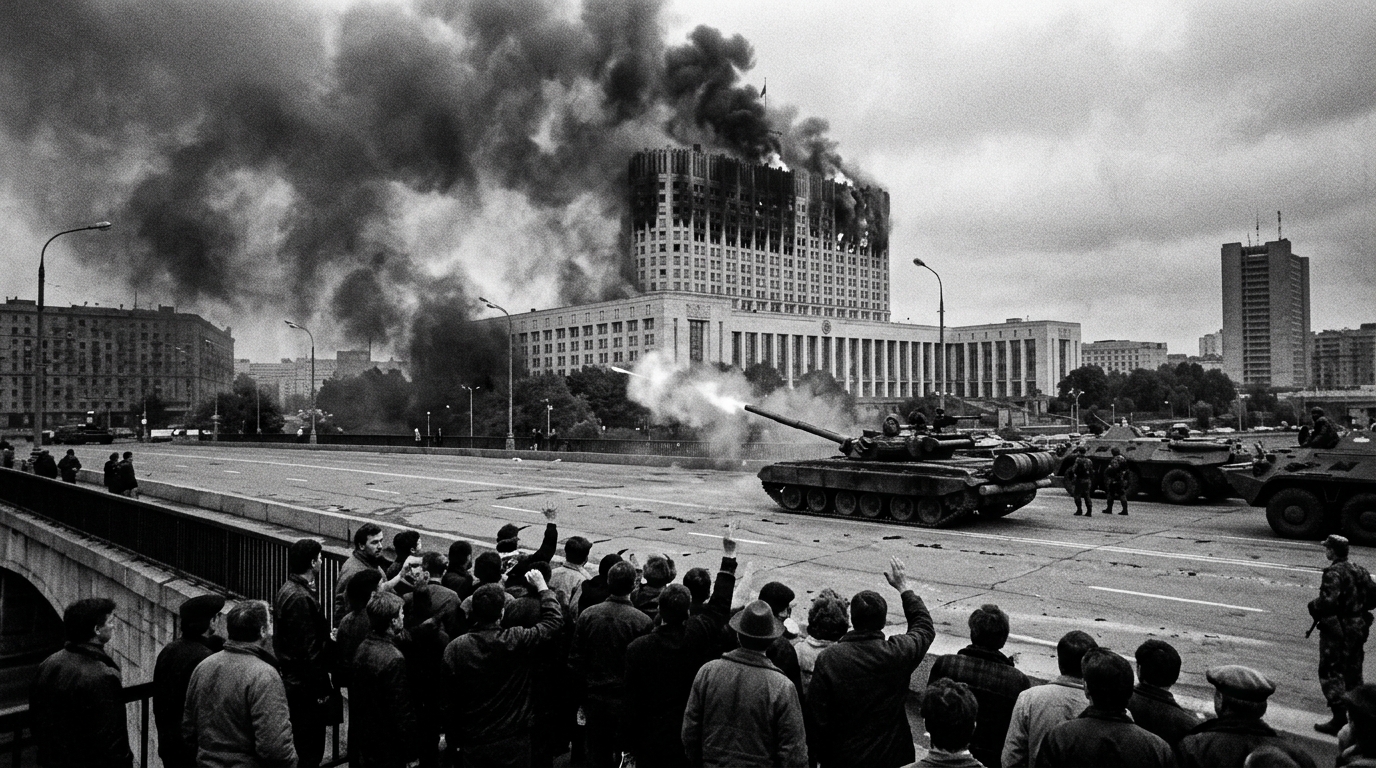
By 8:00 AM, heavy infantry fighting vehicles (BMPs) and armored personnel carriers (BTRs) opened fire with 30mm cannons on the barricades and windows of the White House. At 9:20 AM, six T-80UD tanks positioned on the Kalininsky (now Novoarbatsky) Bridge commenced the systematic shelling of the upper floors of the parliament building. The devastating impact of the 125mm high-explosive shells set the upper half of the white marble structure ablaze, sending thick plumes of black smoke into the Moscow sky 4.
| Source | Action | Target | Result |
|---|---|---|---|
| Novoarbatsky Bridge | 125mm Tank Shells | White House Upper Floors | Ignite major fire |
| Novoarbatsky Bridge | 125mm Tank Shells | White House Upper Floors | Shatter parliamentary morale |
As thousands of onlookers gathered along the embankments of the Moskva River to watch the spectacle live, elite special forces units—"Alpha" and "Vympel"—were ordered to storm the building. Recognizing that an assault would lead to a massacre, officers from the Alpha Group took the initiative to enter the burning building under a temporary truce to negotiate a surrender.
At 6:00 PM, the defense of the White House collapsed. Ruslan Khasbulatov, Aleksandr Rutskoy, and other leaders of the parliamentary faction emerged from the smoke-blackened building and surrendered to authorities. They were immediately arrested and transported to Lefortovo Prison.
The official death toll of the two-day clash in Moscow was placed at 147, though independent estimates and parliamentary investigations subsequently claimed that between several hundred and over a thousand people perished in the violence.
Geopolitical Consequences and Aftermath
The violent resolution of the 1993 constitutional crisis was a pivotal moment in modern Russian history, fundamentally reshaping the country's domestic political landscape and its relationship with the wider world.
The 1993 Constitution and the Rise of the "Super-Presidency"
With the legislature dissolved and his opponents imprisoned, Yeltsin moved quickly to consolidate his authority. In December 1993, a nationwide referendum was held alongside elections for the new parliament (the State Duma and the Federation Council). Voters approved a new Constitution of the Russian Federation, which replaced the outdated 1978 Soviet-era document.
The 1993 Constitution established what political scientists categorize as a "super-presidential" system. It granted the President immense, unchecked powers:
- Decree Power: The President could issue decrees (ukazy) with the force of law without legislative approval, provided they did not violate existing federal laws.
- Cabinet Control: The President appointed the Prime Minister and the cabinet. While the State Duma had to approve the Prime Minister, the President could dissolve the Duma if it rejected his nominee three times.
- Impeachment Barrier: The process for impeaching a President was made so complex and multi-layered as to be practically impossible to execute.
- Weakened Legislature: The new State Duma lacked robust oversight mechanisms, particularly regarding budget control and investigation of the executive branch.
By concentrating power in the hands of the executive to push through market reforms, the 1993 Constitution dismantled the system of checks and balances. This institutional arrangement laid the structural foundation for the subsequent rise of Vladimir Putin’s highly centralized "vertical of power" in the 2000s 5.
Impact on Domestic Politics and Public Disillusionment
The violent destruction of Russia's first democratically elected parliament had a profound psychological impact on the Russian public. The image of tanks firing on the nation's own legislative body shattered the romanticism of the late-perestroika period. For millions of Russians, the word "democracy" became synonymous with economic misery, lawlessness, and state violence.
This disillusionment was reflected in the December 1993 parliamentary elections. Despite the suppression of the communist and nationalist opposition during the October events, the newly formed State Duma was highly critical of Yeltsin. The nationalist Liberal Democratic Party of Russia (LDPR), led by the populist demagogue Vladimir Zhirinovsky, won the largest share of the party-list vote (22.9%), while the resurgent Communist Party of the Russian Federation (CPRF) finished third.
| Party | Vote Share |
|---|---|
| LDPR (Zhirinovsky) | 22.9% |
| Russia's Choice (Yeltsin) | 15.5% |
| CPRF (Communists) | 12.4% |
In a direct rebuke to Yeltsin, the newly elected State Duma passed a sweeping amnesty in February 1994, releasing Ruslan Khasbulatov, Aleksandr Rutskoy, and all other participants in the 1993 uprising from Lefortovo Prison, effectively ending any legal prosecution of the parliamentary rebels.
Western Reactions and Geopolitical Repercussions
The reaction of Western governments to the crisis was characterized by pragmatic realpolitik. Throughout the standoff, U.S. President Bill Clinton and key G7 allies maintained unwavering public support for Boris Yeltsin.
In a statement issued on October 4, President Clinton noted:
"It is clear that the opposition to President Yeltsin was led by a coalition of extreme nationalists and communists who were determined to resort to violence... President Yeltsin acted with great discipline and went to extraordinary lengths to avoid violence."
This stance was driven by several geopolitical calculations:
- Nuclear Security: The West feared the disintegration of a nuclear-armed Russia and viewed Yeltsin as the only leader capable of maintaining command over the Soviet nuclear arsenal.
- Economic Commitments: Western financial institutions and governments had invested heavily in Russia's market reforms and feared that a parliamentary victory would lead to the re-nationalization of industries and a return to state-directed economic planning.
- Fear of Communism: The prospect of a communist-nationalist restoration in Moscow was seen as a direct threat to the post-Cold War security architecture of Europe.
However, this uncritical support for Yeltsin’s undemocratic methods compromised the moral standing of Western-style democracy in the eyes of many Russians. It created a lasting perception that the West prioritized its geopolitical interests over genuine democratic values, fueling the rise of anti-Western sentiment that would become a defining feature of Russian foreign policy in the decades to follow 6.
Analysis of Key Actors and Decisive Actions
The outcome of the 1993 crisis was determined as much by the personalities of its primary protagonists as it was by structural forces. All three key leaders—Yeltsin, Khasbulatov, and Rutskoy—exhibited political miscalculations and tactical errors that made a peaceful resolution impossible.
Boris Yeltsin: The Pragmatic Autocrat
- Role: President of the Russian Federation.
- Character & Style: A populist political survivor with a high tolerance for risk and a deeply combative political style. Yeltsin was at his best in moments of crisis, but often struggled with the daily, consensus-building work of governance.
- Decisive Actions: Signing Decree 1400 on September 21, which initiated the constitutional break. His determination to secure the backing of the military on the night of October 3-4 was the decisive operational victory of the crisis.
- Critical Analysis: While celebrated in the West as a "democratic champion," Yeltsin's actions in 1993 demonstrated a profound impatience with constitutional constraints. By resorting to military force to resolve a political dispute, he established a dangerous precedent: that the ends (market reform and anti-communism) justified the means (unconstitutional violence).
Ruslan Khasbulatov: The Academic Turned Agitator
- Role: Chairman of the Supreme Soviet.
- Character & Style: A brilliant academic (he was a professor of economics) who possessed a sharp intellect but lacked tactical restraint. His vanity and personal animosity toward Yeltsin prevented him from accepting compromise solutions.
- Decisive Actions: Steering the Supreme Soviet to impeach Yeltsin and appoint Rutskoy as acting President. His refusal to accept the "zero option" during the Patriarch's mediation talks doomed the peace negotiations.
- Critical Analysis: Khasbulatov miscalculated his own political leverage. He believed that the army and the provincial governors would rally to the defense of the legal constitution. By failing to appreciate that power ultimately rested on the control of physical force rather than legal documents, he led his followers into an unwinnable military confrontation.
Aleksandr Rutskoy: The Impulsive Patriot
- Role: Vice President of Russia (declared Acting President by Parliament).
- Character & Style: A highly decorated military officer (Hero of the Soviet Union) who possessed a volatile, emotional temperament. Rutskoy was a populist who spoke in black-and-white terms and was deeply affected by the suffering caused by economic reforms.
- Decisive Actions: Taking the oath of office as Acting President on September 22. His call from the balcony of the White House on October 3 for his supporters to storm the Mayor’s office and Ostankino TV was the fatal mistake that alienated potential supporters in the military and justified Yeltsin's use of force.
- Critical Analysis: Rutskoy’s military mindset proved to be a liability. Instead of seeking a political compromise that could have preserved some of the parliament's power, he sought a total victory through street mobilization, a strategy that played directly into Yeltsin's hands by transforming a constitutional dispute into an armed insurrection.
Trivia and Lesser-Known Facts
- The CNN Effect: The shelling of the Russian White House was broadcast live around the world by CNN. For hours, viewers globally watched smoke billow from the iconic building. Ironically, the White House had been a symbol of Russian democracy just two years prior during the 1991 August Coup, when Yeltsin himself had stood on a tank outside the same building to defend it from Soviet hardliners.
- Special Forces Disobedience: When ordered to storm the White House on the morning of October 4, commanders of the elite KGB-legacy special forces units "Alpha" and "Vympel" initially refused. They argued that their role was to fight terrorists and foreign agents, not to kill fellow Russian citizens or elected representatives. It was only after a personal visit from Yeltsin and a negotiated agreement to act as negotiators inside the building that they agreed to deploy.
- The Role of the "Black Hand": In the aftermath of the crisis, rumors persisted about the presence of unidentified snipers on the roofs of buildings near the White House. Both sides claimed these snipers were firing on both protesters and soldiers to deliberately escalate the violence. While some investigations pointed to the involvement of ultra-radical groups, the identity of these shooters was never officially established.
- The Fates of the Protagonists: Following their release in 1994, both Khasbulatov and Rutskoy returned to public life, though neither reached the same political heights. Ruslan Khasbulatov returned to academia, heading the Department of World Economy at the Plekhanov Russian University of Economics until his death in 2023. Aleksandr Rutskoy ran for office and served as the Governor of Kursk Oblast from 1996 to 2000, integrating himself back into the state structure he had once tried to overthrow.
References and Literature
- The Russian Constitutional Crisis of 1993: A Case Study - An analytical piece by Foreign Affairs detailing the domestic and international calculations during the crisis.
- Boris Yeltsin, Midnight Diaries - Boris Yeltsin's personal memoirs, providing his inner perspective on the decisions made during the dramatic autumn of 1993.
- The 1993 Russian Constitution: Institutional Design and Political Consequences - Academic analysis from the Journal of Democracy on how the crisis shaped the post-Soviet Russian state structure.
- The Autumn of 1993: Official Report of the State Duma Commission - The archival records and findings of the parliamentary commission established to investigate the events of September 21–October 5, 1993.
---
Footnotes & Explanations
- See The 1993 Russian Constitution: Institutional Design and Political Consequences for an analysis of how this "dual sovereignty" created an inevitable constitutional trainwreck. ↩
- Aleksandr Rutskoy's speeches in early 1993 frequently targeted the privatization vouchers distributed by Anatoly Chubais, which he claimed were worth less than "two pairs of trousers." ↩
- The full text of Decree No. 1400 was published in Rossiyskaya Gazeta on September 22, 1993, alongside the dissenting opinion of the Constitutional Court. ↩
- The visual of the burning White House on October 4, 1993, remains one of the defining media images of the 1990s, signaling the end of Russia's romantic transition period. ↩
- Political scientists often refer to the resulting structure as an "executive-dominated autocracy under a democratic facade." ↩
- See The Russian Constitutional Crisis of 1993: A Case Study in Foreign Affairs for an assessment of how Western support for Yeltsin's unconstitutional actions degraded the domestic legitimacy of Russian liberal reformers. ↩