Key Takeaways
- The 2020 Belarusian protests represented the most significant and widespread challenge to Alexander Lukashenko’s 26-year authoritarian rule, ignited by undeniable evidence and public perception of systemic electoral fraud.
- Sviatlana Tsikhanouskaya, initially an unlikely and underestimated figure, emerged as a unifying symbol of the democratic opposition, mobilizing unprecedented numbers and diverse segments of Belarusian society against a regime reliant on a loyal and brutal security apparatus.
- Russia’s multifaceted strategic intervention, encompassing political, financial, intelligence, and implicit security lifelines, proved to be the decisive external factor in preventing the collapse of the Lukashenko administration and solidifying Belarus's integration into Russia's sphere of influence.
- The crisis irrevocably altered Belarus's geopolitical orientation, ending its 'multi-vector' foreign policy and cementing its status as a strategic outpost for Moscow, while simultaneously isolating it from Western democracies and fostering a severe internal crackdown on civil society.
Historical Context and Origins: The 'Belarusian Model' and Precursors to Dissent
The Belarusian political system, often characterized as the "last dictatorship in Europe," has functioned under the firm grip of Alexander Lukashenko since 1994. His rise to power came on a wave of anti-corruption sentiment following the chaotic early years of post-Soviet independence. From the outset, Lukashenko systematically dismantled democratic institutions, consolidated executive power, and eliminated political opposition, establishing what came to be known as the "Belarusian Model" of authoritarianism. This model was distinct from its post-Soviet counterparts in its overt rejection of rapid market reforms and its strong emphasis on state control over the economy, a robust social welfare system, and an omnipresent, loyal security apparatus.
For decades, Lukashenko maintained a precarious yet effective "social contract" with his populace. This contract offered citizens a degree of economic stability, social predictability, and security, primarily through the continued operation of large state-owned enterprises (SOEs) that provided employment, housing, and social benefits. In exchange, citizens were expected to forgo political freedoms, dissent, and genuine participation in governance. This arrangement, buttressed by a pervasive state propaganda machine and the absence of a viable political alternative, fostered a general sense of apathy and acceptance among significant segments of the population. Occasional protests, such as those following the 1996 referendum expanding Lukashenko's powers, the 2006 and 2010 presidential elections, or the 2017 demonstrations against the 'parasite tax,' were met with swift and decisive force, reinforcing the regime's control and deterring future challenges.
By 2020, however, this social contract began to fray under the weight of accumulating pressures. Key factors included:
- Economic Stagnation: The state-centric economic model, while providing stability, had largely failed to modernize or innovate. Belarus experienced years of stagnant GDP growth, declining real incomes, and limited opportunities for upward mobility, particularly for younger generations.
- COVID-19 Mismanagement: Lukashenko's dismissive approach to the COVID-19 pandemic – famously advising citizens to drink vodka and visit saunas as cures – severely eroded public trust. The government's initial refusal to implement lockdowns, provide transparent data, or offer adequate public health support highlighted a disconnect between the regime and its people, pushing many previously apolitical individuals into civic activism.
- Generational Shifts and Information Access: A new generation, more globally connected through the internet and less scarred by Soviet memories, harbored growing aspirations for greater political freedoms, human rights, and closer ties with Europe. The state's monopoly on information was increasingly challenged by independent online media and social media platforms like Telegram.
- Perceived Weakness and Succession Talk: There were growing whispers about Lukashenko's health and potential successors, creating a sense of fluidity and opportunity for change that had been absent for decades.
Against this backdrop, the 2020 presidential election cycle unfolded. The state’s initial actions were characteristic of its long-standing approach to opposition:
- Viktar Babaryka, a popular former banker and philanthropist who had managed Gazprombank's Belarusian subsidiary, emerged as a strong contender. His campaign rapidly collected a record number of signatures, tapping into a broad base of discontent. He was subsequently arrested on dubious charges of corruption and money laundering.
- Valery Tsepkalo, a former diplomat and founder of the Belarus High Technologies Park, presented a more modern, pro-Western image. He too was disqualified on grounds of invalid signatures and eventually fled the country after facing threats.
The disqualification of these prominent, well-resourced, and credible opposition candidates inadvertently created a vacuum that was filled by Sviatlana Tsikhanouskaya. She was initially perceived by the regime as an unthreatening 'housewife' candidate, merely standing in for her imprisoned husband, Sergei Tikhanovsky, a popular vlogger who had coined the protest slogan "Stop the Cockroach." However, her simple message of honesty, change, and a promise to hold new, free elections resonated profoundly. With the unexpected support and strategic coordination from the campaign teams of Babaryka and Tsepkalo (represented by Maria Kalesnikava and Veranika Tsapkala, respectively), Tsikhanouskaya's campaign transformed into a broad national movement. Her rallies drew unprecedented crowds, transcending traditional political boundaries and mobilizing a demographic that had previously remained largely apolitical, including women, young professionals, and even segments of state employees. This unexpected surge in popular support set the stage for a dramatic post-election confrontation.
Timeline of Events and Key Moments
The trajectory of the 2020 crisis followed a pattern of escalating confrontation, from mass mobilization and a brief period of hope to brutal state repression, external intervention, and finally, the entrenchment of the Lukashenko regime.
| Date | Key Event | Significance |
|---|---|---|
| May-July 2020 | Disqualification & Arrests | Prominent opposition candidates Viktar Babaryka and Valery Tsepkalo are disqualified/exiled; Sergei Tikhanovsky is arrested. Sviatlana Tsikhanouskaya registers as a candidate. |
| August 9, 2020 | Election Day & Initial Protests | The Central Election Commission announces Lukashenko won over 80% of the vote. Widespread allegations of fraud ignite spontaneous protests across Minsk and other cities. Security forces respond with extreme violence, including rubber bullets, stun grenades, and tear gas. |
| August 10-12, 2020 | Escalating Brutality & Mass Detentions | Security forces launch a brutal crackdown. Thousands are arbitrarily detained, subjected to torture and inhumane conditions in facilities like the Okrestina detention center. Images and testimonies of abuse begin to circulate widely, fueling public outrage. |
| August 11, 2020 | Tsikhanouskaya Exiled | Under immense pressure and implied threats to her children, Sviatlana Tsikhanouskaya is forced by state authorities to flee to Lithuania. This act, meant to decapitate the opposition, instead galvanized public support. |
| August 13-14, 2020 | Industrial Strikes & "Women in White" | Workers at major state-owned factories begin spontaneous strikes, a significant challenge to the regime's economic base. The "Women in White" movement emerges, with thousands of women forming peaceful human chains, challenging the narrative of violent protesters. |
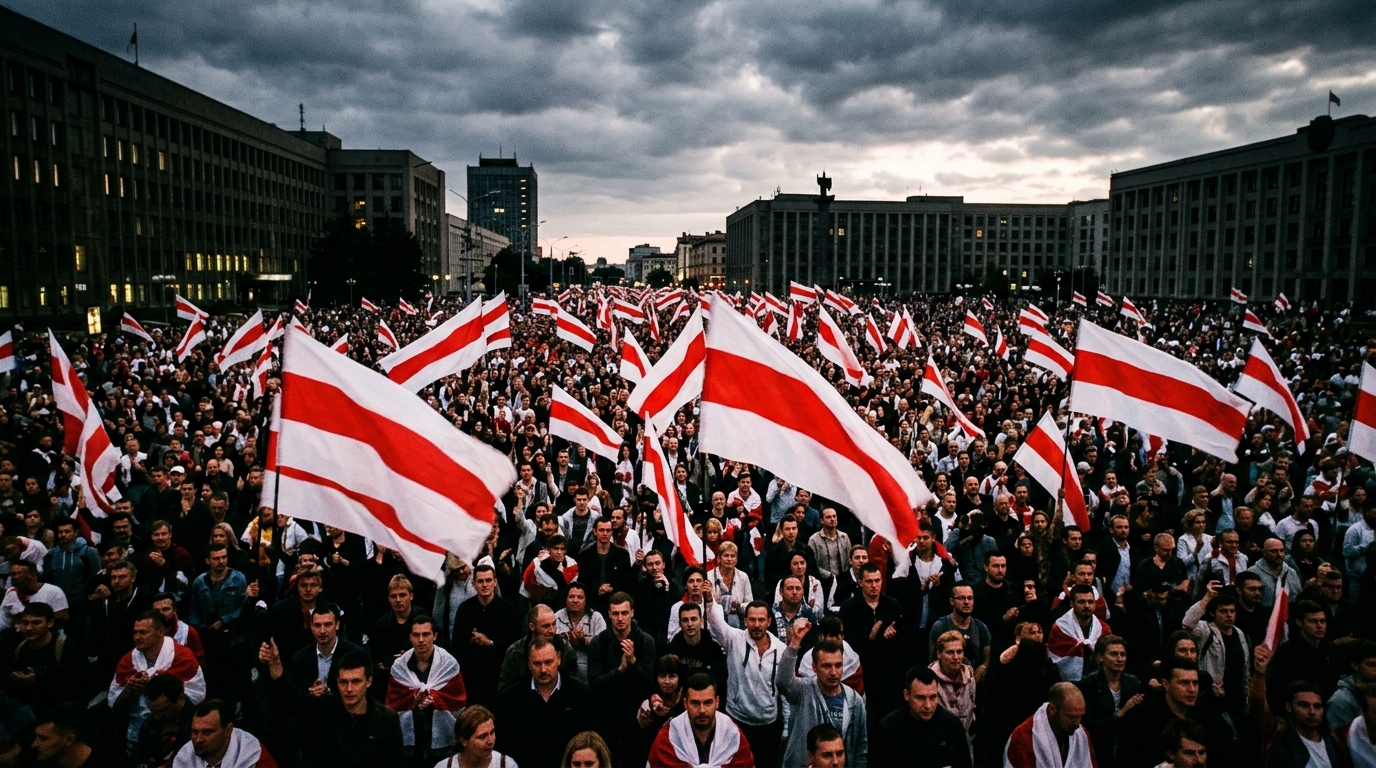
| August 16, 2020 | "March of Freedom" | The largest demonstration in Belarusian history, with estimated hundreds of thousands in attendance in Minsk alone, alongside massive rallies in other cities. This showcased the scale of popular discontent and directly challenged Lukashenko's claim to legitimacy. |
| August 19, 2020 | Coordination Council Formed | The opposition establishes the Coordination Council, aiming to facilitate a peaceful transfer of power. Its members are swiftly targeted by the state, with arrests and forced exiles. |
| August 27, 2020 | Putin's "Reserve Force" | Russian President Vladimir Putin announces that a "reserve police force" is on standby, ready to assist Minsk if the situation "gets out of control." This serves as a clear signal of Russian support and a warning to both the opposition and the West. |
| September 23, 2020 | Secret Inauguration | Lukashenko holds a surprise, unannounced inauguration ceremony, further delegitimizing his rule in the eyes of protesters and international observers. The secrecy underscored the lack of public support. |
| Late 2020 - Early 2021 | Continued Repression & Exodus | Weekly protests gradually diminish under sustained state violence. Thousands of activists, journalists, and IT specialists flee the country, signaling a deep chill in civil society and a 'brain drain.' |
| May 23, 2021 | Ryanair Flight Diversion | Belarusian authorities force Ryanair Flight 4978 to land in Minsk under false pretenses, arresting dissident journalist Roman Protasevich. This act, condemned as "state piracy," significantly deepens Belarus's international isolation and triggers new Western sanctions. |
The "March of Freedom" represented the zenith of the opposition's momentum, demonstrating unprecedented popular unity and a profound desire for change. Yet, the subsequent weeks and months revealed that while the protest movement possessed immense moral authority and sheer numbers, it lacked the organizational capacity, a unified political leadership (partly due to forced exile and arrests), and crucially, the ability to force a change in the security sector's loyalty, which remained the regime's bedrock.
Analysis of Key Actors and Decisive Actions
The survival of the Lukashenko regime was not a matter of popular mandate, but of its structural resilience, strategic ruthlessness, and the decisive external backing from Moscow.
The Security Apparatus and the "Siloviki"
The decisive factor in the regime's survival was the unwavering loyalty and brutal efficiency of the siloviki—a term encompassing the leadership and members of the KGB (State Security Committee), the Ministry of Internal Affairs (which controls police and internal troops), and the OMON (Special Purpose Police Units). Lukashenko, himself a former state farm director with a background valuing order and control, had meticulously cultivated this apparatus for decades.
- Institutional Culture: The Belarusian security forces are not merely an enforcement arm; they are a deeply entrenched political class, enjoying significant privileges, generous salaries, state-provided housing, and immunity from prosecution. Their loyalty is ensured through a combination of fear (of losing privileges or facing consequences for disloyalty), ideological indoctrination (portraying Lukashenko as the guarantor of stability against Western plots), and a pervasive network of patronage.
- Brutal Response: In the days following the election, the government unleashed a campaign of systemic violence unprecedented in modern European history. Protesters faced rubber bullets, stun grenades, tear gas, water cannons, and direct physical assault. Thousands were arbitrarily detained in overcrowded and unsanitary facilities like the infamous Okrestina detention center, where testimonies of torture, beatings, sleep deprivation, and psychological abuse became commonplace. This deliberate strategy of terror aimed to break the will of the protesters through sheer, overwhelming force, demonstrating that the state was prepared to go to any length to maintain power.
- Centralized Control: Unlike some other post-Soviet states where splits within the security forces might occur, Belarus's siloviki remained remarkably unified under Lukashenko's direct command. This centralization of power prevented any significant defections or internal challenges, ensuring that the state's coercive apparatus remained firmly under his absolute control. The regime correctly assessed that as long as the siloviki held, the popular movement, however large, could not prevail.
The Role of Moscow and the Geopolitical Chessboard
As Western nations swiftly condemned the election fraud, imposed targeted sanctions, and expressed solidarity with the opposition, Alexander Lukashenko found his traditional "multi-vector" foreign policy strategy—balancing relations between the EU and Russia—untenable. He turned decisively toward the Kremlin. Vladimir Putin, observing the unfolding events with keen concern, saw an existential threat:
- "Color Revolution" Precedent: Putin views popular, pro-democracy movements in post-Soviet states as Western-backed "Color Revolutions" aimed at undermining Russian influence and encircling Russia with hostile states. The possibility of a successful, pro-Western uprising in Belarus, a crucial buffer state and strategic ally, was unacceptable to the Kremlin.
- Comprehensive Rescue Package: Russia provided a multifaceted and timely intervention:
By offering this comprehensive package of support, Russia not only saved Lukashenko's regime from collapse but also accelerated Belarus's strategic integration into the Union State framework, solidifying its position as Moscow's closest military and political ally on its western flank. The crisis effectively ended Belarus's precarious balancing act and cemented its geopolitical orientation firmly eastward.
International Condemnation and the Diplomacy of Isolation
The 2020 Belarusian protests and the subsequent state crackdown provoked widespread international condemnation, particularly from Western democracies. However, the responses varied in their intensity and effectiveness, contributing to Belarus's increasing diplomatic isolation from the West while deepening its reliance on Russia.
European Union Response
The European Union, geographically closest to Belarus and with significant interests in regional stability, reacted strongly.
- Initial Condemnation: EU leaders swiftly condemned the election as neither free nor fair, refused to recognize Lukashenko's legitimacy, and called for new elections.
- Sanctions Regimes: The EU implemented several rounds of targeted sanctions against Belarusian officials, including Lukashenko himself, and entities deemed responsible for electoral fraud, human rights abuses, and the suppression of civil society. These sanctions included travel bans, asset freezes, and restrictions on financial transactions.
- Civil Society Support: The EU redirected funding away from the Belarusian government towards civil society organizations, independent media, and support for victims of repression and their families.
- Diplomatic Stalemate: Diplomatic dialogue between Brussels and Minsk largely ceased. The forced diversion of Ryanair Flight 4978 in May 2021, a brazen act of "state piracy" to arrest dissident journalist Roman Protasevich, marked a nadir in relations, prompting the EU to ban Belarusian airlines from its airspace and impose further sectoral sanctions.
United States Response
The United States likewise condemned the fraudulent election and the subsequent violence.
- Sanctions and Non-Recognition: The US joined the EU in imposing sanctions on key Belarusian officials and state-owned enterprises. It also refused to recognize Lukashenko as the legitimate president of Belarus.
- Rhetorical Support: US officials consistently expressed solidarity with the Belarusian democratic movement, advocating for human rights and political freedoms.
- Limited Leverage: While strongly condemning the regime, the US's direct leverage over Minsk was somewhat limited compared to Russia's, given the deep historical and economic ties between Belarus and its eastern neighbor.
International Organizations and Human Rights Bodies
Organizations like the Organization for Security and Co-operation in Europe (OSCE) and the United Nations High Commissioner for Human Rights (OHCHR) played crucial roles in documenting abuses and advocating for accountability.
- OSCE Moscow Mechanism: Under the OSCE's "Moscow Mechanism," a report was commissioned by 17 participating states, which concluded that the 2020 election was fraudulent and that human rights violations were "massive and systemic."
- UN Condemnation: UN bodies repeatedly expressed grave concern over the human rights situation, calling for investigations into alleged torture and arbitrary detentions.
- Council of Europe: Belarus's already strained relationship with the Council of Europe (of which it is not a member) deteriorated further, with stronger calls for democratic reforms.
Despite this concerted international pressure, the sanctions and diplomatic isolation, while impactful, ultimately proved insufficient to dislodge Lukashenko, primarily due to Moscow's unwavering political and material support. The West's inability to prevent the crackdown underscored the limitations of its "soft power" and economic sanctions against a regime willing to rely on brute force and backed by a powerful geopolitical patron.
Geopolitical Consequences and Aftermath
The 2020 crisis fundamentally altered the trajectory of Eastern European geopolitics, consolidating Belarus's authoritarian turn and cementing its role as a key Russian strategic asset.
- Accelerated Integration of the Union State: The crisis effectively ended the era of "multi-vector" diplomacy, where Belarus attempted to balance its relations between the EU and Russia for strategic and economic benefit. Today, Belarus is more closely integrated with Russia militarily, economically, and diplomatically than at any point since the fall of the Soviet Union. This includes increased joint military exercises, the deployment of Russian military assets within Belarus, deeper economic dependence through loans and energy subsidies, and a near-complete alignment of foreign policy. The prospect of a full "Union State" integration, long a point of contention for Lukashenko who valued his nominal sovereignty, became a more immediate and less resistible reality, solidifying Belarus's position as a Russian strategic outpost.
- Profound European Alienation: The crackdown, the systematic dismantling of civil society, and specific incidents like the Ryanair flight diversion fundamentally severed Belarus's remaining ties with the West. Diplomatic dialogue programs between Minsk and Brussels were suspended, high-level contacts ceased, and Belarus became a pariah state in the eyes of most democratic nations. This alienation has broad implications, including stifled economic development, limited access to Western markets and technology, and the perpetuation of an authoritarian political model.
- Dismantling of Civil Society and Human Rights Crisis: The period following the protests saw a systematic and brutal purge of civil society. Thousands of NGOs, independent media outlets, human rights organizations, and cultural institutions were forcibly closed or declared "extremist." Journalists, activists, lawyers, and human rights defenders were arrested, imprisoned, or forced into exile. This created a climate of fear and political atomization, effectively stifling any organized domestic opposition for the foreseeable future. The human rights situation in Belarus deteriorated catastrophically, drawing comparisons to the darkest periods of Soviet repression.
- Emigration and Brain Drain: The intense repression triggered a significant exodus of Belarusian citizens, including thousands of highly skilled IT professionals, academics, artists, and political activists. This "brain drain" represents a long-term loss for Belarus's economic and intellectual capital, further entrenching the current regime and hindering any future democratic transition.
"The Belarusian protests proved that in the contemporary era, a determined security apparatus, backed by a strong regional hegemon, can neutralize even the most widespread and peaceful mass movements, demonstrating a grim playbook for authoritarian survival in the post-Soviet space." — Diplomatic Assessment, 2021
Trivia and Lesser-Known Facts
- The "Belarusian flag" symbolism: The protests popularized the white-red-white flag, which served as the official flag of the Belarusian Democratic Republic in 1918 and was briefly restored after the collapse of the Soviet Union. Its widespread use became a direct symbol of defiance against the state-sanctioned red-green flag, which is largely associated with Lukashenko's regime and its Soviet-era aesthetics.
- The Role of Telegram: The Telegram channel Nexta (meaning "someone" in Belarusian), operated by exiles, served as the primary and most vital communication hub for protesters. Its ability to quickly disseminate information, organize demonstrations, and expose state brutality bypassed traditional state-controlled media. The government's inability to fully censor digital communication led to a massive expansion of the state’s cybersecurity and surveillance capabilities, along with attempts to declare such channels "extremist."
- Symbolic Solidarity and "Women in White": A notable and impactful feature of the early protests was the "Women in White" movement. Thousands of women, dressed predominantly in white, formed human chains, carrying flowers, and refusing to engage with the violence of the riot police. This tactic sought to highlight the peaceful nature of the protests and minimize the regime’s ability to justify its brutal use of force, garnering significant international attention and sympathy.
- The 'Chain of Repentance': In a stark display of intimidation, some state-controlled media outlets featured videos of detained protesters, visibly bruised and coerced, "confessing" to their involvement and denouncing the opposition. These "chains of repentance" were widely condemned as blatant psychological warfare and a violation of human rights.
- Lukashenko's Son and Succession: During the height of the protests, Lukashenko appeared publicly with his then 15-year-old son, Nikolai, both holding automatic rifles. This highly choreographed display was interpreted as a signal of his resolve to fight to the end and, for some, as a morbid hint at a potential dynastic succession.
- Cultural Resistance: Beyond street protests, artists, musicians, and actors engaged in various forms of cultural resistance, from spontaneous concerts in courtyards to theatrical performances that subtly (or overtly) critiqued the regime, becoming key avenues for expressing dissent when public gatherings became too dangerous.
References and Literature
- The Belarus Crisis: A Historical Analysis - A detailed analysis of the structural weaknesses of the Lukashenko model and the geopolitical implications of the 2020 events.
- Silitsky, Vitali; Zaremba, Jan. "The History of the Belarusian State" - A seminal work detailing the evolution of Belarusian authoritarianism and the intermittent struggles of civil society against it.
- OSCE Report on the 2020 Belarusian Election and Human Rights Violations - The official documentation by the OSCE Office for Democratic Institutions and Human Rights outlining widespread electoral irregularities and subsequent systemic human rights violations.
- Amnesty International Reports on Belarus - Ongoing documentation of human rights abuses, arbitrary arrests, torture, and the crackdown on civil society in Belarus.
- Wilson, Andrew. "Belarus: The Last European Dictatorship." - A comprehensive academic study providing deep historical and political context to Lukashenko's rule and the societal forces at play.
Footnotes & Explanations
- Historical analysis of the 1994 transition shows the foundational roots of current executive power and Lukashenko's deliberate dismantling of checks and balances. ↩
- The reliance on state-owned enterprises was a key economic stabilizer that became a source of stagnation and ultimately contributed to public discontent during the 2020 economic downturn. ↩