Key Takeaways
- The 2016 coup attempt signaled a definitive end to the era of military interventionism in Turkish politics, fundamentally altering the nation's civil-military relations and consolidating civilian control over the armed forces.
- President Erdogan’s innovative use of digital media, particularly a FaceTime broadcast, to mobilize the public proved that modern communication technology can bypass traditional institutional power centers and sway popular opinion during critical moments.
- The massive post-coup purges catalyzed Turkey’s transition toward an executive presidency, reshaped its judiciary and bureaucracy, and severely strained its long-standing alliance with Western democratic institutions, leading to a more independent and assertive foreign policy.
- The event exposed significant intelligence failures within Turkey's security apparatus and deepened societal divisions, with profound socio-economic and human rights implications for thousands of citizens.
Historical Context and Origins
To understand the tumultuous night of July 15, 2016, one must appreciate the long, fraught history of civil-military relations in the Turkish Republic, a dynamic steeped in the legacy of its founder, Mustafa Kemal Atatürk. Since the foundation of the state in 1923, the Turkish military had perceived itself as the ultimate guardian of secularism, national unity, and the state's founding ideology—a rigid interpretation of "Kemalism" that prioritized a secular, Western-oriented, and unitary state. This self-appointed role, enshrined in an unwritten social contract and historically reinforced by a strong military presence within state institutions, gave the Turkish Armed Forces (TSK) an almost supra-constitutional authority.
This guardianship role was not merely theoretical. Between 1960 and 2005, the Turkish military staged four successful coups or "memoranda" interventions to oust governments deemed too Islamist, too inefficient, or a threat to the Kemalist principles. The 1960 coup, following widespread social unrest, saw the execution of Prime Minister Adnan Menderes. The "coup by memorandum" in 1971 intervened in a period of political instability. The 1980 coup, the most brutal, led to widespread arrests and executions, profoundly reshaping the political landscape. Finally, the "postmodern coup" of 1997 forced the resignation of the Welfare Party-led government, seen as too Islamist. Each intervention served to reassert the military's dominance and its commitment to the secular order, making it a powerful, often feared, and largely unquestionable actor in Turkish politics.
However, the rise of the Justice and Development Party (AKP) in 2002 initiated a slow, methodical erosion of the military’s political influence. Under Recep Tayyip Erdogan, the AKP, a religiously conservative party with roots in political Islam, gradually implemented reforms aimed at strengthening civilian control. Initially, these reforms were framed as part of Turkey's bid for European Union membership, garnering international support. Key steps included parliamentary oversight of military spending, reduction of the military's representation on the National Security Council (MGK), and changes to the legal framework that insulated military officers from civilian prosecution.
A pivotal period in this process was the infamous Ergenekon and Balyoz (Sledgehammer) trials in the late 2000s and early 2010s. These controversial trials, launched with significant public and judicial support, targeted hundreds of high-ranking military officers, journalists, academics, and politicians, accusing them of plotting to overthrow the AKP government. While later widely seen as flawed and potentially fabricated, these trials—initially aided by the Gulenist network which sought to undermine its own rivals within the state—systematically purged or imprisoned officers suspected of harboring anti-government or Kemalist sentiments. This period effectively broke the military's back as an independent political force, drastically diminishing its capacity for intervention and altering the civil-military balance of power fundamentally.
By 2016, a deep fissure had formed within the security establishment, complicated by the shifting alliances of power. The alliance between Erdogan and the Gulen movement, a transnational Islamic network led by cleric Fethullah Gulen, which had once been the primary vehicle for dismantling military hegemony and prosecuting its secularist elements, had shattered into a bitter rivalry. This rupture began around 2013-2014, when the Gulenists, having deeply infiltrated the police and judiciary during their alliance with the AKP, allegedly launched corruption investigations targeting Erdogan's inner circle. What followed was a full-blown power struggle, with Erdogan now branding the Gulen movement a "parallel state" and a terrorist organization (FETO). When the "Peace at Home Council"—the self-appointed name of the junta—launched its operation, it was not merely an attempt to take power; it was a desperate gamble by a faction, allegedly comprising Gulenist sympathizers and other disgruntled officers, who believed their complete obsolescence within the state hierarchy was imminent. This backdrop of historical military interventions, the AKP's long game to neutralize military influence, and the bitter internal struggle with the Gulenists set the stage for the dramatic events of July 15.
Timeline of Events and Key Moments
The coup attempt unfolded with a rapid sequence of events that stunned the international community and plunged Turkey into an unprecedented night of chaos and uncertainty. What began with unusual troop movements quickly escalated into a full-blown military insurrection.
| Time (UTC+3) | Key Event | Description and Significance |
|---|
Historical Context and Origins
To comprehend the tumultuous night of July 15, 2016, one must first appreciate the long, fraught, and often violent history of civil-military relations in the Turkish Republic, a dynamic steeped in the legacy of its founder, Mustafa Kemal Atatürk. Since the foundation of the modern Turkish state in 1923, the Turkish military, or Türk Silahlı Kuvvetleri (TSK), had perceived itself not merely as a defense force, but as the ultimate, indispensable guardian of secularism, national unity, and the state's founding ideology—a rigid interpretation of "Kemalism." This doctrine prioritized a secular, Western-oriented, modern, and unitary state, often viewing itself as above the fray of day-to-day politics, yet simultaneously holding the final say on the nation's trajectory. This self-appointed role, reinforced by a strong military presence within key state institutions and an unwritten social contract, granted the TSK an almost supra-constitutional authority.
This guardianship role was far from theoretical. It manifested in a series of direct interventions that fundamentally altered the course of Turkish democracy. Between 1960 and 1997, the Turkish military staged four successful coups or "memoranda" interventions, each designed to "restore order" or "protect Kemalist principles" from governments deemed too Islamist, too inefficient, or a threat to the Republic's foundational tenets.
- The 1960 Coup: Following widespread social unrest and accusations of authoritarianism against the Democrat Party (DP) government, the military intervened, leading to the trial and execution of Prime Minister Adnan Menderes and several cabinet members. This event cemented the military's role as the ultimate arbiter of Turkish politics.
- The 1971 "Coup by Memorandum": Amidst economic crises and political polarization, the military issued an ultimatum (memorandum) to the government, forcing the resignation of Prime Minister Süleyman Demirel without directly seizing power, but demonstrating its decisive influence.
- The 1980 Coup: This was the most comprehensive and brutal intervention. With Turkey on the brink of civil war due to intense left-right political violence, General Kenan Evren led a takeover that suspended the constitution, dissolved political parties, arrested hundreds of thousands, and executed dozens. This coup profoundly reshaped the political landscape, ushering in a new constitution that increased military influence.
- The 1997 "Postmodern Coup": This less direct but equally effective intervention saw the military issue a stern memorandum and launch a public campaign against the Welfare Party (Refah Partisi)-led government of Necmettin Erbakan, seen as too Islamist. The pressure eventually forced Erbakan's resignation and led to the closure of his party, a clear demonstration of the military's continued power to shape political outcomes.
Each intervention served to reassert the military's dominance and its commitment to the secular order, making it a powerful, often feared, and largely unquestionable actor in Turkish politics, a critical guarantor against perceived threats to the republic.
However, the rise of the Justice and Development Party (AKP) in 2002, led by Recep Tayyip Erdogan, initiated a slow, methodical, and ultimately successful erosion of the military’s political influence. The AKP, a religiously conservative party with roots in political Islam, understood the historical impediment the military posed to its agenda. Initially, these reforms were shrewdly framed as part of Turkey's bid for European Union membership, cleverly garnering crucial international support and masking deeper domestic power plays. Key steps included:
- Judicial Reforms: Laws were passed to allow civilian courts to try military personnel for offenses committed outside of military duties, significantly undermining their legal immunity.
- National Security Council (MGK) Restructuring: The MGK, historically dominated by generals, was reformed to increase civilian representation and reduce its decision-making power, transforming its recommendations from binding directives into mere advisory opinions.
- Budgetary Oversight: Civilian parliamentary oversight of military spending was strengthened, reducing the TSK's financial autonomy.
A pivotal and highly controversial period in this process was the infamous Ergenekon and Balyoz (Sledgehammer) trials in the late 2000s and early 2010s. These extensive trials targeted hundreds of high-ranking military officers, journalists, academics, and opposition figures, accusing them of plotting to overthrow the AKP government. While later widely seen as flawed, politically motivated, and potentially based on fabricated evidence, these trials—initially aided by the Gulenist network which sought to undermine its own rivals within the state—systematically purged or imprisoned officers suspected of harboring anti-government or Kemalist sentiments. This period effectively broke the military's back as an independent political force, drastically diminishing its capacity for intervention and altering the civil-military balance of power fundamentally in favor of the civilian government.
By 2016, a deep fissure had formed within the security establishment, complicated by the shifting alliances of power. The formidable alliance between Erdogan and the Gulen movement—a transnational Islamic network led by cleric Fethullah Gulen, then living in self-imposed exile in Pennsylvania, USA—which had once been the primary vehicle for dismantling military hegemony and prosecuting its secularist elements, had shattered into a bitter rivalry. This rupture began around 2013-2014, when the Gulenists, having deeply infiltrated the police, judiciary, and bureaucracy during their alliance with the AKP, allegedly launched corruption investigations targeting Erdogan's inner circle. What followed was a full-blown power struggle, with Erdogan now branding the Gulen movement a "parallel state" and a terrorist organization (FETO). The government launched a counter-purge, dismissing Gulenist sympathizers from state institutions.
It was against this backdrop of historical military interventions, the AKP's long game to neutralize military influence, and the bitter internal struggle with the Gulenists that the "Peace at Home Council"—the self-appointed name of the junta—launched its operation. This was not merely an attempt to take power; it was a desperate gamble by a faction, allegedly comprising Gulenist sympathizers and other disgruntled officers, who believed their complete obsolescence within the state hierarchy was imminent. For these plotters, the coup was perhaps a final, desperate attempt to reclaim a perceived lost influence, protect what they saw as the Republic's threatened secular foundations, or preempt further purges. This confluence of factors set the stage for the dramatic and fateful events of July 15.
Timeline of Events and Key Moments
The coup attempt unfolded with a rapid sequence of events that stunned the international community and plunged Turkey into an unprecedented night of chaos and uncertainty. What began with unusual troop movements quickly escalated into a full-blown military insurrection.
| Time (UTC+3) | Key Event | Description and Significance |
|---|
The 2016 Coup Attempt: A Night of Fury and Defiance
The night of July 15, 2016, began with an eerie sense of unease that rapidly escalated into outright panic and confusion across Turkey. At approximately 9:00 PM (UTC+3), residents of Istanbul and Ankara reported unusual military movements. In Istanbul, units of the Gendarmerie and infantry closed the Bosphorus bridges, crucial arteries connecting the European and Asian sides of the city, causing immediate traffic chaos. Simultaneously, low-flying fighter jets and military helicopters were heard over the capital, Ankara, their presence signaling a serious, unprecedented breach of security. These initial actions were the first tremors of a coordinated attempt to seize power.
Within hours, the situation crystallized. Around 11:00 PM, soldiers stormed the headquarters of the state broadcaster, TRT, taking it off air. Soon after, a female anchor, under duress, was forced to read a statement on air, announcing that the "Peace at Home Council" had seized control of the country. The statement declared martial law, imposed a curfew, and stated that the military was acting "to restore democracy and human rights" from an "increasingly authoritarian" government. This broadcast aimed to create an impression of a successful takeover, a tactic used in previous coups. However, unlike earlier interventions, this broadcast was quickly interrupted, signaling the plotters' failure to secure full control over crucial media infrastructure.
The government's initial response was marked by confusion and a scramble for communication. President Erdogan was vacationing in Marmaris, on Turkey's Aegean coast. Prime Minister Binali Yıldırım was the first senior official to publicly denounce the actions as an "illegal attempt" by a faction within the military, emphasizing that the government remained in charge. However, the lack of immediate, clear communication from the President fueled speculation and fear.
The Turning Point: The FaceTime Call
The most decisive moment of the night, which arguably swung the tide against the coup plotters, occurred shortly after midnight. At approximately 00:26 AM, President Erdogan, recognizing that state media had been compromised and traditional communication channels were either seized or unreliable, made an impromptu video call to Hande Fırat, a news anchor on the private CNN Turk channel. Using a reporter's smartphone and a FaceTime connection, Erdogan appeared on national television, his image broadcast live via the journalist's phone. This imagery was iconic and unprecedented: a modern leader, physically displaced and seemingly vulnerable, utilizing consumer technology to broadcast a message of defiance to his nation.
In his emotional address, Erdogan condemned the coup attempt as an "act of treason," urged citizens to take to the streets and squares to resist the plotters, and declared that he was returning to Ankara. This direct appeal to the populace, bypassing traditional institutional power centers and leveraging the ubiquity of digital media, catalyzed a profound shift in public perception. It demonstrated that the elected government was not overthrown and that the president was alive and fighting. It emboldened millions of Turks, loyal to Erdogan and the democratic process, to ignore the military's imposed curfew and physically confront armored vehicles and soldiers.
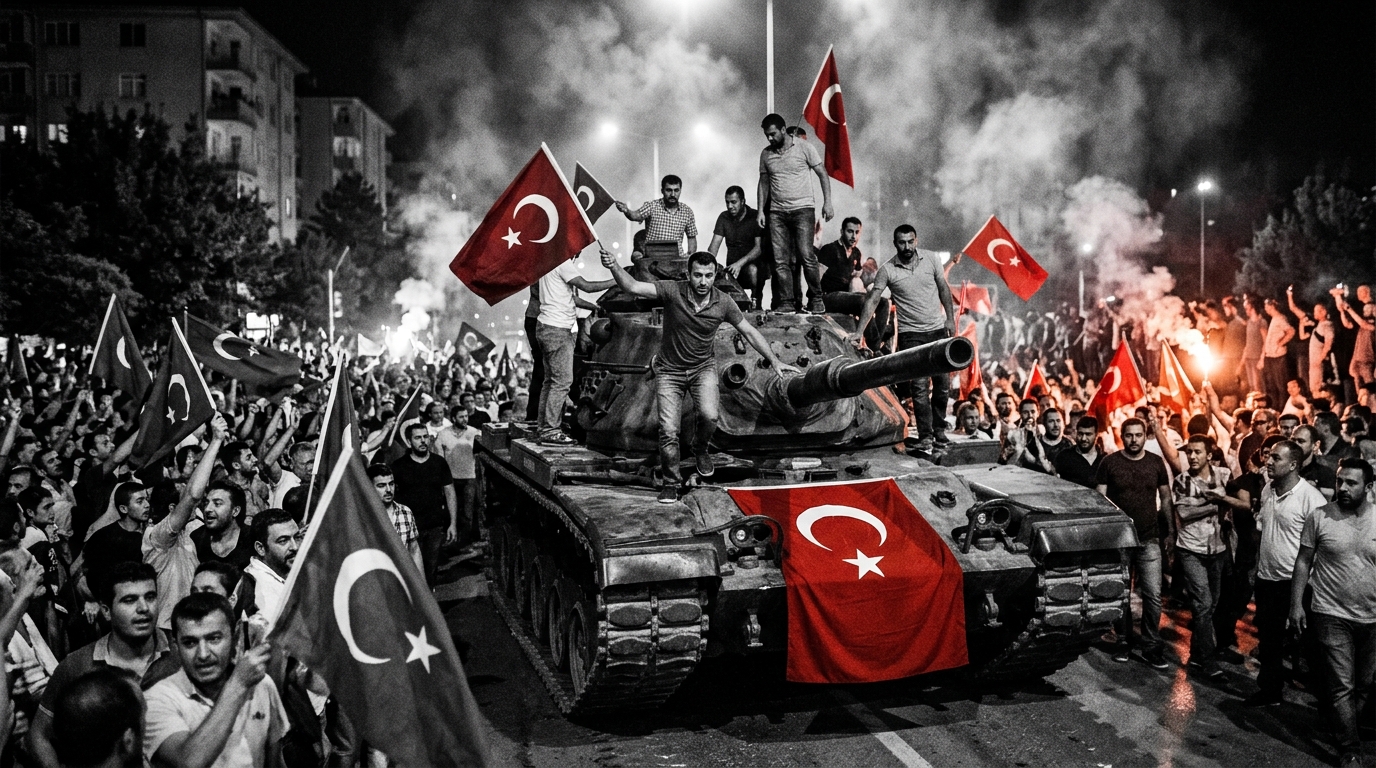
As the night progressed, ordinary citizens, inspired by Erdogan's call and deeply mistrustful of military intervention after decades of coups, began pouring into the streets. They climbed onto tanks, blocked roads, and confronted armed soldiers. This mass mobilization was a critical, often overlooked, factor.
- 02:00 AM: Protesters began actively confronting tanks and soldiers in Istanbul and Ankara. Police forces loyal to the government, having been largely purged of Gulenist elements in previous years, fiercely resisted putschist units, often outgunning or outmaneuvering them.
- 04:00 AM: The Parliament building in Ankara became a target, suffering multiple aerial bombings from coup-affiliated F-16 jets. Despite significant damage and civilian casualties, the building remained largely under government control, symbolizing the resilience of democratic institutions. Simultaneously, special police forces and loyal military units began to push back effectively, securing key government ministries and police headquarters.
- 06:00 AM: The tide definitively turned. Remaining coup leaders, facing overwhelming civilian resistance, coordinated police and military action, and dwindling support, began to surrender. The state quickly regained control of major infrastructure, including airports, bridges, and media outlets. President Erdogan landed safely at Istanbul Atatürk Airport, where he was greeted by jubilant crowds, further solidifying his victory.
The sheer scale of public resistance, the rapid and coordinated response by loyal security forces, and the plotters' failure to neutralize key political figures or secure crucial communication channels in the early hours ultimately sealed the fate of the coup attempt. The night of July 15, 2016, ended not with a military takeover, but with a resounding affirmation of civilian rule, albeit one that would profoundly reshape Turkey's political landscape.
Geopolitical Consequences and Aftermath
The immediate aftermath of the failed coup was characterized by an environment of extreme national trauma, quickly followed by a state of emergency that lasted for two years (July 2016 – July 2018). This period enabled the government to implement sweeping measures to consolidate power and redefine Turkey's domestic and international trajectory.
Domestic Consolidation and the Executive Presidency
The failed coup provided the AKP government with unprecedented political capital to fundamentally overhaul the Turkish constitution and state apparatus. President Erdogan framed the attempt as an existential threat from a "parallel state" and an act of foreign-backed subversion, justifying a massive crackdown.
- Mass Purges: Under the state of emergency, an estimated 150,000 civil servants, judges, prosecutors, police officers, military personnel, academics, and journalists were dismissed or suspended from their positions. Over 77,000 people were arrested, many on charges of being members of FETO or having links to the coup. These purges drastically reshaped the bureaucracy, judiciary, education system, and media landscape, removing perceived opponents and replacing them with loyalists.
- Constitutional Referendum: The most significant institutional consequence was the constitutional referendum held in April 2017. Narrowly approved by 51.4% of voters, this referendum paved the way for Turkey's transition from a parliamentary system to an executive presidential system. This reform, effective after the 2018 general elections, centralized vast authority under the President, abolishing the office of the Prime Minister, allowing the President to issue decrees with the force of law, appoint judges, and control the bureaucracy, effectively removing many of the traditional institutional checks and balances that had existed for decades. Critics argued this move pushed Turkey further towards authoritarianism, while supporters claimed it created a more stable and efficient government.
International Relations and Geopolitical Realignment
The 2016 coup attempt led to a profound and lasting cooling of relations between Ankara and its long-standing Western allies, particularly the United States and European Union member states.
- Strained Relations with the US: The Turkish government vehemently criticized the United States for the continued presence of Fethullah Gulen in Pennsylvania, demanding his extradition. Washington, citing legal requirements and a lack of sufficient evidence, resisted, leading to a deepening sense of betrayal and resentment in Ankara. This dispute became a persistent irritant, undermining trust and cooperation on various geopolitical fronts.
- Deterioration of EU Relations: European leaders' initial condemnations of the coup were often tempered by expressions of concern over the scale of the purges and human rights abuses that followed. This perceived "lukewarm" support, coupled with the executive presidency reforms, led to a significant deterioration of Turkey's already faltering EU accession process. Ankara, in turn, accused European nations of hypocrisy and harboring terrorists.
- Pivot to the East and Strategic Autonomy: Feeling alienated and betrayed by the West, Turkey’s foreign policy shifted dramatically. Ankara adopted a more assertive, independent foreign policy, often described as "Neo-Ottomanism" or a pursuit of "strategic autonomy." This involved:
In essence, the 2016 coup attempt did not just reshape Turkey internally; it fundamentally altered its position in the international system, accelerating a trajectory towards greater independence, but also increasing its isolation from traditional Western partners and complicating global efforts on issues ranging from security to human rights.
Analysis of Key Actors and Decisive Actions
The failure of the 2016 coup attempt can be attributed to the interplay of several key actors and their decisive actions throughout that chaotic night.
- Recep Tayyip Erdogan: President Erdogan's leadership during the crisis was paramount. Physically displaced in Marmaris, his ability to project strength and defiance while appearing on a smartphone screen demonstrated a keen understanding of modern communication and the power of populist appeal. By successfully framing the coup as an existential threat to the "national will" and an attack on democracy itself, he solidified his base and galvanized millions. His immediate return to Istanbul, despite security risks, projected an image of a resolute leader in control, contrasting sharply with the plotters' inability to secure their grip on power or communicate a coherent message. His charismatic appeal, cultivated over years, allowed him to mobilize a deeply loyal segment of the population, turning a military crisis into a populist uprising for democratic legitimacy.
- The Gulenist Network (FETO): The Turkish government’s designation of the Fethullah Gulen movement as the 'Fethullahist Terrorist Organization' (FETO) and its primary instigator of the coup attempt became the central narrative for the largest purge in the history of the Turkish Republic. While Gulen himself denied any involvement, the government presented extensive evidence, including testimonies and intelligence reports, suggesting a clandestine network operating within state institutions for decades, aiming to seize control. According to this narrative, Gulenist officers within the military, fearing imminent purges by the AKP government, acted preemptively. The alleged hierarchical structure and secrecy of the network meant that even sympathetic elements within the military who were not direct members could be leveraged or misled. The trials that followed the coup attempt saw thousands accused of being FETO members, dismantling what the government called a "parallel state structure" and providing the legal and ideological justification for the sweeping purges.
- The Turkish Public: The ordinary citizen played a role often overlooked in traditional military coup literature, making the 2016 event unique. The willingness of the populace to heed President Erdogan's call, to literally face down tanks and armed soldiers at great personal risk, marked a profound shift in the "social contract." This wasn't merely a passive acceptance of government authority; it was an active, physical defense of it. Millions poured into the streets, standing in front of armored vehicles, climbing onto tanks, and confronting soldiers at strategic locations like the Bosphorus bridges and Atatürk Airport. This mass mobilization, driven by a mix of loyalty to Erdogan, fervent nationalism, and a deep-seated rejection of military interventions, proved to be the ultimate arbiter of power. The images of unarmed civilians blocking military convoys, enduring gunfire, and defying curfews became powerful symbols of democratic resilience, underscoring that in modern Turkey, public engagement, rather than just institutional power, could determine the fate of a government. The sacrifices of these citizens, with 251 losing their lives, transformed the event into a national narrative of democratic victory against an insidious, traitorous plot.
Intelligence Failures and Missed Warnings
The 2016 coup attempt also brought to light significant intelligence failures and a controversial debate regarding missed warnings within Turkey’s formidable security apparatus. For a country with a history of military interventions and a highly centralized intelligence agency (MIT - National Intelligence Organization), the fact that a faction within its own military could orchestrate such an extensive plot came as a shock.
Reports indicate that information regarding unusual military movements and potential coup preparations began to surface hours before the main events unfolded.
- Pre-Coup Intelligence: On the afternoon of July 15, around 2:00 PM, a military major reportedly walked into the MIT headquarters in Ankara, claiming that a general was about to launch a military operation. This initial warning triggered a flurry of activity, but its full significance was not immediately grasped.
- MIT's Response: MIT chief Hakan Fidan reportedly met with Chief of General Staff Hulusi Akar following this tip-off. Initial assessments seemed to downplay the threat, interpreting it as a potential abduction attempt rather than a full-scale coup. Orders were issued to ground all military aircraft and close Turkish airspace to military flights, and all military units were put on alert. However, these measures proved insufficient to deter or neutralize the plotters, who had already set their plans in motion.
- Failure of Coordination: Critics argue that there was a critical failure in coordination and information sharing between MIT, the General Staff, and the Interior Ministry. The fragmented nature of Turkey’s intelligence community, with multiple agencies often working in silos or even in rivalry, may have contributed to the inability to piece together disparate pieces of intelligence into a clear, actionable picture.
- The Gulenist Infiltration Debate: The government's narrative strongly attributes the intelligence failure to the deep infiltration of state institutions, including MIT and the military, by the Gulenist network. According to this view, Gulenist sympathizers within these agencies actively suppressed or manipulated intelligence to facilitate the coup attempt, or at the very least, prevented loyalists from fully understanding the scale of the threat. This argument, while providing a convenient explanation for the government, also highlighted severe vulnerabilities within Turkey's national security framework.
- Aftermath and Reforms: In the wake of the coup, a significant restructuring of Turkey's intelligence and security architecture took place. MIT's authority was expanded, and new legislation aimed to improve inter-agency coordination. However, the exact extent of foreknowledge by top government officials and the precise reasons for the intelligence failures remain subjects of intense debate and conspiracy theories, with some critics even suggesting that elements within the government allowed the coup to progress to use it as a pretext for a broader crackdown. The fact that President Erdogan was reportedly alerted relatively late, while on vacation, further complicated the narrative and fueled questions about the efficacy and loyalty of his own intelligence chiefs.
The intelligence failures underscore the chaotic nature of the night, but also reveal deep-seated structural issues and internal divisions within Turkey's powerful security and intelligence organizations, making them highly susceptible to internal subversion.
Socio-Economic Aftermath and Human Rights Concerns
Beyond the immediate political and geopolitical shifts, the 2016 coup attempt and its aftermath profoundly impacted Turkish society, leading to significant socio-economic changes and raising widespread human rights concerns. The two-year state of emergency enacted post-coup became the legal framework for a sweeping campaign against perceived enemies of the state.
Purges and Societal Impact:
The scale of the purges was unprecedented in modern Turkish history, affecting nearly every sector of public and private life:
- Education: Tens of thousands of teachers, university professors, and educational administrators were dismissed, and hundreds of private schools and universities (many Gulen-affiliated) were shut down. This had a chilling effect on academic freedom and led to a "brain drain" as many intellectuals sought opportunities abroad.
- Judiciary and Legal System: Approximately 25% of all judges and prosecutors in Turkey were dismissed or arrested, severely compromising judicial independence and expertise. The subsequent appointments were often perceived as politically motivated, undermining public trust in the rule of law.
- Media and Civil Society: Over 180 media outlets were closed, and hundreds of journalists were arrested, making Turkey one of the world's leading jailers of journalists. Freedom of expression and press freedom deteriorated sharply. Numerous NGOs and associations were also shut down, stifling civil society and dissent.
- Private Sector: Thousands of businesses and individuals were targeted for alleged links to FETO, leading to confiscation of assets and significant economic disruption. Many individuals, stripped of their livelihoods, found it impossible to work or travel, creating a generation of "civil deaths."
Human Rights Concerns:
International human rights organizations, the United Nations, and various Western governments expressed deep alarm over the human rights situation in Turkey post-2016.
- Due Process and Fair Trials: Thousands of detainees faced prolonged pre-trial detention, often in harsh conditions, and were denied access to legal representation or fair trial proceedings. Evidence presented in court was frequently criticized as flimsy, relying heavily on vague accusations of "terrorist propaganda" or "membership in an armed terrorist organization" based on tenuous connections (e.g., using a specific messaging app, having a bank account at a Gulen-affiliated bank, or attending a certain school).
- Torture Allegations: Numerous reports of torture and ill-treatment of detainees in custody emerged, which the Turkish government largely denied or dismissed.
- Freedom of Expression and Assembly: The state of emergency severely curtailed fundamental freedoms. Public protests were routinely banned, and criticism of the government was often met with arrest and prosecution under broad anti-terrorism laws.
- Gender and Minority Rights: While not directly targeted by the coup, women's rights organizations and minority groups also faced increased pressure and a more restrictive environment as the government focused on national unity and security above all else.
Socio-Economic Consequences:
The purges and political instability had tangible economic effects:
- Loss of Human Capital: The mass dismissals and arrests led to a significant loss of experienced human capital in critical sectors, impacting public service efficiency and the private sector's innovation capacity.
- Economic Downturn: Investor confidence was shaken, leading to capital flight and a slowdown in foreign direct investment. The Turkish Lira experienced significant depreciation, and economic growth, while initially robust, became more volatile.
- Deepening Societal Divisions: The government's narrative of "us vs. them" deepened existing societal cleavages. Families were torn apart by accusations, and a climate of fear and suspicion permeated daily life. The polarization between government supporters and its critics intensified, making genuine national reconciliation incredibly challenging.
The 2016 coup attempt, therefore, was not just a political event; it was a societal earthquake that fundamentally reshaped the fabric of Turkish life, leaving behind a legacy of enhanced state control, eroded civil liberties, and a deeply fractured national consciousness.
Trivia and Lesser-Known Facts
- The "Peace at Home Council": The name chosen by the plotters, "Yurtta Sulh Konseyi" (Peace at Home Council), was a direct, albeit ironic and profoundly cynical, nod to Mustafa Kemal Atatürk’s famous motto: "Peace at home, peace in the world" (Yurtta Sulh, Cihanda Sulh). This deliberate appropriation was likely an attempt to legitimize their actions by invoking Atatürk's legacy as guardians of the state, suggesting they were acting to restore perceived order and secular principles.
- The Power of Prayer: During the darkest hours of the night, as tanks rolled and jets soared, the Diyanet (Presidency of Religious Affairs), an official state institution, issued an unprecedented directive. Thousands of mosques across the country recited the Sela—a special prayer typically reserved for funerals or to announce a death to the community. This extraordinary call, broadcast from minarets, served to rally the public, imbuing their resistance with a religious and spiritual dimension, effectively summoning loyal citizens to the streets.
- Aviation Feats and Failures: The coup plotters utilized sophisticated military assets, including aerial refueling tankers (KC-135 Stratotankers) to refuel their F-16 fighter jets mid-air. This complex maneuver, typically reserved for advanced air forces, allowed the rogue jets to remain in the air for extended periods, bombing targets like the Parliament building and the presidential palace. However, the quick thinking of loyal air force commanders, who scrambled F-16s from other bases, eventually led to dogfights and the grounding of the putschist planes.
- Erdogan's Escape: President Erdogan was vacationing in Marmaris when the coup began. He reportedly departed his hotel just minutes before it was attacked by putschist soldiers, a close call that fueled suspicions about how much the plotters truly knew about his movements or how effective their intelligence gathering was. His swift escape and subsequent safe journey to Istanbul by air were critical for the government's survival.
- The Role of Social Media: While state media was initially compromised, social media platforms, despite government attempts to block them in times of crisis, played an unexpected and pivotal role. Beyond Erdogan's FaceTime call, many citizens used platforms like Twitter and Facebook to share real-time updates, coordinate resistance, and debunk false narratives spread by the plotters, demonstrating the decentralized power of modern communication against top-down attempts to control information.
- The "Democracy Watch" Protests: In the days and weeks following the failed coup, millions of Turks participated in daily "democracy watch" rallies in public squares across the country. These gatherings, often orchestrated by the government, served to maintain public vigilance, celebrate the victory over the coup plotters, and project an image of national unity behind President Erdogan.
- The Human Cost: The coup attempt resulted in a tragic loss of life. Beyond the initial figures, a comprehensive count indicated that 251 people were martyred, overwhelmingly civilians and loyal security forces, with thousands more injured. This significant human cost underscored the brutality of the events and became a central element of the government's narrative of victimhood and defiance.
References and Literature
- The Attempted Coup in Turkey: A Timeline - Council on Foreign Relations analysis detailing the chronological breakdown of the night and initial responses.
- Inside the Turkish Military Purge - A deep dive into the structural changes in the Turkish Armed Forces and the wider state apparatus post-2016.
- Erdogan's New Turkey: The Failed Coup and its Aftermath - Academic examination by various scholars on the societal and political shifts in Turkey after 2016, offering diverse perspectives.
- Turkish Official Report on the FETO Network - Government records detailing the state's stance on the involvement of the Gulenist movement and its evidentiary claims.
- Amnesty International Reports on Turkey Post-Coup - Comprehensive documentation of human rights violations, purges, and the erosion of the rule of law in the aftermath of the coup attempt.
- Turkey's Post-Coup Economy: Challenges and Resilience - Analysis from the Brookings Institution on the economic impact and trajectory of Turkey following the 2016 events.
- The Geopolitics of Turkey's Pivot - A geopolitical analysis of Turkey's shifting alliances and foreign policy direction after the coup attempt.
Footnotes & Explanations
- The death toll of the night reached 251 civilians and security personnel, with thousands more injured. These individuals are officially honored as "martyrs" in Turkey. ↩
- Over 150,000 civil servants, judges, and military personnel were dismissed or suspended in the subsequent months. Approximately 77,000 people were arrested and formally charged. ↩