Key Takeaways
- The Soviet blockade of West Berlin was triggered by the introduction of the Deutsche Mark, representing a clash over Germany's post-war economic and political future.
- The Western Allies bypassed the blockade via a massive, round-the-clock airlift (Operation Vittles/Plainfare) that delivered over 2.3 million tons of supplies over 11 months.
- The crisis accelerated the formal division of Germany into East and West, catalyzed the creation of NATO, and shifted German public perception of the Allies from occupiers to defenders.
In the immediate aftermath of the Second World War, the victorious Allied powers faced the colossal task of governing a ruined Germany. What was intended as a temporary administrative division soon hardened into the fault lines of a new, global struggle. By 1948, the uneasy wartime alliance between the Western democracies—led by the United States and the United Kingdom—and the Marxist-Leninist Soviet Union had degenerated into mutual suspicion and ideological hostility.
The epicenter of this nascent Cold War was Berlin. Situated over one hundred miles deep within the Soviet occupation zone, the former capital of the Third Reich was itself divided into four sectorial zones: American, British, French, and Soviet. This geographic anomaly made Berlin uniquely vulnerable. When geopolitical tensions peaked in June 1948, Soviet Premier Joseph Stalin seized upon this vulnerability, cutting off all ground transit to West Berlin. The resulting Berlin Blockade was the first major geopolitical flashpoint of the Cold War, testing the resolve of the Western Allies and prompting a logistical miracle that reshaped global politics.
Historical Context and Origins
To understand the outbreak of the Berlin Blockade, one must look to the wartime conferences at Yalta and Potsdam in 1945. There, the Allies agreed to partition Germany and Berlin into occupation zones, intended to be governed collectively under the Allied Control Council (ACC). However, the systemic differences between Western democratic capitalism and Soviet communism quickly stymied effective governance.
While the Western Allies sought to rebuild Germany as an economically viable, democratic buffer against Soviet expansionism, Moscow aimed to extract heavy reparations and establish a compliant, socialist buffer state. The Soviet Union systematically stripped its occupation zone of industrial machinery and agricultural goods, leaving the population in deep poverty.1
By late 1947, the economic stagnation of occupied Germany had become a liability for Western Europe’s broader recovery. The United States introduced the Marshall Plan (European Recovery Program) in 1948 to rebuild war-torn economies, an initiative Stalin vehemently rejected and forbade his Eastern European satellites from joining. Recognizing that Germany’s economic paralysis was dragging down the continent, the United States, Great Britain, and France quietly made plans to consolidate their zones (creating the "Trizone") and build a federalist West German state.
The critical catalyst for the crisis came on June 18, 1948, when the Western Allies announced a sweeping currency reform, replacing the hyper-inflated, highly counterfeited Reichsmark with the new Deutsche Mark (DM). This reform was vital to halting the black market and stimulating productive industry. However, the Western powers also introduced the DM into the Western sectors of Berlin.
Stalin viewed this unilateral move as an aggressive economic encroachment into the Soviet zone. The introduction of a stable, Western-backed currency in the heart of the Soviet-administered territory threatened to drain the Eastern zone of goods and expose the failure of the Soviet economic model. The Soviet administration immediately declared the Western currency invalid in Berlin and demanded that the entire city use the Soviet-backed East German Mark. When the Western Allies refused, the stage was set for confrontation.
Timeline of Events and Key Moments
The physical blockade was not implemented overnight but rather escalated through a series of administrative maneuvers.
- March 20, 1948: Following months of escalating disputes over currency and German sovereignty, the Soviet delegation, led by Marshal Vasily Sokolovsky, walked out of the Allied Control Council, effectively dissolving the joint governing body of occupied Germany.
- April 1, 1948: The Soviets began restricting Western military supply trains traveling through the Soviet zone to Berlin, demanding to search cargo and passengers—a direct violation of previous informal agreements. This period, known as the "Little Blockade," prompted the U.S. military governor, General Lucius D. Clay, to organize a small-scale, temporary airlift to supply American personnel.
- June 18, 1948: The Western Allies officially announced the introduction of the Deutsche Mark in the Western zones of Germany, scheduled to go into circulation on June 21.
- June 23, 1948: The Soviets attempted to introduce their own currency reform across all of Berlin. In response, the Western powers declared the Deutsche Mark legal tender in West Berlin, stamping the banknotes with a "B" to distinguish them.
- June 24, 1948: The Soviet Union implemented a total land and water blockade. All railway lines, highways, canals, and passenger traffic between the Western zones and Berlin were halted. The Soviets also severed the electrical grids supplying West Berlin from power plants located in the Soviet sector.
- June 25, 1948: General Lucius D. Clay formally ordered the initiation of a massive military airlift to sustain West Berlin’s population of over two million people. The American effort was designated Operation Vittles, while the British contribution was named Operation Plainfare.
- June 26, 1948: The first American Douglas C-47 Skytrain transport aircraft landed at Tempelhof Airport in Berlin, carrying 80 tons of milk, flour, and medicine.
- August 13, 1948 ("Black Friday"): In torrential rain, several supply planes crashed or ran off the runway at Tempelhof, halting all inbound traffic and threatening to collapse the operation. This crisis led to the appointment of Major General William H. Tunner, a veteran of the wartime "Hump" airlift over the Himalayas, who restructured the entire operation with assembly-line precision.
- September 9, 1948: Over 300,000 Berliners gathered in front of the ruined Reichstag building to protest the Soviet blockade. It was here that Ernst Reuter, the democratic mayor-elect of Berlin, delivered his famous appeal to the global community:
"Peoples of the world! Look upon this city! You cannot, you must not, abandon us, our city, and our people!" [^2]
- April 16, 1949 ("The Easter Parade"): To demonstrate the absolute capability of the airlift, Tunner organized a maximum-effort operation. Over a 24-hour period, Allied planes landed 1,398 times, delivering a record-breaking 12,941 tons of coal and food—more than the average daily amount previously brought in by rail.
- May 12, 1949: Realizing that the blockade had failed to force the Western Allies out of Berlin or halt the creation of a West German state, the Soviet Union lifted the land blockade at one minute after midnight. Ground traffic resumed, though the airlift continued until August 31, 1949, to build up a safe surplus of supplies in West Berlin in case the blockade was reinstated.
| WEST GERMANY | SOVIET ZONE | WEST BERLIN |
|---|---|---|
| Allied Airbases (Wunstorf, Wiesbaden, Fassberg, etc.) | Three Air Corridors (Strictly defined by 1945 Agreement) | Tempelhof / Gatow / Tegel Airports (Population: 2M+) |
Constraint Notes:
- Flow: The air supply route proceeds from West Germany through the Soviet Zone to West Berlin.
- Obstacle: The Soviet Land Blockade (Rail, Road, and Canals Cut) bypassed the air corridors.
Geopolitical Consequences and Aftermath
The Berlin Blockade of 1948-1949 catalyzed the formal transition from post-war fragmentation to the structured, bipolar confrontation of the Cold War. Rather than driving the Western Allies out of Berlin, Stalin's aggressive gambit backfired, solidifying Western unity and accelerating the very political outcomes Moscow had sought to prevent.
The Division of Germany
The crisis made a unified German state impossible under the contemporary geopolitical climate. In April 1949, while the airlift was still active, the Western Allies approved the Basic Law (Grundgesetz), which laid the constitutional foundation for the Federal Republic of Germany (FRG, or West Germany), formally established in May 1949. In response, the Soviet Union oversaw the creation of the German Democratic Republic (GDR, or East Germany) in October 1949. Berlin remained a divided island within East Germany, foreshadowing the construction of the Berlin Wall twelve years later.
The Birth of NATO
The blockade acted as a powerful warning to Western European nations regarding Soviet expansionist tendencies. The fear of direct military aggression led to intense negotiations for a mutual defense treaty. On April 4, 1949, the United States, Canada, and ten Western European nations signed the North Atlantic Treaty, establishing NATO. Article 5 of the treaty enshrined the principle of collective defense: an attack on one member was an attack on all.3
Public Relations and Cultural Shift
In terms of soft power, the Berlin Blockade was a disaster for the Soviet Union and a triumph for the West. Before 1948, the German population largely viewed the American, British, and French militaries as occupying conquerors. The humanitarian effort of the airlift completely transformed this dynamic. Western pilots, once dropping bombs on German cities, were now risking their lives to drop food, coal, and medicine. This psychological shift anchored West Germany firmly within the Western democratic sphere of influence.
Analysis of Key Actors and Decisive Actions
The outcome of the Berlin Crisis was determined by a series of high-stakes decisions made by leaders who walked a tightrope between appeasement and global thermonuclear war.
THE BERLIN IMPASSE
| Western Strategy | Soviet Strategy |
|---|---|
| • Retain Berlin at all costs | • Leverage geographical isolation |
| • Avoid direct armed convoys | • Starve West Berlin into orbit |
| • Leverage air corridors | • Prevent West German state |
| • Establish a defensive bloc | • Avoid direct aerial shootdowns |
Joseph Stalin
Stalin's strategy was built on a calculated assumption: the Western Allies could not logistically support a city of over two million people solely by air. He believed the West would either abandon Berlin, thereby losing international credibility, or halt their plans for an independent West German state.
Stalin deliberately avoided directly shooting down Allied transport planes inside the three established air corridors. Doing so would have constituted an overt act of war against the United States, which held a monopoly on atomic weapons at the beginning of the crisis. Instead, the Soviets used harassment tactics—buzzing transport planes with fighter aircraft, shining searchlights, and conducting anti-aircraft drills near the corridors—to intimidate Allied pilots. This cautious aggression ultimately allowed the Allies to maintain their airbridge uninterrupted.
General Lucius D. Clay
As the Military Governor of the American Zone in Germany, General Lucius D. Clay was the driving force behind the initial American resistance. When the blockade began, Clay famously cabled Washington:
"We are convinced that our remaining in Berlin is essential to our prestige in Germany and in Europe. Whether we like it or not, our position in Berlin has become a symbol of our intent." [^4]
Clay initially advocated for a highly risky military solution: sending an armored convoy down the Autobahn from West Germany to Berlin to smash through Soviet checkpoints. President Harry S. Truman rejected this proposal, fearing it would trigger World War III. Clay then turned his formidable organizational energy toward the airlift. He worked closely with Berlin's mayor-elect, Ernst Reuter, to prepare the German population for a winter of severe rationing, building a partnership that sustained civilian morale.
Major General William H. Tunner
If Clay was the political champion of the airlift, Major General William H. Tunner was its operational mastermind. Arriving in late July 1948, Tunner realized the informal, ad-hoc system used by pilots was unsustainable and highly dangerous.
Tunner implemented a series of rigorous, industrialized procedures:
- Constant Instrument Flight Rules (IFR): Regardless of the weather, all planes flew under strict instrument control to maintain uniform spacing.
- The Single-Attempt Rule: If a pilot missed their landing approach at Tempelhof, they were not permitted to circle back. They had to return to West Germany immediately with their cargo to avoid disrupting the tight sequence of landing aircraft.
- In-Plane Turnarounds: Pilots were not allowed to leave their aircraft upon landing. Instead, mobile refreshment stands run by German civilians met the planes on the tarmac while unloading crews emptied the cargo bays in under 30 minutes.
Under Tunner's command, the airlift was transformed into an efficient conveyor belt, eventually delivering more cargo per day than Berlin had previously received via rail.
Trivia and Lesser-Known Facts
"Uncle Wiggly Wings" and the Candy Bomber
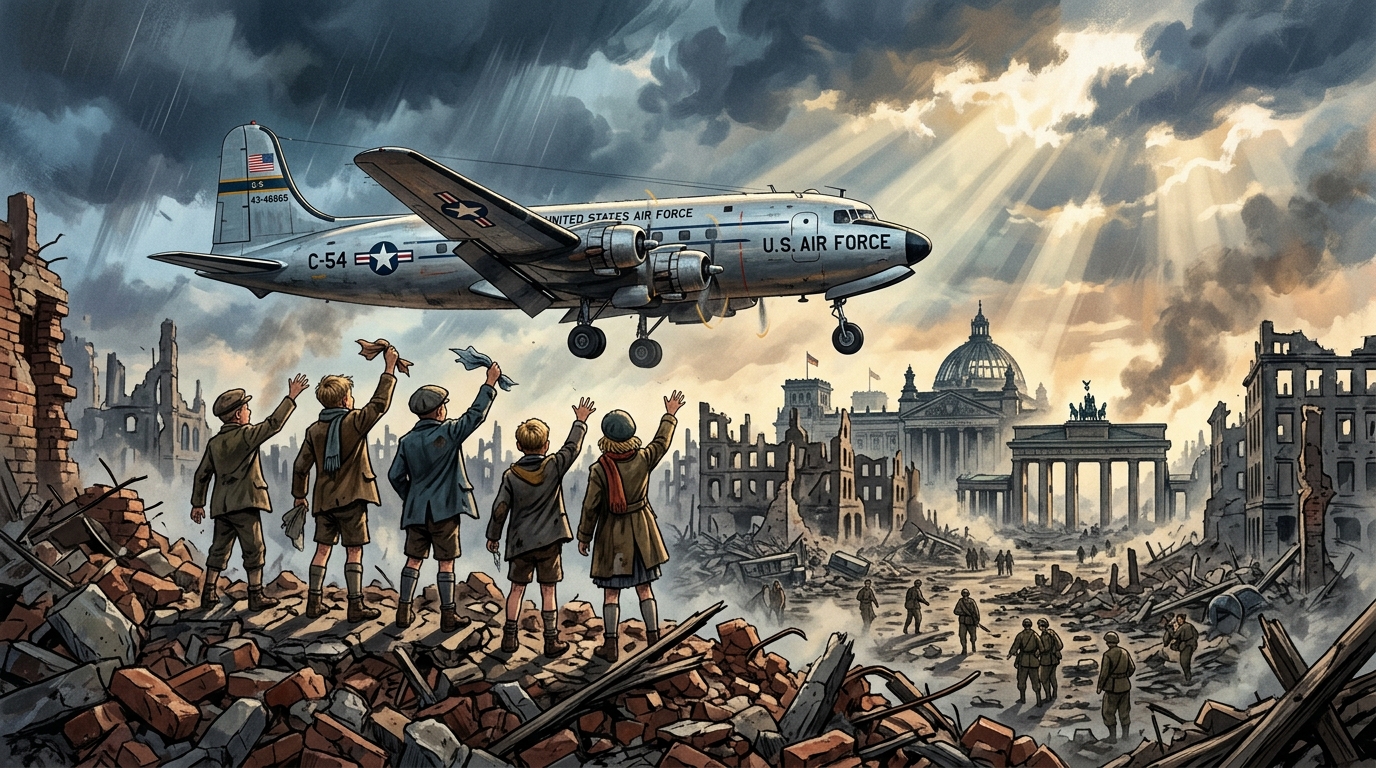
One of the most enduring human-interest stories of the Cold War began with a chance encounter at the edge of Tempelhof's runway. U.S. Air Force pilot Lieutenant Gail Halvorsen met a group of young Berlin children watching the planes land. Unlike children in other countries who begged for candy, the German children asked him for nothing, merely expressing gratitude for the food keeping them alive.
Touched, Halvorsen promised to drop chewing gum and chocolate from his plane on his next run. To signal the children below which plane was his, he promised to wiggle the wings of his C-54 transport plane during the landing approach.
This unauthorized initiative, which Halvorsen called Operation Little Vittles, quickly caught the attention of the media and his commanding officers. Rather than court-martialing him, Major General Tunner recognized the immense public relations value. The operation was officially expanded, and American school children and candy manufacturers donated over 23 tons of chocolate and sweets, which were dropped over Berlin using tiny homemade handkerchief parachutes.
- Gail Halvorsen's C-54
The Rapid Construction of Tegel Airport
By late summer 1948, the two existing airfields in West Berlin—Tempelhof (U.S. Sector) and Gatow (British Sector)—were operating at absolute capacity. A third airfield was desperately needed. The French sector had a large tract of land in Tegel, but the French military lacked the heavy equipment and manpower to build an airport quickly.
In an extraordinary display of civic mobilization, more than 19,000 German volunteers—over half of them women, known as Trümmerfrauen (rubble women)—worked in round-the-clock shifts for 90 days. Using salvaged materials and hand tools, they constructed a brand-new, 8,000-foot runway, then the longest in Europe.
A major obstacle to safe landings at Tegel was a nearby radio tower used by the Soviet-controlled Radio Berlin. Despite repeated protests from the French commander, General Jean Ganeval, the Soviets refused to dismantle or move the tower. On December 16, 1948, Ganeval took matters into his own hands, ordering French engineers to blow up the tower. When a furious Soviet commander demanded to know how he could do such a thing, Ganeval reportedly replied, "With dynamite, my dear friend."
The Corrosion Problem of Airborne Coal
While food was essential, the heaviest and most critical cargo needed to keep Berliners warm through the winter was coal. However, transporting coal by air presented a severe technical challenge. The coal dust from the thousands of canvas bags loaded onto the planes was highly abrasive and corrosive.
It seeped into the fuselage, coated electrical wiring, and began eating away at the control cables of the C-54s, posing a major risk of mechanical failure. To combat this, maintenance crews had to thoroughly vacuum and wash down the interior of every transport plane after coal flights, and eventually, the Allies began using specialized tankers and sealing the coal in airtight paper sacks to protect the aircraft.
References and Literature
- The Berlin Airlift: Legacy of Hope - An extensive archive-based article by the U.S. National Archives detailing the logistics and personal accounts of the operation.
- The Berlin Airlift, 1948–1949 - Office of the Historian, United States Department of State, offering diplomatic records and analytical overviews of the crisis.
- Clay, Lucius D. Decision in Germany. Garden City, NY: Doubleday, 1950 - First-hand memoir of the U.S. Military Governor during the blockade, detailing the decision-making process in Berlin and Washington.
- Tunner, William H. Over the Hump. Washington, D.C.: Office of Air Force History, 1985 - Detailed operational memoir by the mastermind of the airlift's logistical triumph.
Footnotes & Explanations
- See The United States and Germany in the Era of the Cold War, 1945-1990, edited by Detlef Junker, for an analysis of the divergence in Allied and Soviet economic strategies during early reconstruction. ↩
- Ernst Reuter, Speech before the Reichstag, September 9, 1948. Berlin City Archives. ↩
- See North Atlantic Treaty, Article 5, signed Washington D.C., April 4, 1949. ↩
- Cable from General Lucius D. Clay to the Department of the Army, June 25, 1948. Truman Presidential Library. ↩